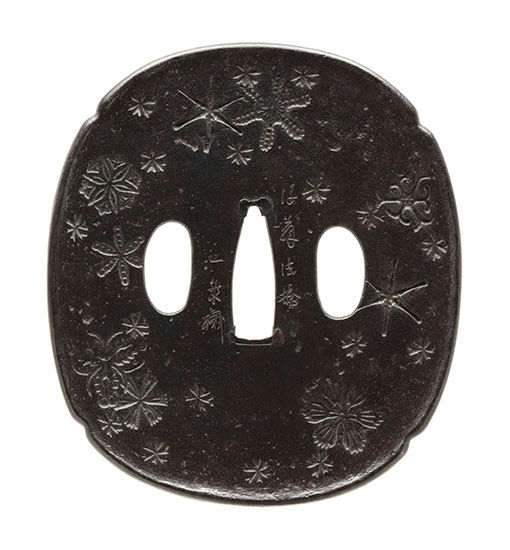
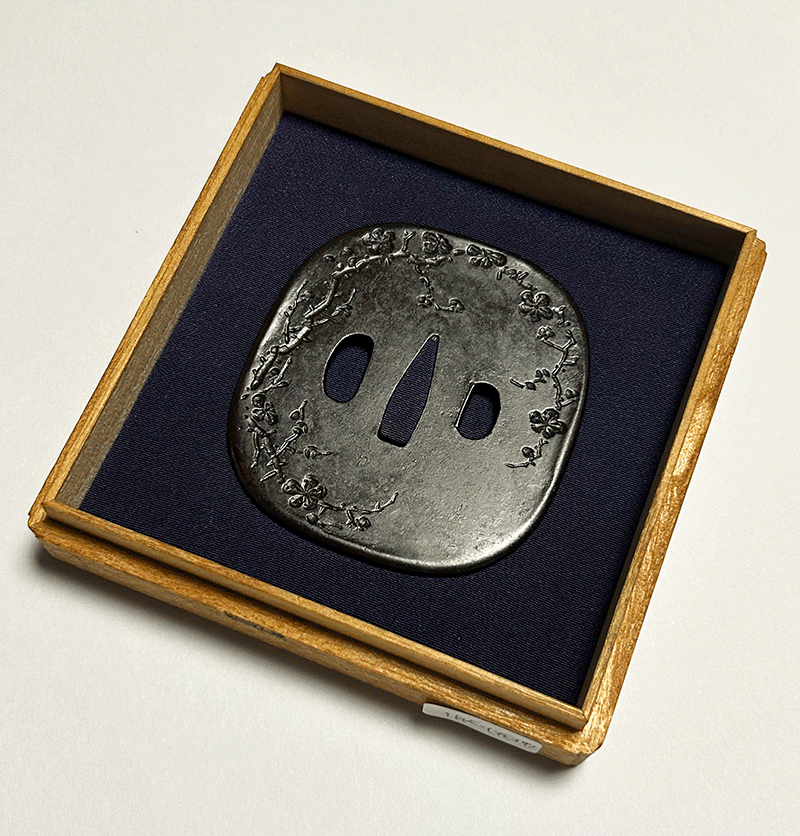
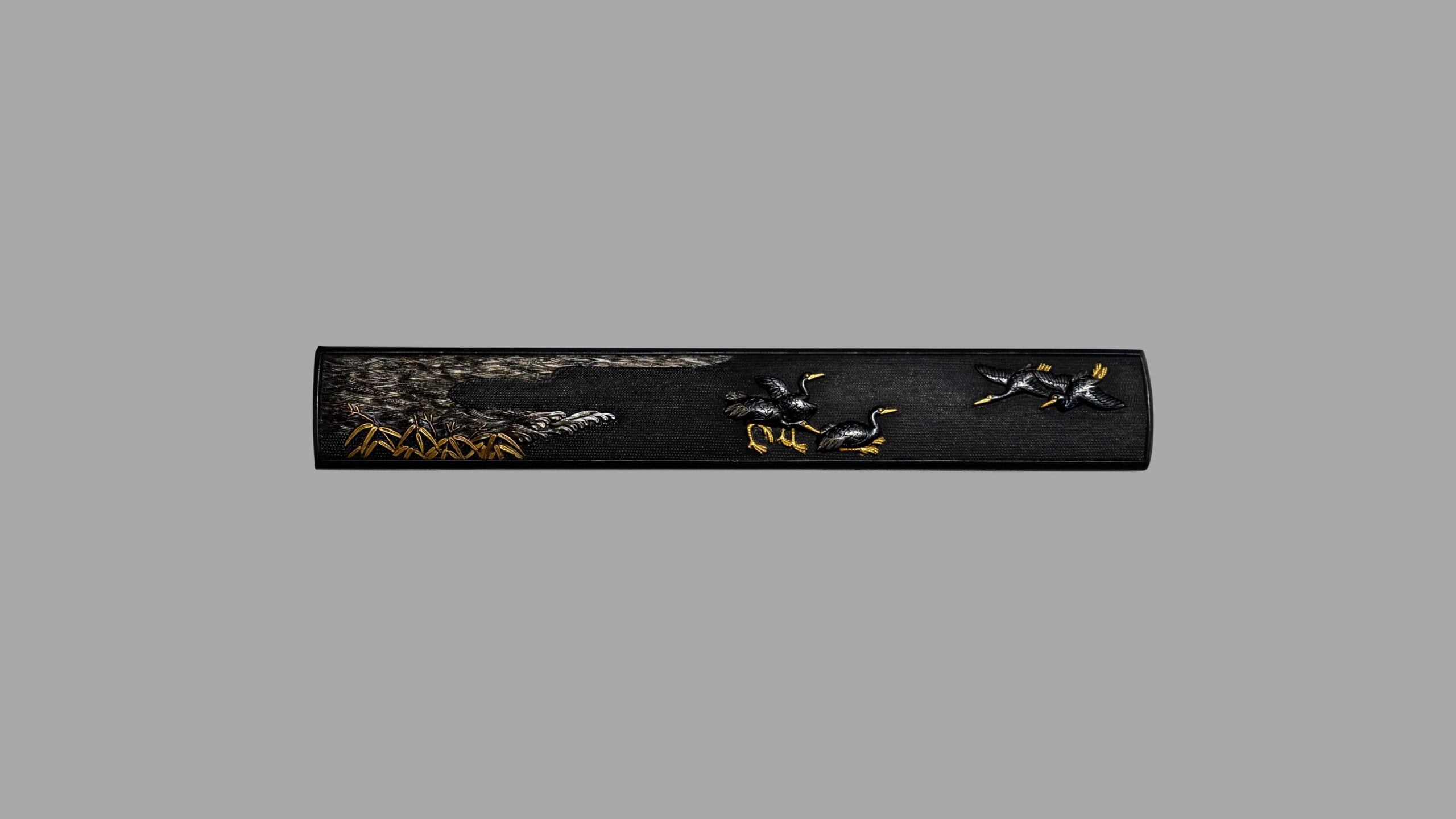
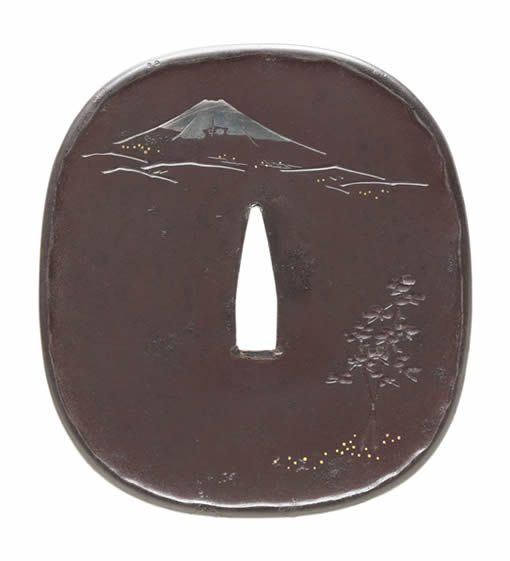
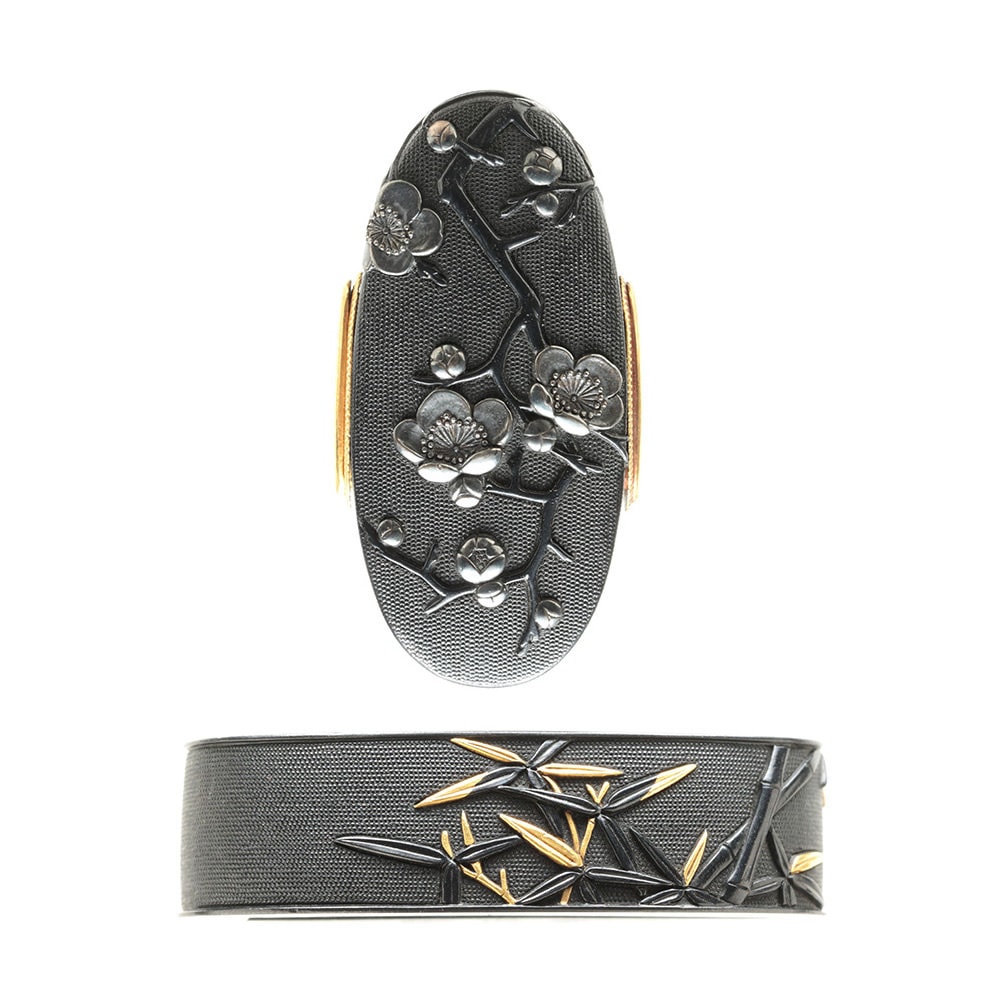
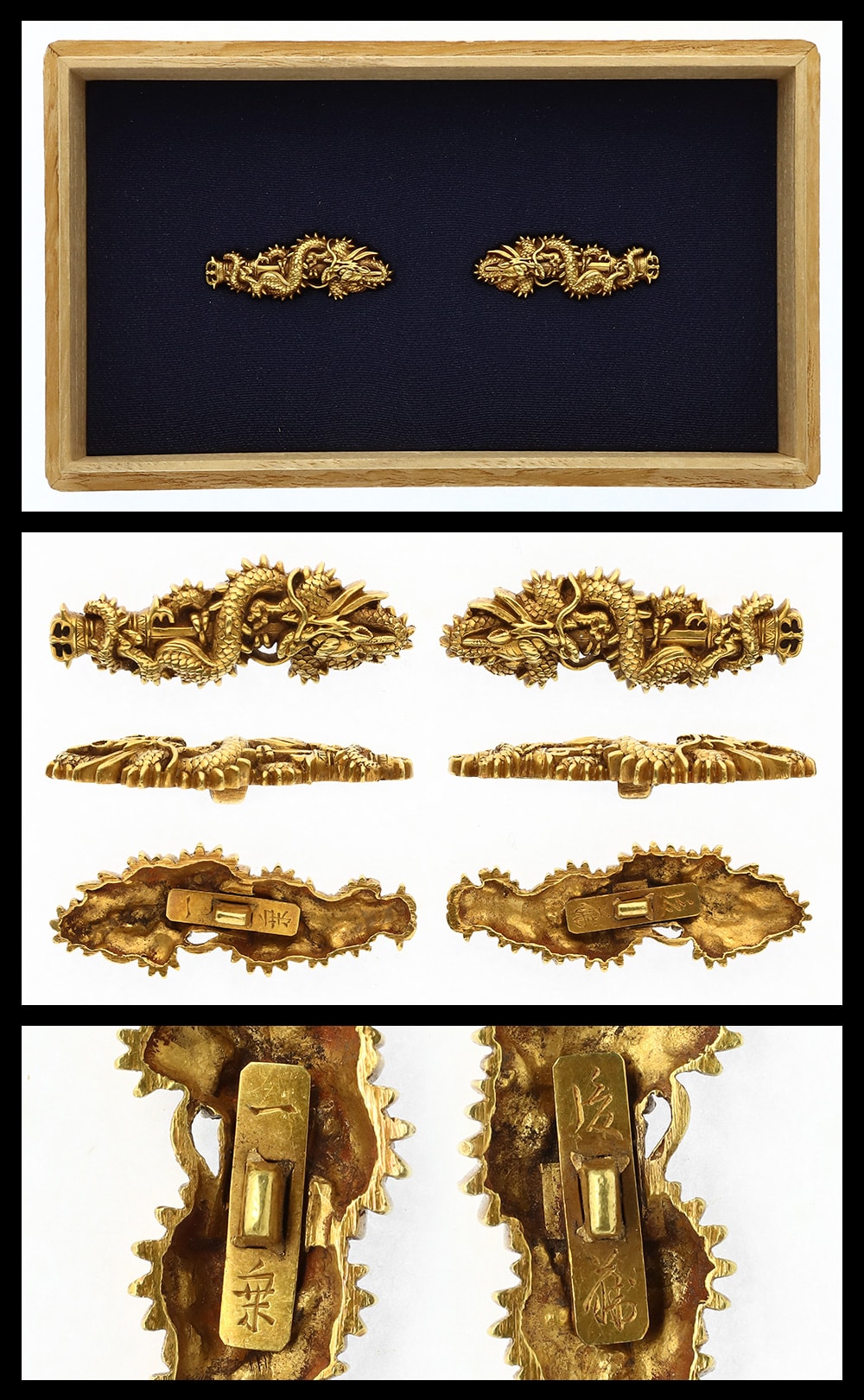
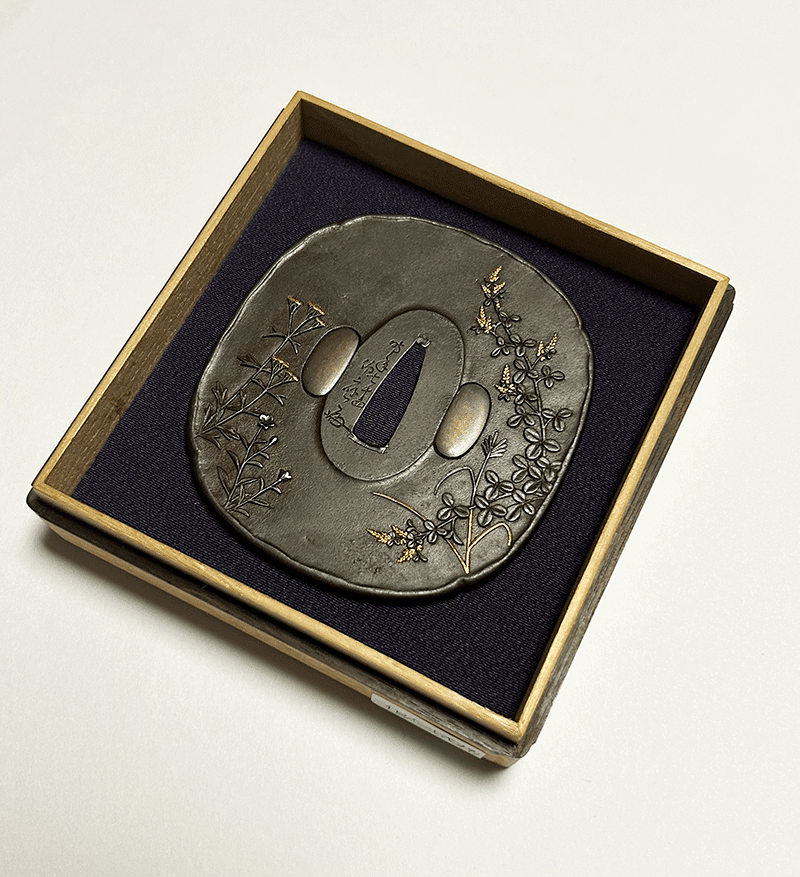
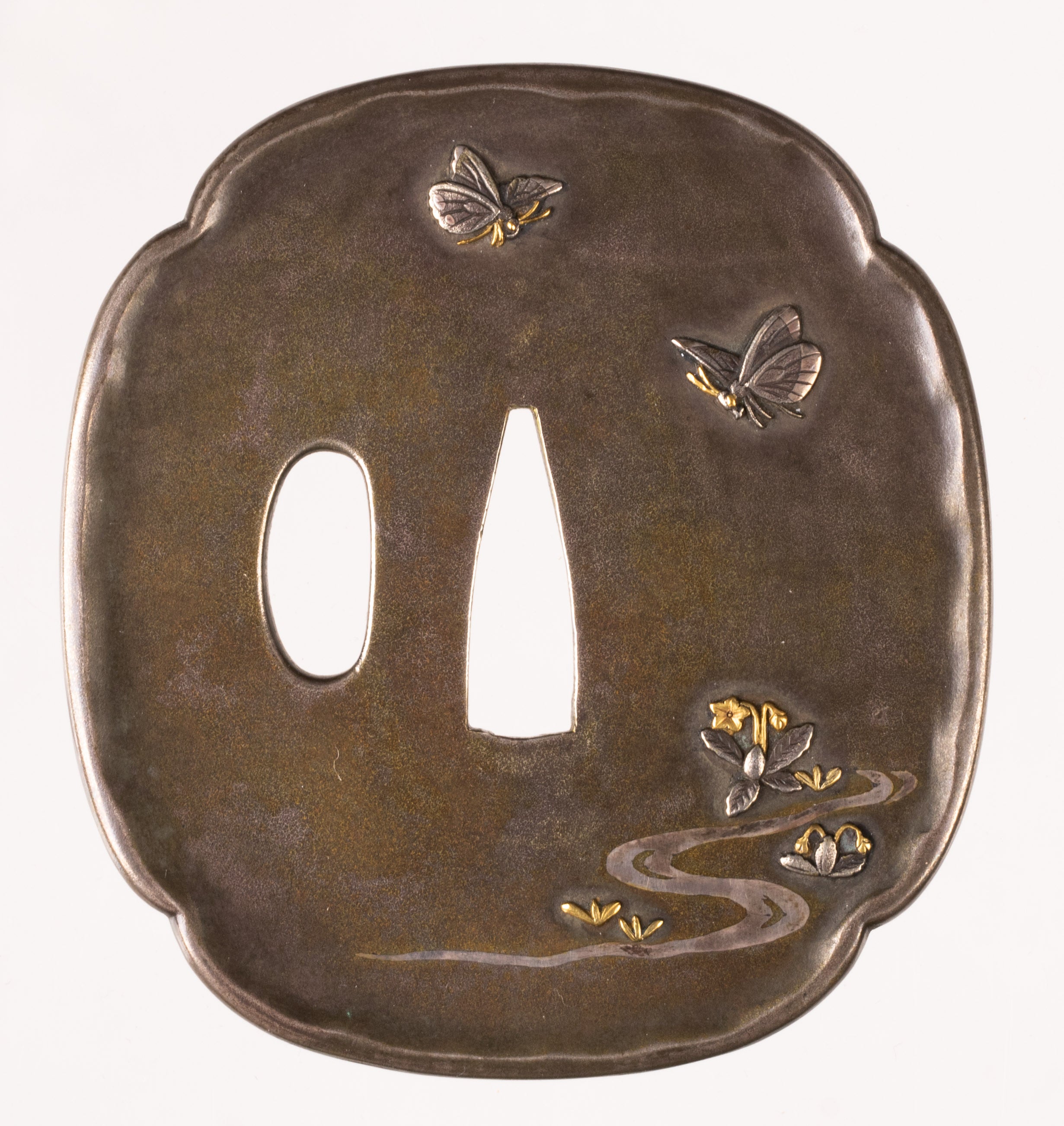
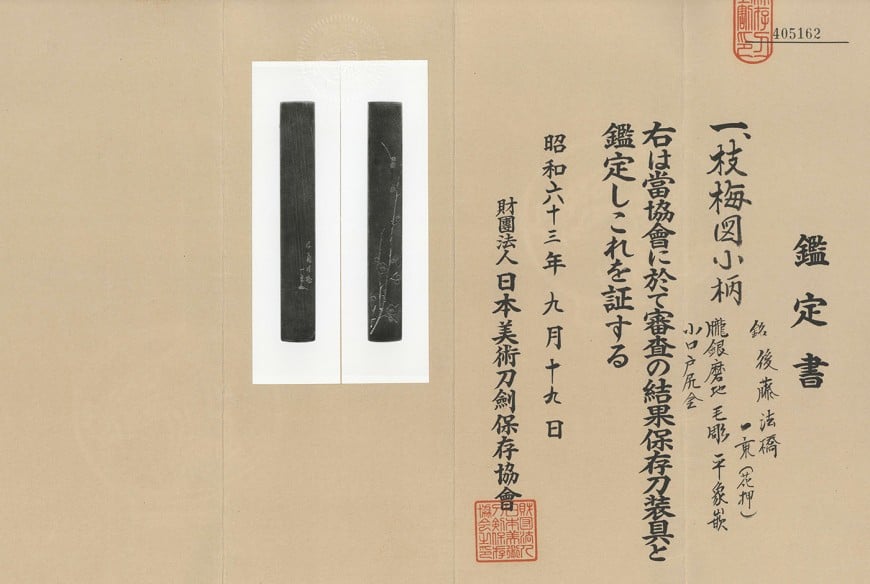
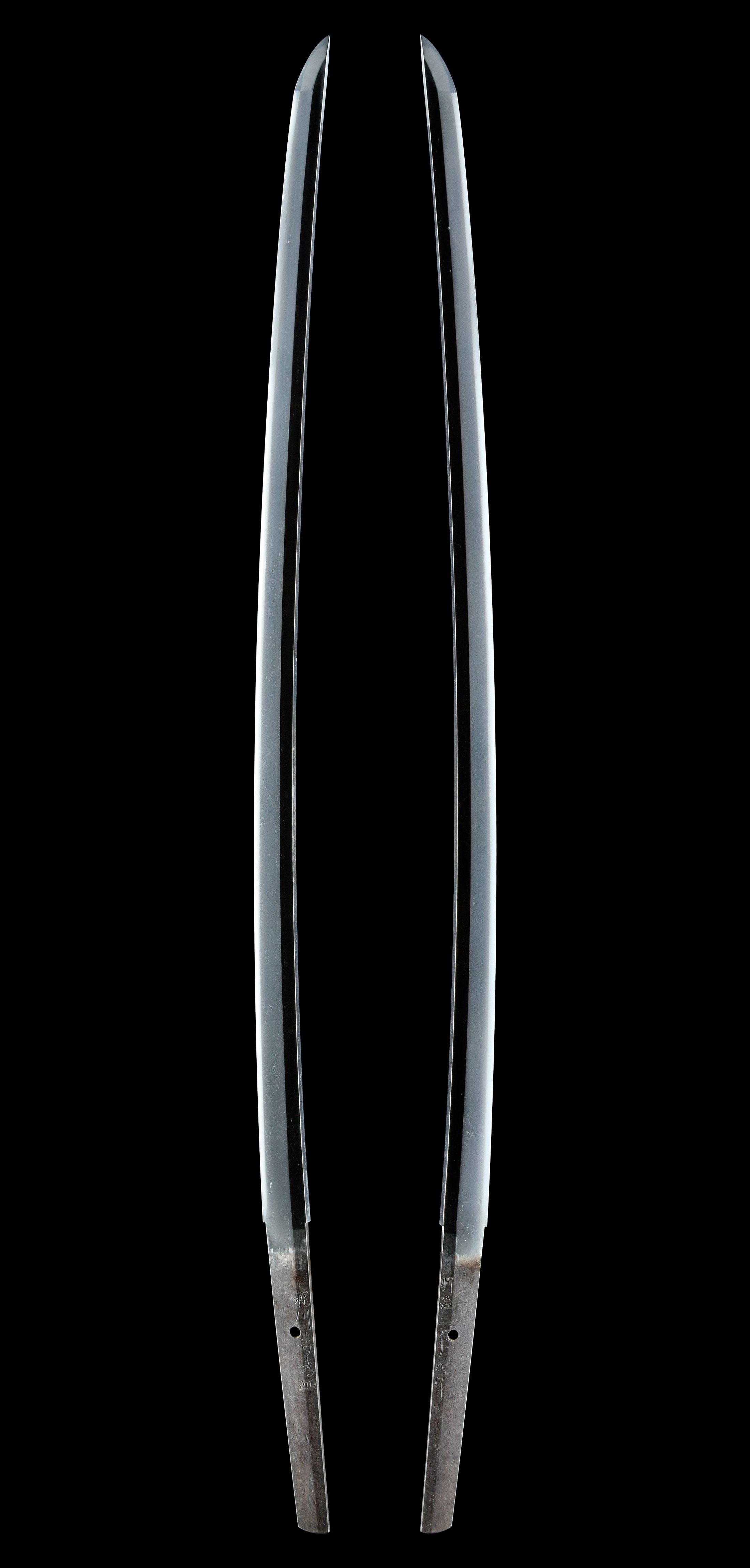
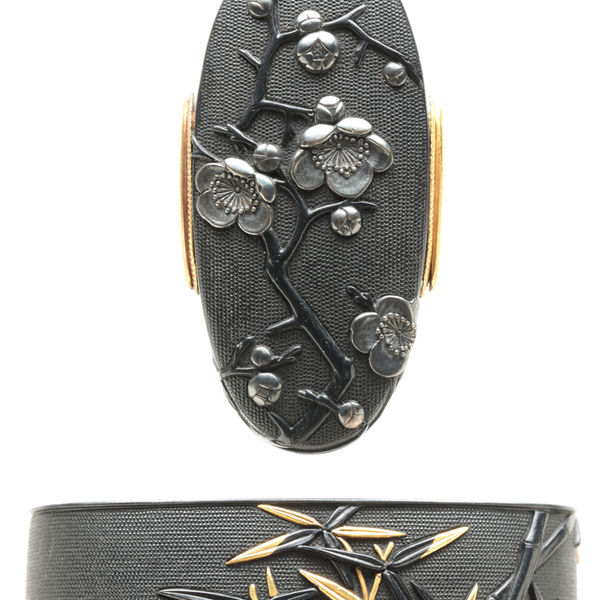
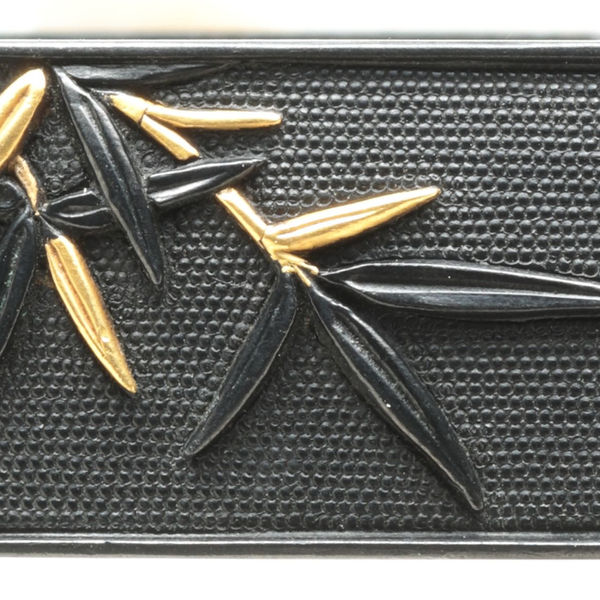
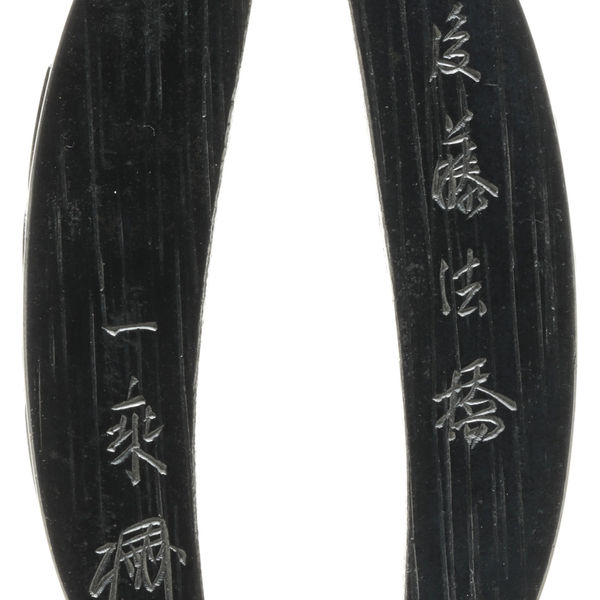
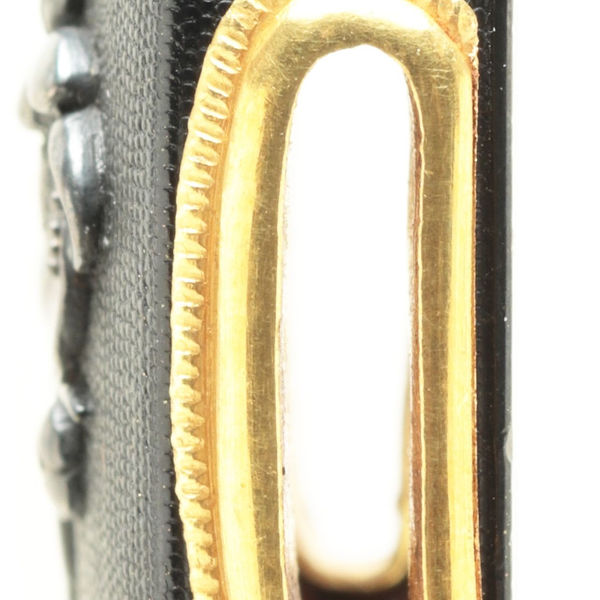
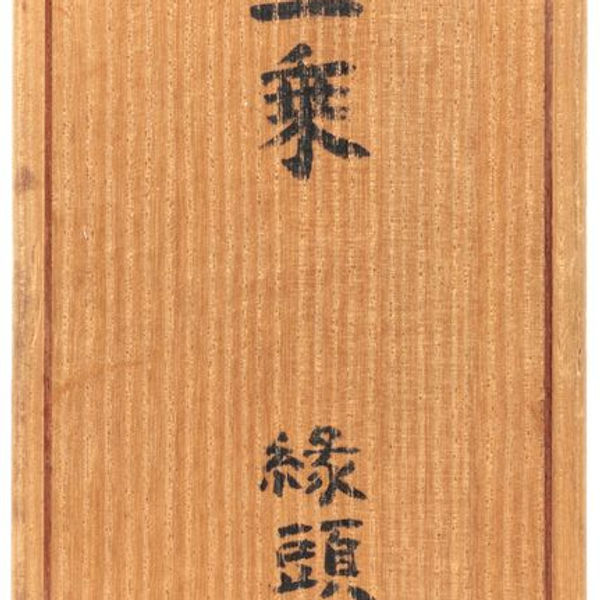
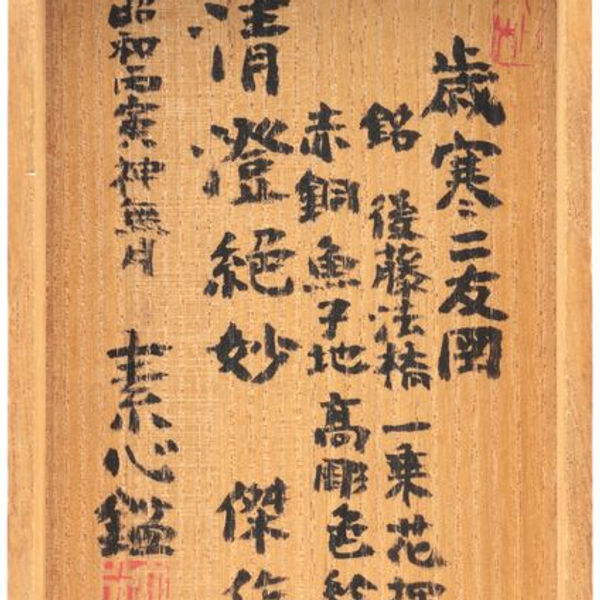
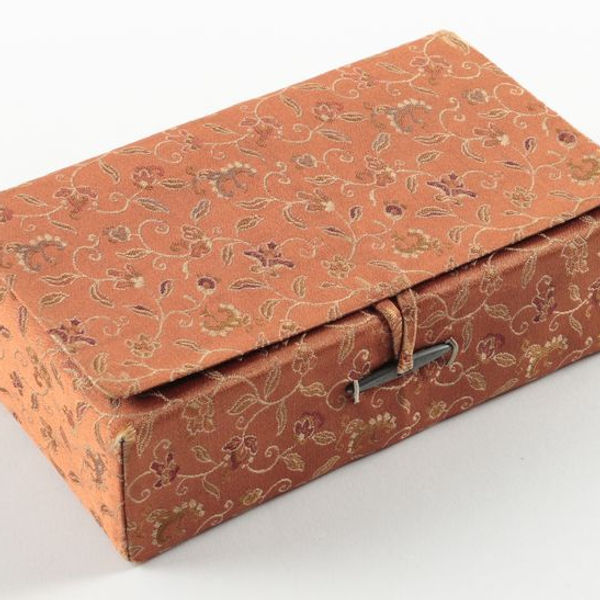
This is a fuchi-kashira set made by Goto Ichijo in the late Edo period. The set features a design of white plum blossoms and bamboo, known as "Saikan Niga", on a shakudo nanako ground. It comes with a box written by Sasano Daiyu.
 NihontoWatch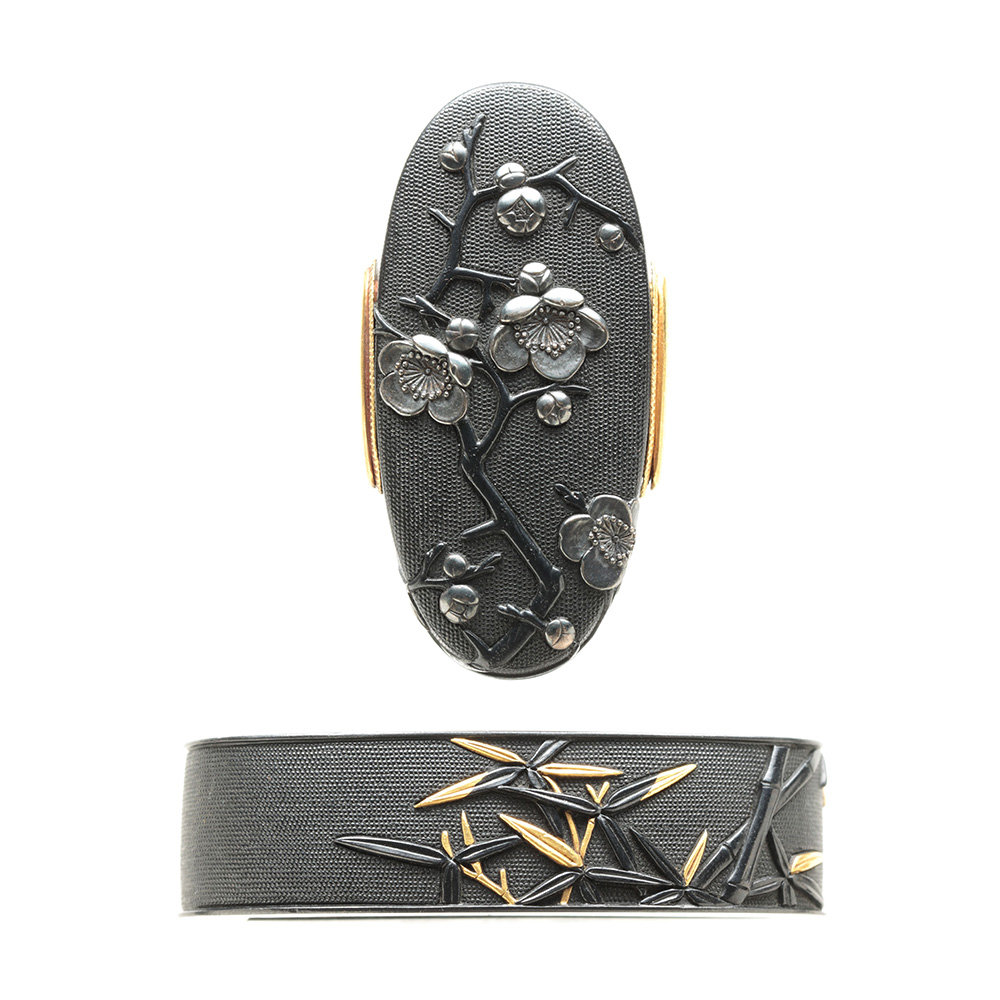
Gotō
Edo
Yamashiro
Signed
Iebori · Yamashiro
6 pieces on the market now
Goto Ichijo was born in Kyoto in Kansei 3 (1791) as the son of Shigejo, fourth-generation head of the Shichiroemon house, a cadet branch of the Goto family. At the age of nine he was adopted by Hachirobei Kenjo of the Goto, and at eleven he studied metal carving under Hanzaemon Kamejo. Following the death of his adoptive father, he succeeded to the headship at fifteen. His elder brother was Korejo Mitsuhiro, and his younger brother was Hisajo. He initially used the name Mitsuka, then Mitsuyuki, and later Mitsuyo. In Bunsei 7 (1824), at the age of thirty-four, he produced sword fittings for Emperor Kokaku; in recognition of this achievement he was granted the rank of Hokyo and adopted the art name Ichijo. In Bunkyu 2 (1862) he produced fittings for an imperial tachi for Emperor Komei, and the following year he was promoted to Hogen. He died in Meiji 9 (1876) at the age of eighty-six. The NBTHK consistently characterizes him as a master craftsman who "brought the Goto lineage to a brilliant culmination," and in one notable formulation, as the artist who "adorned the shaft-end" (sao-ojiri) of the Goto family line.
Ichijo's technical foundation rests upon the hereditary Goto manner of iebori -- canonical motifs such as dragons and lions carved in accordance with established conventions -- but "building upon this foundation, he shifted toward works centered on close observation (shasei), rendering grasses and flowers, insects, birds, landscapes, and related subjects with meticulous carving and a refined, dignified presence." His characteristic ground is shakudo nanako-ji of such surpassing fineness that the NBTHK describes it as "minute and orderly, deep and limpid," deserving the appellation kinume-nanako ("silk-textured nanako")[[c:1]]. Upon this ground he deploys takabori that "combines strength with delicacy," enriched by polychrome iroe in gold, silver, shakudo, shibuichi, and suaka. His favored tsuba form is the sumi-iri mokko-gata, and many works exhibit the chuya shitate ("day-and-night" construction) using contrasting alloys on obverse and reverse. Beyond shakudo, he commanded an exceptional range of materials: refined copper (suaka) for which he is renowned, high-quality shibuichi approaching silver in tone, and iron migaki-ji grounds animated by his distinctive kin-sunago zogan. He frequently engraved waka or Classical Chinese verses in kebori on reverse plates, reinforcing the literati character of his themes. His characteristic wari-mei and tanzaku-style split signatures appear across mitokoromono, mitsudogu, and complete daishō soroe kanagu sets, testifying to the comprehensive scope of his production.
The NBTHK evaluations return repeatedly to the union of minute finish and elevated dignity as Ichijo's defining quality. Works from the Kaei era, when he was in his late fifties, "frequently display this combination of meticulousness and elevated tone," and the committee observes that "while it is often said that excessive minuteness can dilute artistic tone and dignity, Ichijo -- true to his stature -- achieves both minute finish and high dignity, permitting no rival." Even at seventy-seven, his capacity to produce work of the highest caliber was "worthy of deep admiration, attesting both to the height of his technique and to his vigor." His handling of the Goto iebori heritage is judged to have been "sublimated into a more modern sensibility," and the dignity of his finest pieces is said to lie "far beyond the reach of other craftsmen." In summation, Ichijo stands as the terminal master of the Goto tradition, an artist whose works embody what the NBTHK calls "outstanding color sensibility" and whose command of the full repertoire of metalworking techniques[[c:3]] -- takabori, katakiribori, kosuki-bori, zogan, and polychrome iroe -- sustained the ancestral standard across a career spanning more than seven decades.
Where Goto Ichijo stands among comparable artisans: across all of nihontō, and within tradition, era, and period. The tiers (Foremost · Leading · Major · Notable) weigh official designations from the NBTHK and Japan's Agency for Cultural Affairs, together with historical honors of lasting repute such as the Sansaku and Meibutsu-chō.
Select a lens to see how it's measured.
Iebori · Kyoto
32 pieces on the market now
" Ichijo was the fifth-generation head of the Shichiroemon house, a cadet branch of the Goto family, and trained under Hanzaemon Kamejo before succeeding to the headship at fifteen. His imperial commissions -- fittings for Emperor Kokaku in 1824 and Emperor Komei in 1862 -- earned him the ranks of Hokyo and Hogen respectively, and his atelier in Kyoto attracted a circle of gifted disciples who extended his aesthetic into the Bakumatsu and early Meiji periods. Among them, the celebrated "Five Tigers" (Goko) -- Funada Ikkin, Imai Nagatake, Hashimoto Isshi, Nakagawa Issho, and Wada Isshin -- together with the master's younger brother Goto Koran, constituted one of the most prolific and technically accomplished workshops in the history of Japanese tosogu production. The collective technical identity of the Ichijo school rests upon a foundation of shakudo nanako-ji of surpassing fineness -- described as "minute and orderly, deep and limpid," meriting the appellation kinume-nanako -- upon which elaborate pictorial compositions are built through takabori enriched by polychrome iroe employing gold, silver, shakudo, shibuichi, and suaka. Ichijo himself established the artistic direction by shifting from the canonical iebori subjects of dragons and lions toward compositions centered on close observation (shasei), rendering grasses, flowers, insects, birds, and landscapes with meticulous carving and refined dignity. This painterly sensibility pervades the entire school. Nagatake brought a distinctive ornamental density, arranging seasonal plants across entire surfaces with richly varied colored metals.
" Ikkin developed an unrivaled command of kosuki-bori -- a bold, thick chiseling technique that even Ichijo conceded was "beyond my own reach[[c:1]]" -- and his dragon subjects carried a distinctive forcefulness. " Isshin absorbed the hereditary vocabulary while concentrating creative zeal into individual passages of invention, and Issho achieved works of luxurious, courtly elegance through refined kinu-nanako and precise kebori. Koran, working in a manner akin to his elder brother yet "finished with an even more delicate and nuanced sensibility," brought the Shichiroemon branch to its most accomplished expression. Across the school, the favored tsuba form is the sumi-iri mokko-gata, and many works exhibit chuya shitate -- "day-and-night" construction using contrasting alloys on obverse and reverse. Complete daisho soroe kanagu sets, coordinated around seasonal, auspicious, or literary-historical themes, represent the school's highest format. " This standard was transmitted faithfully through the circle. " The school's productions are consistently praised for an elevated, Kyoto-inflected refinement that balances splendor and restraint in just measure. Learn more →
| Smith | Era | Designated |
|---|---|---|
| Goto Ichijo後藤一乗 | — | 91 |
| Tomei東明 | — | 31 |
| Nagatake永武 | — | 14 |
| Ikkin一琴 | — | 11 |
| Issho一匠 | 1828-1876 | 10 |
We could not find an authenticity certificate on the seller’s listing. Japanese swords and fittings are normally papered by the NBTHK (or the NTHK). Without one, the attribution is the seller’s own assessment and has not been independently verified — treat it with caution and ask the dealer about certification before buying.
If, due to our fault, the item differs significantly from its proper condition, the item may be returned. Cooling-off is within one week of the item's arrival.
This is a fuchi-kashira set made by Goto Ichijo in the late Edo period. The set features a design of white plum blossoms and bamboo, known as "Saikan Niga", on a shakudo nanako ground. It comes with a box written by Sasano Daiyu.
NihontoWatchGotō
Edo
Yamashiro
Signed
Iebori · Yamashiro
6 pieces on the market now
Goto Ichijo was born in Kyoto in Kansei 3 (1791) as the son of Shigejo, fourth-generation head of the Shichiroemon house, a cadet branch of the Goto family. At the age of nine he was adopted by Hachirobei Kenjo of the Goto, and at eleven he studied metal carving under Hanzaemon Kamejo. Following the death of his adoptive father, he succeeded to the headship at fifteen. His elder brother was Korejo Mitsuhiro, and his younger brother was Hisajo. He initially used the name Mitsuka, then Mitsuyuki, and later Mitsuyo. In Bunsei 7 (1824), at the age of thirty-four, he produced sword fittings for Emperor Kokaku; in recognition of this achievement he was granted the rank of Hokyo and adopted the art name Ichijo. In Bunkyu 2 (1862) he produced fittings for an imperial tachi for Emperor Komei, and the following year he was promoted to Hogen. He died in Meiji 9 (1876) at the age of eighty-six. The NBTHK consistently characterizes him as a master craftsman who "brought the Goto lineage to a brilliant culmination," and in one notable formulation, as the artist who "adorned the shaft-end" (sao-ojiri) of the Goto family line.
Ichijo's technical foundation rests upon the hereditary Goto manner of iebori -- canonical motifs such as dragons and lions carved in accordance with established conventions -- but "building upon this foundation, he shifted toward works centered on close observation (shasei), rendering grasses and flowers, insects, birds, landscapes, and related subjects with meticulous carving and a refined, dignified presence." His characteristic ground is shakudo nanako-ji of such surpassing fineness that the NBTHK describes it as "minute and orderly, deep and limpid," deserving the appellation kinume-nanako ("silk-textured nanako")[[c:1]]. Upon this ground he deploys takabori that "combines strength with delicacy," enriched by polychrome iroe in gold, silver, shakudo, shibuichi, and suaka. His favored tsuba form is the sumi-iri mokko-gata, and many works exhibit the chuya shitate ("day-and-night" construction) using contrasting alloys on obverse and reverse. Beyond shakudo, he commanded an exceptional range of materials: refined copper (suaka) for which he is renowned, high-quality shibuichi approaching silver in tone, and iron migaki-ji grounds animated by his distinctive kin-sunago zogan. He frequently engraved waka or Classical Chinese verses in kebori on reverse plates, reinforcing the literati character of his themes. His characteristic wari-mei and tanzaku-style split signatures appear across mitokoromono, mitsudogu, and complete daishō soroe kanagu sets, testifying to the comprehensive scope of his production.
The NBTHK evaluations return repeatedly to the union of minute finish and elevated dignity as Ichijo's defining quality. Works from the Kaei era, when he was in his late fifties, "frequently display this combination of meticulousness and elevated tone," and the committee observes that "while it is often said that excessive minuteness can dilute artistic tone and dignity, Ichijo -- true to his stature -- achieves both minute finish and high dignity, permitting no rival." Even at seventy-seven, his capacity to produce work of the highest caliber was "worthy of deep admiration, attesting both to the height of his technique and to his vigor." His handling of the Goto iebori heritage is judged to have been "sublimated into a more modern sensibility," and the dignity of his finest pieces is said to lie "far beyond the reach of other craftsmen." In summation, Ichijo stands as the terminal master of the Goto tradition, an artist whose works embody what the NBTHK calls "outstanding color sensibility" and whose command of the full repertoire of metalworking techniques[[c:3]] -- takabori, katakiribori, kosuki-bori, zogan, and polychrome iroe -- sustained the ancestral standard across a career spanning more than seven decades.
Where Goto Ichijo stands among comparable artisans: across all of nihontō, and within tradition, era, and period. The tiers (Foremost · Leading · Major · Notable) weigh official designations from the NBTHK and Japan's Agency for Cultural Affairs, together with historical honors of lasting repute such as the Sansaku and Meibutsu-chō.
Select a lens to see how it's measured.
Iebori · Kyoto
32 pieces on the market now
" Ichijo was the fifth-generation head of the Shichiroemon house, a cadet branch of the Goto family, and trained under Hanzaemon Kamejo before succeeding to the headship at fifteen. His imperial commissions -- fittings for Emperor Kokaku in 1824 and Emperor Komei in 1862 -- earned him the ranks of Hokyo and Hogen respectively, and his atelier in Kyoto attracted a circle of gifted disciples who extended his aesthetic into the Bakumatsu and early Meiji periods. Among them, the celebrated "Five Tigers" (Goko) -- Funada Ikkin, Imai Nagatake, Hashimoto Isshi, Nakagawa Issho, and Wada Isshin -- together with the master's younger brother Goto Koran, constituted one of the most prolific and technically accomplished workshops in the history of Japanese tosogu production. The collective technical identity of the Ichijo school rests upon a foundation of shakudo nanako-ji of surpassing fineness -- described as "minute and orderly, deep and limpid," meriting the appellation kinume-nanako -- upon which elaborate pictorial compositions are built through takabori enriched by polychrome iroe employing gold, silver, shakudo, shibuichi, and suaka. Ichijo himself established the artistic direction by shifting from the canonical iebori subjects of dragons and lions toward compositions centered on close observation (shasei), rendering grasses, flowers, insects, birds, and landscapes with meticulous carving and refined dignity. This painterly sensibility pervades the entire school. Nagatake brought a distinctive ornamental density, arranging seasonal plants across entire surfaces with richly varied colored metals.
" Ikkin developed an unrivaled command of kosuki-bori -- a bold, thick chiseling technique that even Ichijo conceded was "beyond my own reach[[c:1]]" -- and his dragon subjects carried a distinctive forcefulness. " Isshin absorbed the hereditary vocabulary while concentrating creative zeal into individual passages of invention, and Issho achieved works of luxurious, courtly elegance through refined kinu-nanako and precise kebori. Koran, working in a manner akin to his elder brother yet "finished with an even more delicate and nuanced sensibility," brought the Shichiroemon branch to its most accomplished expression. Across the school, the favored tsuba form is the sumi-iri mokko-gata, and many works exhibit chuya shitate -- "day-and-night" construction using contrasting alloys on obverse and reverse. Complete daisho soroe kanagu sets, coordinated around seasonal, auspicious, or literary-historical themes, represent the school's highest format. " This standard was transmitted faithfully through the circle. " The school's productions are consistently praised for an elevated, Kyoto-inflected refinement that balances splendor and restraint in just measure. Learn more →
| Smith | Era | Designated |
|---|---|---|
| Goto Ichijo後藤一乗 | — | 91 |
| Tomei東明 | — | 31 |
| Nagatake永武 | — | 14 |
| Ikkin一琴 | — | 11 |
| Issho一匠 | 1828-1876 | 10 |
We could not find an authenticity certificate on the seller’s listing. Japanese swords and fittings are normally papered by the NBTHK (or the NTHK). Without one, the attribution is the seller’s own assessment and has not been independently verified — treat it with caution and ask the dealer about certification before buying.
If, due to our fault, the item differs significantly from its proper condition, the item may be returned. Cooling-off is within one week of the item's arrival.