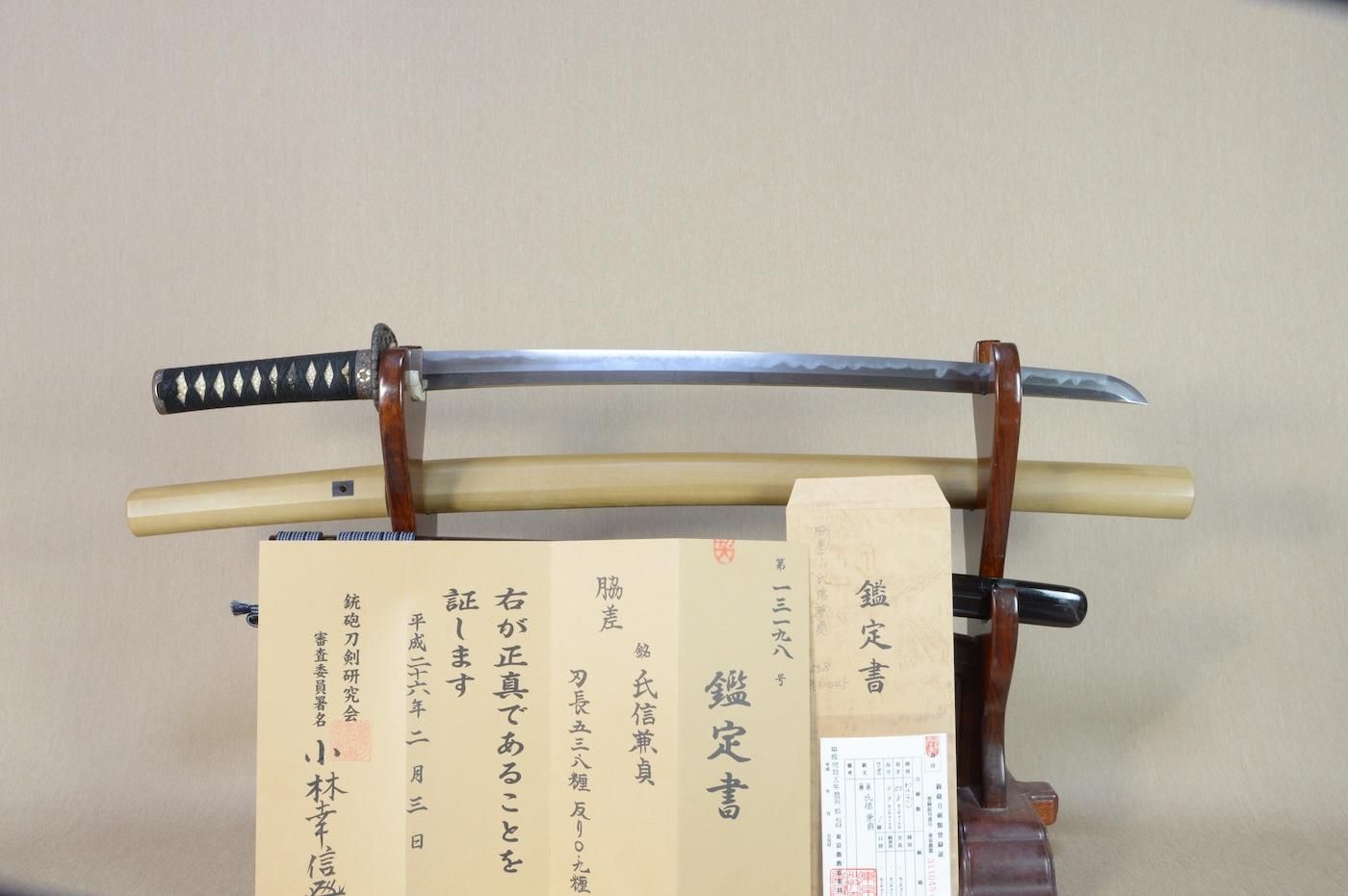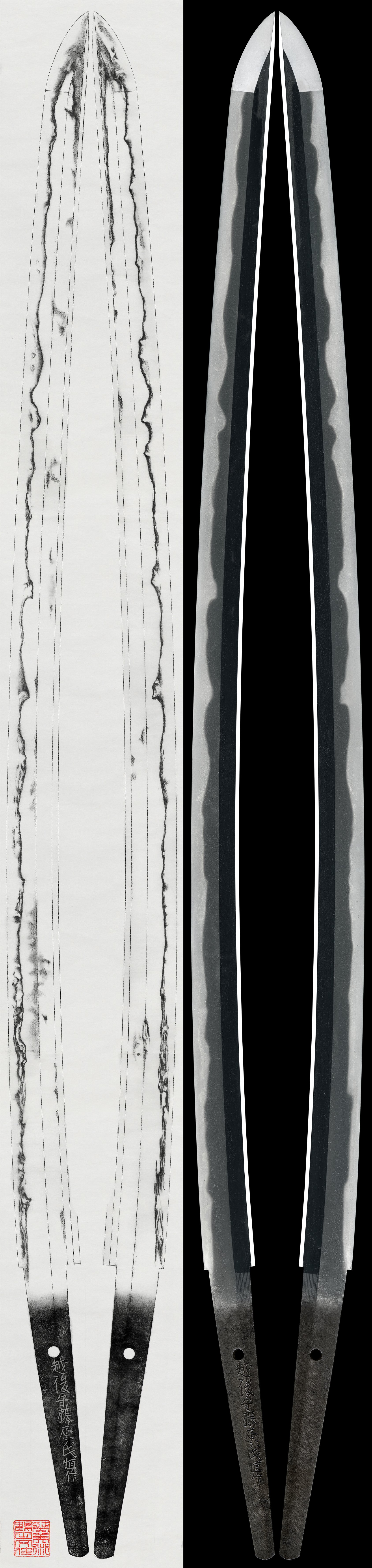



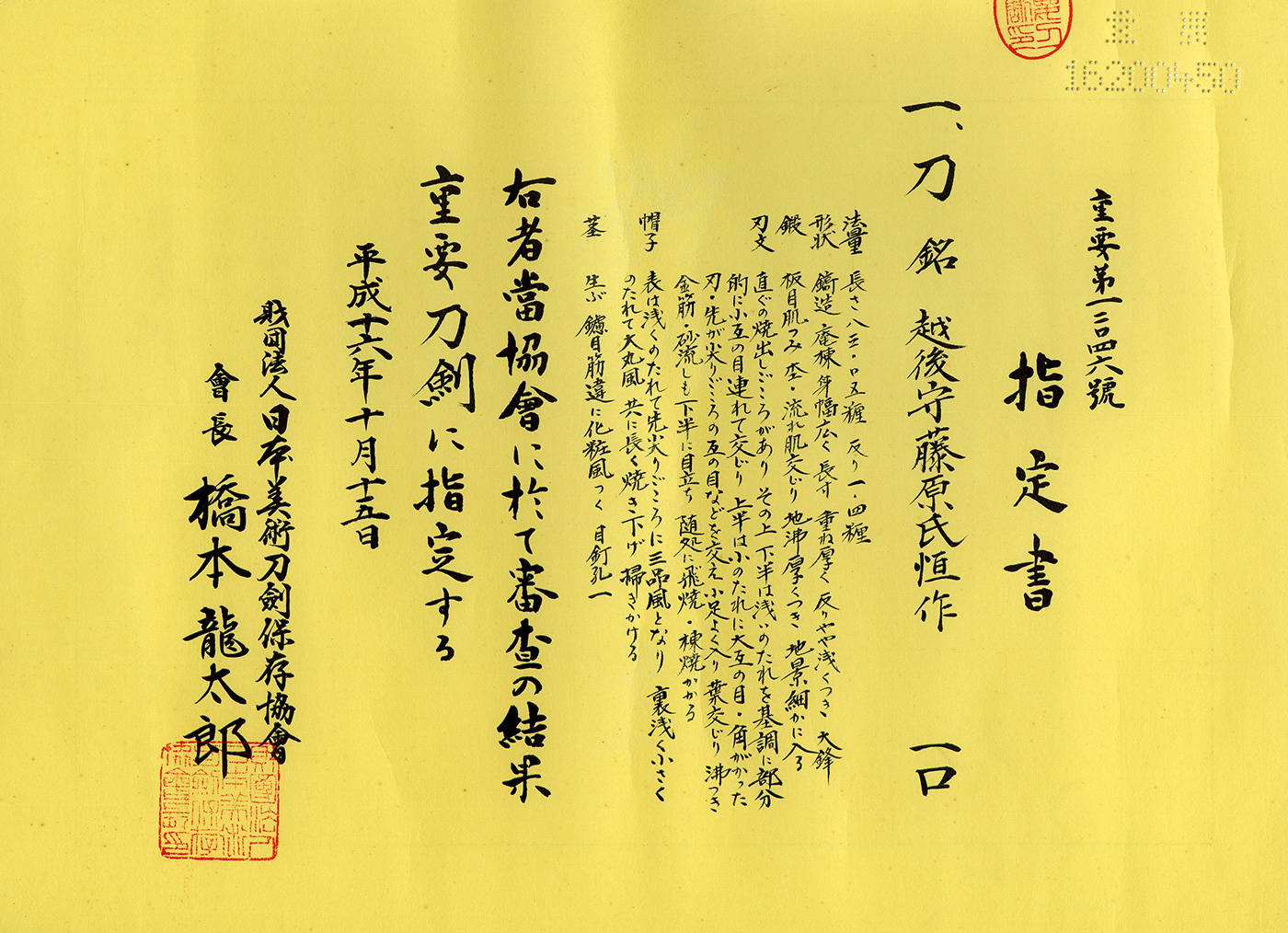
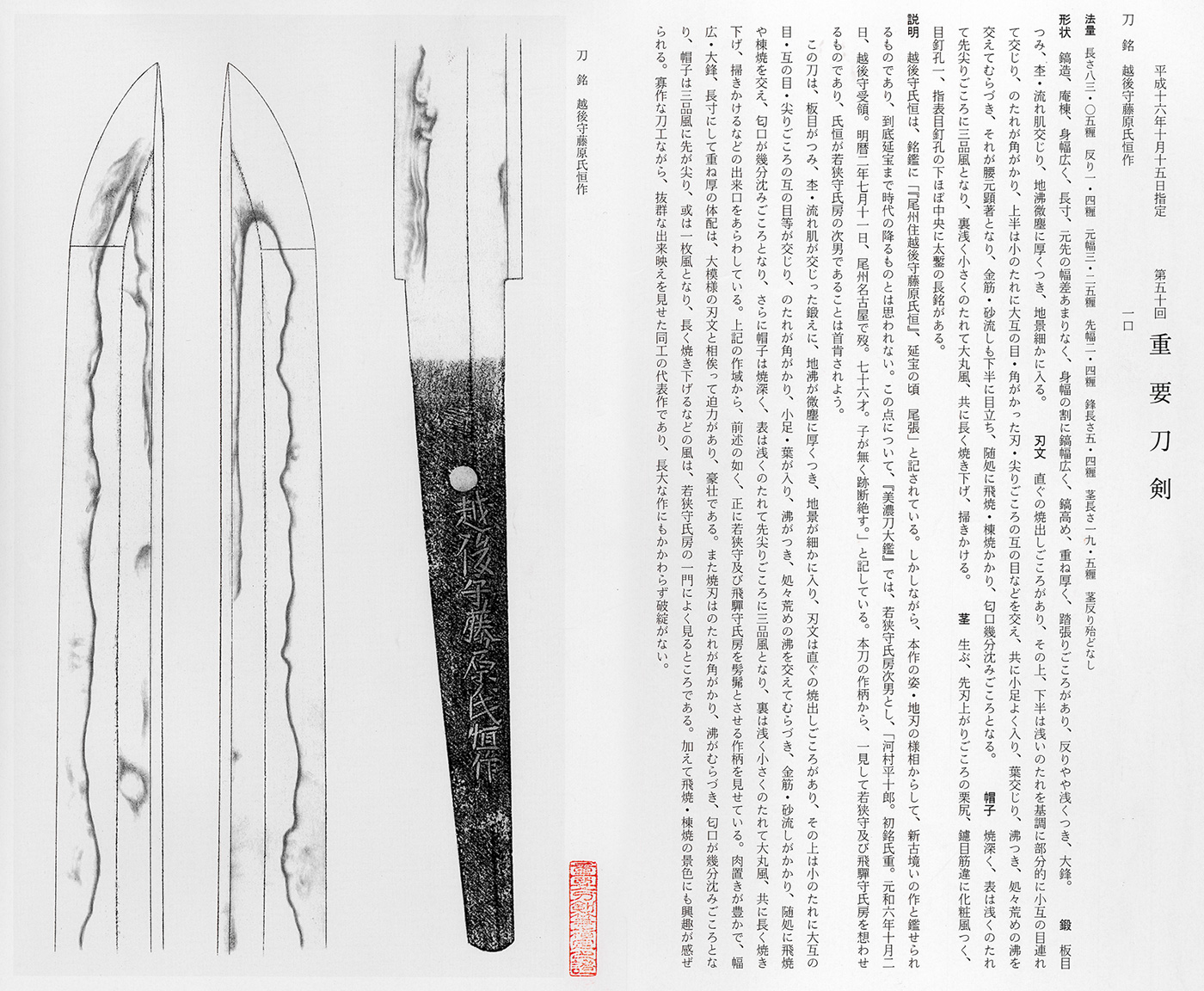
-, 50th Session — Designated October 15, 2004
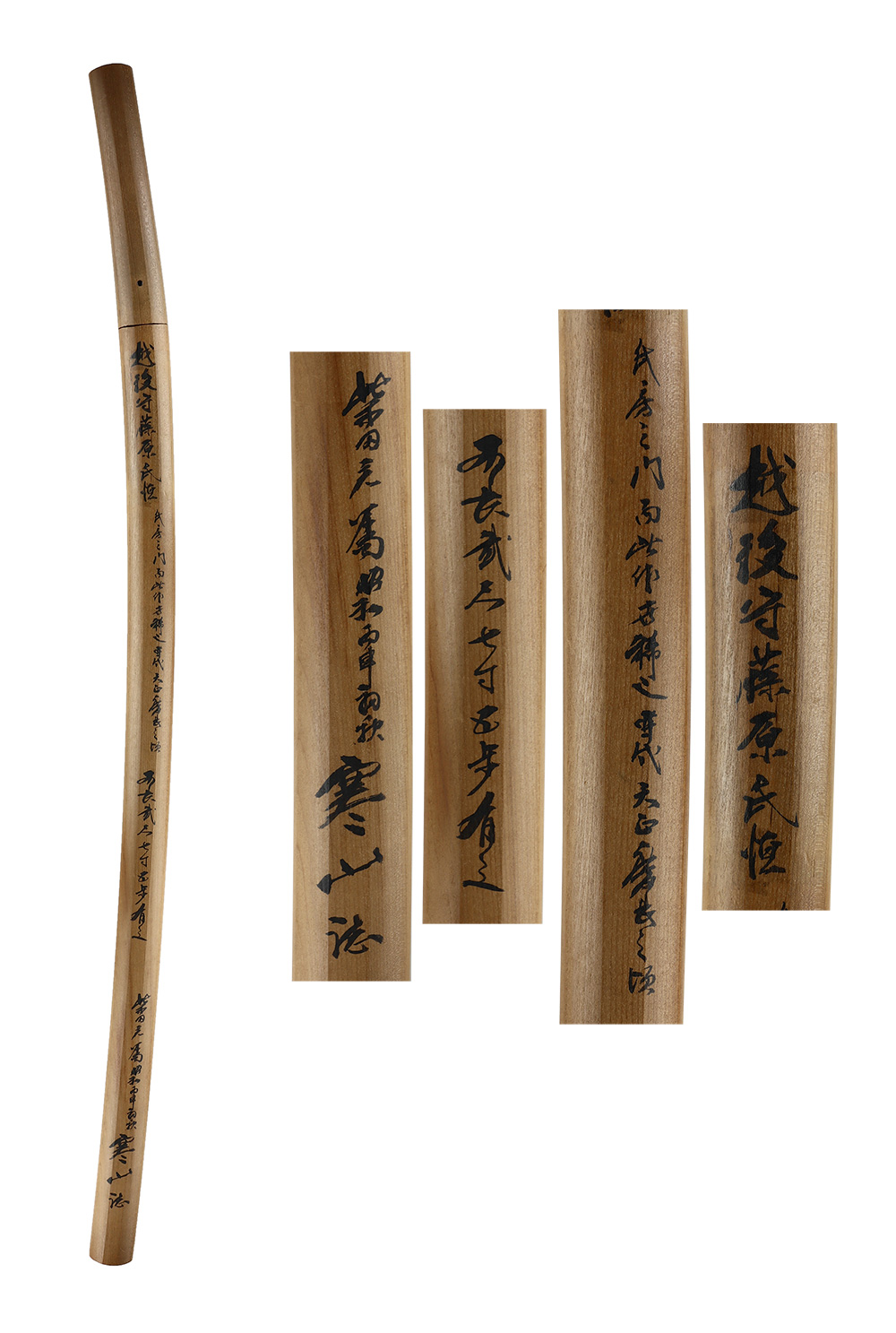
, : Echigo no Kami Fujiwara Ujitsune (越後守藤原氏恒作)
Measurements 83.05 cm, 1.4 cm, 3.25 cm, 2.4 cm, 5.4 cm, 19.5 cm, almost none
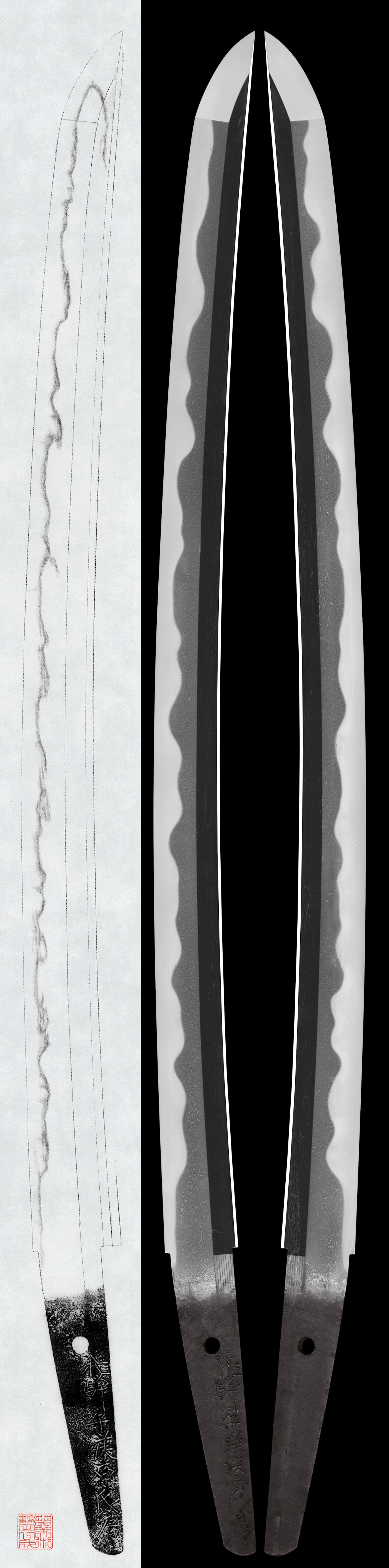
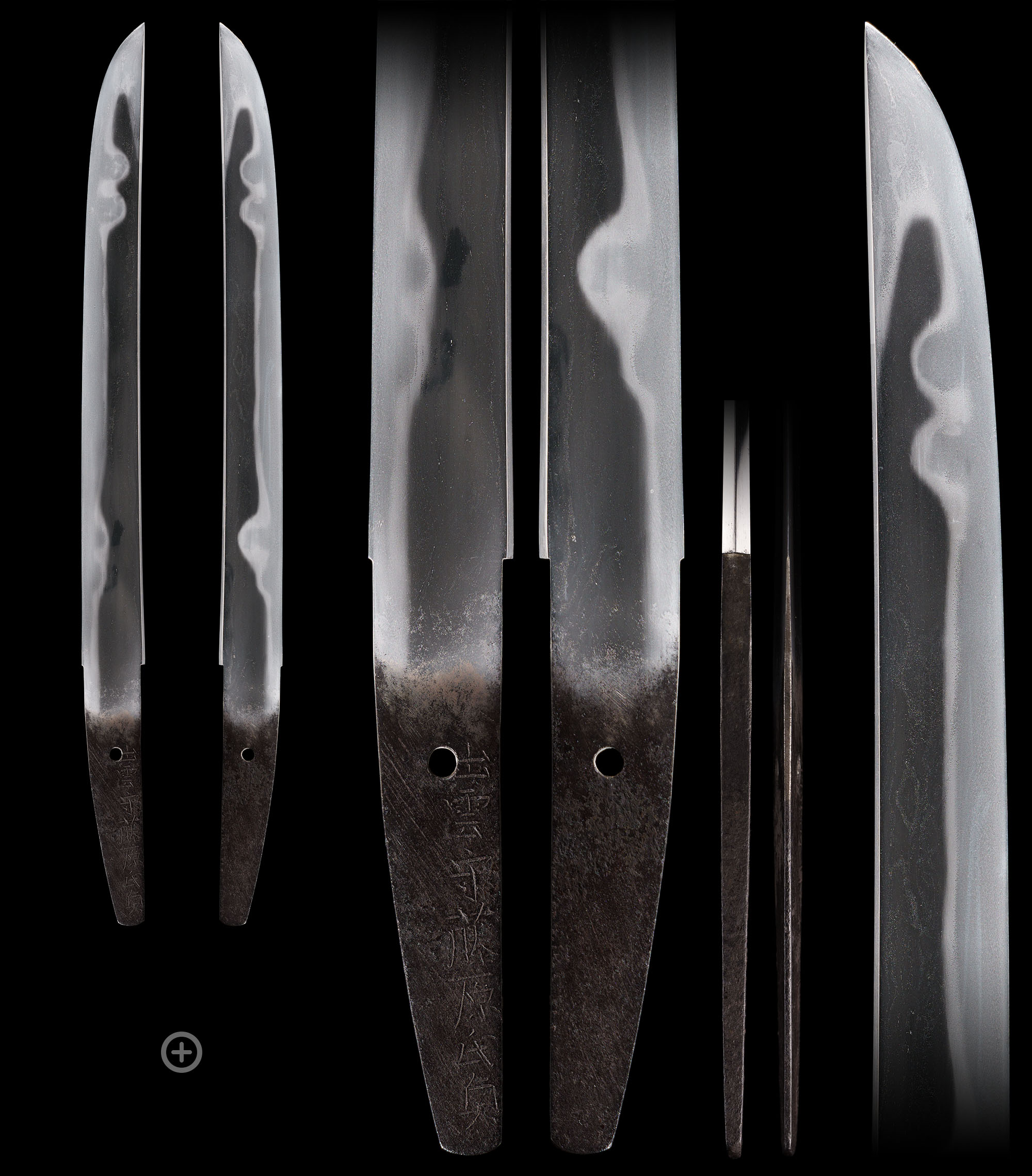
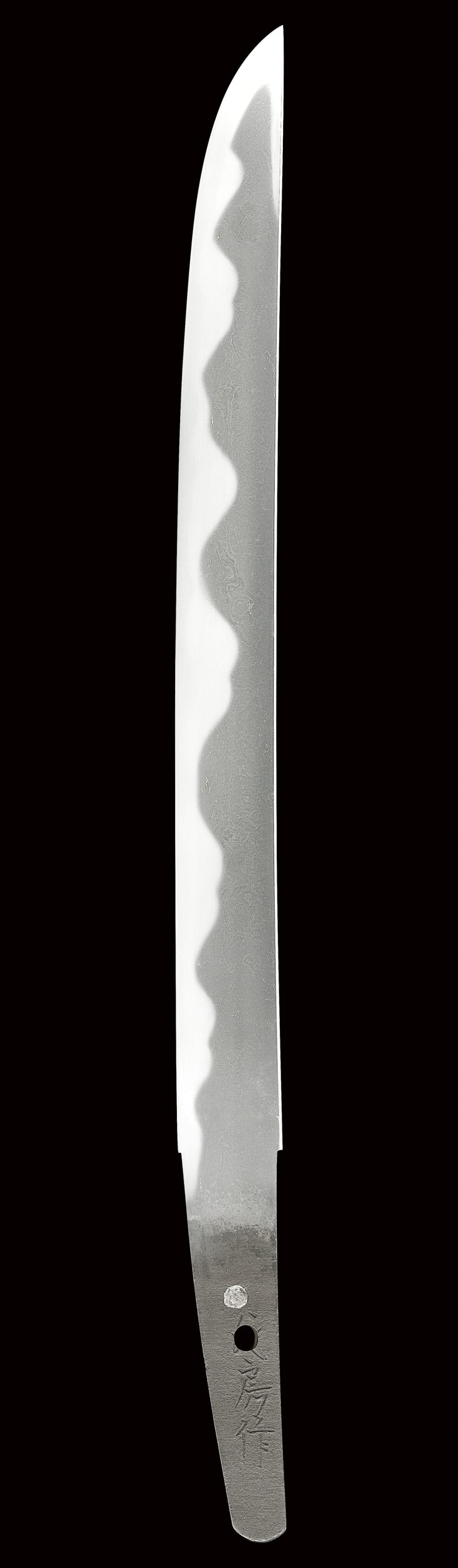
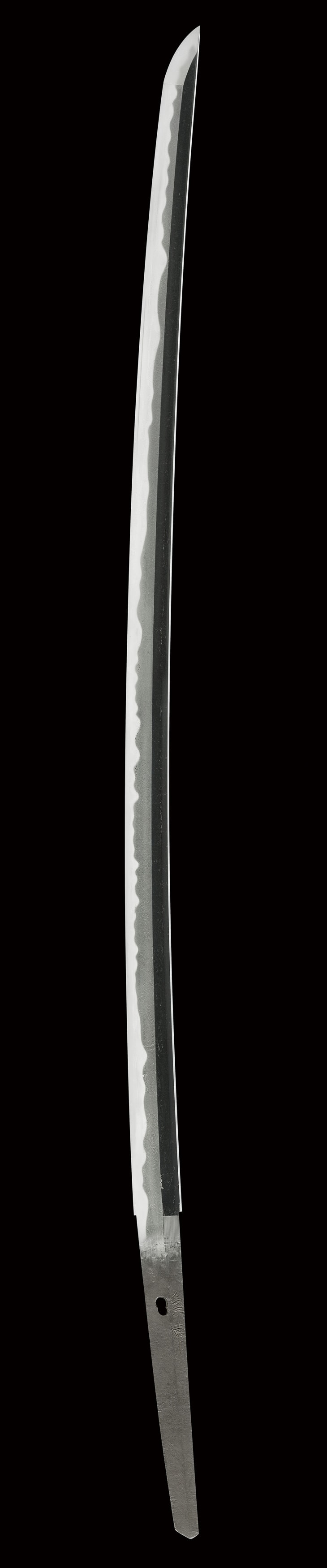
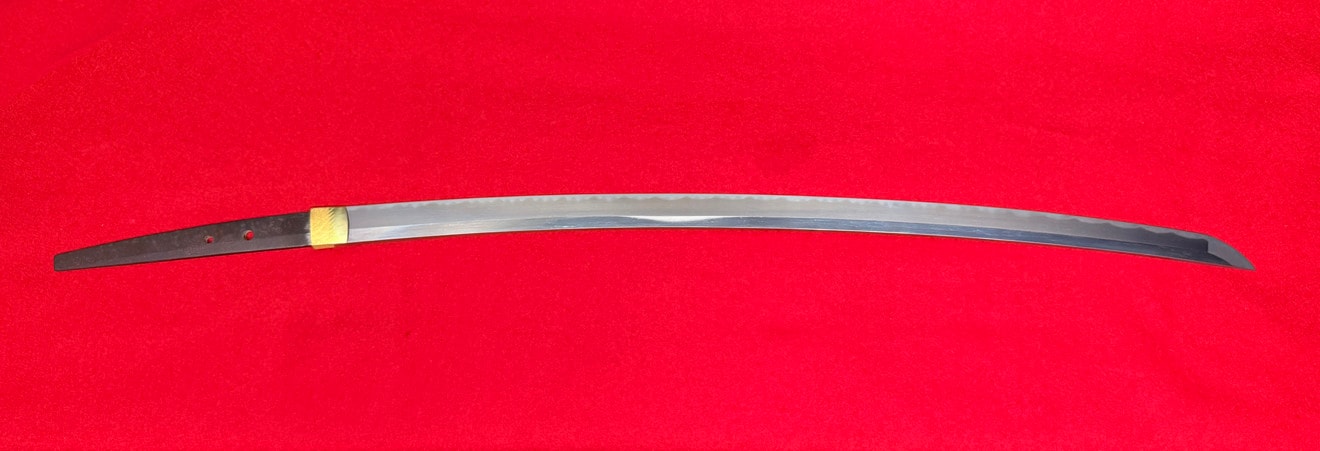
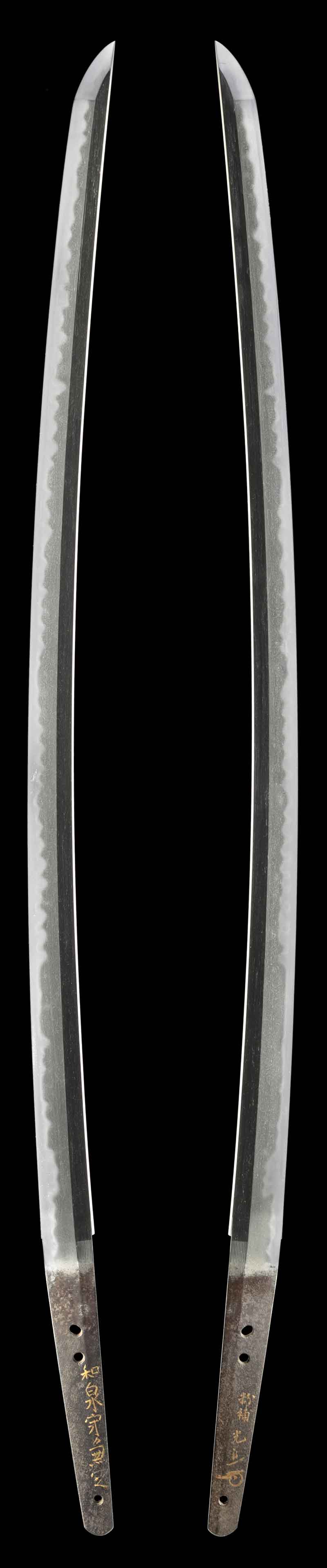
Description Keijō: , ; wide and long ; little difference between base and tip widths; comparatively wide for the blade width; rather high ; thick ; some suggestion of ; somewhat shallow ; . : Dense with areas of and mixed ; very fine forms a thick layer, with fine appearing. : With a feeling of straight ; above this, the lower half is based on a shallow with partial in ; the shows angular turns (kado-gakari). The upper half mixes with large , angular elements, and pointed (-suggestive) ; enter well, with mixed in. attaches, and in places slightly coarse is mixed, producing uneven, patchy areas—particularly conspicuous around the . and stand out in the lower half; and appear in various places; the shows some tendency toward (subdued). : Deeply tempered; on the it is a shallow that becomes somewhat pointed at the tip, showing a -style flavor; on the it is shallow and small , tending to an style. Both sides are tempered far down () and show . : None. : ; tendency with ; with a -like appearance; one . A long signature in thick chisel strokes is cut on the , positioned almost centrally below the .
Artisan Echigo no Kami Fujiwara Ujitsune (越後守藤原氏恒)
Era Early period ()
Explanation Echigo no Kami Ujitsune is recorded in the as signing “Bishū-jū Echigo no Kami Fujiwara Ujitsune,” and being active around the Enpō era (1673–1681) in Owari. However, judging from this sword’s overall form and the manner of its and , it should be appraised as work from the transitional boundary between and , and it is difficult to believe that it could date as late as Enpō.
Regarding this point, the -tō Taikan states that he was the second son of Wakasa no Kami Ujifusa, and records: “Kawamura Heijūrō. First signature: Ujishige. Received the title of Echigo no Kami on the 2nd day of the 10th month of Genna 6 (1620). Died in Nagoya, Bishū, on the 11th day of the 7th month of Meireki 2 (1656), aged 76. Having no children, his line became extinct.” From the workmanship of this blade, at a glance it calls to mind both Wakasa no Kami and Hida no Kami Ujifusa, and it may be accepted that Ujitsune was indeed Wakasa no Kami Ujifusa’s second son.
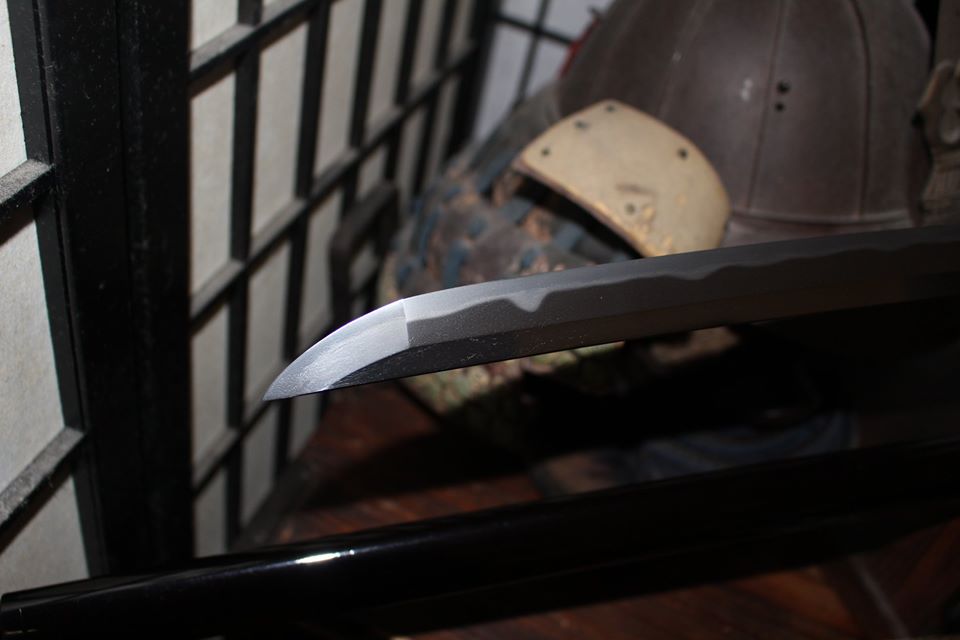
This shows a forging of dense mixed with and , with very fine thickly applied and fine entering. The suggests a straight ; above it, is mixed with large and pointed , while the takes on angular turns. and enter, attaches, and in places slightly coarse is mixed so that the temper shows uneven patches; and appear, and and are interspersed throughout. The further takes on some (subdued) tendency. The is deeply tempered: on the it becomes pointed in a -style manner, while on the it tends toward an style; both are tempered far down and finished with . These characteristics, as noted above, are precisely reminiscent of the workmanship seen in Wakasa no Kami and Hida no Kami Ujifusa.
The blade has abundant (meat), and its broad width, , long , and thick create a forceful and heroic impression when combined with the large-patterned . The angular , unevenly applied , the somewhat -inclined , and the -style pointed (sometimes with an -like impression) with long are all features frequently seen within the Wakasa no Kami Ujifusa group. In addition, the scenery of and is also engaging. Although this smith was a scant producer, this sword is his representative work showing exceptionally fine execution; moreover, despite its great length, it shows no loss of coherence or balance.