二世紀半の泰平のあいだ、刀は武器である以上に武士の身分の標章であった。江戸の実証と大坂の華やぎのように都市ごとの作風が育ち、時代の末には需要も細っていく。
 NihontoWatchNihontoWatch
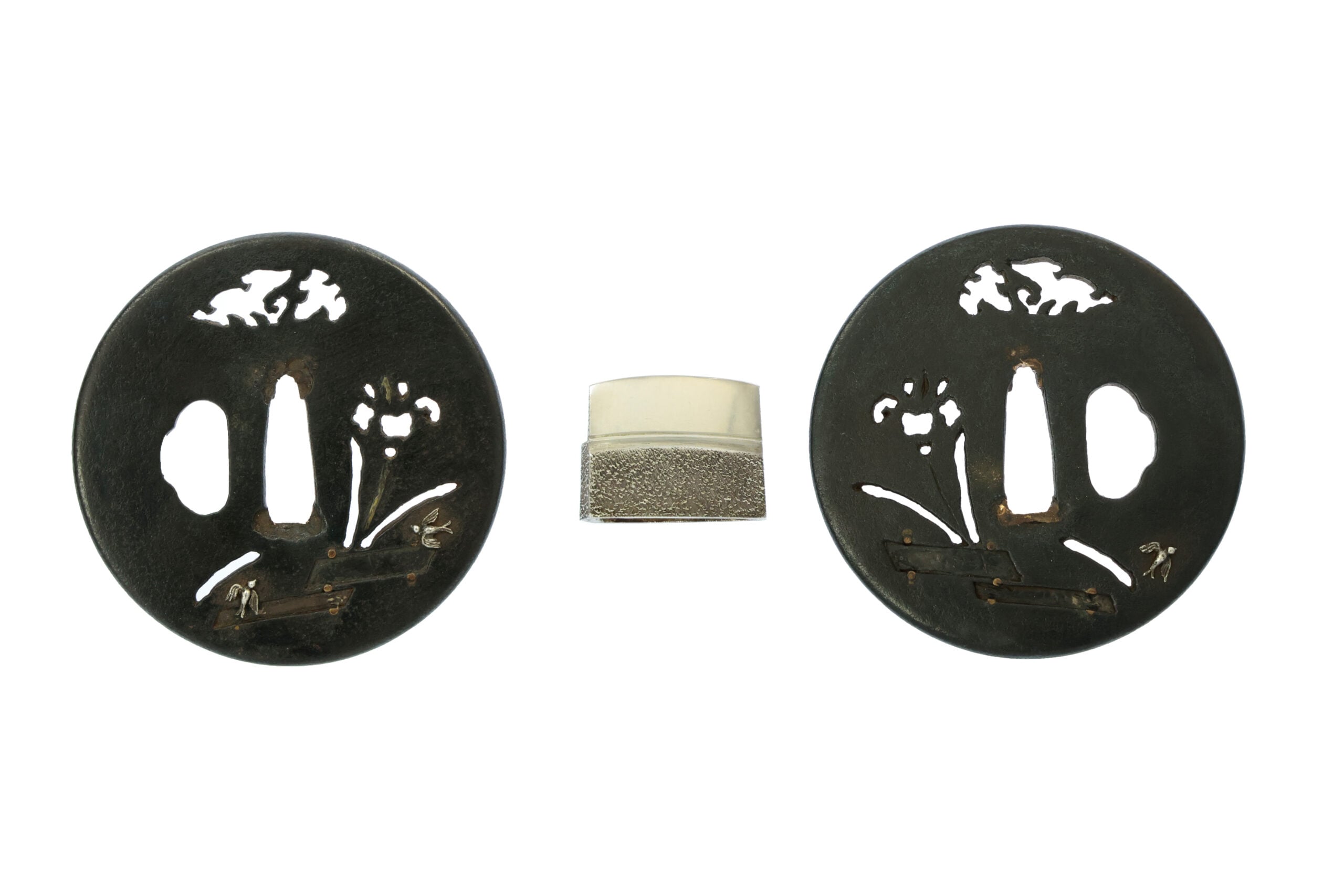
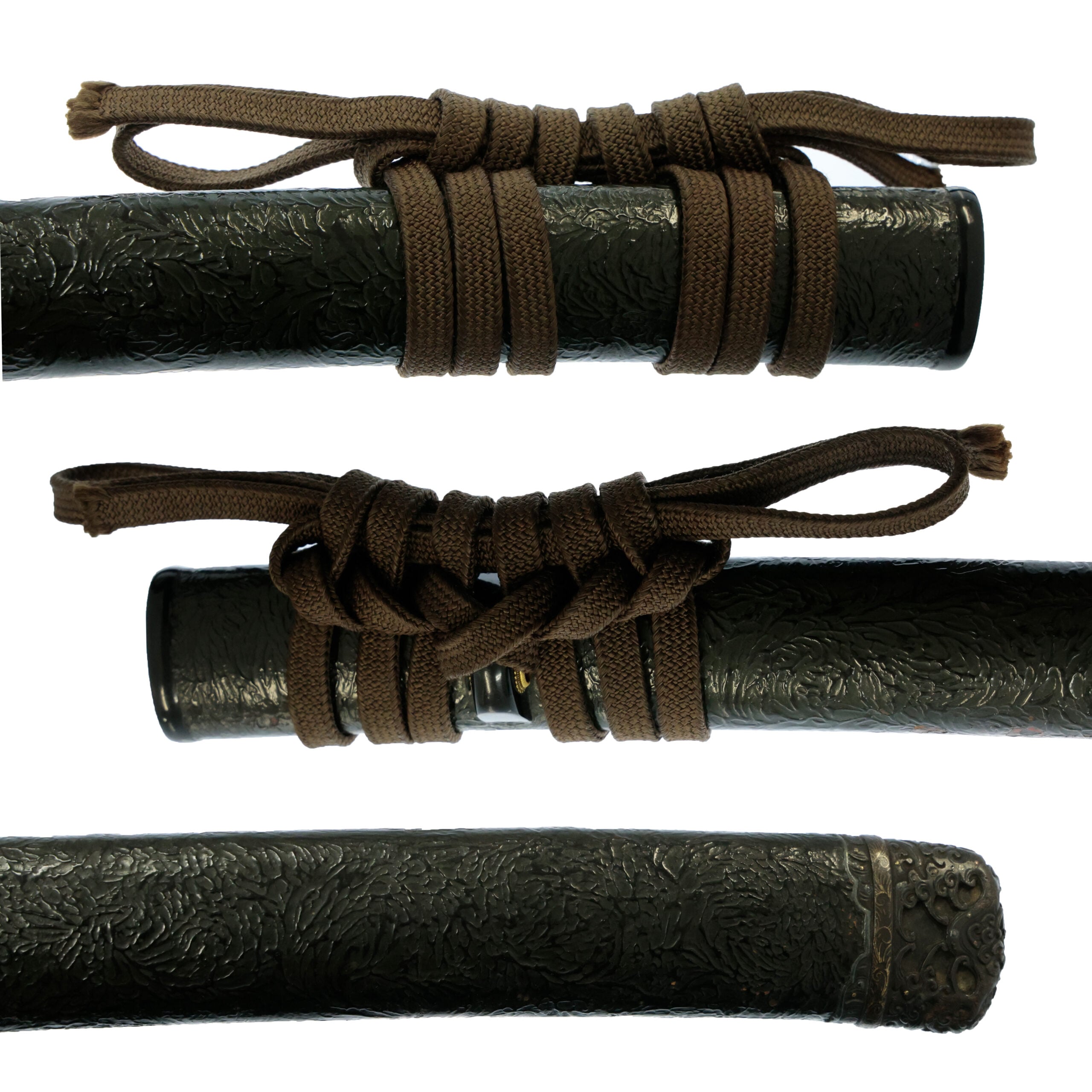
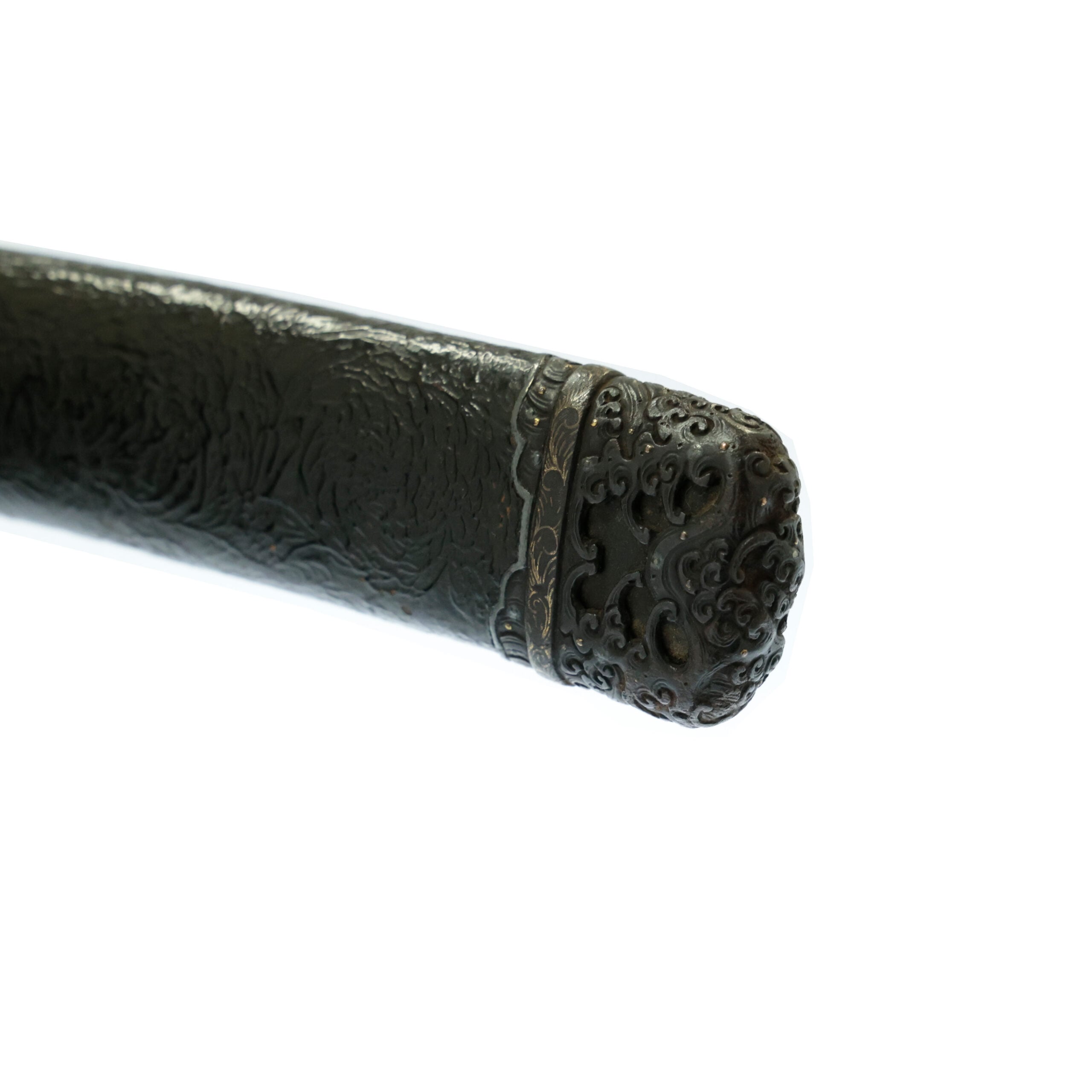
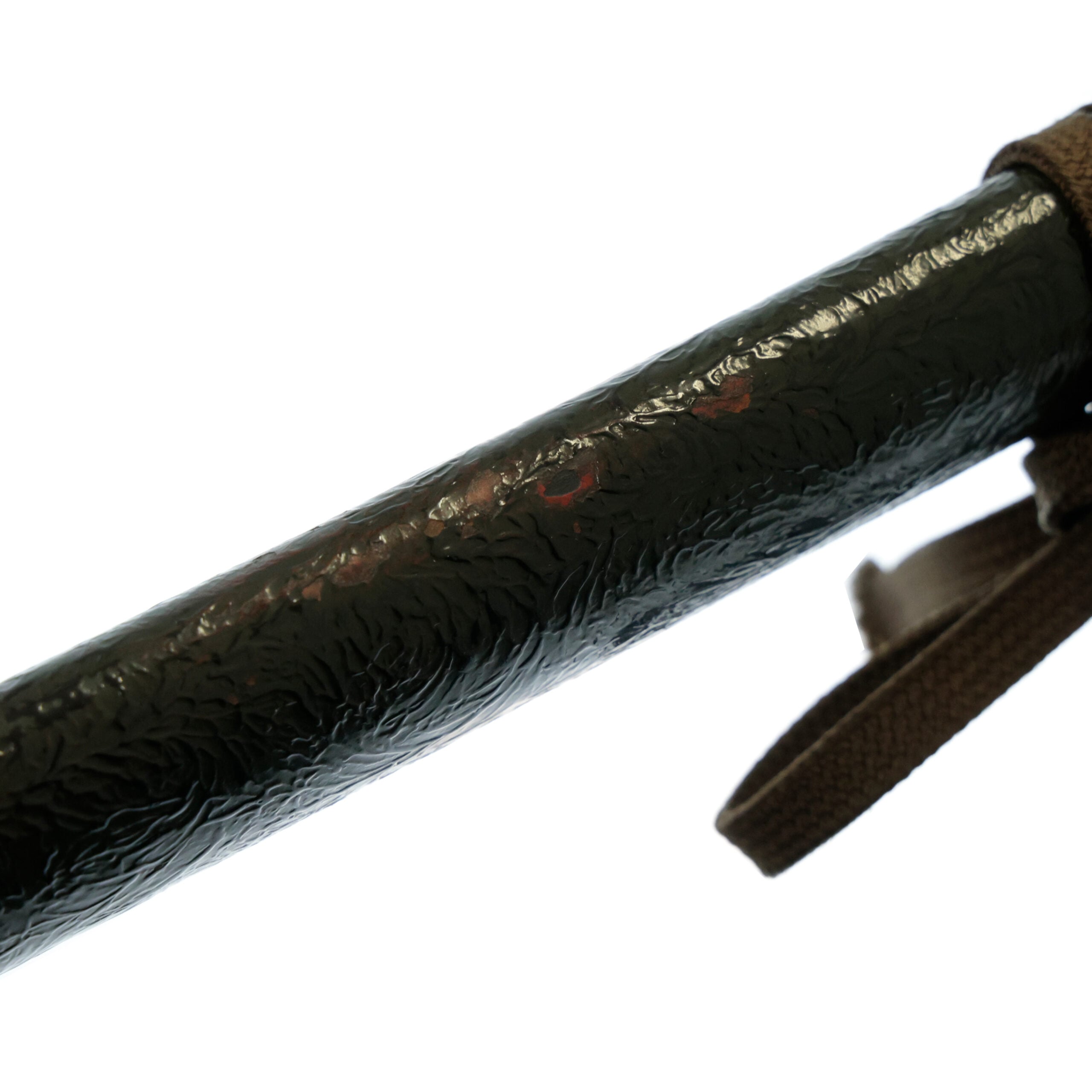
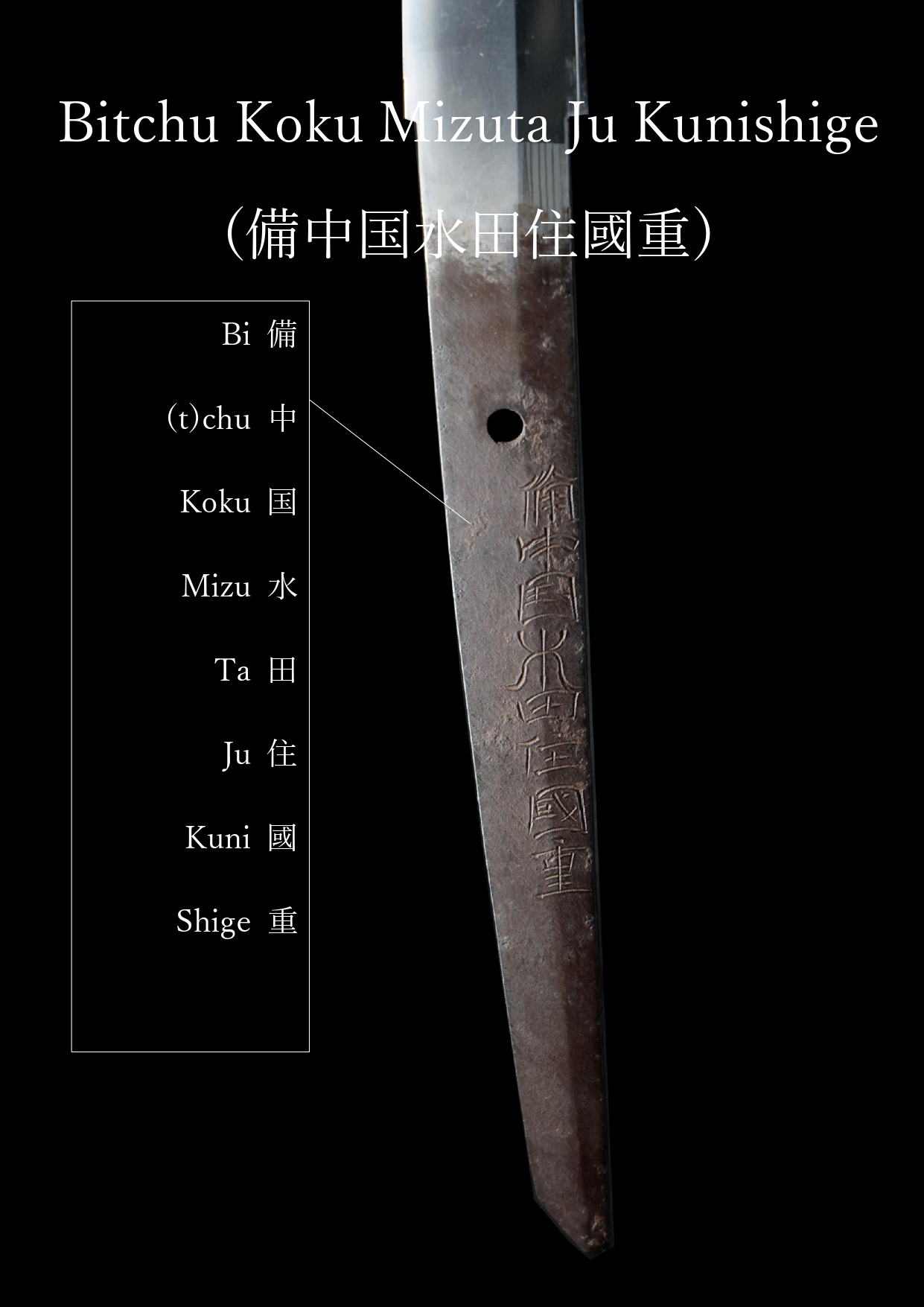
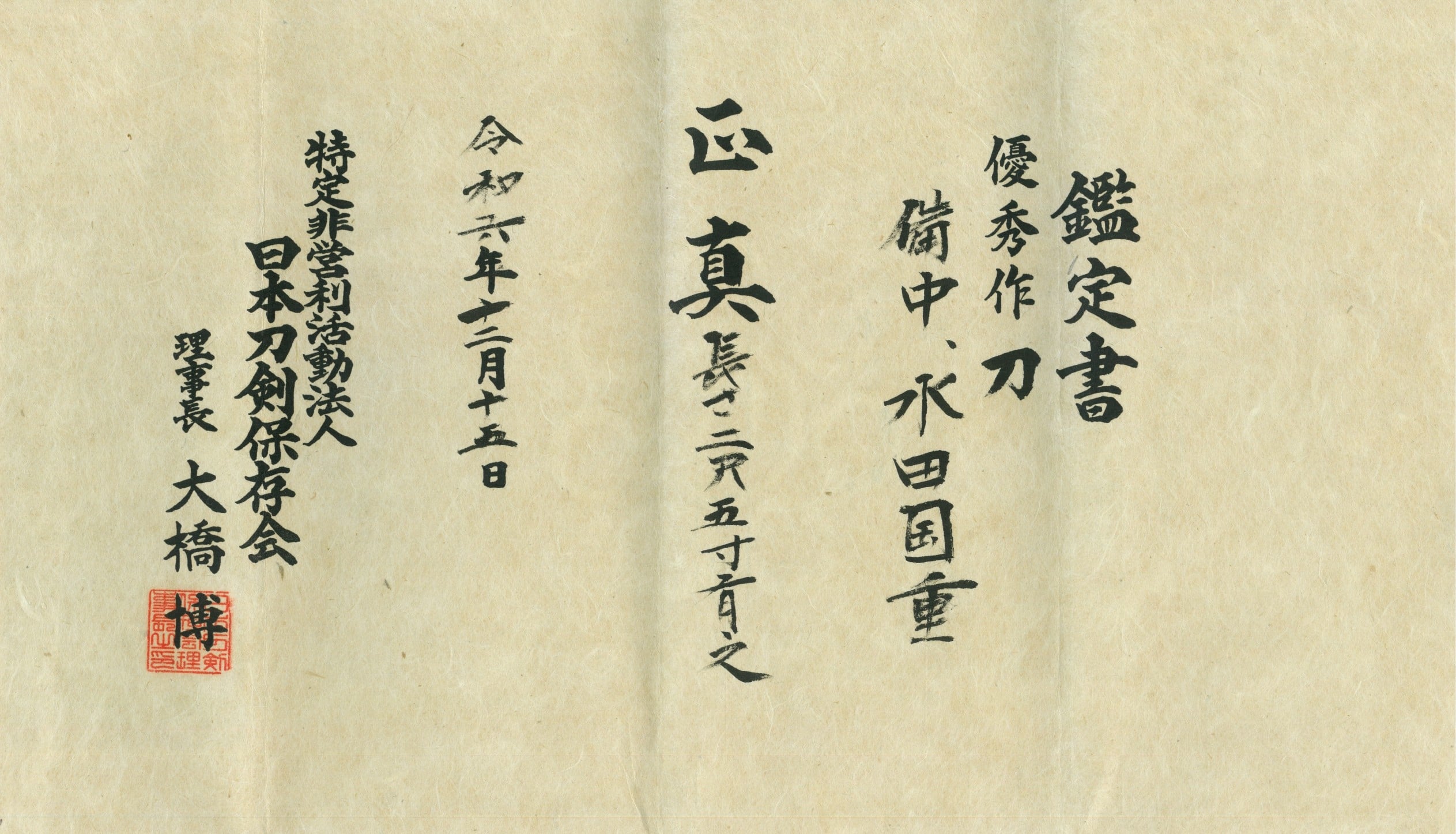
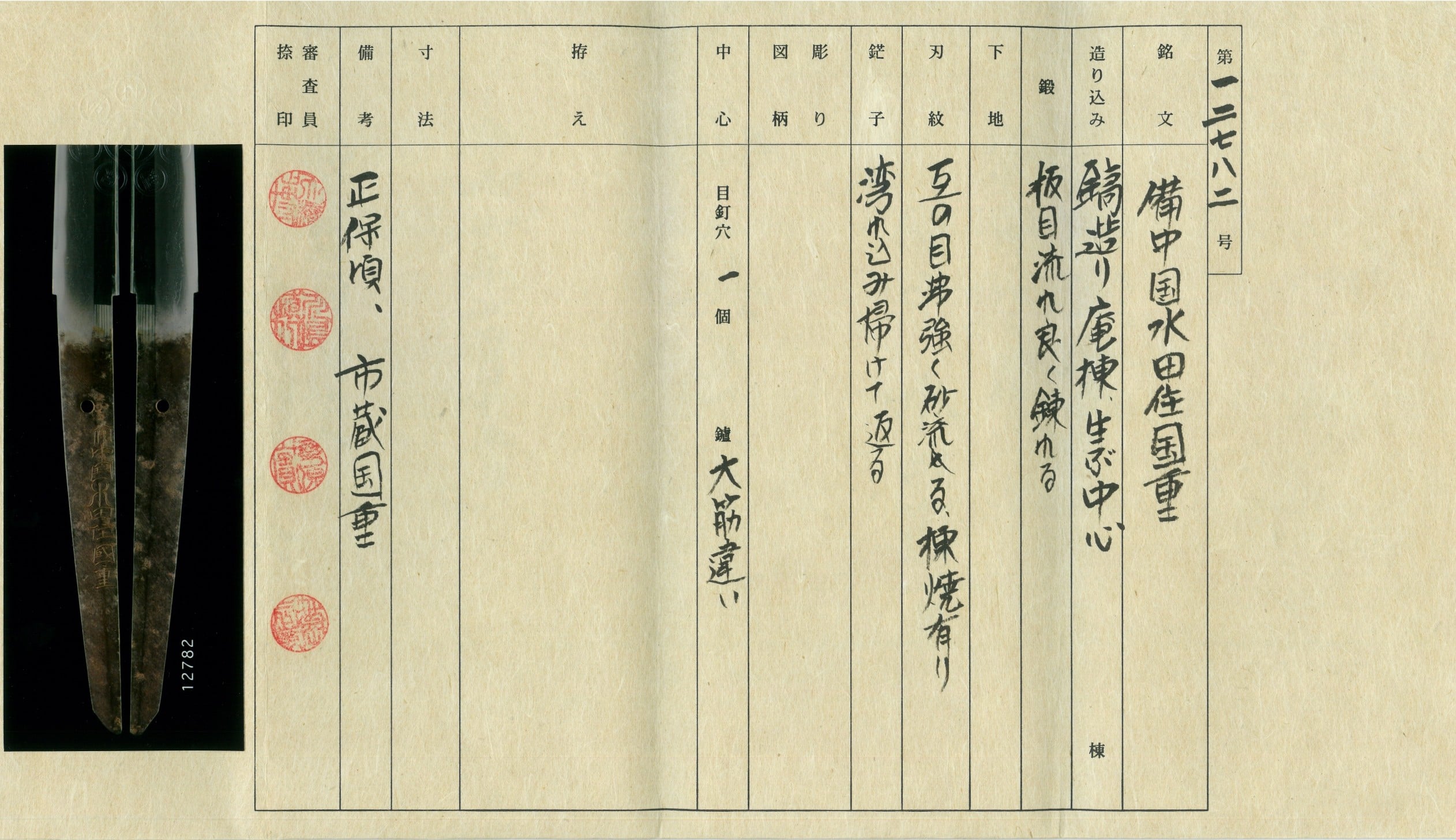
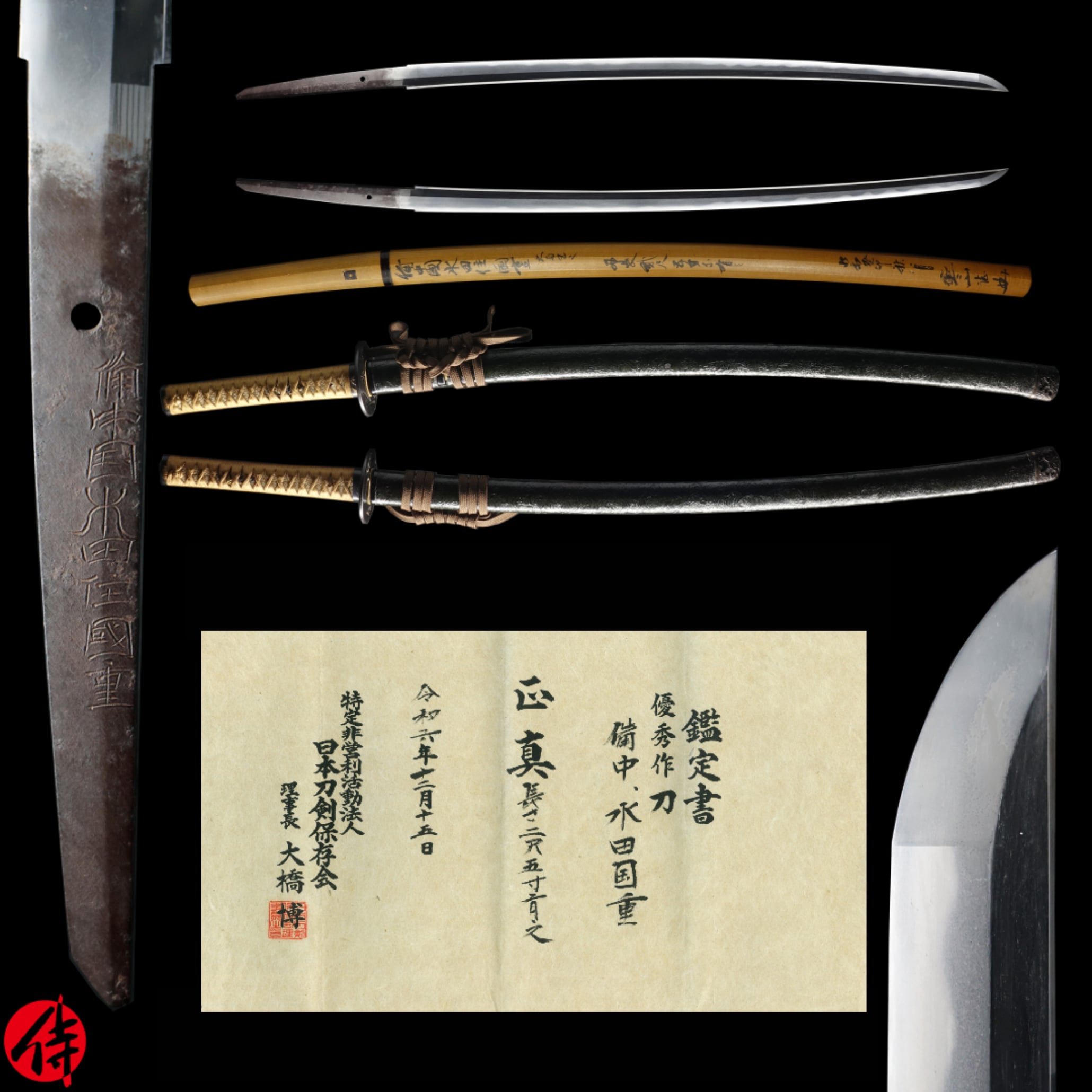
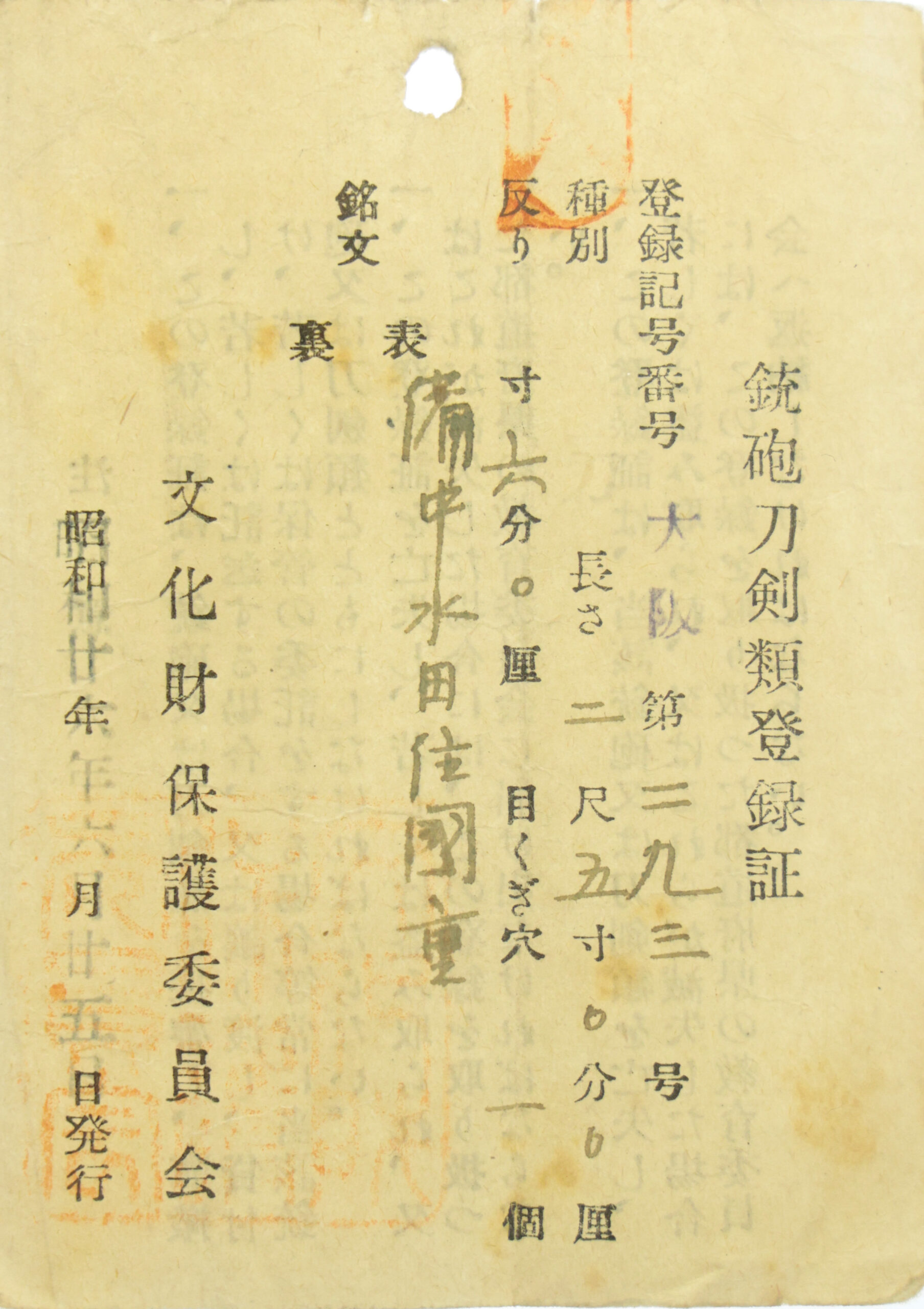
This blade was signed by Bitchu Koku Mizuta Ju Kunishige (備中国水田住国重) during the Shoho era (1644-1648: Early Edo period), according to this NTHK’s appraisal. Bitchu Koku is the name of the province located in today’s Okayama prefecture and it means Kunishige resided in this area when he forged this blade. The real name of Kunishige is Ichizo (市蔵), and he was also known as Yamashiro Daijyo Minamoto Kunishige (山城大掾源国重). He was most active in sword-forging during the early Edo period (the mid 17th century). Yamashiro Daijyo is the honorable title given to this swordsmith in the second year of the Shoho era (1646). He was the younger brother of Otsuki Yogoro Kunishige (third-gen Kunishige), the most highly-regarded swordsmith in Mizuta school, located in Bitchu province (today’s Okayama prefecture). He also forged swords in Edo city with his son, the second-gen Yamashiro Daijyo Kunishige. The Mizuta school is believed to have been founded in Bitchū Province during the late Muromachi period, around the 16th century, by swordsmiths who traced their lineage to Ko-Aoe Tametsugu (古青江為次). Tametsugu was one of the most highly regarded smiths of the Ko-Aoe tradition and was active from the late Heian to the early Kamakura period (late 12th–early 13th century). One of his surviving works is designated a National Treasure of Japan. Aoe (青江) was the name of a renowned sword-making school based in an area corresponding to present-day Kurashiki City, Okayama Prefecture. The school flourished from the late Heian through the Nanbokuchō period but declined during the Muromachi period. The Mizuta school later emerged in Bitchū Province as an important successor to the Aoe tradition, preserving elements of its earlier workmanship while developing its own distinctive style. The abundant and strongly visible Nie (沸)—bright crystalline particles formed along the hardened edge—seen on this blade is consistent with the workmanship traditionally associated with the Bitchū Mizuta school, a later branch of the Ko-Aoe lineage. The Bitchu Koku Mizuta school flourished from 1530-1700 (the end of the Sengoku period to the mid-Edo period) in today’s Okayama prefecture. It lasted until the end of the Edo period. There were about 60 swordsmiths who belonged to Mizuta school, and Kunishige was the most prestigious smith name only selected swords maker were allowed to use in this school. During the Edo period, many Kunishige swordsmiths moved to other parts of Japan. There were two major groups in Kunishige swordsmiths during the Edo period. One is called Oyogo Kunishige school (大与五国重派), lead by Master Otsuki (大月) and the other is called Kono school (河野派) led by Tameie (為家). Since he was the younger brother of Otsuki Yogoro Kunishige, this Kunishige belonged to Oyogo Kunishige school. Yamato Daijyo Kunishige was a prestigious swordsmith. He used Kunishige as his maker’s name and received the honorable title (Yamato Daijyo). Okayama prefecture is located near the Chugoku Mountains, where iron sands, one of the essential materials for making Japanese swords, were abundant. Furthermore, the swordsmiths in Okayama prefecture had close access to the Yoshi River to find pure water and high-quality charcoal, which are essential to make great swords. This geological location contributed to the swordsmiths to forge high-quality refined blades. We presume Bichu was quite active in sword-forging from ancient times. Yushu Saku Appraisal This blade has successfully passed the Yūshū-tō (Excellent Sword) examination conducted by the NPO Tōken Hozonkai, a respected Japanese sword preservation organization. The Yūshū-tō certification is not easily obtained. During the appraisal process, swords are subjected to strict and detailed evaluation by qualified judges with deep knowledge of traditional Japanese sword craftsmanship. Factors such as forging quality, hamon activity, balance, preservation state, and historical importance are thoroughly examined. Only swords that meet these demanding standards are awarded this distinction. As a result, the Yūshū-tō paper is regarded as strong evidence of both authenticity and superior artistic and historical merit. *Please keep in mind that there are a couple of Kitae Kizu on the blade. Fuchi-Kashira You would find the figure of a flying bird on the Kashira, and a man looking up in the sky from a boat on the Fuchi. The bird seems to be Tsubame (燕, swallow). The swallow has been regarded as a migratory spring bird, as compared to the migratory autumn bird, wild geese. Also, the swallow was widely rooted in Japanese culture, such as being mentioned in the Manyoshu (万葉集), the oldest extant collection of Japanese waka (poetry in classical Japanese) in the Nara period (the 8th century). It is also said that swallows appeared as a motif on Kimonos and Kabuki costumes. Tsuka and Menuki The motif of this Menuki is a plant called Fuji (藤, Japanese wisteria). Wisteria has strong fertility and grows being entwined with other trees. Therefore, people regarded this flower as a symbol of longevity and prosperity for future generations. Also, its Japanese name Fuji (藤) is likened to another word Fushi, which is written as “不死,” which means immortality. That is why the Fujiwara (藤原) family, who reached the height of glory in the Heian period (794-1185), used this motif for their family name and family crest. A theory says that more than 100 types of wisteria’s family crest designs in the Edo period. We could assume how this motif was popular among people. Besides, wisterias bloom downward. Its appearance was likened to a scene in which the gods or Buddha is descending to the earth. Tsuba and Habaki The flower engraved with openwork on this Tsuba is probably the Kakitsubata (燕子花, rabbit-ear iris). Its flower is blooming, and birds are flying around it. Kakitsubatas color the waterside during their short flowering time; Japanese people have loved this elegant appearance since ancient times. This flower has been treated as a motif in various arts, such as poems or pictures. There is a famous collection of Japanese poems that is called the Ise Monogatari (伊勢物語, The Tales of Ise). One of the well-known episodes in this book treats the Kakitsubata. The plot of the story is as follows. The protagonist no longer felt comfortable living in the city and decided to go to the eastern country, which was the countryside at that time. He left the town with his friends, and during the journey, one of them found that Kakitsubatas were blooming at the waterside. The protagonist was requested to write a poem using characters of the Kakitsubata (it is written as かきつばた in Hiragana character), and he responded to this challenging request. He composed a nostalgic poem, and it made them feel homesickness for their home or families. We could feel their importance when we are away from these things. Since this event happened at the Yatsuhashi (八橋, a bridge in which several narrow bridge boards are connected in a lightning-like shape to a pond or stream), the combination of the Kakitsubata and the Yatsuhashi became popular. We guess that The Tales of Ise have inspired this Tsuba’s theme. There is another possibility of this flower’s model; the Shoubu (菖蒲, iris flower). Its Japanese name has the same pronunciation as the word “Shoubu (勝負),” which means battle. So, the “Shoubu” (菖蒲, iris flower) motif was associated with the idea of “Shoubu” (勝負, fight) due to the same pronunciation. Therefore, these motifs have reminded Samurais of battles. Based on these ideas, we would judge one of these two flowers is the motif of this Tsuba’s design. Saya On the head of this Saya, you would find the wave pattern is engraved. As waves’ movements continue endlessly, the wave pattern represents eternity, immortality, longevity, birth, etcetera. Also, since tides repeatedly change the shape and terrain of rocks, some people hoped for a strong will by using this motif. People used this pattern wishing for an indomitable spirit to rechallenge time and time without giving up. Thanks to its dynamic design, this motif has been appreciated, especially for men’s Kimono (traditional Japanese costume). Also, the surface of this Saya s decorated with an uneven pattern. *Please note that the surface of this Saya is partly damaged. Authentication Paper NTHK, also known as NPO Nihon Touken Hozon Kai, is the oldest organization for sword authentication of Japanese swords in modern times. It was established in 1910 during the post-Samurai era. They authenticated the blade on September 15th in the 6th year of Reiwa (2024). They appraised it as Yushu-Saku To (優秀作刀): an outstanding sword considered especially worthy of preservation for Japanese society. Registration Number It is called Jyu Hou Touken Rui Torokusho (銃砲刀剣類登録証).

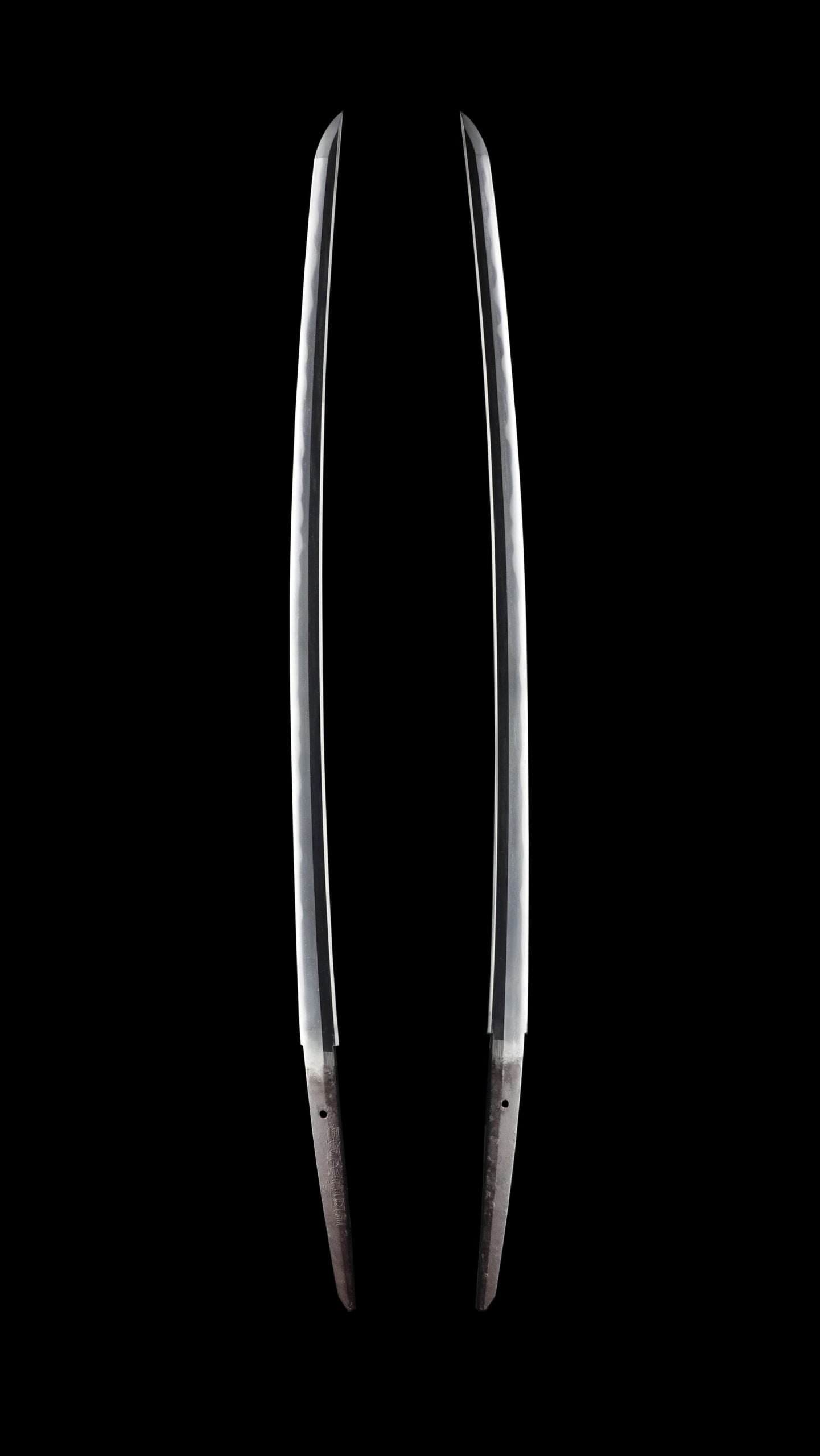
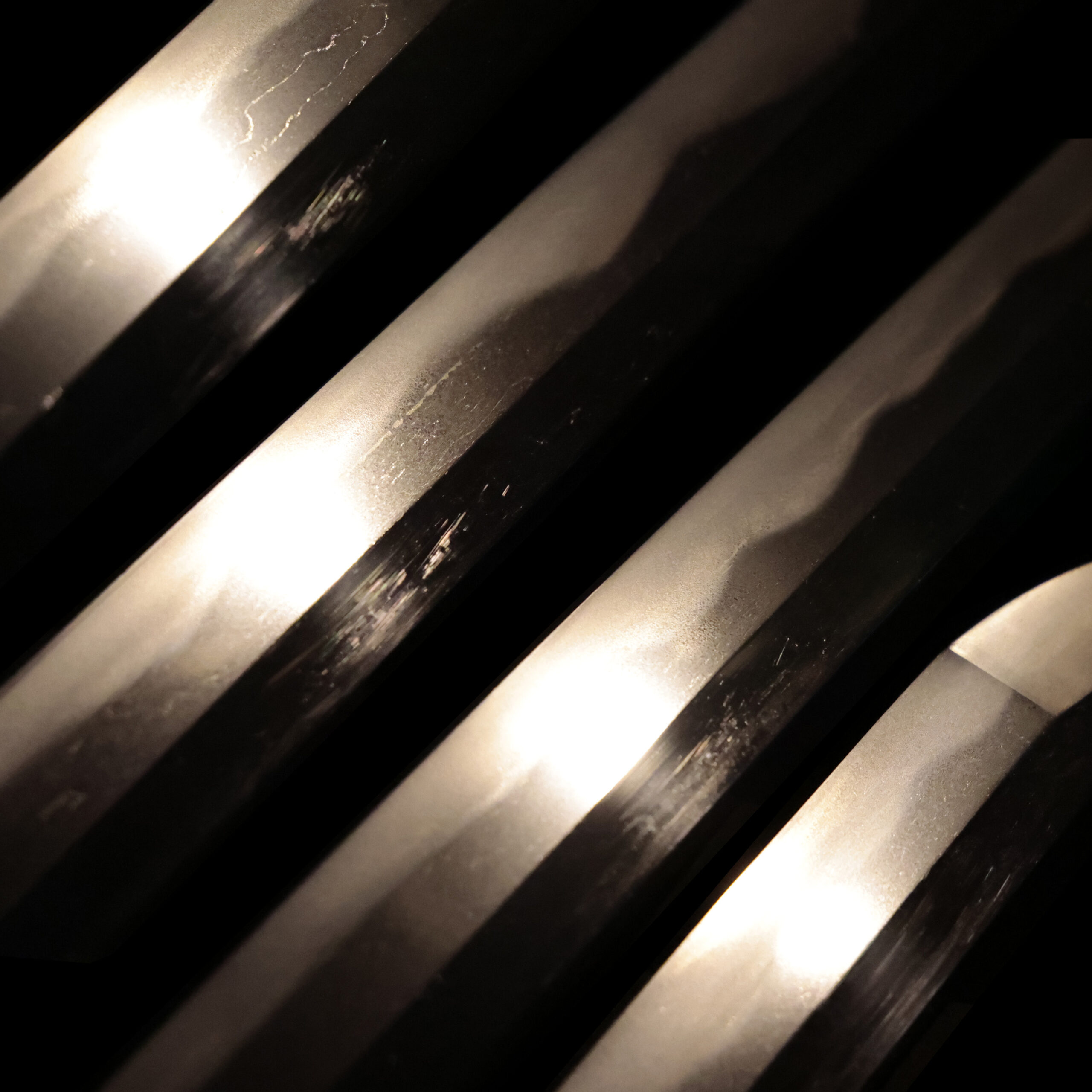
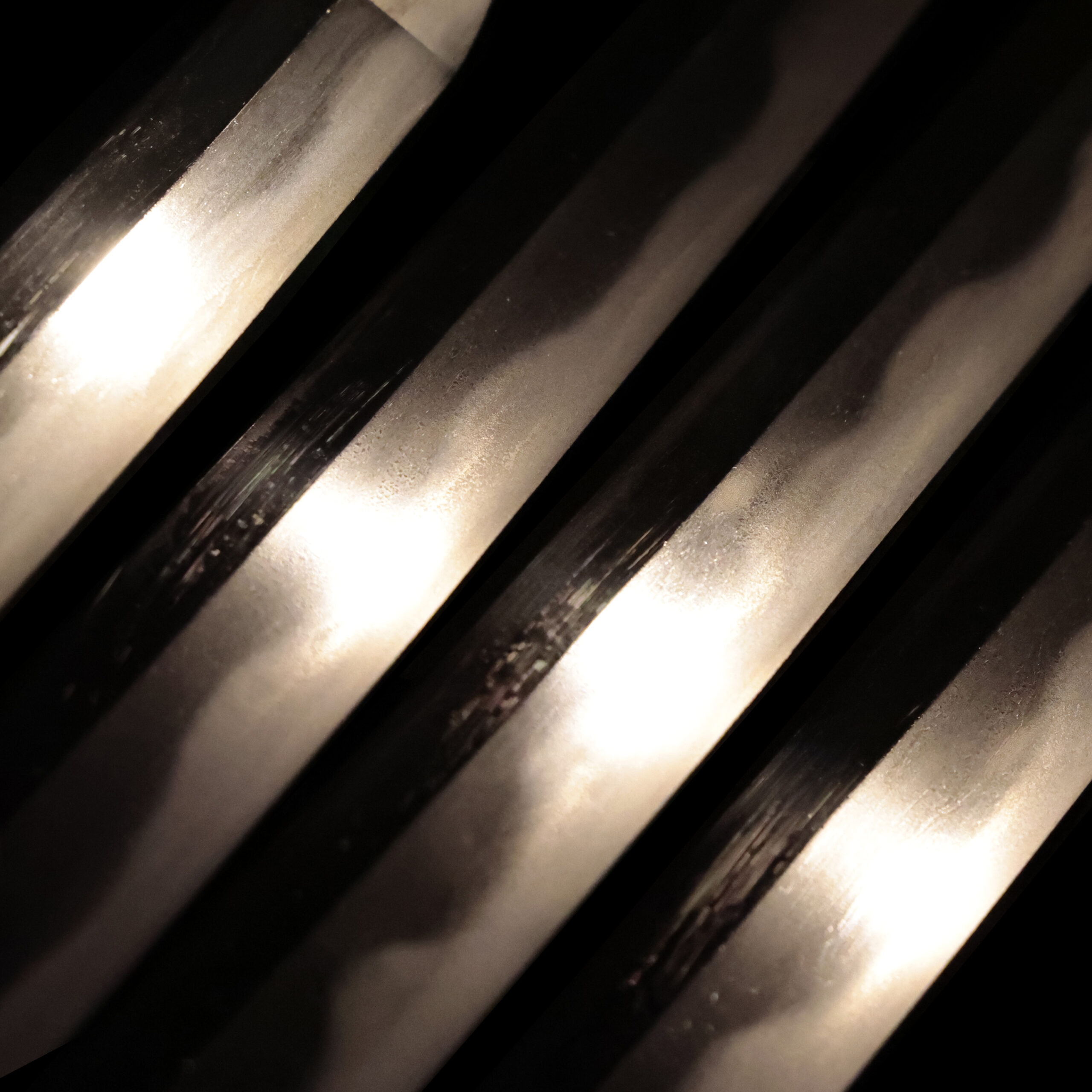
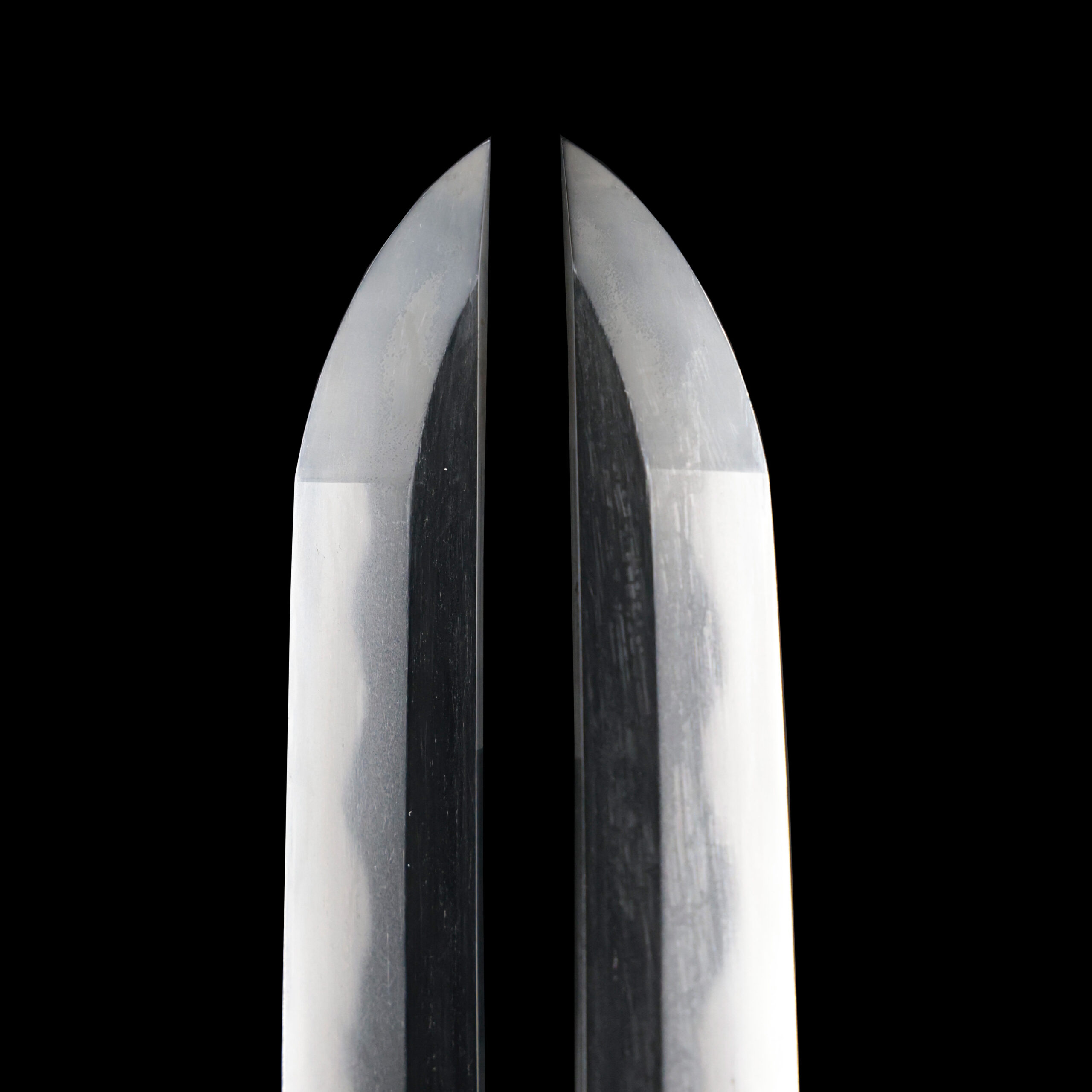
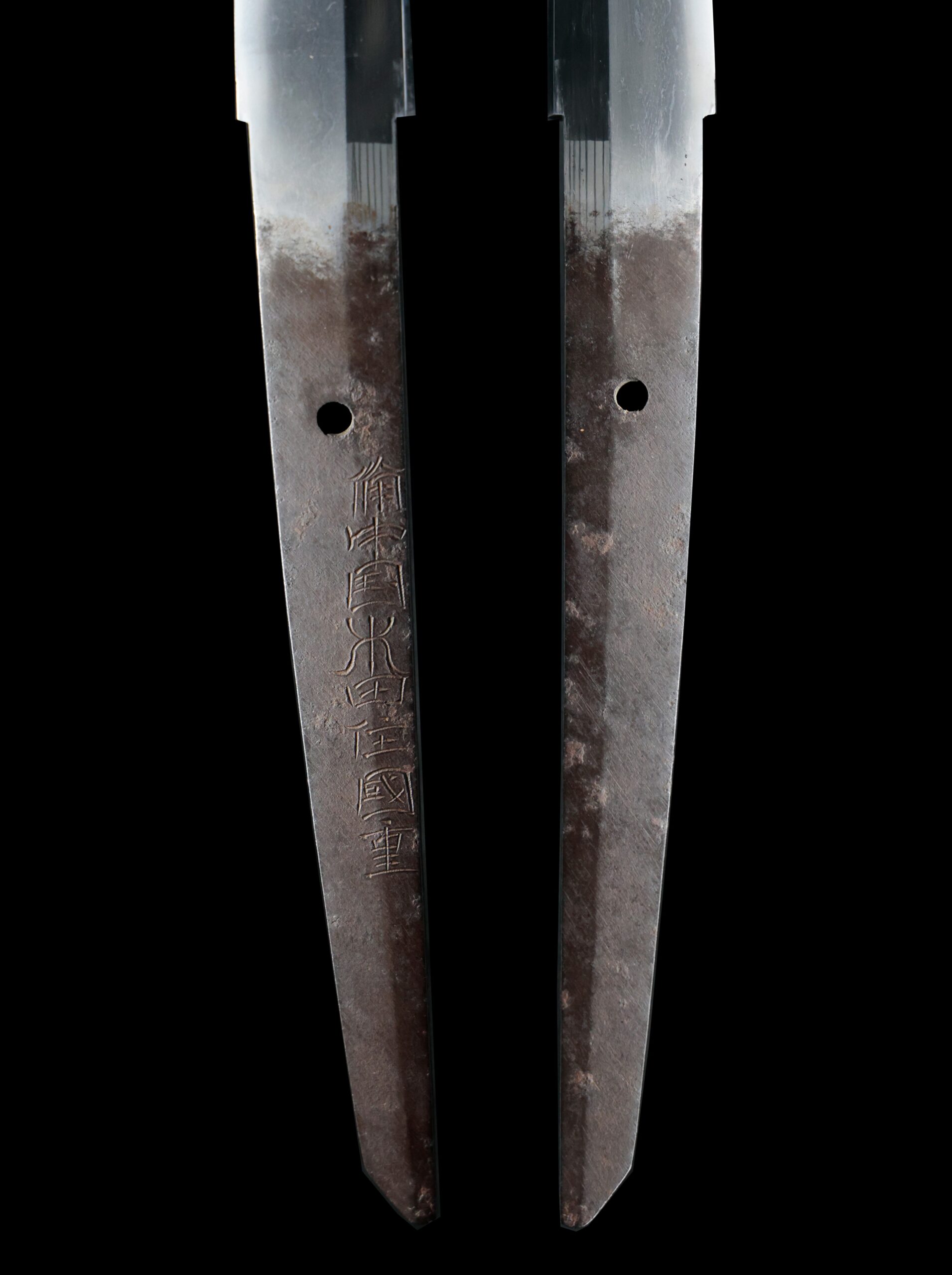
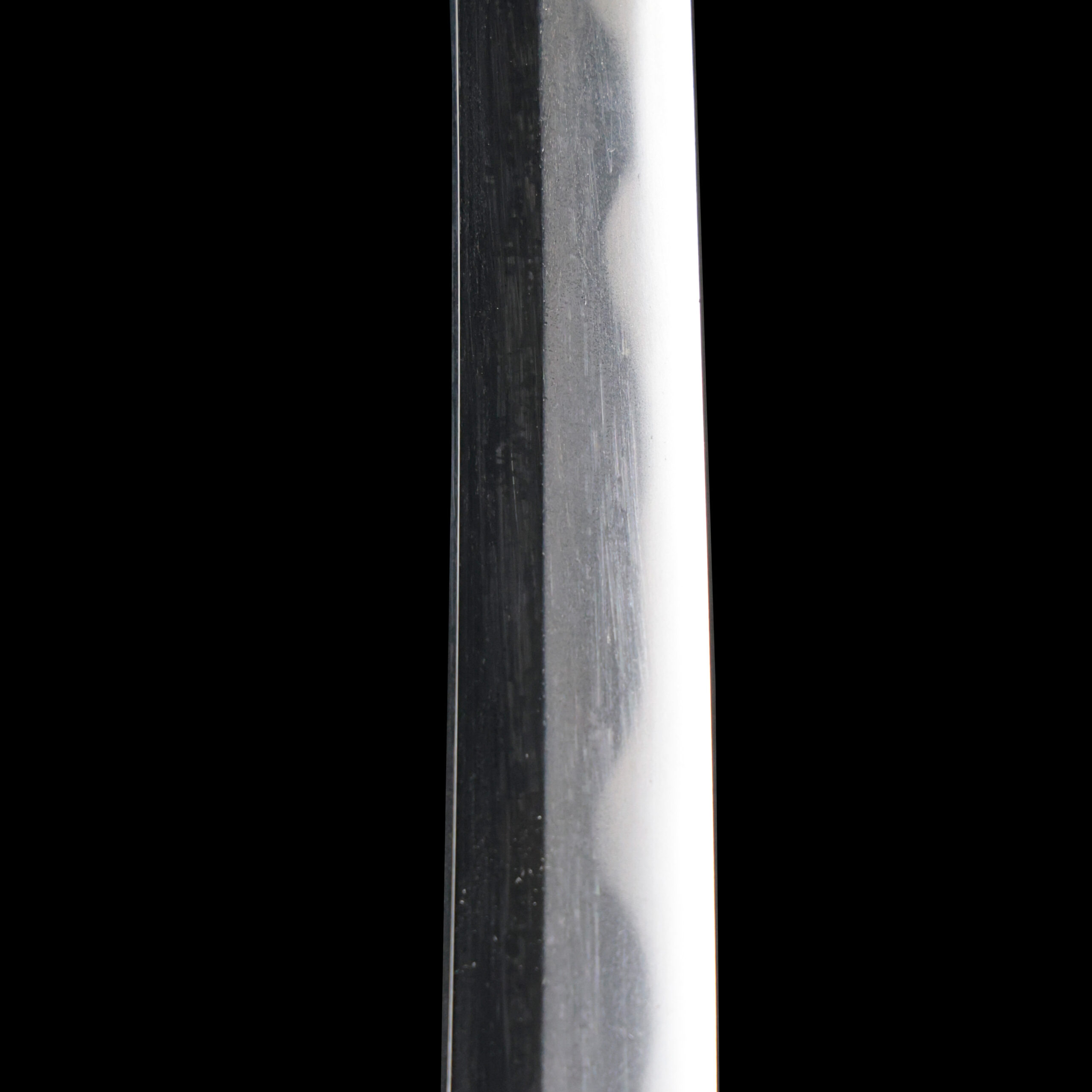
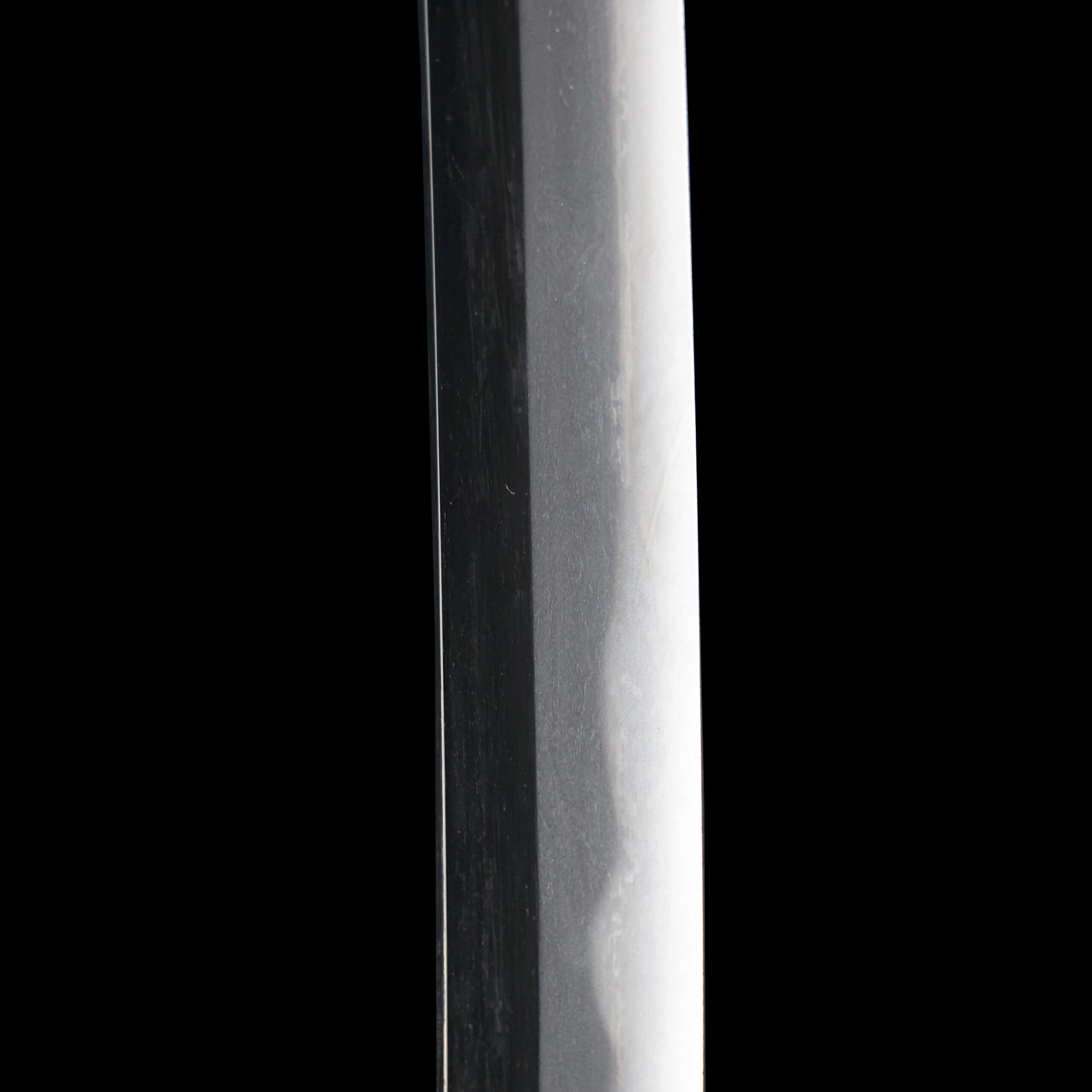
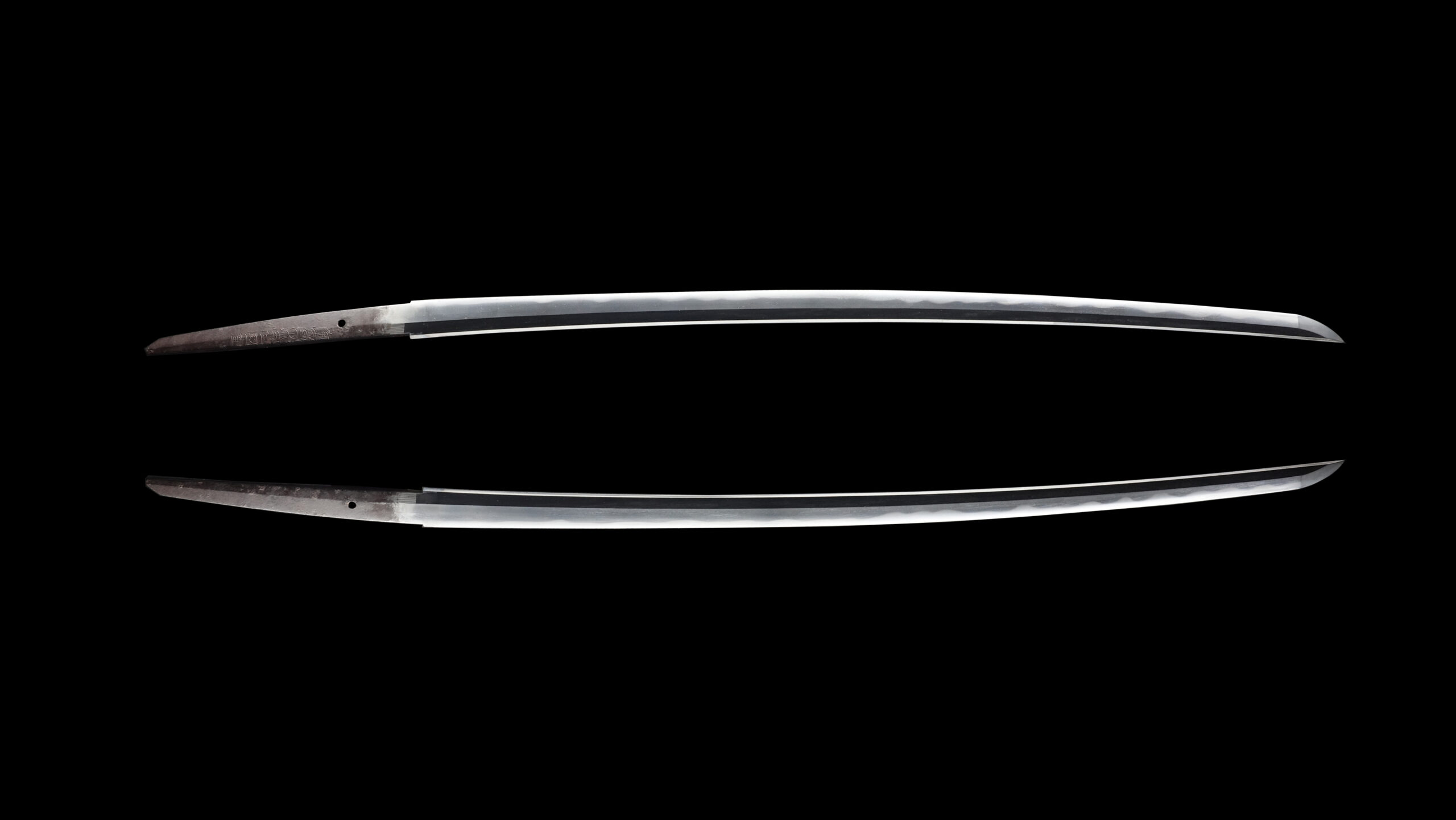
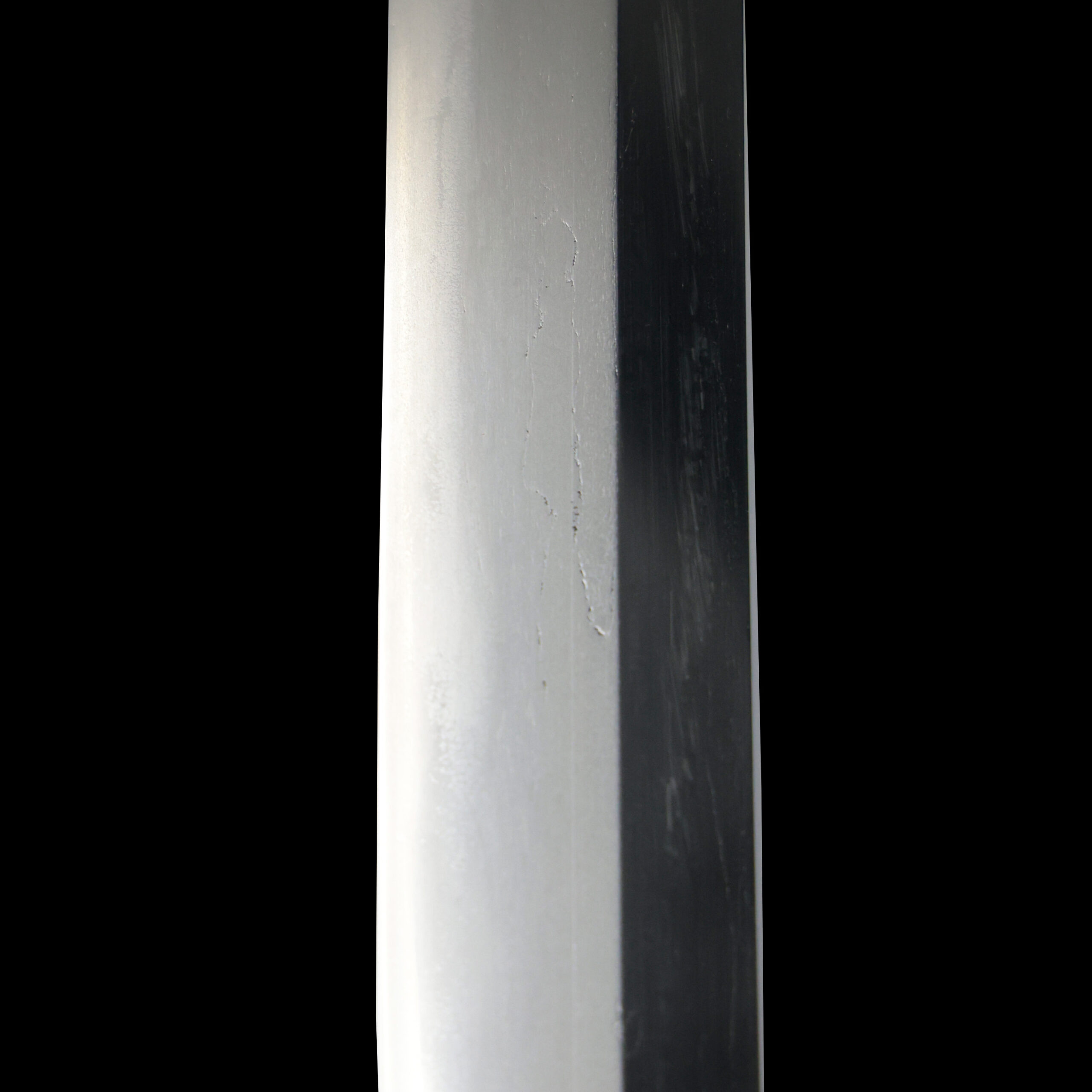
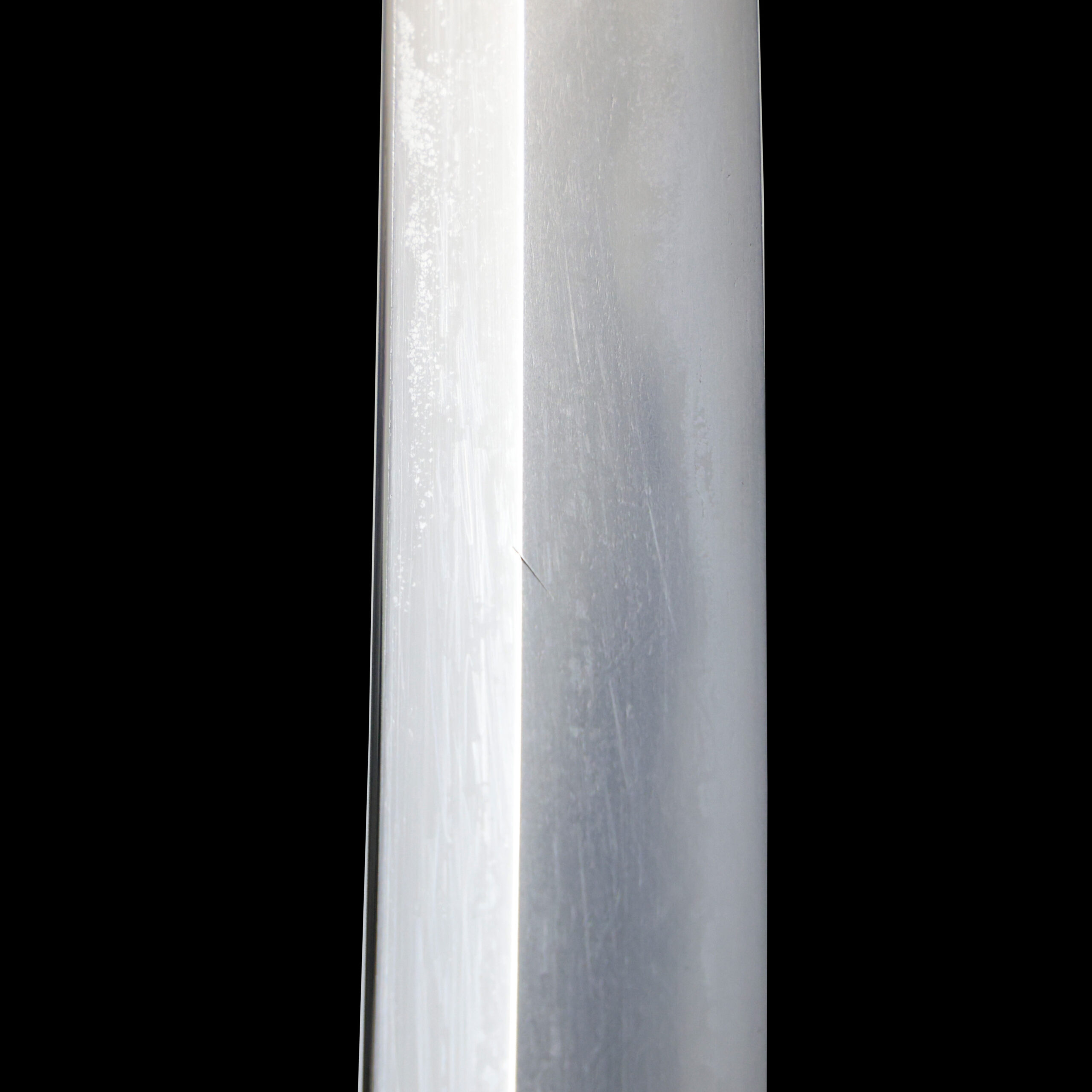
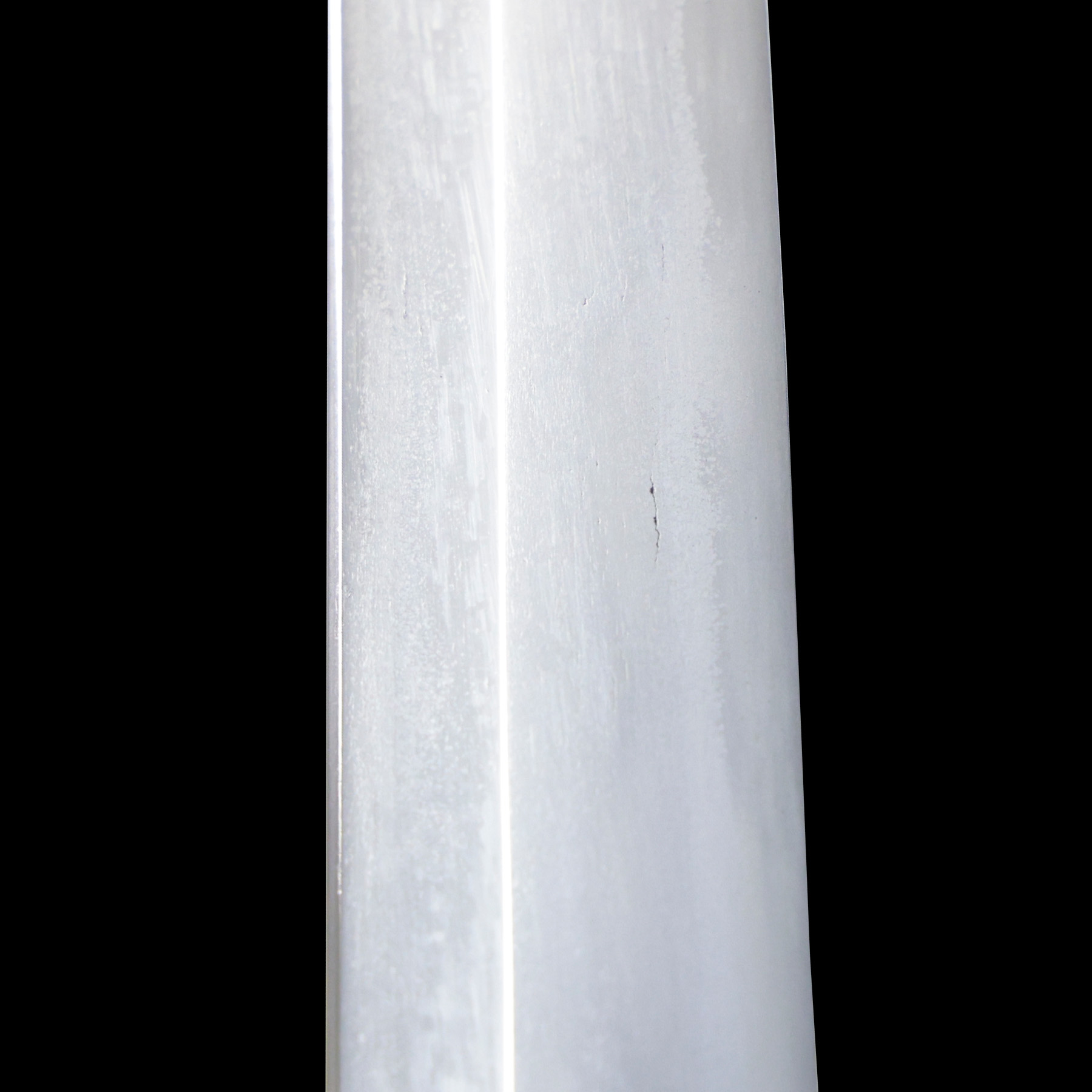
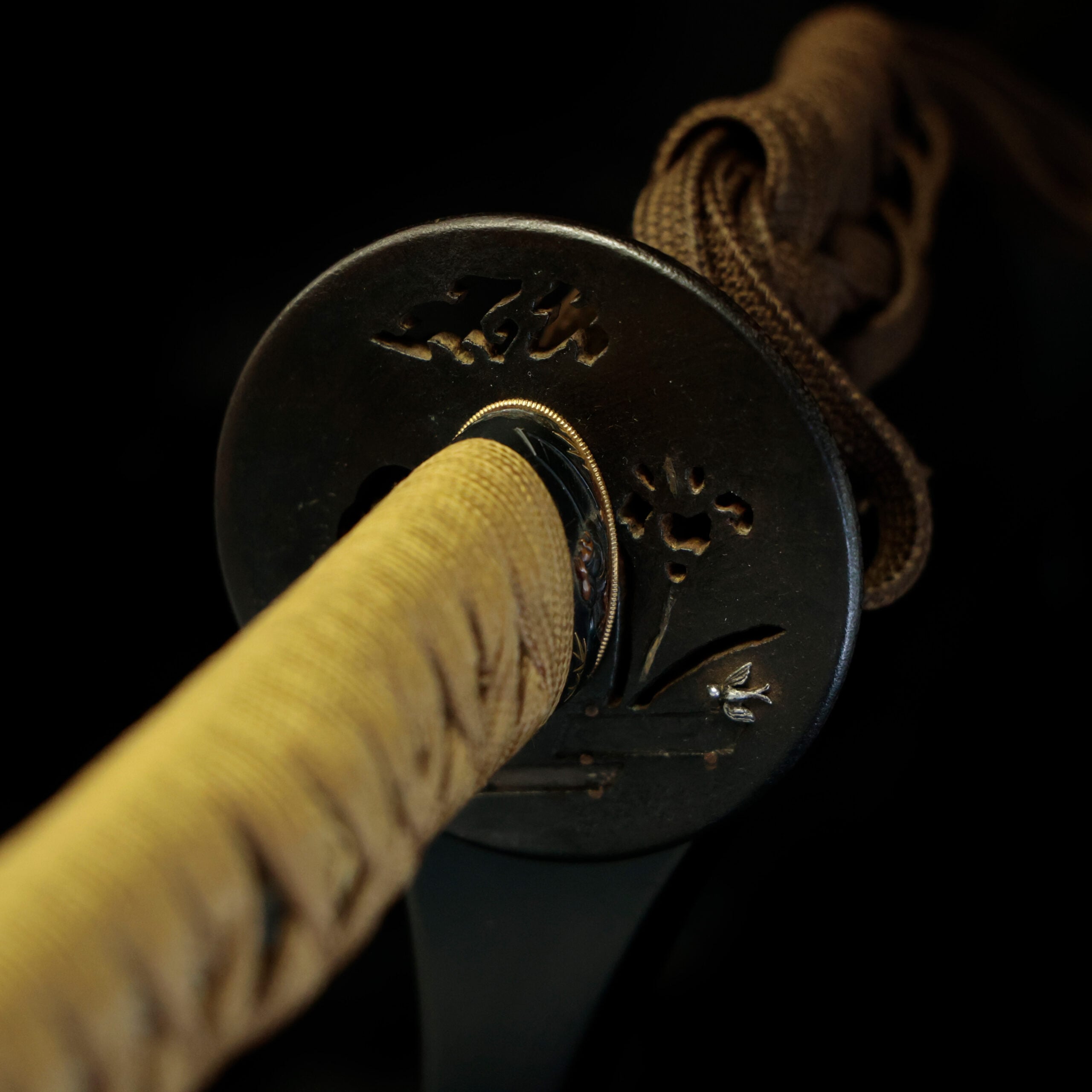
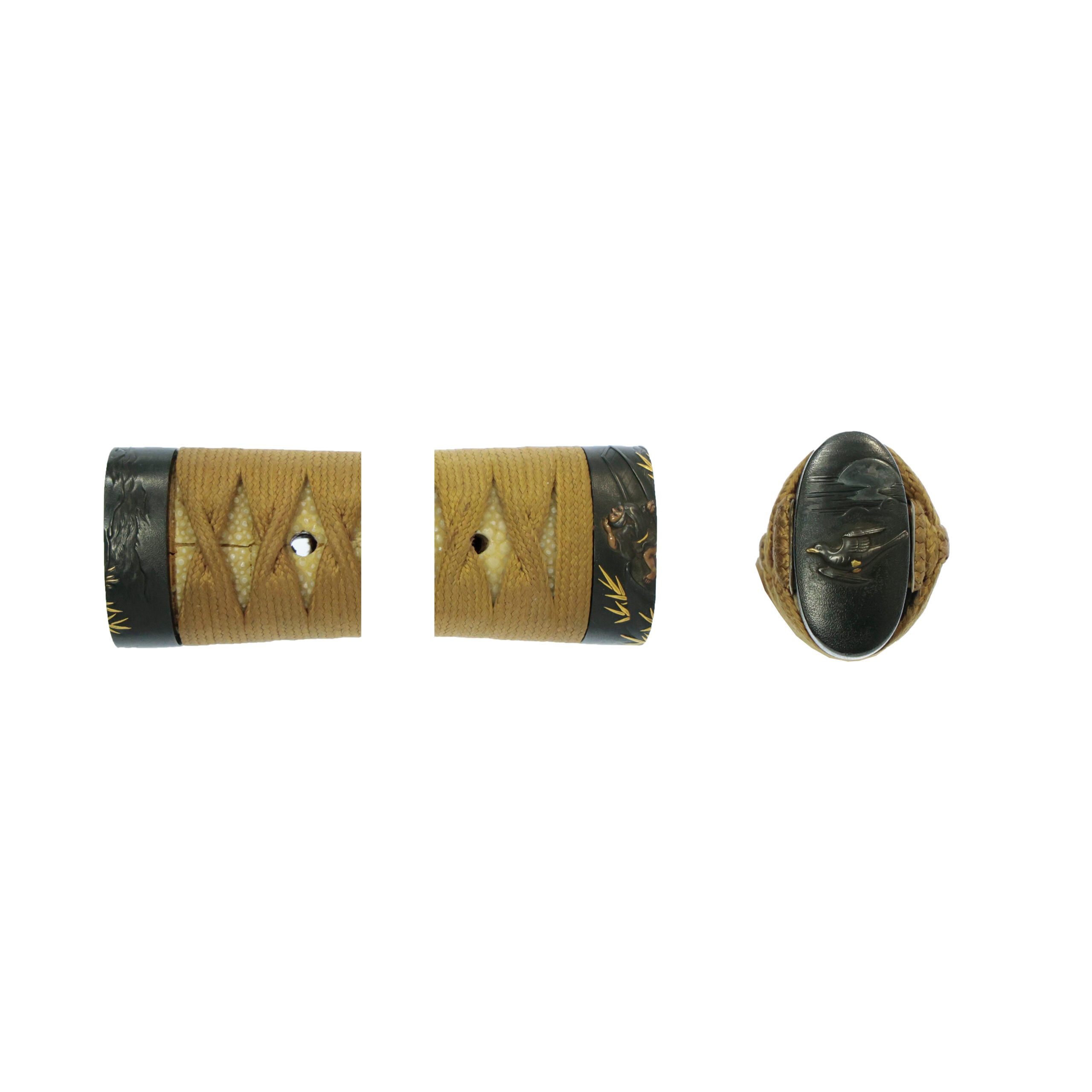
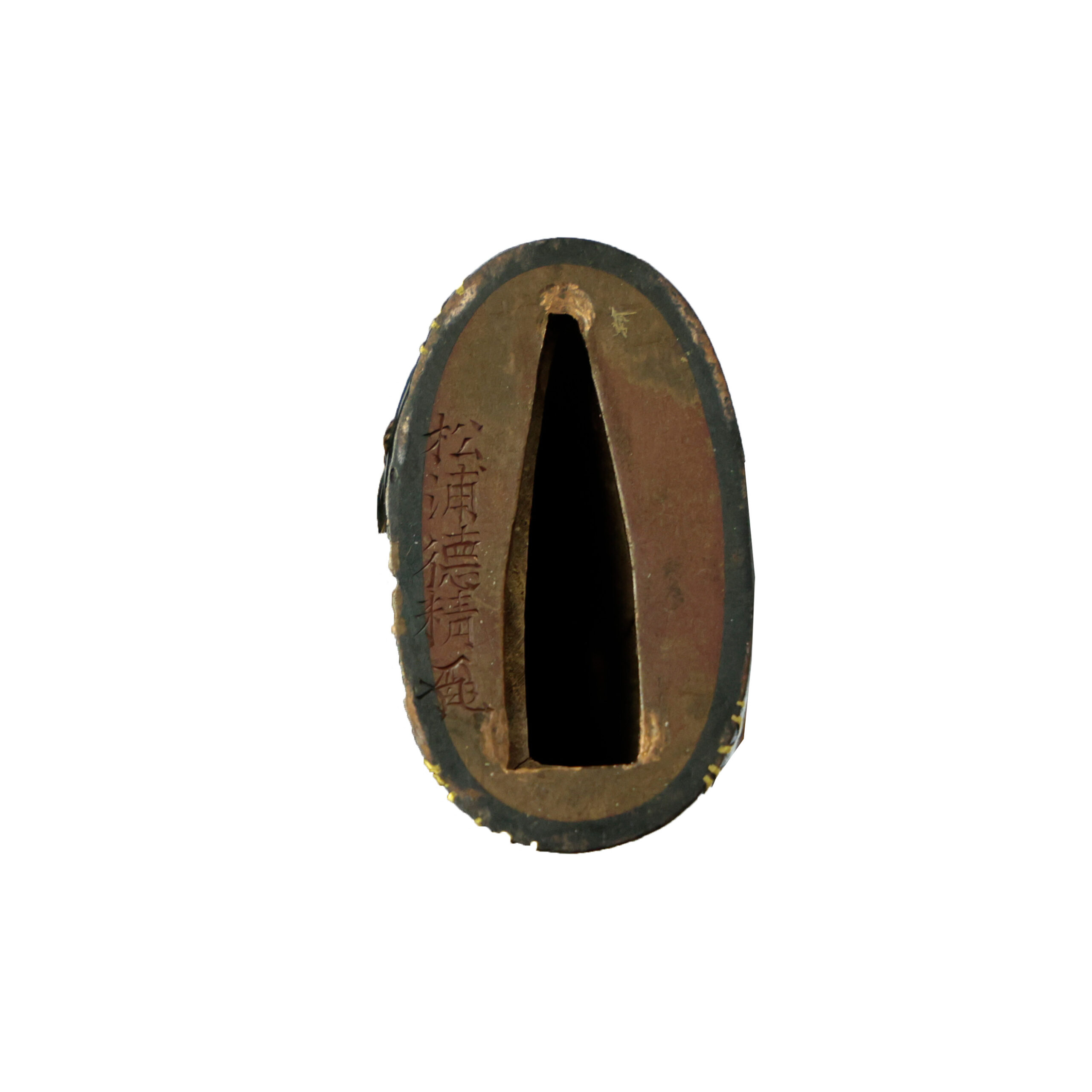
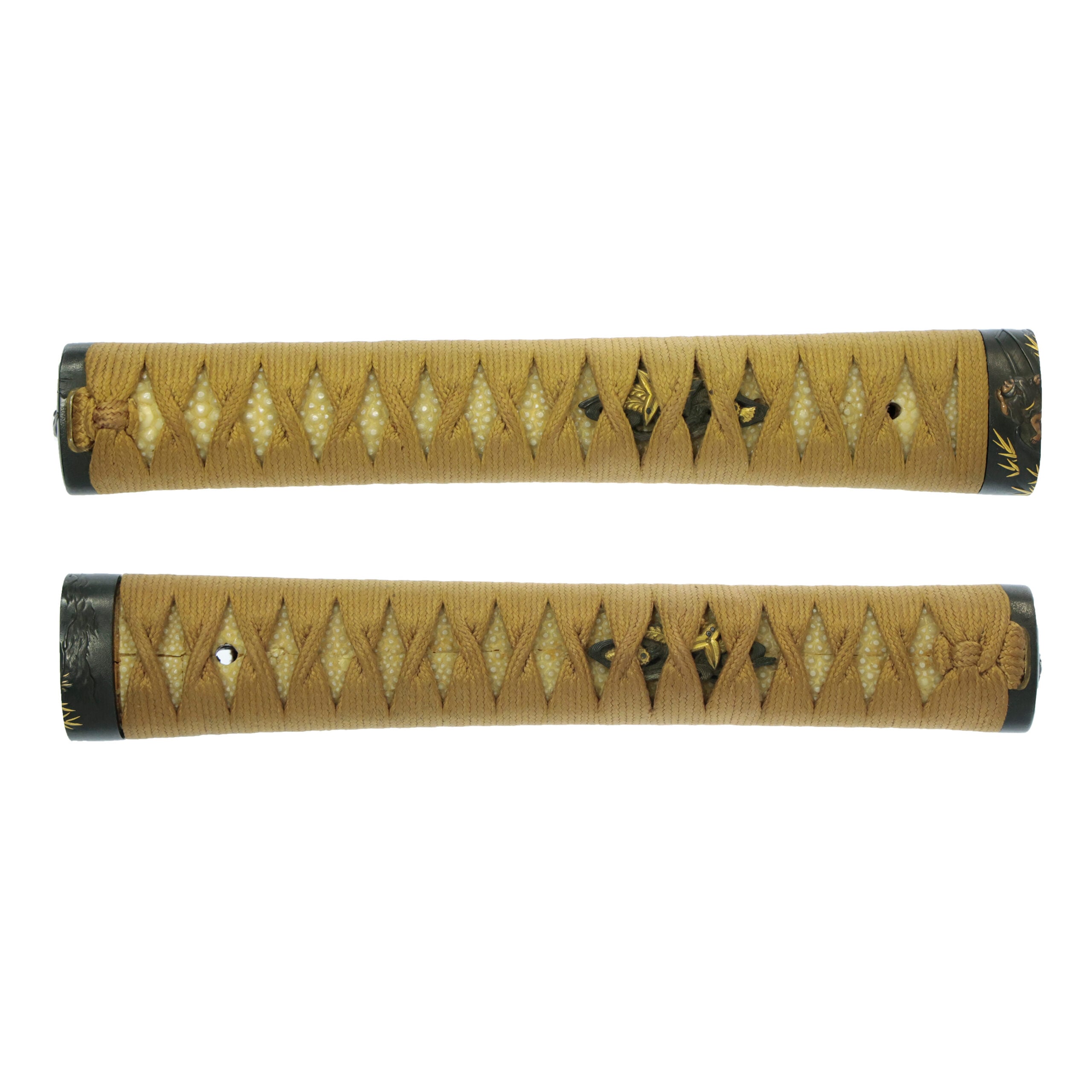
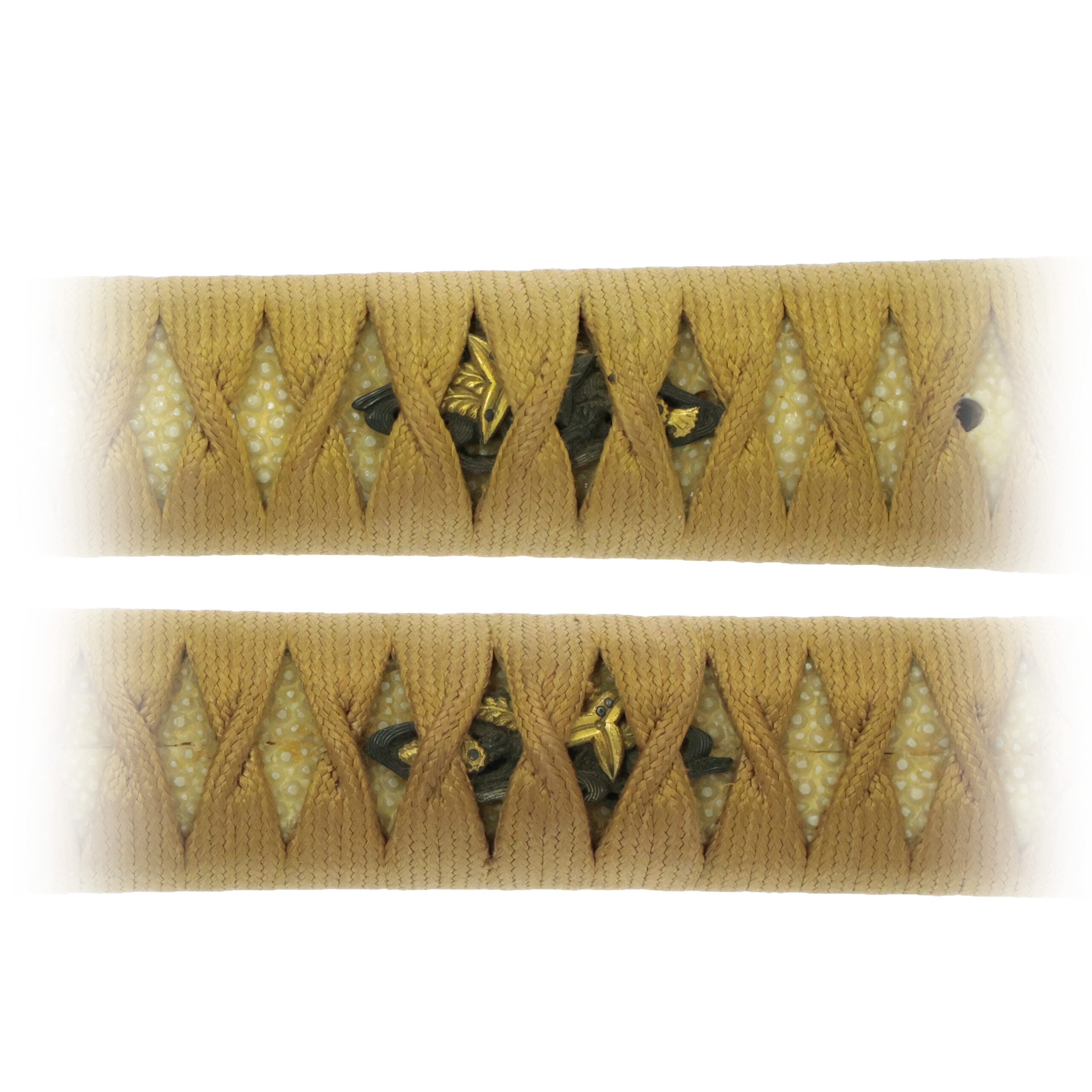
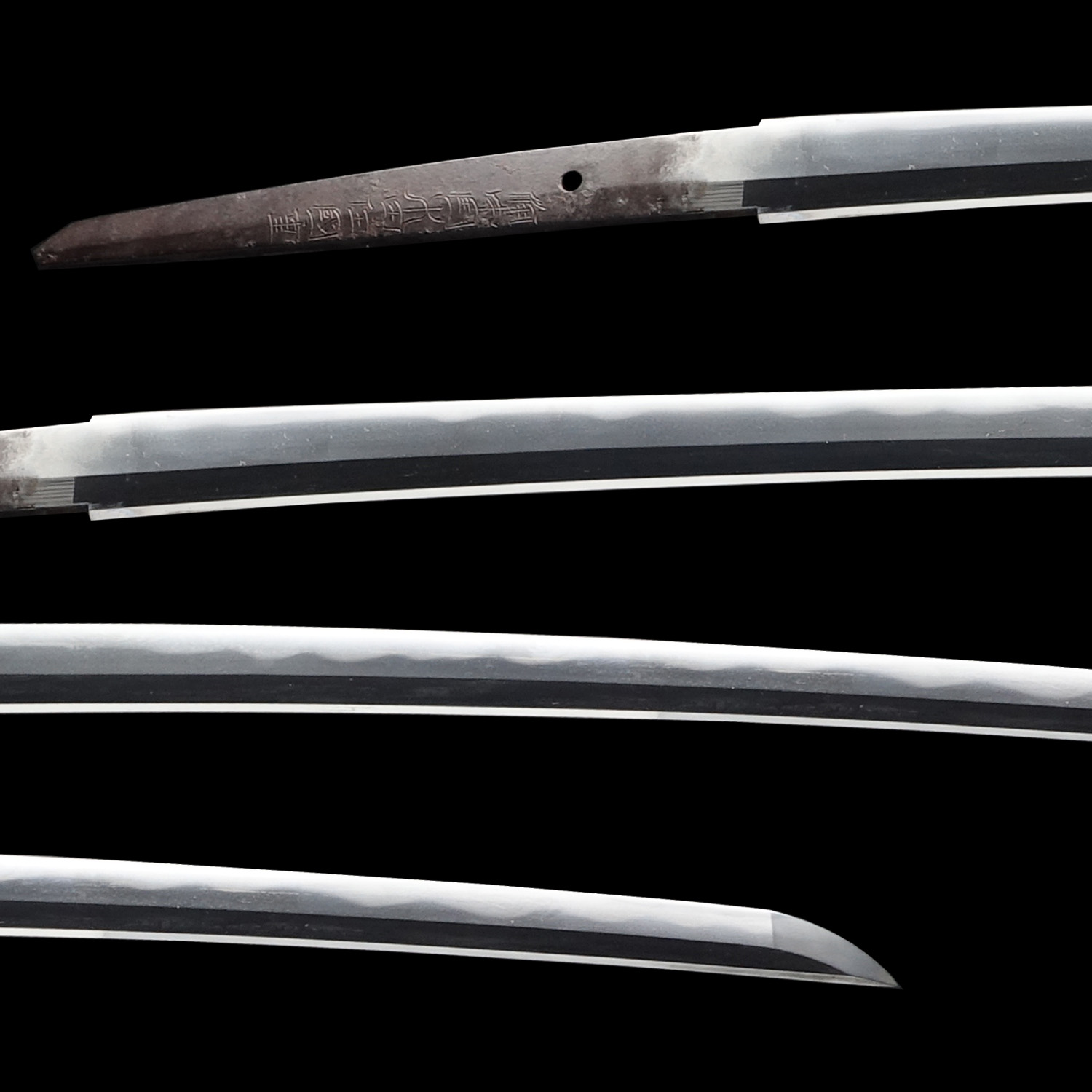
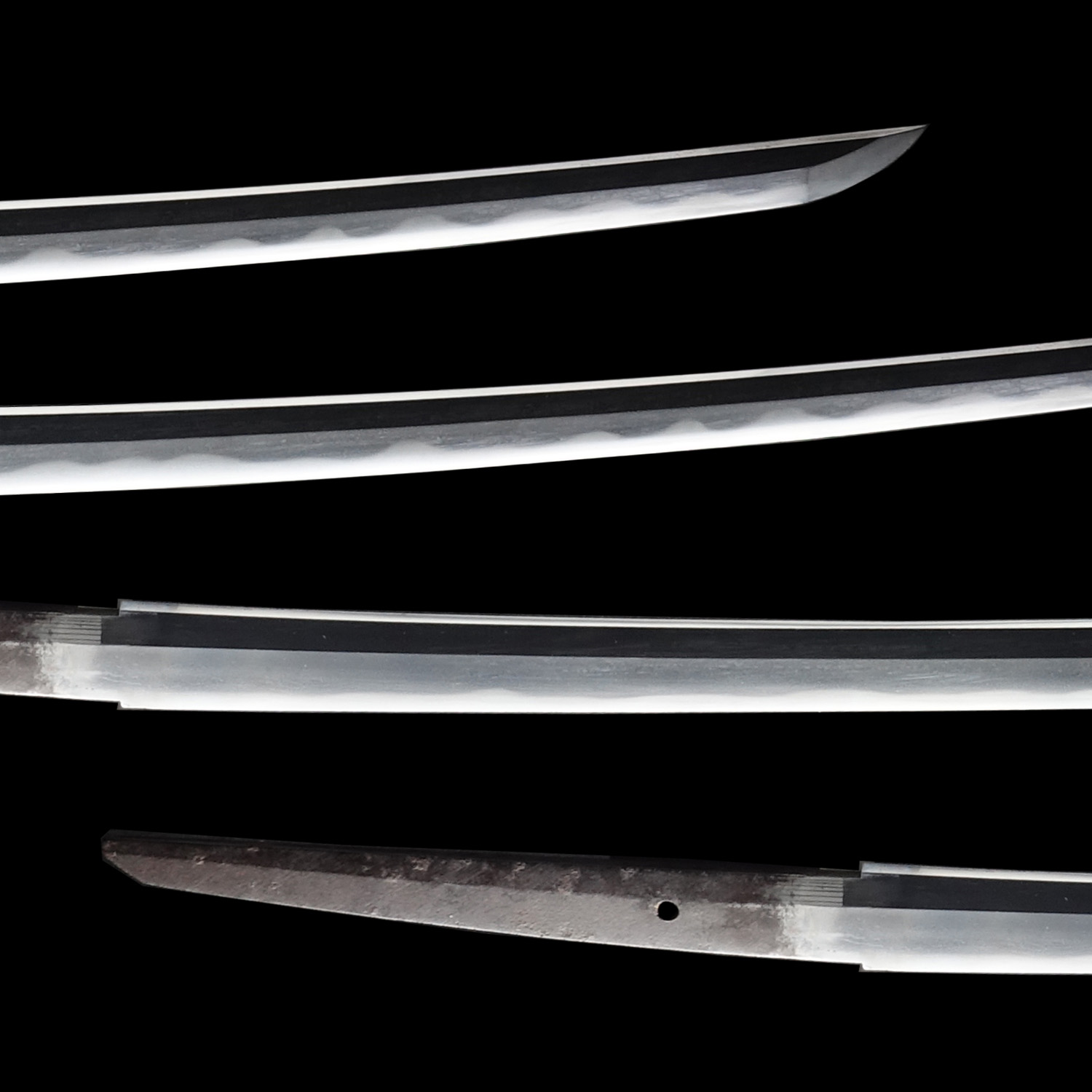
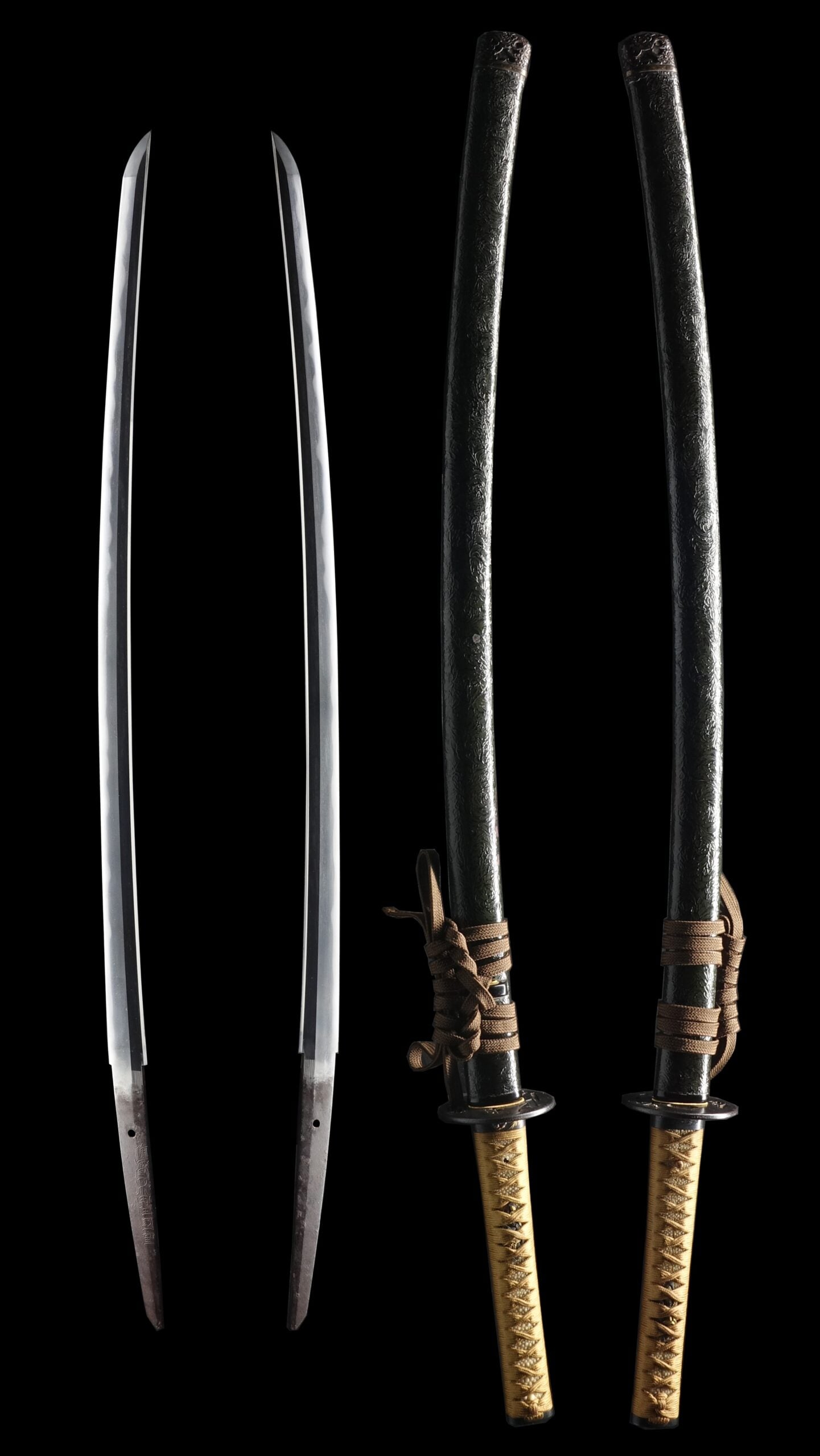
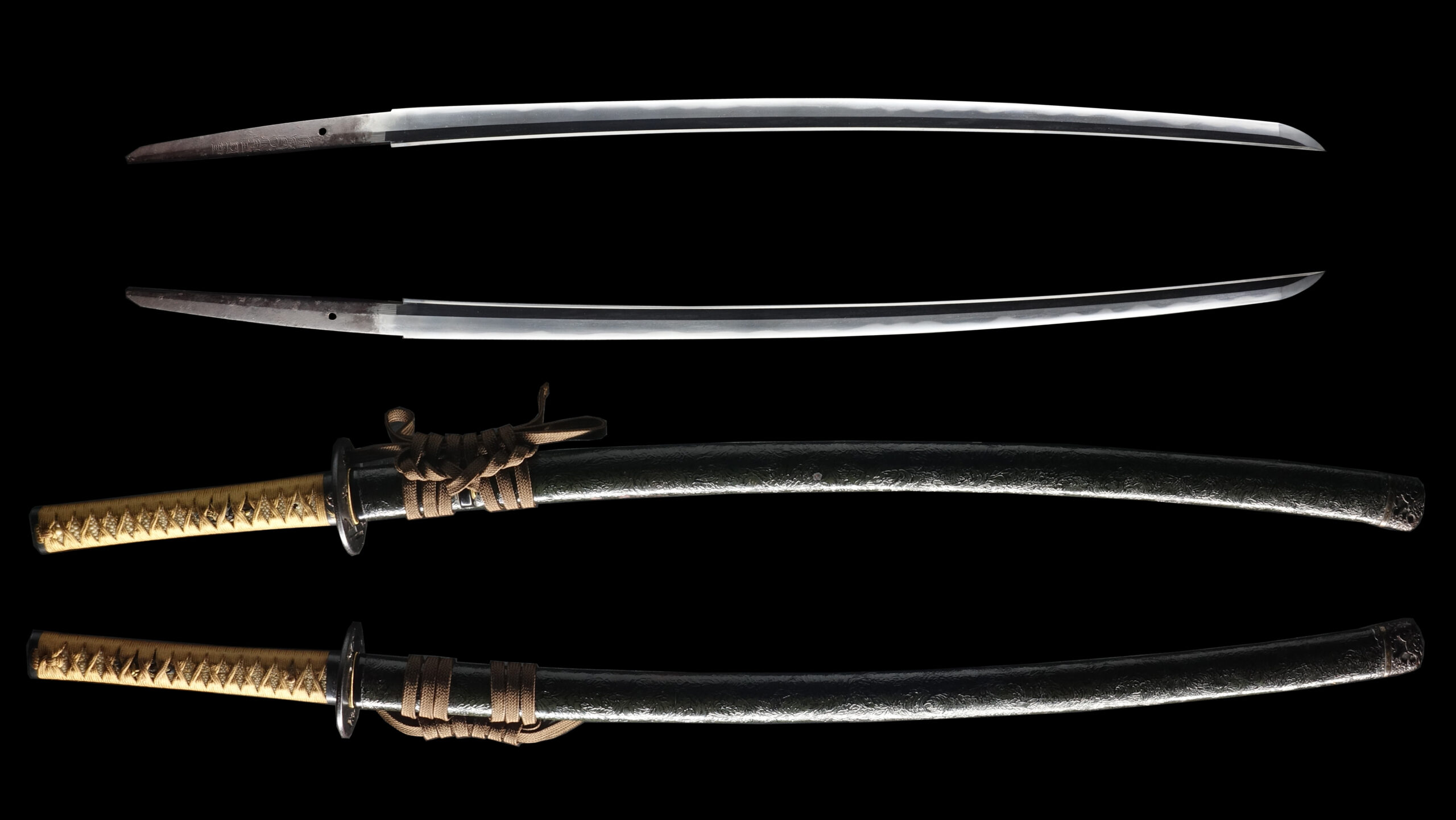
販売店の記載のまま
新刀 · 備中 · 1624-1644頃
藤代 上々作 · 刀剣大鑑 上位26%
現在6点販売中
國重の位置づけを、日本刀全体および伝法・時代・時期ごとに示します。各区分(随一・屈指・有数・著名)は、日刀保および文化庁による指定に加え、三作や名物帳などの歴史的栄誉を加味したものです。
各項目を選ぶと評価方法が表示されます。
新刀 · 備中
現在15点販売中
水田派は、室町時代末期の備中国に現れ、国重の名を代々受け継いだ一派である。松山、呰部、井原、荏原、新見など備中各地に拠を構えて作刀し、その勢いは古刀期から新刀期にまで及んだ。説示によれば、新見の国重は銘鑑により備後から備中新見荘に入り、後に松山城主三村家の刀工となったとされ、ほかに備後福山や河波でも作刀した工が知られる。新見住三郎左衛門尉国重、井原住の国重、英賀郡呰部住の大月左兵衛尉国重、水田住の大月与五右衛門国重など、地名と俗名を冠して長銘を切る工が代を重ねて連なり、国重と名乗る刀工が一門に圧倒的に多いことが、この派の大きな特徴をなしている。 作風は古刀期と新刀期とで趣を異にする。古水田と称される作には、腰の開いた互の目乱れを主調として小丁子や小乱れを交え、匂口が締まって小沸がつく、ややこせこせとした趣のものが見られ、茎先が大きく刃上りとなる点が見どころとされる。地鉄は小板目肌つみ、地沸がついて映りが立つ。新刀期の作になると、板目が流れて柾を交じえる鍛えに、小のたれや互の目を焼き、沸が深く、殊に荒沸が激しくつき、相州伝を強く意識した出来となる。地沸厚く地景太く入って湯走りがかかり、砂流し・金筋を頻りに見せ、棟焼がしきりにかかって皆焼風を呈する一群があり、帽子は掃き掛けて火焰風となり、あるいは焼深く一枚風となって長く返る。物打辺に矢筈風の刃を交えること、また小板目に小杢目を交え地沸微塵に厚くついて淡く映り立つ地鉄も、この派を見分ける拠りどころとなる。彫物を巧みにこなす工もあり、棒樋に倶利迦羅や梵字を施した大小の作が残る。 鑑定にあたっては、互の目や角ばる刃を交えた焼高い刃取り、矢筈風の刃、一枚風あるいは火焰風の帽子、棟焼の頻発といった水田特有の見どころが、相州・美濃に寄った実用本位の造込みと相俟って手掛かりとなる。沸の崩れや荒沸の激しさは、よく斬れる実戦の刀としての性格を物語る。在銘の確かな作は数が限られ、なかでも大月与五右衛門国重のごとく一門の他工にも稀なほど出来の優れたものが存する。新見の国重の一作は『光山押形』に所載し、附帯する古鞘に六代将軍徳川家宣すなわち文昭院の御陣刀であった旨が記される伝来の確かなものであって、備中の地に長く栄えた水田派の位置づけを今に伝えている。 詳しく見る →
江戸時代
二世紀半の泰平のあいだ、刀は武器である以上に武士の身分の標章であった。江戸の実証と大坂の華やぎのように都市ごとの作風が育ち、時代の末には需要も細っていく。
日本刀剣保存会の最高位で、年に一度の審査において、出来・保存状態・資料的価値の傑出した作に与えられます。通常の鑑定書より上位の評価です。
日本刀剣保存会は、日本美術刀剣保存協会(1948年設立)に先立つ1910年に創立された、日本で最も古い刀剣鑑定団体です。長く会を率いた会長の没後、日本刀剣保存会と特定非営利活動法人日本刀剣保存会の二つに分かれ、いずれも審査を続けています。刀剣に対する日本刀剣保存会の鑑定書は、点数と審査員の所見を併記する詳細な審査表が特徴です(刀装具の鑑定書に点数は付されません)。特に無銘作の極めに定評があります。
Returns/exchanges limited to defects caused by shipping (except willful misconduct or gross negligence by the company); customers must contact within 72 hours of receiving the product.