NihontoWatch Mon

NihontoWatchBETA

マーケットオークション
事典
NihontoWatch Mon

NihontoWatchBETA

マーケットオークション
事典

説明

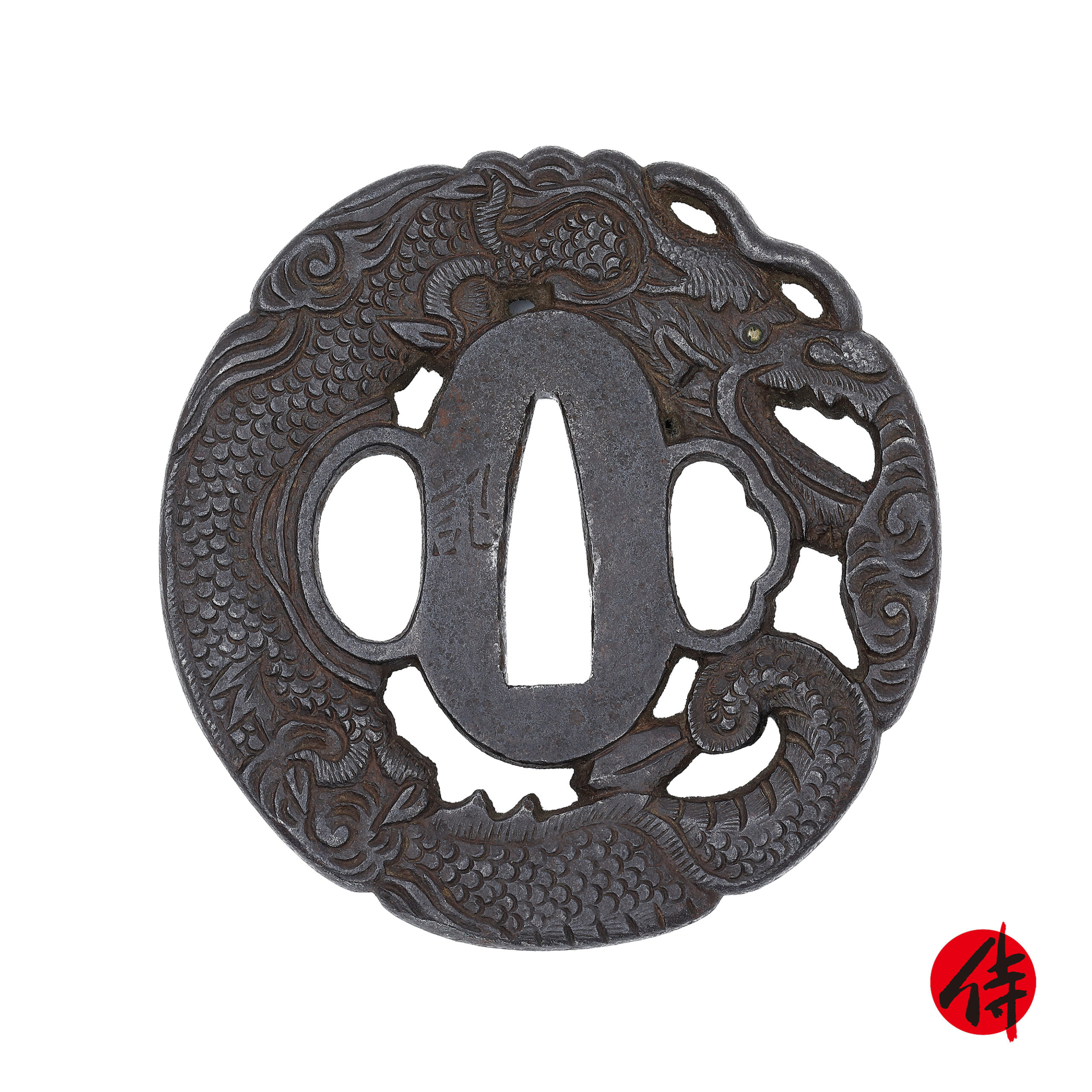
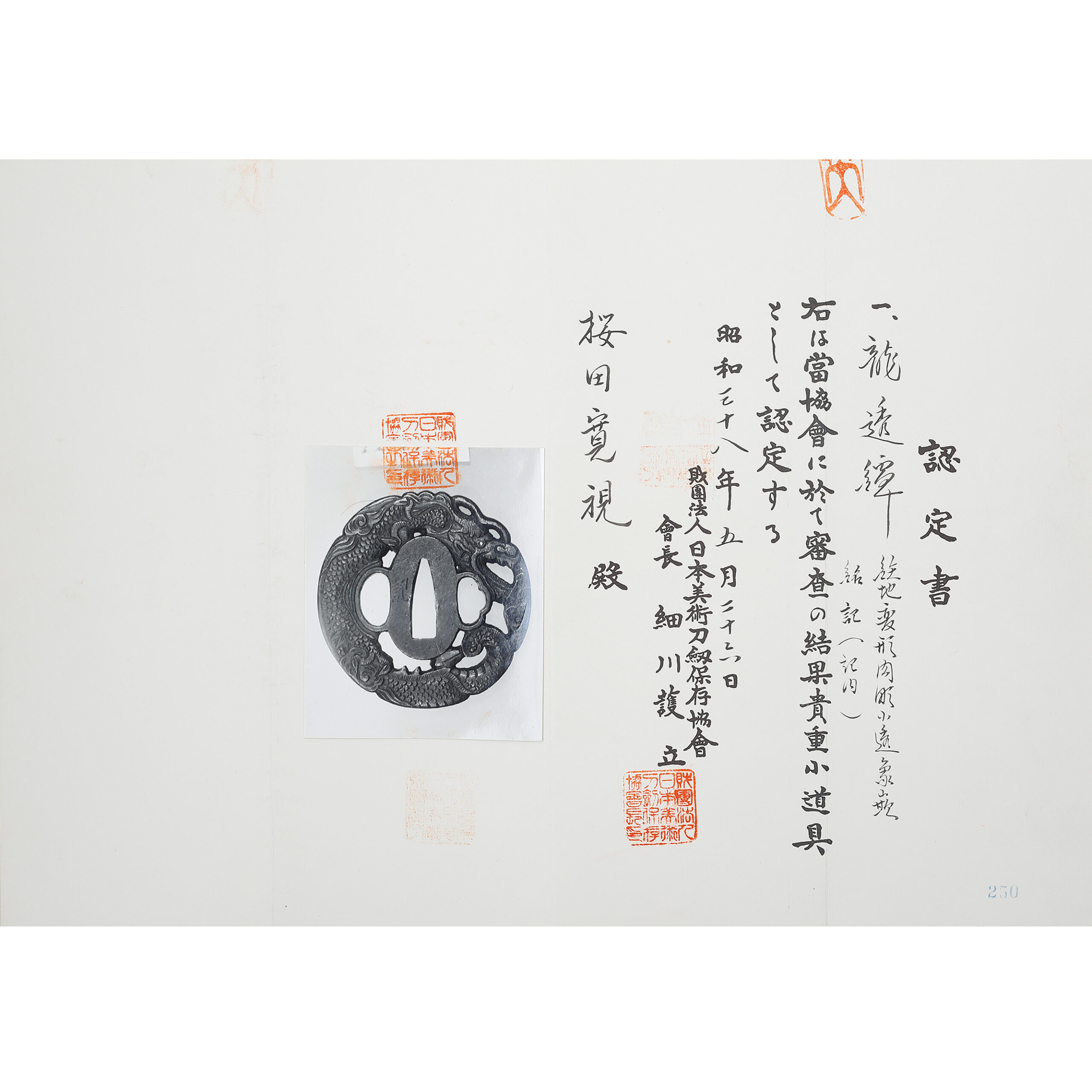
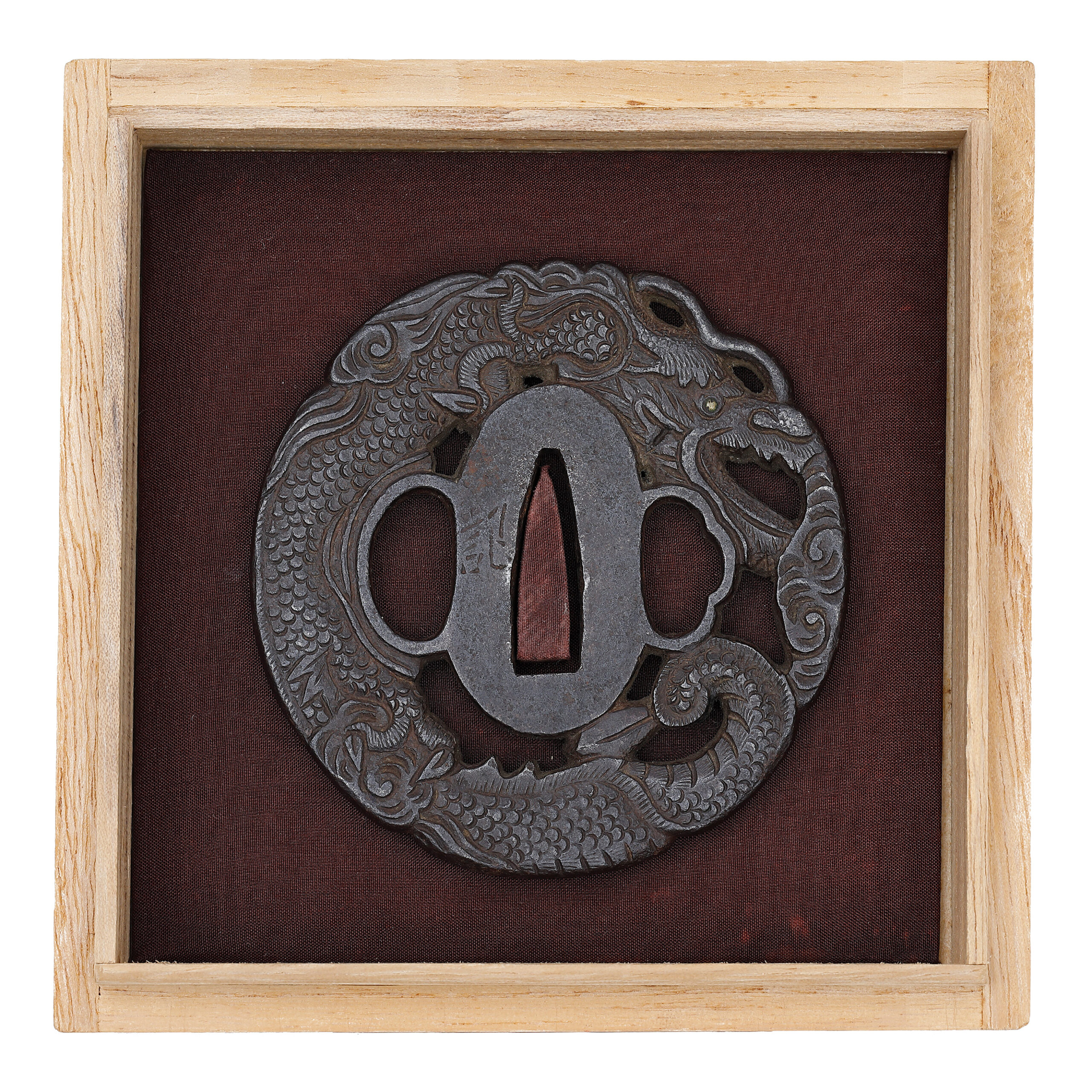
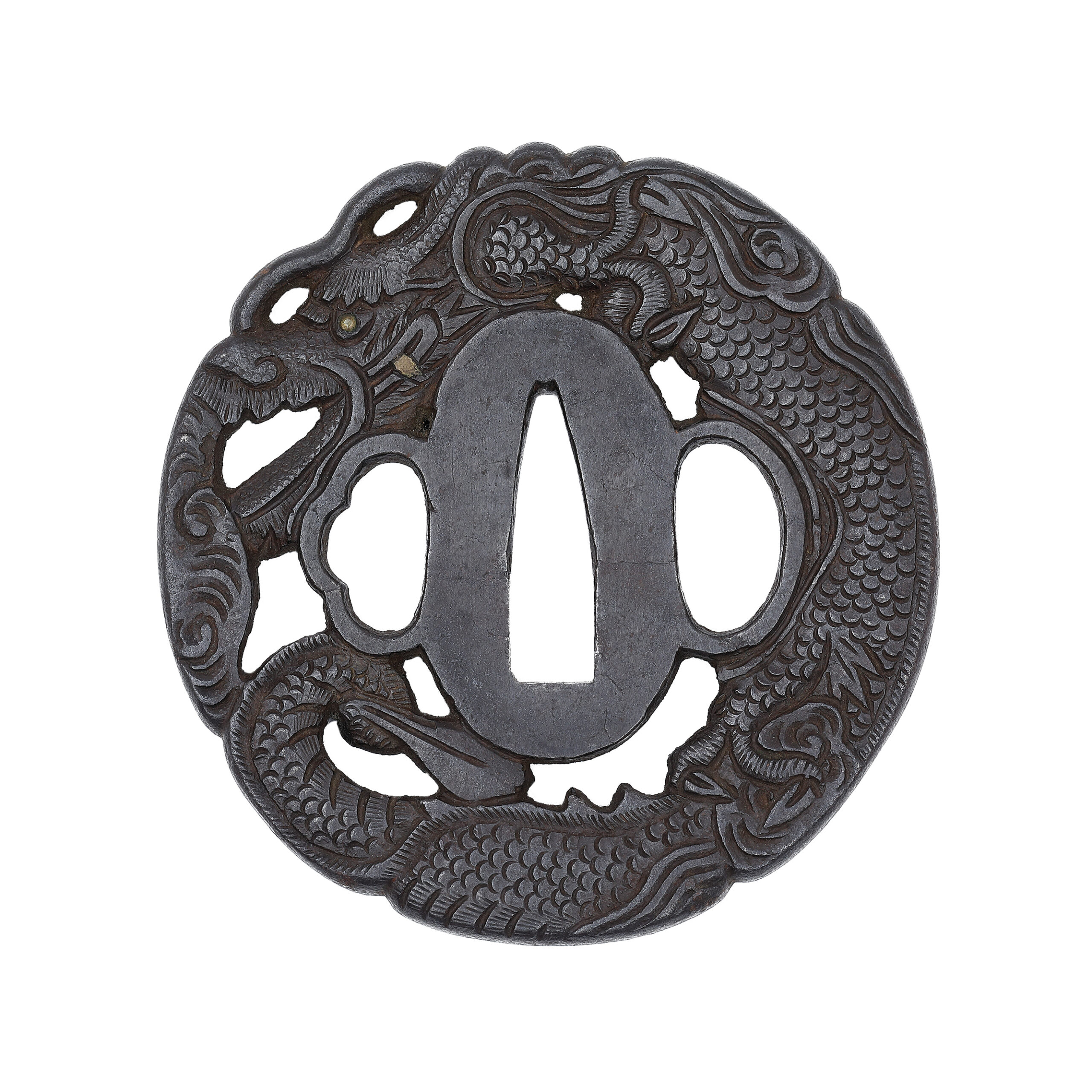
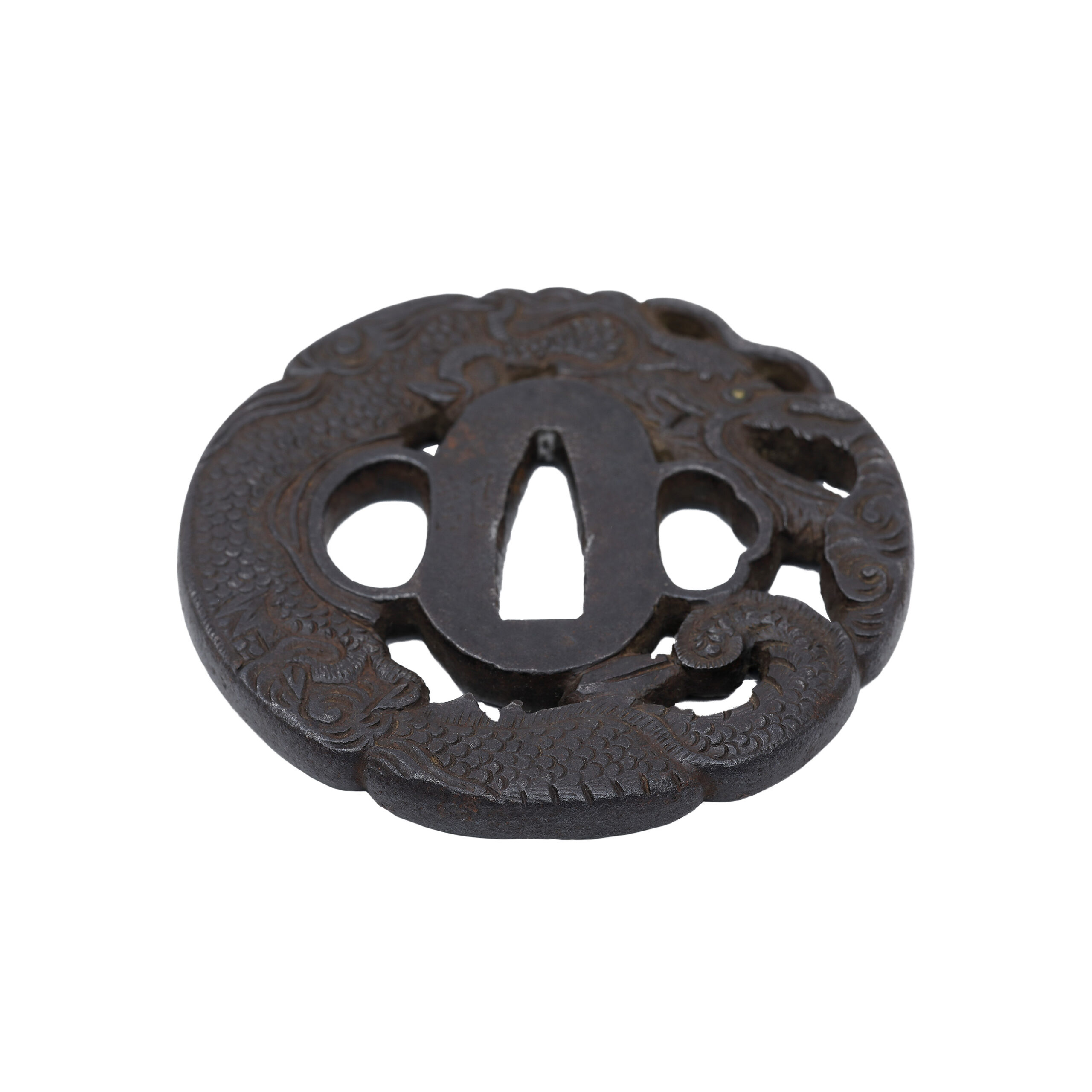
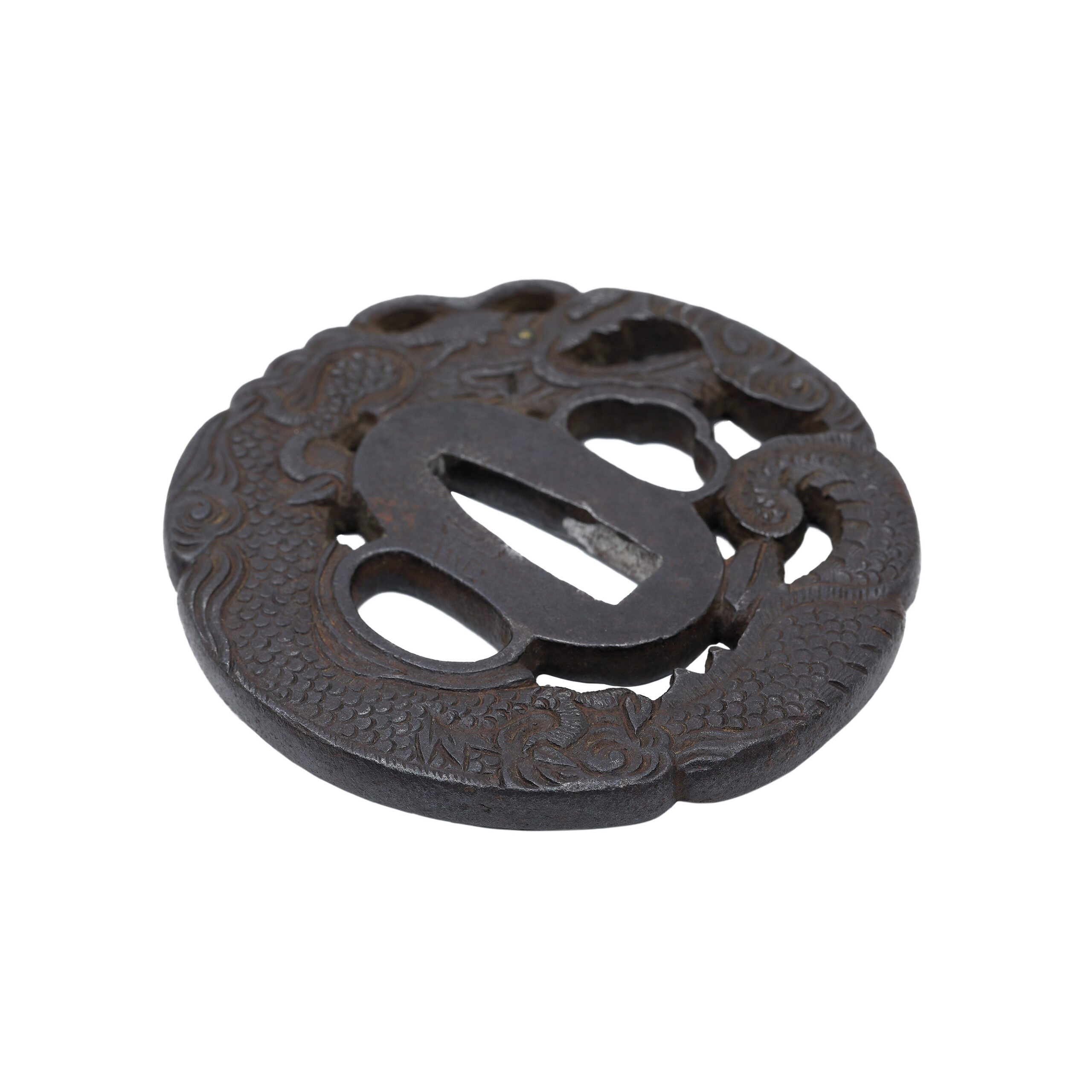
Title: Ryu Sukashi Zu Description This Tsuba is recognized by The Society for Preservation of Japanese Art Swords, which is known as NBTHK and this was signed by Kinai school (記内派). Kinai school was founded by the first generation Gonbe (権兵衛), and flourished in Echizen province (today’s Fukui prefecture) until around 1681. The hallmark of their craftsmanship is their engraving techniques, with many pieces featuring dragon designs. About the design, it depicts a large dragon (龍, Ryu) and a cloud and it shows that this dragon is a Unryu (雲龍, cloud dragon). Initially, the dragon is an imaginary creature found in ancient Chinese traditions or myths. Furthermore, it is regarded as a symbolic beast of auspicious signs. Its body is likened to nine animals: antlers are deer, the head is a camel, eyes are demons, the neck is a snake, belly is Mizuchi (蛟, mythical animal in Japan which looks like a snake and have a horn and four legs), scales are fish, claws are falcons, palms are tigers, and ears are cows. It was thought that the dragon would reign at the top of all animals because of its odd-looking appearance. In ancient China, the dragon pattern was used for emperors’ clothing so that people strictly defined its shape or even the number of nails. On the other hand, the dragon pattern does not have detailed rules to represent classes in Japan. However, still, it maintains its meaning as the all-purpose auspicious pattern. Also, in Japan, there is a belief that worships dragon as a water god and is called Ryujin Shinkou (竜神信仰). Since rice cultivation flourished in this country, water is always an essential resource. Therefore, the dragon motif has been familiar to Japanese people since a long time ago. What is Tsuba? Tsuba is the hand-guard of the Japanese sword. High-class Samurai wore his Katana sword with its beautiful sword mountings such as Tsuba. Tsuba’s front design tends to be more decorative as this part was often seen by other Samurais when he was walking on the streets. Why is it that the sword mounting was important for Samurai? The sword mountings of the Japanese sword have many kinds of decorations such as handguards (Tsuba), sword hilt (Menuki), pommel (Fuchi Kashira). The Japanese sword worked as a weapon and as an object to show who he was. For example, it shows their personalities and beliefs. You could say that it is like decorations for smartphones today. We recommend you zoom in on the pictures of the sword fittings. When you do so, you can see the skill of Japanese metal engraving techniques. They are mainly made of iron and copper with inlays of gold, silver, and bronze. When it comes to handguard (Tsuba), each one has a different outline and weight. These sword fittings that have lived with Japanese swords of the same age might be worth as much as the Japanese swords. They are inconspicuous parts of the Japanese sword. Nevertheless, if you are knowledgeable or particular about it, you will become a connoisseur of the Samurai. Authentication Paper : NBTHK Kichou Certificate NBTHK, also known as Nihon Bijutsu Touken Hozon Kyokai (the Society for the Preservation of the Japan Art Sword), is one of the oldest Japanese sword appraising organizations in modern-day Japan. They authenticated the Tsuba on May 26th in the 38th year of Showa (1963). They appraised it as Kichou Kodougu, the Tsuba an old form of the certificate. The purchaser will receive this original certificate as well. We can also translate what is written into English and make a PDF file for your record if you request. 【About us】 Samurai Museum is located in Tokyo, Japan, exhibiting antique artifacts related to the Samurai history. Samurai Museum Shop is the place for those who are interested in Japanese culture and craftsmanship. We deal with antique Samurai swords/armor, traditional crafts made in Japan and so on. 【Payment method】 We accept payment through Stripe (Credit card), PayPal , Apple Pay or ChromePay, all of which are secure payment methods.

NihontoWatch MonNihontoWatchBETA
MarketAuctionsEncyclopedia
刀装具›記内›Antique Tsuba for Samurai Sword with NBTHK Kichou Certificate (T-717)
鍔Kicho
記内派

Antique Tsuba for Samurai Sword with NBTHK Kichou Certificate (T-717)

在銘 · Kinai · 江戸

売却済
記内派 — 1 of 6
記内派 — 2 of 6
記内派 — 3 of 6
記内派 — 4 of 6
記内派 — 5 of 6
記内派 — 6 of 6
1 / 6
1 / 6
記内派 — 1 of 6記内派 — 2 of 6記内派 — 3 of 6記内派 — 4 of 6記内派 — 5 of 6記内派 — 6 of 6
法量・詳細
作者

記内派

時代

江戸

国

越前

銘

在銘

説明

Title: Ryu Sukashi Zu Description This Tsuba is recognized by The Society for Preservation of Japanese Art Swords, which is known as NBTHK and this was signed by Kinai school (記内派). Kinai school was founded by the first generation Gonbe (権兵衛), and flourished in Echizen province (today’s Fukui prefecture) until around 1681. The hallmark of their craftsmanship is their engraving techniques, with many pieces featuring dragon designs. About the design, it depicts a large dragon (龍, Ryu) and a cloud and it shows that this dragon is a Unryu (雲龍, cloud dragon). Initially, the dragon is an imaginary creature found in ancient Chinese traditions or myths. Furthermore, it is regarded as a symbolic beast of auspicious signs. Its body is likened to nine animals: antlers are deer, the head is a camel, eyes are demons, the neck is a snake, belly is Mizuchi (蛟, mythical animal in Japan which looks like a snake and have a horn and four legs), scales are fish, claws are falcons, palms are tigers, and ears are cows. It was thought that the dragon would reign at the top of all animals because of its odd-looking appearance. In ancient China, the dragon pattern was used for emperors’ clothing so that people strictly defined its shape or even the number of nails. On the other hand, the dragon pattern does not have detailed rules to represent classes in Japan. However, still, it maintains its meaning as the all-purpose auspicious pattern. Also, in Japan, there is a belief that worships dragon as a water god and is called Ryujin Shinkou (竜神信仰). Since rice cultivation flourished in this country, water is always an essential resource. Therefore, the dragon motif has been familiar to Japanese people since a long time ago. What is Tsuba? Tsuba is the hand-guard of the Japanese sword. High-class Samurai wore his Katana sword with its beautiful sword mountings such as Tsuba. Tsuba’s front design tends to be more decorative as this part was often seen by other Samurais when he was walking on the streets. Why is it that the sword mounting was important for Samurai? The sword mountings of the Japanese sword have many kinds of decorations such as handguards (Tsuba), sword hilt (Menuki), pommel (Fuchi Kashira). The Japanese sword worked as a weapon and as an object to show who he was. For example, it shows their personalities and beliefs. You could say that it is like decorations for smartphones today. We recommend you zoom in on the pictures of the sword fittings. When you do so, you can see the skill of Japanese metal engraving techniques. They are mainly made of iron and copper with inlays of gold, silver, and bronze. When it comes to handguard (Tsuba), each one has a different outline and weight. These sword fittings that have lived with Japanese swords of the same age might be worth as much as the Japanese swords. They are inconspicuous parts of the Japanese sword. Nevertheless, if you are knowledgeable or particular about it, you will become a connoisseur of the Samurai. Authentication Paper : NBTHK Kichou Certificate NBTHK, also known as Nihon Bijutsu Touken Hozon Kyokai (the Society for the Preservation of the Japan Art Sword), is one of the oldest Japanese sword appraising organizations in modern-day Japan. They authenticated the Tsuba on May 26th in the 38th year of Showa (1963). They appraised it as Kichou Kodougu, the Tsuba an old form of the certificate. The purchaser will receive this original certificate as well. We can also translate what is written into English and make a PDF file for your record if you request. 【About us】 Samurai Museum is located in Tokyo, Japan, exhibiting antique artifacts related to the Samurai history. Samurai Museum Shop is the place for those who are interested in Japanese culture and craftsmanship. We deal with antique Samurai swords/armor, traditional crafts made in Japan and so on. 【Payment method】 We accept payment through Stripe (Credit card), PayPal , Apple Pay or ChromePay, all of which are secure payment methods.

流派について

記内

鐔工 · 越前

›
0名の刀工指定0口
記内流派を見る →
真贋は保証されません

本作はNBTHKの旧鑑定書(貴重・特別貴重)を有しますが、これらは現在発行されておらず、信頼性に欠けるとされています。極めを確認するには、公的な鑑定機関(NBTHK・NTHKなど)への再提出による現代の鑑定をご検討いただけます。

販売店
サ
サムライミュージアム
🇯🇵日本から発送
›
✓認証販売店samuraimuseum.jp
✓海外発送可✓英語対応PayPalクレジットカード
返品ポリシー

Returns/exchanges limited to defects caused by shipping (except willful misconduct or gross negligence by the company); customers must contact within 72 hours of receiving the product.

サムライミュージアムの出品一覧を見る→販売店サイトでこの商品を見る→

記内派の売約済み

葵美術
保存
Tsuba - Hozon - by Kinai School - 鍔:越前住記内作(日本美術刀剣保存協会 保存刀装具)Tsuba - Hozon - by Kinai School - 鍔:越前住記内作(日本美術刀剣保存協会 保存刀装具)
売切れ

鍔

作記内派
古刀
売却済
銀座誠友堂
特別保存
Tsuba - Tokuho - by Kinai School - 鍔 越前住光長 日本美術刀剣保存協会 特別保存刀装具Tsuba - Tokuho - by Kinai School - 鍔 越前住光長 日本美術刀剣保存協会 特別保存刀装具
売切れ

鍔

作記内派
江戸
売却済
Japanese Sword Books and Tsuba
Tsuba - by Kinai School - Q159. 越前記内 象嵌 鍔Tsuba - by Kinai School - Q159. 越前記内 象嵌 鍔
売切れ

鍔

作記内派
江戸
売却済

記内派の作

すべて見る →
Nihon Collection
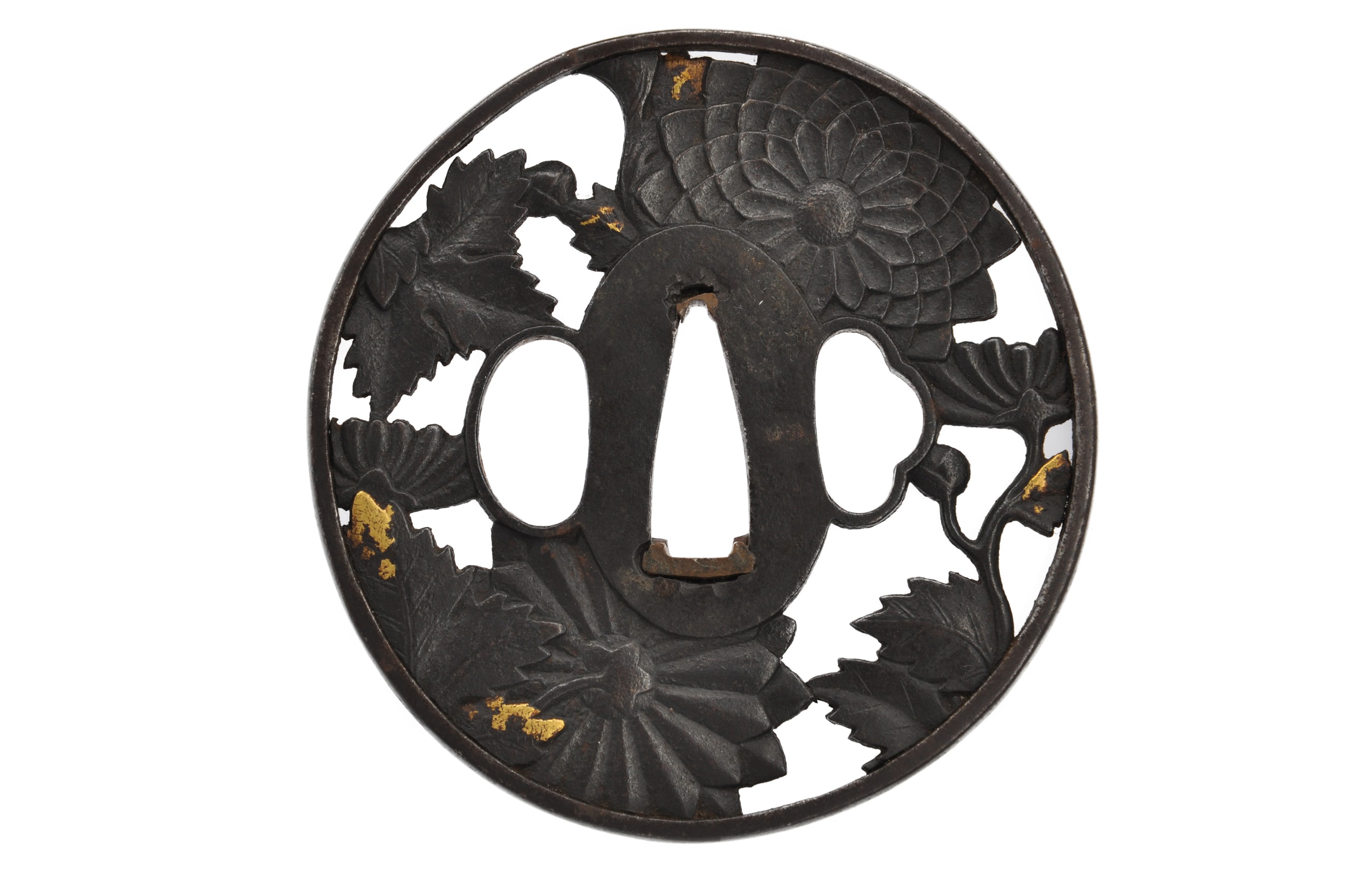
Tsuba - by Kinai School - 越前記内 菊花図Tsuba - by Kinai School - 越前記内 菊花図

鍔

作記内派
江戸
¥900
刀心
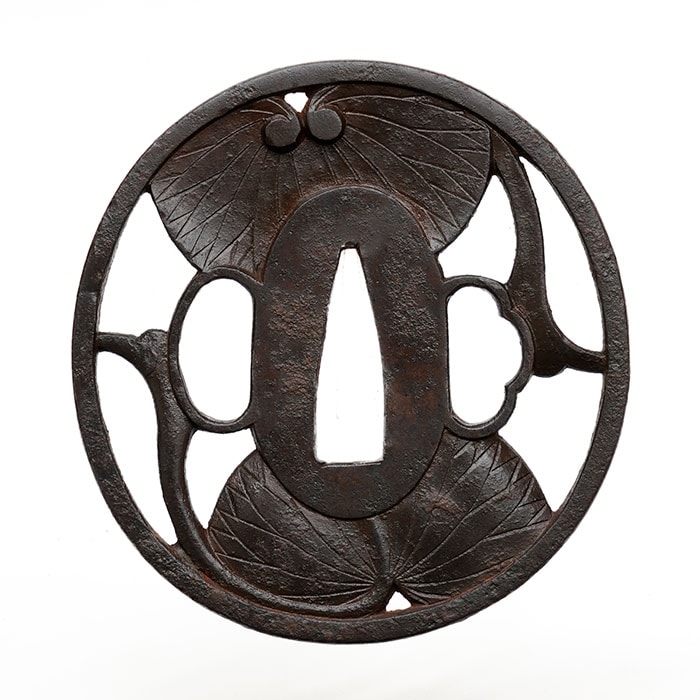
Tsuba - by Kinai School - 葵透図鐔 無銘(記内)Mumei(Kinai) 12-1303Tsuba - by Kinai School - 葵透図鐔 無銘(記内)Mumei(Kinai) 12-1303

鍔

作記内派
江戸
¥33,000

刀剣

  • 刀
  • 脇差
  • 短刀
  • 太刀
  • 薙刀
  • 槍

刀装具

  • 鍔
  • 縁頭
  • 小柄
  • 目貫

鑑定別

  • 特重
  • 重要
  • 特別保存
  • 保存

リソース

  • 刀剣商一覧
  • 刀工一覧
  • すべて見る
Nihontowatch© 2026
利用規約プライバシーCookie運営者情報

説明

Title: Ryu Sukashi Zu Description This Tsuba is recognized by The Society for Preservation of Japanese Art Swords, which is known as NBTHK and this was signed by Kinai school (記内派). Kinai school was founded by the first generation Gonbe (権兵衛), and flourished in Echizen province (today’s Fukui prefecture) until around 1681. The hallmark of their craftsmanship is their engraving techniques, with many pieces featuring dragon designs. About the design, it depicts a large dragon (龍, Ryu) and a cloud and it shows that this dragon is a Unryu (雲龍, cloud dragon). Initially, the dragon is an imaginary creature found in ancient Chinese traditions or myths. Furthermore, it is regarded as a symbolic beast of auspicious signs. Its body is likened to nine animals: antlers are deer, the head is a camel, eyes are demons, the neck is a snake, belly is Mizuchi (蛟, mythical animal in Japan which looks like a snake and have a horn and four legs), scales are fish, claws are falcons, palms are tigers, and ears are cows. It was thought that the dragon would reign at the top of all animals because of its odd-looking appearance. In ancient China, the dragon pattern was used for emperors’ clothing so that people strictly defined its shape or even the number of nails. On the other hand, the dragon pattern does not have detailed rules to represent classes in Japan. However, still, it maintains its meaning as the all-purpose auspicious pattern. Also, in Japan, there is a belief that worships dragon as a water god and is called Ryujin Shinkou (竜神信仰). Since rice cultivation flourished in this country, water is always an essential resource. Therefore, the dragon motif has been familiar to Japanese people since a long time ago. What is Tsuba? Tsuba is the hand-guard of the Japanese sword. High-class Samurai wore his Katana sword with its beautiful sword mountings such as Tsuba. Tsuba’s front design tends to be more decorative as this part was often seen by other Samurais when he was walking on the streets. Why is it that the sword mounting was important for Samurai? The sword mountings of the Japanese sword have many kinds of decorations such as handguards (Tsuba), sword hilt (Menuki), pommel (Fuchi Kashira). The Japanese sword worked as a weapon and as an object to show who he was. For example, it shows their personalities and beliefs. You could say that it is like decorations for smartphones today. We recommend you zoom in on the pictures of the sword fittings. When you do so, you can see the skill of Japanese metal engraving techniques. They are mainly made of iron and copper with inlays of gold, silver, and bronze. When it comes to handguard (Tsuba), each one has a different outline and weight. These sword fittings that have lived with Japanese swords of the same age might be worth as much as the Japanese swords. They are inconspicuous parts of the Japanese sword. Nevertheless, if you are knowledgeable or particular about it, you will become a connoisseur of the Samurai. Authentication Paper : NBTHK Kichou Certificate NBTHK, also known as Nihon Bijutsu Touken Hozon Kyokai (the Society for the Preservation of the Japan Art Sword), is one of the oldest Japanese sword appraising organizations in modern-day Japan. They authenticated the Tsuba on May 26th in the 38th year of Showa (1963). They appraised it as Kichou Kodougu, the Tsuba an old form of the certificate. The purchaser will receive this original certificate as well. We can also translate what is written into English and make a PDF file for your record if you request. 【About us】 Samurai Museum is located in Tokyo, Japan, exhibiting antique artifacts related to the Samurai history. Samurai Museum Shop is the place for those who are interested in Japanese culture and craftsmanship. We deal with antique Samurai swords/armor, traditional crafts made in Japan and so on. 【Payment method】 We accept payment through Stripe (Credit card), PayPal , Apple Pay or ChromePay, all of which are secure payment methods.

NihontoWatch MonNihontoWatchBETA
MarketAuctionsEncyclopedia
刀装具›記内›Antique Tsuba for Samurai Sword with NBTHK Kichou Certificate (T-717)
鍔Kicho
記内派

Antique Tsuba for Samurai Sword with NBTHK Kichou Certificate (T-717)

在銘 · Kinai · 江戸

売却済
記内派 — 1 of 6
記内派 — 2 of 6
記内派 — 3 of 6
記内派 — 4 of 6
記内派 — 5 of 6
記内派 — 6 of 6
1 / 6
1 / 6
記内派 — 1 of 6記内派 — 2 of 6記内派 — 3 of 6記内派 — 4 of 6記内派 — 5 of 6記内派 — 6 of 6
法量・詳細
作者

記内派

時代

江戸

国

越前

銘

在銘

説明

Title: Ryu Sukashi Zu Description This Tsuba is recognized by The Society for Preservation of Japanese Art Swords, which is known as NBTHK and this was signed by Kinai school (記内派). Kinai school was founded by the first generation Gonbe (権兵衛), and flourished in Echizen province (today’s Fukui prefecture) until around 1681. The hallmark of their craftsmanship is their engraving techniques, with many pieces featuring dragon designs. About the design, it depicts a large dragon (龍, Ryu) and a cloud and it shows that this dragon is a Unryu (雲龍, cloud dragon). Initially, the dragon is an imaginary creature found in ancient Chinese traditions or myths. Furthermore, it is regarded as a symbolic beast of auspicious signs. Its body is likened to nine animals: antlers are deer, the head is a camel, eyes are demons, the neck is a snake, belly is Mizuchi (蛟, mythical animal in Japan which looks like a snake and have a horn and four legs), scales are fish, claws are falcons, palms are tigers, and ears are cows. It was thought that the dragon would reign at the top of all animals because of its odd-looking appearance. In ancient China, the dragon pattern was used for emperors’ clothing so that people strictly defined its shape or even the number of nails. On the other hand, the dragon pattern does not have detailed rules to represent classes in Japan. However, still, it maintains its meaning as the all-purpose auspicious pattern. Also, in Japan, there is a belief that worships dragon as a water god and is called Ryujin Shinkou (竜神信仰). Since rice cultivation flourished in this country, water is always an essential resource. Therefore, the dragon motif has been familiar to Japanese people since a long time ago. What is Tsuba? Tsuba is the hand-guard of the Japanese sword. High-class Samurai wore his Katana sword with its beautiful sword mountings such as Tsuba. Tsuba’s front design tends to be more decorative as this part was often seen by other Samurais when he was walking on the streets. Why is it that the sword mounting was important for Samurai? The sword mountings of the Japanese sword have many kinds of decorations such as handguards (Tsuba), sword hilt (Menuki), pommel (Fuchi Kashira). The Japanese sword worked as a weapon and as an object to show who he was. For example, it shows their personalities and beliefs. You could say that it is like decorations for smartphones today. We recommend you zoom in on the pictures of the sword fittings. When you do so, you can see the skill of Japanese metal engraving techniques. They are mainly made of iron and copper with inlays of gold, silver, and bronze. When it comes to handguard (Tsuba), each one has a different outline and weight. These sword fittings that have lived with Japanese swords of the same age might be worth as much as the Japanese swords. They are inconspicuous parts of the Japanese sword. Nevertheless, if you are knowledgeable or particular about it, you will become a connoisseur of the Samurai. Authentication Paper : NBTHK Kichou Certificate NBTHK, also known as Nihon Bijutsu Touken Hozon Kyokai (the Society for the Preservation of the Japan Art Sword), is one of the oldest Japanese sword appraising organizations in modern-day Japan. They authenticated the Tsuba on May 26th in the 38th year of Showa (1963). They appraised it as Kichou Kodougu, the Tsuba an old form of the certificate. The purchaser will receive this original certificate as well. We can also translate what is written into English and make a PDF file for your record if you request. 【About us】 Samurai Museum is located in Tokyo, Japan, exhibiting antique artifacts related to the Samurai history. Samurai Museum Shop is the place for those who are interested in Japanese culture and craftsmanship. We deal with antique Samurai swords/armor, traditional crafts made in Japan and so on. 【Payment method】 We accept payment through Stripe (Credit card), PayPal , Apple Pay or ChromePay, all of which are secure payment methods.

流派について

記内

鐔工 · 越前

›
0名の刀工指定0口
記内流派を見る →
真贋は保証されません

本作はNBTHKの旧鑑定書(貴重・特別貴重)を有しますが、これらは現在発行されておらず、信頼性に欠けるとされています。極めを確認するには、公的な鑑定機関(NBTHK・NTHKなど)への再提出による現代の鑑定をご検討いただけます。

販売店
サ
サムライミュージアム
🇯🇵日本から発送
›
✓認証販売店samuraimuseum.jp
✓海外発送可✓英語対応PayPalクレジットカード
返品ポリシー

Returns/exchanges limited to defects caused by shipping (except willful misconduct or gross negligence by the company); customers must contact within 72 hours of receiving the product.

サムライミュージアムの出品一覧を見る→販売店サイトでこの商品を見る→

記内派の売約済み

葵美術
保存
Tsuba - Hozon - by Kinai School - 鍔:越前住記内作(日本美術刀剣保存協会 保存刀装具)Tsuba - Hozon - by Kinai School - 鍔:越前住記内作(日本美術刀剣保存協会 保存刀装具)
売切れ

鍔

作記内派
古刀
売却済
銀座誠友堂
特別保存
Tsuba - Tokuho - by Kinai School - 鍔 越前住光長 日本美術刀剣保存協会 特別保存刀装具Tsuba - Tokuho - by Kinai School - 鍔 越前住光長 日本美術刀剣保存協会 特別保存刀装具
売切れ

鍔

作記内派
江戸
売却済
Japanese Sword Books and Tsuba
Tsuba - by Kinai School - Q159. 越前記内 象嵌 鍔Tsuba - by Kinai School - Q159. 越前記内 象嵌 鍔
売切れ

鍔

作記内派
江戸
売却済

記内派の作

すべて見る →
Nihon Collection
Tsuba - by Kinai School - 越前記内 菊花図Tsuba - by Kinai School - 越前記内 菊花図

鍔

作記内派
江戸
¥900
刀心
Tsuba - by Kinai School - 葵透図鐔 無銘(記内)Mumei(Kinai) 12-1303Tsuba - by Kinai School - 葵透図鐔 無銘(記内)Mumei(Kinai) 12-1303

鍔

作記内派
江戸
¥33,000

刀剣

  • 刀
  • 脇差
  • 短刀
  • 太刀
  • 薙刀
  • 槍

刀装具

  • 鍔
  • 縁頭
  • 小柄
  • 目貫

鑑定別

  • 特重
  • 重要
  • 特別保存
  • 保存

リソース

  • 刀剣商一覧
  • 刀工一覧
  • すべて見る
Nihontowatch© 2026
利用規約プライバシーCookie運営者情報
NihontoWatch Mon

NihontoWatchBETA

マーケットオークション
事典
NihontoWatch Mon

NihontoWatchBETA

マーケットオークション
事典