説明
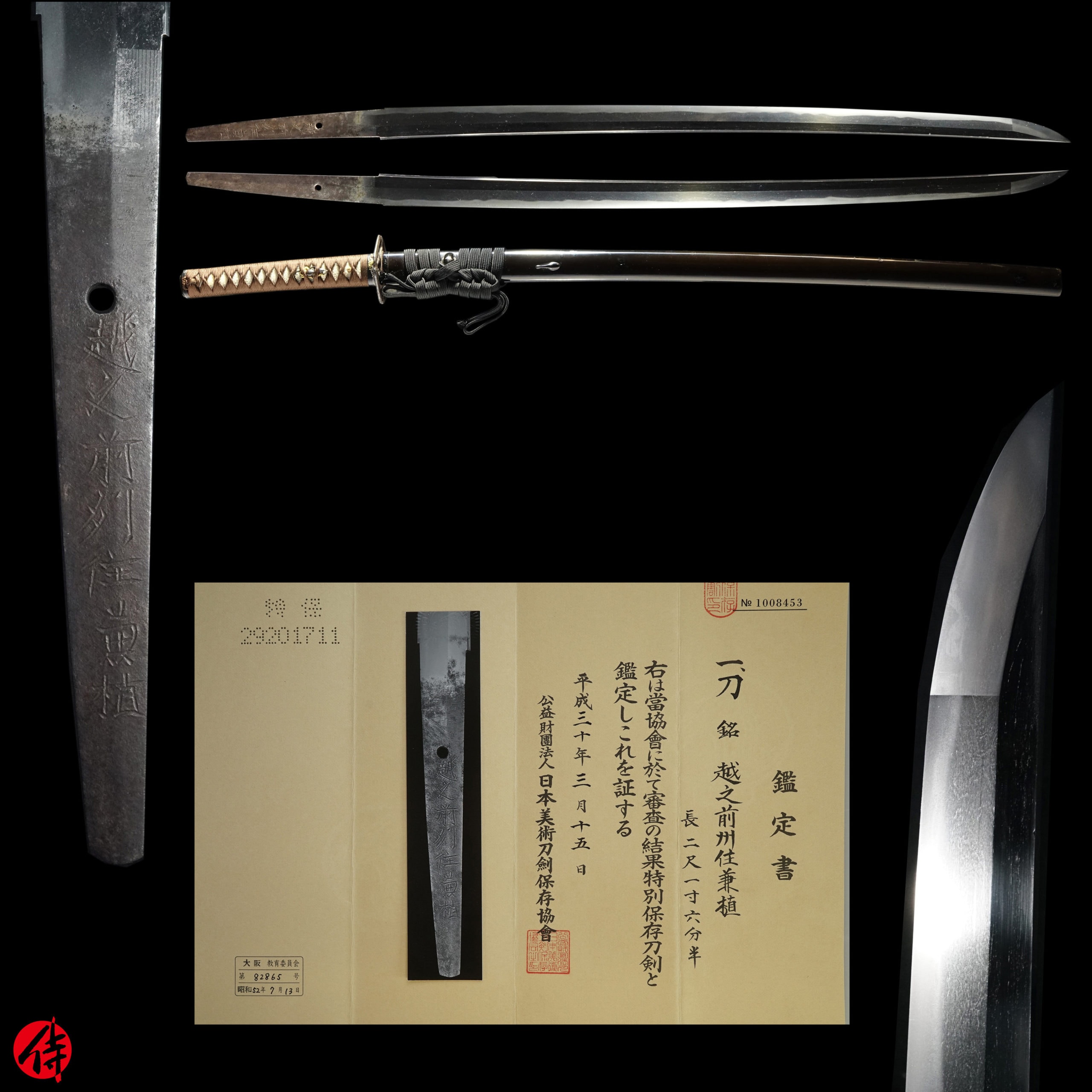
Antique Japanese Sword Katana Signed by Kanetane with
NBTHK
Tokubetsu Hozon
Certificate
【Description】
This sword was forged by ECHINOZENSHUU JYUU KANETANE(越前州住兼植).
The first generation Kanetane was originally from Mino province.(Gifu, prefecture). He was invited by the feudal family Asakura and moved to Echizen province (Fukui Prefecture today) around 1501(Late Muromachi period). It was the time many feudal lords fought each other over territories(Sengoku Jidai: Warring state period). He and another famous swordsmith Kenori worked for the Asakura family in Echizen province. After Nobunaga Oda destroyed the Asakura family, the first-gen Kanetane started to serve Shibata Katsuie(another famous feudal lord).
The swordsmith name “Kanetane” lasted a few generations until the Edo period(The last Samurai period. We believe the second Kanetane forged this blade in the early Edo period based on the tang signature.
This sword has a Tokubetsu Hozon certificate issued by NBTHK. This authentication paper was only given to Japanese swords, especially worth preserving by Nihon Bijutsu Touken Hozon Kyokai(the Society for the Preservation of the Japan Art Sword). This blade is in excellent condition, and comes with a beautiful set of KOSHIRAE.
【 Blade】
Cutting EdgeLength(Nagasa)
:
65.7 cm(25.9 inches)
Curvature(Sori)
:
1.0 cm(0.4 inches)
Hamon
:
Large waves with some TOGARI-BA
TOGARI-BA( Pointed s hapes protruding from the HAMON)
Jimon
:
Close-grained with some white UTSURI
UTSURI ( A white misty formation that runs parallel to the HAMON to the JI)
【Koshirae】
Fuchi-Kashira&Menuki
:
The material is SHAKUDOU inlaying crabs and waves with copper, silver & gold.
Due to the land shape of an island nation surrounded by sea on all sides, various marine products have been incorporated into designs in Japan. Fuchi Kashira is decorated with Kani (crab) pattern, and seashells are designed for Menuki. As crabs walk sideways, they were compared “Oukou Kunshi (横行君子),” which means going my way against authority. Samurai might have felt the strong would not bow before power from it.
These seashells are bivalves. In the Heian period (794-1185), Kaiawase (a game that uses clams) became popular among aristocrats. Each clam matches only with its pair shell. Therefore, people consider that the clam pattern represents a happy marriage.
Tsuka
:
The material is SHAKUDOU inlaying waves, shellfishes & waterweeds with gold & silver.
Tsuka is coiled with the Hishi-Maki technique, which is a general way to cover the Tsuka.
Tsuba and Habaki
:
Iron tsuba which is designed four Mt. FUJI with open work.
As its shape looks like the combination of four Mt. Fuji, this type of Tsuba’s form is called Yotsu-Fuji-Gata. The same kind of geometric pattern is engraved with Sukashi-Bori (openwork) technique.
Saya
:
it is coated with black polished lacquer.
Authentication Paper
:
NBTHK TOKUBETSU Hozon Certificate for the blade
NBTHK
, also known as Nihon Bijutsu Touken Hozon Kyokai (the Society for the Preservation of the Japan Art Sword), is one of the oldest Japanese sword appraising organizations in modern-day Japan. They authenticated the blade on March 15th in the 30th year of Heisei(2018). They appraised it as Tokubetsu Hozon Touken, the blade especially worth preserving for Japanese society. The purchaser will receive this original certificate as well. We also provide a
PDF file
with English subtitles if requested.
Registration Number :
Osaka
82865
The Board of Education in Osaka prefecture issued a registration paper for this sword . In order to obtain this paper, the sword needs to be traditionally hand forged. With this paper, its owner can legally own an authentic Japanese sword in Japan.
—————————————————————–
【About us】
Samurai Museum is located in Tokyo, Japan, exhibiting antique artifacts related to the Samurai history. Samurai Museum Shop is the place for those who are interested in Japanese culture and craftsmanship. We deal with antique Samurai swords/armor, traditional