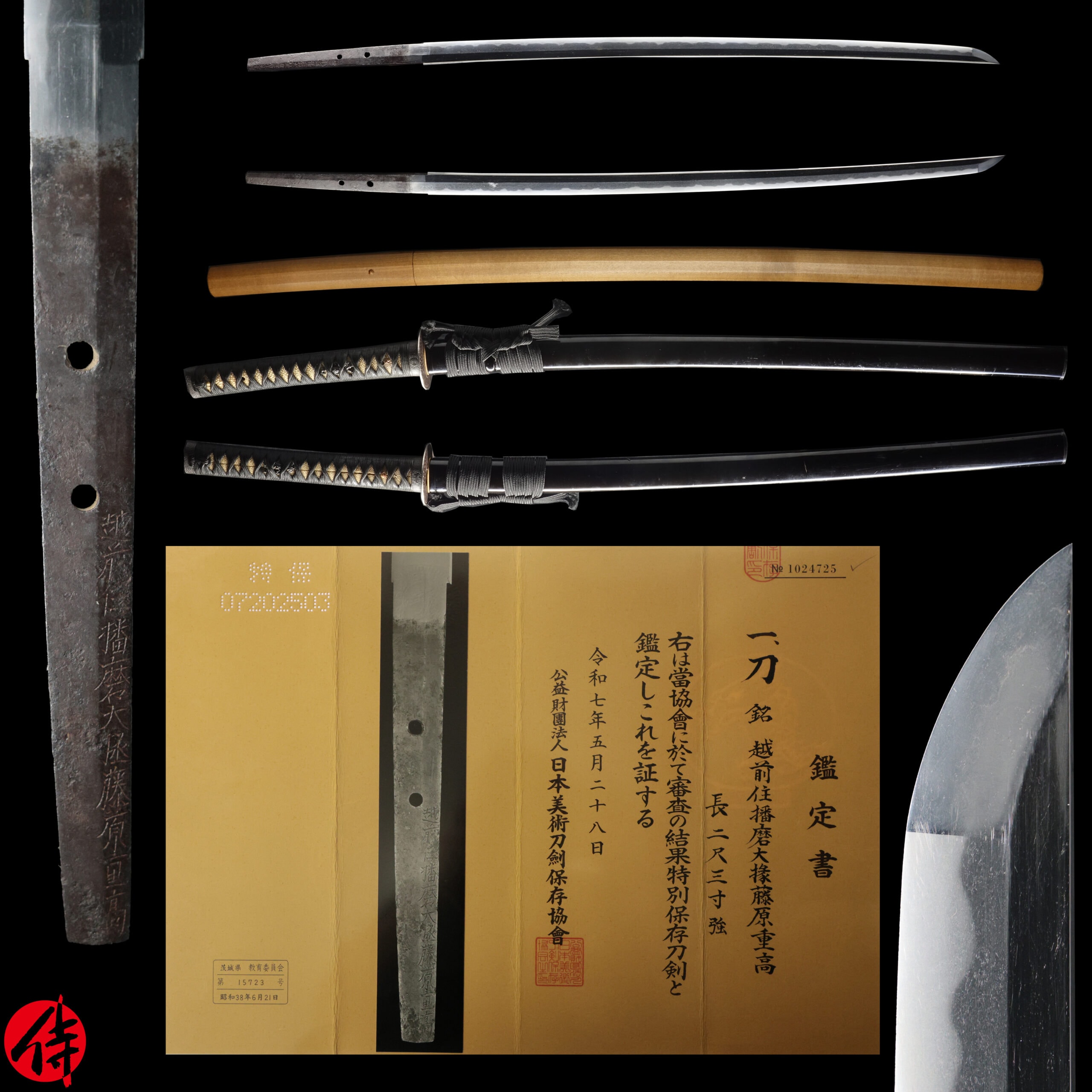
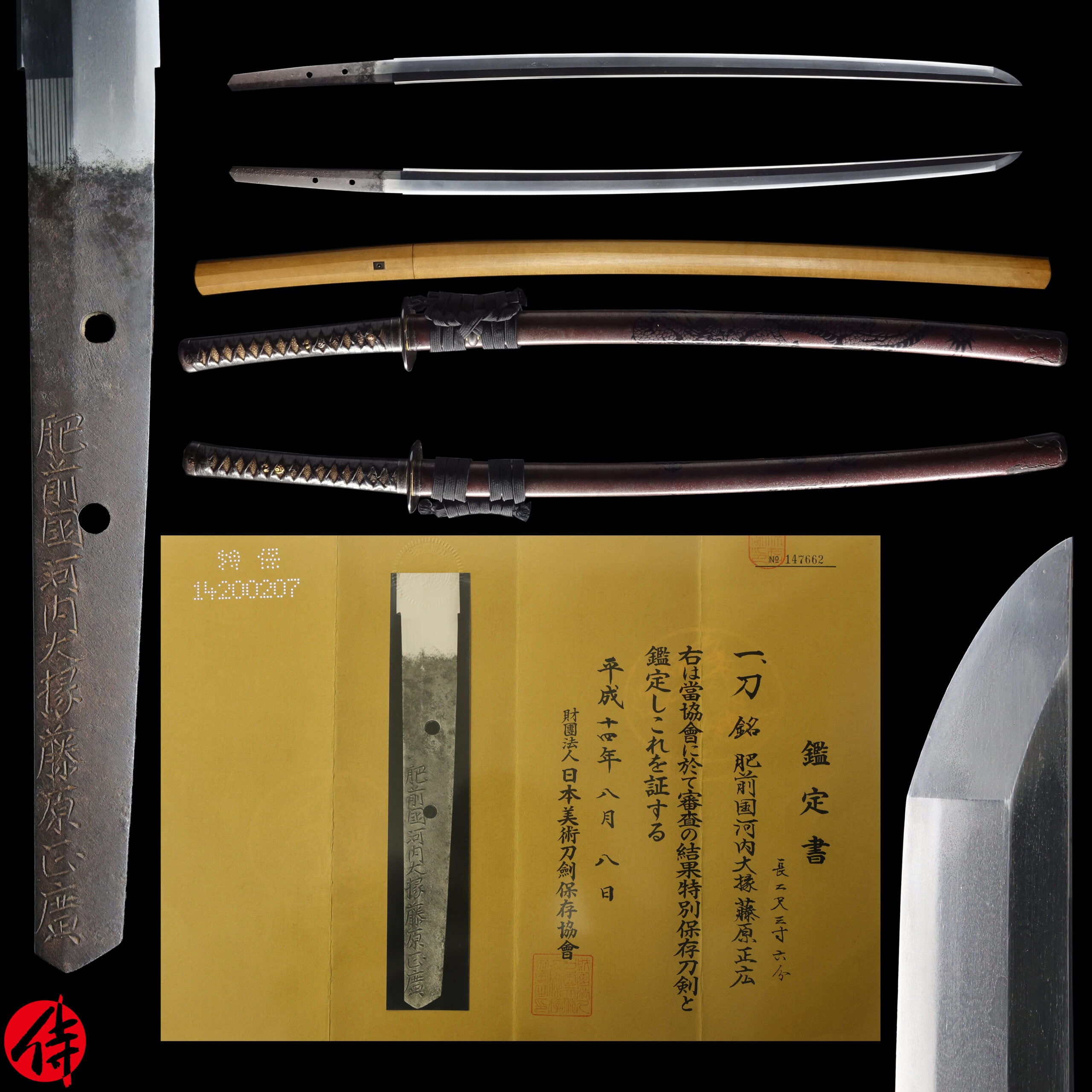
説明
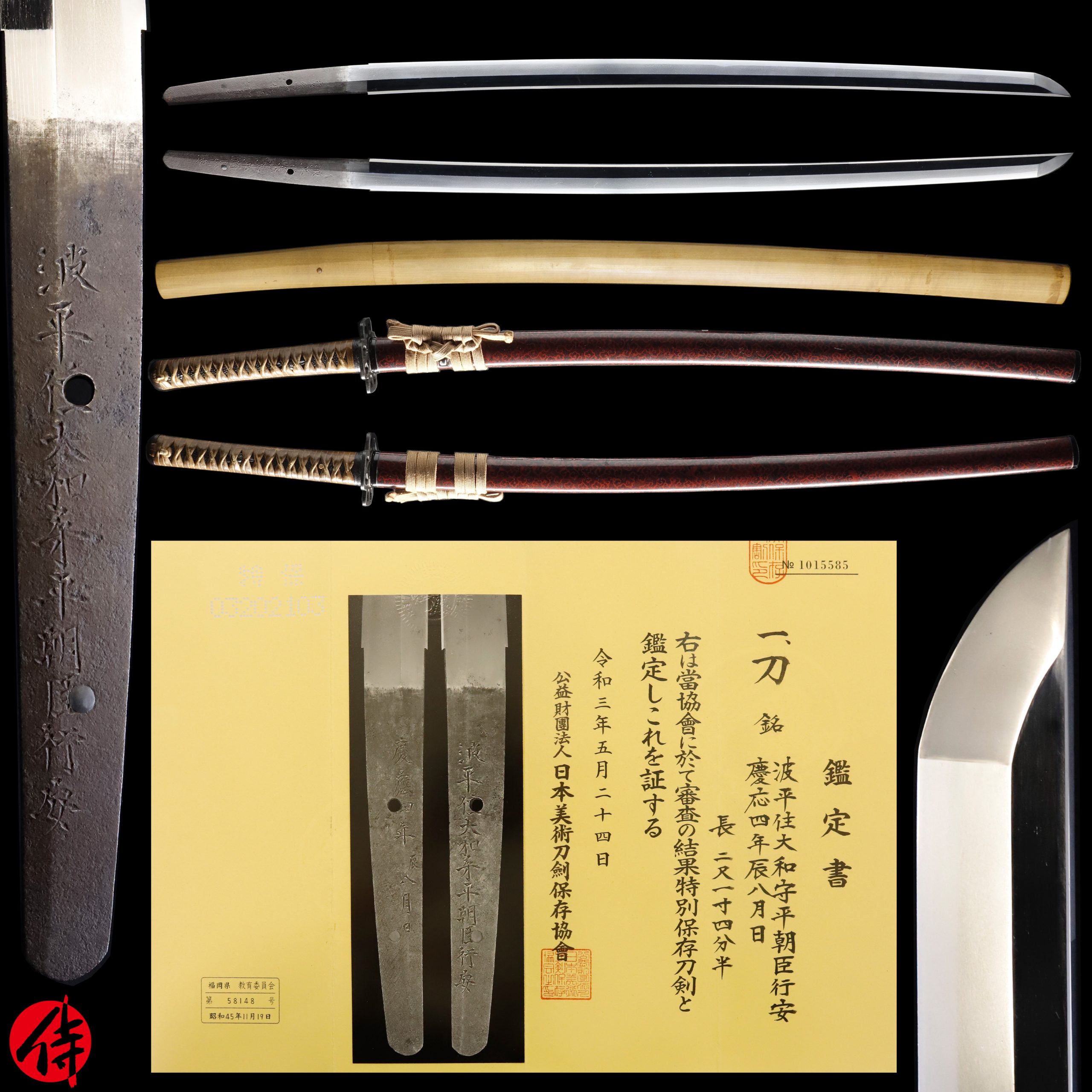
Antique Japanese Sword Katana Signed by Naminohira Yukiyasu with
Tokubetsu Hozon
Certificate
【Description】
Naminohira Yukiyasu
This blade was signed by Naminohira Jyu Yamato no Kami Taira Ason Yukiyasu (波平住大和守平朝臣行安) in the 4th year of the Keio era (1868). Naminohira is the place in Satsuma Domain (today’s Kagoshima prefecture) where he forged this blade. Yamato no Kami is an official rank given to this swordsmith for his excellent craftsmanship. Ason is also a respected high-ranked sir name. Yukiyasu is his maker’s name. It was common for many swordsmiths to sign where they lived or their official title before writing their signature.
Yukiyasu belonged to Naminohira school.
Yukiyasu was the younger brother of the 62nd generation Yasutoshi, one of the linages in Naminohira school. Yukiyasu was born in the 7th year of the Bunka era (1810).
He became a Hanko (藩工) for the Stauma domain in the second year of the Tenpo era (1831). Hanko is a swordsmith exclusively forging blades for a specific clan or domain.
He forged swords under the 62nd-gen Naminohira Yasutoshi (his older brother). And in the 5th year of the Kaei-era (1852), he became an independent swordsmith and called himself the 63rd head of the Naminohira school.
In the 5th year of the Ansei era (1858), he was appointed to forge a sword for Emperor Komei. He received an honorable official rank of Yamatosuke from the emperor Komei. And he was promoted to Yamato no Kami in the first year of the Keio era (1865) when he visited Kyoto. He had such a brilliant career as a swordsmith, seeing this biography. We assume his craftsmanship was highly acknowledged because he was ordered to make a sword for the emperor.
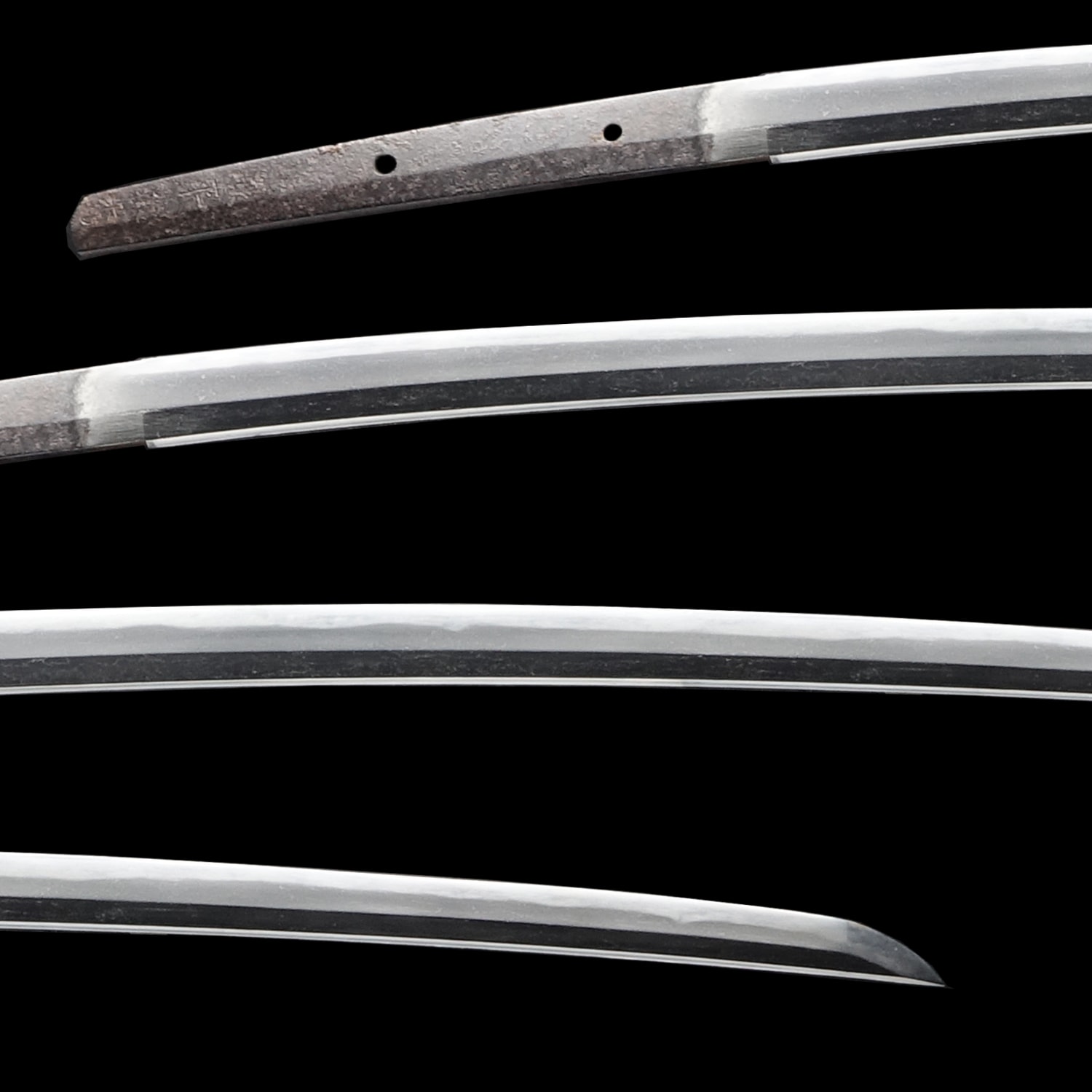
Yukiyasu applied the quintessential Yamato-Den techniques in his craft. The swords forged in Yamato DEN techniques are famous for their beautiful Jigane, steel surface, and straight tempering line(Suguha). This blade shows an outstanding characteristic of the Yamato DEN sword.
Satsuma province had many Samurais and smiths back in the day, making it difficult for most smiths to keep their jobs throughout the era. However, the Naminohira school always remained prominent in the evolving sword, and their work is still beloved by Japanese sword fans to date.
Naminohira School
Naminohira(波平) was one of the most influential schools in Satsuma domain, founded by a swordsmith named Masakuni(正國) during the late-Heian period(Late 12th century). The swordsmiths in this school were known for having their name with one of these letters, 行(Yuki) or 安(Yasu). From the late-Heian period until the end of Samurai times(Late 19th century), the Naminohira family had kept the mastership for a thousand years.
The Naminohira swords were cherished among Samurais in the marine army, mainly because the name Naminohira(波平) means “Tides are quiet.” in Japanese. The origin of the name Naminohira dates back to the school’s foundation. It is said that the founder Masakuni was originally from Yamato domain (Today’s Nara prefecture). The legend says he was able to calm the waves by dedicating his sword to the sea when his school in Yamato sailed to settle in Satsuma domain. Since then, he began to use the title “Naminohira Yukiyasu (波平行安)” – “Tides are quiet, easy to go.”
This blade is appraised as a
Tokubetsu Hozon Token
(特別保存刀剣) issued by NBTHK(Nihon Bijutsu Touken Hozon Kyokai:日本美術刀剣保存協会). This authentication paper was only given to authentic Japanese swords, especially well preserved and high quality with artistic value.
【 Blade】
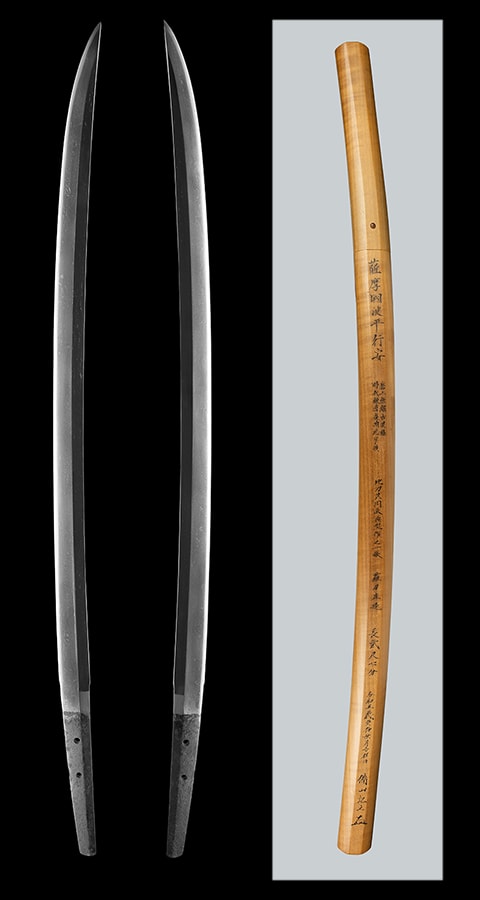
Cutting Edge Length(Nagasa)
:
64.2 cm(25.3 inches)
Curvature(Sori)
:
0.8 cm( 0.31 inches)
Hamon
:
The crystalline structure which forms along the cutting edge of a blade as a result of the hardening process
Jimon(Jihada)
:
visible steel surface pattern created by folding and hammering during forging process
Nakago
:
Nakago is the tang of the Japanese sword.
Japanese swordsmiths left the black rust on the tang because it prevents red rust while the tang is in its handle. And th