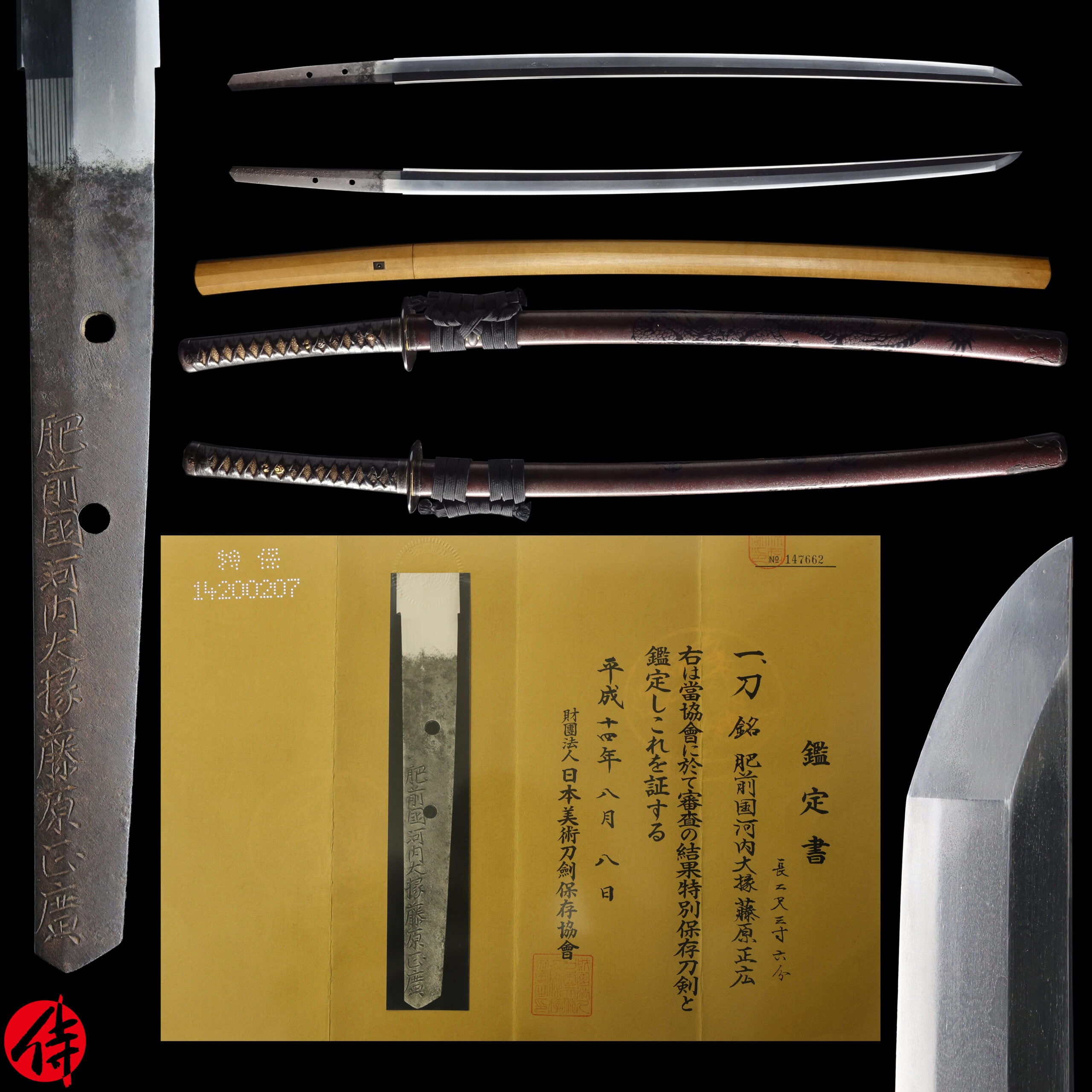
説明
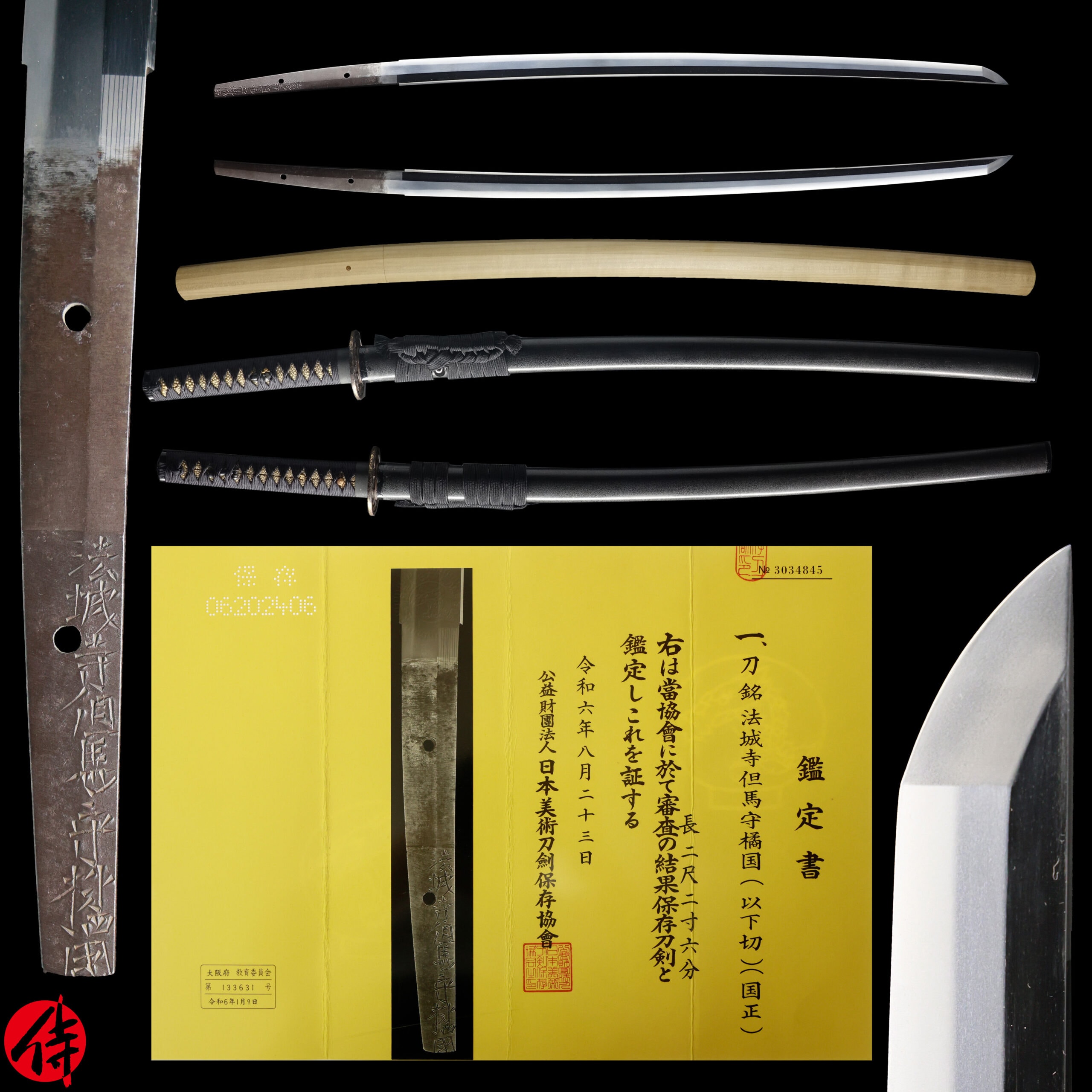
Antique Japanese Sword Katana Signed by Kunimasa
with NBTHK
Hozon
Certificate
【Description】
This blade was signed by Hojoji Tajima no Kami Tachibana Kunimasa (法城寺但馬守橘國正). Hojoji is the name of the prestigious school he was part of, and Tajima no Kami is an honorable official title for his excellent craftsmanship. Tachibana is his last name.
This blade has been shortened, causing the signature to be partially cut off. However, based on other characteristics, it has been authenticated as the work of Kunimasa by the NBTHK (Nihon Bijutsu Token Hozon Kyokai, The Society for the Preservation of Japanese Art Swords).
He was active during the early Edo period (1673-1688) and one of the most prominent figures in the school in Edo city (Today’s Tokyo). Since Kunimasa was a highly regarded swordsmith, this blade might have been made for a high-class Samurai who resided in Edo. Based on the back of the signature, this blade was created when he was 48 years old when he mastered a high level of craftsmanship.
Hojoji school was founded by Hojyoji Kunimitsu, a renowned swordsmith in Tajima no Kuni (Today’s Hyogo prefecture) during the late Nanbokucho-Muromachi period. It is said that Kunimitsu was one of three apprentices of Sadamune, who was one of the most prominent makers in Soshu province (Today’s Kanagawa prefecture).
Hojyoji Masahiro (法城寺正弘), an offspring of Kunimitsu, is the one who moved to Edo city and established the Edo Hojoji school during the early Edo period. He brought his apprentices, including Kunimasa from Tajima no Kuni, based on available records. And those who came to Edo city with Masahiro received the last name of Tachibana.
The blades forged by members of Edo Hojoji swordsmiths closely resemble Kotetsu, one of the most famous swordsmiths. Other renowned swordsmiths who belonged to this school are Kaneshige, Sadakuni, and Yoshitsugu. The school was prosperous during the Edo period and forged many blades for the Edo government. The founder, Masahiro, once resided in Mito domain (today’s Ibaraki prefecture) to forge swords for Tokugawa Mitsukuni.
It is appraised as a
Hozon Token
(保存刀剣) issued by NBTHK (Nihon Bijutsu Touken Hozon Kyokai:日本美術刀剣保存協会). This authentication paper was only given to authentic Japanese swords, well preserved and high quality with artistic value.
【Blade】
Cutting Edge Length(Nagasa)
:
68.5 cm (26.9 inches)
Curvature(Sori)
:
1.2 cm (0.47 inches)
Hamon
:
The crystalline structure which forms along the cutting edge of a blade as a result of the hardening process
Jimon(Jihada)
:
visible steel surface pattern created by folding and hammering during forging process
Kissaki
:
Kissaki is the tip of the Japanese sword.
Nakago
:
Nakago is the tang of the Japanese sword.
Japanese swordsmiths left the black rust on the tang because it prevents red rust while the tang is in its handle. And the discoloration of the tang was created over time, and it is a great indicator for a Japanese sword specialist to estimate when the sword was forged.
Koshirae
:
Koshirae is the mounting of the Japanese sword. There are several parts that consist of Koshirae such as Saya (Scabbard), Tsuka (Handle), Tsuba (Handguard).
Fuchi-Kashira
:
A pair of matching sword fittings that cover the upper and bottom parts of its sword hilt.
Nanakoji (魚々地) technique was applied to the Fuchi part of this Fuchi Kashira.
Nanakoji features a pattern of evenly spaced small dots, creating a beautiful texture reminiscent of fish eggs. This technique not only adds decorative appeal but also provides practical anti-slip functionality.
Tsuka and Menuki
:
Tsuka is the handle of the Japanese sword and Menuki is its decoration.
This menuki features a horse (馬, Uma) design. For samurai, the horse was not only an essential companion in battle but also held significant cultural meaning in Japan. The horse symbolizes strength, nobility, and loyalty, reflecting qualities that were highly valued by the samurai. In Japanese culture, the horse is also seen as a symb

![盛岡住義次(新刀)阿掲多設羝 主多光□多麻□尼 保存刀剣鑑定書 Wakizashi(Morioka-sumi Yoshitsugu)[NBTHK:Hozon] 品番:WA006](/_next/image?url=https%3A%2F%2Fitbhfhyptogxcjbjfzwx.supabase.co%2Fstorage%2Fv1%2Fobject%2Fpublic%2Flisting-images%2Ftoyuukai%2FL398996%2F00.jpg&w=2560&q=90)