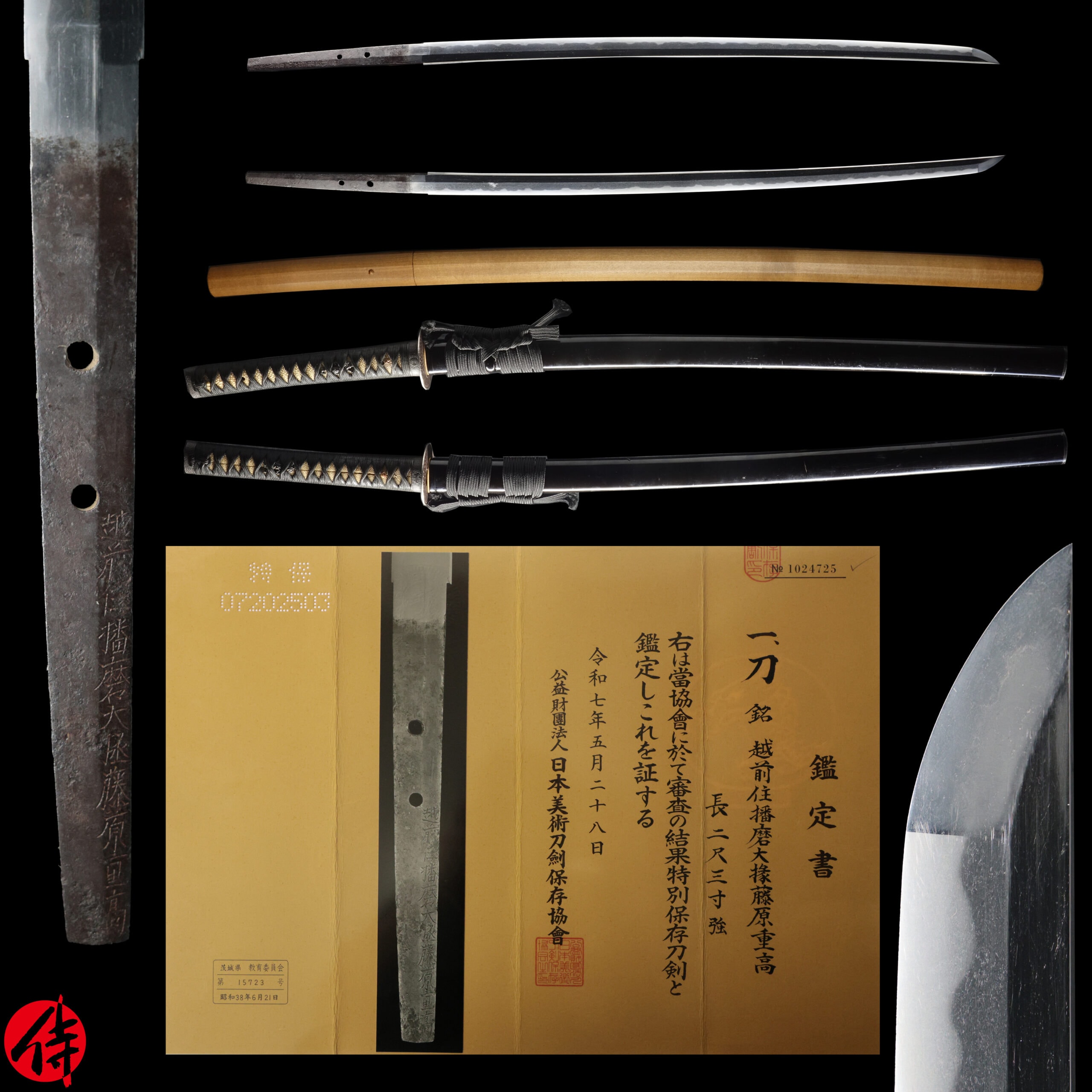
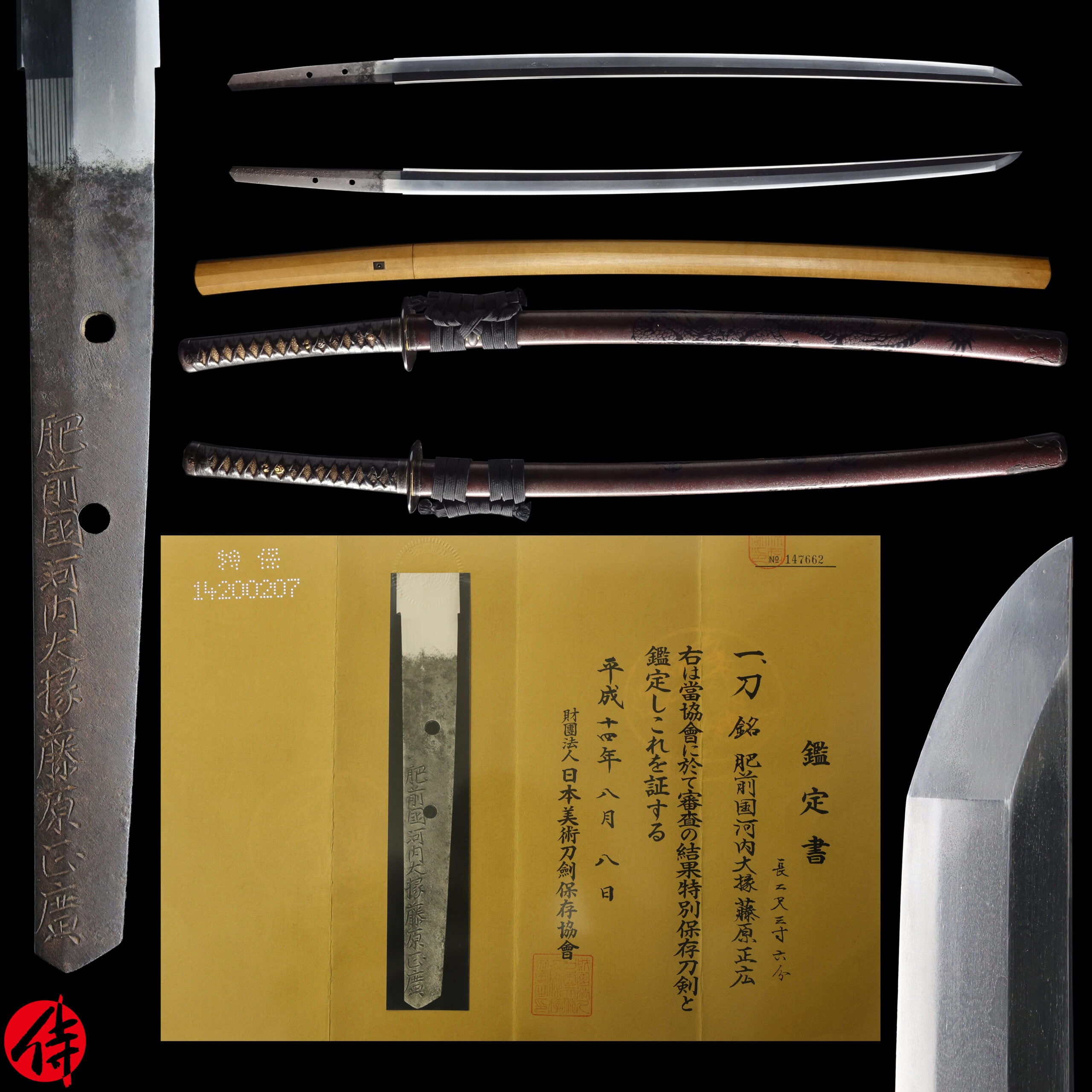
説明
Antique Japanese Sword Katana Signed by Tairyusai Soukan with
Tokubetsu Hozon
Certificate
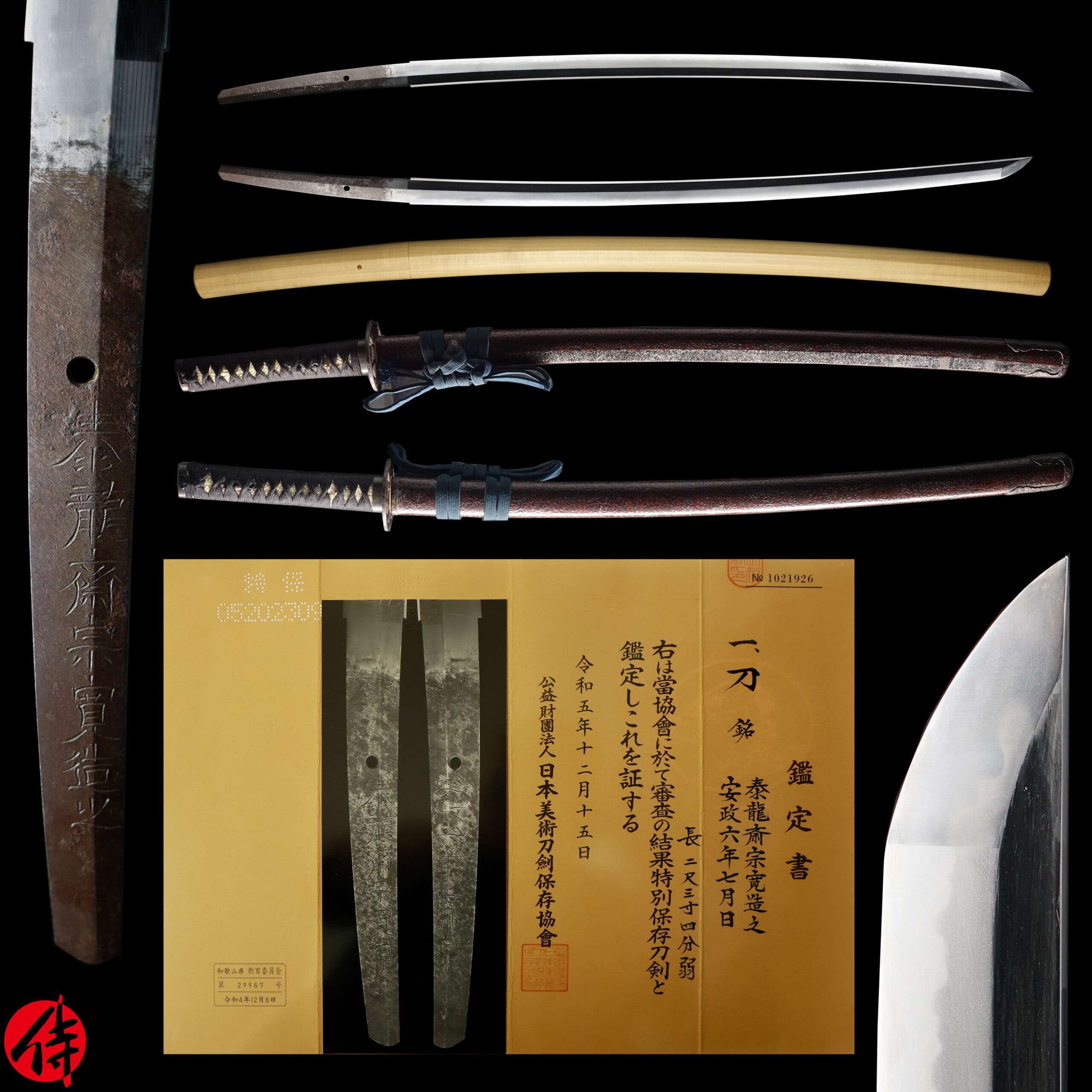
This blade was made by Tairyusai Soukan (泰龍斎宗寛) in the 6th year of the Ansei era (1859, late Edo period) in Musashi (Today’s Tokyo). Soukan was born in 1818 as a son of Ono Heizo, a clansman/ Samurai of Oshu Shirakawa domain, and his childhood name was Takanoshin. And in 1836, at the age of 18, the lord of the Koga domain liked his sword-making talent and diligence, and he became the exclusive sword-maker of the Koga domain. In 1852, he went to Edo by order of the lord and became a student of Koyama Munetsugu. Later, he had a son named Kanji, who is said to be as good a master as his father Soukan.
Who is Koyama Munetsugu?
Munehiro’s teacher , Koyama Munetsugu (固山宗次), was born in 1803 and is generally called Soubei. He worked for the Hisamatsu-Matsudaira family of the Shirakawa domain, and Matsudaira Sadanobu, whom he served, is widely known in Japan as one of the most famous politicians of the Edo period.
Munetsugu’s birthname name was Koyama Sobei (固山宗兵衛). He was born as the third son of Koyama Munehira(固山宗平) in Shirakawa domain in Mutsu province (today’s Fukushima prefecture) in 1802. It is said that he learned the sword-forging technique from Kato Tsunahide (加藤綱英) first and was also an apprentice of
Chounsai Tsunatoshi (長運斎綱俊)
, a younger brother of Tsunahide to improve his craftsmanship.
His work reflects Bizen Den, one of the five most traditional Japanese sword-forging techniques (五箇伝). He was excellent at forging blades with Choji Gunome Midare tempering line, one of the most noticeable characteristics of Bizen Tradition. He was active in sword-forging during 1830-1870. He is arguably the finest smith working in the Bizen tradition at the end of the Edo period.
About late Edo period
The Bakumatsu period (幕末) was the final part of Japan’s Edo period, lasting from around 1853 to 1868. It began when American ships led by Commodore Perry arrived in Japan and encouraged the country to open its ports to international trade. This moment was a turning point in Japanese history. Many people in Japan were surprised by Western technology and started thinking about how the country should respond to the changing world.
At the time, there were strong debates between those who supported the traditional Tokugawa shogunate and others who believed Japan needed to modernize and return political power to the Emperor. These disagreements eventually led to conflict and the end of samurai-led government.
Samurai were important figures during the Bakumatsu period. Their swords, known as Katana, were not just weapons but also powerful symbols of their values and way of life. However, as Japan began to build a modern army and adopt new weapons, swords became less common in battle.
It is appraised as a
Tokubetsu Hozon Token
(特別保存刀剣) issued by NBTHK (Nihon Bijutsu Touken Hozon Kyokai:日本美術刀剣保存協会). This authentication paper was only given to authentic Japanese swords, especially well preserved and high quality with artistic value.
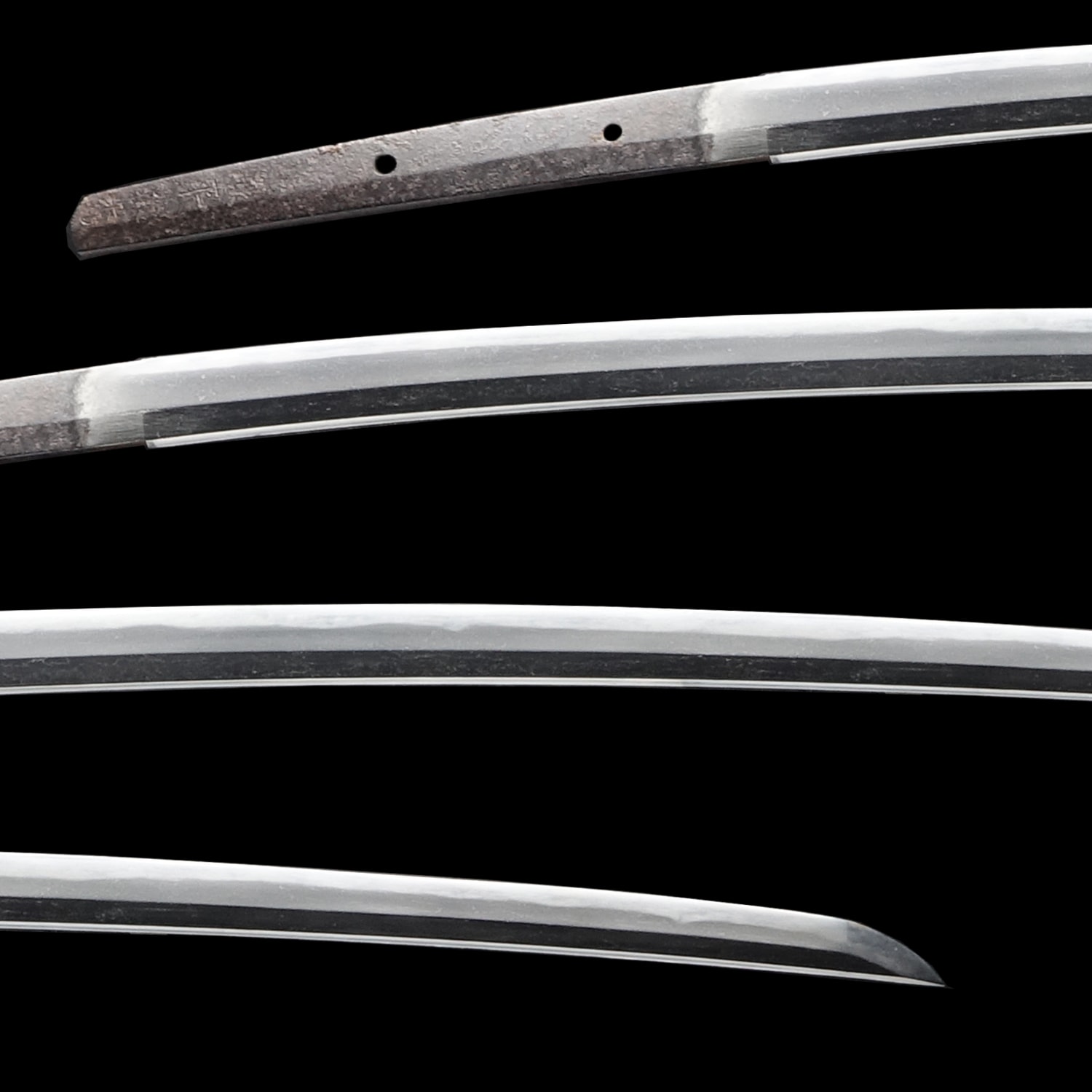
【Blade】
Cutting Edge Length(Nagasa)
:
70.7 cm (27.8 inches)
Curvature(Sori)
:
1.3 cm (0.51 inches)
Hamon
:
The crystalline structure which forms along the cutting edge of a blade as a result of the hardening process
Jimon(Jihada)
:
visible steel surface pattern created by folding and hammering during forging process
Kissaki
:
Kissaki is the tip of the Japanese sword.
Nakago
:
Nakago is the tang of the Japanese sword.
Japanese swordsmiths left the black rust on the tang because it prevents red rust while the tang is in its handle. And the discoloration of the tang was created over time, and it is a great indicator for a Japanese sword specialist to estimate when the sword was forged.
Koshirae
:Koshirae is the mounting of the Japanese sword. There are several parts that consist of Koshirae such as Saya (Scabbard), Tsuka (Handle), Tsuba (Handguard).
Fuchi-Kashira
:
A pair of matching sword fittings that cover the upper and bottom p