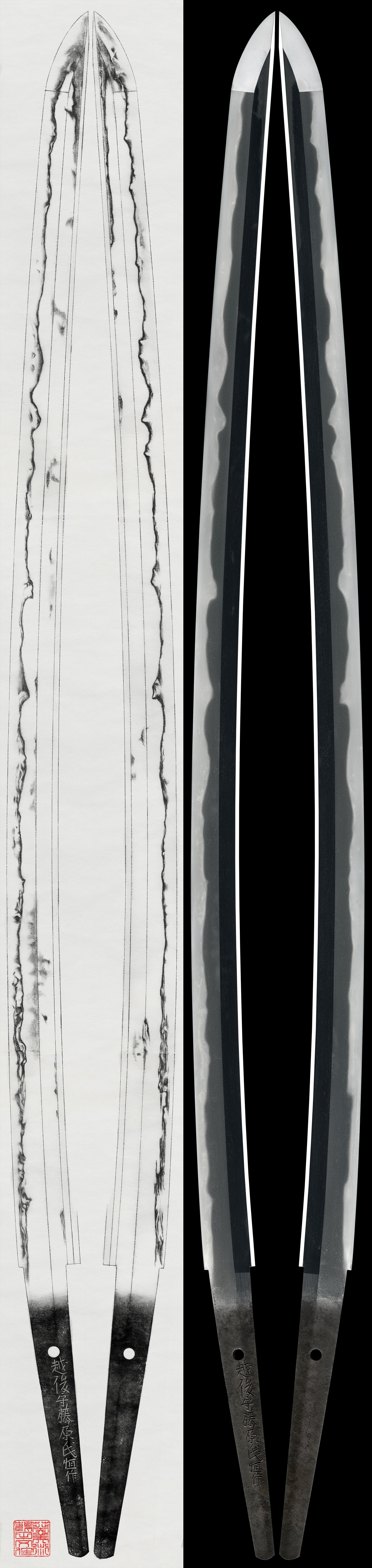
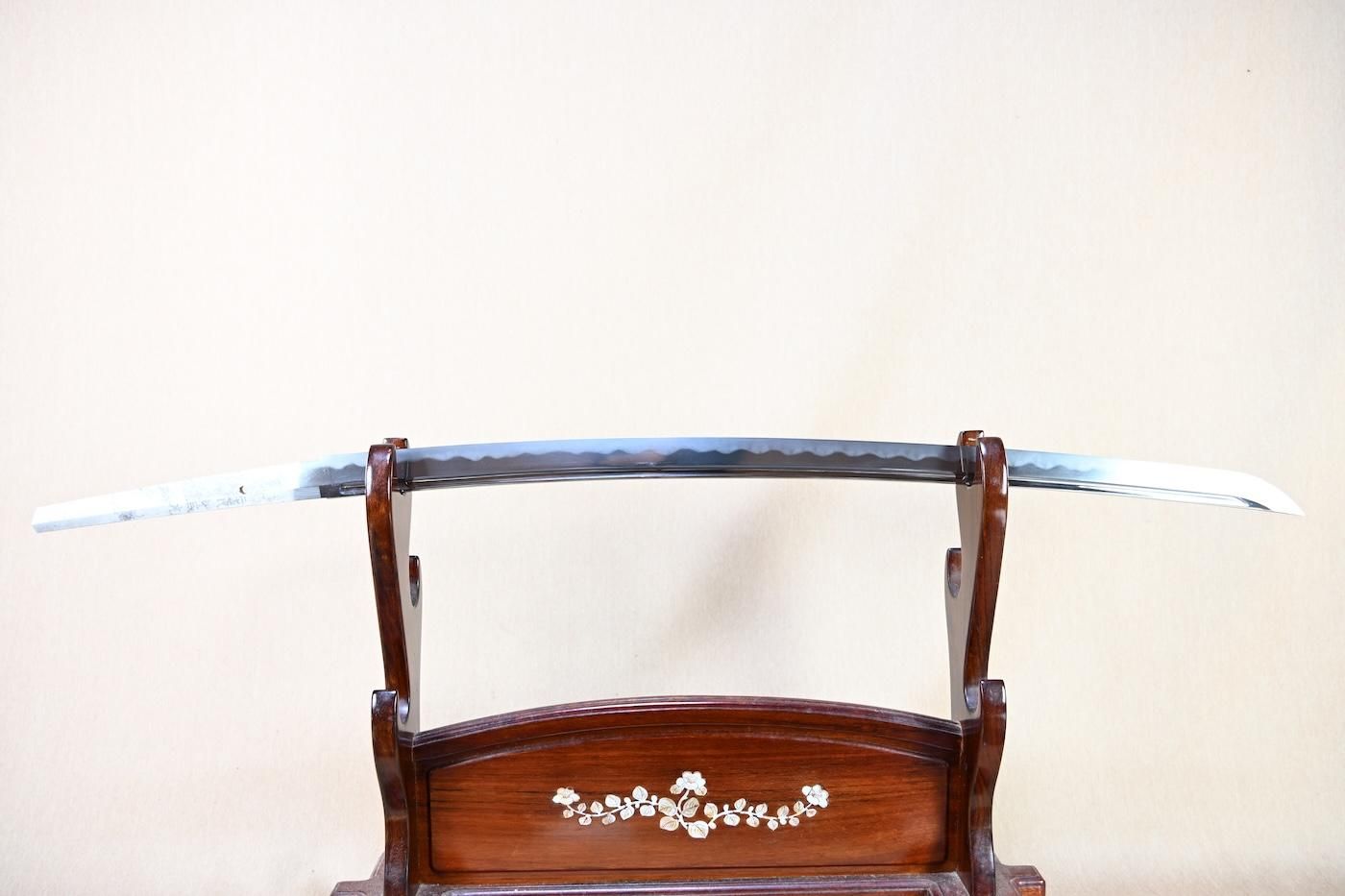
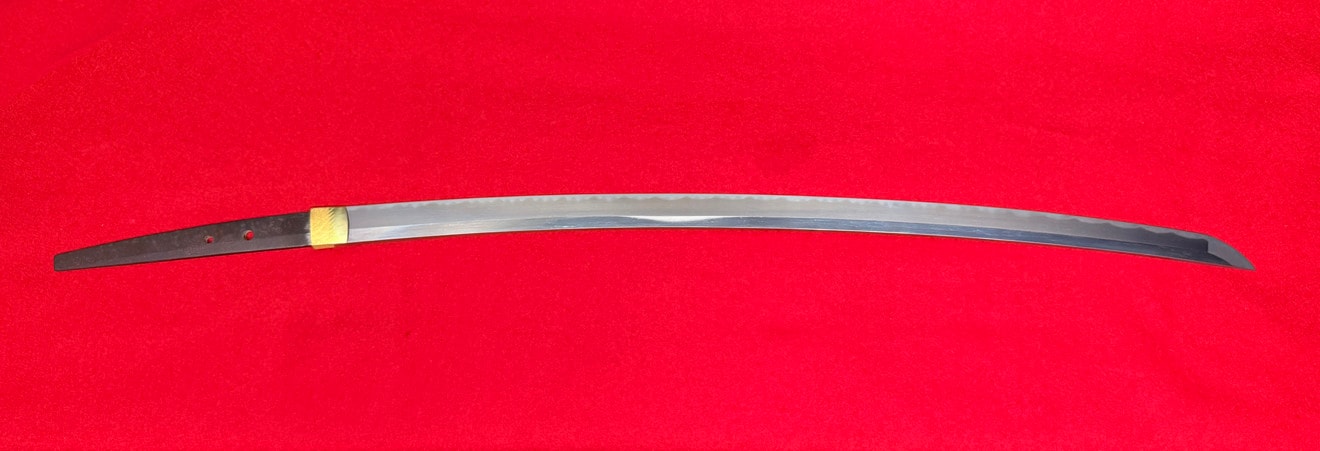
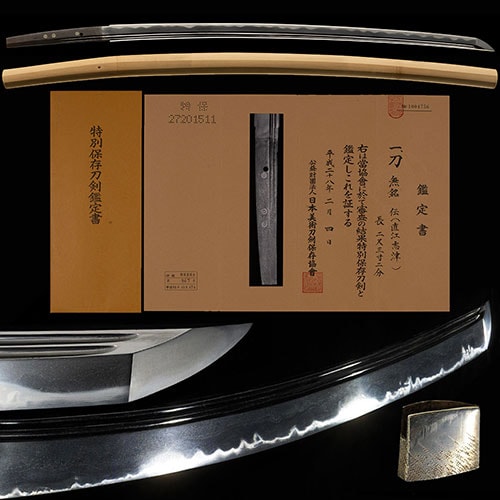
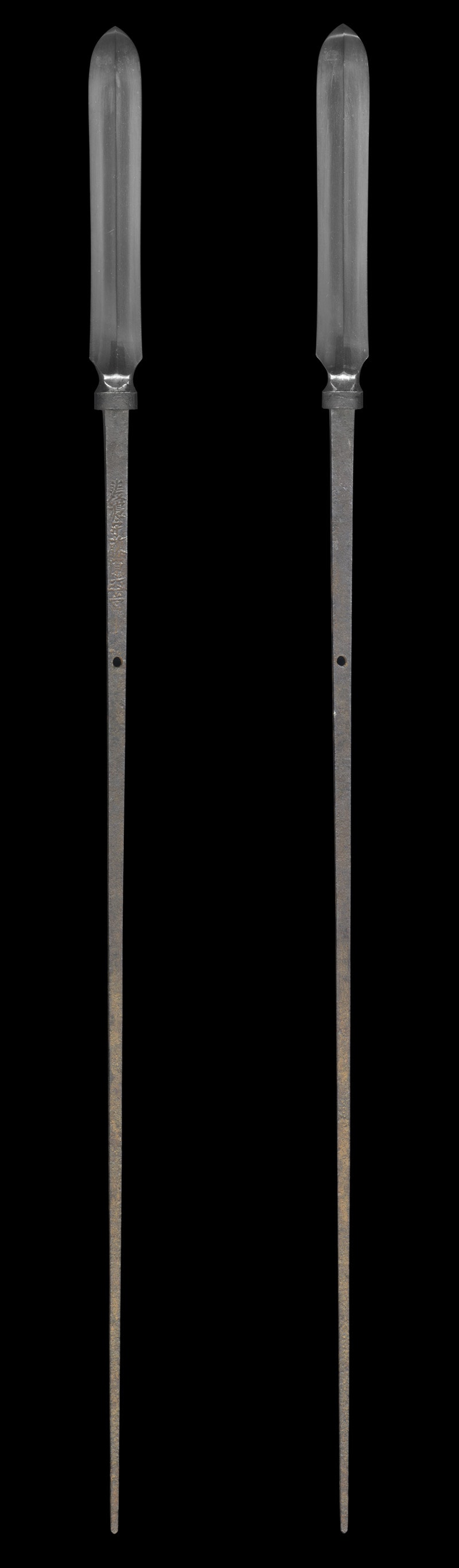
Among the dated works of Kaneyoshi, a swordsmith of the Seki Zensada group (関善定派) of , the earliest is a inscribed for the second month of Kōō 1 (1389), at the very close of the period, and the finest are the and he made a generation later in the Ōei era. The reference works on signatures place the origin of the line in Yamato, recording the first-generation founder as the man as, or the son of, Kaneyoshi (手掻包吉) of the school, who carried the Yamato manner east into Seki. From that root the name continued through several generations of the period and survived into the era, but it is the Ōei work that the published sources single out, observing that among all the generations it is the Ōei pieces that leave the finest examples, 'among them it is the Ōei-period works that leave the finest pieces'. The four blades on this record, three and a dated Ōei 9 (1402), Ōei 10 (1403) and Ōei 27 (1420), are that prime work, each an , signed blade reading Nōshū-jū Kaneyoshi or Nōshū jūnin Kaneyoshi, with the cyclical date cut on the reverse of the tang.
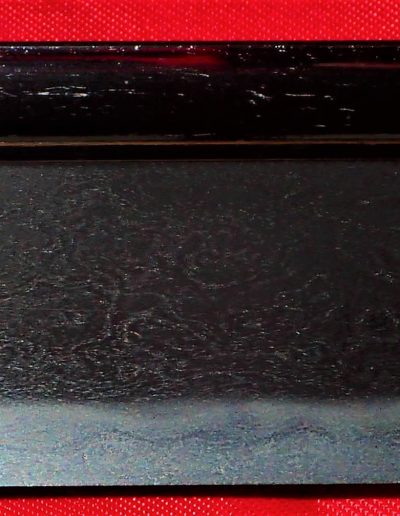
The hand is a tight rather than a flamboyant , the disciplined face of late Seki. Over the body he tempers a straight line, at its most restrained an (糸直刃) as fine as thread, into which a little (小互の目) is mixed on the two later , the small teeth breaking what is otherwise a quiet temper. The is tight in character and -dominant, attaching along it, entering and intermittent appearing at the , with drifting over the lower of one and fine running within the . The published sources name this controlled straight temper the manner the smith favored and most excelled at, calling one Ōei a blade that 'shows the style at which he excelled' and reading the 's whitish forging and tight as work in which 'Kaneyoshi's favored style is well revealed'. It is restraint, not display, that marks him.
The carries the Yamato inheritance plainly. He forges a or that flows overall toward , so that a -inclination (柾がかり) stands toward the edge, attaching across the surface and a faint entering here and there. Over that rises a whitish (白け映り), the misty reflection of Yamato and steel that appears on every blade of this record, set apart from the bright of contemporary . The runs almost straight and turns back in a small , on one tending slightly to notare and pointing a little on the . The is the slender, forward-curving shape of its age: a somewhat narrow , a that runs deep and tends to , a or , the elongated figure the published sources read as characteristic of the period and especially of the Ōei years; the is with a thick and a slight , a touch elongated for its width, the proportions that also fix it firmly in Ōei.
The record divides into two manners, only one of them held here. The documented founder phase is the Kōō 1 , which the published sources describe as having a rather thick , a somewhat high , an forging tempered in and a with , a piece of, in their words, 'a distinctly strong Yamato temperament'. The Ōei prime that follows is the hand of these four blades, the Yamato substrate now settled into the cooler . The dated tangs make the corpus valuable beyond its workmanship, the Ōei 9 standing among examined works second only to the Kōō 1 founder piece, and the Ōei 10 being, the published sources note, the only Ōei-dated the committee has examined, since 'apart from this piece no has been seen'. Across the generations the name was carried by many hands, and it is the Ōei pieces that anchor the whole.
Within Seki, Kaneyoshi is read first by his own typical traits rather than by comparison: the -leaning under a and the tight lightly broken with are the features the published sources call the heart of his work. On the Ōei 27th-session the workmanship in both and is judged sound, and on a later the committee writes that 'everything here is typical' and that the blade 'fully displays the highlights of Kaneyoshi's work, leaving nothing out'. His Yamato-grounded restraint sets him apart from the showier late-Seki smiths, whose pointed runs hot where his straight line stays cool, and it is that quiet, -grounded by which a Seki Zensada Kaneyoshi of the Ōei era is recognized. The school's debt to is legible in his every blade, the Yamato and the whitish carried down from the founder.
Kaneyoshi's work is rated chū-jō by Fujishiro, and the four blades on record stand in the tier, all and signed and dated to the Ōei years he is remembered for. These are not blades that often change hands. Of the four, provenance survives for one, the Ōei 27th-session , which the published sources record as 'a blade transmitted in the Kuroda family through the domain era', passing through one of the great houses of Kyushu. A signed and dated Ōei or by this smith is encountered only from time to time and a dated scarcely at all, so a private collector may hope to meet his work rarely and with patience, most often through the tier in which these examples sit. The appeal is exactly what the published sources praise: an honest, well-forged Ōei blade in which the Yamato descent of the Seki Zensada line shows clearly, its straight temper and whitish typical of the manner the committee returns to as the smith's finest.