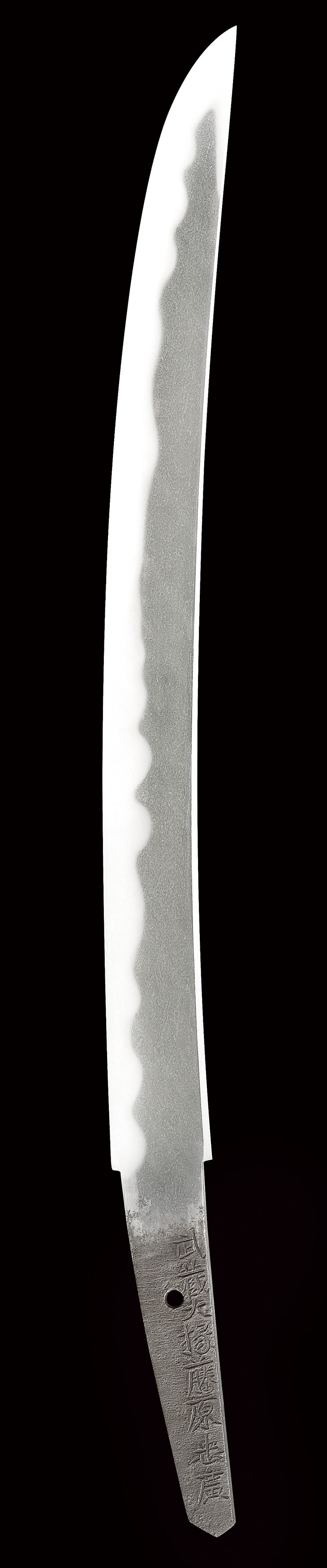
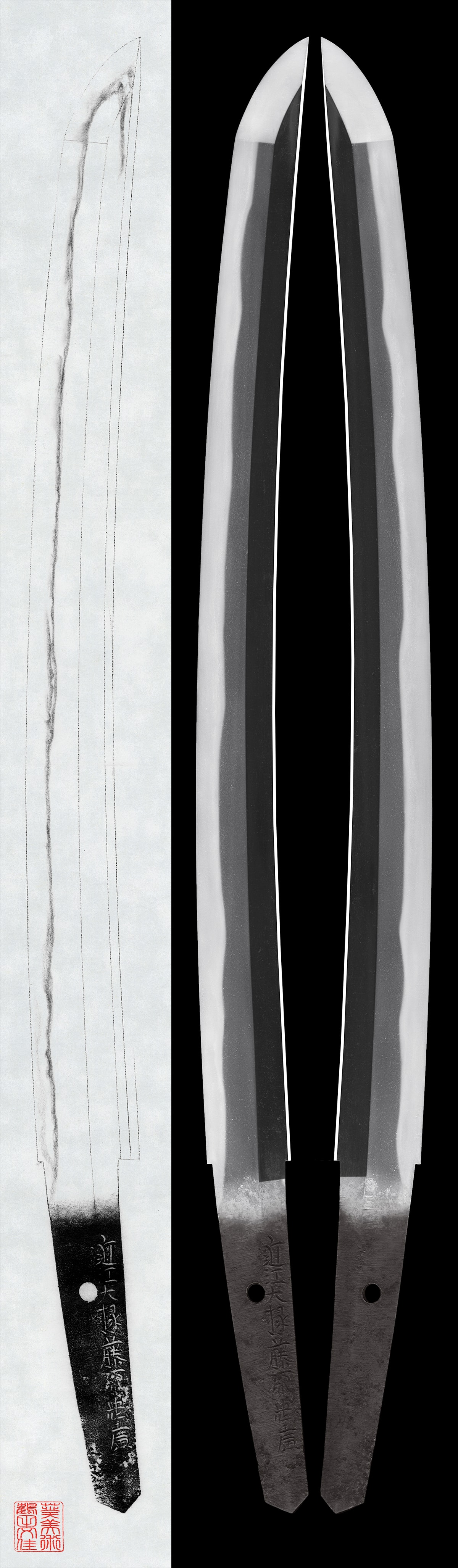
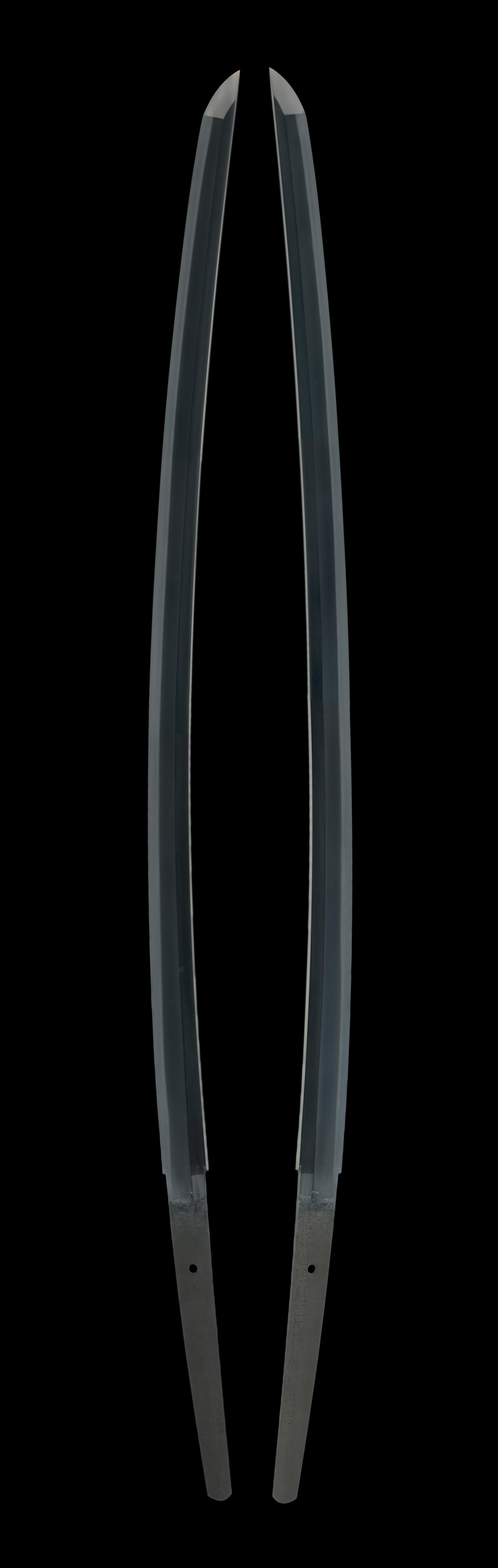
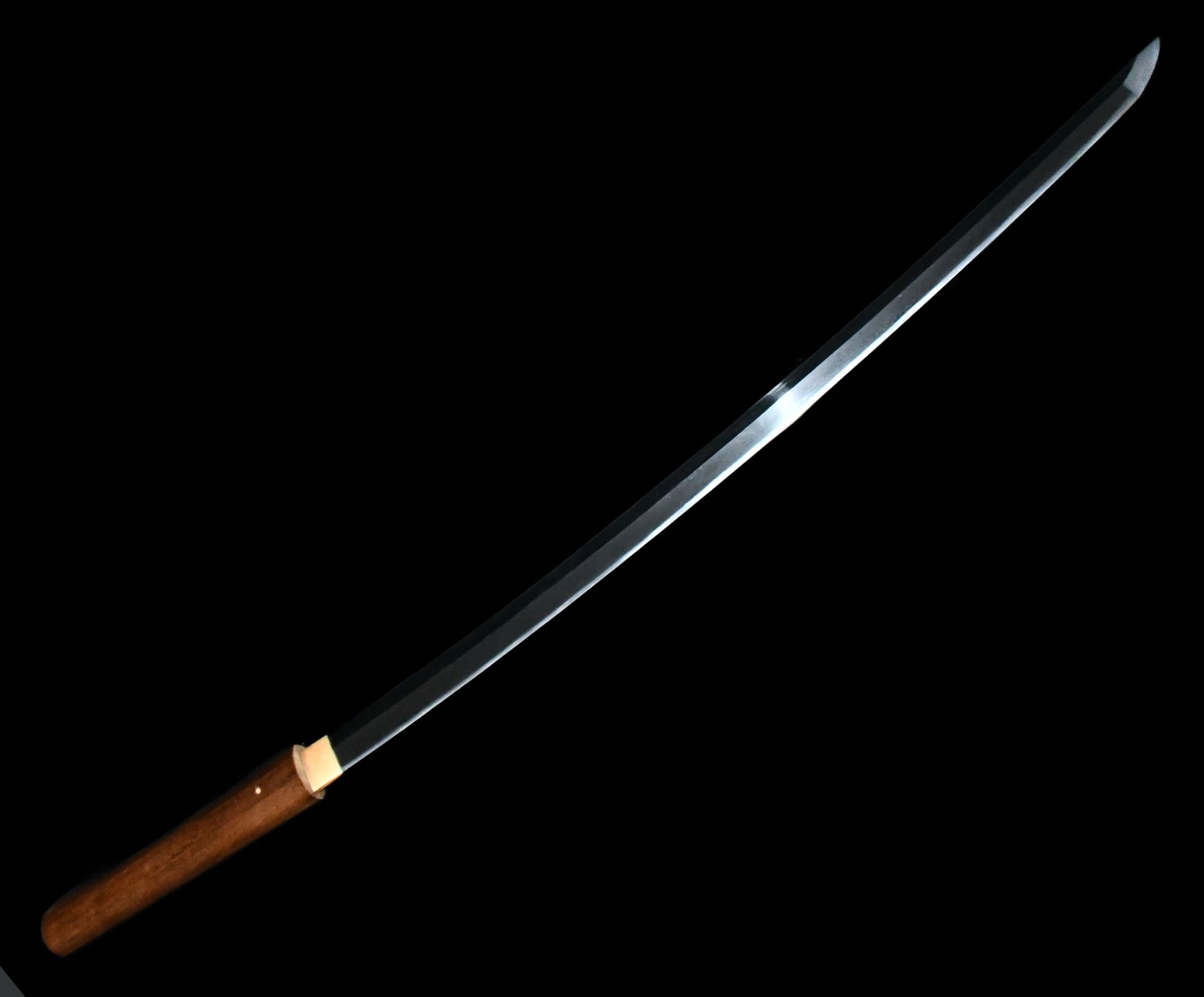
The second-generation Masahiro of was born in 'ei 4 (1627), the son and direct heir of the first-generation Kawachi Daijo Masahiro, and he died in Genroku 12 (1699) at the age of seventy-three. He styled himself Sadenji and first signed Masanaga; in Manji 3 (1660) he received the title no Daijo and then no Kami, and on the death of his father in 5 (1665), when he was thirty-nine, he transferred to the title Kawachi no Kami and took up the name Masahiro. He worked within the main line at Saga, and the published sources read him as a successor who matched his father so nearly that in many pieces the hands cannot be separated, the workmanship of both, in and in , holding "scarcely anything by which to rank one above the other". He inherited the refined and the bright temper directly, and his record divides cleanly into two manners.
His characteristic hand is the flamboyant the published sources say he favored above all, "especially adept at the irregular temper". Over the he lays a -dominant , into which he mixes , round-headed , large and a shallow , with at times a -like or angular flavor, opening on occasion from a slight at the base and linking the clusters of with a quieter -toned line. The temper is laid high and low; long enter frequently with among them; the is deep, with thick gathering in the valleys of the and breaking out above; runs broadly and long appear, and the is bright and clear. The published sources call the broad into which he develops this flamboyant "precisely the area in which he excelled", and they read the -like teeth and round-headed set into the temper as the tell of his particular -dori.
The is the constant beneath both manners. It is a tightly packed , the grain at times standing a little, into which extremely fine is laid thickly until it takes on the rice-bran characteristic of work, with fine entering throughout and the steel bright. This is the refined the main house carried, and the second-generation Masahiro forges it faithfully, so that the showy edge sits over a quiet, lucid surface. The , on either manner, runs straight into a with and a deep turnback, at times opening into a small or a larger . The is robust and dignified, often wide in body with a thick and an extended , at times reaching an .
The other face of his record is the , the manner the published sources note he commanded in greater number than the first generation, observing that "works in are encountered more frequently in his output than in that of the first Masahiro". It is a medium straight temper that takes on a shallow -tendency in places and mixes and , at times a flavor and a small about the ; the stays deep with thick , in places a coarser , running and long appearing, the whole bright and clear over the komenuka . The published sources hold his even and consistent, and call one such blade conspicuous for a deeper and a thicker than the usually seen from him, reading the manner as recalling the at which the main house excelled. His blades are signed no Kawachi no Kami Fujiwara Masahiro, and at times Kawachi no Kami -uji Masahiro; several are dated, in 7 and 12, giving fixed points in his career.
What sets him apart within the school is read first from the signature, not the steel, since his hand follows his father's so closely. The published sources name the means of telling the two generations: the form of the element within the character , written one way by the first generation and another by the second, and an added stroke in the element of the character Hiro, together with his consistent practice of signing on the , the differing manner a guard against forgery. In workmanship the distinction is one of proportion rather than kind: the father favored the and the son carries the flamboyant forward, while the son's , the more numerous of the two for him, returns the line to the calm straight temper that is the main house's own signature.
For the collector he is a master of the era recorded entirely in the tier, where twenty-four of his works are designated; Fujishiro grades him Jo . He has no National Treasures or Important Cultural Properties, and his designation record stands instead on that body of blades, among the denser such records for a smith. The published commentary calls one of his "a sword that stands as a representative example of -to" and another the "most flamboyant and brilliant workmanship seen among his works", while noting that cutting-test inscriptions are themselves rare on blades, that "on blades pieces bearing cutting-test inscriptions are extremely rare". Several of his carry the gold-inlaid cutting tests of Yamano Kanjuro Hisahide and the nicknames that go with them, -kosode, Aranami and Senpu, each praising the blade's sharpness. No owner provenance is recorded on his designated blades, so the honest account is that they pass quietly among private and institutional collections of recorded whereabouts; one of his works in or comes to the market only from time to time, a substantial acquisition when it does, and the most direct way for a collector to hold a sword of the main line at the height of its second generation.