NihontoWatch MonNihontoWatchBETA
MarketEncyclopedia
NihontoWatch Mon

NihontoWatchBETA

Market
Encyclopedia
Overview·Kantei·Designations·Blade Forms·Signatures·School
OverviewKanteiDesignationsBlade FormsSignaturesSchool
  1. Schools
  2. Hizen Tadayoshi
  3. Muneyasu

Tadayoshi Muneyasu

宗安

Jūyō
Vol. 52, No. 114 · Katana

Tadayoshi Muneyasu

宗安

4 ranked works

ProvinceHizenEraKan'ei (1624–1644)PeriodEarly EdoSchoolHizen TadayoshiTraditionShintoTypeSwordsmithCodeMUN788
4Jūyō Tōken

Overview

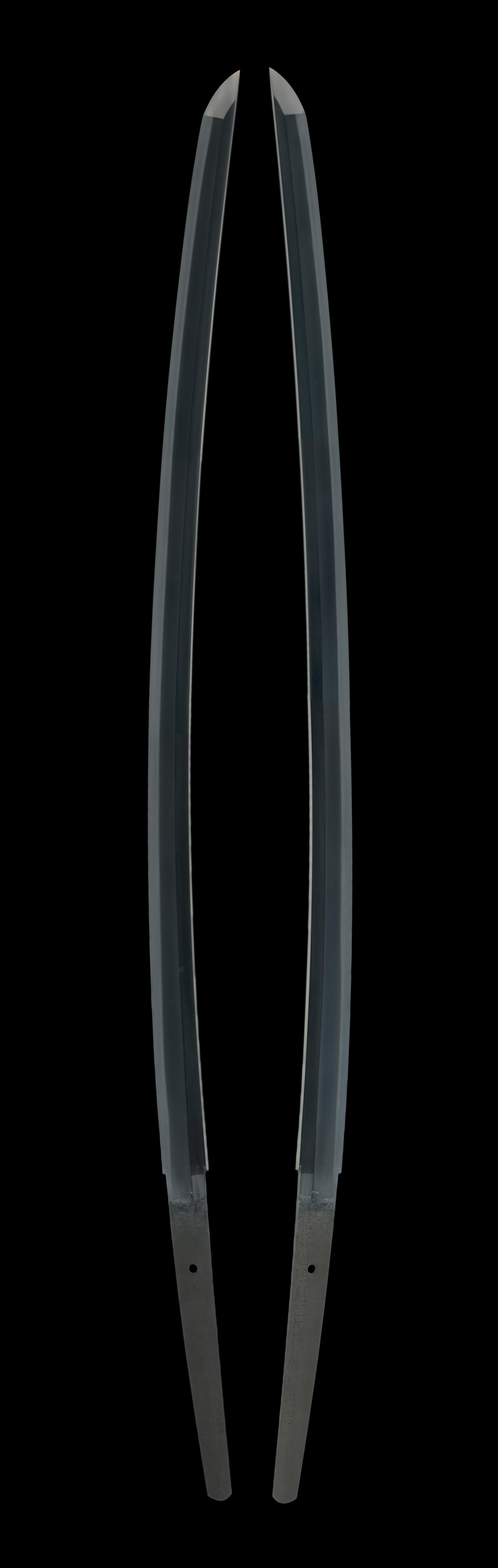
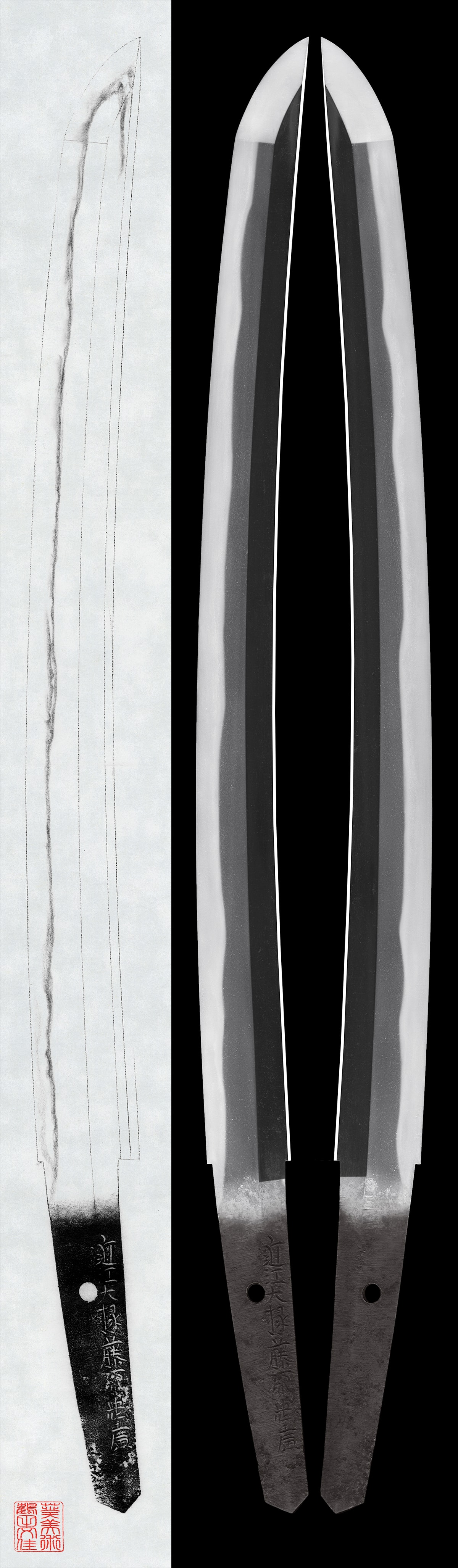
Muneyasu of Province is known from a handful of signed , each cut with a long reading -no- junin Minamoto Muneyasu in a bold, distinctive hand, and on the strength of a single document the published sources now read the name as the earliest signature of a major master. The old reference texts placed him as a disciple of the first-generation Iyo-no-jo: the Bengi allows only that he was 'perhaps a disciple of Iyo-no-jo (the first generation),' and the Ichiran and the Kokon Kajibiko repeat the formula. The prevailing view today, however, holds that 'Muneyasu' was the initial name used by the second-generation Iyo-no-jo Munetsugu himself, an interpretation corroborated by a surviving naming warrant recording that the domain lord Nabeshima Katsushige bestowed the name Muneyasu on the ninth day of the ninth month of 'ei 9, in 1632. The published record of the 33rd, 52nd and 70th sessions states this plainly: 「今日の通説では二代伊予掾宗次の初銘とされている」. These few blades therefore stand at the head of one of the school's distinctive lines, made before their author took the name by which his mature work is known.

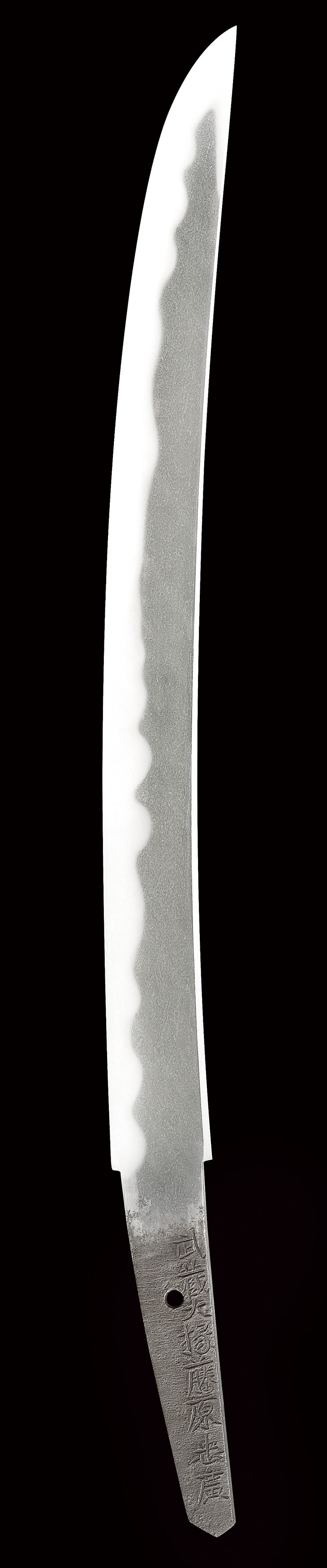
Within the school, whose mainstream is built on a fine drawn over the closely packed konuka-, the Iyo-no-jo Munetsugu line worked apart in the -, and the Muneyasu blades show that manner already formed. The hand most readily named in them is the conspicuous pointed set within a varied . The published commentary ties this directly to the model the line worked from: the first-generation Munetsugu customarily took old as his standard, 「初代は古作志津辺を範としたものが常で」, and made pointed elements a feature of his , and the 52nd-session is judged to mix into the in the way, sharing a workmanship range with the first generation in both and . The base of the temper is a present on every survival, over which ride , , the pointed and at times large or a --like edge; the runs wide, and enter well, the is deep and bright, and the adheres thickly with here and there a coarser .

The is an that packs closely and in places stands, mixed with and , the thick and at times extremely fine, with entering well, the steel overall well consolidated and of excellent quality. Across this the activity of the temper is full: and appear faintly, runs through the , and small -like mingle near the , with on one piece. The runs and turns in with a rather long , the point vigorously brushed with and strongly laden with , on the widest blade rounding in a Jizo-like manner. The 70th-session , whose is read as fine mixed with and presenting an impression of excellent steel, is described as bright in the and softened by thick , the activity within the temper carrying 'an unforced, natural taste reminiscent of older work,' 「古作を思わせるような自然な味わい」, in which the published sources discern 'the high level of skill of this maker,' 「本工の高い技術が窺える」.

The surviving works are uniform in form and in signature. All are of with , the body ranging from standard to somewhat wide; on the deeper-curved pieces the is full, while the wider, fuller-bodied blade carries a shallow curvature and an elongated , and one is given a notably thick . Every is , finished with a and shallow file marks, and every signature is the long toward the of the , fine-chiseled yet boldly executed. The published commentary treats the manner of the inscription as itself a marker of the group, noting that from the way the is cut one can clearly perceive the distinctive traits of this line. There is no temporal phase to draw here beyond what the bodies suggest, since the work is read as one continuous - manner aiming at , and the name Muneyasu belongs wholly to the period before the second Munetsugu signature.

What sets the Muneyasu blades apart from the broad run of work is precisely this - orientation, against a school whose name is otherwise a byword for refined . The distinction is carried by his own grounded traits rather than by contrast: the bright deep on a notare base, the conspicuous , the rich activity of and , and the long-returning are the features that locate him within the Munetsugu line and away from the mainstream. The published sources are careful with the man behind the name. The 25th-session record preserves an old view that Muneyasu was the person as a smith named Masatsugu, but notes there is no material to substantiate it, while affirming that he was, at the least, a smith with the closest ties to the first-generation Iyo-no-jo Munetsugu. The modern reading resolves the question by the 'ei 9 warrant, making these the early works of the second generation, and the documentary value of that resolution is part of why the blades are prized.

The record is small and entirely at the level of : four , all signed, none raised to a higher designation, and none carrying a recorded provenance. Within that compass each is judged a superior piece among the scant survivals of the name. The 25th-session is called a superior work among the few by this smith and 'rich in spirited vigor,' 「覇気に富んでいる」; the 70th-session , designated as recently as 2024, is held to be a valuable reference piece that will greatly contribute to research on the Munetsugu line, a group the published sources say occupied a distinctive position within blades. For a collector the consequence is plain. These are not blades that pass often, the known examples being few and held rather than traded, and a Muneyasu-signed is encountered only from time to time and with patience; when one does appear it is valued twice over, for the quality of a vigorous - and for the inscription that documents the earliest hand of the second Iyo-no-jo Munetsugu.

Kantei

one Soshu-den manner of the Kan'ei years aiming at old Shizu, carried in a single signed register of long-mei ubu katana, the few survivals all close in make to the first-generation Iyo-no-jo Munetsugu

Muneyasu is the early signature of the second-generation Iyo-no-jo Munetsugu of Hizen, the name the domain lord Nabeshima Katsushige bestowed on the ninth day of the ninth month of Kan'ei 9 (1632); the surviving works are few, all signed katana cut with a long mei reading Hizen-no-kuni junin Minamoto Muneyasu in a distinctive bold hand. Within the Hizen school, founded on the suguha-konuka-hada of the Tadayoshi line, these blades stand apart for taking the Soshu-den as their model: over an itame that packs closely and at times stands, with ko-itame and nagare-hada mixed, thick fine ji-nie and chikei entering well, he hardens a varied midareba based on notare with gunome, conspicuous pointed togariba, ko-notare and large gunome, the nioiguchi deep and bright, ko-nie thick with occasional coarse nie, kinsuji, sunagashi, yubashiri, tobiyaki and muneyaki appearing. The boshi runs midare-komi to ko-maru with a long return and vigorous hakikake, at times Jizo-like. The published sources read this manner as continuous with the first-generation Munetsugu, who customarily took old Shizu as his model and made togariba conspicuous within his midare.

Diagnostic discriminators

75% of his works

100% of his works

75% of his works

75% of his works

Observation by phase

Prime manner: Soshu-den midareba aiming at old Shizu, with conspicuous togariba

The katana are shinogi-zukuri with iori-mune, the body ranging from standard to somewhat wide, the kasane moderate to thick, the sori deep on the earlier-feeling pieces and shallow with an elongated chu-kissaki on the wider, fuller-bodied ones, the nakago ubu with kurijiri and shallow katte-agari file marks. The kitae is itame that packs closely and in places stands, mixed with ko-itame and nagare-hada, ji-nie adhering thickly and at times extremely fine, with chikei entering well, the steel overall well consolidated and of excellent quality. The hamon is a varied midareba: notare as the base, mixed with gunome, conspicuous pointed togariba, ko-notare, ko-gunome and at times large gunome and a gunome-choji-like edge, the yakihaba wide, ashi and yo entering well, the nioiguchi deep and bright, ko-nie thick with here and there coarser nie, kinsuji and nie-suji slight, sunagashi appearing, and small yubashiri-like tobiyaki mingling near the yakigashira, on one piece muneyaki as well. The boshi runs midare-komi and turns in ko-maru with a rather long kaeri and vigorous hakikake, at times rounding in a Jizo-like manner, at times tending to point. Horimono are absent. The signature is a long mei toward the mune of the sashi-omote, cut with a fine chisel yet boldly, in a hand the published sources call distinctive to this line.

Sugata 姿
Jigane 地鉄
Hamon 刃文
Bōshi 帽子
Signed long-mei ubu katana (Hizen-no-kuni junin Minamoto Muneyasu)— every survival is an ubu katana cut with a long mei reading Hizen-no-kuni junin Minamoto Muneyasu toward the mune of the sashi-omote, fine-chiseled yet bold in a hand the records call distinctive to this line; the inscription's manner is itself read as evidence of the group
長銘cho-mei
Scholarship

The old reference texts treat him as a disciple of the first-generation Iyo-no-jo: the Shinto Bengi says perhaps a disciple of Iyo-no-jo (the first generation), and the Shinto Ichiran and Kokon Kajibiko likewise call him a disciple of Iyo-no-jo.

The prevailing view today holds Muneyasu to be the early signature of the second-generation Iyo-no-jo Munetsugu, corroborated by a naming warrant recording that the domain lord Nabeshima Katsushige bestowed the name Muneyasu on the ninth day of the ninth month of Kan'ei 9.

The first-generation Munetsugu customarily took old Shizu as his model and made conspicuous pointed togariba a hallmark within his varied midareba; the 52nd-session katana is judged to share a workmanship range with the first generation, mixing togariba into the midare in the same manner.

One view recorded in the 25th-session text holds Muneyasu to have been the same person as Masatsugu, but the published record notes there is no supporting material to substantiate it, while affirming he was a smith with the closest ties to the first-generation Iyo-no-jo Munetsugu.

Designations

Kokuhō—
Jūyō Bunkazai—
Jūyō Bijutsuhin—
Gyobutsu—
Tokubetsu Jūyō—
Jūyō Tōken4

Elite Standing

0.02 across 4 designated works

Top 28% among smiths

Blade Forms

Distribution across 4 ranked works

Signatures

Signature types across 4 ranked works

Currently Available

Hizen Tadayoshi School

Other artisans of the Hizen Tadayoshi school

  1. 1.Tadayoshi忠吉8 for sale125designated
  2. 2.Tadayoshi忠吉4 for sale60designated
  3. 3.Tadahiro忠廣7 for sale169designated
  4. 4.Tadakuni忠國1 for sale32designated
  5. 5.Masahiro正廣3 for sale32designated
  6. 6.Masahiro正廣4 for sale24designated
  7. 7.Yukihiro行廣1 for sale16designated
  8. 8.Yoshiie吉家4designated
  9. 9.Yoshinobu吉信4designated
  10. 10.Yoshifusa吉房3designated
  11. 11.Tadakuni忠國1 for sale3designated
  12. 12.Hironori廣則3designated