
Meihin MuseumNo. 3
The Hercules Tsuba
First-generation Hōan 法安 (NBTHK paper: Jingo 甚五)
Formerly in the collection of Prime Minister Count Terauchi
Particulars
- Maker
- The first-generation Hōan 法安, in the museum’s study. Akiyama Kyūsaku judged it Hōan (c. 1907), Wada Tsunashirō recorded it as Hōan’s (1913), and Ogura Sōemon named it among the masterpieces of the first-generation Hōan (1925); the NBTHK paper attributes it to Jingo 甚五, in the form reserved for the first and second masters
- Type
- Tsuba, iron, openwork
- Period
- Momoyama to early Edo period, c. 1590–1640
- Measurements
- Height 7.65 cm, width 7.44 cm; rim 0.54 cm thick
- Papers
- Tokubetsu Hozon Tōsōgu, NBTHK, 2025
- Collection
- Private collection
An unsigned iron tsuba pierced with eight Roman capitals: HERCULES. It was made between about 1590 and 1640, in Japan’s first age of contact with Europe. It is the guard that the connoisseur Akiyama Kyūsaku examined in late Meiji, and that Ogura Sōemon named among the masterpieces of the first-generation Hōan.
Eight letters
Eight capitals run round the plate of this iron guard. They are not engraved on its surface: they are the openwork itself, left standing in the iron with their serifs, and together they make the ring that holds the centre of the guard to its rim. Read clockwise from the top, they spell HERCULES, the Latin name of Hercules.
The plate is a square with softened corners. A broad, rounded rim stands above the thinner pierced ground, so that the weight of the guard lies at its edge and the letters seem to hang in light. The iron is dark and finely textured. Copper lines part of the opening for the tang, and the two smaller openings beside it are closed with dark plugs: the traces of the guard’s fitting to a sword.
Latin in Momoyama Japan
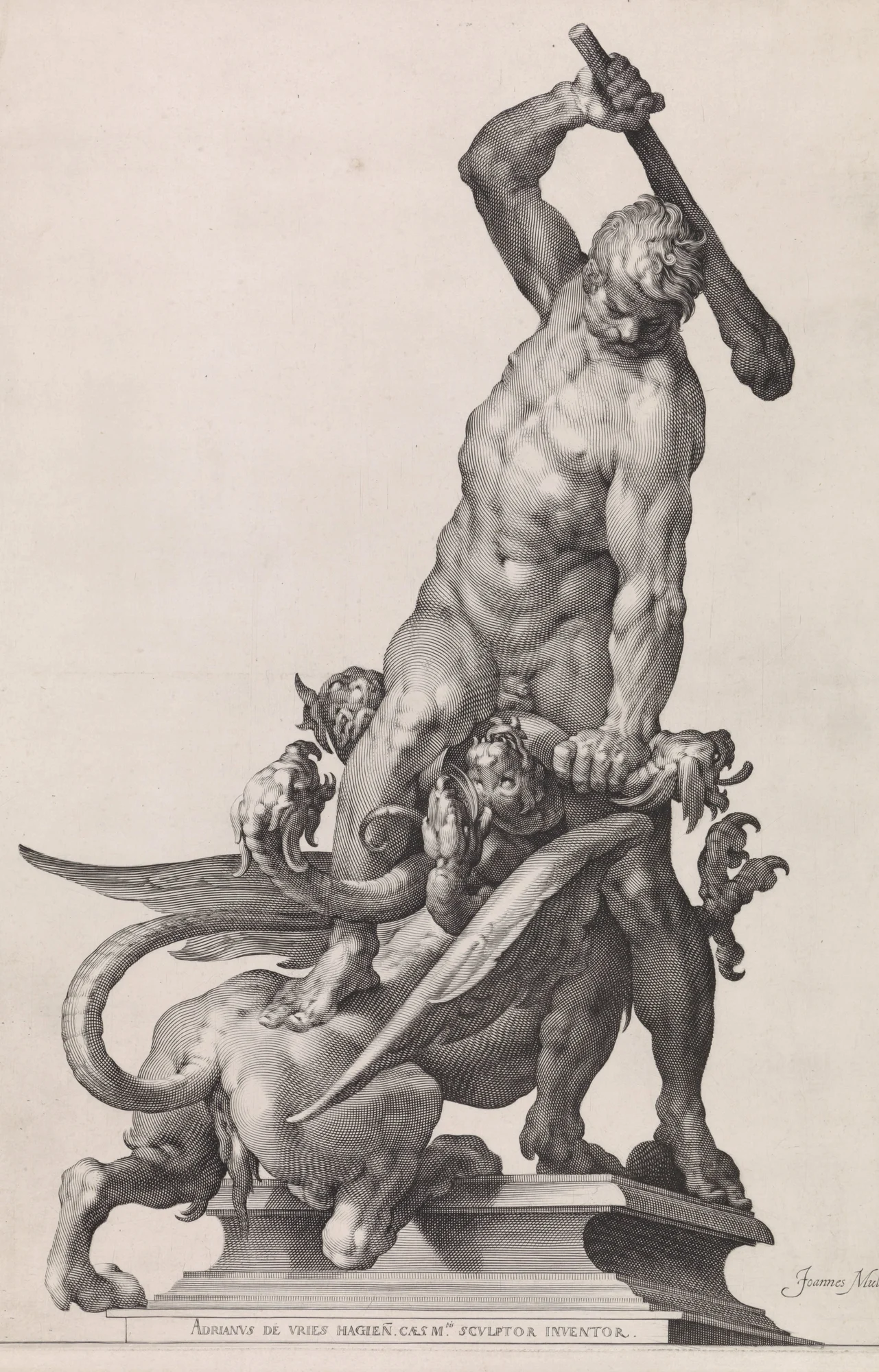
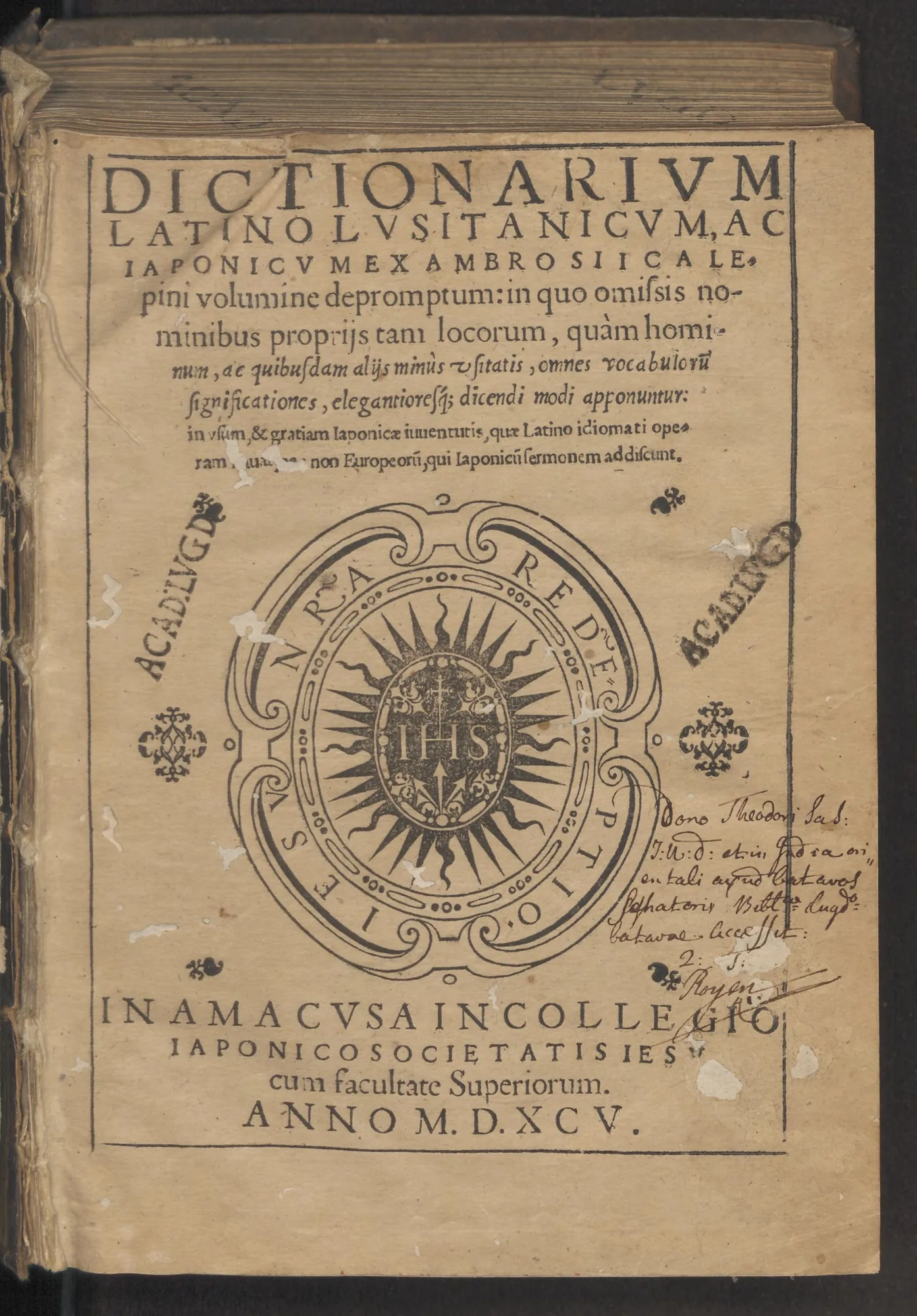
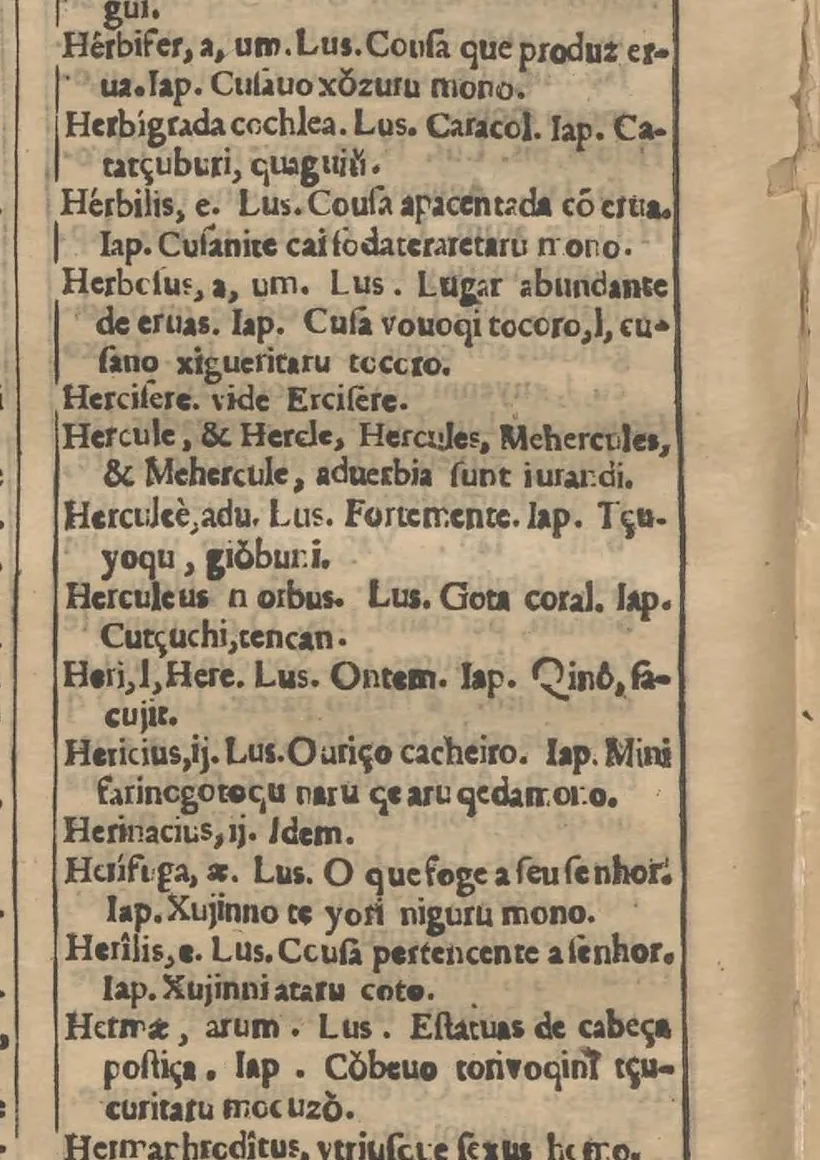
Roman letters were printed in Japan in the last years of the sixteenth century. The press of the Jesuit mission, set up first at Kazusa and then at Amakusa, in Higo, issued books in Latin between 1591 and 1597, among them a Latin grammar in 1594 and a dictionary of Latin, Portuguese and Japanese in 1595; and Virgil’s Aeneid, in which the name of Hercules stands, was probably read in the mission’s seminary. It is the world in which a word like this one could be read in Japan, and it is offered here as that: the context of the guard, not the source of its design.1
The guard can be dated by that world. Roman letters could be known and copied in Japan only in the Christian century: the mission brought its press to Japan in 1590, the expulsion edict of 1614 ended its printing, and the expulsion of the Portuguese in 1639 closed that world; in Higo, Roman-letter seals were given up in 1648. Its letters are of the kind printed in those years. The guard was made between about 1590 and 1640.2
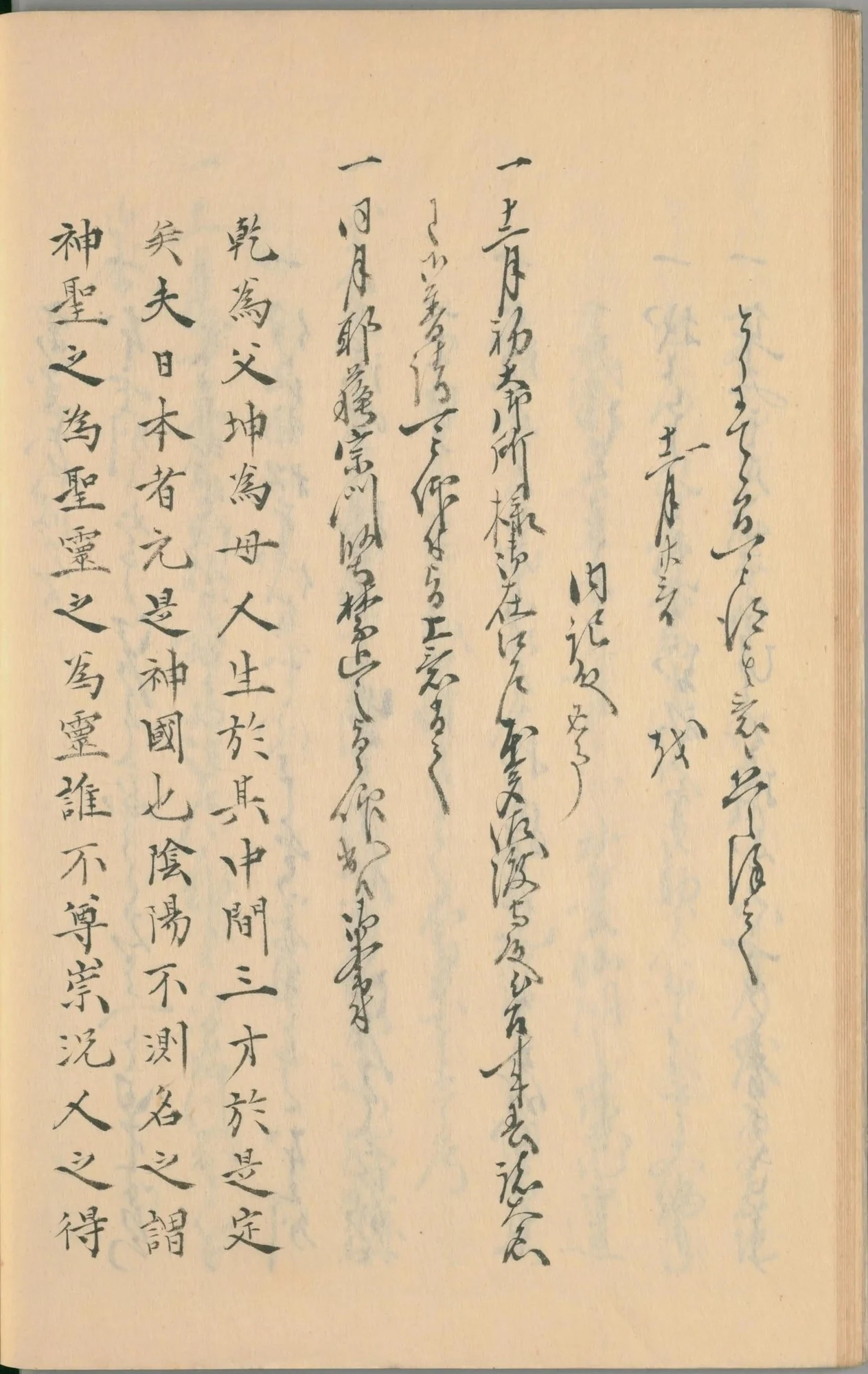
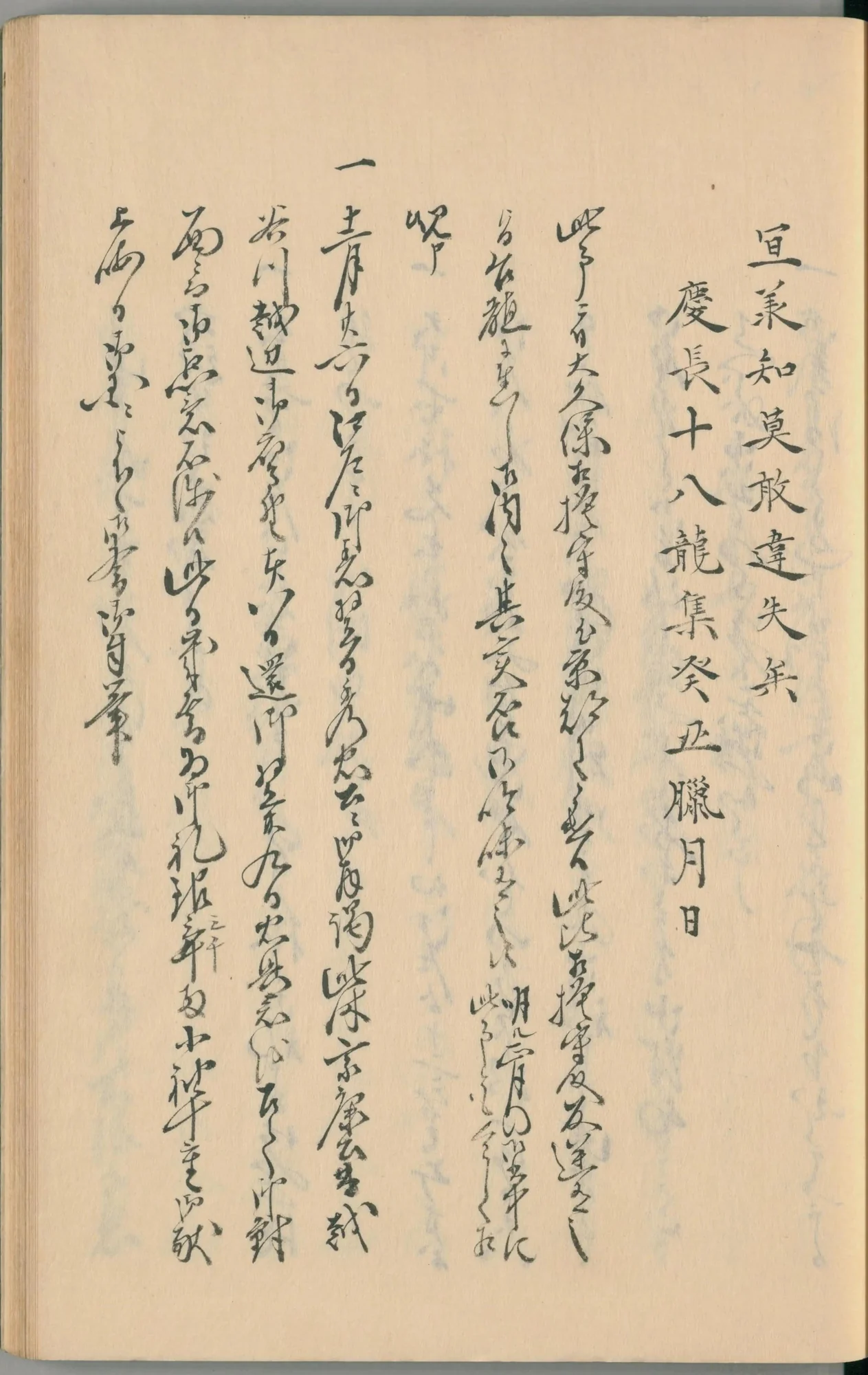
A Latin name in iron
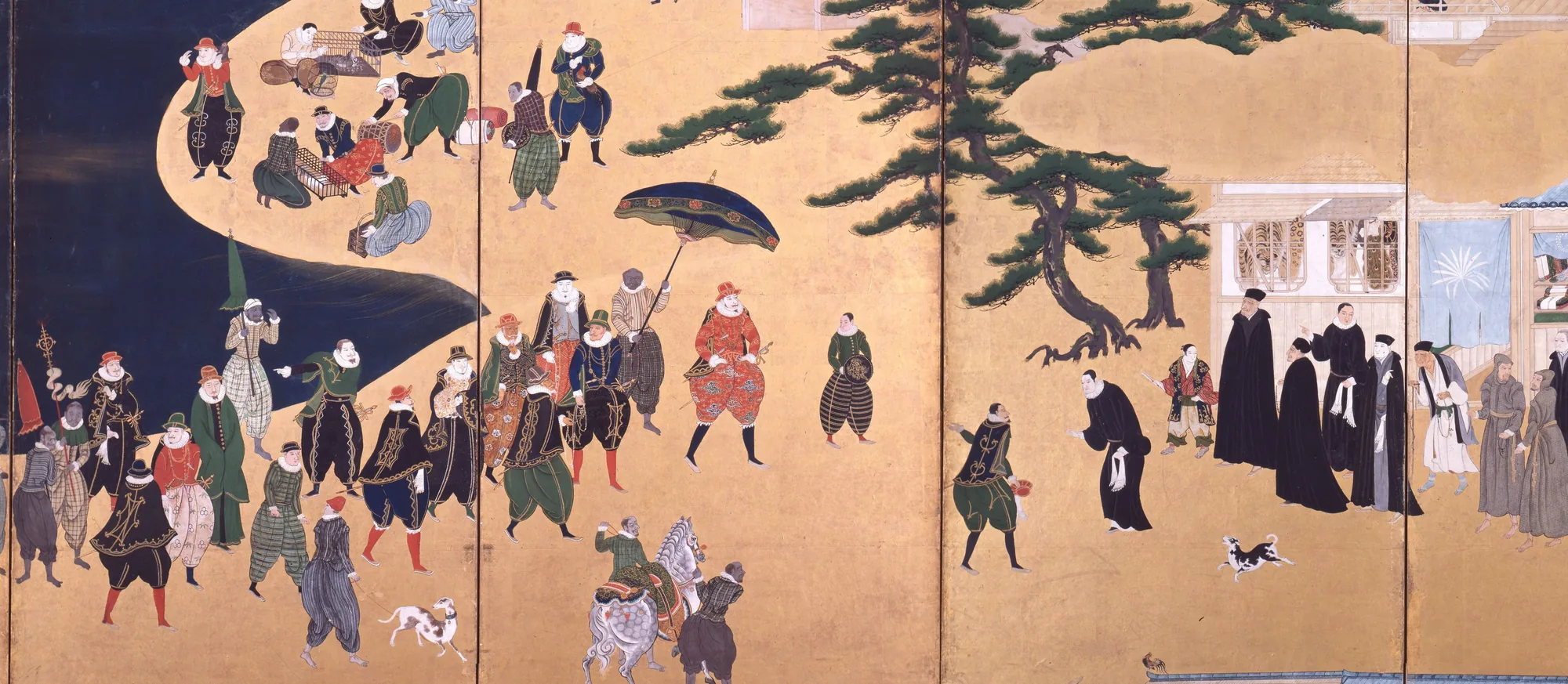
Roman letters came to Japan with the Jesuits, whom Oda Nobunaga took under his protection in 1569 and kept there until his death in 1582. The guard belongs to the afterglow of that world, before the country closed.
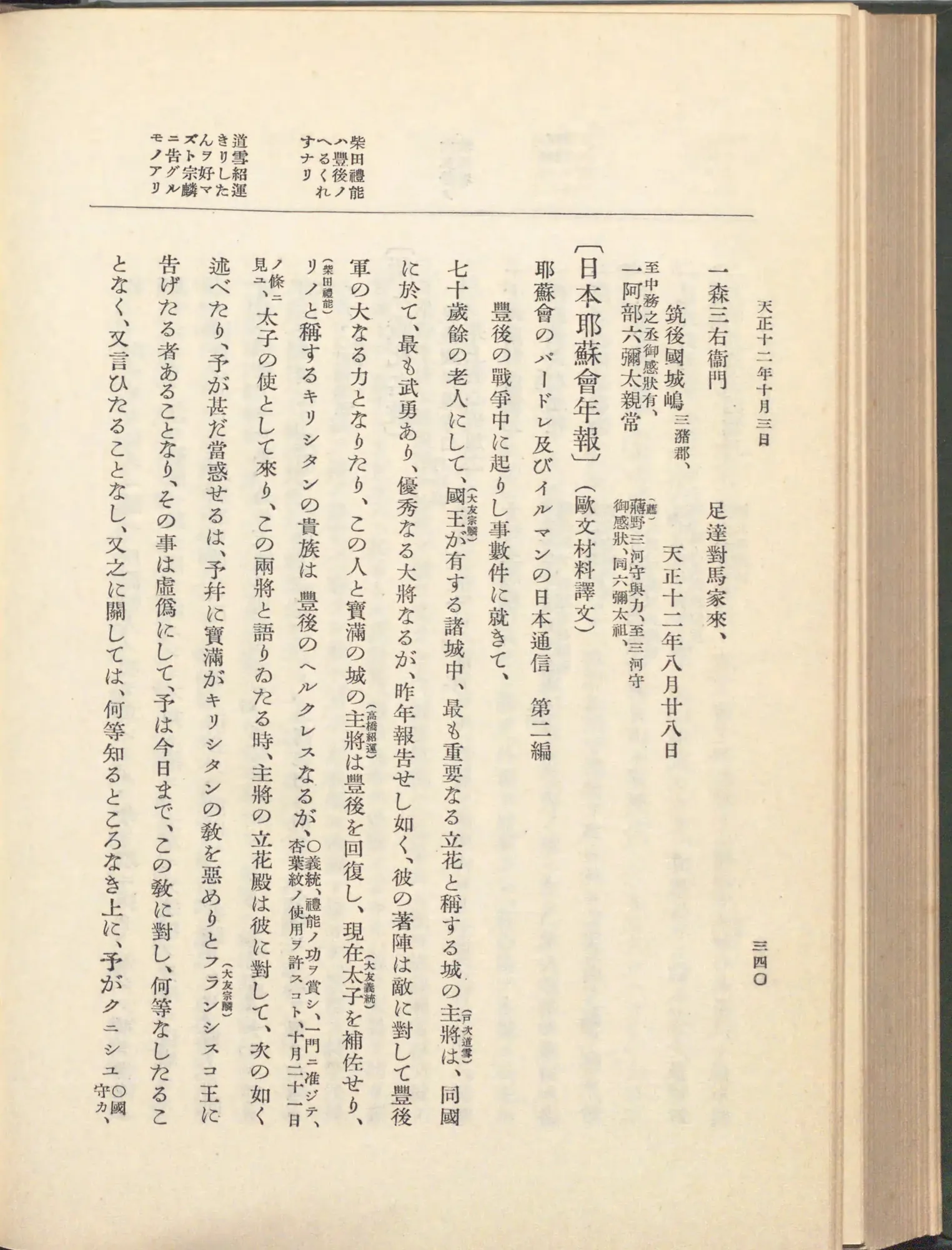
The word itself had reached Japan. In the Jesuits’ letters of the 1580s, it appears, one Japanese Christian was known as “the Hercules of Bungo”: Shibata Reinō, confidant and spear-master of the Christian lord Ōtomo Sōrin. Among the missionaries the name appears to have praised a warrior’s strength; it belonged to no scripture.3
Its capitals are of the kind set on the title pages of the mission’s Latin books, and to the museum their precision suggests a pattern, laid out by someone who knew Roman letters.
Elsewhere on Japanese guards, it appears, Roman letters were chiefly Christian signs, kept for those who could read them: INRI, alpha and omega. Here the word stands in the open, the name of a pagan hero, not a line of scripture. That, Akiyama Kyūsaku would later argue, is how the guard came safely through the years when Christianity was forbidden.4
To the museum it reads as a commission, made for someone who wanted this word in iron, in the decades when nanban fashion, from Portuguese dress to painted screens, ran through the taste of the great. Few things survive in which that first encounter is written so plainly.
Akiyama’s two viewings
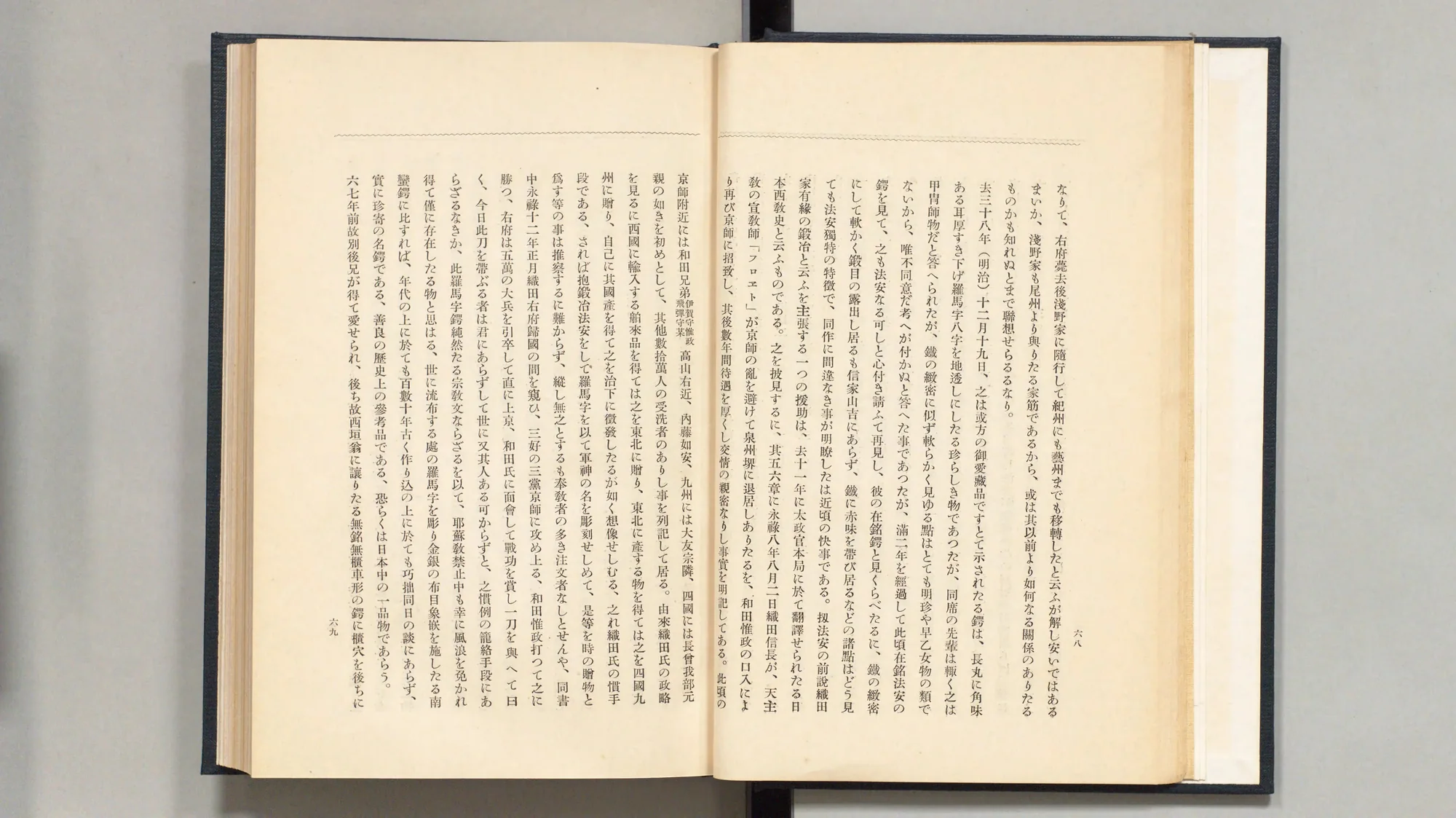
The written record of the guard begins on 19 December 1905. That day the connoisseur Akiyama Kyūsaku was shown a tsuba as “the treasured piece of a certain person”: oblong, with something square in its outline, a thick rim with the ground cut down inside it, and eight Roman letters pierced through the ground. A senior colleague present called it at once the work of an armourer. Akiyama did not agree, though he could not yet say whose work it was.5
「長丸に角味ある耳厚すき下げ羅馬字八字を地透しにしたる珍らしき物」
“A curious thing, oblong with a squared character, the rim thick and the ground planed down, eight Roman letters pierced in the ground.”
Two years later, having seen a tsuba signed by Hōan, Akiyama came to think that the lettered guard was Hōan’s work too. He asked to see it again, set the two side by side, and found them of one hand.
「實に珍寄〔ママ〕の名鍔である、善良の歷史上の參考品である、恐らくは日本中の一品物であらう」
“Truly a rare and celebrated guard, a sound historical reference piece, probably the only one of its kind in all Japan.”
Hōan was a family of tsuba makers. By the accounts that Wada Tsunashirō and Ogura Sōemon carry, its first master, Kawaguchi Saburōemon Hōan, lived in Owari and worked in the circle of Nobuie and Yamakichibei; the family followed the Asano lords to Kai and to Kii, and in 1619 to Hiroshima.6
Akiyama’s account of the second viewing, as Ogura printed it in 1925:
「滿二年を經過して此頃在銘法安の鍔を見て、之も法安なる可しと心付き請ふて再見し、彼の在銘鍔と見くらべたるに、鐵の緻密にして軟かく鍛目の露出し居るも信家山吉にあらず、鐵に赤味を帶び居るなどの諸點はどう見ても法安獨特の特徵で、同作に間違なき事が明瞭したは近頃の快事である」
“A full two years passed; seeing about then a tsuba signed Hōan, it came to me that the other too must be Hōan. I asked to see it again and set it beside the signed guard: iron dense yet soft, the forging grain laid bare, yet not Nobuie or Yamakichi, and carrying a reddish cast: every point, however examined, the trait peculiar to Hōan. That the two are of the same hand became plain: one of the satisfactions of recent days.”
In Count Terauchi’s collection
By 1913 the guard was in the collection of Count Terauchi. That year Wada Tsunashirō, writing of Hōan, described an unsigned iron tsuba by him with the letters “Hercles” pierced in it, and added in small type 寺内伯爵所藏, “in the collection of Count Terauchi”. The print has seven letters, the U lost in setting the type; Akiyama, who had twice held the guard, counted eight.7
「蓋し洋字を鐔に用ひたる濫觴ならん」
“Surely the very beginning of Western letters on tsuba.”
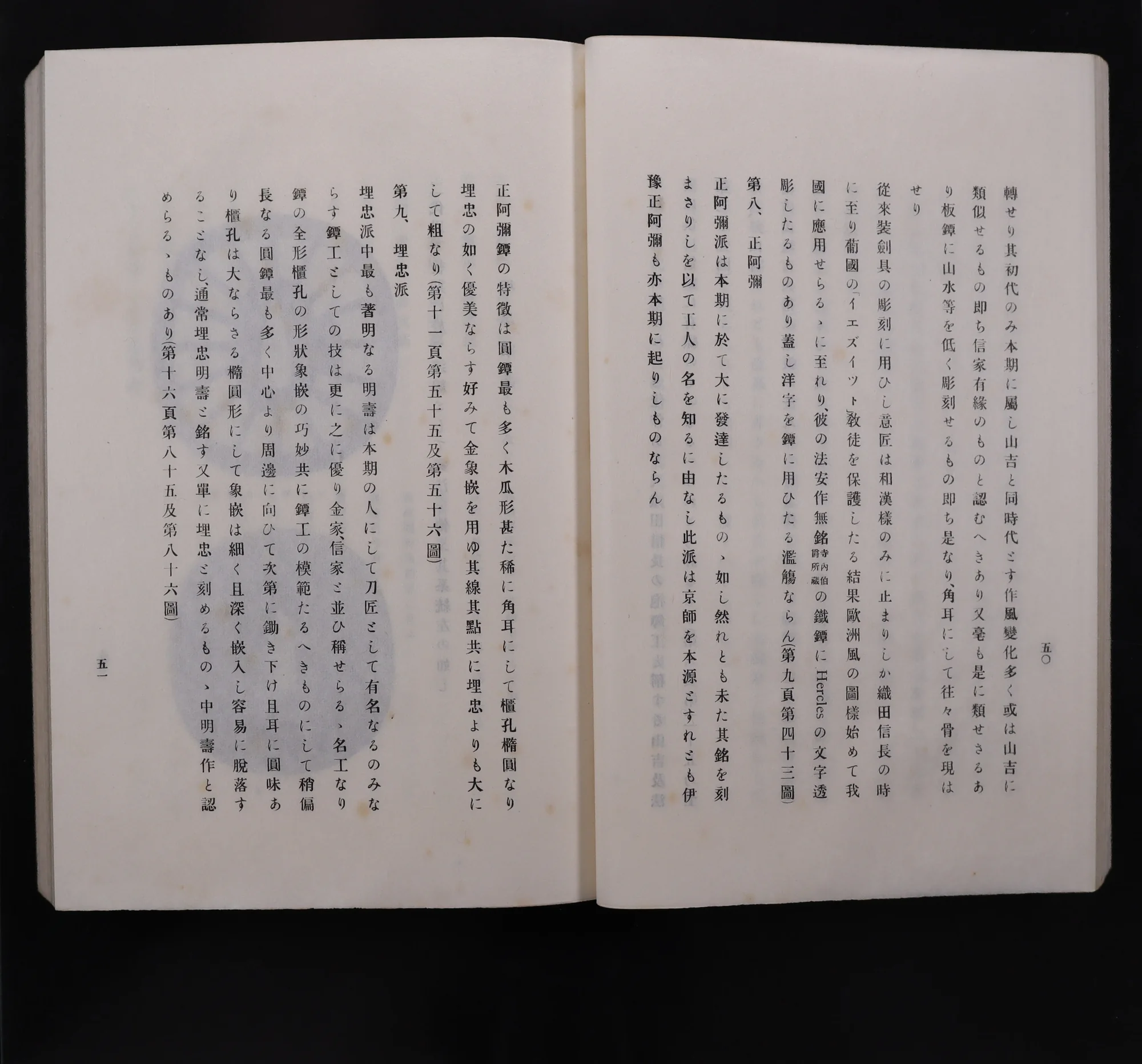
The Count Terauchi of 1913 was Terauchi Masatake (1852–1919), a soldier of Chōshū: Army Minister from 1902 to 1911 and Governor-General of Korea from 1910 to 1916, created count in 1911, field marshal in 1916, and prime minister from 1916 to 1918.
He was also a collector. The private library of the house, which he began and his son and heir Hisaichi opened in Yamaguchi in 1922 as the Ōho Terauchi Bunko, survives in large part at Yamaguchi Prefectural University. Of the house’s fittings, Ogura in 1925 closes his pages on Hōan by naming this guard once more: “a celebrated tsuba of the Terauchi collection”.8
Among the masterpieces of Hōan
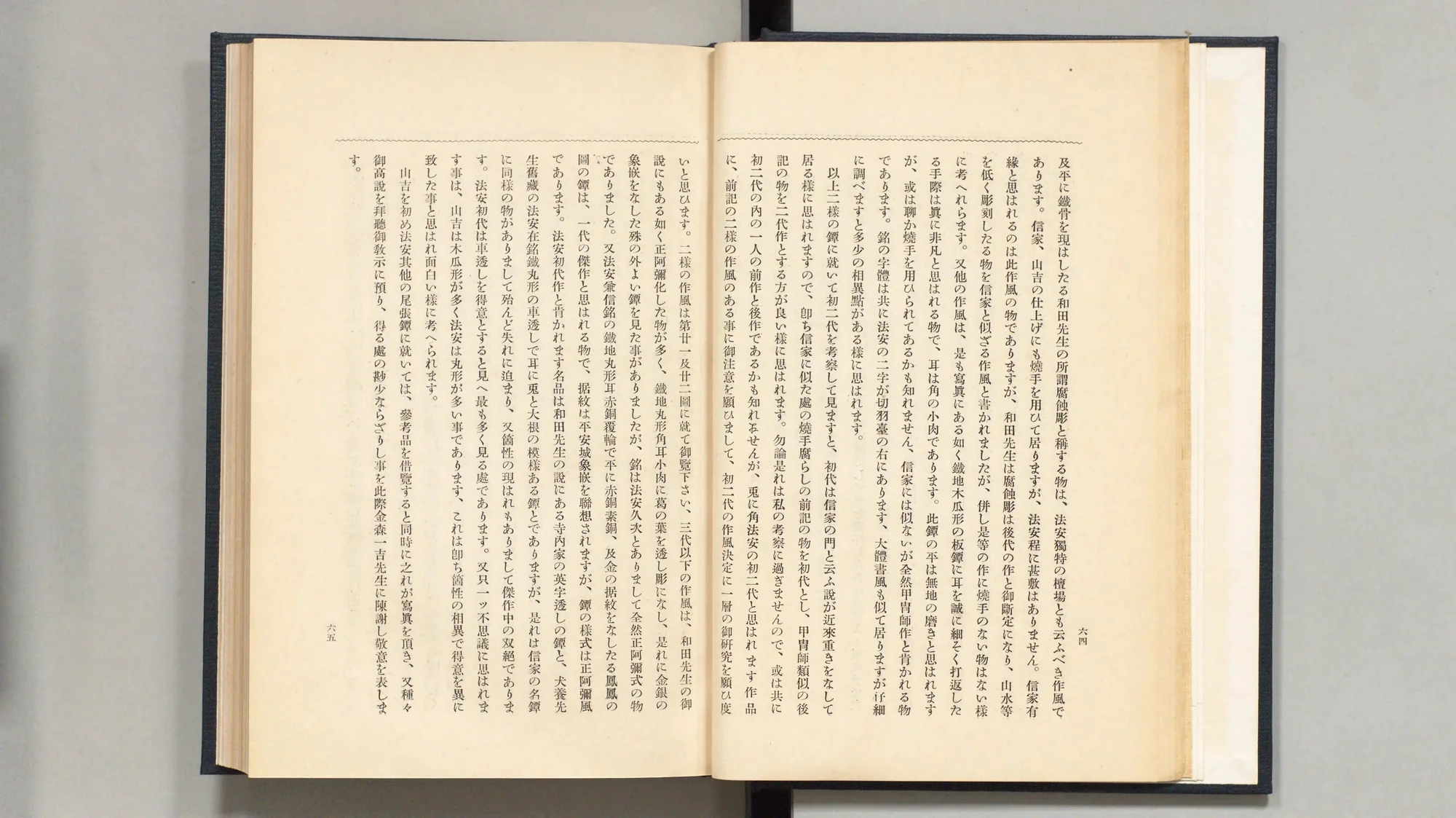
In 1925 Ogura Sōemon, fifth head of the house of Amiya, wrote the chapter on Hōan in his Nihon tsuba tōkō-roku. As the masterpieces accepted as works of the first-generation Hōan he named two guards: “the English-letter openwork tsuba of the Terauchi family”, given in Wada’s account, and a signed round iron guard pierced as a wheel, formerly in the collection of Inukai Tsuyoshi (Bokudō). His words “of the Terauchi family” show the lettered guard still with the house after the count’s death in 1919.9
「法安初代作と肯かれます名品は和田先生の說にある寺內家の英字透しの鐔と……傑作中の双絕であります」
“The masterpieces accepted as works of the first-generation Hōan are the English-letter openwork tsuba of the Terauchi family … the twin unsurpassed pieces among his works.”
Ogura described the guard once more, it appears, in a lecture on sword fittings first printed in 1934–35: an exceedingly finely made tsuba, a square plate with softened corners and a raised rim, with the letters “Hercles” pierced in its ground. With the signed wheel guard, he wrote, it raised Hōan’s name the higher; and of both he added that they seemed to stand at a considerable distance from Hōan’s usual work.10
Over thirty years these accounts agree in every particular with the guard shown here: eight Roman letters pierced in the ground, the name of Hercules, a square plate with softened corners, and a thick rim standing above a lowered ground. The guard of the Terauchi family is this one.
Ogura, 1925:
「法安初代作と肯かれます名品は和田先生の說にある寺內家の英字透しの鐔と、犬養先生舊藏の法安在銘鐵丸形の車透しで耳に兎と大根の模樣ある鐔とでありますが、是れは信家の名鐔に同樣の物がありまして殆んど失れ〔ママ=夫れ〕に迫まり、又箇性の現はれもありまして傑作中の双絕であります」
“The masterpieces accepted as works of the first-generation Hōan are the English-letter openwork tsuba of the Terauchi family, given in Wada-sensei’s account, and the signed Hōan round iron tsuba with wheel openwork and a hare and daikon on the rim, formerly in Inukai-sensei’s collection. The latter has its like among Nobuie’s celebrated tsuba and comes very near to it; and, each showing its maker’s individuality, they are the twin unsurpassed pieces among his masterpieces.”
The guard today
Today the guard carries the papers of the NBTHK, the Society for the Preservation of Japanese Art Swords, as Tokubetsu Hozon Tōsōgu, issued in 2025. The paper names it 英字透鐔, an openwork tsuba of Western letters. Its paper records no history; it attributes the guard, unsigned, to Jingo 甚五, with the characters the NBTHK reserves for the first and second masters of that name. Its pre-war history is the museum’s own research.11
Whose hand
This is the Terauchi guard, and two judgements stand side by side in its history: Hōan, as the connoisseurs who wrote of it between 1907 and 1935 judged it (the first generation, in Ogura’s words of 1925), and Jingo of the NBTHK paper today. The guard is unsigned. What follows is the museum’s own study of the work, weighed against both.
Hōan, the literature records, finished most of his guards with etched relief. “To work a design in low relief by etching is Hōan’s forte,” writes Owari to Mikawa no tsubakō (1983), a study of the tsuba makers of Owari and Mikawa, of plate guards and openwork guards alike; and it adds that “rarely there are pieces with no etched design.” The NBTHK says as much of a tsuba signed Hōan (Jūyō Tōsōgu, 63rd session, designated 17 November 2017): “making full use of his favoured yakite-kusarashi technique, he brings a subtle variation to the flat ground.” The acid eats back the softer iron and leaves the harder standing, in low ridges with softened edges.12
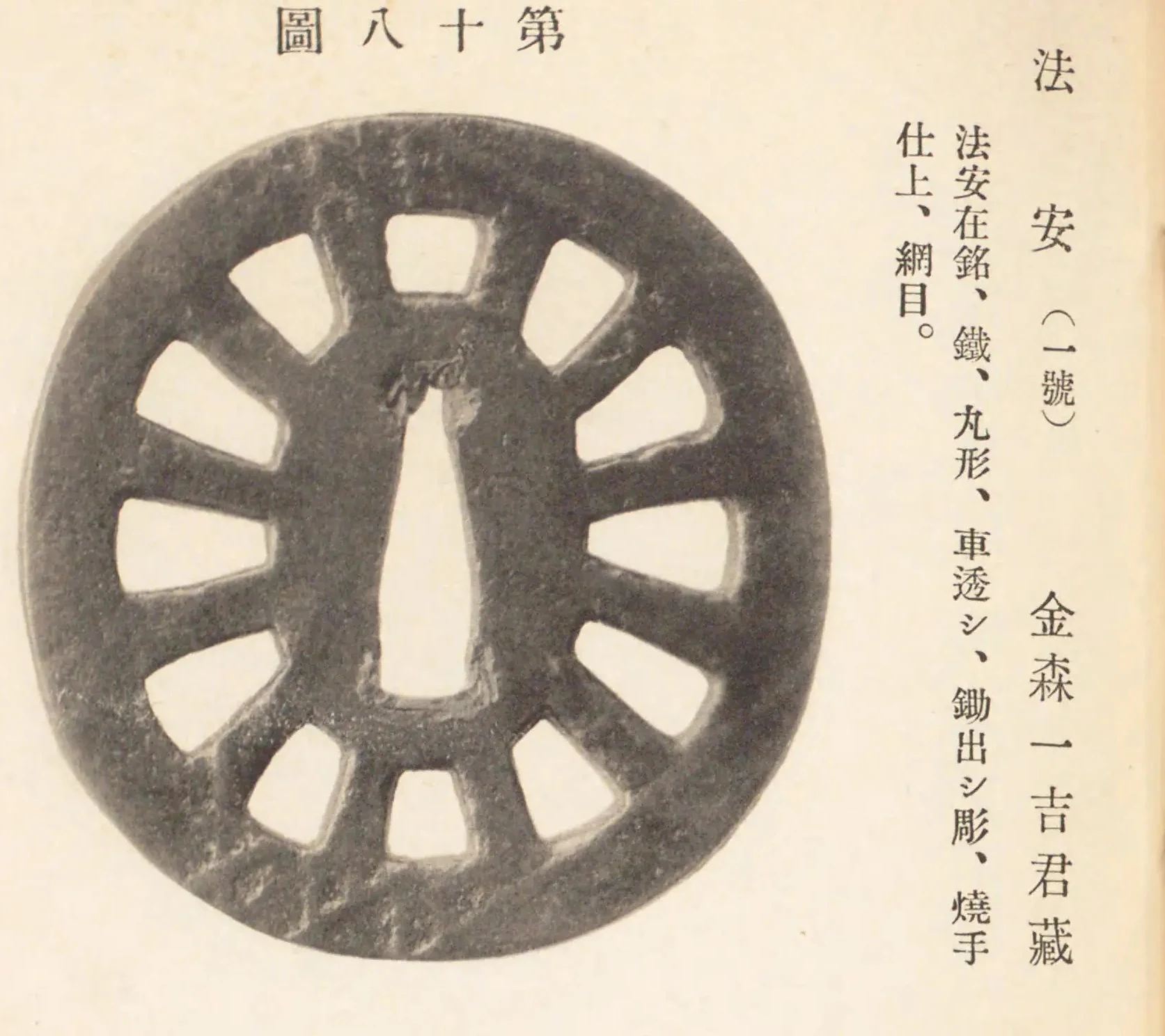
The method is seen at its finest on the other guard of Ogura’s pair. The signed wheel guard formerly in Inukai’s collection, which Ogura set beside this one as the twin unsurpassed pieces among Hōan’s masterpieces, carries a long-eared hare at the edge of its ground: “a long-eared hare in yakite-kusarashi set on the ground at the rim,” as Owari to Mikawa no tsubakō (1983) describes it. It is very probably the guard designated Jūyō Tōsōgu at the NBTHK’s 48th session (2002), whose description records that Hōan “brings out the long-eared hare in his favoured yakite-kusarashi technique.” Ears raised by etching stand as low lines, soft at the edges, a little proud of the iron.13
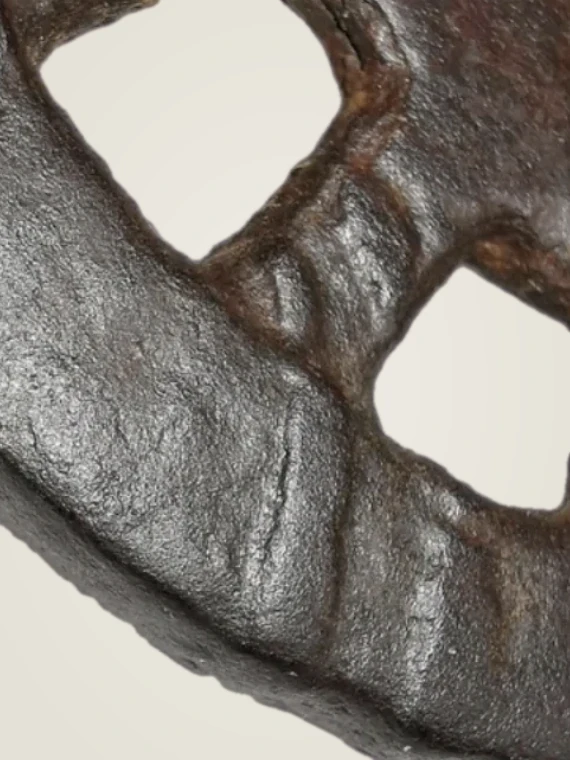
This guard carries no etched design: its letters are plain openwork in hammered iron. Along the rim run the fine linear ridges of tekkotsu, the harder strands of the forged iron that stand slightly proud of the surface. They are natural to the iron, and over most of the rim they are only that: short, broken and uneven.
One line is different. It stands higher, longer and more even than the rest, a single emphatic line along the rim. In the museum’s reading it was brought up by etching, the iron on either side eaten back as it is around a hare’s etched ears: the yakite-kusarashi recorded as Hōan’s forte, turned not to a design but to the iron itself.
In the museum’s reading, the two guards that Ogura paired share that handling. Another signed Hōan wheel guard with a long-eared hare shows it too: the ears are soft-edged ridges raised from the rim, with etched lines running along the rim beside them. Of the likenesses the museum finds, this is the closest, for it is the same method as on signed works.
A second likeness lies in the construction. The letters are anchored to the rim with a small recess where the two meet, so that each seems seated in the rim rather than set against it. On the signed Hōan wheel guard with a long-eared hare shown here, the spokes meet the rim in the same way.
The iron points the same way. It is of the first quality: dense and soft at once, as Akiyama found it, the quality for which the great masters of iron are known. Of the signed guard designated Jūyō Tōsōgu in 2017 the NBTHK writes: “Hōan’s iron is renowned for its tenacity, so much so that it is called uwabami-tetsu, python iron.” To the museum, the iron of this guard has that same dense, tenacious, almost viscous quality. Its colour is reddish, and darker than the iron of the guards known under Jingo’s name.14
Against these stands the paper’s Jingo. The paper’s form allows the first or the second master. The second, Jingorō, was born in 1620 and was twenty at the close of the years in which the guard was made; within those years the paper’s form points rather to the first master, Shimizu Jinbei (1599–1675), who settled in Higo in 1632.15
The guards known under Jingo’s name are bold too, but their boldness lies elsewhere. Again and again the NBTHK’s descriptions of them name one method as his own, unmatched among the makers of Higo: brass applied inlay (shinchū suemon-zōgan), a figure cut separately and set large on the face of a hammered, fired iron plate. The figure is above all an eagle or hawk on pine, the subject the descriptions bind most closely to his name; an owl, a crab or an octopus besides. The reverse is left open, with a crescent moon or the tip of a branch. Openwork is the art of the neighbouring Higo houses, the Hayashi and the Nishigaki, not of Jingo. The two signed guards of the school that the NBTHK has designated with their Higo mountings, both given to the second master, are inlaid too, one in gold and one in brass wire. This guard carries no inlay and no brass. Its boldness is in the iron itself, cut through so that the letters are the whole design.16
In the museum’s study, then, four points stand on Hōan’s side. Akiyama, who knew Hōan’s signed work, set the two guards side by side about 1907 and found them of one hand. The iron has the tenacity the NBTHK records as the mark of Hōan’s, and a reddish colour, darker than Jingo’s iron. Etching, the method recorded as his forte, has raised one line of the rim, as it raised the ears of the hare on the guard Ogura paired with this one. And the letters are seated in the rim as the spokes of a signed Hōan wheel guard are. On the other side stands the paper’s Jingo, which within the dates points to the first master.
Here the museum allows itself a thought, offered as no more than that. The guard was, as the museum reads it, made to order and at the height of the craft, and it was left unsigned. Yet its rim carries that one line, raised by the method its maker’s work is known for. It is tempting to read the line as a signature of a quieter kind: the maker’s mark left in the iron, where a name would have stood.
A paper records a judgement made at a single sitting, among very many works; at that level its attributions are, of necessity, cautious. The museum’s study goes further. On the evidence of the work itself, the museum attributes the guard to the first-generation Hōan.
Provenance
Formerly in the Collection of the House of Count Terauchi
c. 1590–1640
Made in the Christian century, when Roman letters could be known in Japan: seriffed capitals of the kind printed by the Jesuit mission press.
Established
1905
Akiyama Kyūsaku is shown the guard, an iron tsuba pierced with eight Roman letters, and records it as a curious thing.
Established
c. 1907
Setting it beside a signed Hōan, Akiyama judges it the work of the same hand: ‘probably the only one of its kind in all Japan’.
Established
1913
Wada Tsunashirō records the unsigned Hōan tsuba with the letters Hercles in the collection of Count Terauchi.
Established
1925
Ogura Sōemon names the English-letter tsuba of the Terauchi family as one of the two masterpieces of the first-generation Hōan.
Established
1934/35
Ogura describes it again in his lecture on fittings: a rounded-square plate with a raised rim, of very fine work.
Well supported
2025
Designated Tokubetsu Hozon Tōsōgu by the NBTHK, as 英字透鐔, attributed to 甚五 (Jingo).
Established
Notes
- 1Ernest Satow, The Jesuit Mission Press in Japan, 1591–1610 (privately printed, 1888), Preface; Shinmura Izuru, Kirishitan kenkyū yoroku (1948), p. 131 (National Diet Library, pid 1041115, frame 72). ↩
- 2The press, 1590: Satow 1888 and Shinmura 1948. The edict of 1614: Ishin Sūden, Ikoku nikki, in Ikoku nikki shō (1911), pp. 174–175 (National Diet Library, pid 993934, frame 112). The order of 1639: Tokugawa jikki, Taiyūin-den go-jikki, book 41 (1899 printing, p. 31; pid 772999, frame 27), and Tsūkō ichiran, book 183 (1940 ed., vol. 5, p. 25; pid 1908952, frame 18). The seals of Higo, 1648: Kumamoto kinseishi (1970) (pid 9769691, frame 4). ↩
- 3Jūroku-shichi seiki Iezusukai Nihon hōkokushū, series III, vol. 7 (National Diet Library, pid 12281432, frame 43); Frois’s letter of 1 October 1585, printed in Yasokai no Nihon nenpō, vol. 2, p. 151 (pid 1041121, frame 91). ↩
- 4On Roman letters on guards as Christian signs: Abe Akiro, Kirishitan tsuba to sono shōchō (1990) (National Diet Library, pid 13451666, frame 46). Akiyama’s argument is in his account printed by Ogura (1925), pp. 68–69. ↩
- 5Akiyama Kyūsaku’s account, printed in full in Ogura Sōemon, Nihon tsuba tōkō roku (Chūō Tōken Kai, 1925), pp. 68–69 (National Diet Library, pid 1871584, frame 39). ↩
- 6Wada Tsunashirō, ed., Honpō sōken kinkō ryakushi (1913), p. 50 (Shimane University Library, Kuwahara Collection, item 7187); Ogura 1925, pp. 64–65 (pid 1871584, frame 37). ↩
- 7Wada 1913, p. 50, with the interlinear note 寺内伯爵所藏 (Shimane University Library, Kuwahara Collection, item 7187); the passage reprinted in Ogura 1925, pp. 60–61 (pid 1871584, frame 35). ↩
- 8Ogura 1925, pp. 69–71 (National Diet Library, pid 1871584, frame 40). ↩
- 9Ogura 1925, pp. 64–65 (National Diet Library, pid 1871584, frame 37). ↩
- 10Ogura Sōemon, lecture on tsuba makers and fittings, Nihontō kōza, vol. 5, Kodōgu-hen (Yūzankaku, 1934–35), the Hōan section (National Diet Library, pid 1265847, frame 100); in modern wording, Shinpan Nihontō kōza, vol. 6 (1968) (pid 2526253, frame 54). ↩
- 11NBTHK, Tokubetsu Hozon Tōsōgu paper for the work (2025), read from the original document. ↩
- 12Owari to Mikawa no tsubakō (1983) (National Diet Library, pid 12866767, frame 112); NBTHK, Jūyō Tōsōgu, 63rd session, designated 17 November 2017: the description of a tsuba signed Hōan. ↩
- 13Owari to Mikawa no tsubakō (1983) (National Diet Library, pid 12866767, frame 112); NBTHK, Jūyō Tōsōgu, 48th session (2002): the description. ↩
- 14NBTHK, Jūyō Tōsōgu, 63rd session, designated 17 November 2017: the description of a tsuba signed Hōan. ↩
- 15The Shimizu family’s own record of its masters (先祖附写, 1823), transcribed from the Ide documents in Higo kinkō taikan (National Diet Library, pid 8312652, frame 33). ↩
- 16The NBTHK’s descriptions of guards attributed to Jingo; among them Jūyō Tōsō 43-193 (designated 30 October 1997) and 47-269 (designated 11 October 2001), two Higo mountings whose guards bear Jingo’s signature. ↩
Private collection
The presentation
- Presentation
- The Meihin Museum
- Photographs of the guard
- Private collection
- The documents
- National Diet Library; Shimane University Library, Kuwahara Collection; Leiden University Libraries
- Period pictures
- Kobe City Museum; Rijksmuseum, Amsterdam
- The papers
- NBTHK, Tokubetsu Hozon Tōsōgu