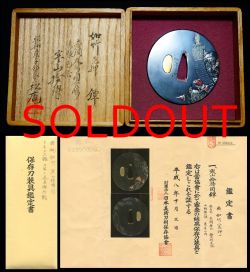
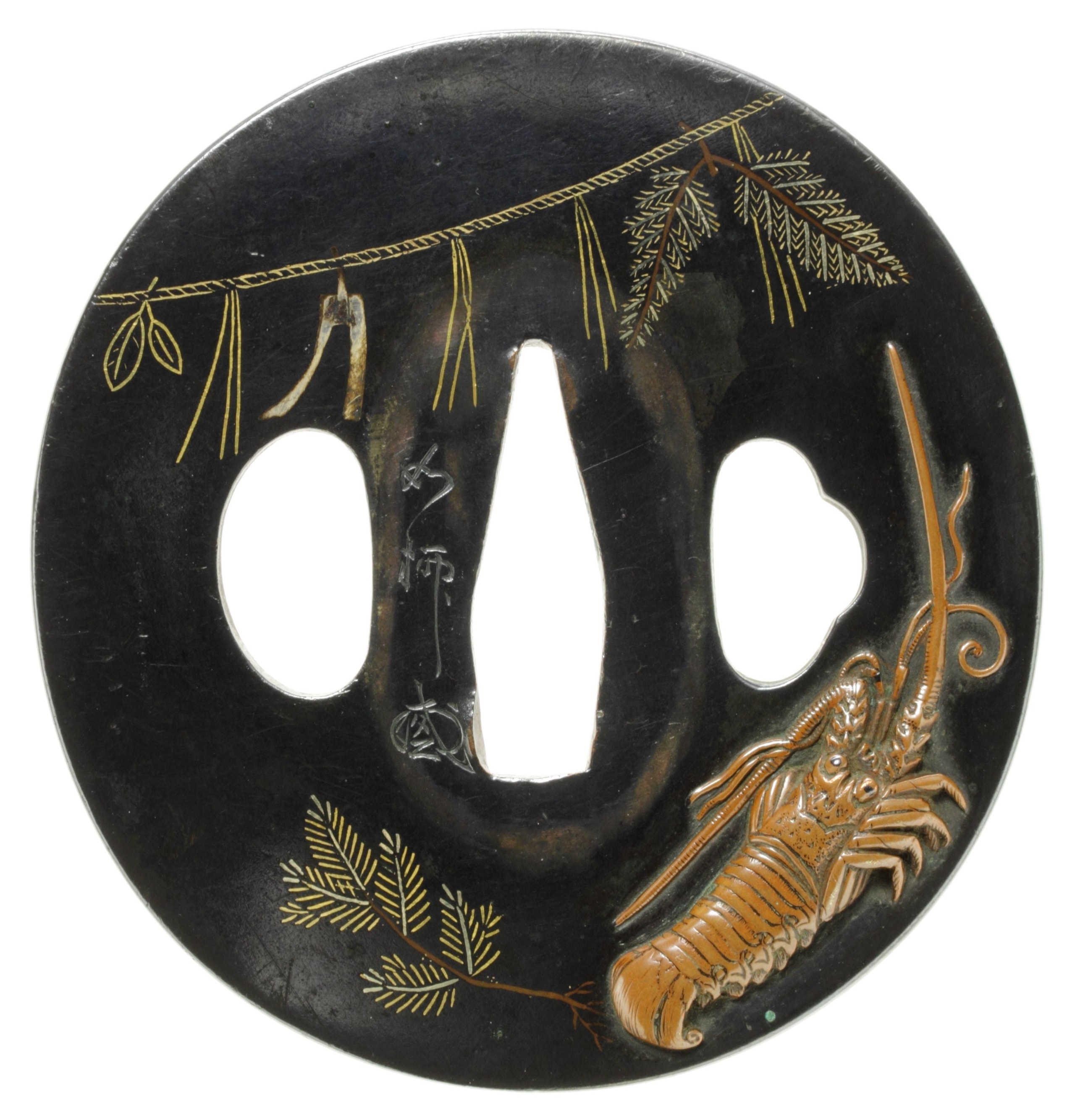
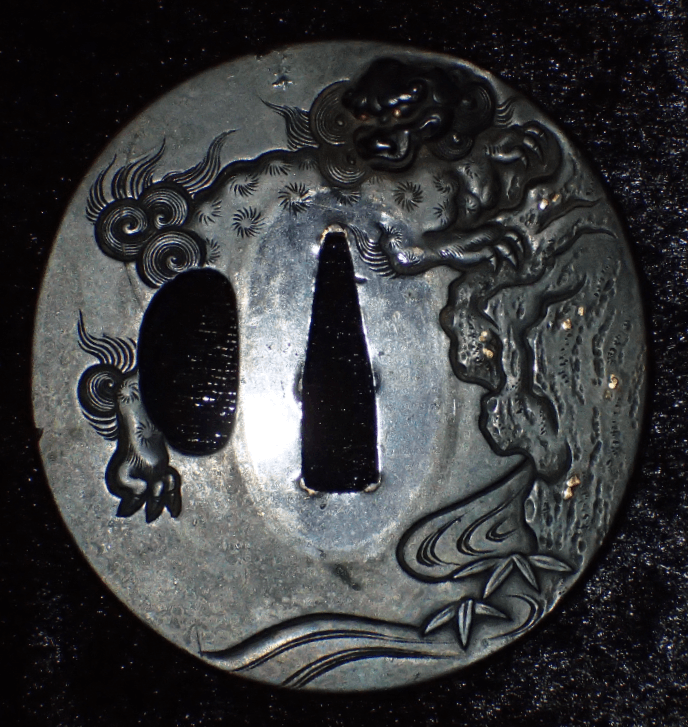
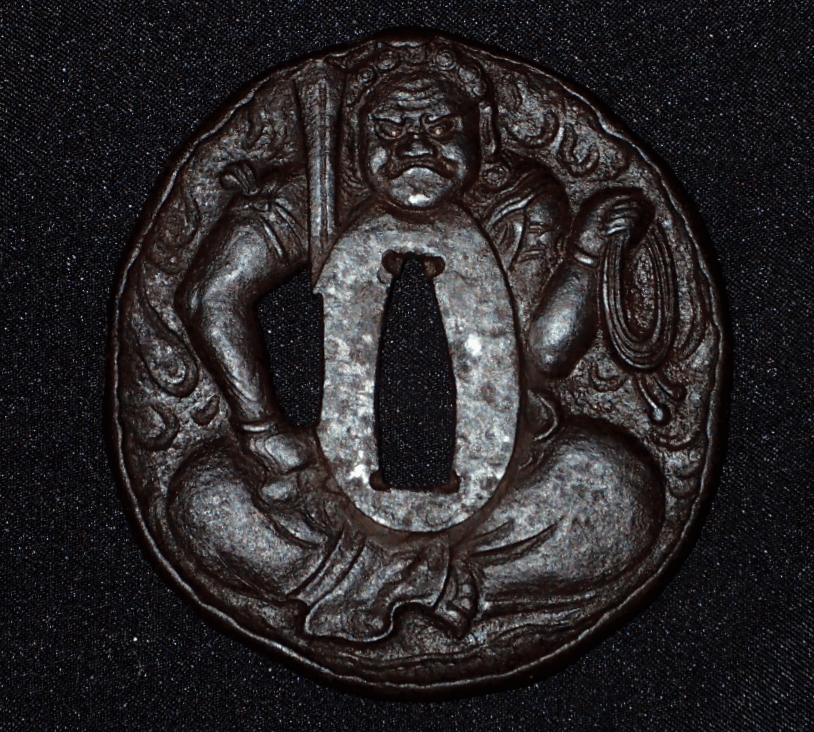
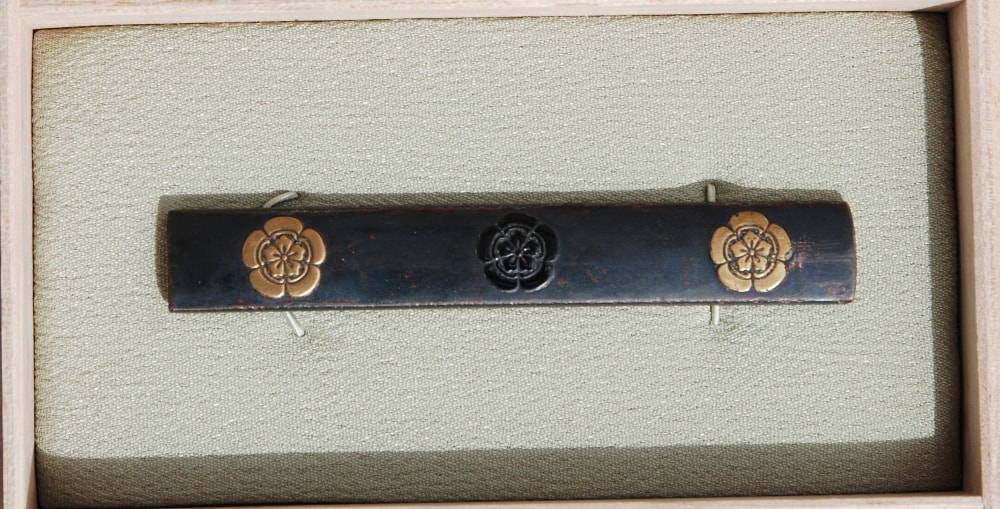
Kanzan Jittoku-zu Tsuba Mei: "Jochiku" with Kao Hozon Tosogu Kanteisho Katamaru-gata, Shakudo Migaki-ji, Sukidashi-bori Iro-e, Kozuka-hitsuan-ume, Kaku-mimi Koniku Length: 74mm, Width: 70mm, Kasane: 4mm, Weight: 139g (All measurements are approximate). With Nippon Bijutsu Token Hozon Kyokai (NBTHK) Kanteisho. This is a famous masterpiece published in the "Nihonto Taikan." It features a box inscription (hakogaki) by Sato Kanzan-sensei and is a truly magnificent masterpiece. Please enjoy it. A sword fitting metal artist of the late Edo period. Lived in Shiba Shinmonzen-cho, Edo, and is estimated to have died between the Tenmei and Kansei eras. His names were Seijiro and Nakanori, and he used the art names Buyozan and Kanshodo. It is said that he initially succeeded his father's profession as an abumi-shi (stirrup maker) but later turned to sword fitting metalwork. His works include the "Tonbo-zu Kozuka," "Nifukujin-zu Tsuba" (both privately owned), and the "Tsurumaru-mon Tsuba" (Tokyo National Museum collection). As the founder of the Murakami school, he is known for a solid style, excelling in takabori as well as katakiri-bori and hira-zogan. He produced many disciples who took names starting with "Jo-," such as his son Josetsu, as well as Joran, Jotoku, and Joryu. 0 Yen (Tax included)
Edo

Murakami Jochiku
Edo
Hozon (NBTHK)
Machibori · around 1670
4 pieces on the market now
Murakami Jochiku lived in Shiba, Edo, active around the Tenmei era (1781--1789). His personal name was initially Nakanori, and he later also signed Mitsunori; he used the art name Kanshodo. He is said to have originally come from a background as an inlay craftsman specializing in stirrups (abumi), and later turned to the work of a metal-fitting artisan, apparently establishing himself without seeking a particular master. The details of his formal training are not clearly known. From the manner of his signatures, his oeuvre can be broadly divided into an early period -- when he signed with the Nakanori seal -- and a mature period under the name Jochiku. Some works bearing the Nakanori seal are recognized as youthful productions on the basis of their powerful manner and signature form.
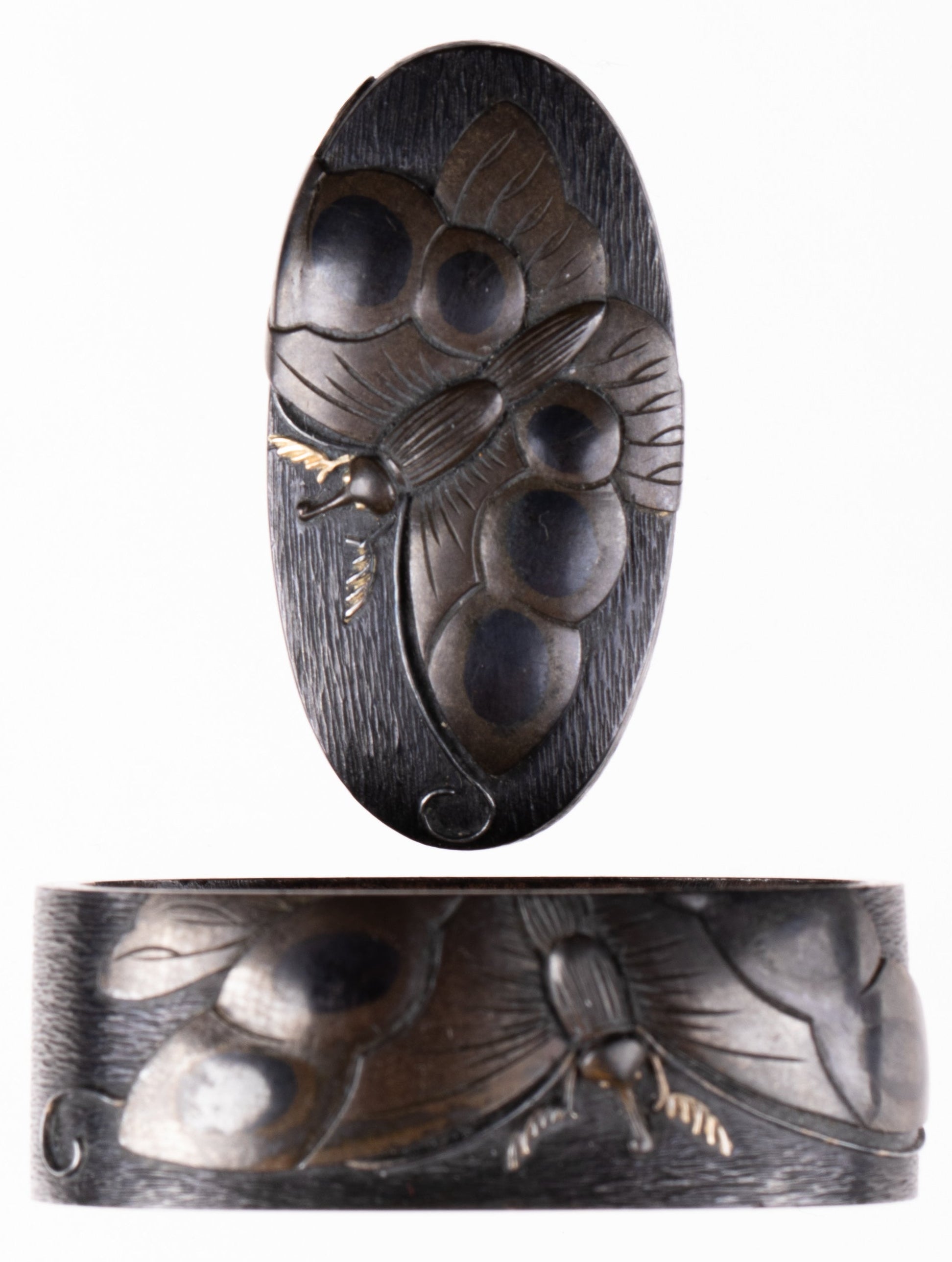
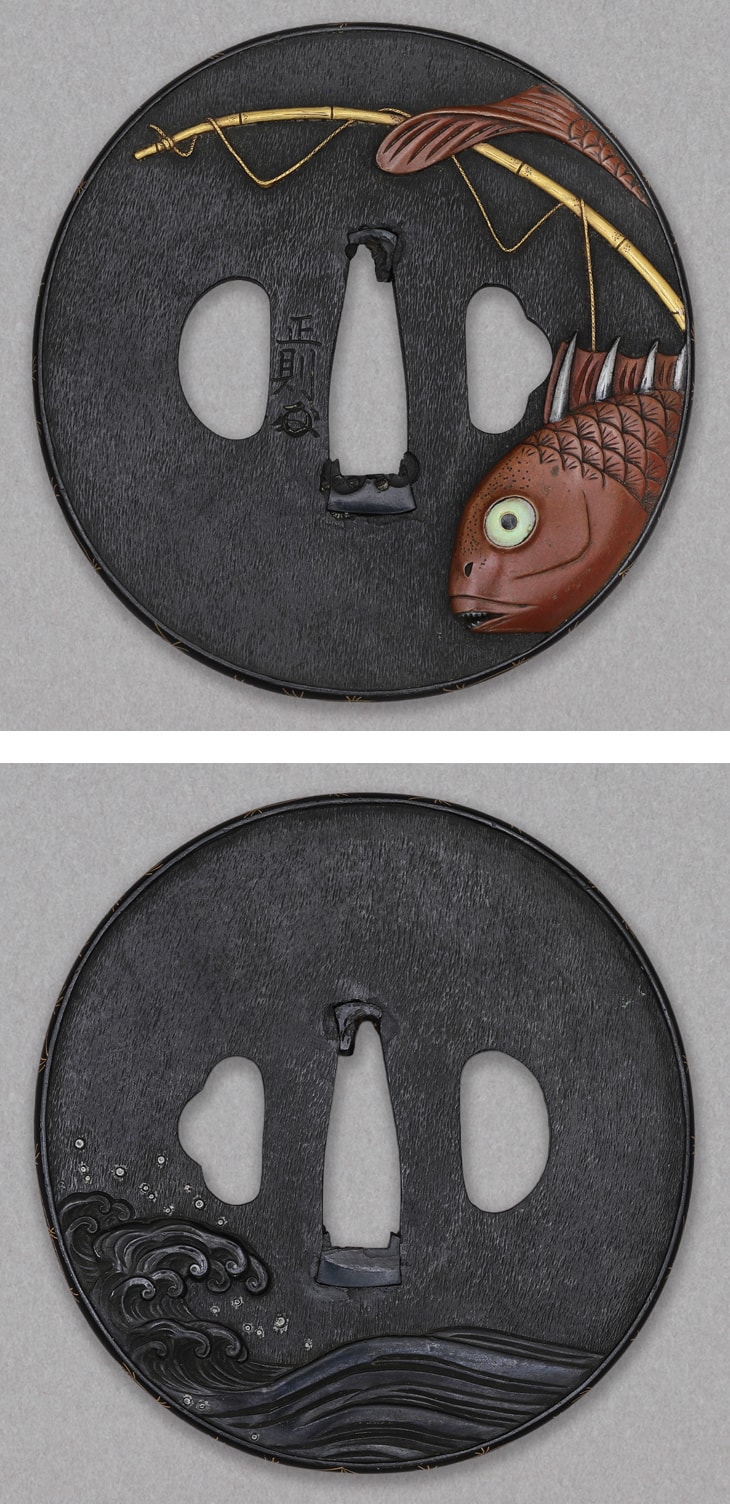
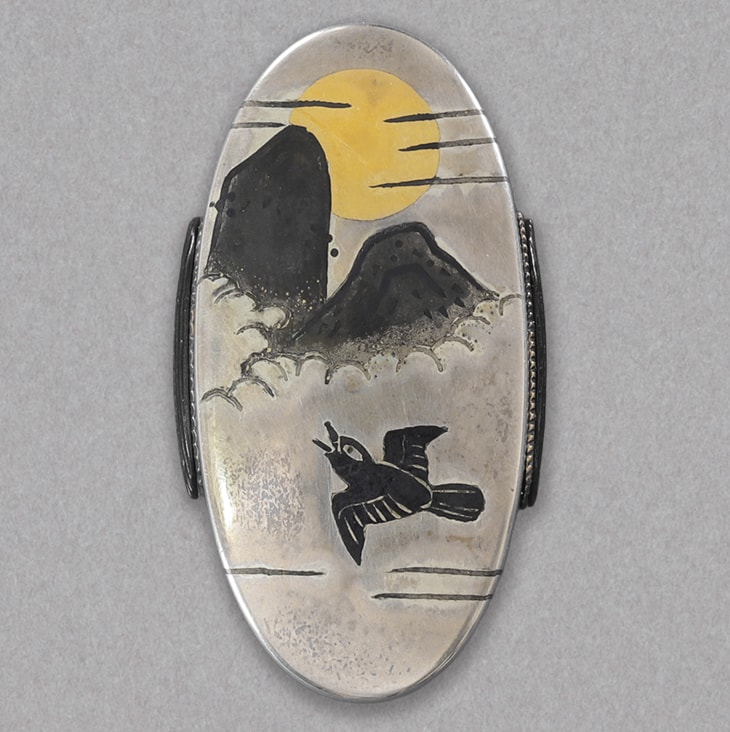
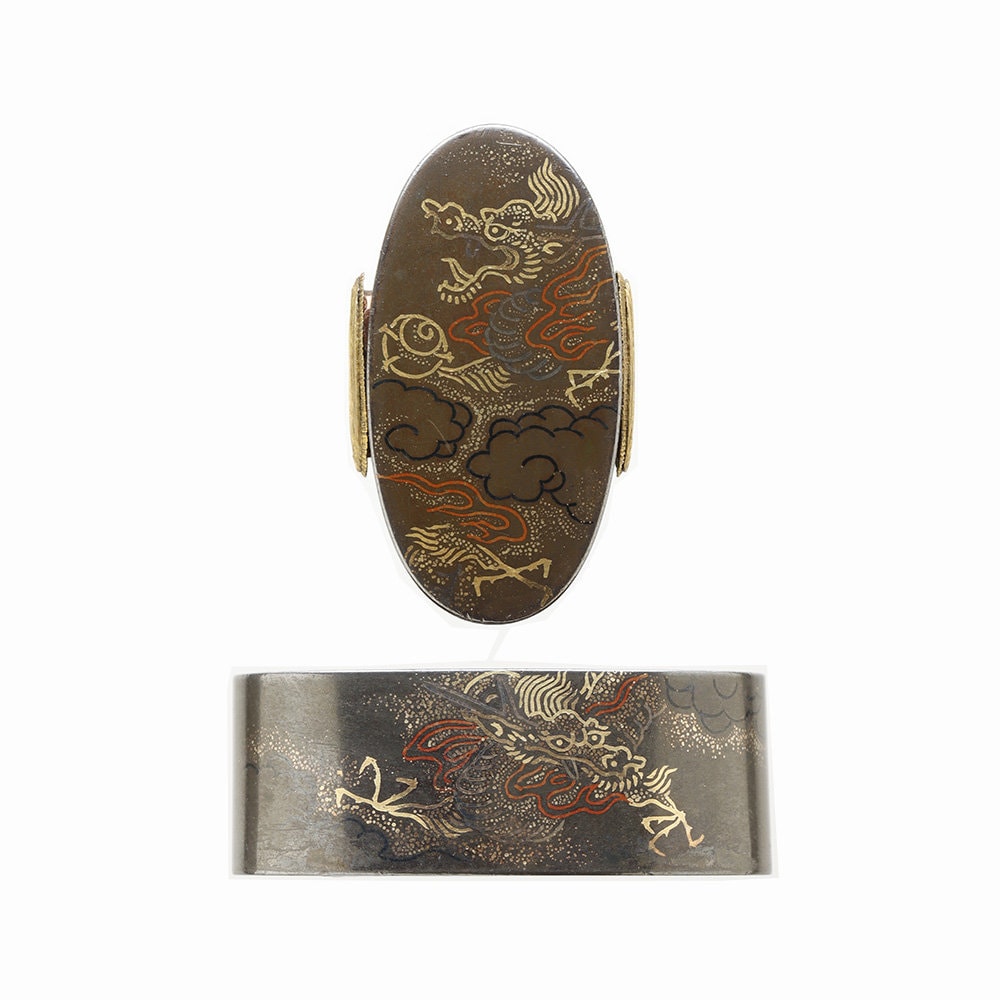
Jochiku's works show particular strength in the techniques of suemon-zogan (applied-motif inlay) and hira-zogan (flat inlay). Many of his designs render, in large, boldly stylized compositions, subjects drawn from the natural world -- insects such as dragonflies, butterflies, and cicadas; fish such as sea bream, squid, whitebait, and shark; and animals such as cats and tigers -- expressed through high-relief inlay (takaniku-zogan) with ample modeling. In parts of these compositions he heightened the coloristic effect by inserting materials such as mother-of-pearl (aogai), coral, blue lacquer, and even glass, in a manner reminiscent of embedded ornaments in lacquerwork (umemono), thereby establishing a distinctive new approach. His favored ground is the chirimen-ishime-ji (crepe-textured stone-grain surface) in shakudo, though carefully executed works on nanako-ji are also known, and all such examples carry a correspondingly high dignity. His tiger depictions, among his recognized specialties, are powerfully expressed down to the rendering of fur through dense, delicate kebori, with crystal or glass insets for the eyes imparting a keen, piercing gaze. The chiseling -- pursued with unwavering commitment to realism -- is consistently praised as superb, with iroe applied with precision across gold, silver, shibuichi, plain copper, and reddish copper (hi-irodo).
Across the designated corpus, the NBTHK repeatedly characterizes Jochiku's manner as "extremely individualistic" and "intensely personal in character," noting that his commanding compositions "overwhelm other works" and that his true strengths allow "no rival craftsmen to surpass him" in the use of aogai inlay. His rusu-moyo ("absence pattern") compositions -- in which the deity Ebisu is evoked solely through attributes such as the sea bream, fishing rod, and eyeless basket -- recur as a signature theme, often embellished with the auspicious character kotobuki inlaid around the rim, and judged to have been produced on commission for wealthy merchant households. In his forceful chiselwork, his pursuit of an overtly craft-oriented decorative beauty, and his innovative synthesis of metalworking with materials drawn from the lacquer and glass arts, Jochiku opened up and mastered a distinctive artistic realm entirely his own.
Where Jochiku stands among comparable artisans: across all of nihontō, and within tradition, era, and period. The tiers (Foremost · Leading · Major · Notable) weigh official designations from the NBTHK and Japan's Agency for Cultural Affairs, together with historical honors of lasting repute such as the Sansaku and Meibutsu-chō.
Select a lens to see how it's measured.
Machibori
13 pieces on the market now
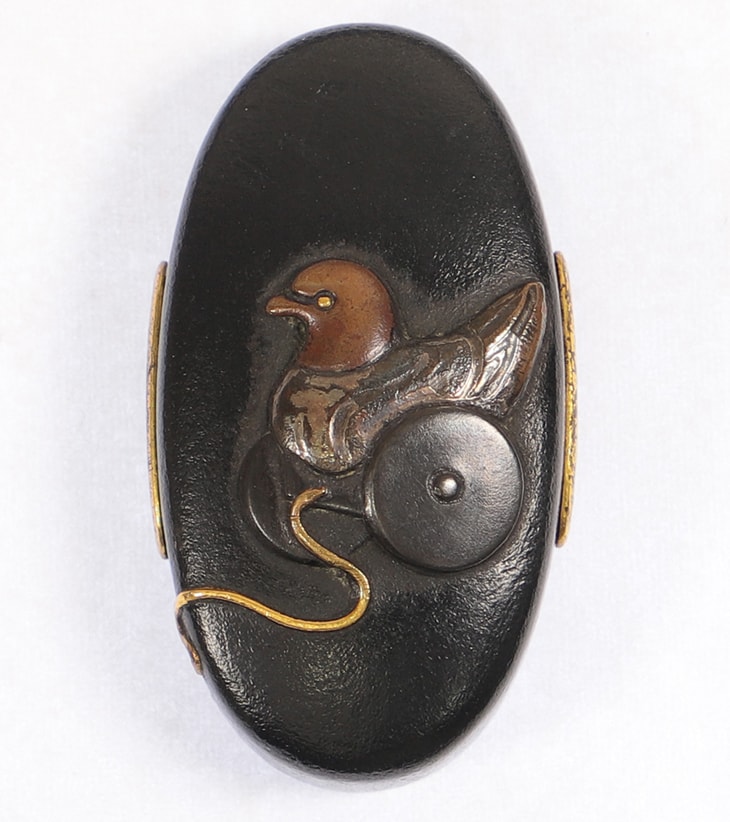
The Murakami school was established in Edo by Murakami Jochiku (村上如竹), who lived in the Shiba district and was active from the mid through late Edo period, around the Tenmei era (1781--1789). His personal name was initially Nakanori (仲矩), later also Mitsunori (光則); he took the art name Kanshodo (歓笙堂). The NBTHK setsumei consistently record that Jochiku "originally came from the trade of inlay work for stirrups" (abumi zogan), and subsequently turned to the profession of a kinko metalworker. One source further notes that he apparently established himself without seeking a particular master, suggesting a largely self-directed artistic formation. This background in stirrup inlay proved foundational to the distinctive inlay vocabulary that would define the school. Jochiku gathered a circle of followers, among whom the most prominent was Masanori (正則), traditionally regarded as his younger brother. While most members of the Jochiku group incorporated the character jo (如) in their art names, Masanori was a notable exception, and his signature was cut in kaisho (standard script) rather than the cursive forms favored by others in the circle. The collective style of the Murakami school is defined by mastery of suemon-zogan (applied-motif inlay) and hira-zogan (flat inlay), executed in bold, large-scale, design-like compositions. The school's preferred ground is the chirimen-ishime-ji[[c:1]] -- a distinctive crepe-textured stone-grain surface in shakudo that recurs across the majority of designated works.
A smaller number of pieces employ nanako-ji, and the setsumei observe that all such works are notably painstaking in execution. Subject matter draws heavily from the natural world: fish and shellfish -- sea bream (tai), cuttlefish, squid, shark, and whitebait -- as well as insects such as butterflies, dragonflies, and cicadas, and animals including cats and tigers. These motifs are rendered in high-relief inlay (takaniku-zogan) with polychrome iroe in gold, silver, shibuichi, suaka, and shakudo. A defining innovation of the school is the insertion of non-metallic materials -- mother-of-pearl (aogai), coral, lacquer, and glass -- into portions of these compositions, "in a manner reminiscent of embedded elements in lacquerwork," thereby heightening the coloristic effect and pursuing visual variety. The treatment of eyes is a particular signature: shell inlaid within shakudo orbs, sometimes covered with glass, and in the celebrated tiger subjects, crystal (suisho) set to produce a piercing gaze. The rusu-moyo ("absence pattern") -- wherein the attributes of Ebisu or Daikoku are depicted without the figure itself, inviting the viewer to imagine the concealed protagonist -- constitutes a major thematic current, often embellished with the auspicious character kotobuki (寿) inlaid repeatedly around the rim. The Murakami school occupies a singular position within the Edo-period machibori tradition by virtue of its intensely individual character and its innovative fusion of metalworking and decorative-arts techniques. The setsumei repeatedly characterize Jochiku's manner as "extremely individualistic" and credit him with having "established an innovative new approach" through the combination of large-scale suemon-zogan with materials drawn from the lacquer and enamel crafts. " The school's designated corpus reveals an atelier that pursued a distinctly craft-oriented decorative beauty -- bridging metalwork, lacquer arts, and glass -- while maintaining the commanding boldness of design and technical precision that the NBTHK recognizes as Jochiku's enduring legacy. Learn more →
| Smith | Era | Designated |
|---|---|---|
| Jochiku如竹 | 1670 | 20 |
| Kazunobu一信 | — | 0 |
| Joryu如柳 | — | 0 |
| Josen如泉 | — | 0 |
| Jochu如 | — | 0 |
Certifies a genuine fitting worth preserving: a correct signature, or, if unsigned, an identifiable era and school, with recognized artistic and craft value.
The NBTHK (Nihon Bijutsu Tōken Hozon Kyōkai, the Society for the Preservation of Japanese Art Swords) is a public-interest incorporated foundation founded in 1948 and supervised by Japan’s Agency for Cultural Affairs (Bunkachō); it is based at the Japanese Sword Museum in Tokyo. Its expert panels physically examine each submitted work (shinsa) and issue a certificate (kanteishō) ranking it by artistic and historical merit. NBTHK papers are the most widely recognized standard of authentication for Japanese swords and fittings.
NBTHK official sitePlease notify us of your intention to return, by email or fax, no later than the day after the item's arrival. Return shipping, insurance, and refund transfer fees are the customer's responsibility.
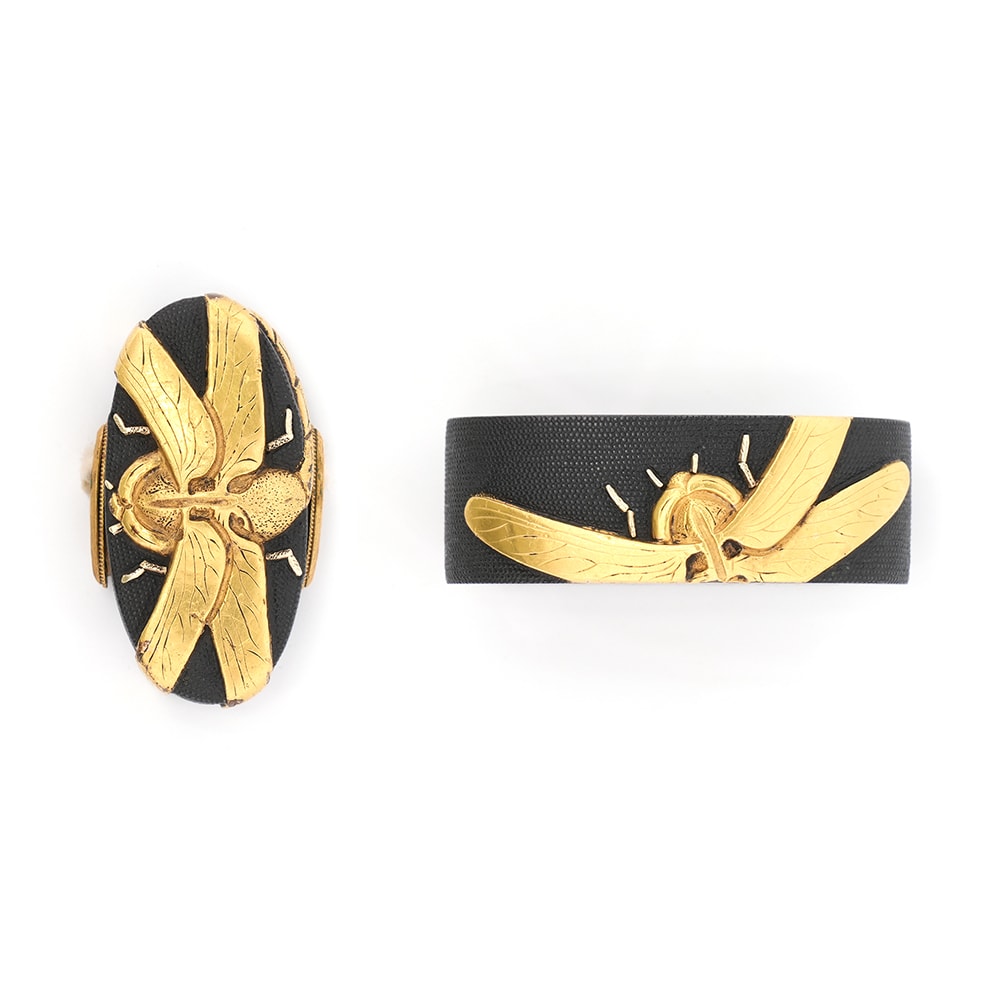
Kanzan Jittoku-zu Tsuba Mei: "Jochiku" with Kao Hozon Tosogu Kanteisho Katamaru-gata, Shakudo Migaki-ji, Sukidashi-bori Iro-e, Kozuka-hitsuan-ume, Kaku-mimi Koniku Length: 74mm, Width: 70mm, Kasane: 4mm, Weight: 139g (All measurements are approximate). With Nippon Bijutsu Token Hozon Kyokai (NBTHK) Kanteisho. This is a famous masterpiece published in the "Nihonto Taikan." It features a box inscription (hakogaki) by Sato Kanzan-sensei and is a truly magnificent masterpiece. Please enjoy it. A sword fitting metal artist of the late Edo period. Lived in Shiba Shinmonzen-cho, Edo, and is estimated to have died between the Tenmei and Kansei eras. His names were Seijiro and Nakanori, and he used the art names Buyozan and Kanshodo. It is said that he initially succeeded his father's profession as an abumi-shi (stirrup maker) but later turned to sword fitting metalwork. His works include the "Tonbo-zu Kozuka," "Nifukujin-zu Tsuba" (both privately owned), and the "Tsurumaru-mon Tsuba" (Tokyo National Museum collection). As the founder of the Murakami school, he is known for a solid style, excelling in takabori as well as katakiri-bori and hira-zogan. He produced many disciples who took names starting with "Jo-," such as his son Josetsu, as well as Joran, Jotoku, and Joryu. 0 Yen (Tax included)
Edo

Murakami Jochiku
Edo
Hozon (NBTHK)
Machibori · around 1670
4 pieces on the market now
Murakami Jochiku lived in Shiba, Edo, active around the Tenmei era (1781--1789). His personal name was initially Nakanori, and he later also signed Mitsunori; he used the art name Kanshodo. He is said to have originally come from a background as an inlay craftsman specializing in stirrups (abumi), and later turned to the work of a metal-fitting artisan, apparently establishing himself without seeking a particular master. The details of his formal training are not clearly known. From the manner of his signatures, his oeuvre can be broadly divided into an early period -- when he signed with the Nakanori seal -- and a mature period under the name Jochiku. Some works bearing the Nakanori seal are recognized as youthful productions on the basis of their powerful manner and signature form.
Jochiku's works show particular strength in the techniques of suemon-zogan (applied-motif inlay) and hira-zogan (flat inlay). Many of his designs render, in large, boldly stylized compositions, subjects drawn from the natural world -- insects such as dragonflies, butterflies, and cicadas; fish such as sea bream, squid, whitebait, and shark; and animals such as cats and tigers -- expressed through high-relief inlay (takaniku-zogan) with ample modeling. In parts of these compositions he heightened the coloristic effect by inserting materials such as mother-of-pearl (aogai), coral, blue lacquer, and even glass, in a manner reminiscent of embedded ornaments in lacquerwork (umemono), thereby establishing a distinctive new approach. His favored ground is the chirimen-ishime-ji (crepe-textured stone-grain surface) in shakudo, though carefully executed works on nanako-ji are also known, and all such examples carry a correspondingly high dignity. His tiger depictions, among his recognized specialties, are powerfully expressed down to the rendering of fur through dense, delicate kebori, with crystal or glass insets for the eyes imparting a keen, piercing gaze. The chiseling -- pursued with unwavering commitment to realism -- is consistently praised as superb, with iroe applied with precision across gold, silver, shibuichi, plain copper, and reddish copper (hi-irodo).
Across the designated corpus, the NBTHK repeatedly characterizes Jochiku's manner as "extremely individualistic" and "intensely personal in character," noting that his commanding compositions "overwhelm other works" and that his true strengths allow "no rival craftsmen to surpass him" in the use of aogai inlay. His rusu-moyo ("absence pattern") compositions -- in which the deity Ebisu is evoked solely through attributes such as the sea bream, fishing rod, and eyeless basket -- recur as a signature theme, often embellished with the auspicious character kotobuki inlaid around the rim, and judged to have been produced on commission for wealthy merchant households. In his forceful chiselwork, his pursuit of an overtly craft-oriented decorative beauty, and his innovative synthesis of metalworking with materials drawn from the lacquer and glass arts, Jochiku opened up and mastered a distinctive artistic realm entirely his own.
Where Jochiku stands among comparable artisans: across all of nihontō, and within tradition, era, and period. The tiers (Foremost · Leading · Major · Notable) weigh official designations from the NBTHK and Japan's Agency for Cultural Affairs, together with historical honors of lasting repute such as the Sansaku and Meibutsu-chō.
Select a lens to see how it's measured.
Machibori
13 pieces on the market now
The Murakami school was established in Edo by Murakami Jochiku (村上如竹), who lived in the Shiba district and was active from the mid through late Edo period, around the Tenmei era (1781--1789). His personal name was initially Nakanori (仲矩), later also Mitsunori (光則); he took the art name Kanshodo (歓笙堂). The NBTHK setsumei consistently record that Jochiku "originally came from the trade of inlay work for stirrups" (abumi zogan), and subsequently turned to the profession of a kinko metalworker. One source further notes that he apparently established himself without seeking a particular master, suggesting a largely self-directed artistic formation. This background in stirrup inlay proved foundational to the distinctive inlay vocabulary that would define the school. Jochiku gathered a circle of followers, among whom the most prominent was Masanori (正則), traditionally regarded as his younger brother. While most members of the Jochiku group incorporated the character jo (如) in their art names, Masanori was a notable exception, and his signature was cut in kaisho (standard script) rather than the cursive forms favored by others in the circle. The collective style of the Murakami school is defined by mastery of suemon-zogan (applied-motif inlay) and hira-zogan (flat inlay), executed in bold, large-scale, design-like compositions. The school's preferred ground is the chirimen-ishime-ji[[c:1]] -- a distinctive crepe-textured stone-grain surface in shakudo that recurs across the majority of designated works.
A smaller number of pieces employ nanako-ji, and the setsumei observe that all such works are notably painstaking in execution. Subject matter draws heavily from the natural world: fish and shellfish -- sea bream (tai), cuttlefish, squid, shark, and whitebait -- as well as insects such as butterflies, dragonflies, and cicadas, and animals including cats and tigers. These motifs are rendered in high-relief inlay (takaniku-zogan) with polychrome iroe in gold, silver, shibuichi, suaka, and shakudo. A defining innovation of the school is the insertion of non-metallic materials -- mother-of-pearl (aogai), coral, lacquer, and glass -- into portions of these compositions, "in a manner reminiscent of embedded elements in lacquerwork," thereby heightening the coloristic effect and pursuing visual variety. The treatment of eyes is a particular signature: shell inlaid within shakudo orbs, sometimes covered with glass, and in the celebrated tiger subjects, crystal (suisho) set to produce a piercing gaze. The rusu-moyo ("absence pattern") -- wherein the attributes of Ebisu or Daikoku are depicted without the figure itself, inviting the viewer to imagine the concealed protagonist -- constitutes a major thematic current, often embellished with the auspicious character kotobuki (寿) inlaid repeatedly around the rim. The Murakami school occupies a singular position within the Edo-period machibori tradition by virtue of its intensely individual character and its innovative fusion of metalworking and decorative-arts techniques. The setsumei repeatedly characterize Jochiku's manner as "extremely individualistic" and credit him with having "established an innovative new approach" through the combination of large-scale suemon-zogan with materials drawn from the lacquer and enamel crafts. " The school's designated corpus reveals an atelier that pursued a distinctly craft-oriented decorative beauty -- bridging metalwork, lacquer arts, and glass -- while maintaining the commanding boldness of design and technical precision that the NBTHK recognizes as Jochiku's enduring legacy. Learn more →
| Smith | Era | Designated |
|---|---|---|
| Jochiku如竹 | 1670 | 20 |
| Kazunobu一信 | — | 0 |
| Joryu如柳 | — | 0 |
| Josen如泉 | — | 0 |
| Jochu如 | — | 0 |
Certifies a genuine fitting worth preserving: a correct signature, or, if unsigned, an identifiable era and school, with recognized artistic and craft value.
The NBTHK (Nihon Bijutsu Tōken Hozon Kyōkai, the Society for the Preservation of Japanese Art Swords) is a public-interest incorporated foundation founded in 1948 and supervised by Japan’s Agency for Cultural Affairs (Bunkachō); it is based at the Japanese Sword Museum in Tokyo. Its expert panels physically examine each submitted work (shinsa) and issue a certificate (kanteishō) ranking it by artistic and historical merit. NBTHK papers are the most widely recognized standard of authentication for Japanese swords and fittings.
NBTHK official sitePlease notify us of your intention to return, by email or fax, no later than the day after the item's arrival. Return shipping, insurance, and refund transfer fees are the customer's responsibility.