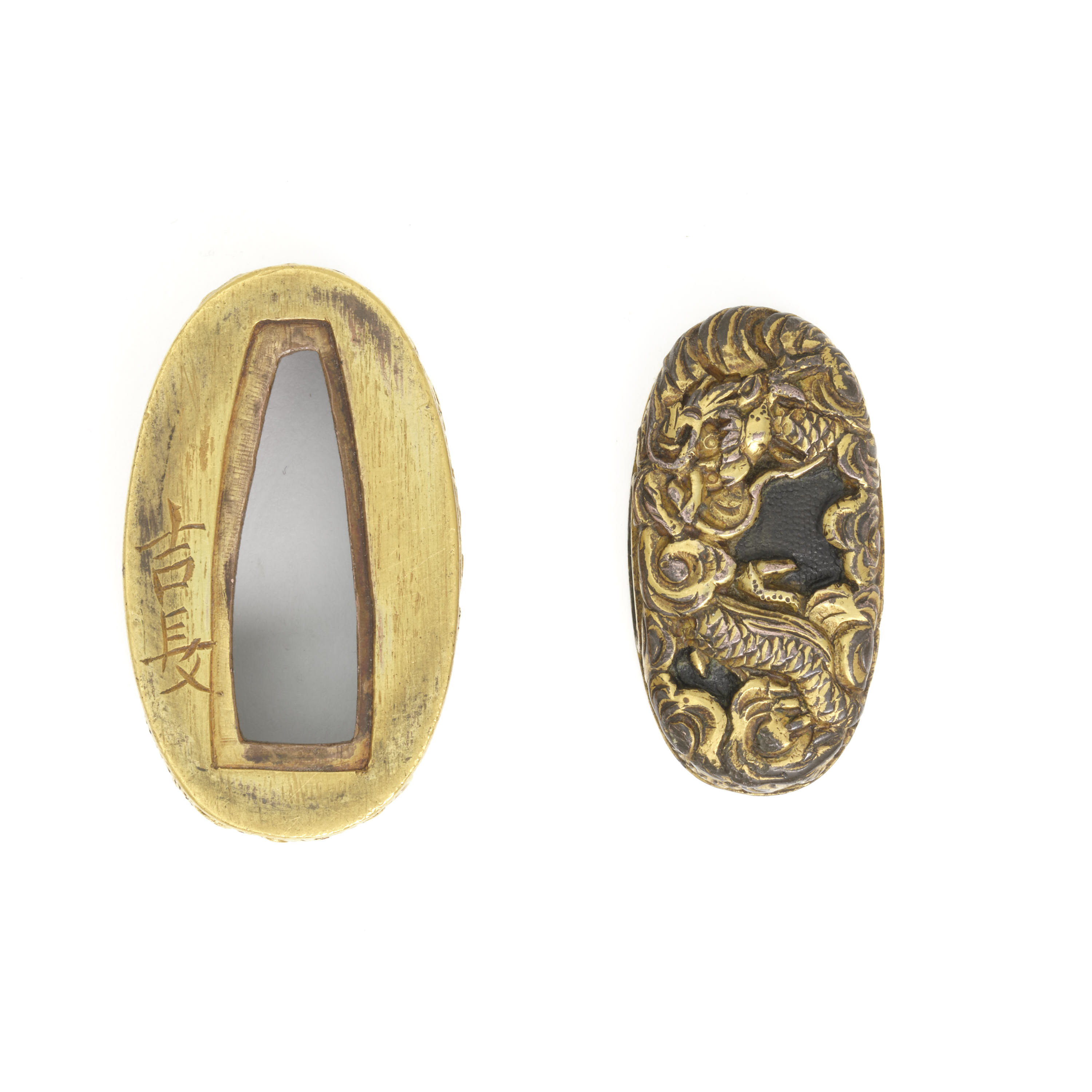
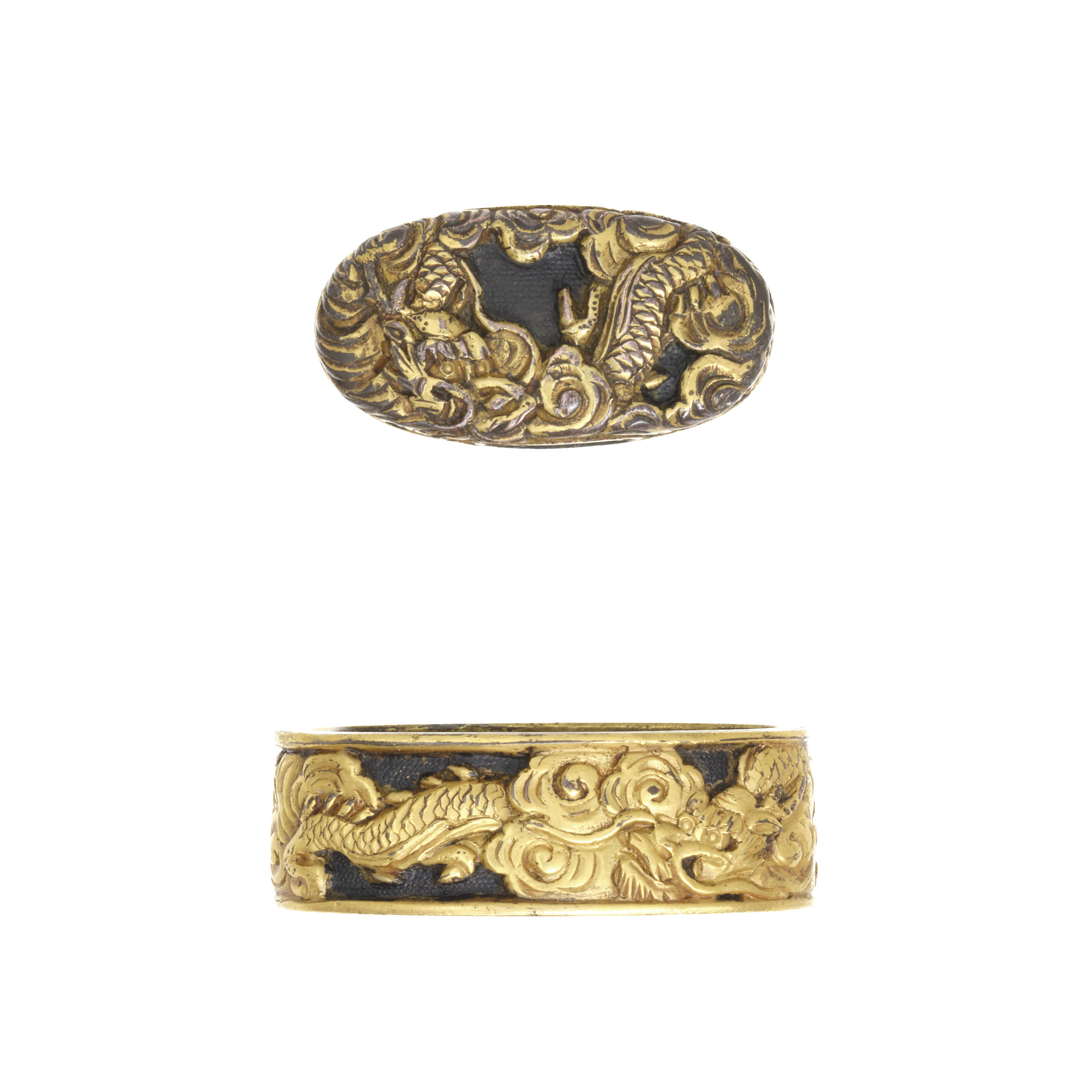
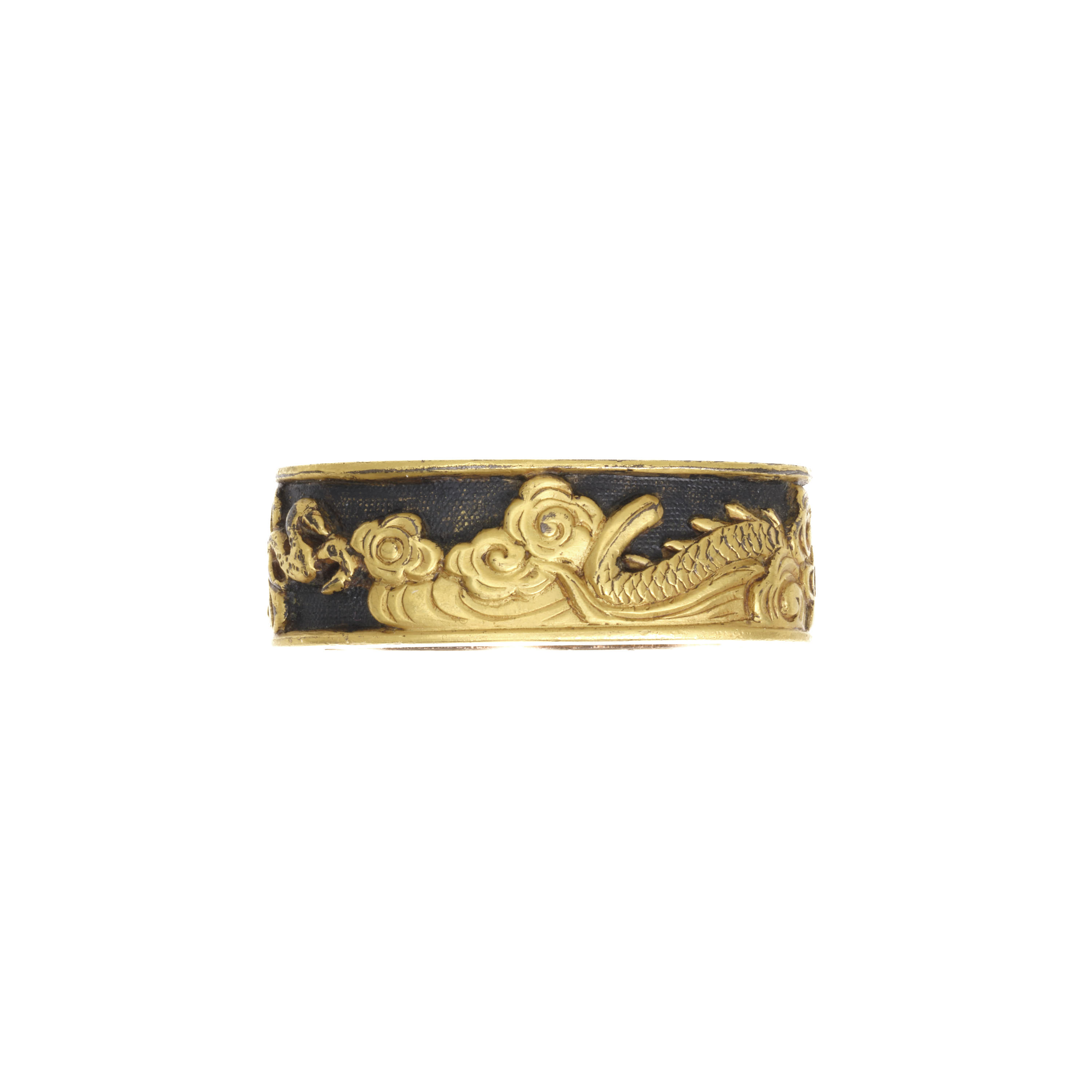
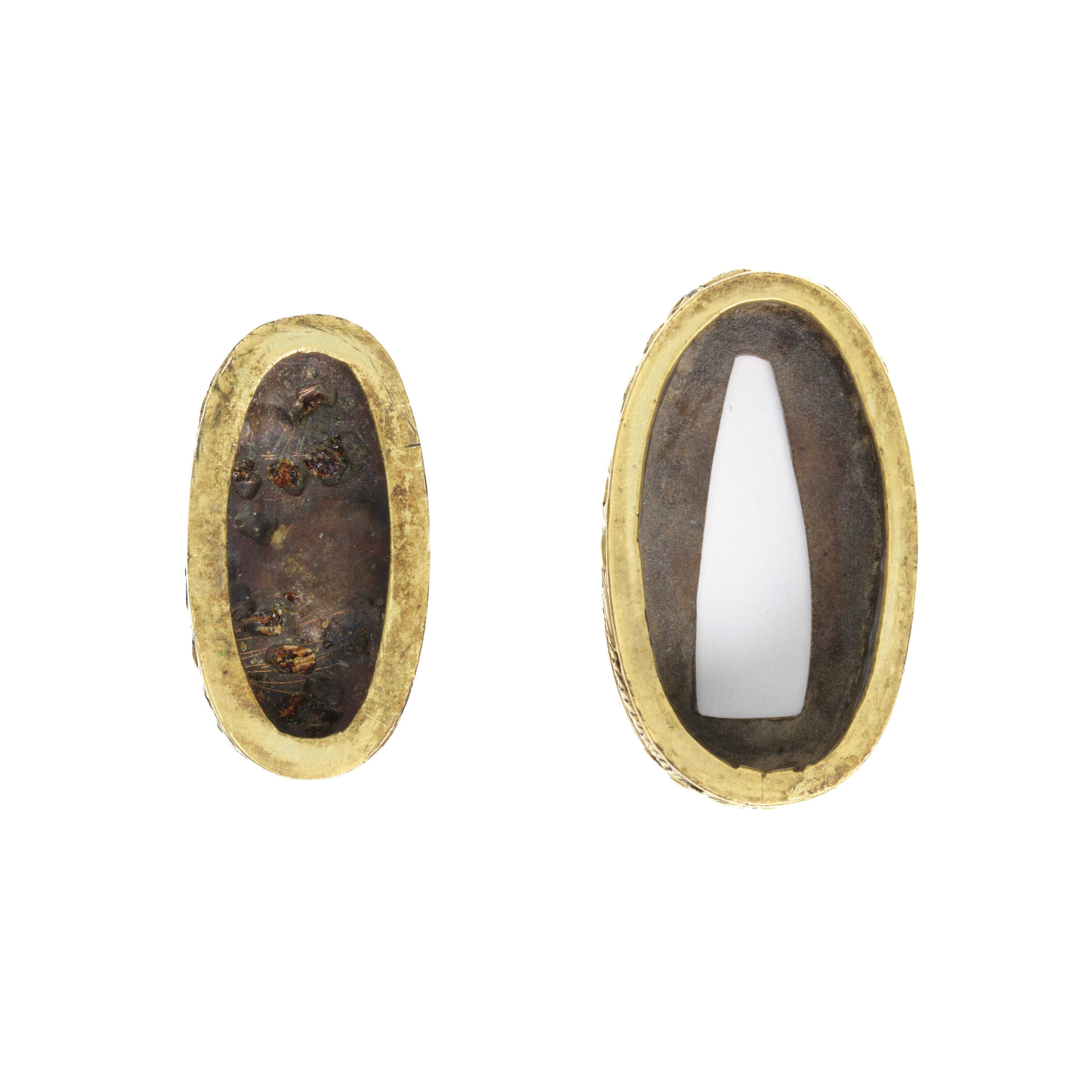
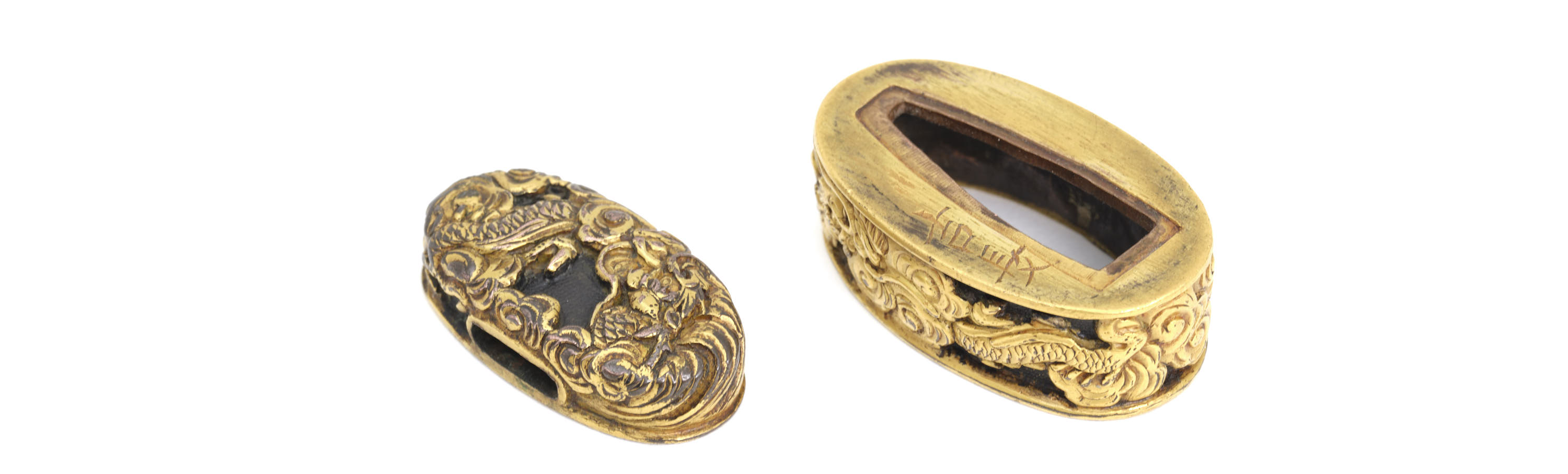
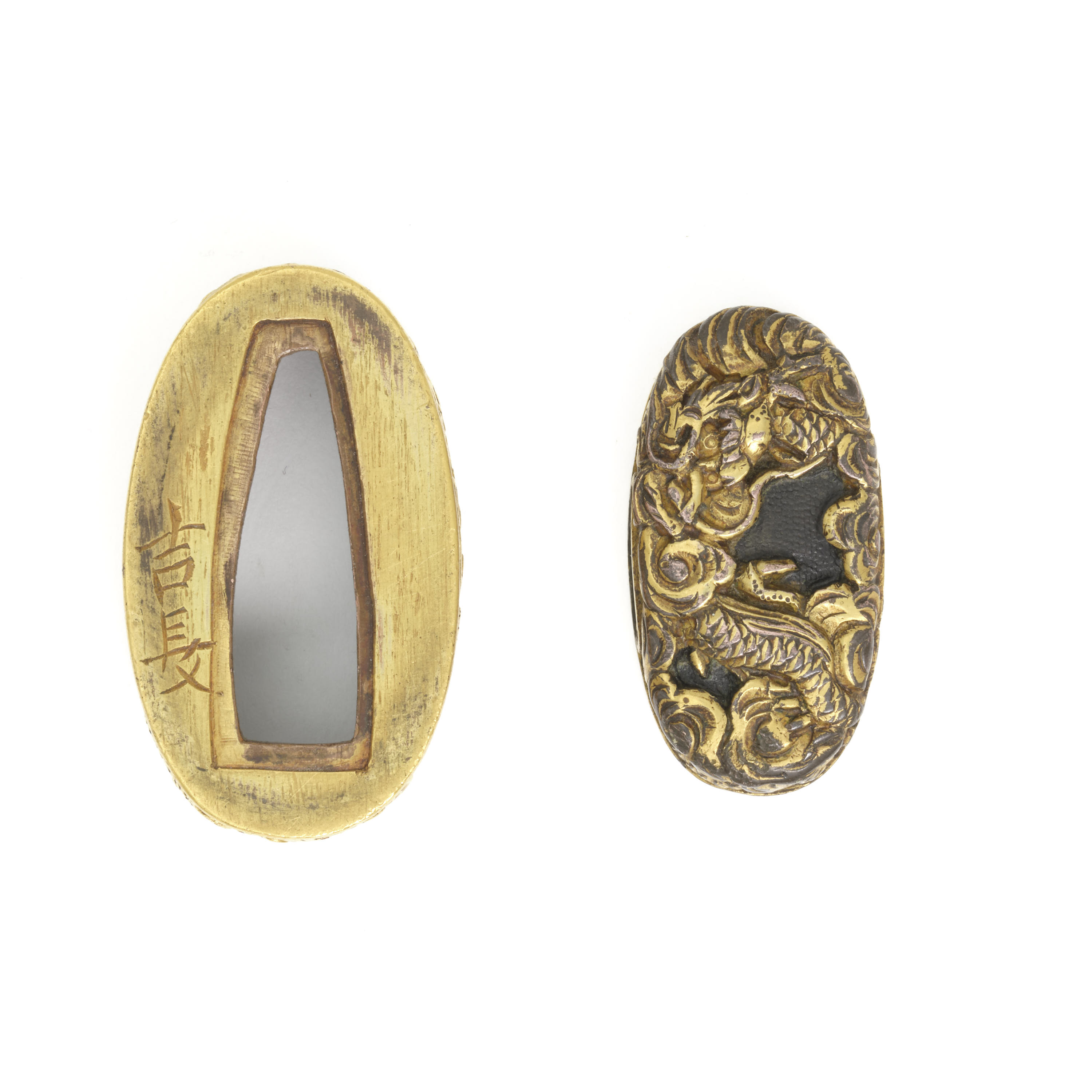
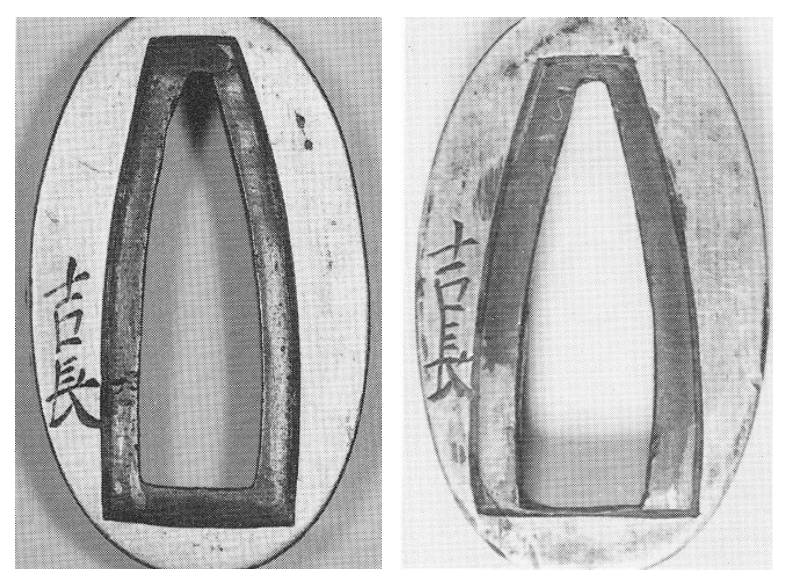
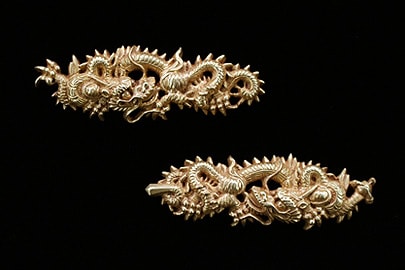
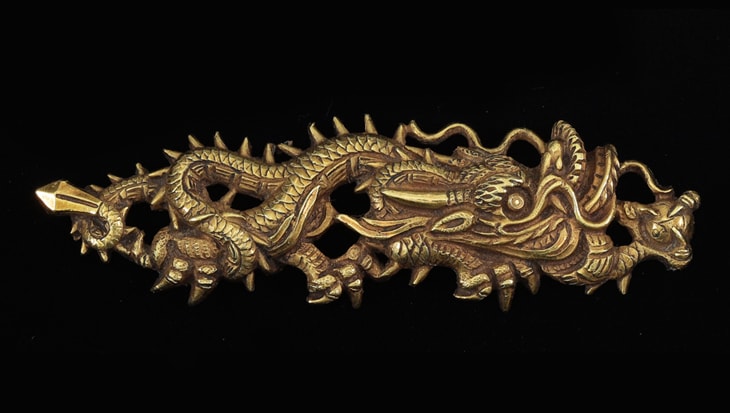
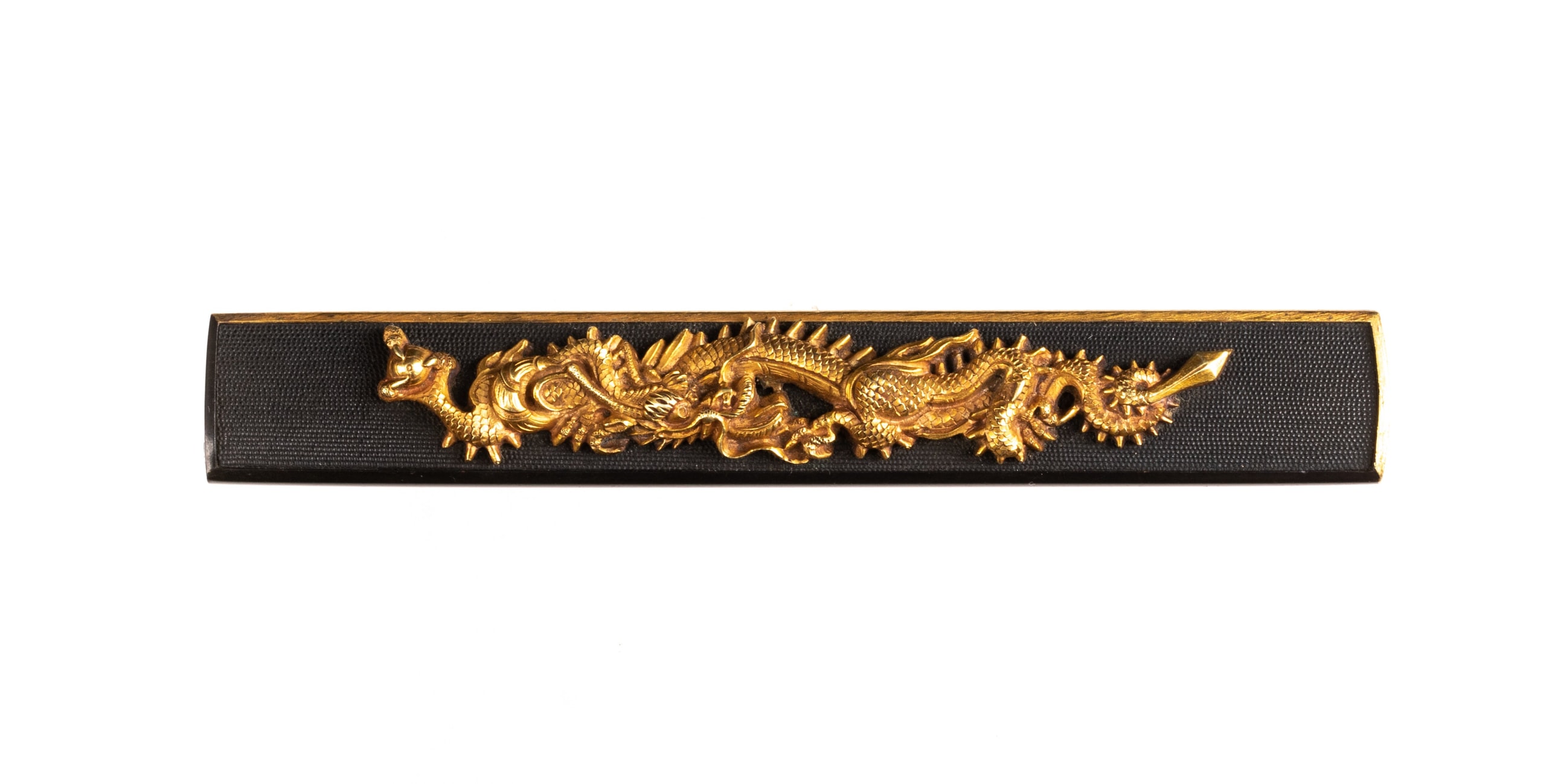
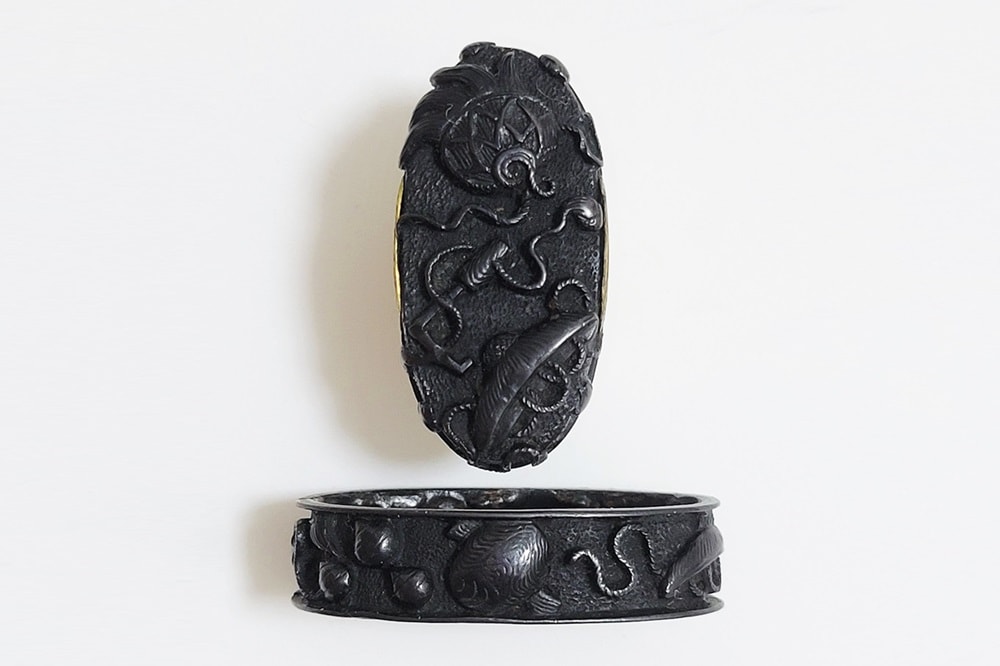
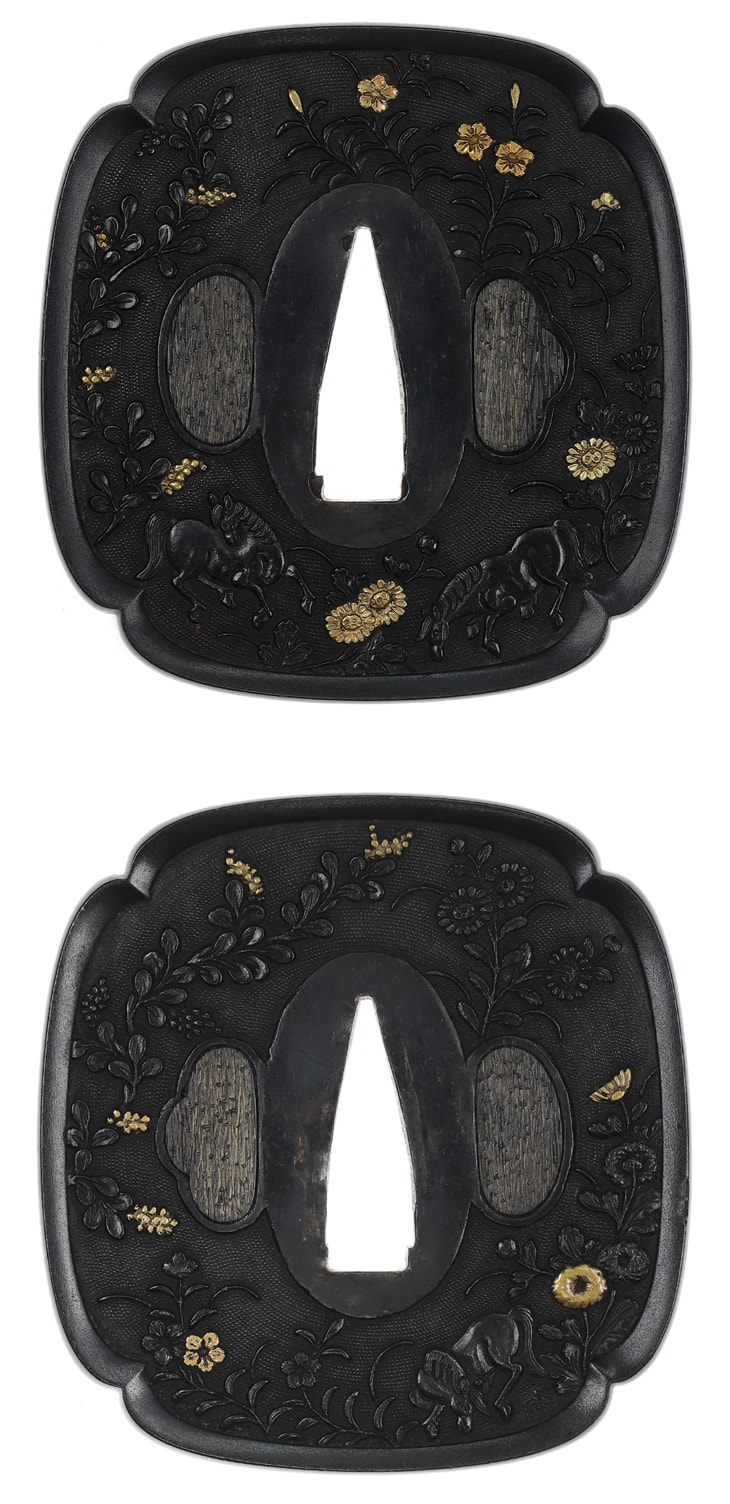
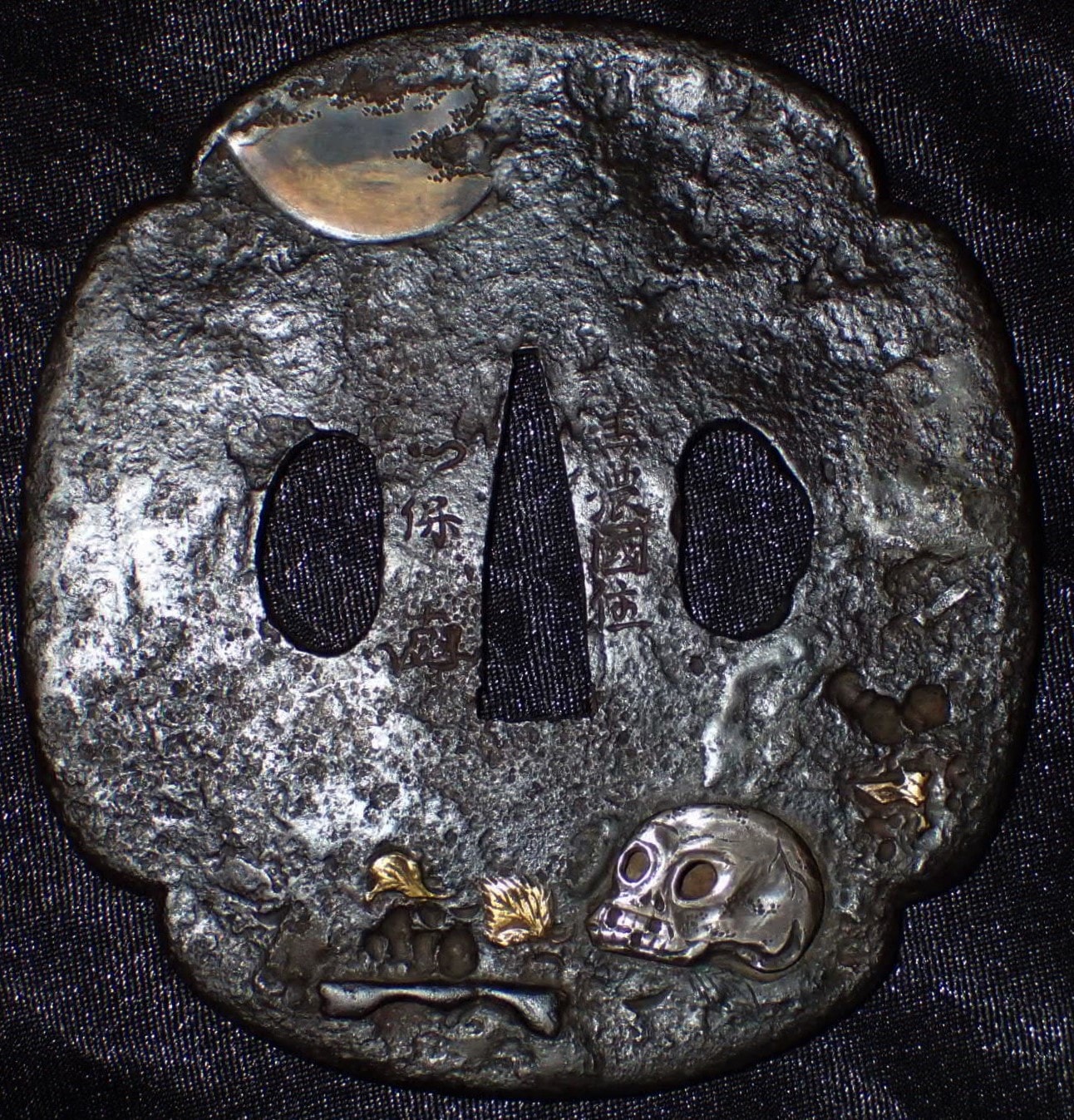
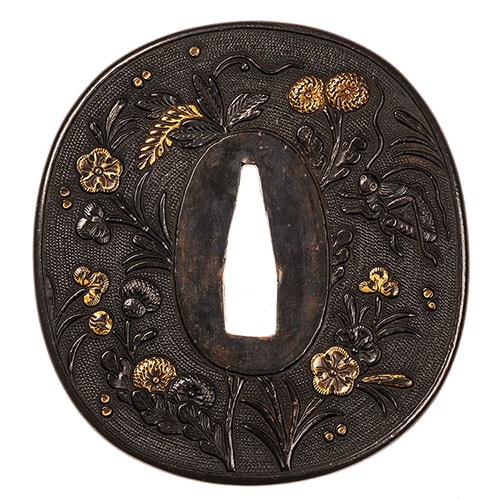
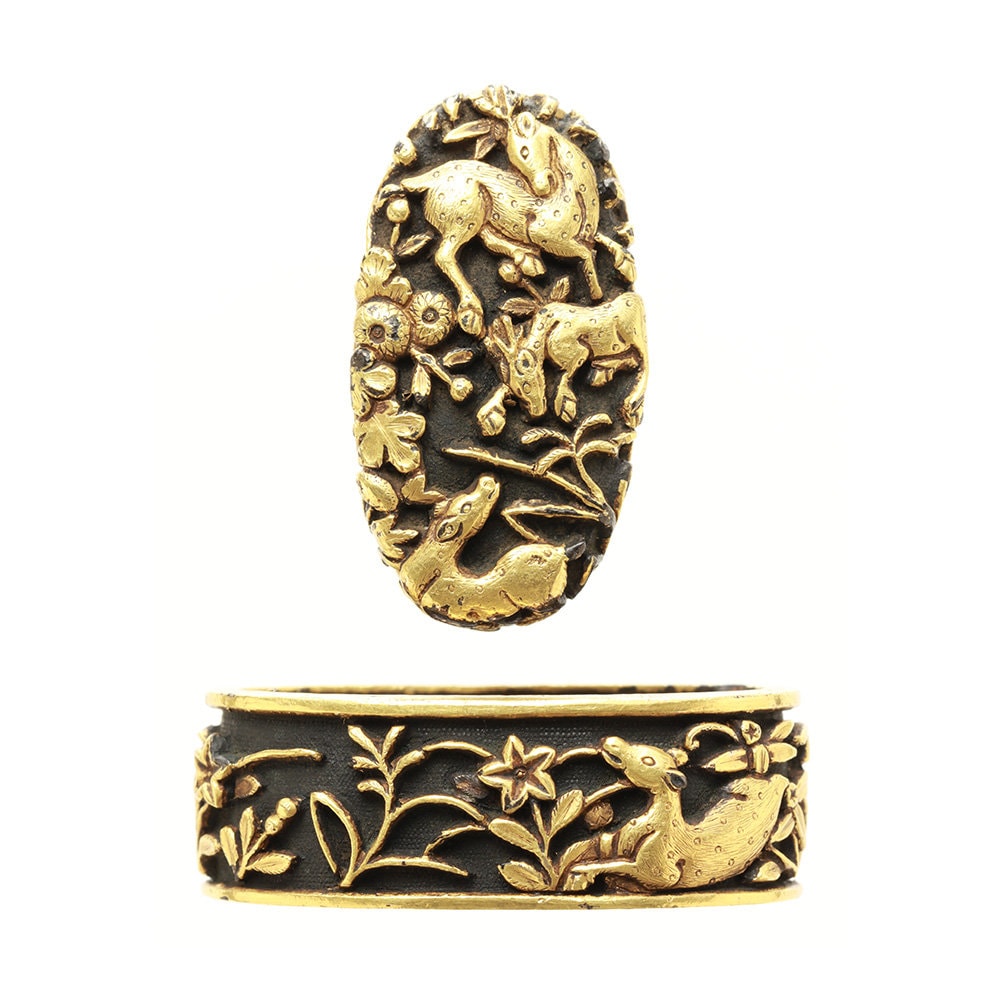
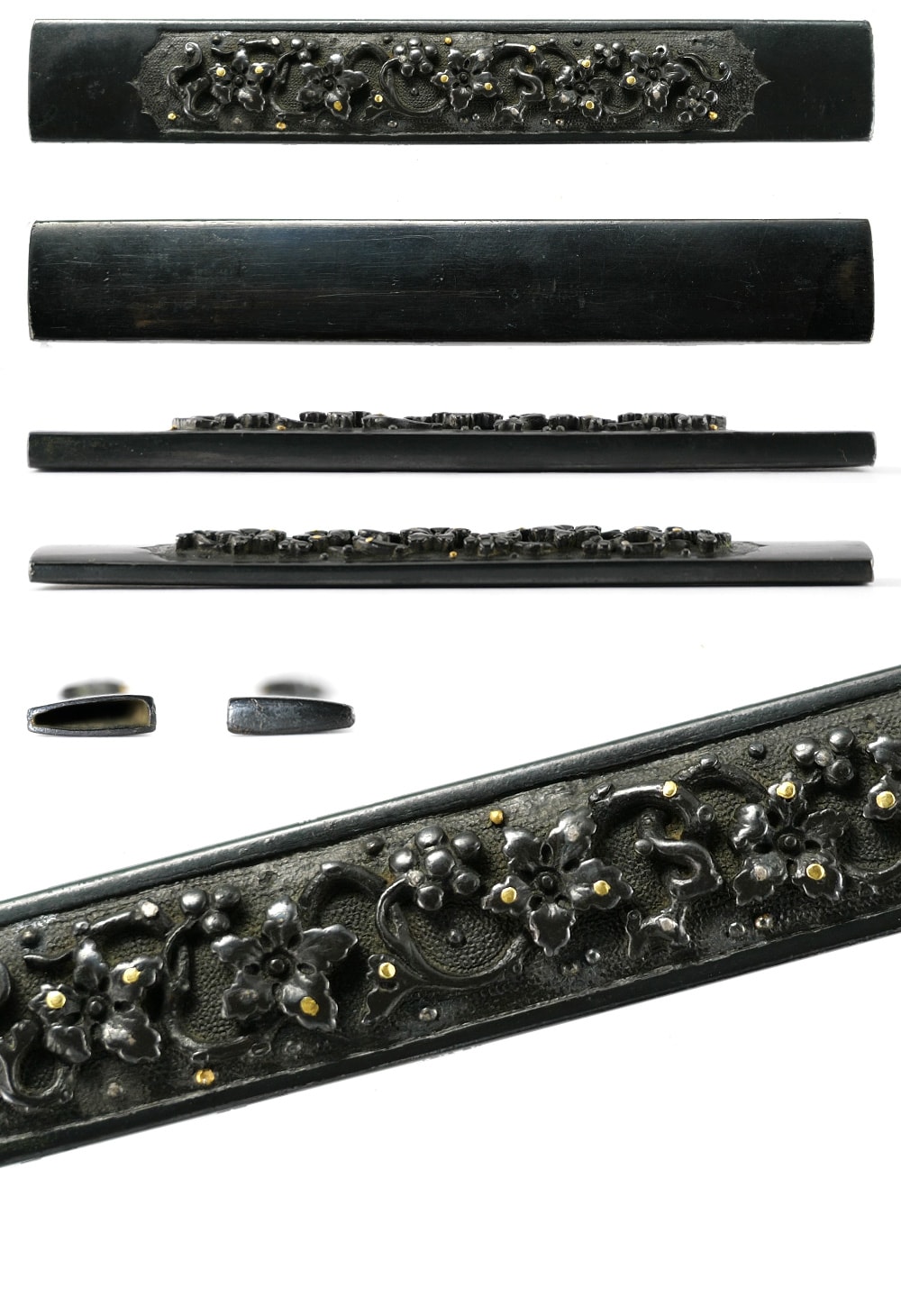
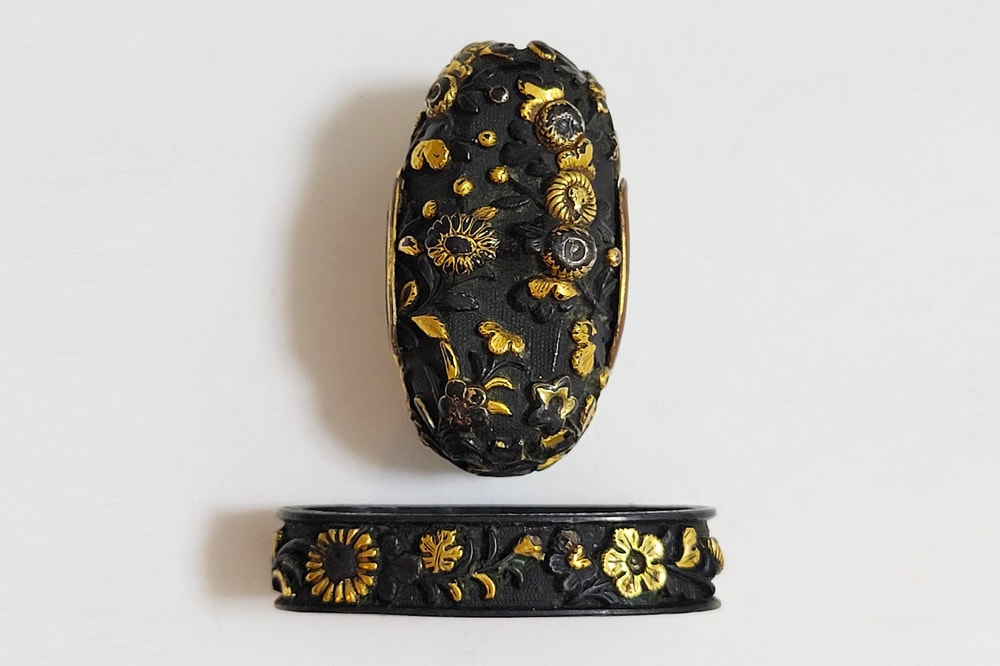
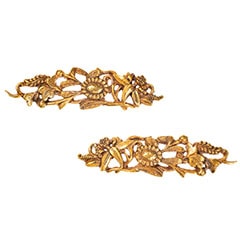
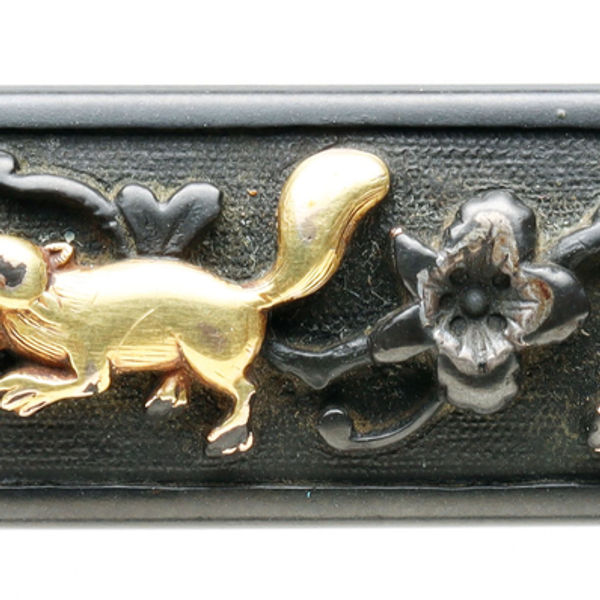
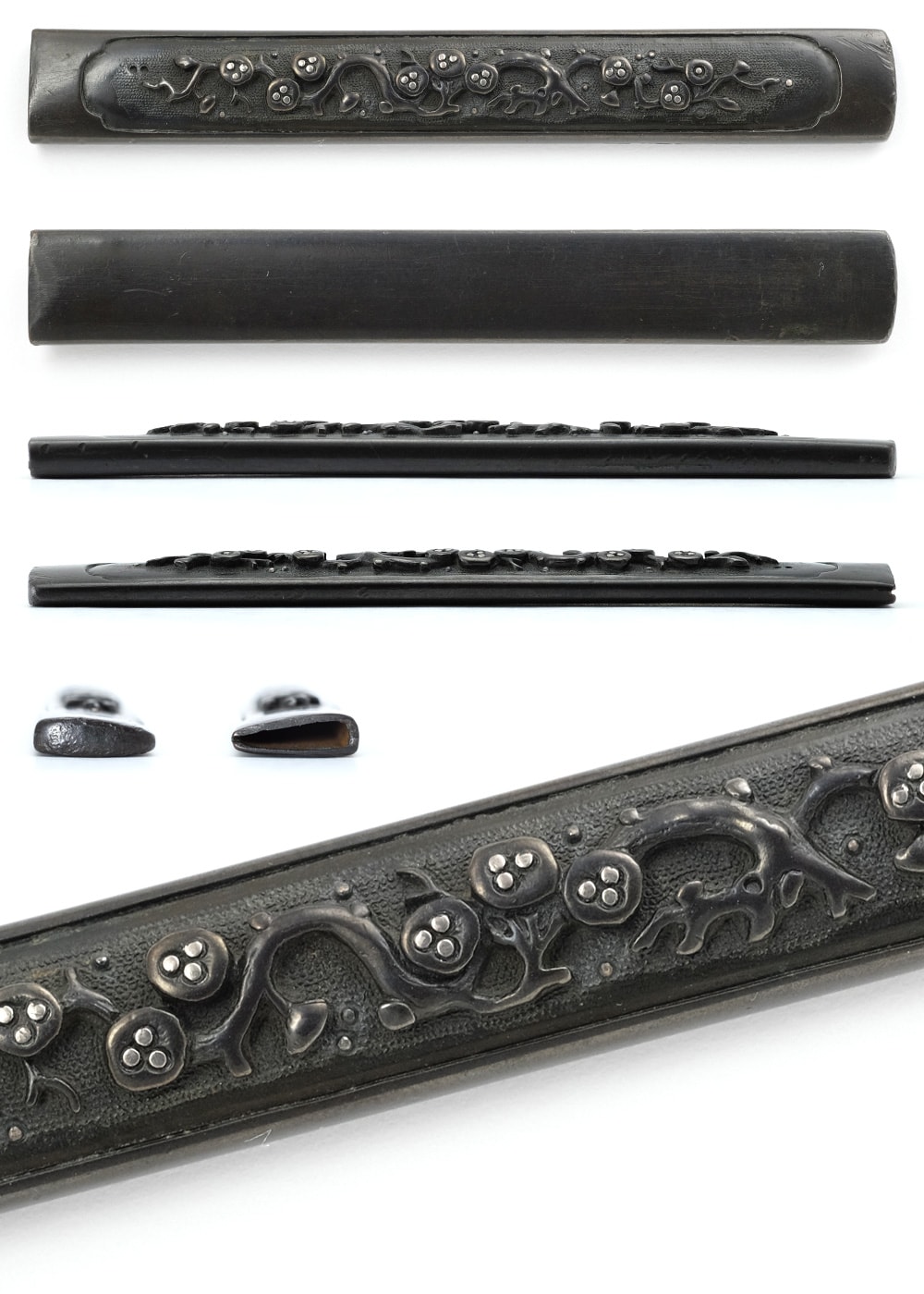
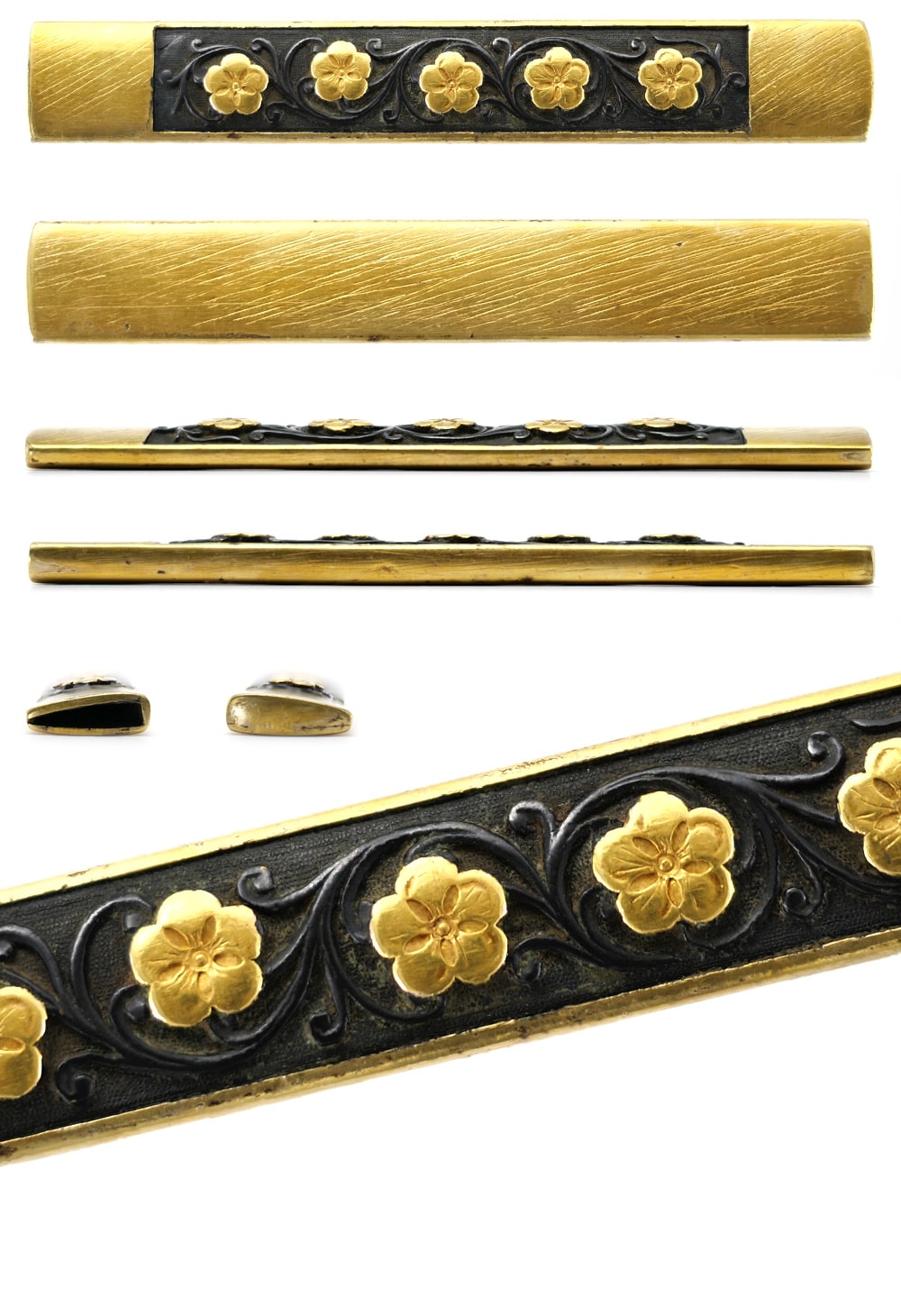
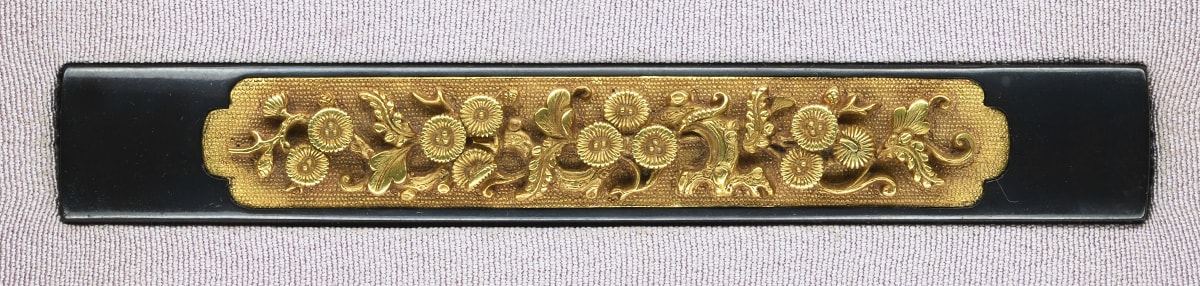
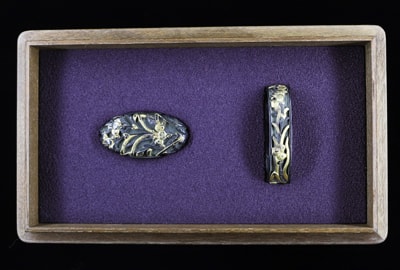
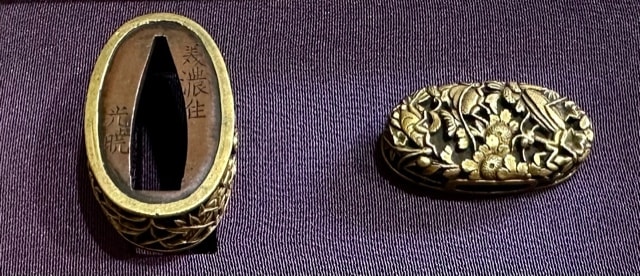
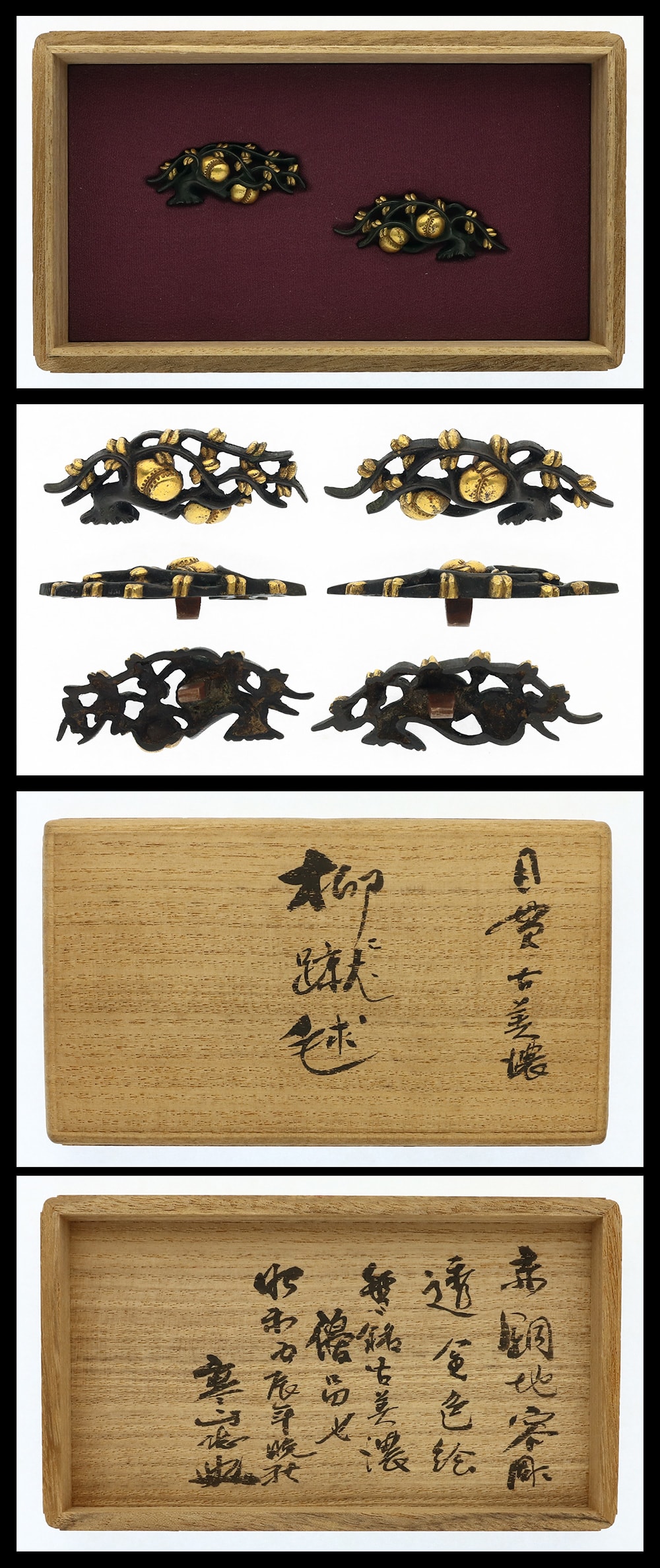
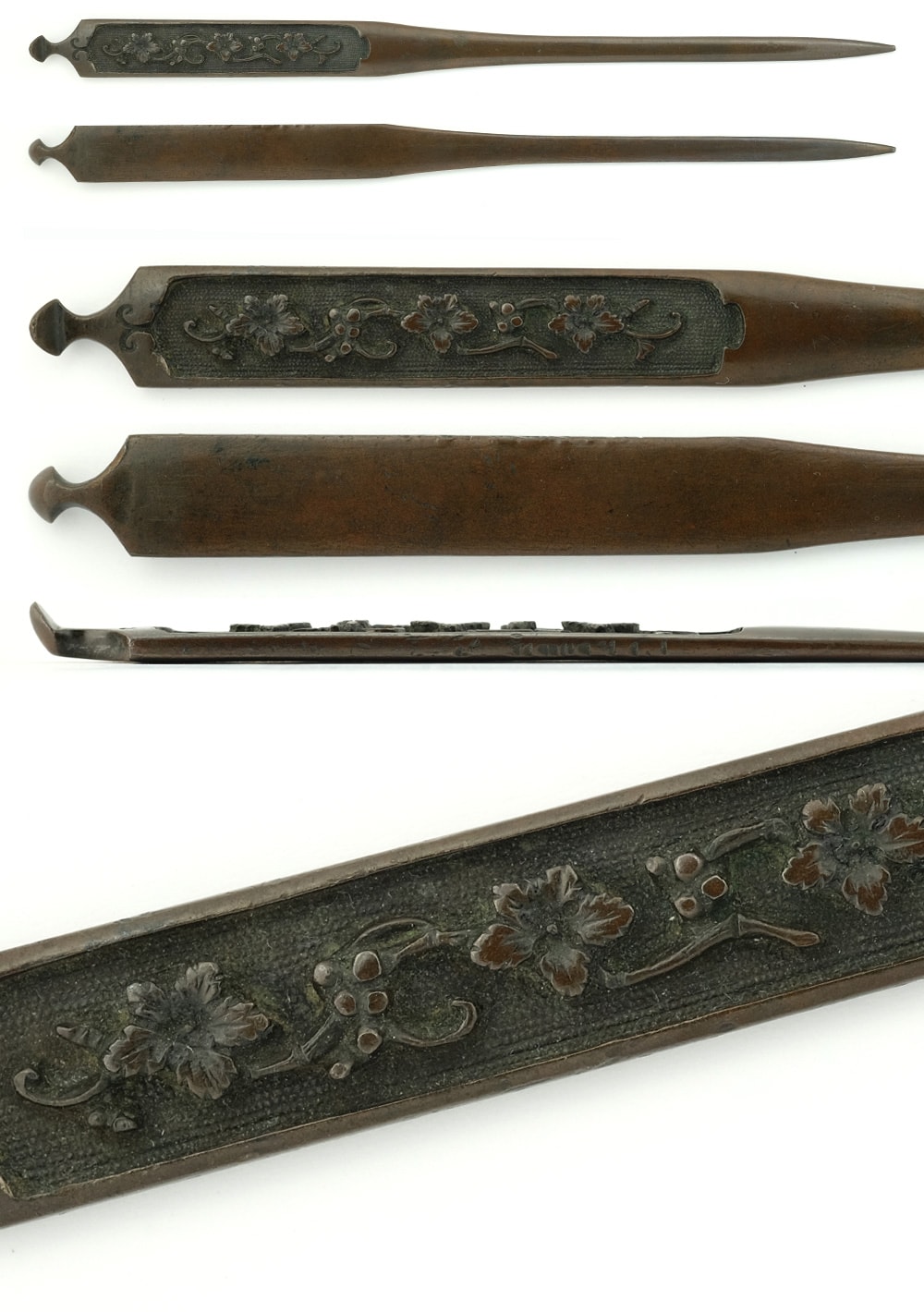
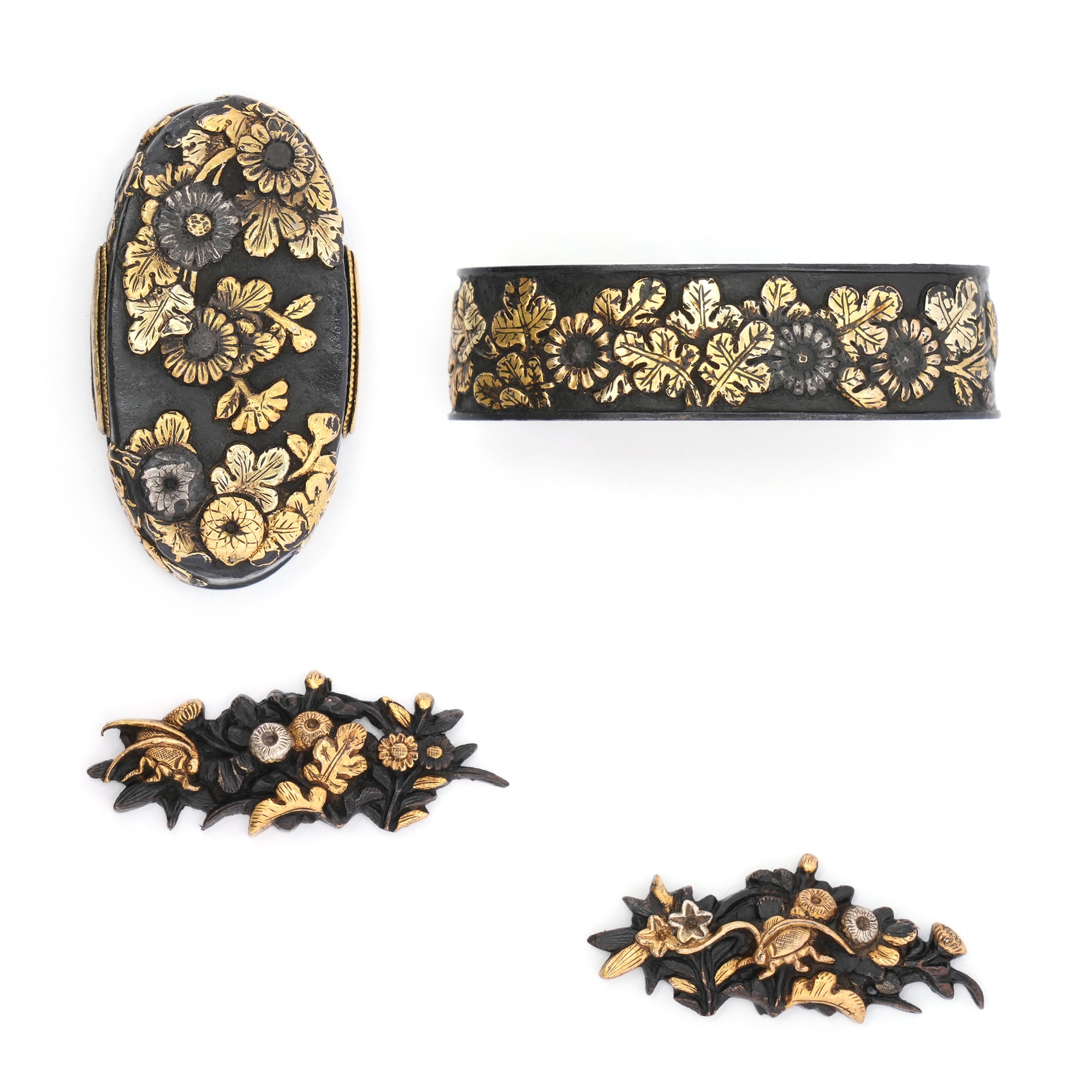
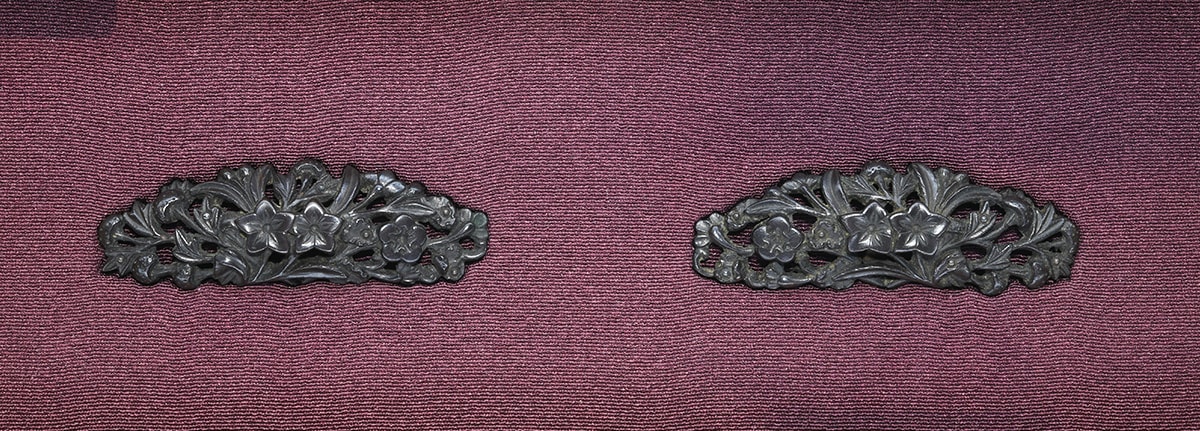
A set of fuchi (ferrule) and kashira (pommel plate) in the typical Mino style of the Edo period. They are made of shakudo with parcel gilding, decorated with dragons over a black nanako background. The fuchi is signed Yoshinaga.


Mino
Edo
Mino
Signed
Iebori · Dewa / Edo / Yamashiro
3 pieces on the market now
Funada Ikkin was born in Shonai in Dewa Province, the son of Funada Hirotsune, himself a pupil of Iwamoto Kanri. In Bunsei 9 (1826), at the age of fifteen, Ikkin went to Edo and studied under Kumagai Yoshiyuki before entering the school of Goto Ichijo in Bunsei 11 (1828), where he trained for seven years in Kyoto. He then returned to Edo, established himself independently, and became a retained artisan of the Sakai family of Shonai. He died in Bunkyu 3 (1863) at the age of fifty-two. The NBTHK consistently identifies him as "one of the foremost disciples" within the circle of Goto Ichijo, a position reinforced across multiple designations that place him at the summit of Ichijo's school.
Ikkin was highly proficient in both takabori and katakiribori, but it is in kosuki-bori that his reputation is singular: in this technique "he admitted no rival," and even his teacher Ichijo is said to have lamented that "kosuki-bori is beyond my own reach."[[c:3]] His work on shakudo ground -- whether nanako-ji or tsuchime-ji -- demonstrates precise control of depth and shallowness in the carving[[c:2]], and his application of gold and silver hira-zogan and iroe is repeatedly described as deft and accomplished. He favored traditional subjects of the Goto house, rendering the shikunshi (Four Gentlemen) and the crawling dragon -- a canonical okagei motif -- with an inventive, distinctive expression that nonetheless honors the lineage from which it springs.
The NBTHK's evaluations return consistently to a vocabulary of power tempered by refinement. His dragon sansho-mono is called "a dignified, forceful work in which Ikkin's vigor and commanding spirit are fully evident[[c:1]]," while his shikunshi sets are praised for "a clear, refined elegance." Of his kozuka depicting the Wago-shin, the assessment is direct: "a painstaking work demonstrating the highest level of skill among the disciples of Goto Ichijo[[c:4]]." The recurring judgment that his ability "comes very close to rivalling his master" places Funada Ikkin at the foremost rank of late Edo tosogu artists working within the Ichijo tradition.
Where Ikkin stands among comparable artisans: across all of nihontō, and within tradition, era, and period. The tiers (Foremost · Leading · Major · Notable) weigh official designations from the NBTHK and Japan's Agency for Cultural Affairs, together with historical honors of lasting repute such as the Sansaku and Meibutsu-chō.
Select a lens to see how it's measured.
Iebori · Kyoto
32 pieces on the market now
" Ichijo was the fifth-generation head of the Shichiroemon house, a cadet branch of the Goto family, and trained under Hanzaemon Kamejo before succeeding to the headship at fifteen. His imperial commissions -- fittings for Emperor Kokaku in 1824 and Emperor Komei in 1862 -- earned him the ranks of Hokyo and Hogen respectively, and his atelier in Kyoto attracted a circle of gifted disciples who extended his aesthetic into the Bakumatsu and early Meiji periods. Learn more →
| Smith | Era | Designated |
|---|---|---|
| Goto Ichijo後藤一乗 | — | 91 |
| Tomei東明 | — | 31 |
| Nagatake永武 | — | 14 |
| Ikkin一琴 | — | 11 |
| Issho一匠 | 1828-1876 | 10 |
We could not find an authenticity certificate on the seller’s listing. Japanese swords and fittings are normally papered by the NBTHK (or the NTHK). Without one, the attribution is the seller’s own assessment and has not been independently verified — treat it with caution and ask the dealer about certification before buying.
Returns accepted on items ordered from the site when an item does not appear to be as depicted and described; buyer must notify via email within 7 days of receipt. Refund covers purchase price minus shipping, bank fees, and currency conversion. Sales on items paid in terms are final, as are sales of items personally inspected.
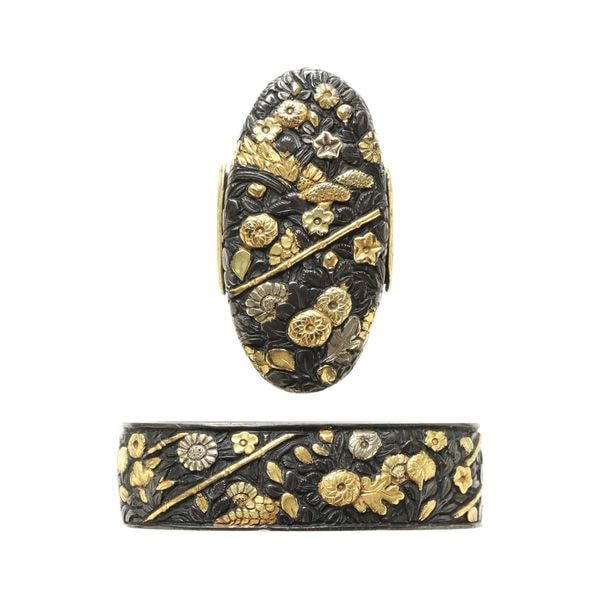
A set of fuchi (ferrule) and kashira (pommel plate) in the typical Mino style of the Edo period. They are made of shakudo with parcel gilding, decorated with dragons over a black nanako background. The fuchi is signed Yoshinaga.


Mino
Edo
Mino
Signed
Iebori · Dewa / Edo / Yamashiro
3 pieces on the market now
Funada Ikkin was born in Shonai in Dewa Province, the son of Funada Hirotsune, himself a pupil of Iwamoto Kanri. In Bunsei 9 (1826), at the age of fifteen, Ikkin went to Edo and studied under Kumagai Yoshiyuki before entering the school of Goto Ichijo in Bunsei 11 (1828), where he trained for seven years in Kyoto. He then returned to Edo, established himself independently, and became a retained artisan of the Sakai family of Shonai. He died in Bunkyu 3 (1863) at the age of fifty-two. The NBTHK consistently identifies him as "one of the foremost disciples" within the circle of Goto Ichijo, a position reinforced across multiple designations that place him at the summit of Ichijo's school.
Ikkin was highly proficient in both takabori and katakiribori, but it is in kosuki-bori that his reputation is singular: in this technique "he admitted no rival," and even his teacher Ichijo is said to have lamented that "kosuki-bori is beyond my own reach."[[c:3]] His work on shakudo ground -- whether nanako-ji or tsuchime-ji -- demonstrates precise control of depth and shallowness in the carving[[c:2]], and his application of gold and silver hira-zogan and iroe is repeatedly described as deft and accomplished. He favored traditional subjects of the Goto house, rendering the shikunshi (Four Gentlemen) and the crawling dragon -- a canonical okagei motif -- with an inventive, distinctive expression that nonetheless honors the lineage from which it springs.
The NBTHK's evaluations return consistently to a vocabulary of power tempered by refinement. His dragon sansho-mono is called "a dignified, forceful work in which Ikkin's vigor and commanding spirit are fully evident[[c:1]]," while his shikunshi sets are praised for "a clear, refined elegance." Of his kozuka depicting the Wago-shin, the assessment is direct: "a painstaking work demonstrating the highest level of skill among the disciples of Goto Ichijo[[c:4]]." The recurring judgment that his ability "comes very close to rivalling his master" places Funada Ikkin at the foremost rank of late Edo tosogu artists working within the Ichijo tradition.
Where Ikkin stands among comparable artisans: across all of nihontō, and within tradition, era, and period. The tiers (Foremost · Leading · Major · Notable) weigh official designations from the NBTHK and Japan's Agency for Cultural Affairs, together with historical honors of lasting repute such as the Sansaku and Meibutsu-chō.
Select a lens to see how it's measured.
Iebori · Kyoto
32 pieces on the market now
" Ichijo was the fifth-generation head of the Shichiroemon house, a cadet branch of the Goto family, and trained under Hanzaemon Kamejo before succeeding to the headship at fifteen. His imperial commissions -- fittings for Emperor Kokaku in 1824 and Emperor Komei in 1862 -- earned him the ranks of Hokyo and Hogen respectively, and his atelier in Kyoto attracted a circle of gifted disciples who extended his aesthetic into the Bakumatsu and early Meiji periods. Learn more →
| Smith | Era | Designated |
|---|---|---|
| Goto Ichijo後藤一乗 | — | 91 |
| Tomei東明 | — | 31 |
| Nagatake永武 | — | 14 |
| Ikkin一琴 | — | 11 |
| Issho一匠 | 1828-1876 | 10 |
We could not find an authenticity certificate on the seller’s listing. Japanese swords and fittings are normally papered by the NBTHK (or the NTHK). Without one, the attribution is the seller’s own assessment and has not been independently verified — treat it with caution and ask the dealer about certification before buying.
Returns accepted on items ordered from the site when an item does not appear to be as depicted and described; buyer must notify via email within 7 days of receipt. Refund covers purchase price minus shipping, bank fees, and currency conversion. Sales on items paid in terms are final, as are sales of items personally inspected.