 NihontoWatchNihontoWatch
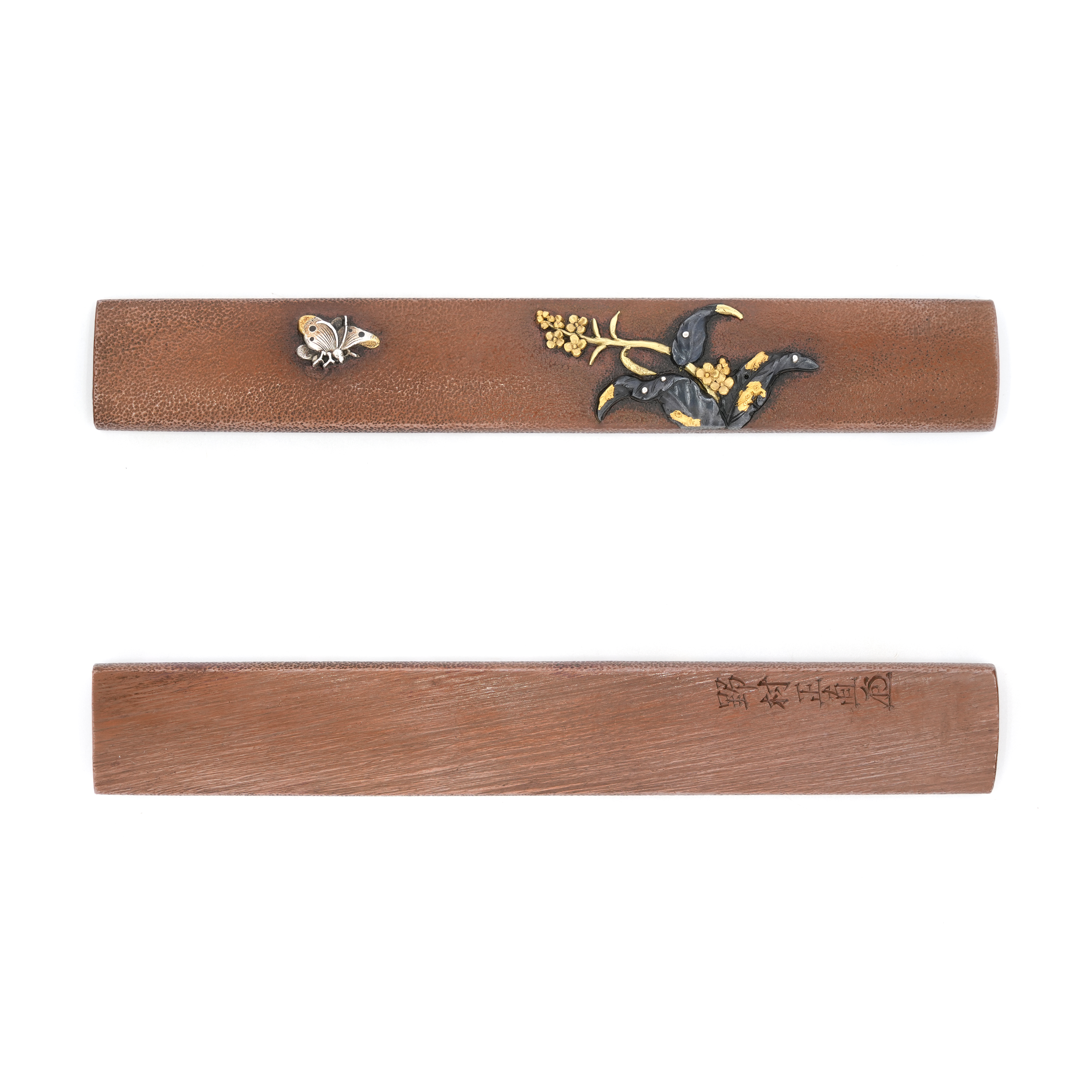
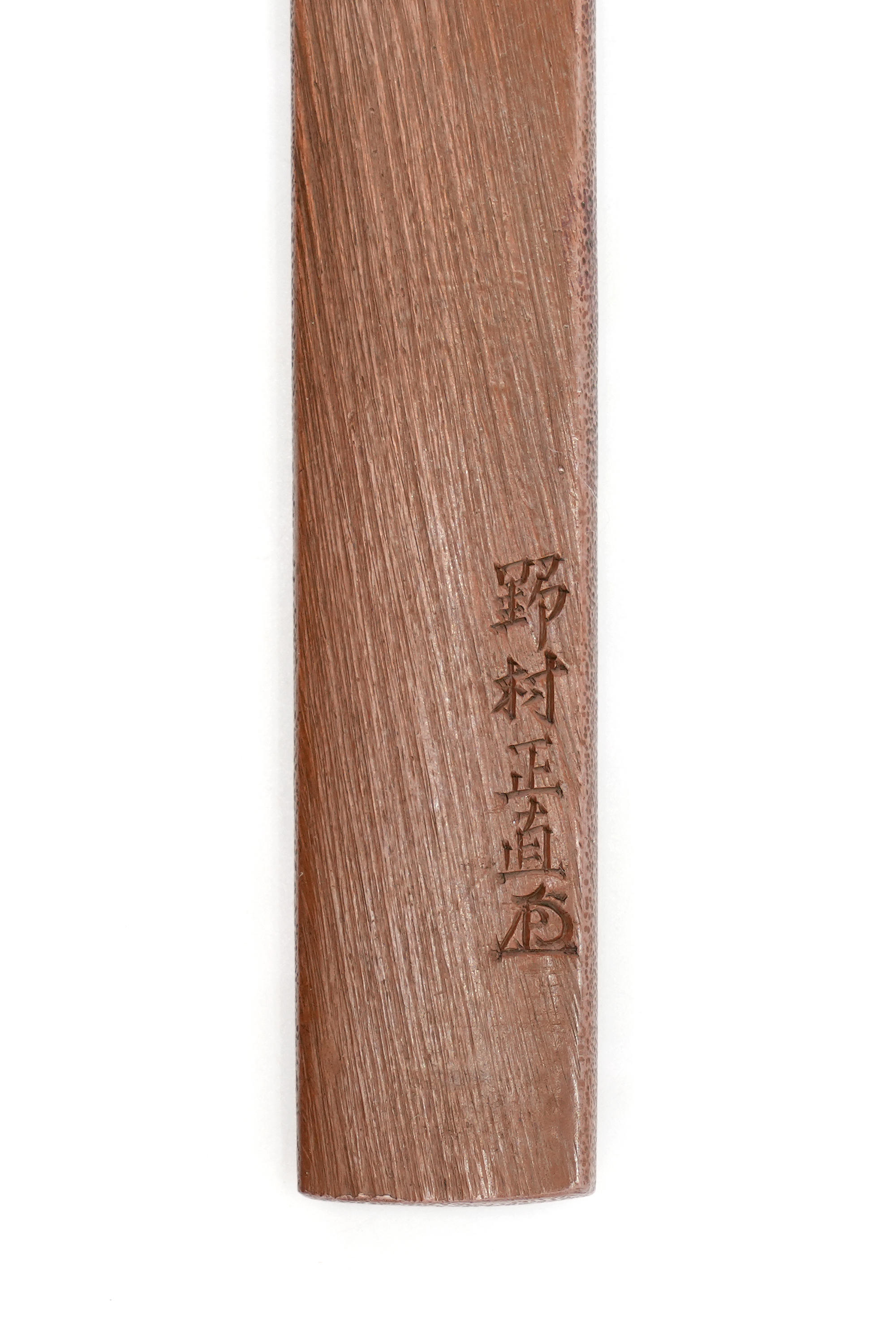
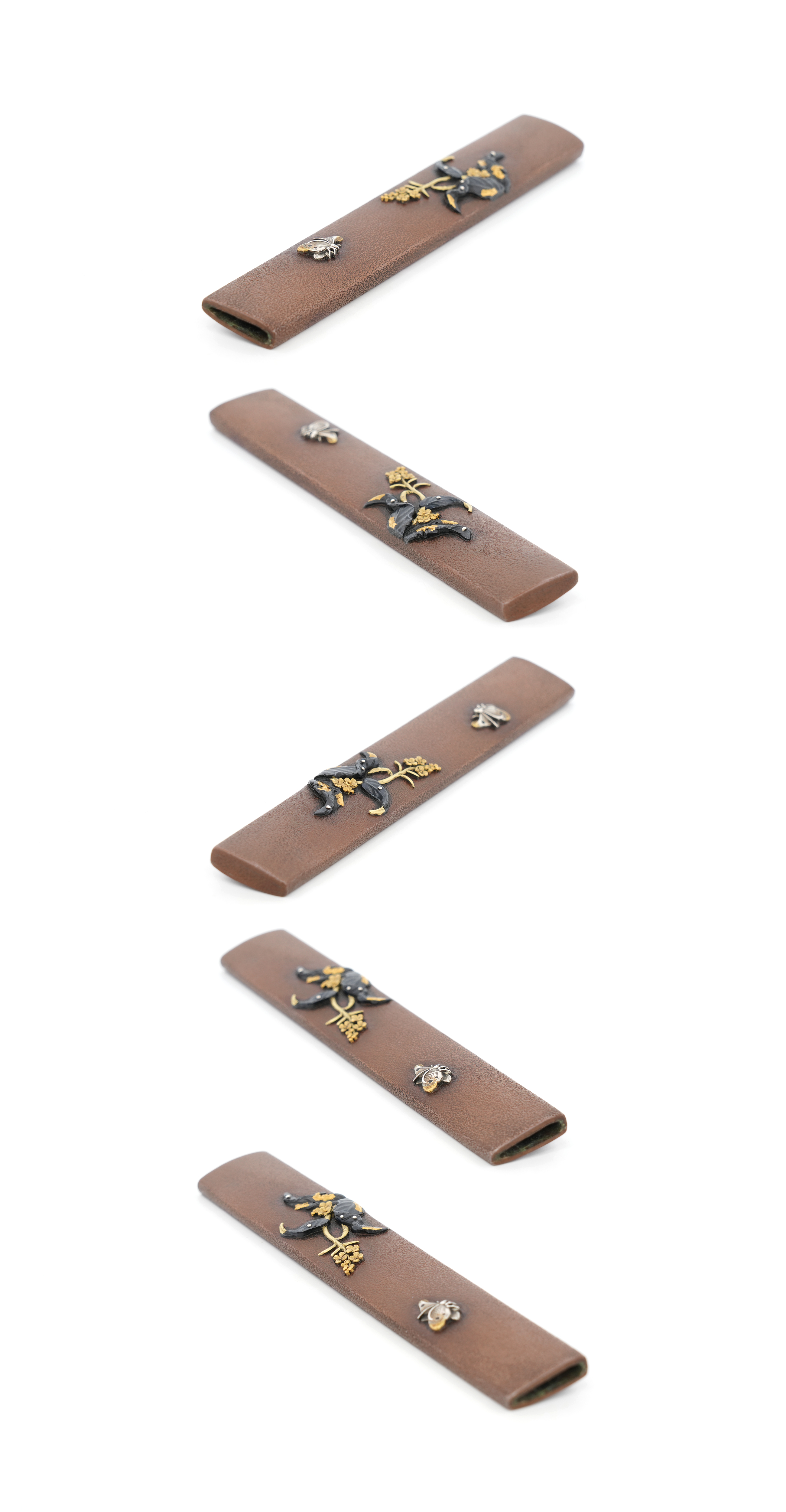
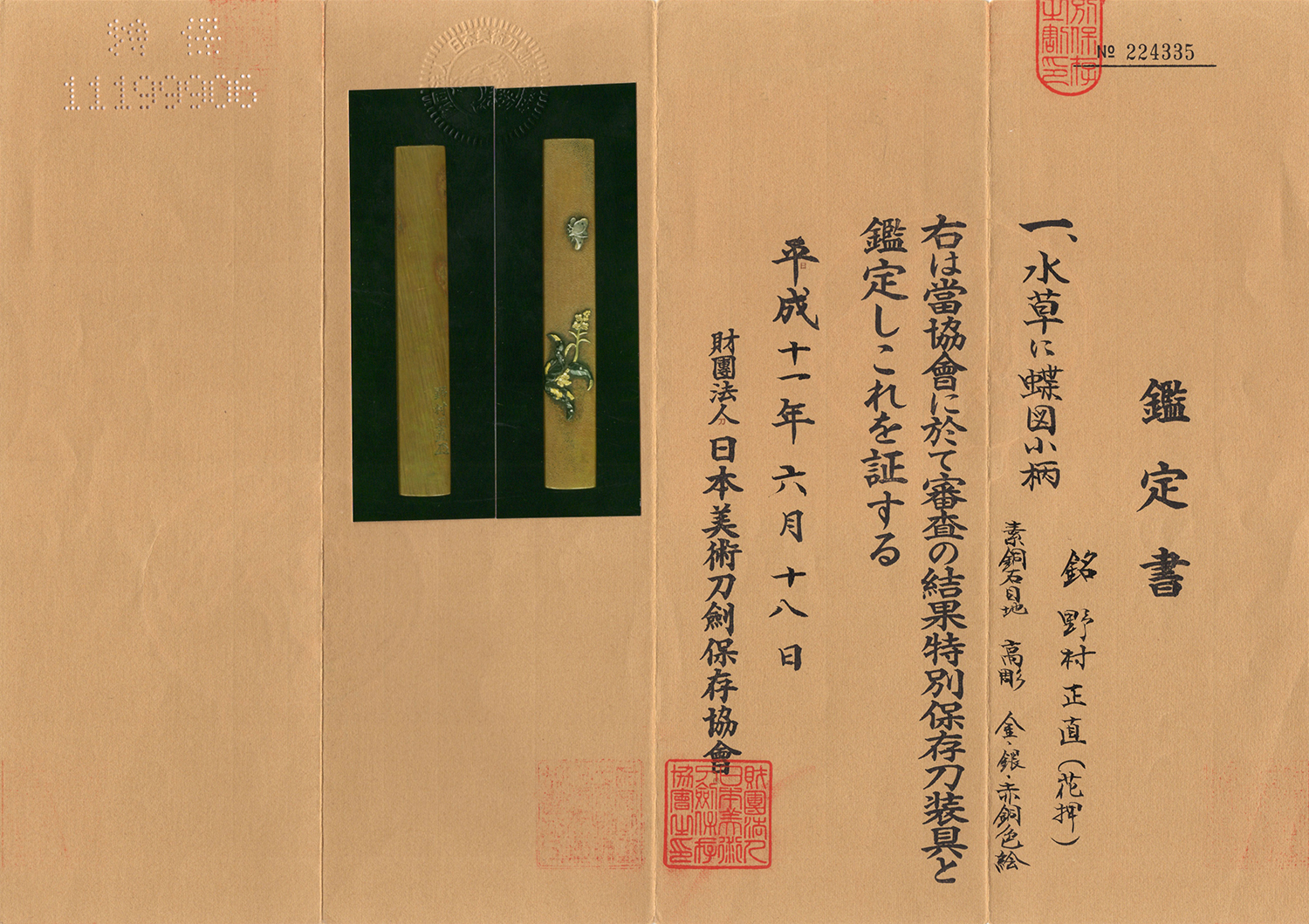
Nomura Masanao was a sword fitting metalworker of the Nomura school who was active in Edo, leaving behind works that combine different coloured metals such as suaka, shakudo, gold, and silver, and depicting familiar animals and plants with rich, realistic takabori iroe. Examples of his work from the first half of the 19th century are known, and the fact that he was a long-lived craftsman who continued to produce works until his later years can be inferred from his posthumous works that include his age, and this piece also has "Gyonen 77 Nomura Masanao" and a kao engraved on the reverse side. Although it is the work of his mature period at the age of 77, the movement of the chisel shows no signs of decline, even down to the antennae and legs of the butterfly, the wing veins, and the leaf veins and dew of the flowers and plants, and his rich powers of observation and masterful handling of coloured metals are condensed into a small surface. The subject matter combines flowers and plants growing by the water's edge with a butterfly fluttering toward them. The appearance of lush, overlapping pointed leaves and small flowers blooming in clusters at the tips of the branches is gracefully contained within the horizontal surface of the kozuka, and in this piece, by representing the flowers in gold, a brilliance of water plants is added to the warm brown of the suaka ground and the deep black of the shakudo leaves. The composition of a butterfly playing near the flowers lightly reflects the cycle of life and the changing of the seasons, conveying the delicate gaze toward nature typical of Edo metalworkers who favored taking up flowers and insects. The front has a dense ishime-ji struck onto the suaka ground, and after leaving a wide area of the ground with soft undulations, the butterfly is placed on the left and the water plants on the right, separated, and the blank space placed between the two is utilized as the space for the butterfly to approach the flowers. The butterfly is set high and plump, mainly in silver, and by shifting the gold colour so that it blurs toward the edges of the wings, it shows a skillful color expression that changes smoothly from the brightness of white silver to a warm golden colour, and the finely engraved wing veins, black spots, and three-dimensional body and legs vividly capture the moment it is just about to leave the ground and flutter toward the flowers. The water plants have leaves represented in thick shakudo, and by placing gold iroe on the tips of the leaves, a pleasant light is added to the deep black leaves, while dew is dotted on the leaf surfaces with silver zogan, making the gold flowers, shakudo leaves, and silver water droplets resonate on the suaka ishime-ji. Each leaf changes its orientation and sori, creating deep shadows inside the overlaps, and because the gold branches extend from the flower clusters weaving between the leaves, a depth where waterside plants grow is born even within the limited area, and every time the angle is changed, the gold and silver iroe and the sparkle of the dew appear and sink, making it a piece rich in appreciation when held in the hand. The reverse side has suichigai-yasuri passed over the entire suaka ground, summarized into a simple and neat taste in contrast to the ishime and takabori iroe on the front, and the mei accompanied by the age and the kao are placed at one end. While applying different ground finishes to the front and back, the composition that brings the whole together through the warm tone of the suaka is stylish, and Masanao's ability is well expressed in the fact that he does not just precisely copy realistic butterflies and flowers, but also makes one feel the atmosphere of the season by using the colour, luster, and texture of each material differently. A Nihon Bijutsu Token Hozon Kyokai Tokubetsu Hozon Tosogu kanteisho is included, and as a signed work with the age engraved, one can confirm the author's mature skill, and it is carefully housed in a specially made fitted paulownia box tailored to the work. Combining warm suaka ishime-ji, deep shakudo, pure silver, and soft gold without excess or deficiency, and equipped with focal points for appreciation from the butterfly's wings to the iroe on the leaf tips and every drop of dew, this piece has high appeal for collecting flower and insect motif kozuka, Nomura school metalwork, or examples with late-life mei, and it is a piece that combines dignity and loveliness, being bright when displayed and enjoyable to examine the detailed work repeatedly when held in the hand.
Offered by Toushin

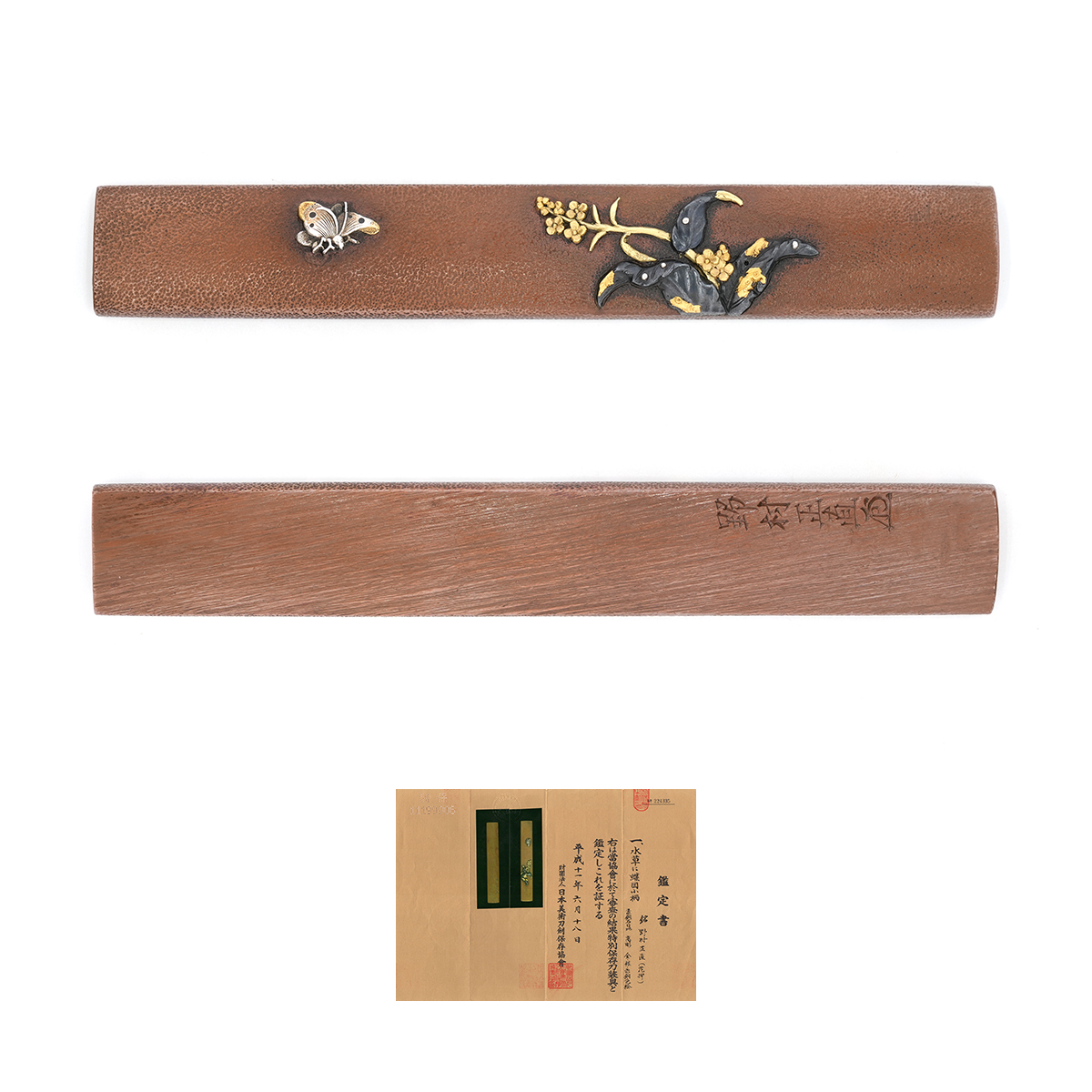
Ito Masanao
Edo
Signed
Tokuho (NBTHK)
Machine translation of the shop's Japanese ·
Machine translation from the shop's Japanese · may contain errors ·
Iron-tsuba · Musashi
5 pieces on the market now
Iron-tsuba · Musashi
55 pieces on the market now
The Ito school (伊藤派) was a prolific kinkō lineage based in Kanda, Edo, in Musashi province. The line was established by Masanaga (正長, d. 1727), who received appointment as official tsuba maker (kōgi o-kakae tsubashi) to the Tokugawa Shogunate following an audience with Shogun Ienobu in 1710. Successive heads bore the character 正 (Masa-) in their art names, producing ten recorded generations from the Genroku era through the Meiji period. The second-generation master Masatsune (正恒) developed ito-sukashi (糸透かし), the school's signature technique of extremely fine saw-cut openwork. The tenth and final head, Itō Katsumi (伊藤勝見, 1829--1910), originally named Masataka (正隆), entered the school of Tanaka Seiju (田中清寿) at twelve, was adopted into his master's household at seventeen, and received the rank of Hōkyō (法橋) while still young, together with the art name Tōryūsai (東竜斎). After parting ways with Seiju, Katsumi studied maki-e under Shibata Zeshin (柴田是真), and in Man'en 1 (1860) was adopted into the Itō Masahiro family, becoming the tenth-generation head. This dual formation -- kinkō discipline under the Tanaka lineage and lacquer refinement under Zeshin -- profoundly shaped the school's late output.
The Ito school's collective style is characterised by mastery of zōgan (象嵌, inlay) and iroe (色絵, polychrome metalwork) deployed with what the setsumei repeatedly describe as precision and accuracy. Works are executed on plates of iron, shibuichi (四分一), oboro-gin (朧銀), or shakudō (赤銅), frequently with nanako-ji (魚子地) grounds. The technical repertoire encompasses takabori (高彫, high relief), sukidashi takabori (鋤出高彫), katakiribori (片切彫), fine kebori (毛彫, hairline engraving), suemon-zōgan (据文象嵌), and nunome-zōgan (布目象嵌), often combined within a single composition. Masatsune's work employs shippō (七宝, cloisonné enamel) on iron plate, as seen in a unified uchigatana koshirae signed "Bushū-jū Masatsune" whose tsuba, fuchi-kashira, kurikata, and kaerizuno are coordinated as a single aesthetic programme[[c:1]] with raden (螺鈿, mother-of-pearl) and gold uchikomi (打込) work. Katsumi's mature output favours figural and narrative subjects: the Frog Battle after the celebrated Chōjū-giga scrolls attributed to Toba Sōjō, Gama Sennin with his toad beneath a willow, and Daisē Fudō Myōō realised with emphatic devotional presence. "[[c:6]] The Ito school occupies a distinctive place in the tsuba canon as a Musashi-based lineage that sustained high-level production across the entire Edo period. Its works were widely disseminated through the sankin-kōtai system, as samurai from all provinces acquired Ito tsuba during their attendance in Edo. "[[c:7]] That his tsuba depicting the Chōjū-giga Frog Battle is described as a "forceful work from his later years"[[c:5]] whose "composition, which successfully preserves the spirit of the original painting, is outstanding" confirms the school's enduring capacity to unite pictorial invention with metalworking virtuosity. Learn more →
| Smith | Era | Designated |
|---|---|---|
| Katsumi勝見 | — | 4 |
| Sadatsune貞恒 | — | 0 |
| Masayoshi正備 | — | 0 |
| Masatsune正常 | — | 0 |
| Masakane正金 | — | 0 |
A Hozon-certified fitting of notably superior craftsmanship and condition, often with signature or workmanship of high reference value.
The NBTHK (Nihon Bijutsu Tōken Hozon Kyōkai, the Society for the Preservation of Japanese Art Swords) is a public-interest incorporated foundation founded in 1948 and supervised by Japan’s Agency for Cultural Affairs (Bunkachō); it is based at the Japanese Sword Museum in Tokyo. Its expert panels physically examine each submitted work (shinsa) and issue a certificate (kanteishō) ranking it by artistic and historical merit. NBTHK papers are the most widely recognized standard of authentication for Japanese swords and fittings.
NBTHK official siteAs a rule we do not accept returns, except when we have sent a different item from the one ordered or when there is a significant discrepancy between the description and the item. If you wish to return an item, please contact us within 3 days of its arrival and then send it back.
¥770,000