 NihontoWatchNihontoWatch
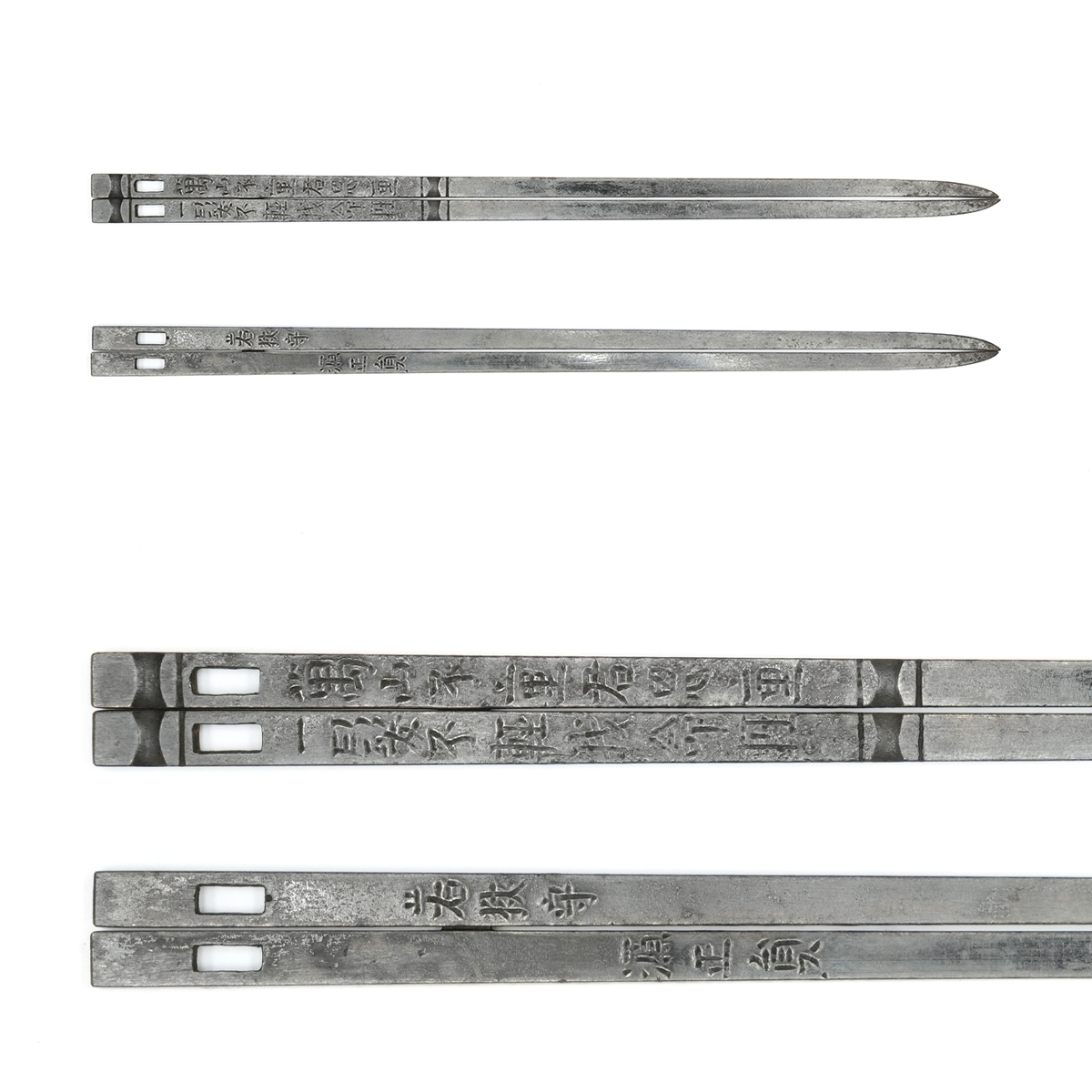
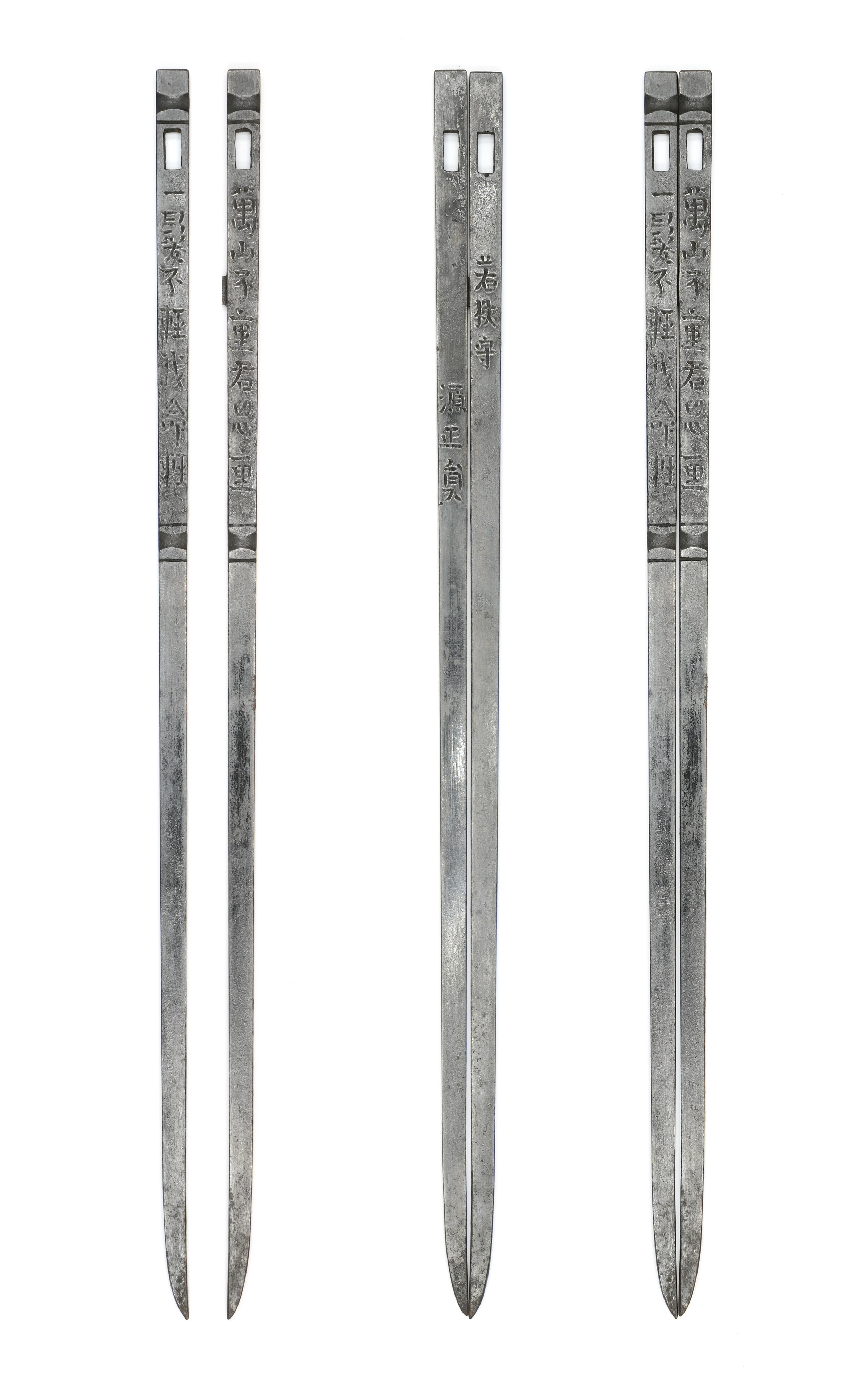
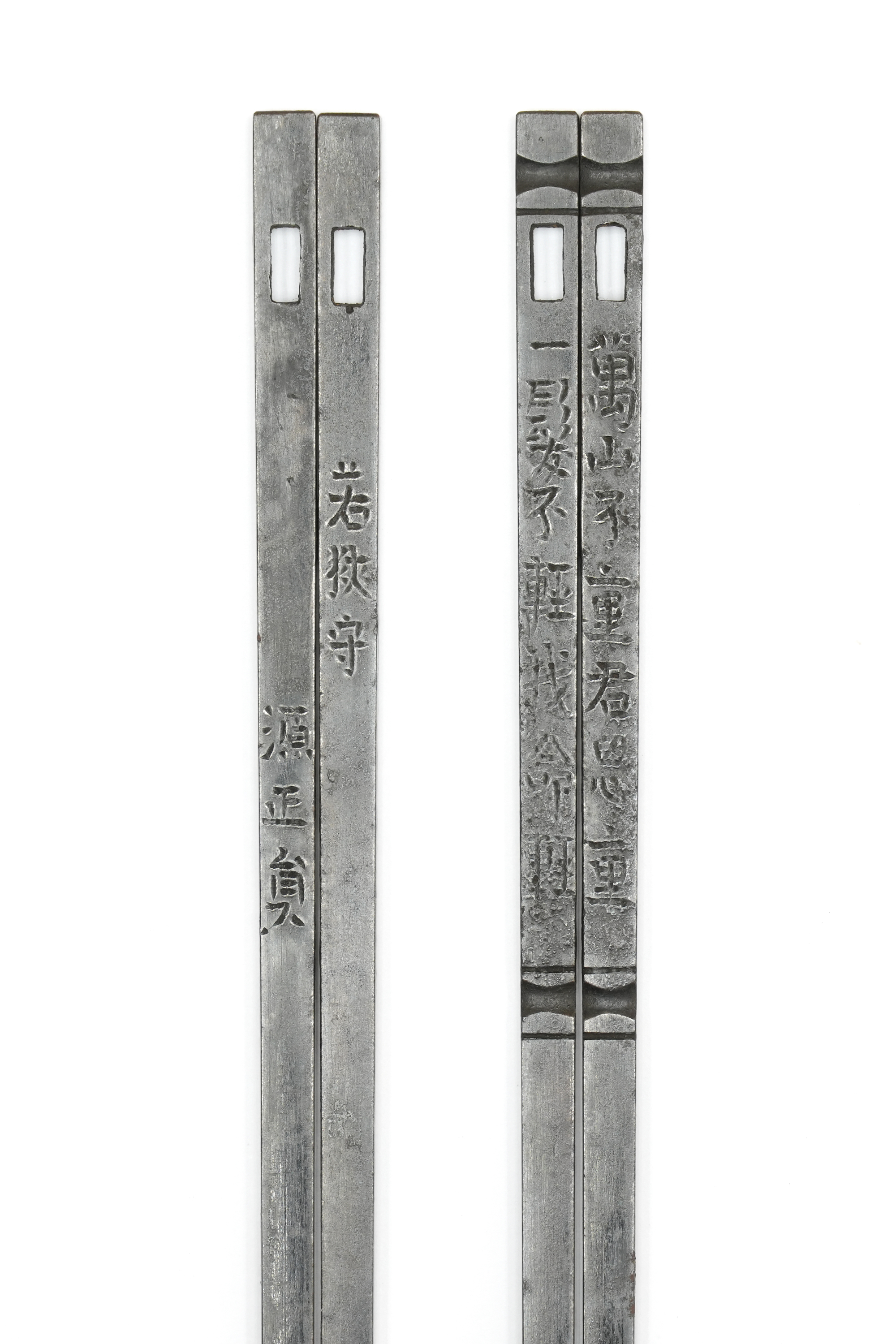
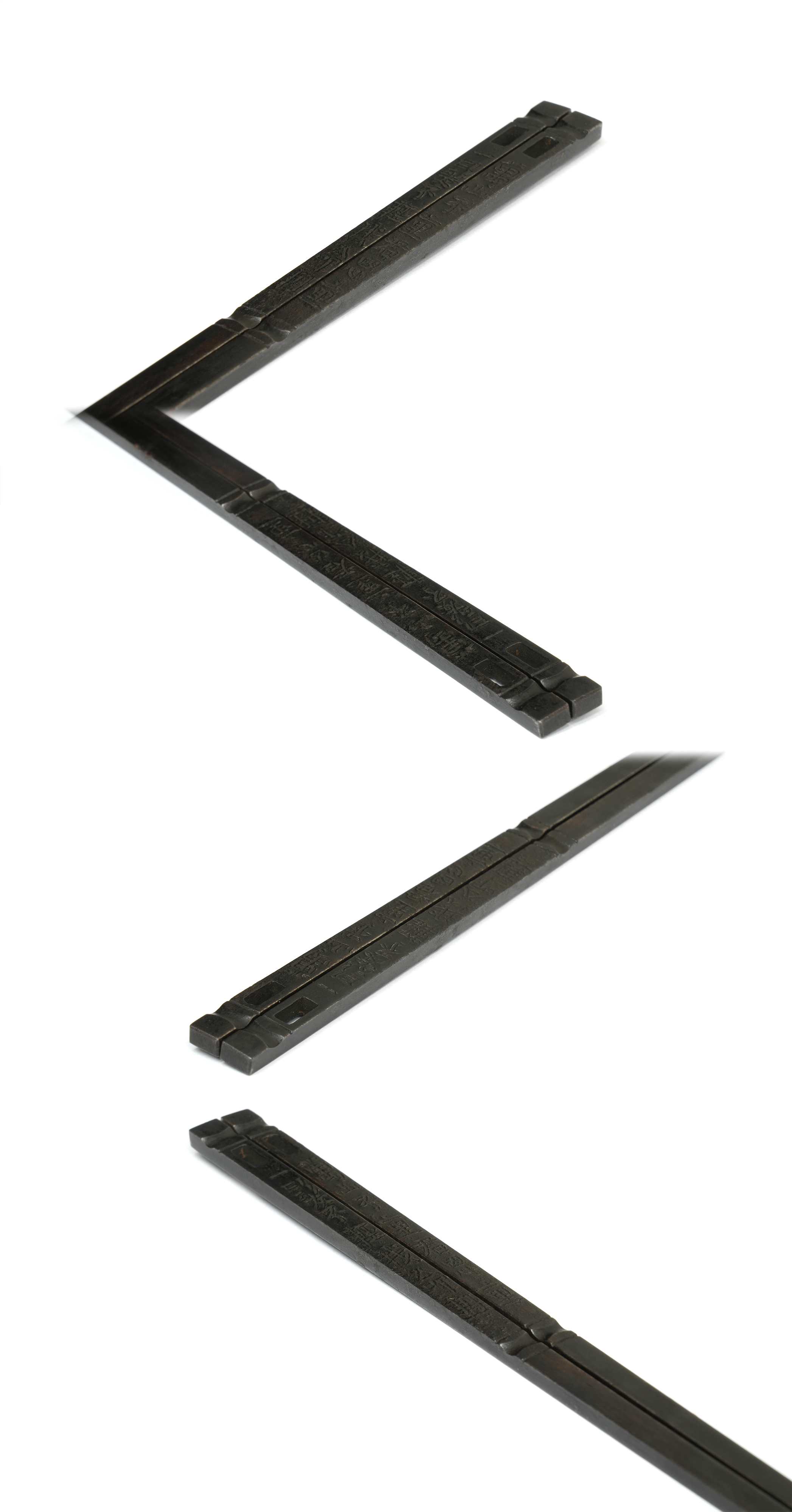
This work, bearing the mei of Wakasa no Kami Minamoto Masasada, is a warigogai that expresses a strong spirituality through the neat form of the tetsu-ji and engraved characters alone, without relying on flamboyant iroe or takabori of flora and fauna. Regarding Wakasa no Kami Minamoto Masasada, currently available materials are insufficient to confirm his location of activity, lineage, or period of activity; however, in the work of aligning the width and thickness when the two kogai are joined, and arranging characters of different content on the omote and ura while engraving each character with good balance onto the long, narrow ji, one can perceive a certain skill in handling iron and a compositional power to transfer calligraphic intent into kinko. Engraved on the omote are the two phrases "Manzan fuju kun-on ju, Ippatsu fukei wagainochi kei," expressing a resolution of loyalty stating that lordly favors are heavier than all mountains, and while even a single hair is not light, one considers one's own life light in the face of those favors. These words are famous for being reportedly engraved by Oishi Kuranosuke Yoshio on a tsuba of his own making and are known as a phrase symbolizing the Ako Gishi; rather than a mere quotation of Chinese poetry, it is a subject extremely appropriate for tosogu, condensing the spirit of obligation, loyalty, and self-sacrifice valued by bushi. The engraved text is distributed across the two ji, with "Manzan fuju kun-on ju" placed on the right piece and "Ippatsu fukei wagainochi kei" on the left piece; by doing so, the paired phrases form a single composition when the left and right are joined, and the very structure of the warigogai resonates with the antithetical expression of the text. The characters are engraved powerfully stroke by stroke while varying in depth and thickness, highlighting the content through only the calm gray of the tetsu-ji and the shadows of the engraved lines, allowing one to appreciate the flavor of archaic calligraphy from the front and the three-dimensional work of the tagane biting into the iron from an angle. Rectangular sukashi are provided on the left and right of the kashira respectively, with lines and rhythmic steps placed above and below them to tighten the start of the composition, and by adding a band-like partition at the boundary between the section holding the engraved text and the sao that extends thinly toward the tip, a clear rhythm is given to the whole while restraining decoration. When the two are aligned, the central seam becomes a single axis creating a neat appearance, and when viewed separately, the characters, sukashi, ridgelines of the sao, and the sharp gathering of the tips on each piece can be confirmed individually, providing a wealth of appreciation unique to the warigogai where one can move between a single form and two structures. On the ura, the mei "Wakasa no Kami" and "Minamoto Masasada" are cut separately on the left and right, concisely indicating the maker's name in response to the text of loyalty on the omote. The composition, which leaves the ji wide on both omote and ura and does not fill the margins with patterns or colors, is intentional so that the texture of the iron, the long straight lines, and the power of the engraved characters take center stage, and the gentle light and shadow appearing on the well-used tetsu-ji add the depth of age to the rigorous appearance of the time of production. This tetsu-ji warigogai, featuring the words conveying the loyalty of Oishi Kuranosuke, a clever composition where the paired phrases are only completed when the two pieces are joined, and the maker's mei, is blessed with both documentary value and narrative quality; for those who collect designs related to the Ako Gishi or Chushingura, tosogu expressing the bushi spirit, or works where calligraphy and kinko are integrated, it possesses an especially unmissable charm. Emitting a dignified presence distinct from gaudy decoration, it is a high-style work to be cherished at hand for a long time, where the meaning and form quietly overlap the more one takes it from the kiri-bako and reads through the characters one by one.
Offered by Toushin
We couldn’t find current papers for this piece. Ask the dealer whether it has been, or can be, submitted to shinsa. — Hoshi
53 on the market

Ito Masasada
Edo
Signed
As written by the shop
Machine translation from the shop's Japanese · may contain errors ·
Iron-tsuba · around 1670
1 piece on the market now
Iron-tsuba · Musashi
53 pieces on the market now
The Ito school (伊藤派) was a prolific kinkō lineage based in Kanda, Edo, in Musashi province. The line was established by Masanaga (正長, d. 1727), who received appointment as official tsuba maker (kōgi o-kakae tsubashi) to the Tokugawa Shogunate following an audience with Shogun Ienobu in 1710. Successive heads bore the character 正 (Masa-) in their art names, producing ten recorded generations from the Genroku era through the Meiji period. The second-generation master Masatsune (正恒) developed ito-sukashi (糸透かし), the school's signature technique of extremely fine saw-cut openwork. The tenth and final head, Itō Katsumi (伊藤勝見, 1829--1910), originally named Masataka (正隆), entered the school of Tanaka Seiju (田中清寿) at twelve, was adopted into his master's household at seventeen, and received the rank of Hōkyō (法橋) while still young, together with the art name Tōryūsai (東竜斎). After parting ways with Seiju, Katsumi studied maki-e under Shibata Zeshin (柴田是真), and in Man'en 1 (1860) was adopted into the Itō Masahiro family, becoming the tenth-generation head. This dual formation -- kinkō discipline under the Tanaka lineage and lacquer refinement under Zeshin -- profoundly shaped the school's late output.
The Ito school's collective style is characterised by mastery of zōgan (象嵌, inlay) and iroe (色絵, polychrome metalwork) deployed with what the setsumei repeatedly describe as precision and accuracy. Works are executed on plates of iron, shibuichi (四分一), oboro-gin (朧銀), or shakudō (赤銅), frequently with nanako-ji (魚子地) grounds. The technical repertoire encompasses takabori (高彫, high relief), sukidashi takabori (鋤出高彫), katakiribori (片切彫), fine kebori (毛彫, hairline engraving), suemon-zōgan (据文象嵌), and nunome-zōgan (布目象嵌), often combined within a single composition. Masatsune's work employs shippō (七宝, cloisonné enamel) on iron plate, as seen in a unified uchigatana koshirae signed "Bushū-jū Masatsune" whose tsuba, fuchi-kashira, kurikata, and kaerizuno are coordinated as a single aesthetic programme[[c:1]] with raden (螺鈿, mother-of-pearl) and gold uchikomi (打込) work. Katsumi's mature output favours figural and narrative subjects: the Frog Battle after the celebrated Chōjū-giga scrolls attributed to Toba Sōjō, Gama Sennin with his toad beneath a willow, and Daisē Fudō Myōō realised with emphatic devotional presence. "[[c:6]] The Ito school occupies a distinctive place in the tsuba canon as a Musashi-based lineage that sustained high-level production across the entire Edo period. Its works were widely disseminated through the sankin-kōtai system, as samurai from all provinces acquired Ito tsuba during their attendance in Edo. "[[c:7]] That his tsuba depicting the Chōjū-giga Frog Battle is described as a "forceful work from his later years"[[c:5]] whose "composition, which successfully preserves the spirit of the original painting, is outstanding" confirms the school's enduring capacity to unite pictorial invention with metalworking virtuosity. Learn more →
| Smith | Era | Designated |
|---|---|---|
| Katsumi勝見 | — | 4 |
| Masafusa正房 | 1670 | 1 |
| Sadatsune貞恒 | — | 0 |
| Masayoshi正備 | — | 0 |
| Masakane正金 | — | 0 |
We could not find an authenticity certificate on the seller’s listing. Japanese swords and fittings are normally papered by the NBTHK (or the NTHK). Without one, the attribution is the seller’s own assessment and has not been independently verified — treat it with caution and ask the dealer about certification before buying.
As a rule we do not accept returns, except when we have sent a different item from the one ordered or when there is a significant discrepancy between the description and the item. If you wish to return an item, please contact us within 3 days of its arrival and then send it back.
¥176,000