The Yamato schools grew up in the shadow of Nara’s great monasteries: Tegai took its name from a gate of Tōdaiji. Their austere masame and quiet suguha are a temple aesthetic, prized ever since for exactly that restraint.
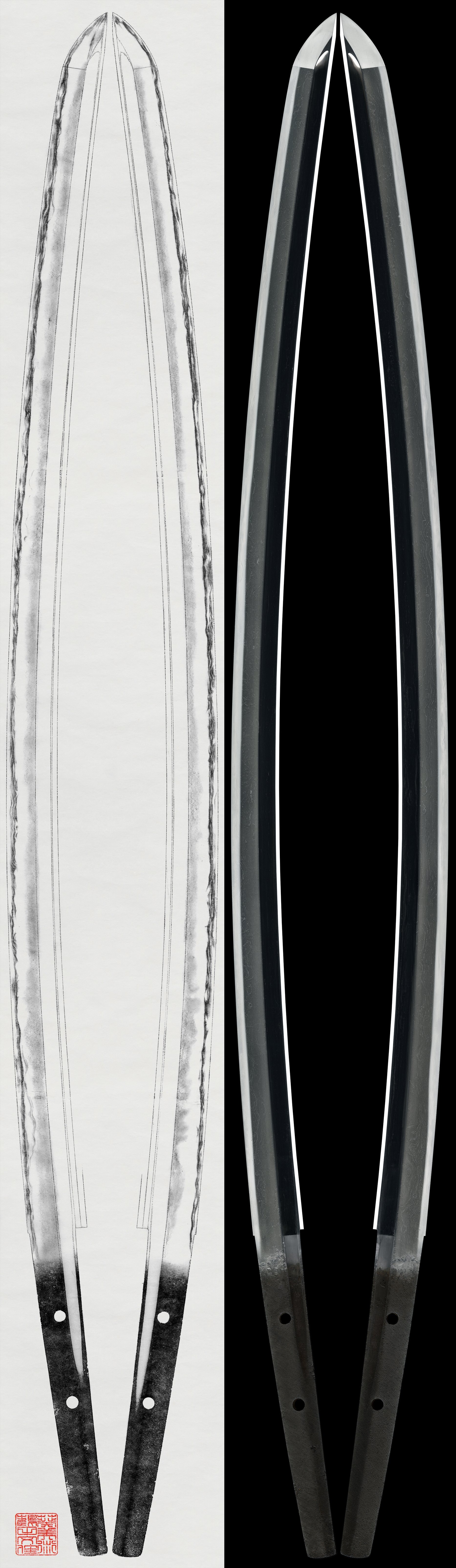
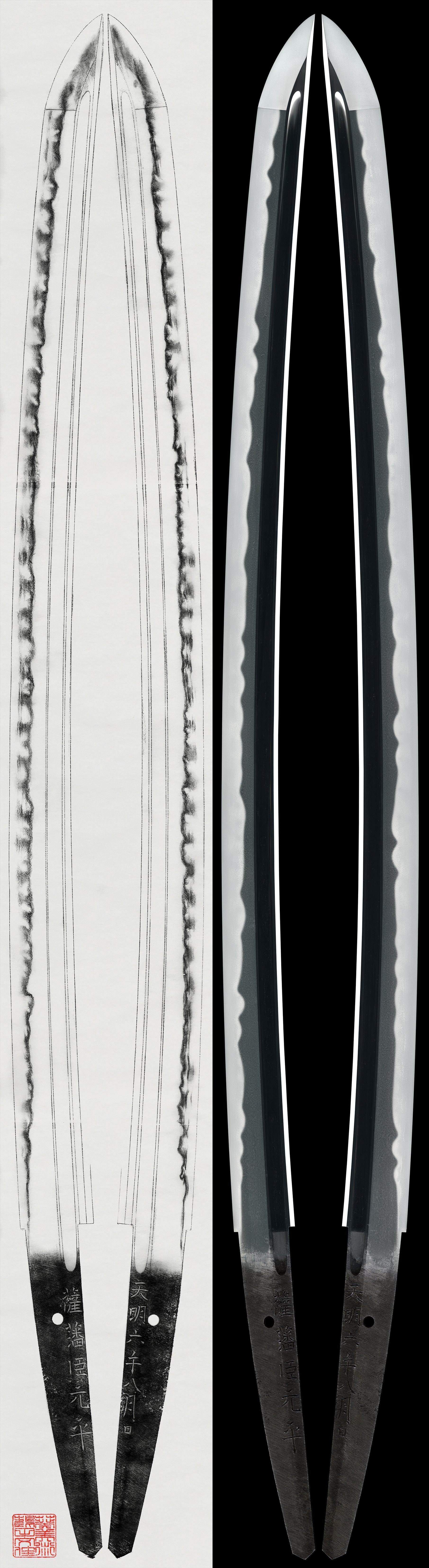
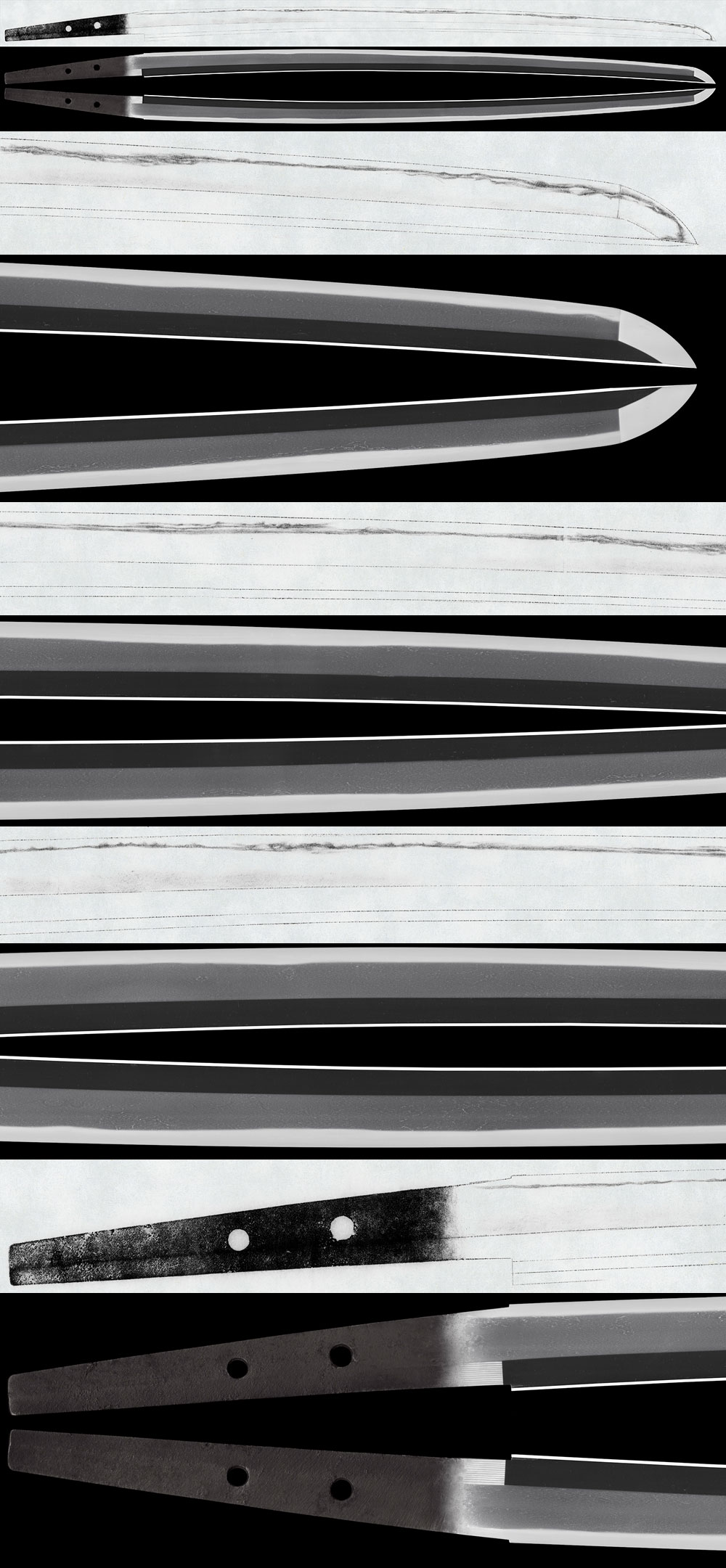
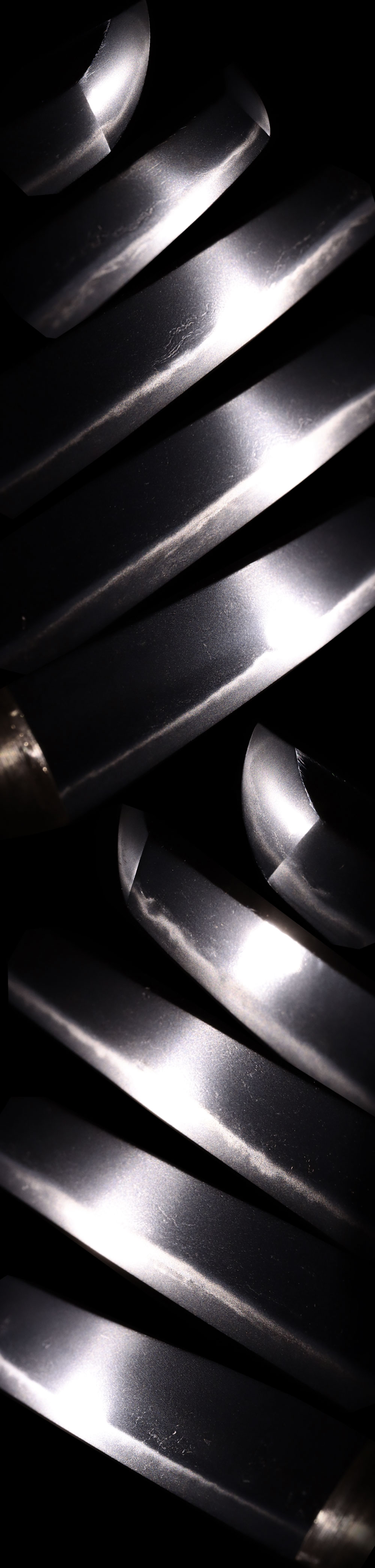
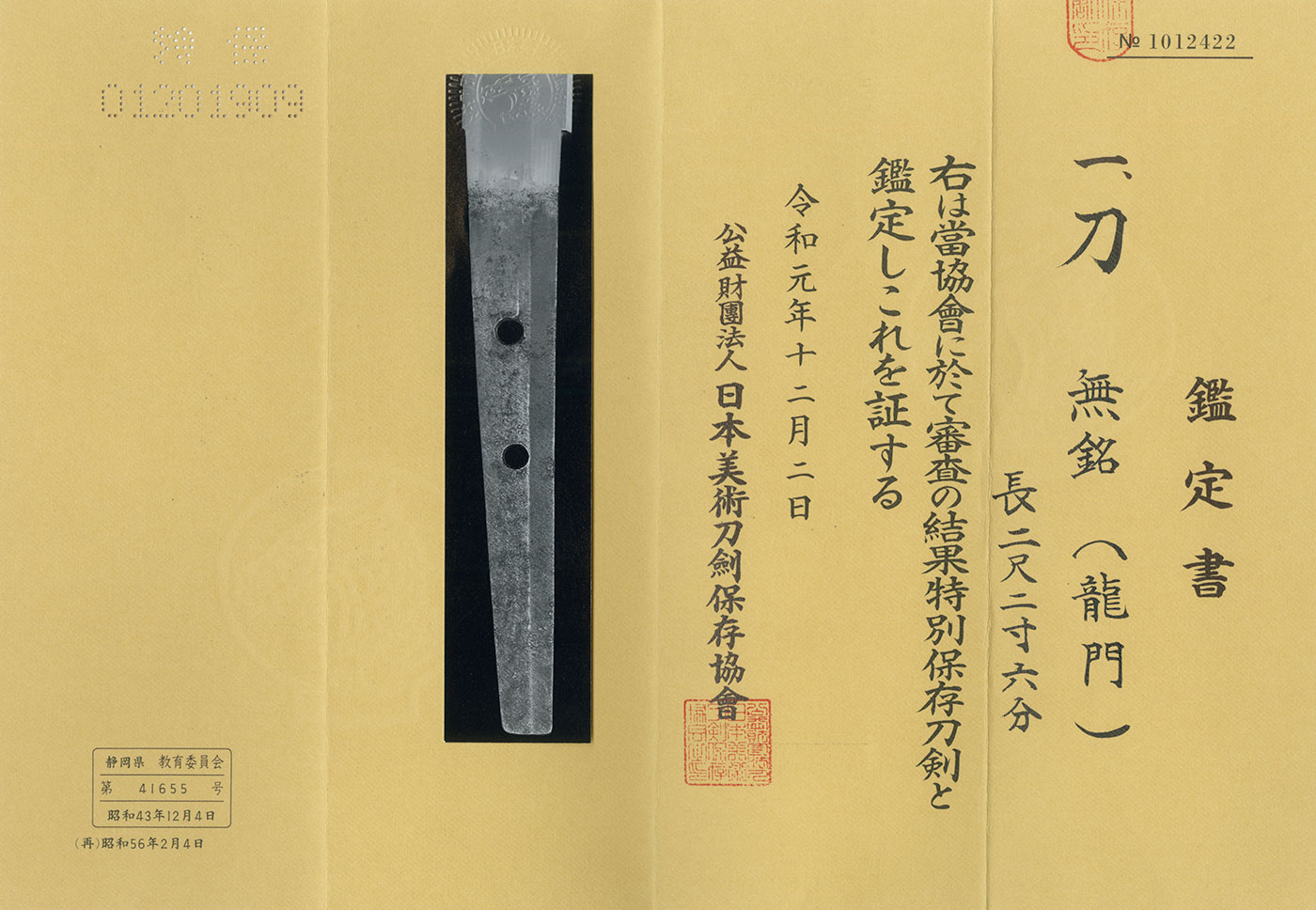
This is a mumei katana attributed to the Ryūmon school from the mid-Kamakura period. It features a well-forged ko-itame hada with abundant ji-nie and a suguha hamon with active ko-ashi, displaying double and triple yakiba. The blade comes with a shirasaya and a koshirae, and is accompanied by an NBTHK Tokubetsu Hozon Token certificate.
 NihontoWatch
mumei · Ryūmon · Kamakura · nagasa 68.7cm · sori 1.2cm


Yamato-den · Yamato
Within the Yamato province, the Ryūmon school took its name from Ryūmon-shō in Yoshino District, where its smiths resided, and the setsumei trace its descent from the Senjuin line of the Yamato-den. The blades gathered here are dated to the late Kamakura through Nanbokuchō periods, the 14th century, and carry attributions to the group rather than to a single hand, all being mumei through ō-suriage. The school is represented above all by Enkichi, with the catalog records also naming Enyoshi, whose suguha-based work mixed with ko-gunome is noted to bear affinity to a Ryūmon piece transmitted in the Chichibu-no-miya house. The setsumei describe two strains within the group: one in which a florid midare-ba is tempered with prominent utsuri, lending a Bizen-like character, and a second, more traditionally Yamato manner in which utsuri stays inconspicuous; the present works belong chiefly to the latter. Across these katana the jihada is itame mixed with mokume and nagare-hada, the grain often standing in a hada-dachi or tsumumo manner that signals the Yamato base; extremely fine ji-nie forms thickly, and chikei enter frequently, in places as large-pattern lines. The hamon is a suguha-chō tempered with ko-chōji or ko-gunome, at times carrying a shallow notare tendency, with ko-ashi entering. Recognition of the hand rests along the habuchi, where the setsumei consistently record hotsure, nijūba, kuichigai-ba, and yubashiri, with fine kinsuji and sunagashi running through and a bright nioiguchi.
A faint sugu-like utsuri near the edge appears on several blades. The bōshi tends to midare-komi or notare-komi, turning with yakizume or ko-maru and hakikake. For kantei, the diagnostic cluster is the masame-tending itame with thick fine ji-nie and frequent chikei, set against a suguha-chō edge broken by hotsure and kuichigai-ba, a combination the appraisers read as the Ryūmon mark in both ji and ha. The luminous nie along the habuchi and the bright nioiguchi are repeatedly singled out, and the utsuri-bearing examples carry the Bizen-leaning temperament noted for one of the two strains. Provenance ties one example to the Chichibu-no-miya house through its resemblance to a recorded Enyoshi. Holding to its Senjuin and Yamato roots while admitting a Bizen-tinged register, the Ryūmon school occupies a defined place among the Yamato-den lineages of Yoshino. Learn more →
Yamato in the Kamakura period
The Yamato schools grew up in the shadow of Nara’s great monasteries: Tegai took its name from a gate of Tōdaiji. Their austere masame and quiet suguha are a temple aesthetic, prized ever since for exactly that restraint.
A Hozon-certified blade judged to show notably superior workmanship and a better state of preservation. The bar is higher: re-tempered blades and most unsigned Muromachi/Edo works are excluded.
The NBTHK (Nihon Bijutsu Tōken Hozon Kyōkai, the Society for the Preservation of Japanese Art Swords) is a public-interest incorporated foundation founded in 1948 and supervised by Japan’s Agency for Cultural Affairs (Bunkachō); it is based at the Japanese Sword Museum in Tokyo. Its expert panels physically examine each submitted work (shinsa) and issue a certificate (kanteishō) ranking it by artistic and historical merit. NBTHK papers are the most widely recognized standard of authentication for Japanese swords and fittings.
NBTHK official siteIf you wish to return an item, please notify us within 3 days of receipt. After this period we cannot accept cancellations. Please ship the return to us within 5 business days. Cancellation is conditional on the item being kept in the same condition as at the time of sale, so please handle it with care.
Starting Bid
¥1,250,000
This is a mumei katana attributed to the Ryūmon school from the mid-Kamakura period. It features a well-forged ko-itame hada with abundant ji-nie and a suguha hamon with active ko-ashi, displaying double and triple yakiba. The blade comes with a shirasaya and a koshirae, and is accompanied by an NBTHK Tokubetsu Hozon Token certificate.
NihontoWatchmumei · Ryūmon · Kamakura · nagasa 68.7cm · sori 1.2cm
Yamato-den · Yamato
Within the Yamato province, the Ryūmon school took its name from Ryūmon-shō in Yoshino District, where its smiths resided, and the setsumei trace its descent from the Senjuin line of the Yamato-den. The blades gathered here are dated to the late Kamakura through Nanbokuchō periods, the 14th century, and carry attributions to the group rather than to a single hand, all being mumei through ō-suriage. The school is represented above all by Enkichi, with the catalog records also naming Enyoshi, whose suguha-based work mixed with ko-gunome is noted to bear affinity to a Ryūmon piece transmitted in the Chichibu-no-miya house. The setsumei describe two strains within the group: one in which a florid midare-ba is tempered with prominent utsuri, lending a Bizen-like character, and a second, more traditionally Yamato manner in which utsuri stays inconspicuous; the present works belong chiefly to the latter. Across these katana the jihada is itame mixed with mokume and nagare-hada, the grain often standing in a hada-dachi or tsumumo manner that signals the Yamato base; extremely fine ji-nie forms thickly, and chikei enter frequently, in places as large-pattern lines. The hamon is a suguha-chō tempered with ko-chōji or ko-gunome, at times carrying a shallow notare tendency, with ko-ashi entering. Recognition of the hand rests along the habuchi, where the setsumei consistently record hotsure, nijūba, kuichigai-ba, and yubashiri, with fine kinsuji and sunagashi running through and a bright nioiguchi.
A faint sugu-like utsuri near the edge appears on several blades. The bōshi tends to midare-komi or notare-komi, turning with yakizume or ko-maru and hakikake. For kantei, the diagnostic cluster is the masame-tending itame with thick fine ji-nie and frequent chikei, set against a suguha-chō edge broken by hotsure and kuichigai-ba, a combination the appraisers read as the Ryūmon mark in both ji and ha. The luminous nie along the habuchi and the bright nioiguchi are repeatedly singled out, and the utsuri-bearing examples carry the Bizen-leaning temperament noted for one of the two strains. Provenance ties one example to the Chichibu-no-miya house through its resemblance to a recorded Enyoshi. Holding to its Senjuin and Yamato roots while admitting a Bizen-tinged register, the Ryūmon school occupies a defined place among the Yamato-den lineages of Yoshino. Learn more →
Yamato in the Kamakura period
The Yamato schools grew up in the shadow of Nara’s great monasteries: Tegai took its name from a gate of Tōdaiji. Their austere masame and quiet suguha are a temple aesthetic, prized ever since for exactly that restraint.
A Hozon-certified blade judged to show notably superior workmanship and a better state of preservation. The bar is higher: re-tempered blades and most unsigned Muromachi/Edo works are excluded.
The NBTHK (Nihon Bijutsu Tōken Hozon Kyōkai, the Society for the Preservation of Japanese Art Swords) is a public-interest incorporated foundation founded in 1948 and supervised by Japan’s Agency for Cultural Affairs (Bunkachō); it is based at the Japanese Sword Museum in Tokyo. Its expert panels physically examine each submitted work (shinsa) and issue a certificate (kanteishō) ranking it by artistic and historical merit. NBTHK papers are the most widely recognized standard of authentication for Japanese swords and fittings.
NBTHK official siteIf you wish to return an item, please notify us within 3 days of receipt. After this period we cannot accept cancellations. Please ship the return to us within 5 business days. Cancellation is conditional on the item being kept in the same condition as at the time of sale, so please handle it with care.
Starting Bid
¥1,250,000