Hizen swords were a domain enterprise: the Nabeshima sent Tadayoshi to study under Umetada Myōju around 1596, then built a licensed school around him. Nine generations carried its famously consistent konuka-hada work into the Meiji era.
 NihontoWatchNihontoWatch
刃渡り(長さ) 72.4センチ 反り 2.8センチ 元鎬厚 8.2ミリ 元重ね8.0ミリ 先鎬厚 4.9ミリ 先重ね4.7ミリ 元幅 31.2ミリ 先幅 21.8ミリ 刀身重量894g 拵鞘払い重量 刀身重量+436g ハバキ 銅 緋銅金色絵 目釘穴 2個 刃文 直刃 小沸出来 映り気現れ 葉、足入り、ほつれ、砂流し働く 小足しきりに入り、一部逆がかる 帽子 横手付近下がり直ぐに焼き、銀筋、二重刃がかり尖り心僅かに返る 鍛え 小糠肌 板、杢、柾目交え詰み地鉄良く錬られる 寸法、グラムは約でご理解ください。刃渡り・反りなど登録書を映しております。 銘文 肥前国出羽守藤原行廣 行廣の評価額 350~580万円 説明 ↓ここに画像が表示されます。(通信環境により数十秒ほどかかる場合もございます。) 1/3 ↓ここに画像が表示されます。(通信環境により数十秒ほどかかる場合もございます。) 2/3 ↓ここに画像が表示されます。(通信環境により数十秒ほどかかる場合もございます。) 3/3 委託出品 無疵無欠点というべき上出来の御刀 地鉄詰み、良く錬られ、匂口は元から先まで焼き叢なく均一、刃も良く働き、技量が優れた刀工だということが茎を見なくてもわかります。 肥前国出羽守藤原行廣 行廣について 初代行廣は名を橋本九郎兵衛といい、元和四年(1618年)に吉信の次男として生まれる。 初代忠吉の孫で兄は河内大掾正広。 正保五年に出羽大掾を受領、寛文三年に出羽守。 長崎では舶来の鍛法「阿蘭陀鍛」を修得する。 行廣の評価は高く、江戸時代の刀剣鑑定家鎌田魚妙は「正廣同等の上手也。殊に龜文刃も陸奥守におとらざる物也」と記載されている。 行廣は備前一文字伝の刀鍛冶に学んだことから茎に「一」文字を冠して自ら「肥前一文字」と称す。 天和三年没(1683年)享年六十六歳 (大名登録) 刀が登録制になった初年度、昭和26年の登録になり、元華族、元大名、元士族順に登録をお願いしたことから名刀が多いとされております。 本刀、昭和26年初年度の希少な4桁の大名登録です。 日本刀は日本の有形文化財でございます。 私たちが後世に残すべき大切な文化財です。 次の主が見つかるまでの間、一時的に弊社にてお預かりし、お世話をさせていただいております。 刀剣のお買取り、下取販売、仲介 も承っております。 注意事項 古美術品のため写真を参考にしてください。 時代が上がる商品のため、新品のような無傷の状態ではございません。古いものなので年数経過に伴った傷み等があります。 令和8年8月24日 福岡県教育委員会に登録証の内容確認済 内容合致、現状で名義変更可と回答いただいておりますが、表と裏で刀銘は逆というのと、一の有無で相違があります。 長さは0.2cm差がありますがこのあたりは許容の範囲内で、反り、目釘穴数も現物と差もないため、恐らく当時の登録担当者様の記入ミスと推測します。肥前刀の表銘、裏銘は良く見るのですが、気になる方は 現物確認、登録証の再交付をお願いいたします。弊社でも代行可能ですが、税込みで登録代込みで3万円頂戴しております。 委託出品、無鑑現状販売となります。正真保証しておりません。 商品の状態 *刃切れ・刃絡み・刃こぼれ・曲がり・撓え・膨れ・匂い切れ・駆け出しなどございません。 *時代による、汚れ、細かな擦れ傷,劣化等はご了承ください。写真を参考にしてください。 刀の欠点や見所 刀剣を初めて購入する方 日本刀の原価・価値
NihontoWatchOffered by Yazawa Shokai

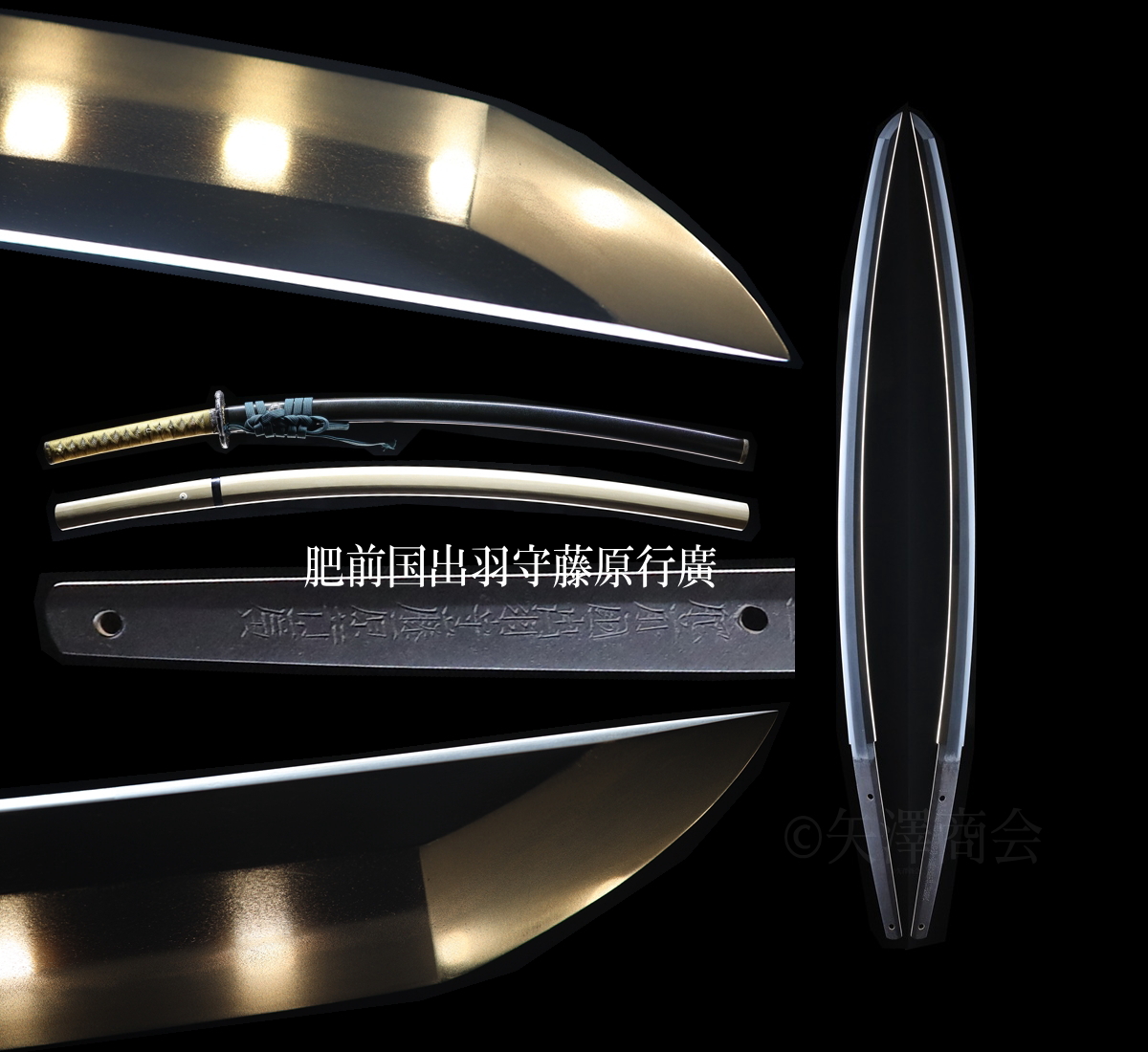



Hizen (waki-Hizen / Soba-Hizen, Saga) · Hizen · around 1639-1683
Fujishiro Jo saku · Tōken Taikan top 23%
8 pieces on the market now
Dewanokami Yukihiro, the first generation of the name, was born in Genna 3 (1617) as the second son of Hashimoto Yoshinobu, with the common name Kurobei. His elder brother was Kawachi no Daijo Masahiro, which made him a grandson of the first-generation Tadayoshi, and he worked at Saga on the collateral line of the Hizen school that the published sources call Soba-Hizen, beside the main house rather than within it. He received the title Dewa Daijo in Shoho 5 (1648), was promoted to Dewanokami in Kanbun 3 (1663), and died in Tenna 2 (1682) at the age of sixty-six. The name passed through several generations, and the published sources are careful on the point: of one katana they write that "there were several generations of the same name; this is the work of the first"[[c:1]].
Within the Hizen group his manner is known above all for a showy choji, and an early paper says simply that he tempers "particularly flamboyant choji within the school"[[c:2]]. On his finest katana a broad yakihaba carries a choji-midare mixed with gunome, angular and round-headed elements and yahazu-like forms, here and there boxy, the pattern large and florid. Long ashi enter vigorously and the nioi runs deep, with nie adhering thickly. Long sunagashi and kinsuji run through the edge, and the nioiguchi is bright. The published sources single out the vertically elongated choji-midare with long ashi as "something often seen in the first-generation Yukihiro" that "clearly manifests this smith's distinctive traits"[[c:3]]. On two outstanding katana they note that the kinsuji and sunagashi stand out beyond his usual work, and on one of them yubashiri-like tobiyaki lends a further charm.
The jigane is that of Hizen: a tightly forged ko-itame with dust-fine ji-nie laid thickly and fine chikei entering, which on several blades the sources call a refined komenuka-hada. On one katana they note a jigane of slightly blackish tone together with a straight yakidashi at the base below the midare, and they treat both as "one of the points of interest of Soba-Hizen"[[c:4]], rather than as faults. A second katana opens with the same straight yakidashi. The boshi runs straight to a ko-maru, on some blades an o-maru, often with hakikake and at times a deep turnback.
Beside the choji he commanded the school's traditional straight temper. A naginata carries a clean suguha over tightly packed ko-itame, its nioiguchi bright and clear. A katana shows a suguha-based temper over komenuka-hada, with an angular notare near the base suggestive of a koshiba. A katana in hiro-suguha, deep in nioi with thick ko-nie, is called a comparatively uncommon example for him, yet "work that could be mistaken for the suguha of the main line"[[c:5]]. One wakizashi reverses the usual Hizen arrangement, with choji and gunome above and a suguha-like shallow notare below; the sources call this unusual within the tradition, though the upper half is still the midare at which he excelled.
Separate from the hamon is the Aranda-kitae. He is said to have gone to Nagasaki in Keian 3 (1650) to learn Dutch forging under the Dutch smith Hisatsugu and Yakushiji Tanenaga, in essence a method of processing imported nanban-tetsu, and many of his blades carry the supplementary inscription "made with Dutch forging." He customarily cut the character ichi on the tang, and in rare cases the full form Hizen Ichimonji. One such katana lacks the Aranda inscription, which the sources take to mean that it was not made by that method. His nearest comparison in the record is his own brother: one large, florid gunome-midare katana is said "at first sight to call to mind rather the work of his elder brother Masahiro"[[c:6]], and another almost to recall a masterwork by Masahiro. His son, the second-generation Dewanokami Yukihiro, first signed Yukinaga, styled himself Tobanojo, and took the Dewanokami title in Jokyo 1 (1684), two years after his father's death.
Fifteen of his works are designated Juyo, and none stands in a higher tier; Fujishiro ranks him Jo saku. Dated pieces are few. A Kanbun 8 (1668) katana, made at fifty-one and bearing the Aranda inscription, is called "valuable source material"[[c:7]], and a long katana dated Enpo 6 (1678) was made as an offering to the Daijingu, a large work without any breakdown in ji or ha. Current owners are not recorded for these blades. Signed Juyo works by him do reach the market from time to time, though, as with most designated swords, they are far more often held than traded.
Where Yukihiro stands among comparable artisans: across all of nihontō, and within tradition, era, and period. The tiers (Foremost · Leading · Major · Notable) weigh official designations from the NBTHK and Japan's Agency for Cultural Affairs, together with historical honors of lasting repute such as the Sansaku and Meibutsu-chō.
Select a lens to see how it's measured.
Years he was demonstrably active, proven by signed-and-dated blades
Shinto · Hizen
103 pieces on the market now
The Hizen school began with a single domain commission. In Keicho 1 (1596) the Nabeshima of Hizen ordered Hashimoto Shinzaemon, the smith who would sign Tadayoshi, up to Kyoto with the carver Munenaga; there he entered the gate of Umetada Myoju and studied forging while Munenaga learned the chisel. The two returned to the province in Keicho 3 (1598), and Tadayoshi settled in the castle town below Saga, where under the domain's patronage the line grew into the dominant sword-making house of Kyushu. His own work runs from Keicho 5 (1600) to his death in Kan'ei 9 (1632); in Genna 10 (1624) he received the court title Musashi Daijo, changed his name to Tadahiro, and shifted his clan name from Minamoto to Fujiwara, so that the late Musashi Daijo blades are the founder under a second name. From him the house became a true generational institution: his son the second-generation Omi Daijo Tadahiro carried it forward as its most prolific hand, the third-generation Mutsu no Kami Tadayoshi returned its highest finish, and a Tosa no Kami branch took the founder's signature when he set it aside. Around this main line grew a circle of disciples and collateral hands, the waki-Hizen or Soba-Hizen smiths, several of them, like Yoshiie and Hironori, working as daisaku substitute makers whose own signed pieces are therefore scarce. The school's signature is its steel. Over a ko-itame forged so tightly it shows no slackness, fine ji-nie gathers in minute particles until the surface takes on the rice-bran konuka-hada (also written komenuka-hada) that no other school produces, fine chikei entering throughout and the ji notably clear and bright.
The orthodox temper laid upon it is a chu-suguha or hiro-suguha, sometimes tinged with a shallow notare and ko-gunome, the nioiguchi deep with finely clustered ko-nie and tightened to a bright clarity, the boshi running straight to a quiet ko-maru. The founder aimed this suguha toward the Rai school yet departed from it, his nioiguchi tighter and his forging carrying more vigor; the third generation refined it to what the published sources call the strongest and most precise hand of the first three generations. Against that calm register the house also worked a showier one, the Hizen choji-midare mixing gunome, long ashi, kinsuji and sunagashi, a manner the published sources already find more often in the founder's late Musashi Daijo work than in his Tadayoshi years, and one the second generation made his own. The branches pushed further from the suguha standard: Tadakuni of the Ogi domain ran sunagashi more conspicuously than any other Hizen hand and reached toward old Ichimonji in his o-choji; Masahiro and Yukihiro favored a flamboyant long-ashi choji over the calm main line; and the Iyo no Jo Munetsugu line worked apart in the Soshu-den, building a midareba on notare with a pointed togariba and a jihada that tends to stand and tone slightly blackish. A collector seeks Hizen-to first for that steel, and reads it the same way the appraiser does: a bright suguha lying over a clear, tight konuka-hada identifies the school before the signature is consulted, and the quiet ko-maru boshi on the ura-signed tang confirms the main-line practice. Generation and branch are then told within that frame, the third generation's powerful sugata recalling not his father but his grandfather, the waki-Hizen hands set apart by their irregular temper, their sujikai file marks and a sashi-ura signature, the Munetsugu line by its Soshu togari. The main line, made in real numbers across so long a span, reaches the market more readily than any Kamakura master, so a papered example is within reach of a patient collector, while the founder's own work and the finest konuka-suguha of the third generation come to open hands only from time to time. Provenance runs back through the house the school served, blades recorded to Nabeshima Katsushige and Nabeshima Naomoto and passing onward to the Owari Tokugawa, the Satake and the Imperial families; documentary inscriptions sharpen the picture further, a Myoju soemei attesting the founder's discipleship, Umetada carving adding flowers to brocade on his late blades, and the gold-inlaid cutting tests of Yamano Kanjuro and Yamano Ka'emon, rare on Hizen work, naming the edge as well as the hand. Learn more →
| Smith | Era | Designated |
|---|---|---|
| Tadayoshi忠吉 | 1596-1632 | 155 |
| Tadayoshi忠吉 | 1660-1686 | 61 |
| Tadahiro忠廣 | 1633-1693 | 133 |
| Masahiro正廣 | 1624-1655 | 30 |
| Tadakuni忠國 | 1648-1652 | 32 |
Hizen: a domain enterprise
Hizen swords were a domain enterprise: the Nabeshima sent Tadayoshi to study under Umetada Myōju around 1596, then built a licensed school around him. Nine generations carried its famously consistent konuka-hada work into the Meiji era.