Business Name: Meirin Sangyo Co., Ltd. Operations Manager: Takashi Tomano Location: 1-32 Rokumantai-cho, Tennoji-ku, Osaka-shi, Osaka 543-0074 Phone Number: TEL 06-6772-3026 FAX 06-6772-3028 Business License: Art Dealer / Antique Dealer, Osaka Prefectural Public Safety Commission Permit No. 621102002025 Additional Charges: Shipping costs, bank transfer fees (when paying by methods other than postal transfer). Cash-on-delivery (daisuki) fees apply when purchasing items other than token. Consumption tax is included in the product price. Payment Methods: Postal transfer, advance payment via bank transfer, various credit cards, loan financing, cash-on-delivery, etc. For postal transfer customers, a transfer form will be sent after the order is placed (fees covered by our company). Please note that it takes approximately 5 days to confirm payment. Shipping will occur upon confirmation. For bank transfers, please transfer to the following account (fees to be paid by the customer): MUFG Bank, Ueroku Branch (Ordinary Account 0000531) Loan Example: (Effective interest rate 8.96% for 280,000 yen) 36 installments / 36 installments / 24 installments 1st payment: 12,320 yen / 8,320 yen / 14,780 yen Subsequent payments: 8,800 yen / 7,200 yen / 12,700 yen Bonus payment: None / 10,000 yen x 6 times / None Please note that a cancellation fee of 10% of the loan amount will be charged for cancellations after a loan contract has been signed. Shipping Costs: 【Token, Yoroi, Ju, etc.】 Flat rate of 1,800 yen nationwide per order; cash-on-delivery fees are free. Shipping is free for orders exceeding 100,000 yen. 【Items other than Token】 Standard shipping: 880 yen Hokkaido, Okinawa (including some remote islands): 2,200 yen *Separate quotes will be provided if purchased together with token or if multiple packages are required. If the payment method is cash-on-delivery, the following fees apply (when purchasing items other than token): Purchase amount up to 10,000 yen: 330 yen Purchase amount up to 30,000 yen: 440 yen Purchase amount up to 100,000 yen: 660 yen Purchase amount up to 300,000 yen: 1,100 yen Purchase amount up to 500,000 yen: 2,200 yen Return Deadline: Within 1 week after arrival of the product. Return Shipping: For returns due to customer convenience, shipping costs are to be borne by the customer. In the event of a shipping error by our company or product defects, our company will bear the cost. Ordering Method: Please inquire via the form on this page, or by phone/FAX. Accepted Credit Cards: VISA / JCB / American Express (AMEX) / China UnionPay Accepted Loans: Orient Corporation
 NihontoWatch
Edo
Hikone Soten
Kinko · Omi · Edo
3 pieces on the market now
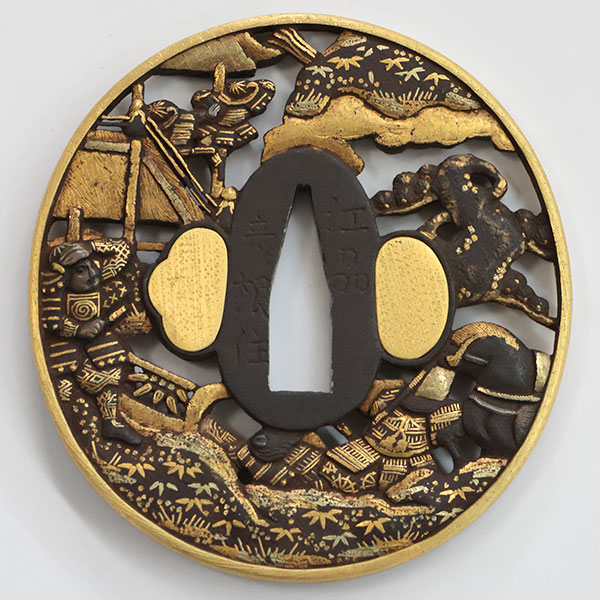
Mogarashi Nyudo Soten, also known by the surname Kitagawa, was originally from Kyoto and later settled at Nakayabu in Hikone, Omi Province. According to the Soken Kisho, he became a retained craftsman of the Kawakita family, a hereditary vassal house of the Hikone domain, and thereupon adopted the Kitagawa surname. His earliest signature name is recorded as Hidenori, and one source states that he initially trained under the Goto family, citing the Kinko Soran for the existence of works signed "made by Kitagawa Hidenori, a disciple of the Goto." He is regarded as the founder of the distinctive carving manner known as Hikone-bori, and his lineage is connected to the traditions of Mino-bori. There were reportedly two generations using the same name; from extant works bearing age inscriptions, it is known that the first generation was born in Joo 1 (1652), with a period of activity spanning from the early through the mid-Edo period.
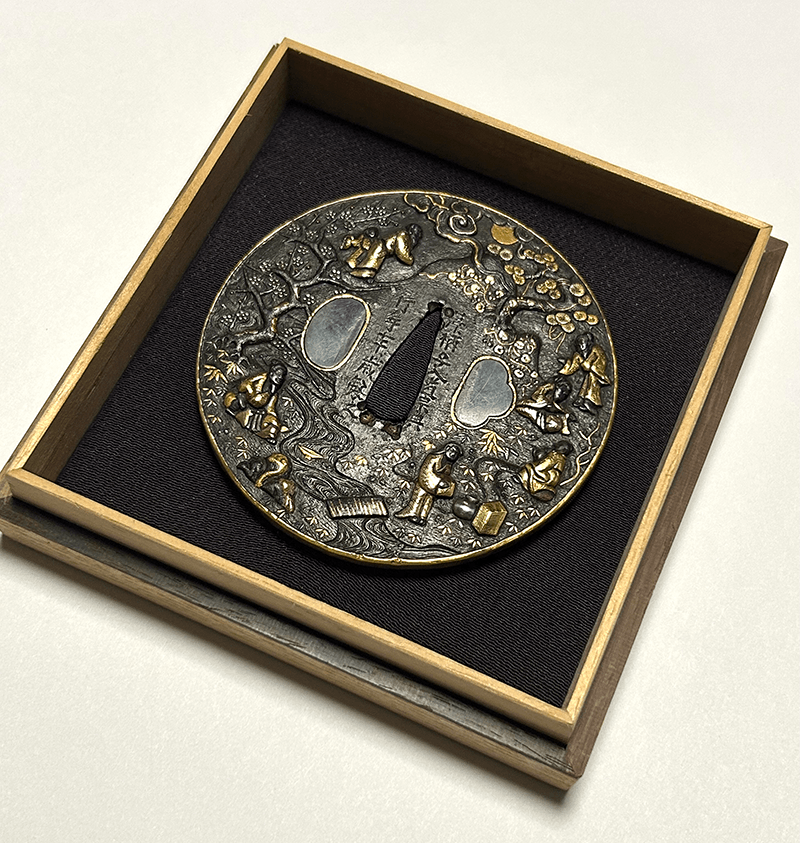
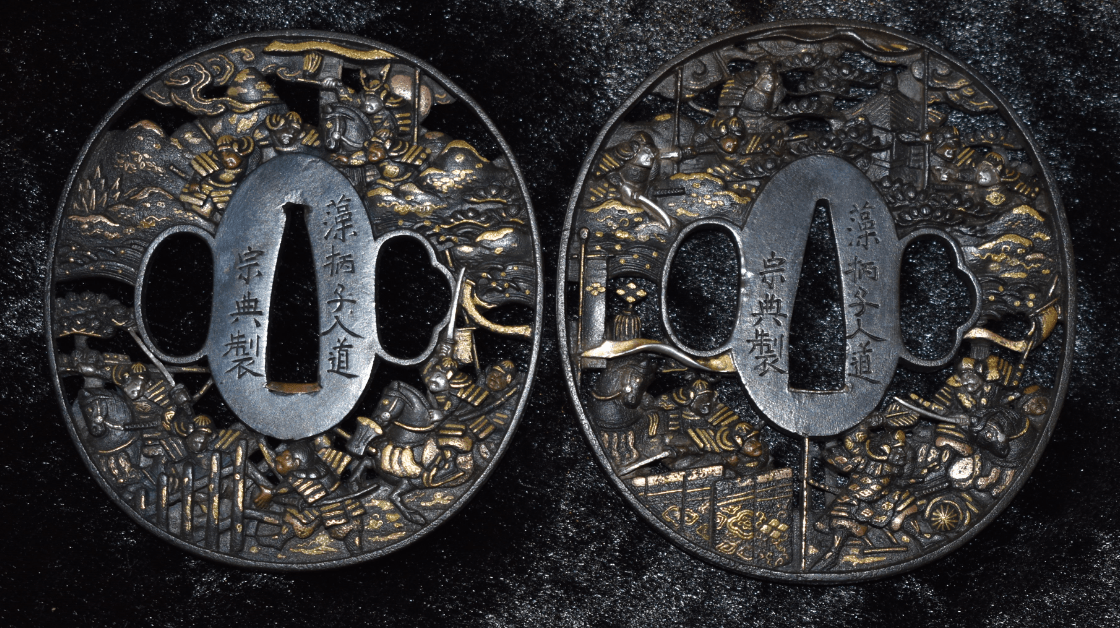
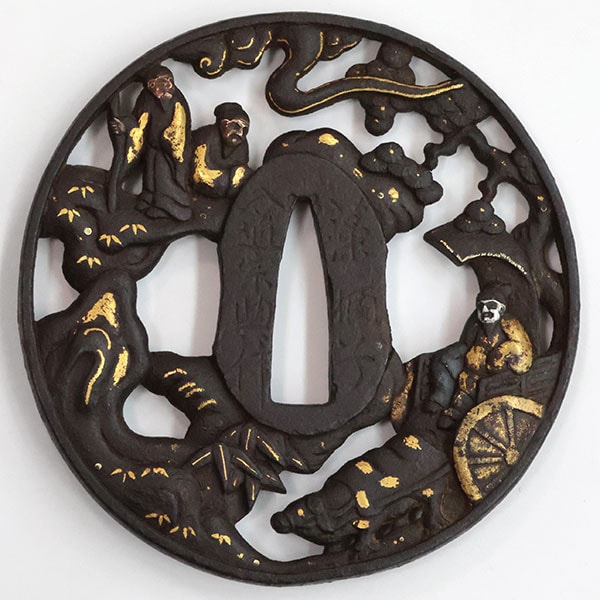
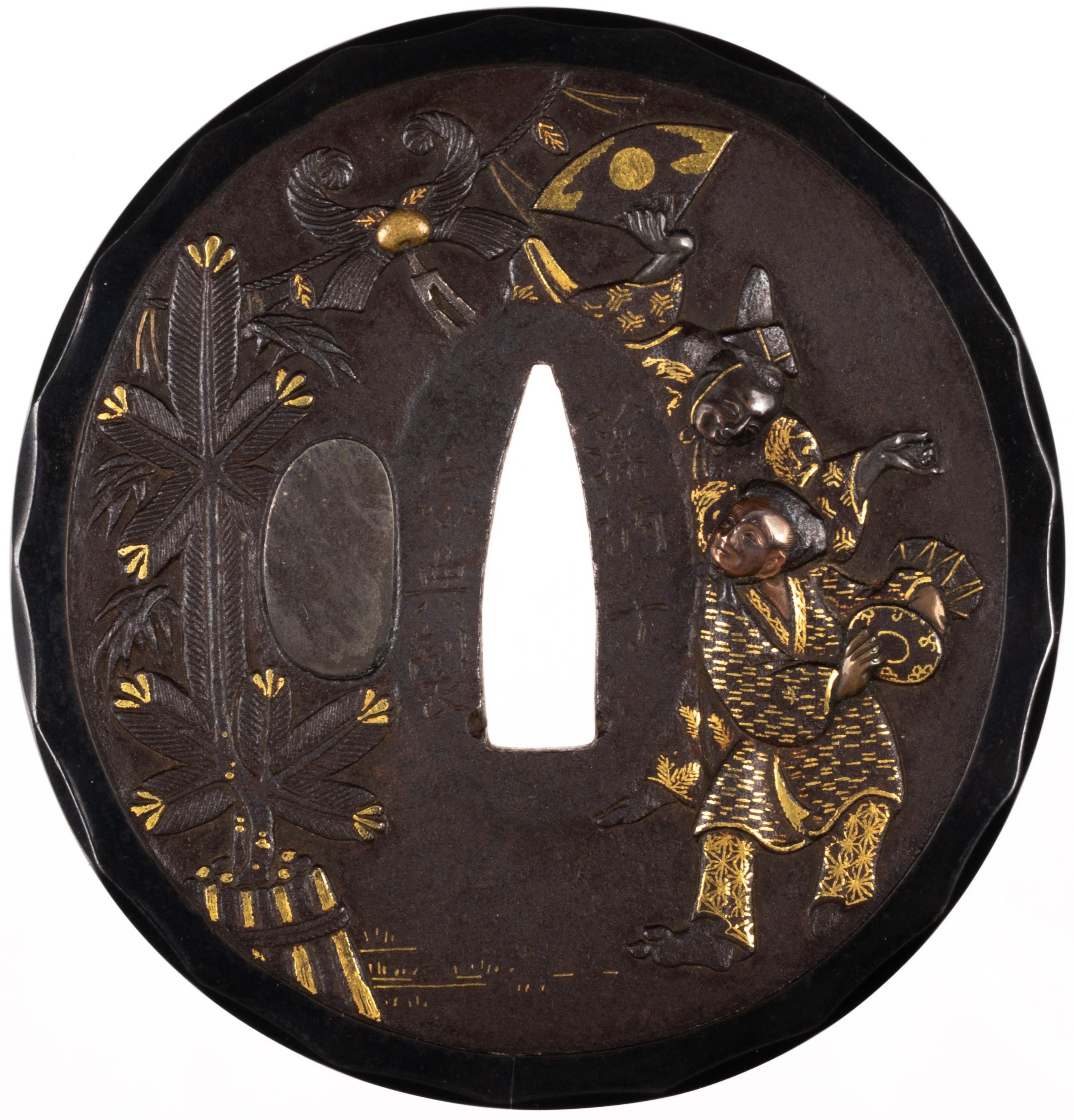
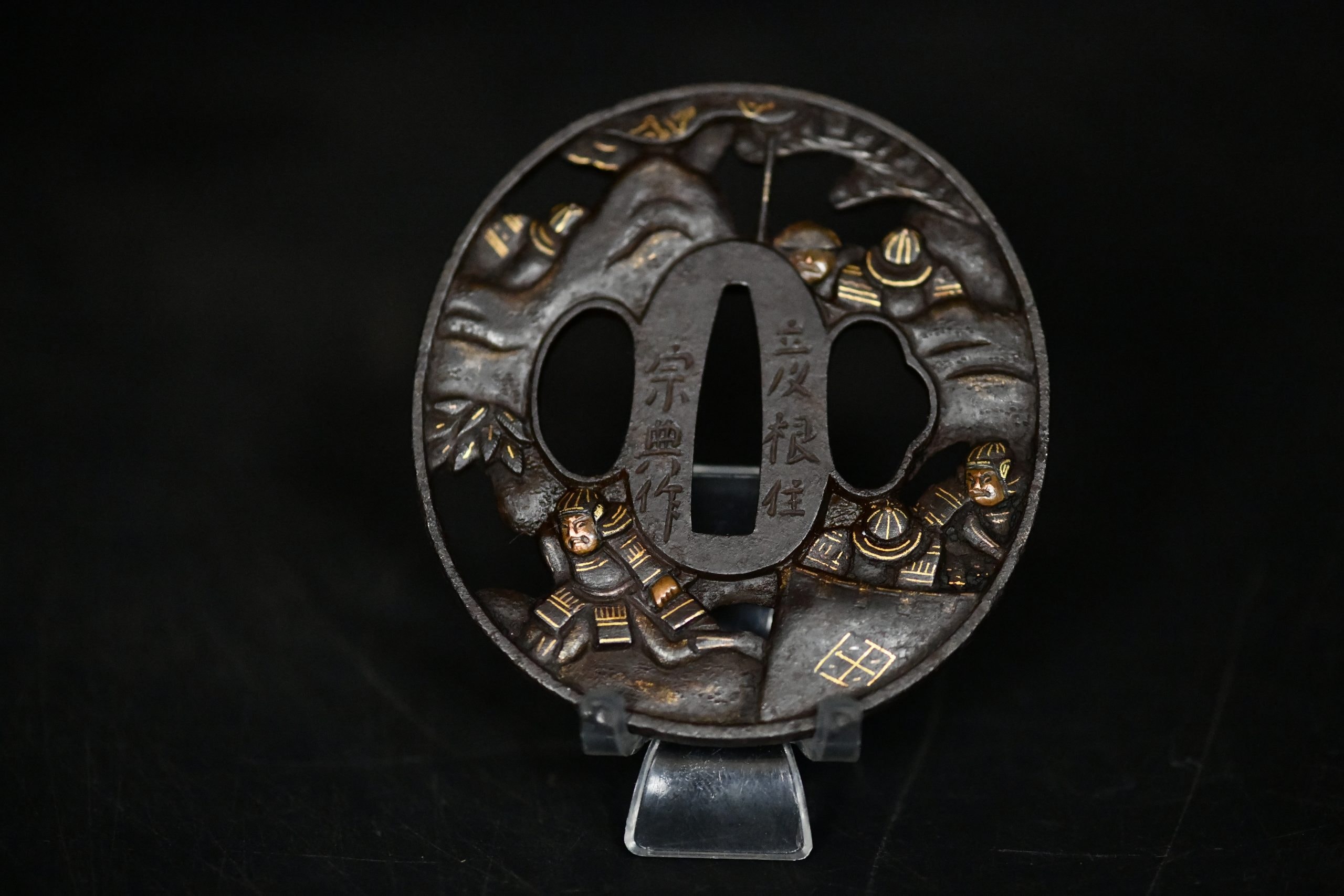
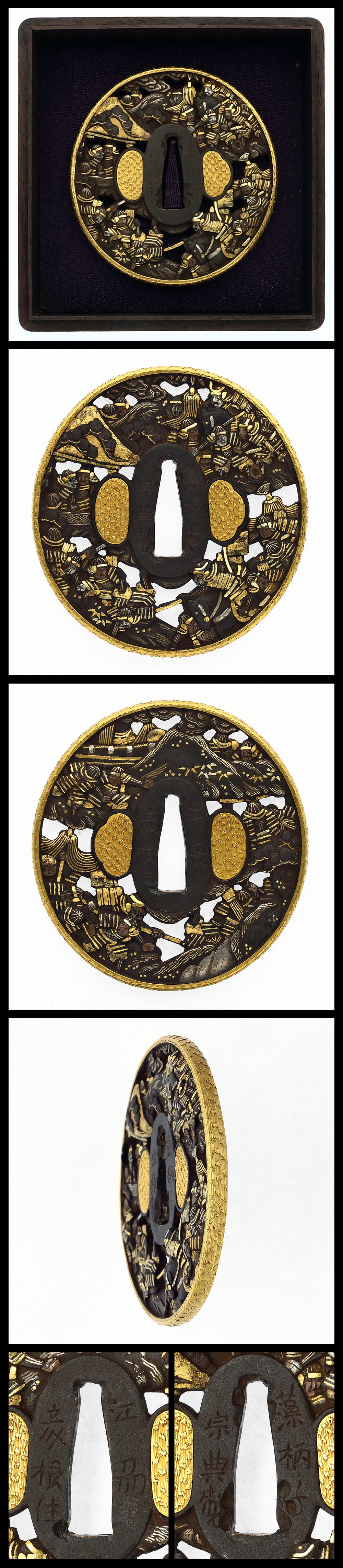
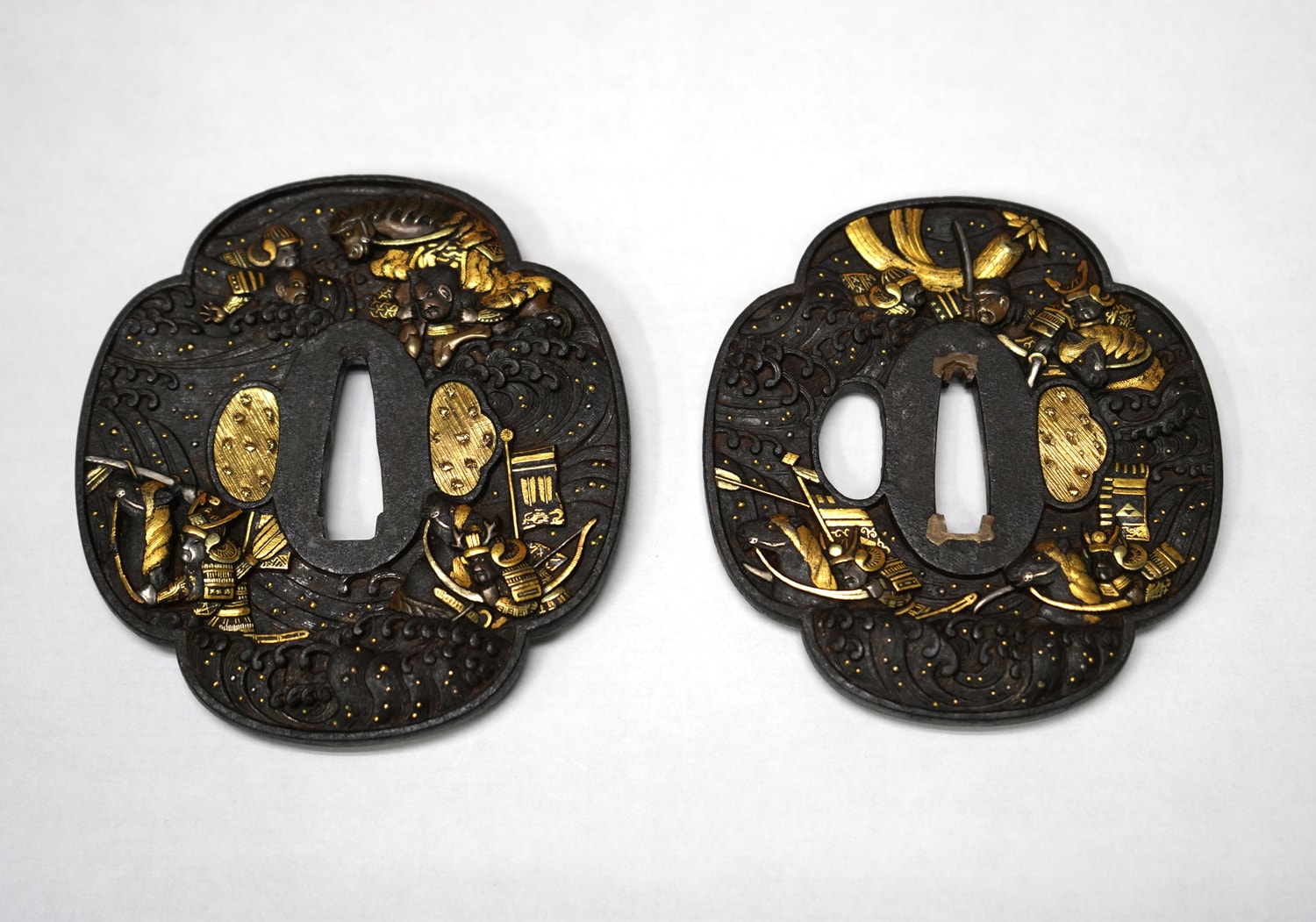
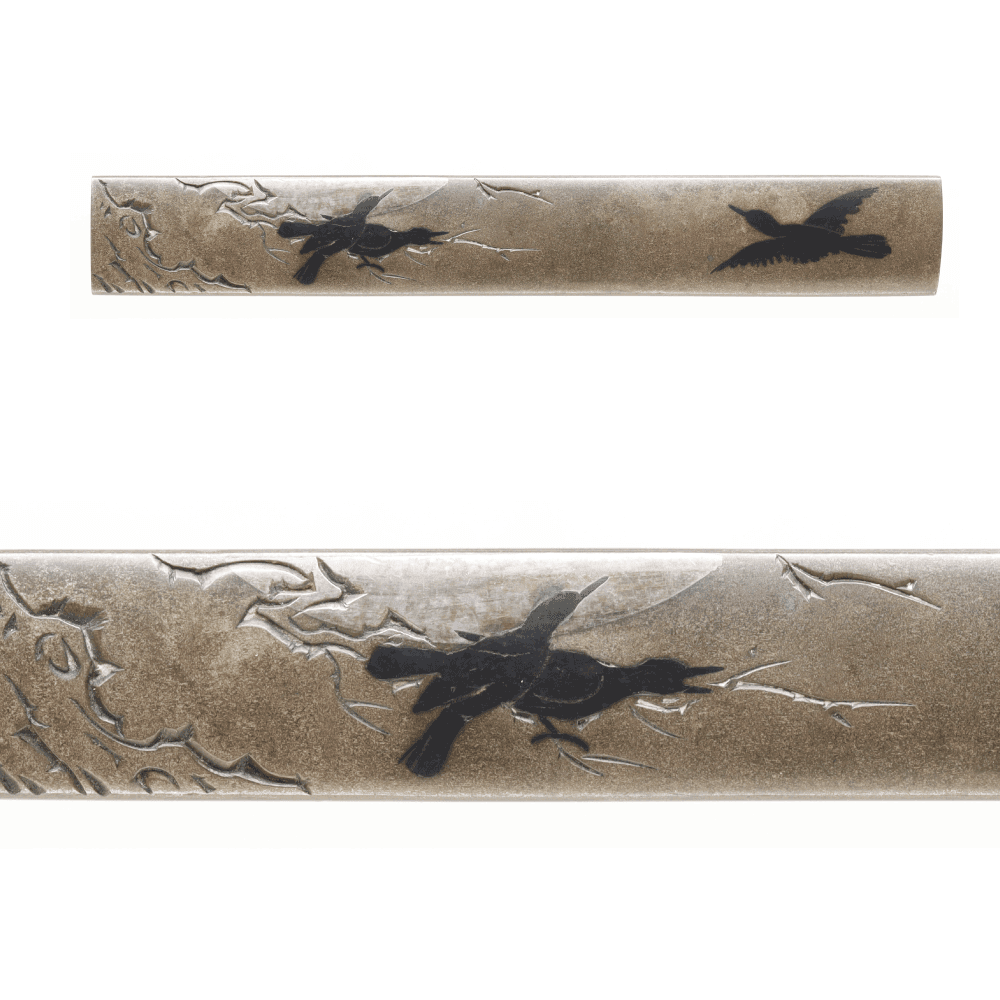
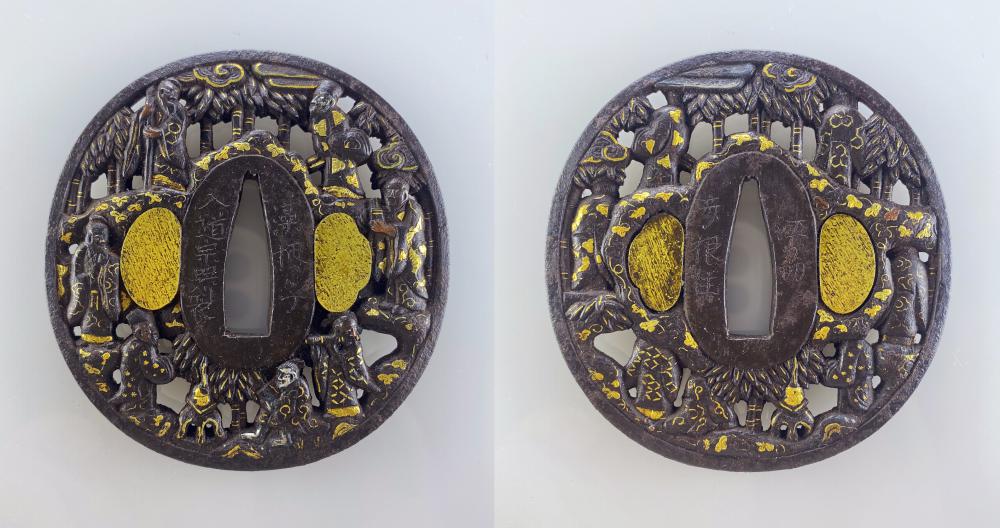
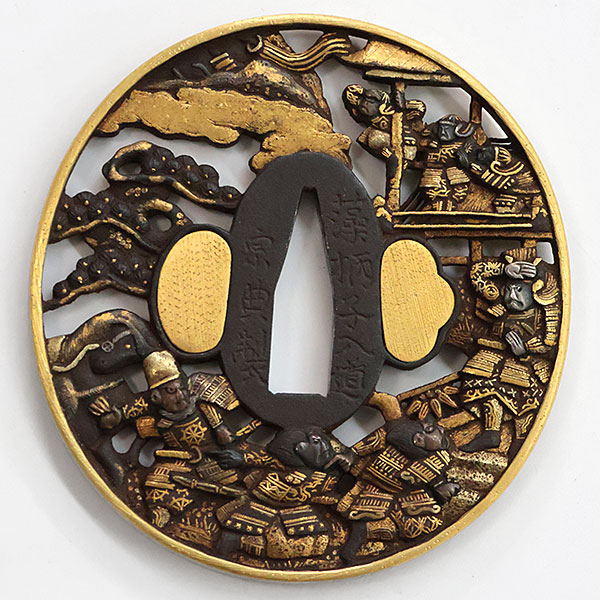
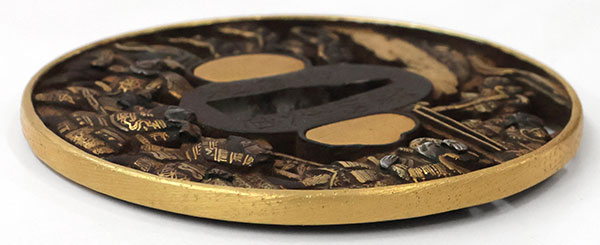
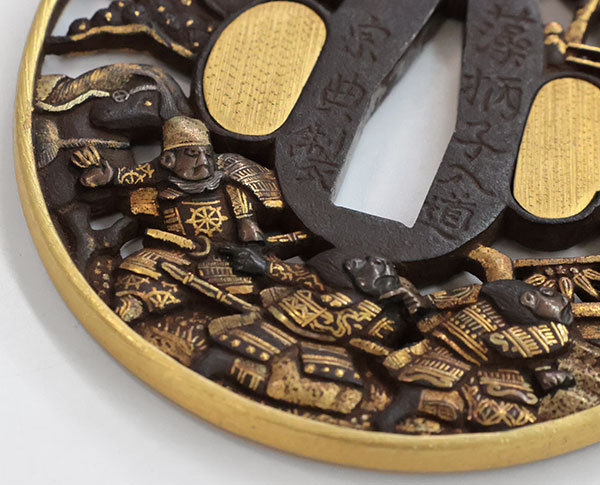
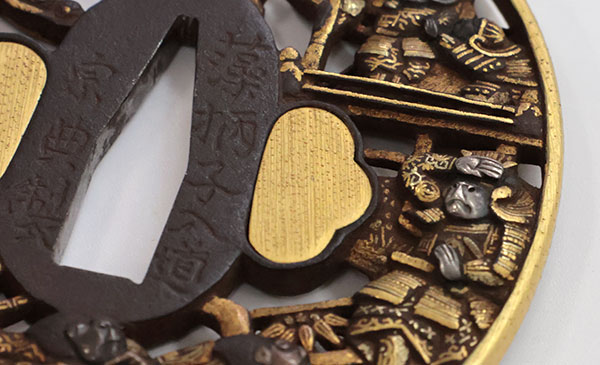
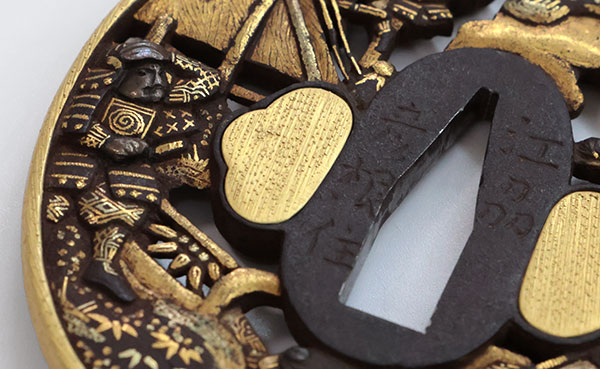
Soten's characteristic technique is sukidashi takabori -- richly modeled high-relief carving executed on generously proportioned iron plates, further enlivened through zogan iroe employing gold, silver, shakudo, and suaka. The NBTHK notes that even among the gold applications, "multiple types of gold are used," producing expansive pictorial fields of considerable chromatic variety. His subjects encompass warriors, Daoist immortals, elder sages at elegant gatherings, and flowers-and-birds compositions, rendered across the entirety of both surfaces. Alongside these iron works, the NBTHK recognizes that "many fine works are to be found" among his shakudo pieces, including nanako-ji plates with high-relief seaweed-and-shell or wave-ground compositions that display a pronounced Goto-like flavor.
The NBTHK's evaluative language for Soten converges on a single defining quality: a "bustling and brilliant unfolding" that constitutes "precisely what S\u014dten excelled at." This animated, celebratory manner is repeatedly described as the artist's "distinctive forte" and "particular strength," one that "has long captivated tsuba connoisseurs" and "attracted many admirers." Crucially, when executed by Soten's own hand, this profusion is "remarkably free of any sense of overstatement," achieving instead what the NBTHK terms "true dignity." The handling of the chisel is characterized as "broad-minded and unhurried," drawing the viewer into a world of yugen. Because of his overwhelming fame, later makers frequently adopted his signature on subsequent Hikone-carved works -- a testament to the enduring authority of his name, and a reminder that authentic examples, with their grand pictorial construction and superb preservation, occupy a position of singular distinction within the tradition.
Where Soten stands among comparable artisans: across all of nihontō, and within tradition, era, and period. The tiers (Foremost · Leading · Major · Notable) weigh official designations from the NBTHK and Japan's Agency for Cultural Affairs, together with historical honors of lasting repute such as the Sansaku and Meibutsu-chō.
Select a lens to see how it's measured.
Kinko · Omi
33 pieces on the market now
The Hikone school of sword fittings -- known as Hikone-bori -- was established at Nakayabu in Hikone, Omi Province, by Mogarashi Nyudo Soten, who settled there after leaving Kyoto and entered the service of the Kawakita family, hereditary vassals of the Hikone domain. One source records that Soten initially trained under the Goto family, citing the Kinko Soran for the existence of works signed "made by Kitagawa Hidenori, a disciple of the Goto," before developing the distinctive carving manner that would define his lineage. The school's connection to the broader Mino-bori tradition is also recognized. There were reportedly two generations working under Soten's name, with the first born in Joo 1 (1652) and active from the early through mid-Edo period. From his workshop emerged a circle of accomplished students, chief among them Nomura Kanenori and Munenori, who carried the Hikone-bori manner forward and established it as one of the most distinctive regional styles in the kinko tradition. The technical hallmark of Hikone-bori is sukidashi takabori -- richly modeled high-relief carving executed on generously proportioned iron plates, further enlivened through zogan iroe employing gold, silver, shakudo, and suaka. The NBTHK notes that even among the gold applications, "multiple types of gold are used," producing expansive pictorial fields of considerable chromatic variety.
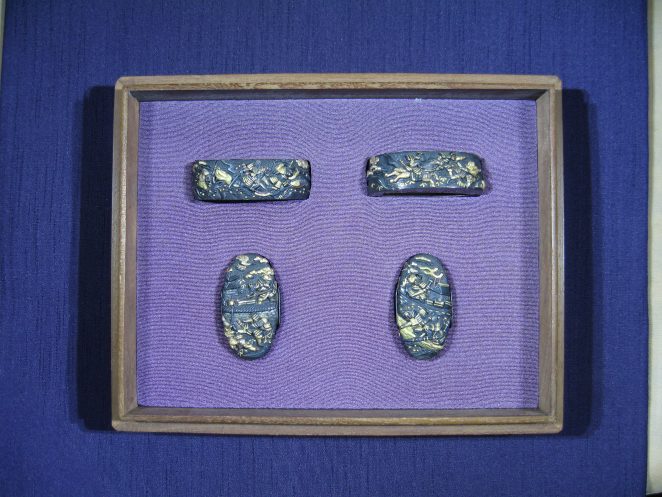
Subjects encompass warriors, Daoist immortals, elder sages at elegant gatherings, and flowers-and-birds compositions, rendered across the entirety of both surfaces of the guard. The school's masters also demonstrated facility in shakudo work, including nanako-ji plates with high-relief compositions displaying a pronounced Goto-like flavor, as well as nikubori ji-sukashi and polychrome mitokoromono sets. What unifies the school's output is the synthesis of imposing compositional scale with refined polychrome technique. " Munenori's contribution is recognized for its assured command of shakudo nanako-ji ground preparation and boldly modeled takabori, enriched with polychrome iroe employing multiple varieties of gold across both faces -- a sumptuous, animated effect characteristic of the mature Hikone style. The Hikone school's significance within the broader kinko tradition rests on its creation of a distinctively pictorial approach to sword-fitting decoration that stands apart from both the restrained elegance of the Goto mainline and the narrative density of the Yokoya school. The NBTHK's evaluative language converges on a single defining quality: the school's ability to fill expansive iron and shakudo surfaces with ambitious narrative compositions while maintaining compositional coherence and chromatic refinement. " That Soten's overwhelming fame led later makers to adopt his signature on subsequent Hikone-carved works testifies to the enduring authority of the school's founding aesthetic, while the surviving origami documentation -- including one dated Kanbun 5 (1665) from Goto Mitsutomo -- provides valuable evidence for understanding workshop practices and the collaborative production that sustained the Hikone tradition across the early and mid-Edo period. Learn more →
| Smith | Era | Designated |
|---|---|---|
| Soten宗典 | Edo | 10 |
| Kanenori包教 | Edo | 3 |
| Masatsugu政次 | Edo | 0 |
| Mitsuyoshi光義 | Edo | 0 |
| Munekata宗賢 | Edo | 0 |
We could not find an authenticity certificate on the seller’s listing. Japanese swords and fittings are normally papered by the NBTHK (or the NTHK). Without one, the attribution is the seller’s own assessment and has not been independently verified — treat it with caution and ask the dealer about certification before buying.
For returns due to customer circumstances, the cost is the customer's responsibility. For returns due to our mis-shipment or a defective item, we bear the cost.
Business Name: Meirin Sangyo Co., Ltd. Operations Manager: Takashi Tomano Location: 1-32 Rokumantai-cho, Tennoji-ku, Osaka-shi, Osaka 543-0074 Phone Number: TEL 06-6772-3026 FAX 06-6772-3028 Business License: Art Dealer / Antique Dealer, Osaka Prefectural Public Safety Commission Permit No. 621102002025 Additional Charges: Shipping costs, bank transfer fees (when paying by methods other than postal transfer). Cash-on-delivery (daisuki) fees apply when purchasing items other than token. Consumption tax is included in the product price. Payment Methods: Postal transfer, advance payment via bank transfer, various credit cards, loan financing, cash-on-delivery, etc. For postal transfer customers, a transfer form will be sent after the order is placed (fees covered by our company). Please note that it takes approximately 5 days to confirm payment. Shipping will occur upon confirmation. For bank transfers, please transfer to the following account (fees to be paid by the customer): MUFG Bank, Ueroku Branch (Ordinary Account 0000531) Loan Example: (Effective interest rate 8.96% for 280,000 yen) 36 installments / 36 installments / 24 installments 1st payment: 12,320 yen / 8,320 yen / 14,780 yen Subsequent payments: 8,800 yen / 7,200 yen / 12,700 yen Bonus payment: None / 10,000 yen x 6 times / None Please note that a cancellation fee of 10% of the loan amount will be charged for cancellations after a loan contract has been signed. Shipping Costs: 【Token, Yoroi, Ju, etc.】 Flat rate of 1,800 yen nationwide per order; cash-on-delivery fees are free. Shipping is free for orders exceeding 100,000 yen. 【Items other than Token】 Standard shipping: 880 yen Hokkaido, Okinawa (including some remote islands): 2,200 yen *Separate quotes will be provided if purchased together with token or if multiple packages are required. If the payment method is cash-on-delivery, the following fees apply (when purchasing items other than token): Purchase amount up to 10,000 yen: 330 yen Purchase amount up to 30,000 yen: 440 yen Purchase amount up to 100,000 yen: 660 yen Purchase amount up to 300,000 yen: 1,100 yen Purchase amount up to 500,000 yen: 2,200 yen Return Deadline: Within 1 week after arrival of the product. Return Shipping: For returns due to customer convenience, shipping costs are to be borne by the customer. In the event of a shipping error by our company or product defects, our company will bear the cost. Ordering Method: Please inquire via the form on this page, or by phone/FAX. Accepted Credit Cards: VISA / JCB / American Express (AMEX) / China UnionPay Accepted Loans: Orient Corporation
NihontoWatchEdo
Hikone Soten
Kinko · Omi · Edo
3 pieces on the market now
Mogarashi Nyudo Soten, also known by the surname Kitagawa, was originally from Kyoto and later settled at Nakayabu in Hikone, Omi Province. According to the Soken Kisho, he became a retained craftsman of the Kawakita family, a hereditary vassal house of the Hikone domain, and thereupon adopted the Kitagawa surname. His earliest signature name is recorded as Hidenori, and one source states that he initially trained under the Goto family, citing the Kinko Soran for the existence of works signed "made by Kitagawa Hidenori, a disciple of the Goto." He is regarded as the founder of the distinctive carving manner known as Hikone-bori, and his lineage is connected to the traditions of Mino-bori. There were reportedly two generations using the same name; from extant works bearing age inscriptions, it is known that the first generation was born in Joo 1 (1652), with a period of activity spanning from the early through the mid-Edo period.
Soten's characteristic technique is sukidashi takabori -- richly modeled high-relief carving executed on generously proportioned iron plates, further enlivened through zogan iroe employing gold, silver, shakudo, and suaka. The NBTHK notes that even among the gold applications, "multiple types of gold are used," producing expansive pictorial fields of considerable chromatic variety. His subjects encompass warriors, Daoist immortals, elder sages at elegant gatherings, and flowers-and-birds compositions, rendered across the entirety of both surfaces. Alongside these iron works, the NBTHK recognizes that "many fine works are to be found" among his shakudo pieces, including nanako-ji plates with high-relief seaweed-and-shell or wave-ground compositions that display a pronounced Goto-like flavor.
The NBTHK's evaluative language for Soten converges on a single defining quality: a "bustling and brilliant unfolding" that constitutes "precisely what S\u014dten excelled at." This animated, celebratory manner is repeatedly described as the artist's "distinctive forte" and "particular strength," one that "has long captivated tsuba connoisseurs" and "attracted many admirers." Crucially, when executed by Soten's own hand, this profusion is "remarkably free of any sense of overstatement," achieving instead what the NBTHK terms "true dignity." The handling of the chisel is characterized as "broad-minded and unhurried," drawing the viewer into a world of yugen. Because of his overwhelming fame, later makers frequently adopted his signature on subsequent Hikone-carved works -- a testament to the enduring authority of his name, and a reminder that authentic examples, with their grand pictorial construction and superb preservation, occupy a position of singular distinction within the tradition.
Where Soten stands among comparable artisans: across all of nihontō, and within tradition, era, and period. The tiers (Foremost · Leading · Major · Notable) weigh official designations from the NBTHK and Japan's Agency for Cultural Affairs, together with historical honors of lasting repute such as the Sansaku and Meibutsu-chō.
Select a lens to see how it's measured.
Kinko · Omi
33 pieces on the market now
The Hikone school of sword fittings -- known as Hikone-bori -- was established at Nakayabu in Hikone, Omi Province, by Mogarashi Nyudo Soten, who settled there after leaving Kyoto and entered the service of the Kawakita family, hereditary vassals of the Hikone domain. One source records that Soten initially trained under the Goto family, citing the Kinko Soran for the existence of works signed "made by Kitagawa Hidenori, a disciple of the Goto," before developing the distinctive carving manner that would define his lineage. The school's connection to the broader Mino-bori tradition is also recognized. There were reportedly two generations working under Soten's name, with the first born in Joo 1 (1652) and active from the early through mid-Edo period. From his workshop emerged a circle of accomplished students, chief among them Nomura Kanenori and Munenori, who carried the Hikone-bori manner forward and established it as one of the most distinctive regional styles in the kinko tradition. The technical hallmark of Hikone-bori is sukidashi takabori -- richly modeled high-relief carving executed on generously proportioned iron plates, further enlivened through zogan iroe employing gold, silver, shakudo, and suaka. The NBTHK notes that even among the gold applications, "multiple types of gold are used," producing expansive pictorial fields of considerable chromatic variety.
Subjects encompass warriors, Daoist immortals, elder sages at elegant gatherings, and flowers-and-birds compositions, rendered across the entirety of both surfaces of the guard. The school's masters also demonstrated facility in shakudo work, including nanako-ji plates with high-relief compositions displaying a pronounced Goto-like flavor, as well as nikubori ji-sukashi and polychrome mitokoromono sets. What unifies the school's output is the synthesis of imposing compositional scale with refined polychrome technique. " Munenori's contribution is recognized for its assured command of shakudo nanako-ji ground preparation and boldly modeled takabori, enriched with polychrome iroe employing multiple varieties of gold across both faces -- a sumptuous, animated effect characteristic of the mature Hikone style. The Hikone school's significance within the broader kinko tradition rests on its creation of a distinctively pictorial approach to sword-fitting decoration that stands apart from both the restrained elegance of the Goto mainline and the narrative density of the Yokoya school. The NBTHK's evaluative language converges on a single defining quality: the school's ability to fill expansive iron and shakudo surfaces with ambitious narrative compositions while maintaining compositional coherence and chromatic refinement. " That Soten's overwhelming fame led later makers to adopt his signature on subsequent Hikone-carved works testifies to the enduring authority of the school's founding aesthetic, while the surviving origami documentation -- including one dated Kanbun 5 (1665) from Goto Mitsutomo -- provides valuable evidence for understanding workshop practices and the collaborative production that sustained the Hikone tradition across the early and mid-Edo period. Learn more →
| Smith | Era | Designated |
|---|---|---|
| Soten宗典 | Edo | 10 |
| Kanenori包教 | Edo | 3 |
| Masatsugu政次 | Edo | 0 |
| Mitsuyoshi光義 | Edo | 0 |
| Munekata宗賢 | Edo | 0 |
We could not find an authenticity certificate on the seller’s listing. Japanese swords and fittings are normally papered by the NBTHK (or the NTHK). Without one, the attribution is the seller’s own assessment and has not been independently verified — treat it with caution and ask the dealer about certification before buying.
For returns due to customer circumstances, the cost is the customer's responsibility. For returns due to our mis-shipment or a defective item, we bear the cost.