 NihontoWatchNihontoWatch
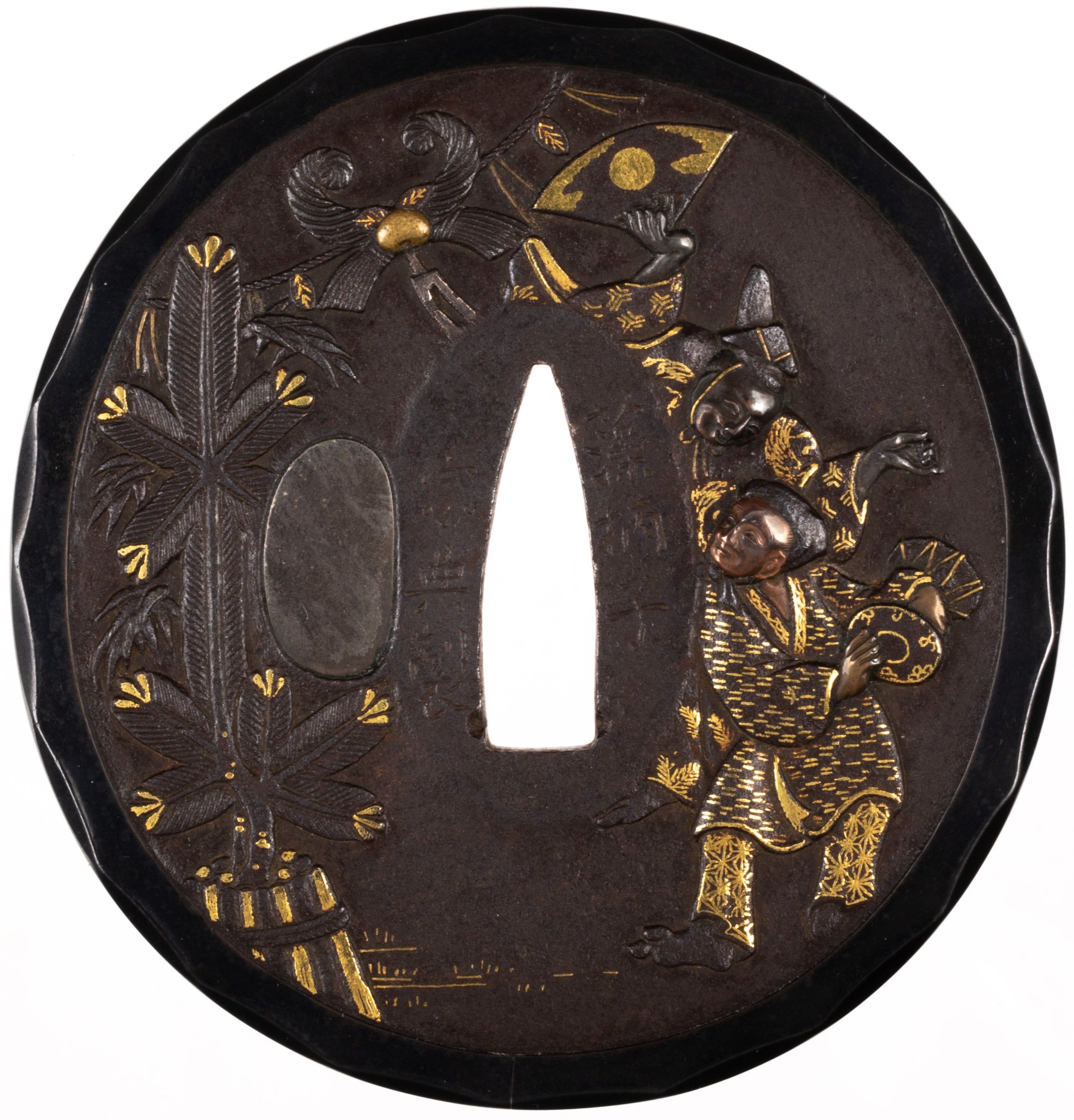
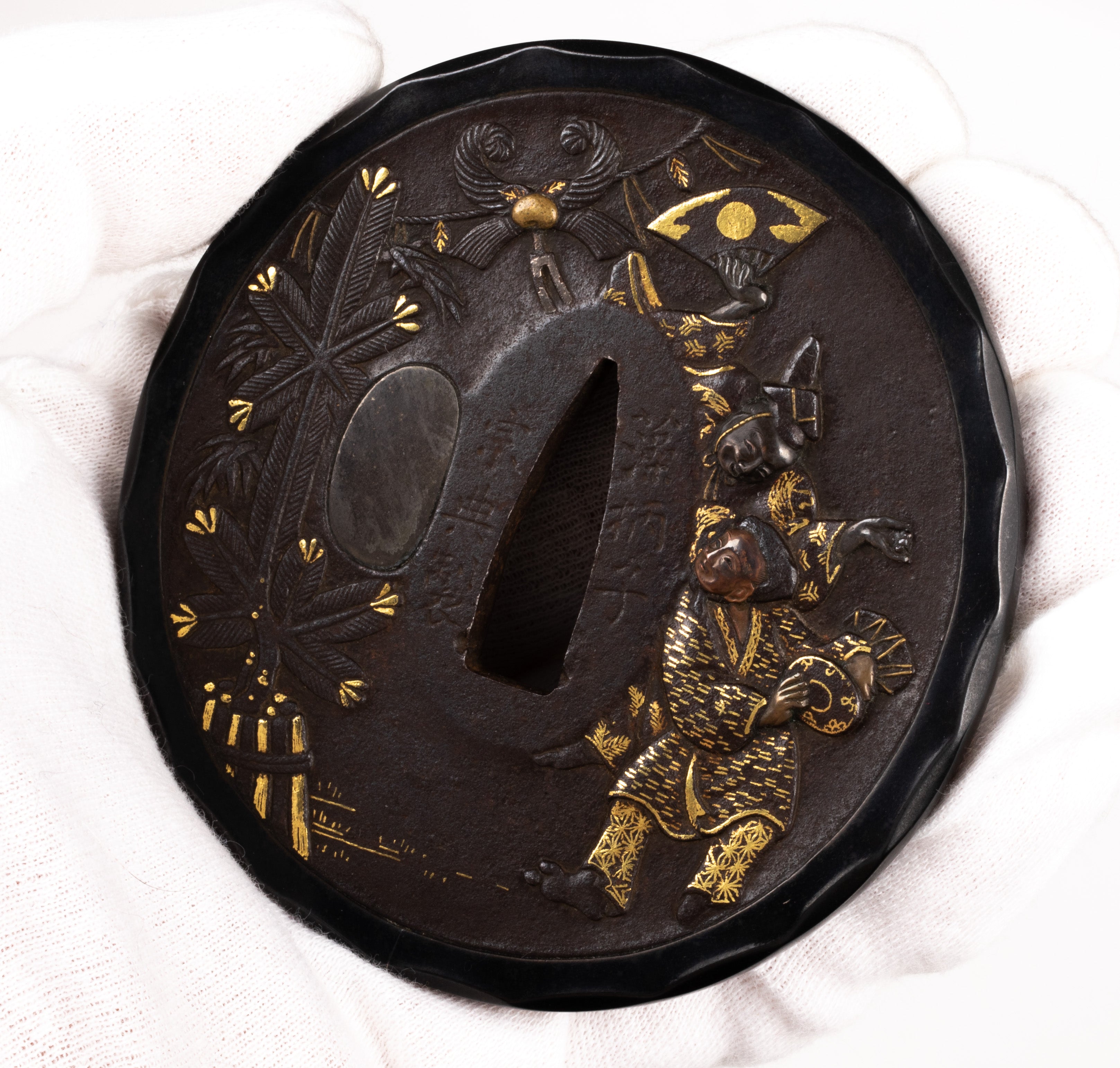
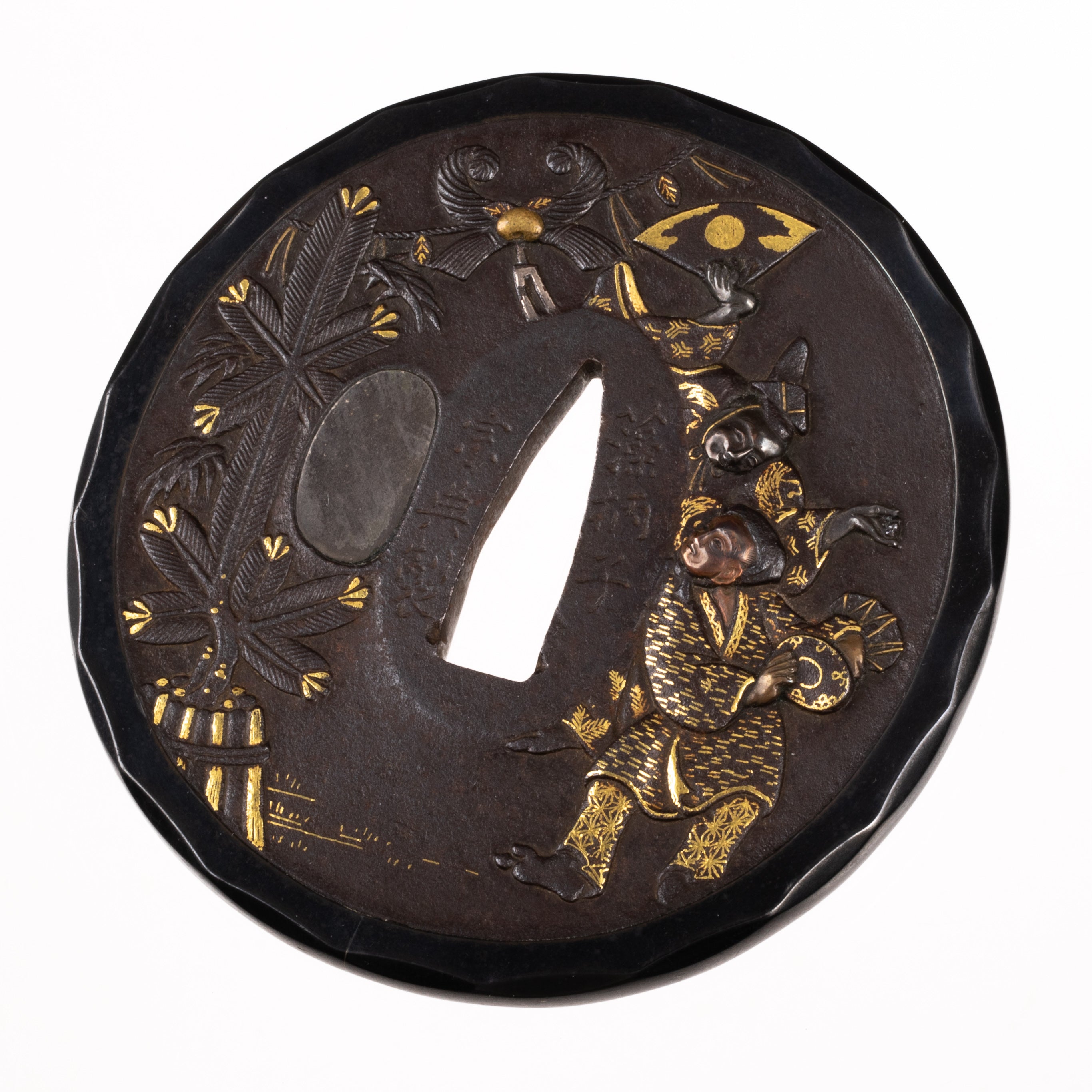
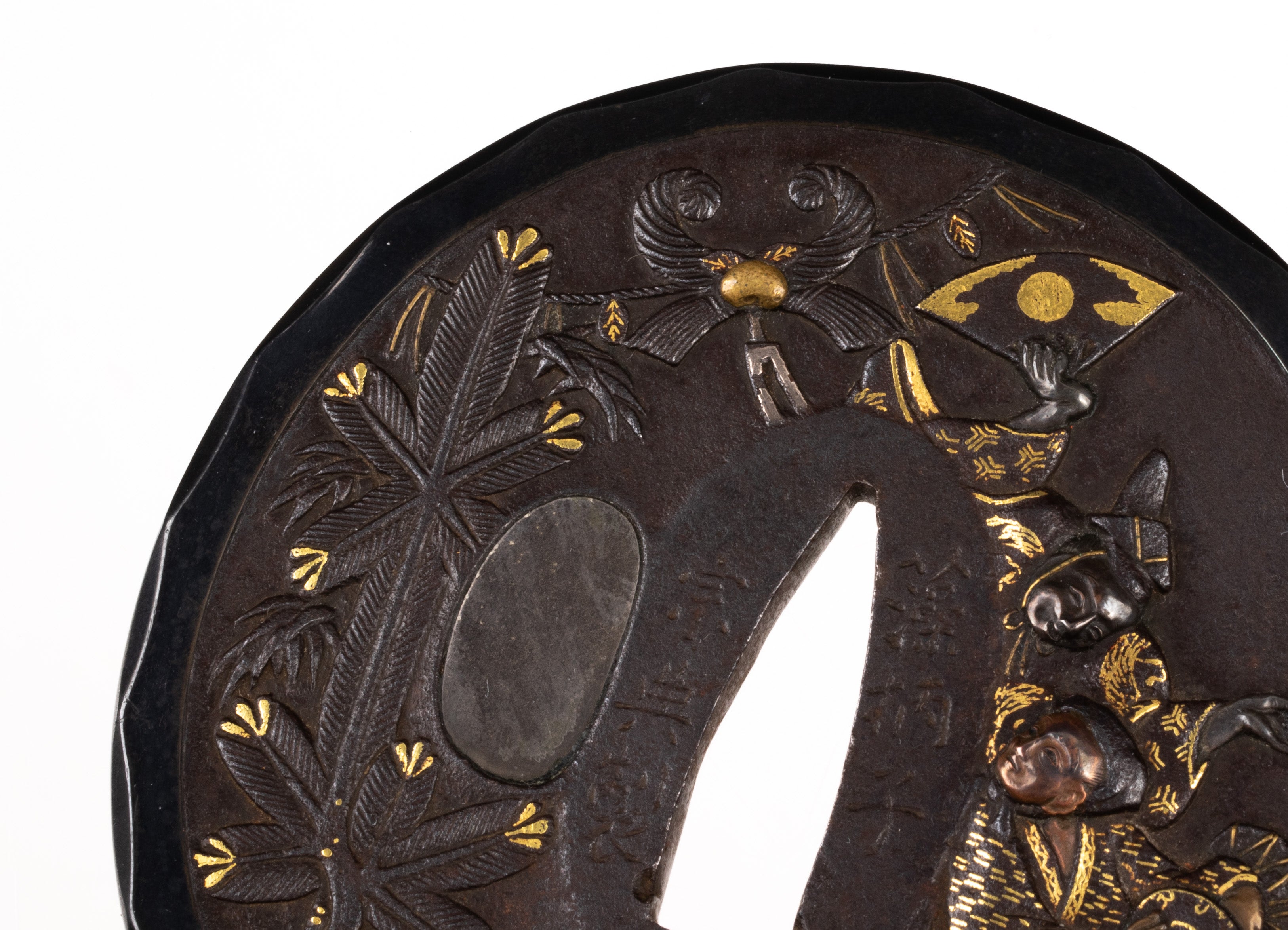
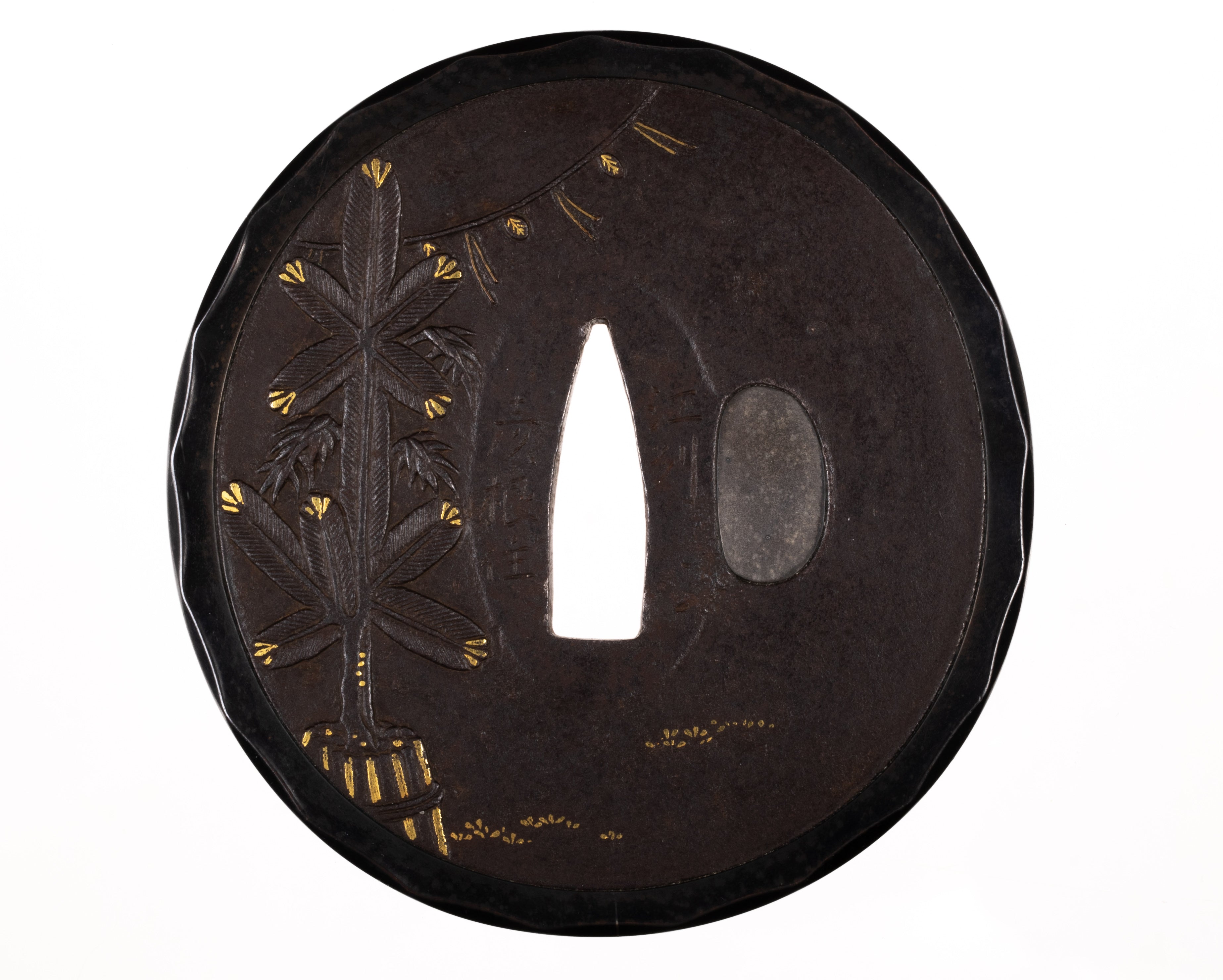
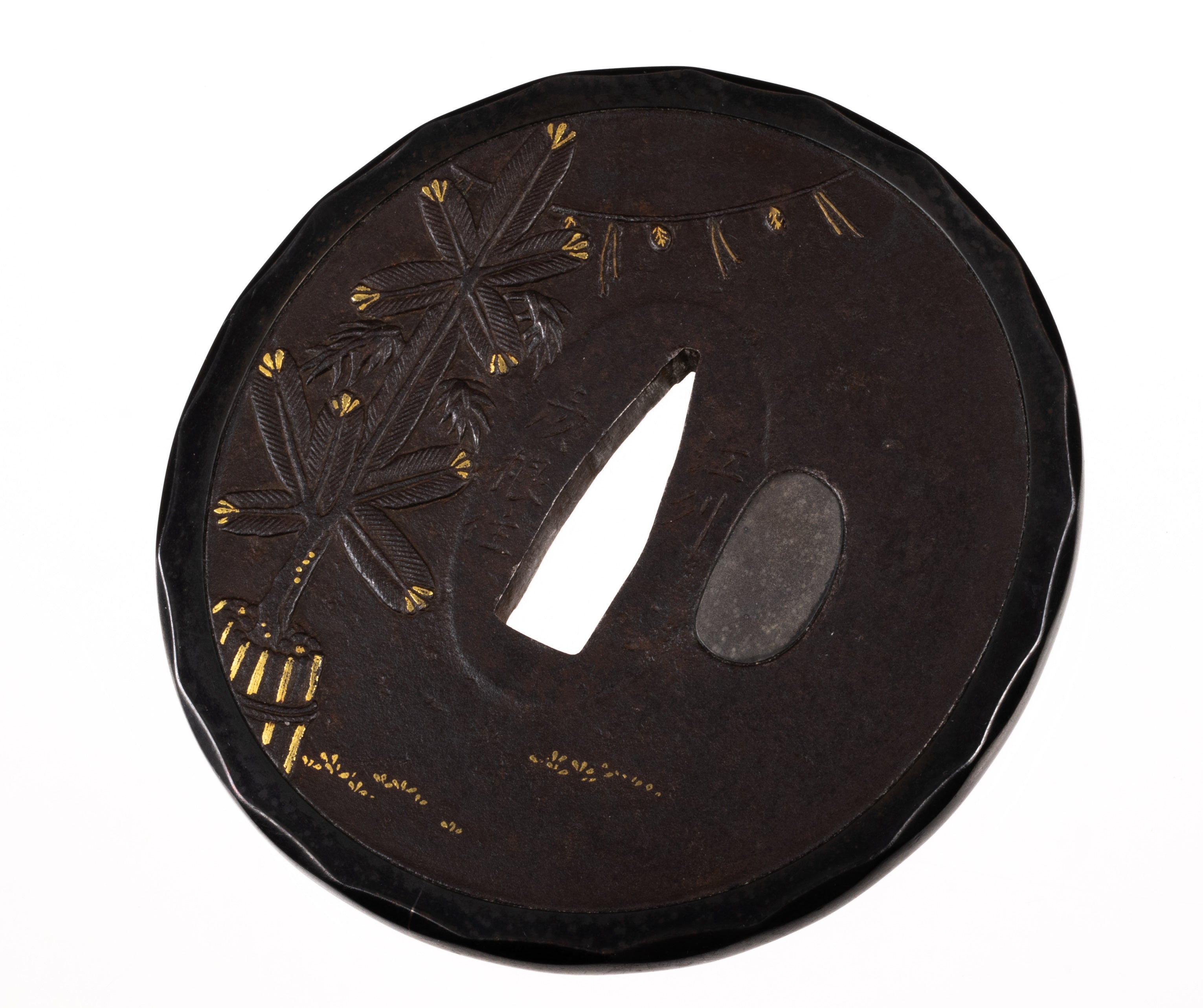
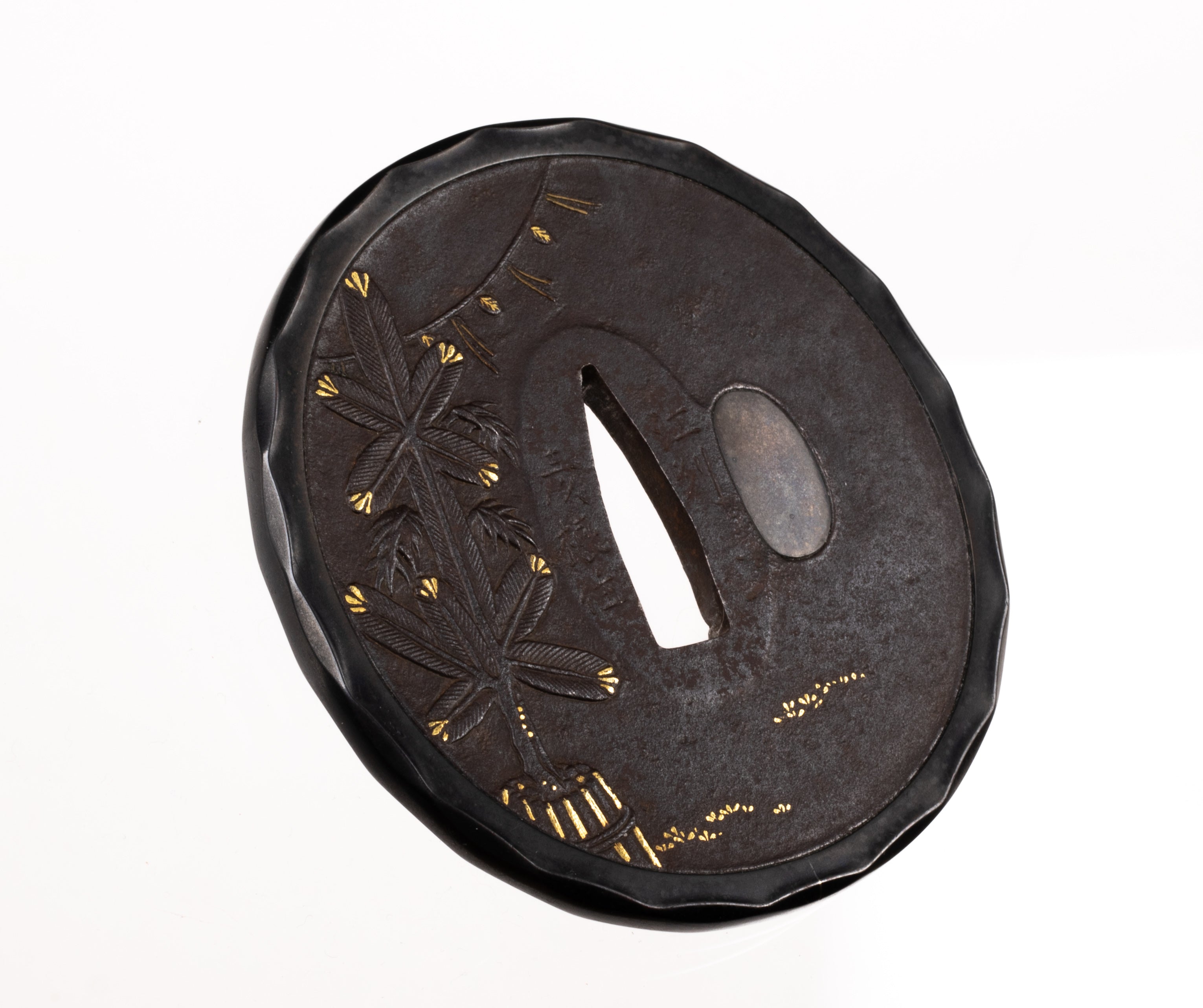
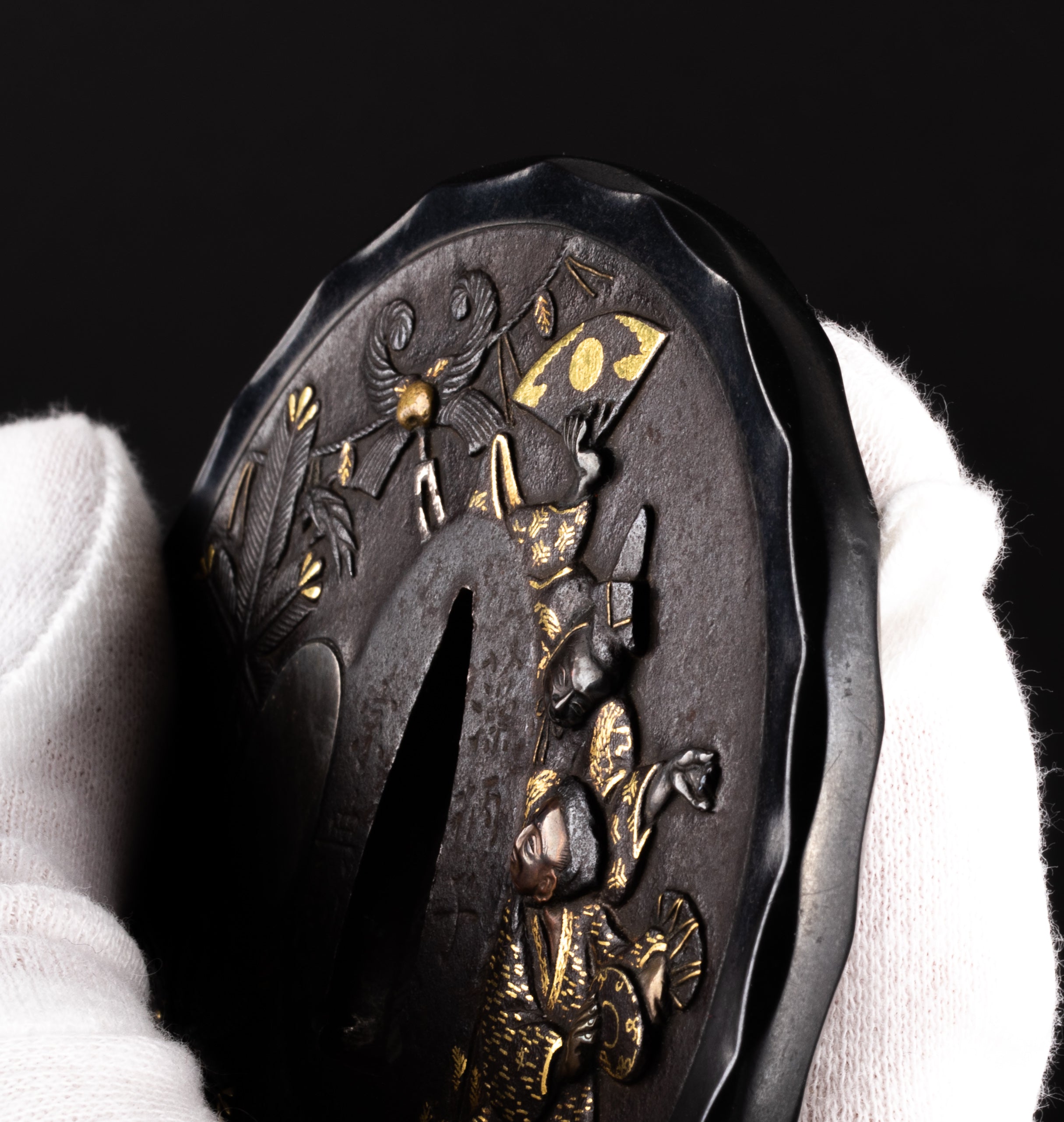
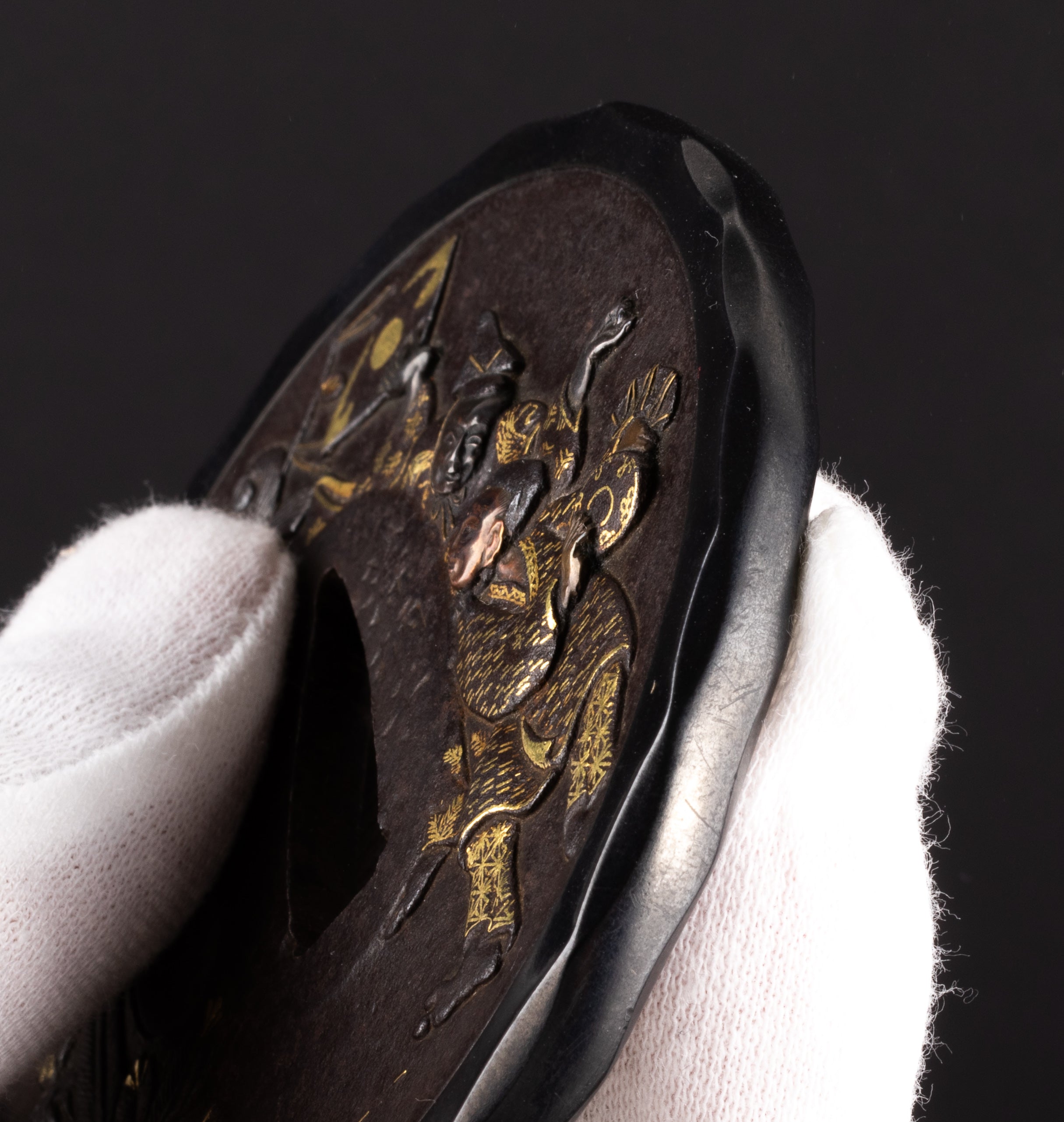
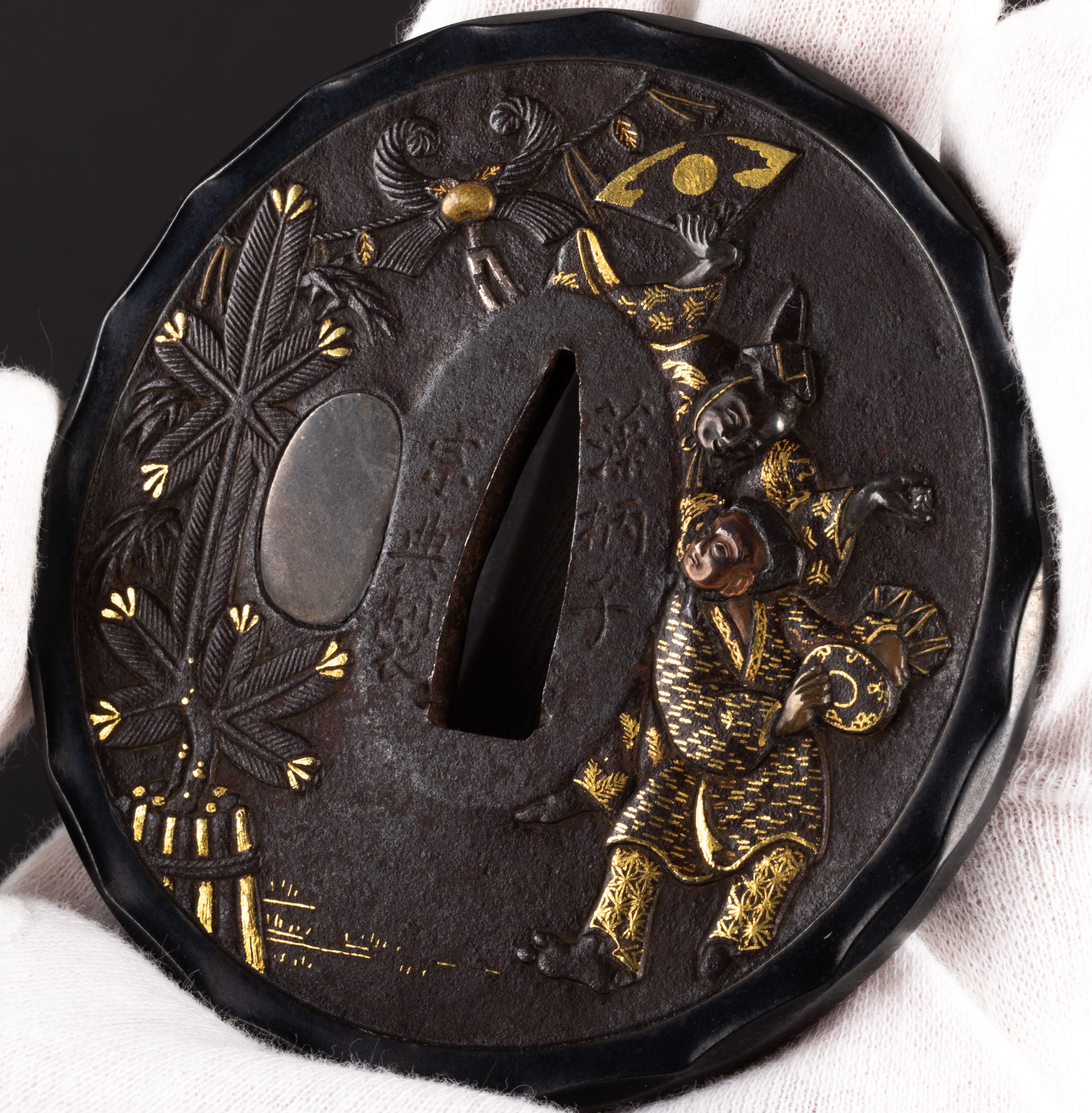
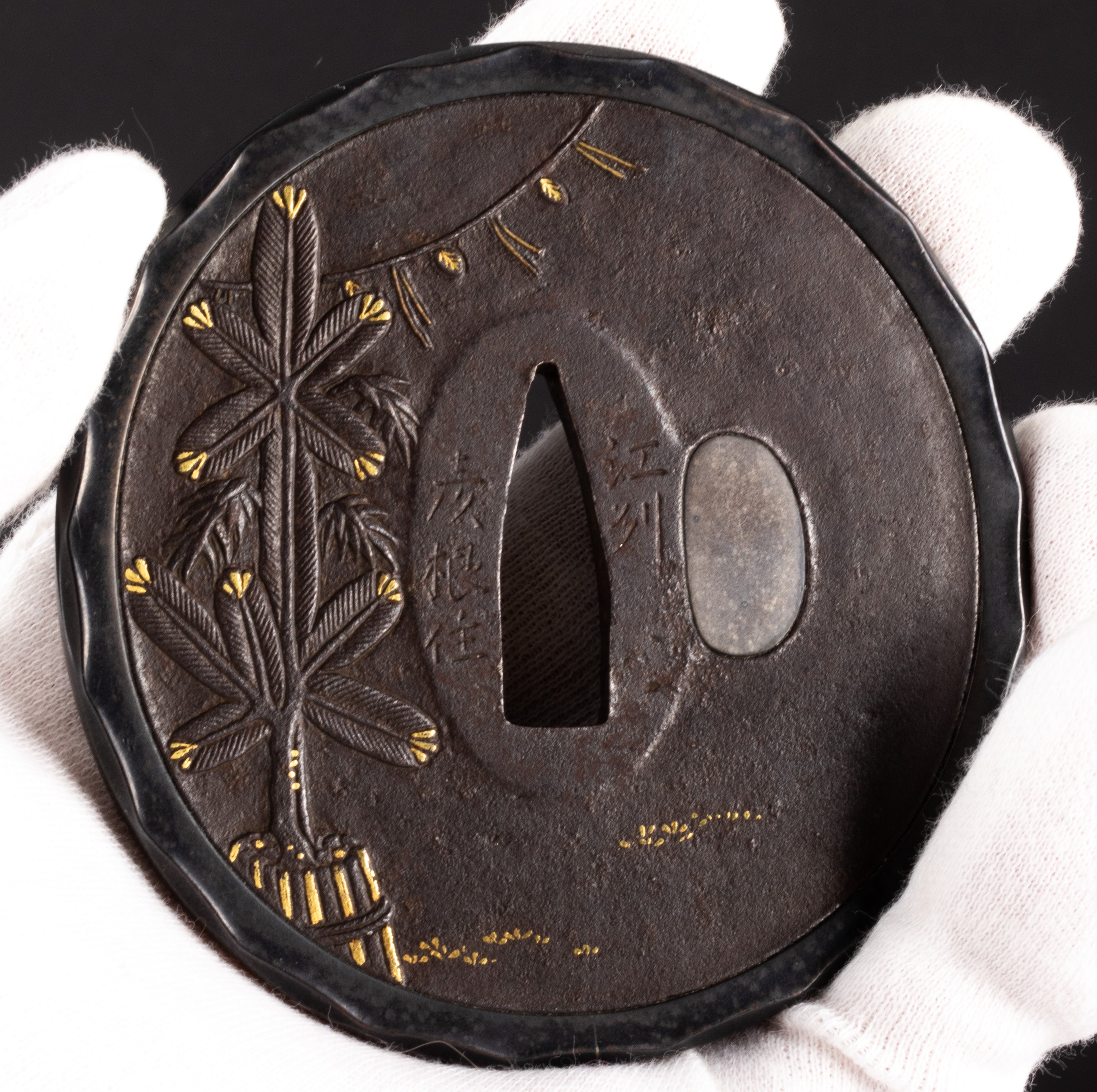
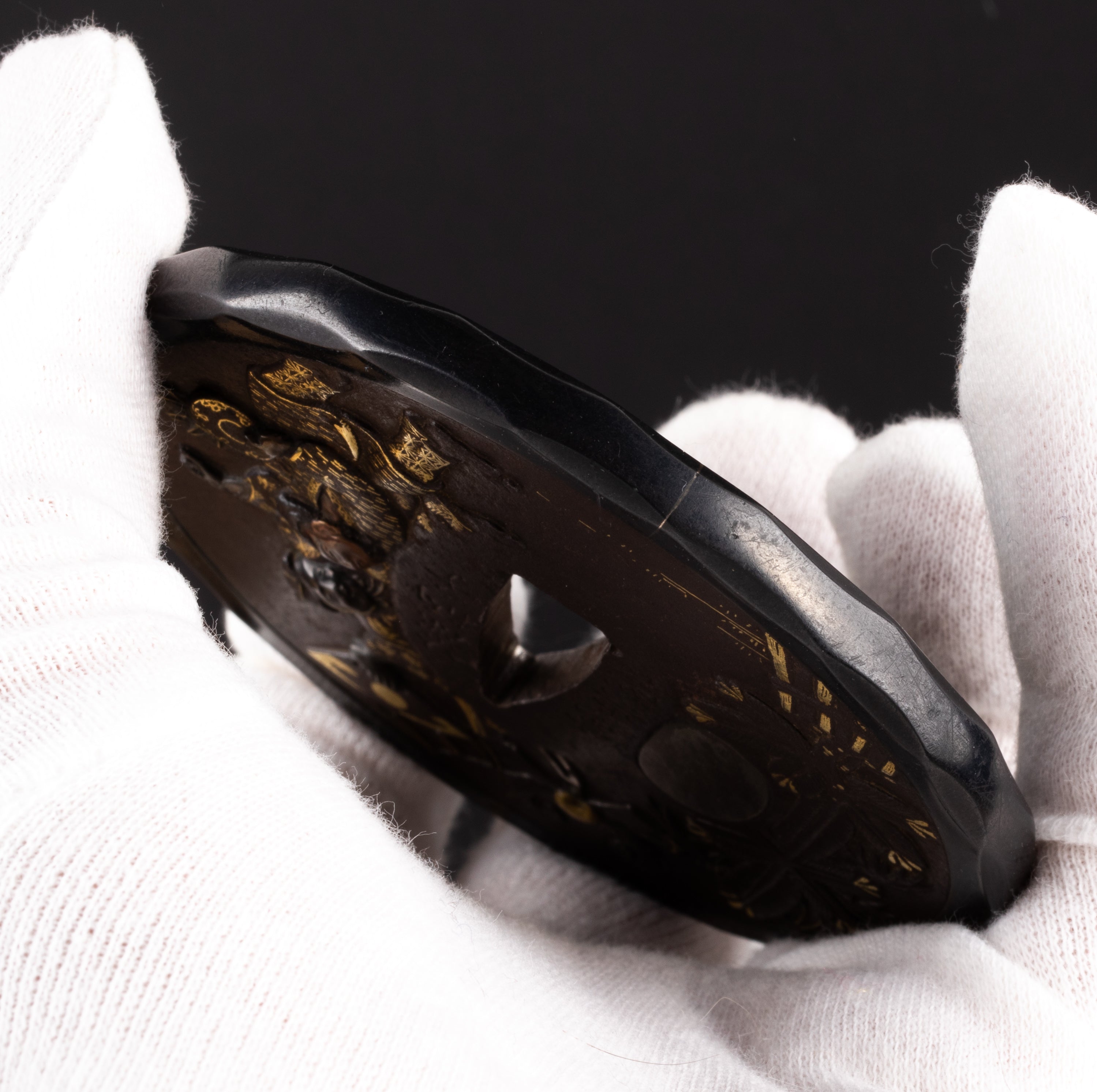
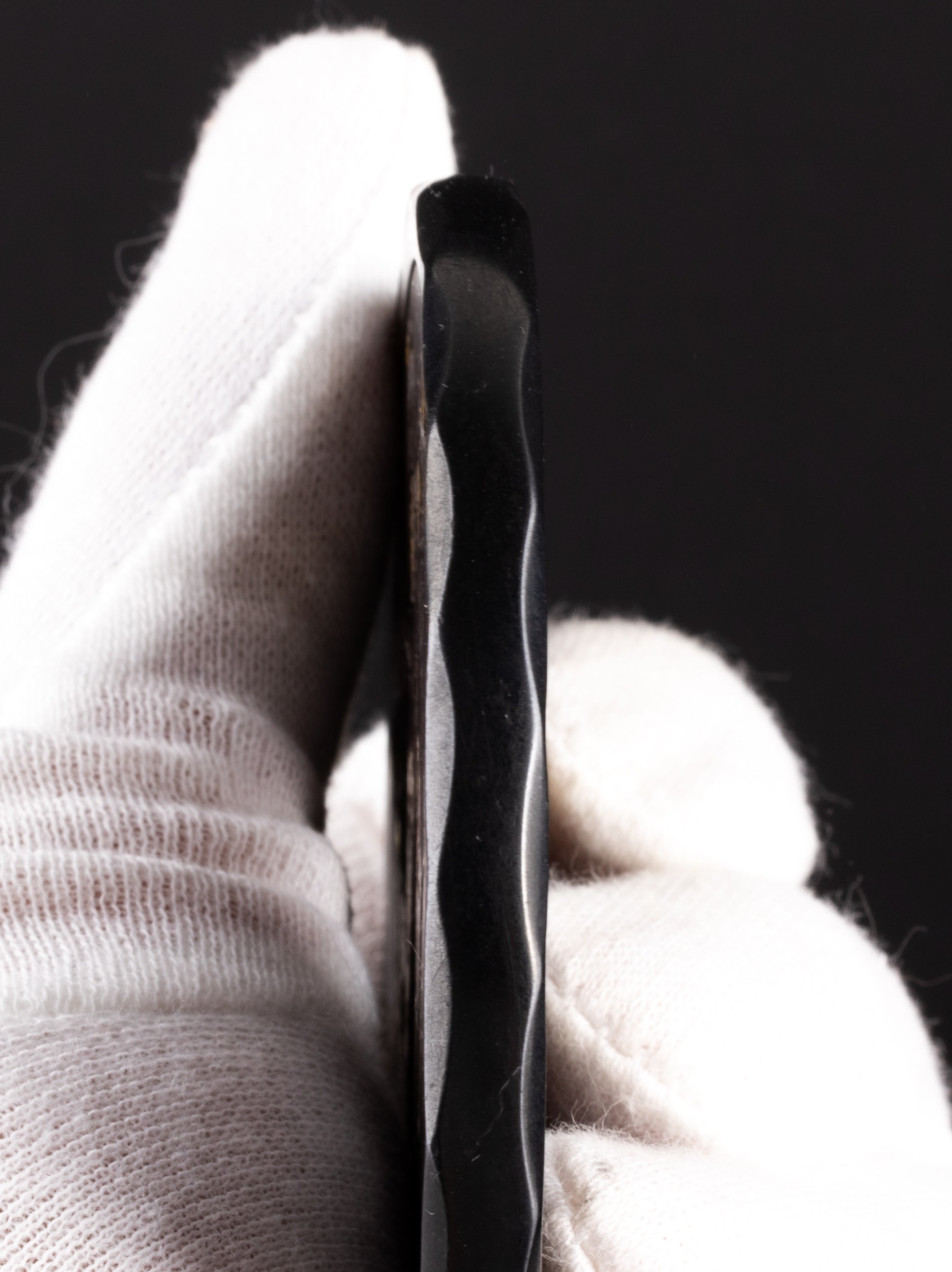
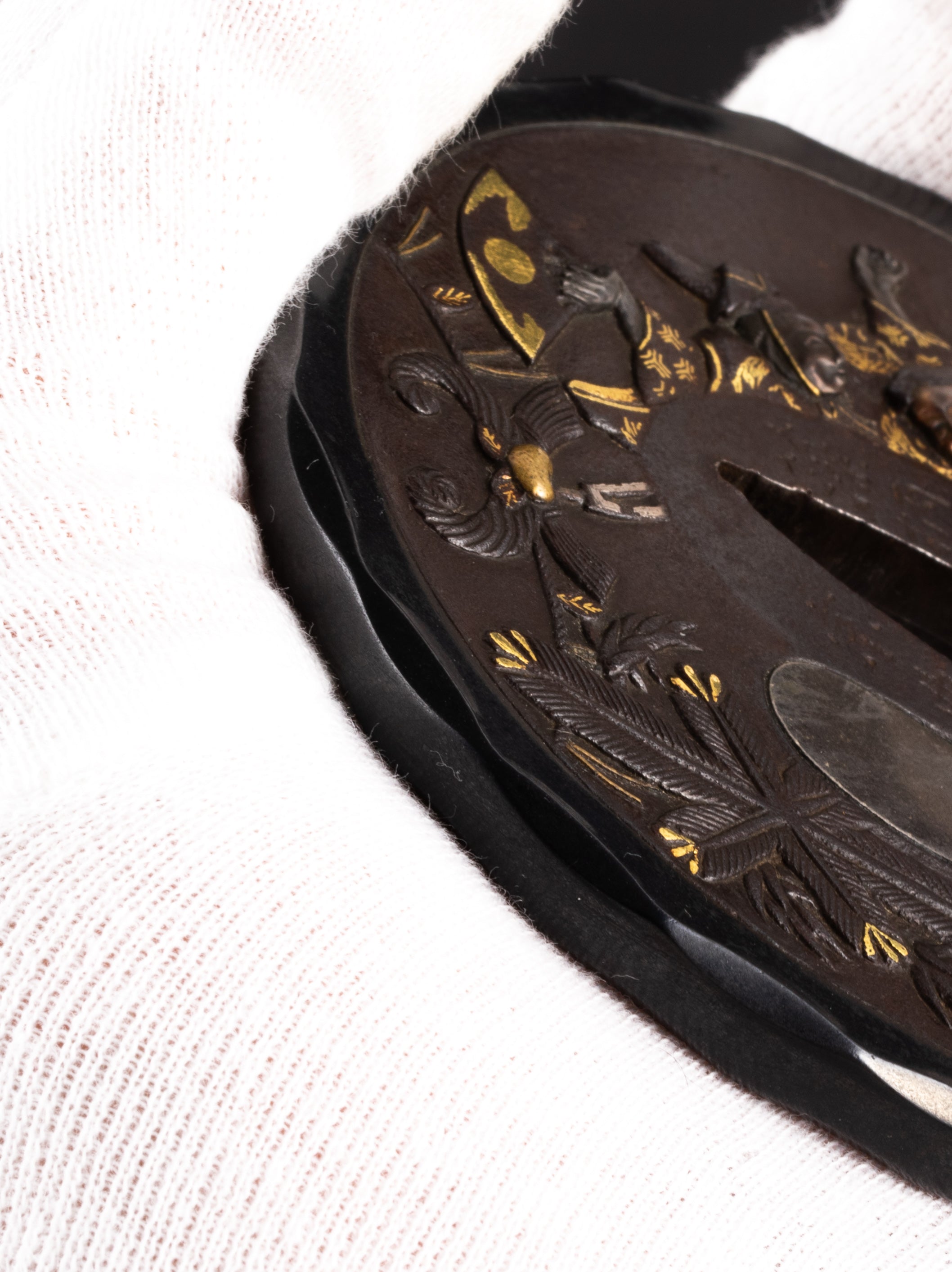
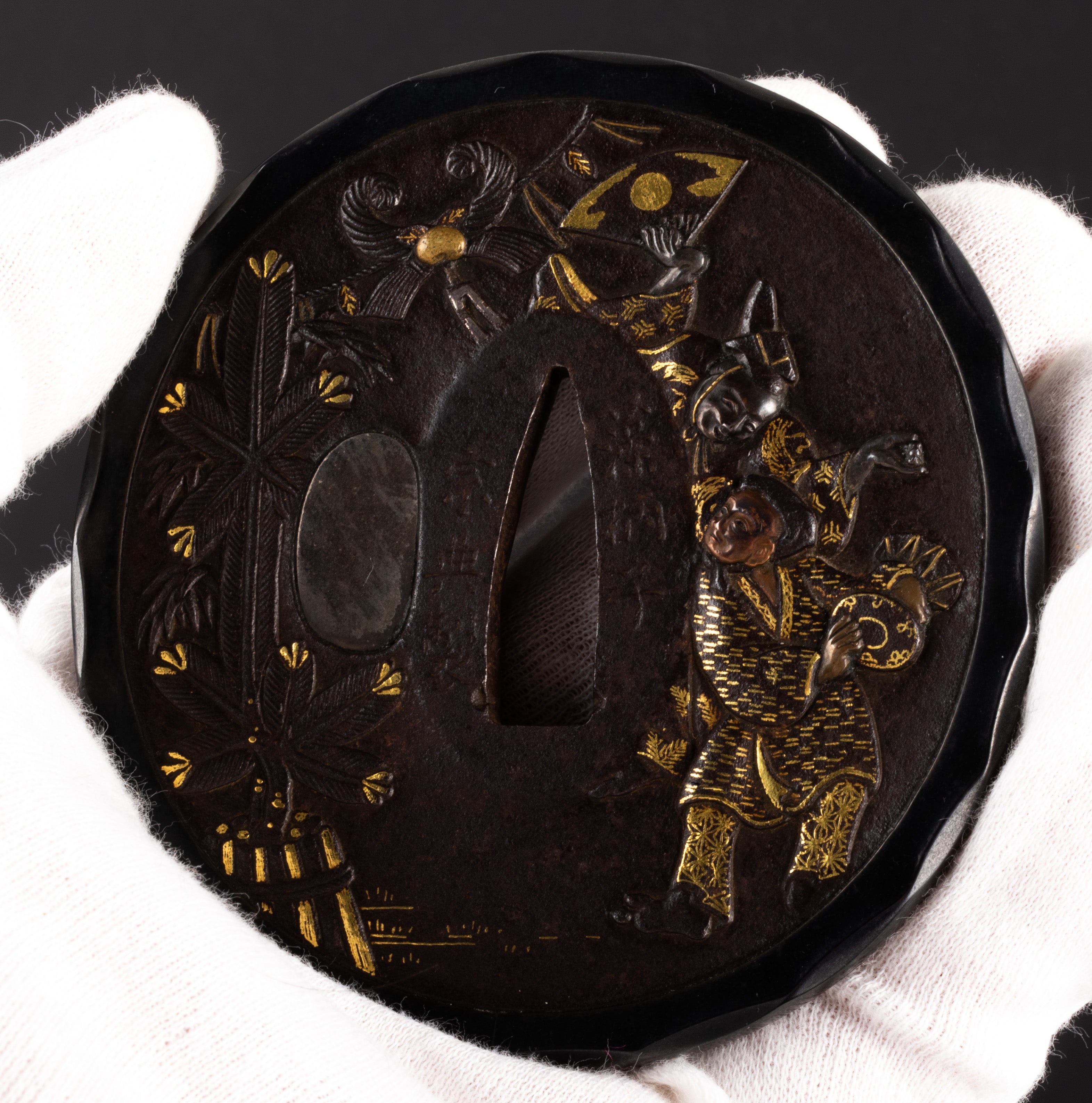
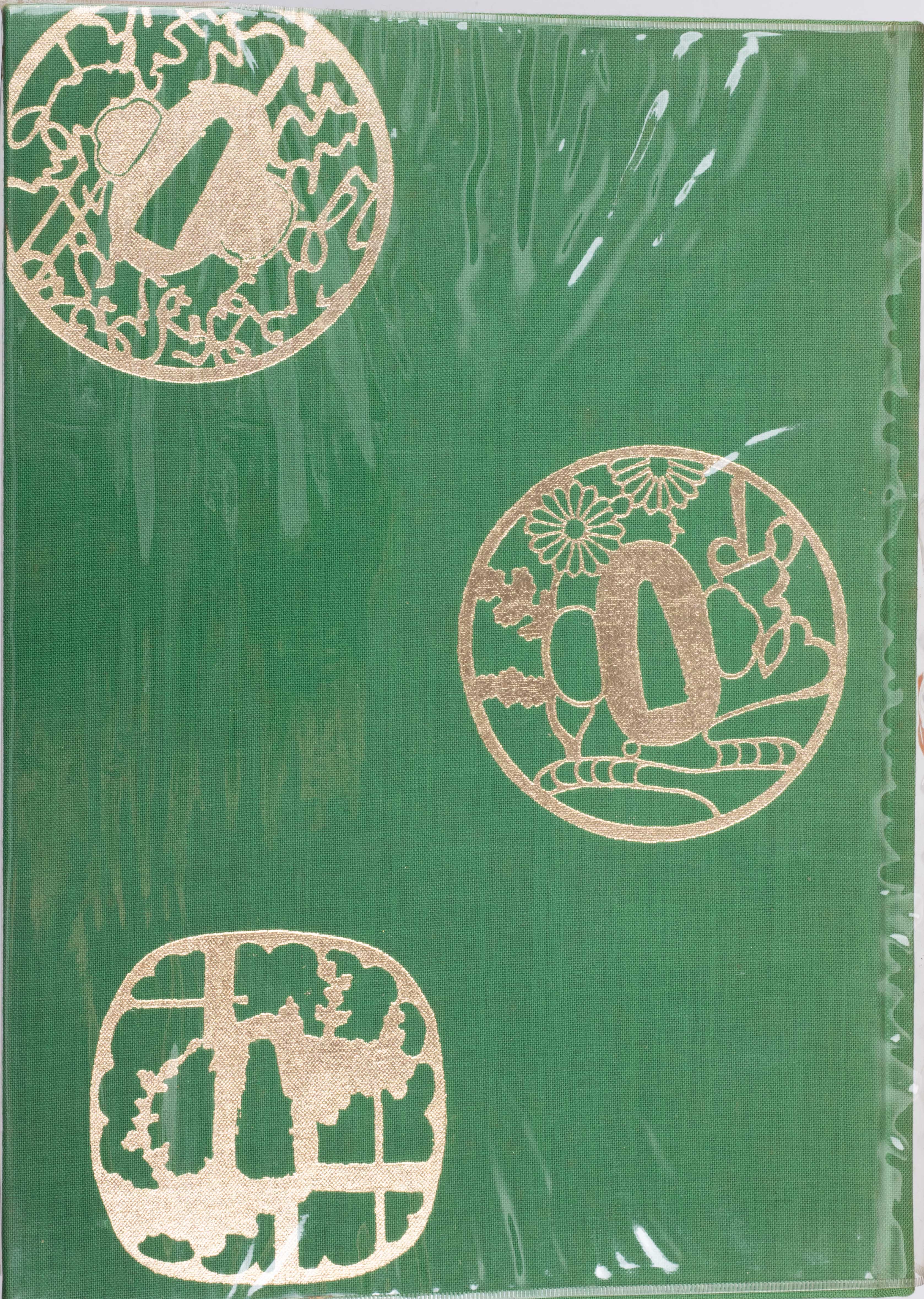
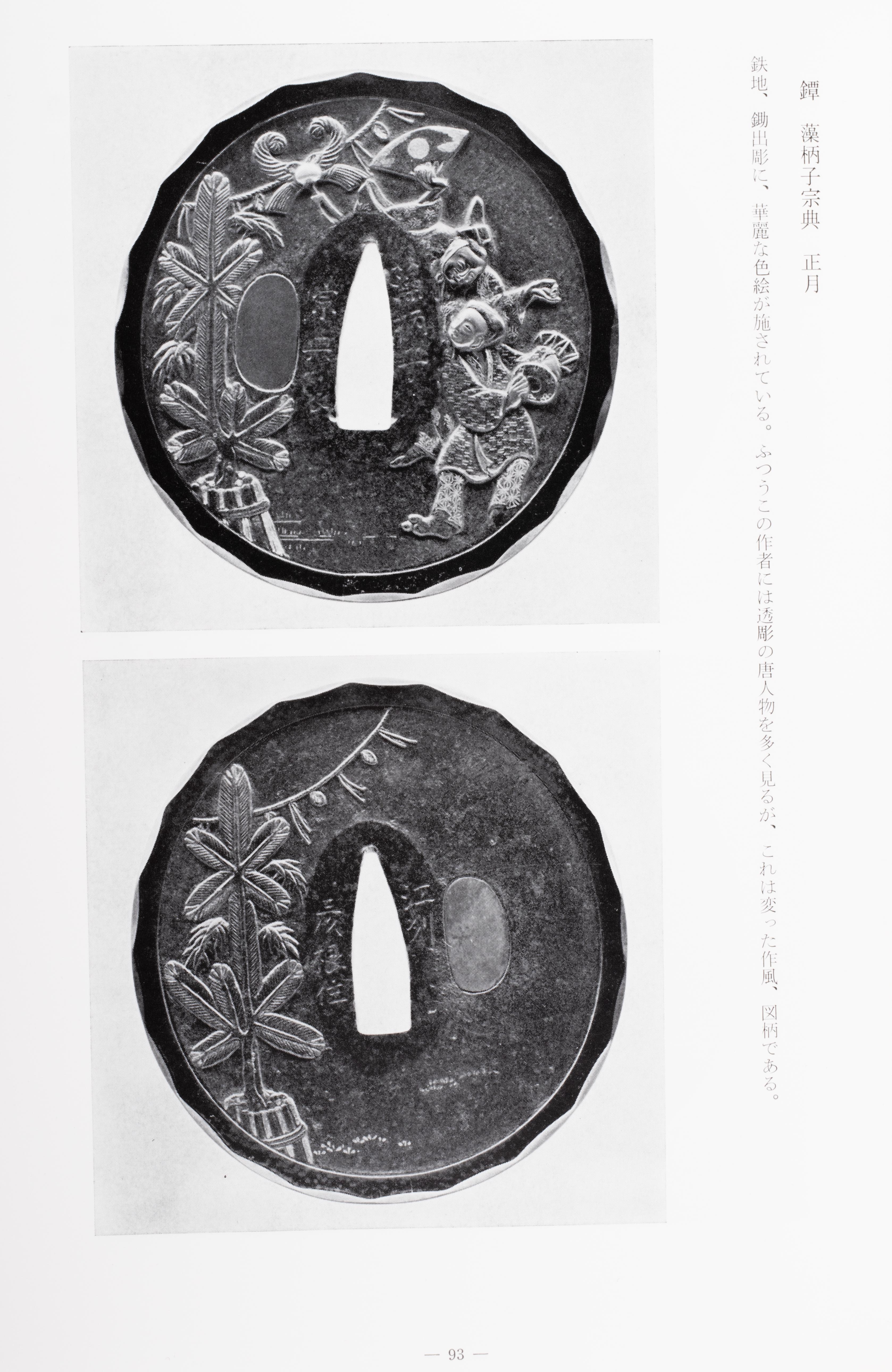
Iron tsuba signed "Goshu Hikone Ju Mogarashi Soten Sei". This tsuba was published on page 93 of "Nihonto Tsuba Kodogu Yuhin Zukan" by Mitsuo Shibata. It is depicting Manzai performed during New Year celebration. Manzai is a traditional Japanese style of comedy involving two man. They are trading jokes at great speed. Most of the jokes revolve around mutual misunderstandings, double-talk, puns and other verbal gags. Please visit wikipedia.org to learn more about Manzai and Japanese New Year celebrations. https://en.wikipedia.org/wiki/Manzai https://en.wikipedia.org/wiki/Japanese_New_Year Made of iron and carved with sukidashi bori. Faces, feet and few other decorations are made with copper, brass and silver inlay. Most of the gold inlay is applied with variations of nunome zogan. It seems that each part has been made differently. We can find classic shallow cross cuts, deep parallel cuts and deep parallel wave shape cuts. Under magnification most gold inlay creates beautiful and precise lines. This tsuba is such a joy to watch as a hole and piece by piece under strong magnification. Stylised shakudo fukurin with single silver weld at the bottom. Sekigane made of silver or shibuichi. Size: 86 mm x 82 mm x 5 mm Weight: 210 g Made in Edo period. This tsuba comes with kiri box and copied pages from the book it was published in. If you would like to buy the whole book please contact me.
NihontoWatchOffered by Soryu
This piece has sold
Get an email when a new Kitagawa Soten I piece hits the market.

Kinko · Omi · Edo
3 pieces on the market now
A tsuba of the Eight Views of Ōmi, carved in high relief and coloured with many metals, carries an inscription that places its maker at Nakayabu in Hikone. The maker is Mogarashi Sōten[[c:1]], named in the published sources as the founder of Hikone-bori and its representative master. Citing the Sōken Kishō, they record that he was originally a man of Kyoto who later lived in Hikone in Ōmi. Taken into the service of the Kawakita family among the Hikone domain's retainers, he changed his surname to Kitagawa, and he is said to have first signed Hidenori (秀典), with the common name Zengorō. The name was carried by two generations[[c:2]]. Works with age inscriptions show that the first generation was born in Jōō 1 (1652) and worked from the early into the middle Edo period.
His training is uncertain. One source in the published record cites the Kinkō Sōran for works signed as by "Kitagawa Hidenori, a disciple of the Gotō", yet the same commentary adds that his work shows no marked feature of Gotō training[[c:3]]. Other entries describe him as a representative Hikone master who came out of Mino-bori[[c:4]]. They say that both a Gotō and a Mino character can be seen in his better works, and one shakudō guard is called the clearest expression of his Mino manner.
His art is above all the iron plate, the material he uses most often, generously proportioned and filled across both faces with figures in deeply modelled high relief. His subjects are warriors, the subject most often met in his iron work, together with immortals, elegant gatherings of sages and the Eight Views of Ōmi. He colours them in inlay and iroe with many kinds of metal, and even the gold is of several kinds. Of a guard of sages at their pastimes among flowers the published sources write that the chisel is broad and unhurried and draws the viewer into a world of yūgen[[c:5]]. The Eight Views guard is judged frankly: it lacks refined elegance, but it overflows with force[[c:6]].
The published record says repeatedly that his best work is not the openwork of the school. Most Hikone guards are cut in openwork, with warriors or the Seven Sages of the Bamboo Grove, but his masterpieces are the solid plates in high relief and coloured inlay. Of a shakudō plate with cranes over waves and plovers on the reverse, the commentary writes that comparatively superior works are found among his unpierced plates[[c:7]]. In shakudō nanako he fills the whole face with dense subjects: a guard of seaweed and shells with some shells coloured half gold and half silver, and another with the twelve zodiac animals worked in several golds.
That bustling, brilliant unfolding is what the published sources call his true forte[[c:8]]. They grant that so animated a guard can tip into excess, but hold that in Sōten's own hand it is remarkably free of excess and gains dignity besides[[c:9]].
All ten of the guards on record are Juyo tsuba, and two of the later designations carry his age inscriptions, which the published sources value as documents. They also warn that because his name became so famous it was cut onto much later Hikone-bori, even onto souvenir-grade pieces. A guard with his own signature and his full, dense high relief is therefore what a collector looks for, and one comes to market only from time to time.
Where Soten stands among comparable artisans: across all of nihontō, and within tradition, era, and period. The tiers (Foremost · Leading · Major · Notable) weigh official designations from the NBTHK and Japan's Agency for Cultural Affairs, together with historical honors of lasting repute such as the Sansaku and Meibutsu-chō.
Select a lens to see how it's measured.
Kinko · Omi
32 pieces on the market now
The Hikone school of sword fittings -- known as Hikone-bori -- was established at Nakayabu in Hikone, Omi Province, by Mogarashi Nyudo Soten, who settled there after leaving Kyoto and entered the service of the Kawakita family, hereditary vassals of the Hikone domain. One source records that Soten initially trained under the Goto family, citing the Kinko Soran for the existence of works signed "made by Kitagawa Hidenori, a disciple of the Goto," before developing the distinctive carving manner that would define his lineage. The school's connection to the broader Mino-bori tradition is also recognized. There were reportedly two generations working under Soten's name, with the first born in Joo 1 (1652) and active from the early through mid-Edo period. From his workshop emerged a circle of accomplished students, chief among them Nomura Kanenori and Munenori, who carried the Hikone-bori manner forward and established it as one of the most distinctive regional styles in the kinko tradition. The technical hallmark of Hikone-bori is sukidashi takabori -- richly modeled high-relief carving executed on generously proportioned iron plates, further enlivened through zogan iroe employing gold, silver, shakudo, and suaka. The NBTHK notes that even among the gold applications, "multiple types of gold are used," producing expansive pictorial fields of considerable chromatic variety.
Subjects encompass warriors, Daoist immortals, elder sages at elegant gatherings, and flowers-and-birds compositions, rendered across the entirety of both surfaces of the guard. The school's masters also demonstrated facility in shakudo work, including nanako-ji plates with high-relief compositions displaying a pronounced Goto-like flavor, as well as nikubori ji-sukashi and polychrome mitokoromono sets. What unifies the school's output is the synthesis of imposing compositional scale with refined polychrome technique. " Munenori's contribution is recognized for its assured command of shakudo nanako-ji ground preparation and boldly modeled takabori, enriched with polychrome iroe employing multiple varieties of gold across both faces -- a sumptuous, animated effect characteristic of the mature Hikone style. The Hikone school's significance within the broader kinko tradition rests on its creation of a distinctively pictorial approach to sword-fitting decoration that stands apart from both the restrained elegance of the Goto mainline and the narrative density of the Yokoya school. The NBTHK's evaluative language converges on a single defining quality: the school's ability to fill expansive iron and shakudo surfaces with ambitious narrative compositions while maintaining compositional coherence and chromatic refinement. " That Soten's overwhelming fame led later makers to adopt his signature on subsequent Hikone-carved works testifies to the enduring authority of the school's founding aesthetic, while the surviving origami documentation -- including one dated Kanbun 5 (1665) from Goto Mitsutomo -- provides valuable evidence for understanding workshop practices and the collaborative production that sustained the Hikone tradition across the early and mid-Edo period. Learn more →
| Smith | Era | Designated |
|---|---|---|
| Soten宗典 | Edo | 10 |
| Kanenori包教 | Edo | 3 |
| Masatsugu政次 | Edo | 0 |
| Mitsuyoshi光義 | Edo | 0 |
| Munekata宗賢 | Edo | 0 |
Inspection period (per the shop's shipping policy): after receiving the item, each customer has two weeks for inspection. In that time you may decide to return it, and the item will be refunded in full. Shipping costs are not refunded. Returns (per the shop's refund policy): the policy lasts 30 days; once 30 days have passed since purchase, no refund or exchange is possible. To be eligible for a return, the item must be in the same condition in which it was received and in its original packaging. Customized products cannot be returned. In certain situations only a partial refund is granted. Return shipping is at the customer's expense, and shipping costs are non-refundable.