 NihontoWatchNihontoWatch
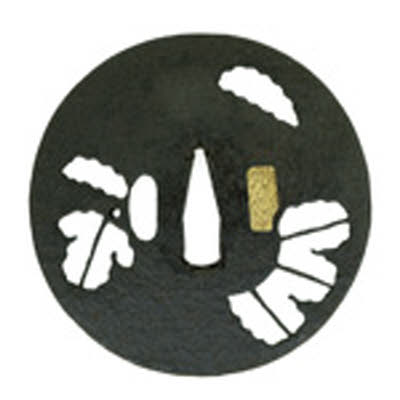
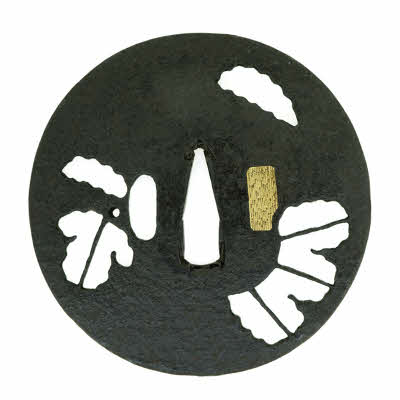
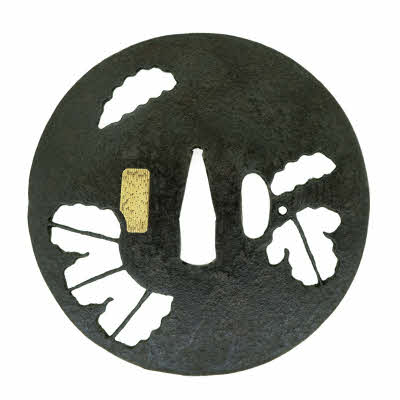
Tosho tsuba are large, perfectly circular iron plate tsuba, where the thickness becomes even thinner from the thin seppa-dai toward the maru-mimi, and while simple, they possess an elegant charm with excellent forging of the iron. Some feature simple ko-sukashi, while others have no decoration at all. The origin of the name comes from the fact that swordsmiths produced them using leftover iron from when they forged swords, but because Tosho tsuba dating back to the Kamakura period were worn down without being cherished or preserved for posterity, it is conjectured that most of the Tosho tsuba seen today were likely produced from the Muromachi period onwards. Although works from before the Momoyama period are called "Ko-Tosho tsuba" and those from the Edo period are called "Tosho tsuba," the reality is that the period judgment of experts relies solely on individual visual and tactile sensations. The reality is that those that are large, thin, with strongly expressed tsuchime, or those with no hitsu-ana and simple ko-sukashi are classified as "Ko-Tosho tsuba." Because Tosho tsuba and Katchushi tsuba are mumei and there are no records, it is likely difficult to determine the exact production date. This Tosho tsuba has hitsu-ana on the left and right, and possesses a style from around the Momoyama period to the early Edo period that is refined despite its antique elegance. Simple chrysanthemum leaves with thin veins are arranged on the left and right, and a water droplet is placed on the yukimochi chrysanthemum leaf on the left. The tsuchime iron ground has slight irregularities and is not flat. The forging of the jitetsu is extremely good, and the iron quality of the purple rust is particularly excellent with a clear iron color that deserves praise. Tekkotsu appear on the maru-mimi, and while simple, it creates a warrior's aesthetic space that fascinates tsuba collectors.
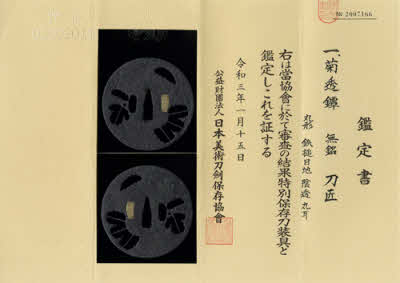
Certificate reading — 無銘(刀匠)
NihontoWatchOffered by Sanmei
17 on the market

Machine translation from the shop's Japanese · may contain errors ·
Tosho-Katchushi
17 pieces on the market now
A Hozon-certified fitting of notably superior craftsmanship and condition, often with signature or workmanship of high reference value.
The NBTHK (Nihon Bijutsu Tōken Hozon Kyōkai, the Society for the Preservation of Japanese Art Swords) is a public-interest incorporated foundation founded in 1948 and supervised by Japan’s Agency for Cultural Affairs (Bunkachō); it is based at the Japanese Sword Museum in Tokyo. Its expert panels physically examine each submitted work (shinsa) and issue a certificate (kanteishō) ranking it by artistic and historical merit. NBTHK papers are the most widely recognized standard of authentication for Japanese swords and fittings.
NBTHK official siteFor a return, please contact us within 7 days of the item's arrival. If specification changes such as dimensions were made at the customer's request, a return cannot be accepted. Shipping and transfer fees are the customer's responsibility.
¥180,000