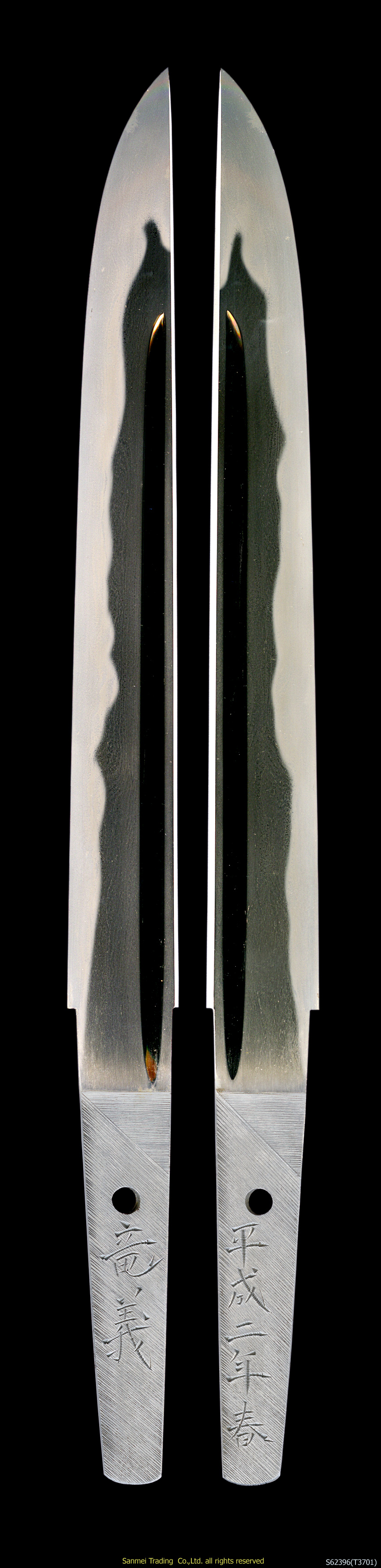
Sword construction: Hira-zukuri with an iori-mune. A tantō of no curvature, with a standard width but an exceptionally thick kasane. The fukura is subdued, and the point also has a thick kasane, giving the blade the robust build of a powerful yoroi-dōshi (armor-piercing dagger). The blade weighs 228 grams including the Habaki, imparting a substantial, weighty feel in hand.
Horimono (Carving): On both sides of the blade there is a bōhi carved in kaki-nagashi style, running down into the tang.
Jihada (Forging Pattern): Well-forged Itame-hada, overall tending toward Masame, with prominent and thick chikei running through the Ji. Abundant Ji-nie is present and the steel displays a clear, bright iron color, resulting in a powerful and resilient forging texture.
Hamon: Beginning with a small-pattern Yakidashi, the Hamon is a vigorous midare with undulations of varying width, based on abundant Nie. The Habuchi is frequently struck with Uchinoke, intermingled with Nijū-ba and Sanjū-ba and is thickly covered in Nie. Within this appear Inazuma and Kinsuji, with frequent Sunagashi flowing through, making the edge bright and clear. The interior of the Hamon is densely filled with Nioi and thick Nie-ashi in small gunome shapes emit vivid flashes of light.
Bōshi: Strongly Midare-komi, vigorously swept back ending in a Jizō-style small circle with a pointed finish.
Nakago: Ubu. The tang ends in a Kuri-jiri shape. The file marks are Ō-sujikai with decorative kesho-yasuri, the mune has a slight contour and also bears Ō-sujikai with decorative kesho-yasuri. There is one Mekugi-ana. On the omote, below the mekugi-ana, is a boldly cut two-character signature “TATSUYOSHI 竜義” and on the ura is engraved the date of manufacture “Spring of Heisei 2 (1990) 平成二年春”
TATSUYOSHI 竜義 was born as Enomoto Eiichirō 榎本栄一郎 on October 31, 1951 at 3-15-21 Ōmiya-chō, Mishima City, Shizuoka Prefecture, the eldest son of the Mukansa swordsmith Yūsui-shin SADAYOSHI 湧水心貞吉, a master who studied under the renowned Gassan Sadakatsu 月山貞勝. Along with his younger brother Enomoto SADAHITO 榎本貞人 (real name Enomoto Einsaburō 榎本栄七朗), he is regarded as one of the representative swordsmiths of the modern era.
Enomoto Eiichirō first received the smith name “Sadayoshi 貞義” from Dr. Satō Kanzan, but because it's pronouncing is the same as his father “Sadayoshi 貞吉”, he changed it to “TATSUYOSHI 竜義” upon his marriage.
He studied under his father, mastering the craftmanship. Since his first submission to the Shinsaku-tō Exhibition in 1975, he has been captivated by the dynamic Chikei, Kinsen and the radiant strength of Nie characteristic of the Sōshū tradition, forging with the aim of achieving masterpieces in that style and earning numerous selections and awards.
This tantō is constructed in the style of an armor-piercing dagger, with an exceptionally thick kasane and a subdued fukura, excelling in thrusting capability. It is a powerful work modeled after the Sa (Samonji) 左 style, seeking to approach the profound depths of the Sōshū tradition. The Jihada features masame with bold chikei running vividly throughout, the steel bright and clear in color. The hamon, centered on Notare, gradually rises in height with increasingly abundant Nie. Thick and powerful Nie cling to the Habuchi, over which multiple layers of Kinsuji, Inazuma, and Sunagashi appear. The bōshi is even stronger and brighter, forming an Ichimai-style appearance, with flame-like Nie lines radiating in multiple layers.
The Nakago retains its silvery sheen from the time of manufacture, and the finely executed kesho-yasuri bears the two-character signature “TATSUYOSHI 竜義” as well as the date “Spring in the 2nd year of Heisei (1990) 平成二年春” indicating the work was made when he was thirty-eight years old.
Fittied with a Silver single-layer Habaki, preserved in a plain wood mounting Shirasaya

 NihontoWatch