After the Ōnin War broke the Ashikaga order, a century of Sengoku warfare armed nearly every province in Japan. The era rewards a discriminating eye: routine work exists in quantity, and beside it stand custom blades of the first rank.
 NihontoWatchNihontoWatch
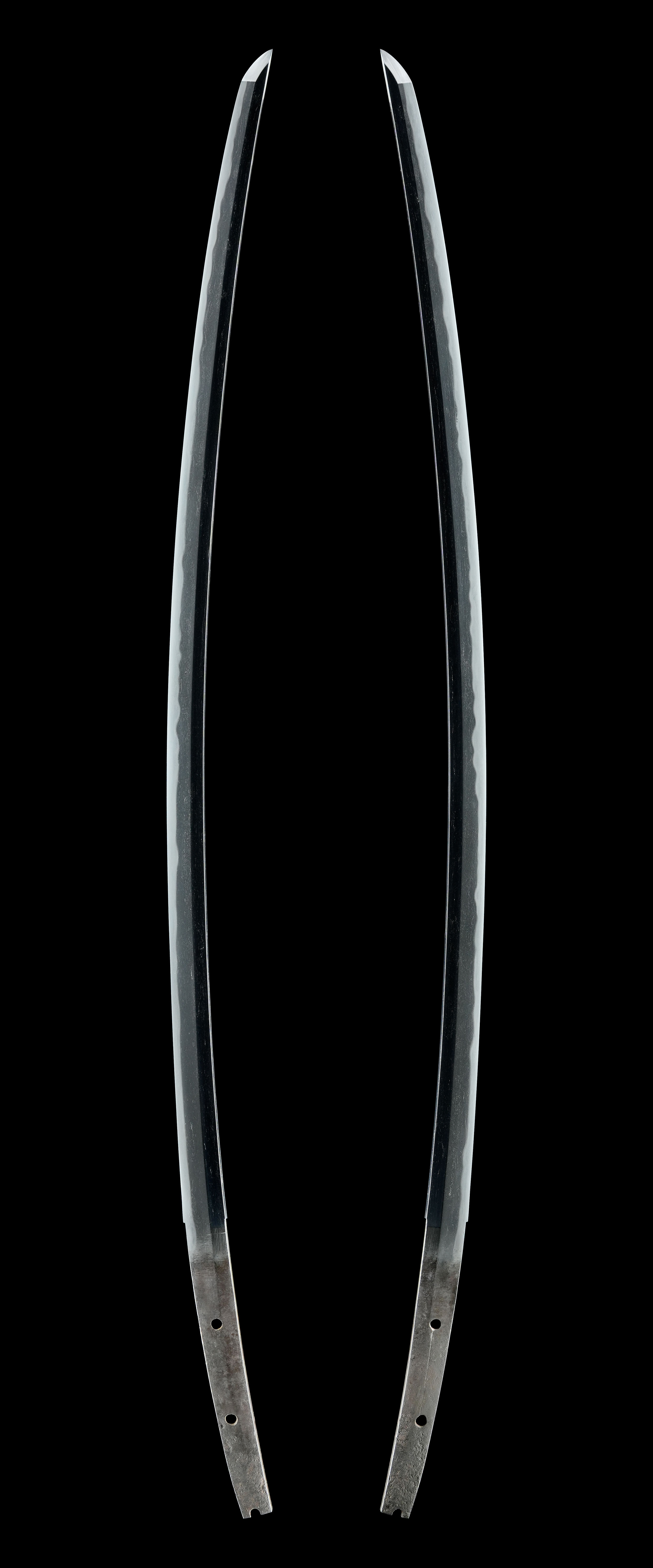
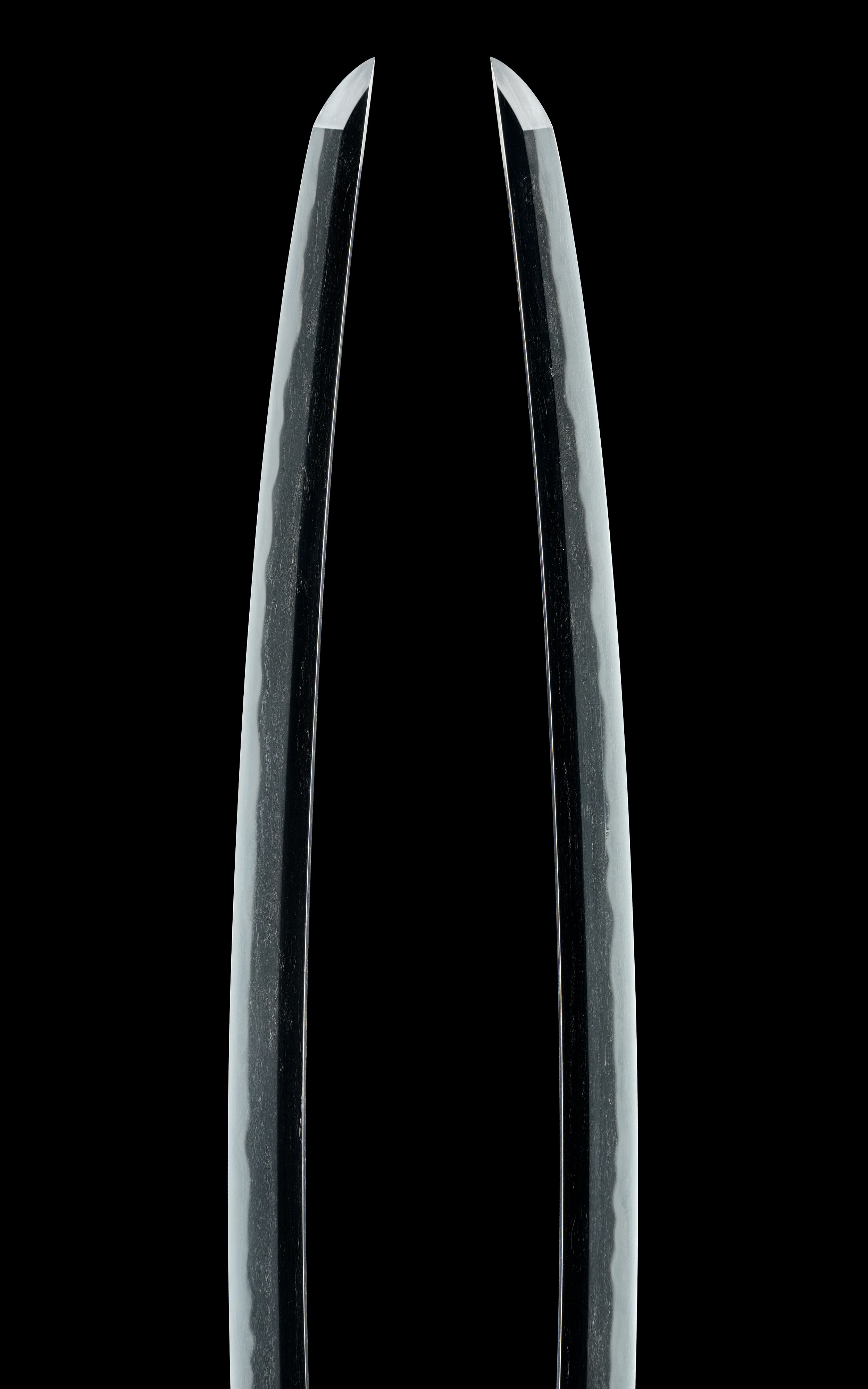
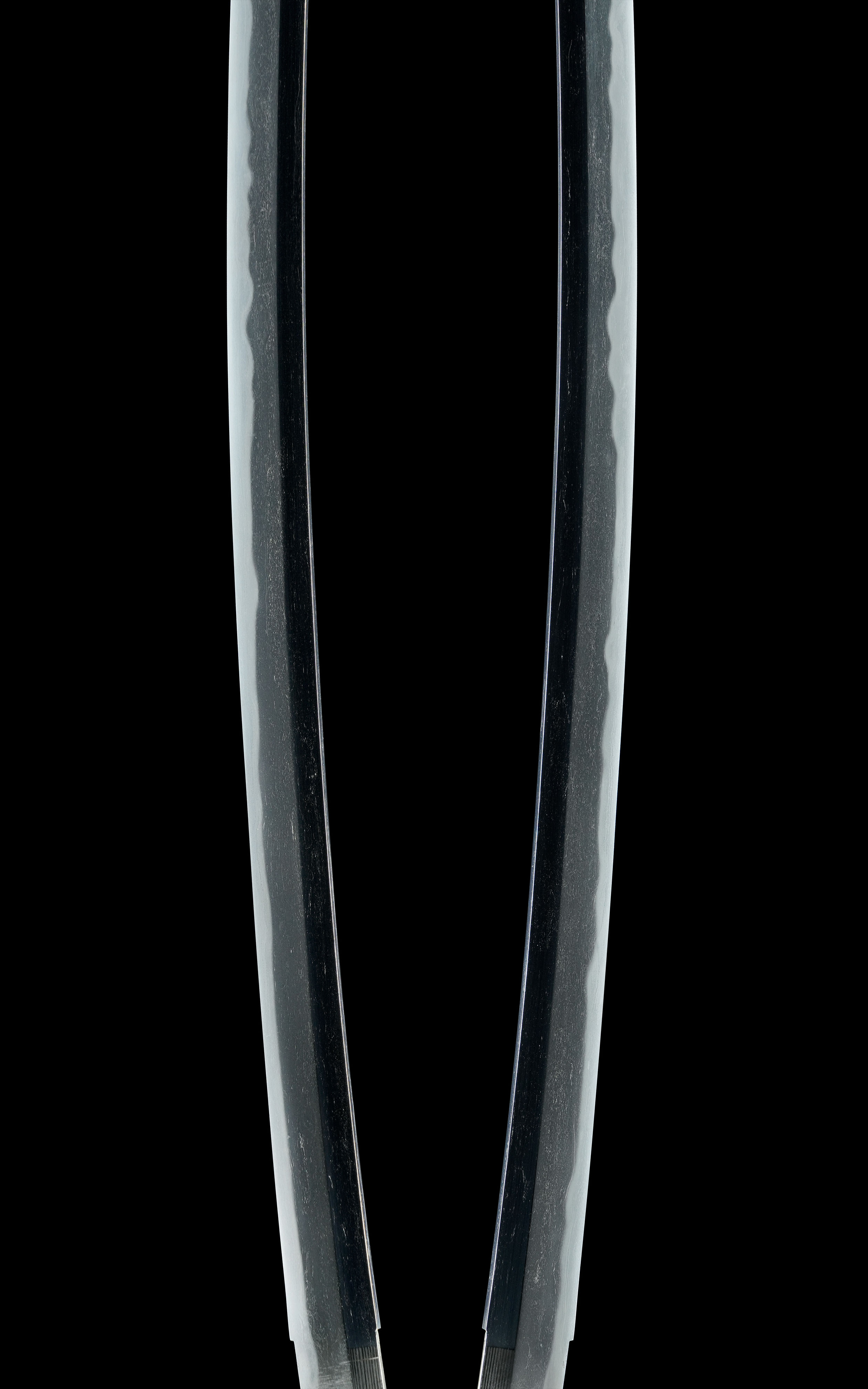
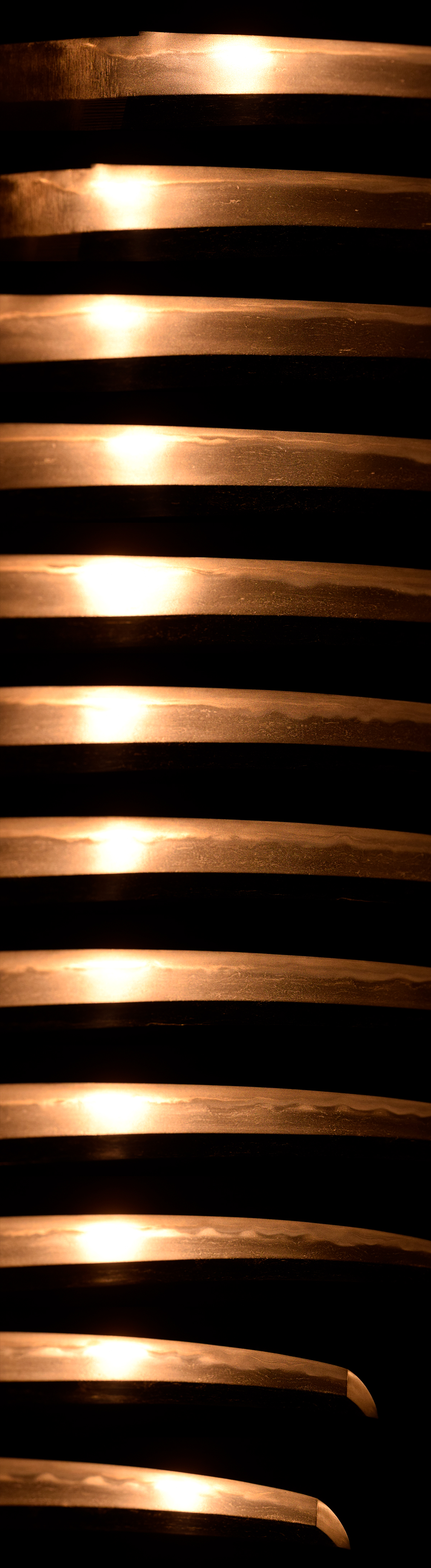
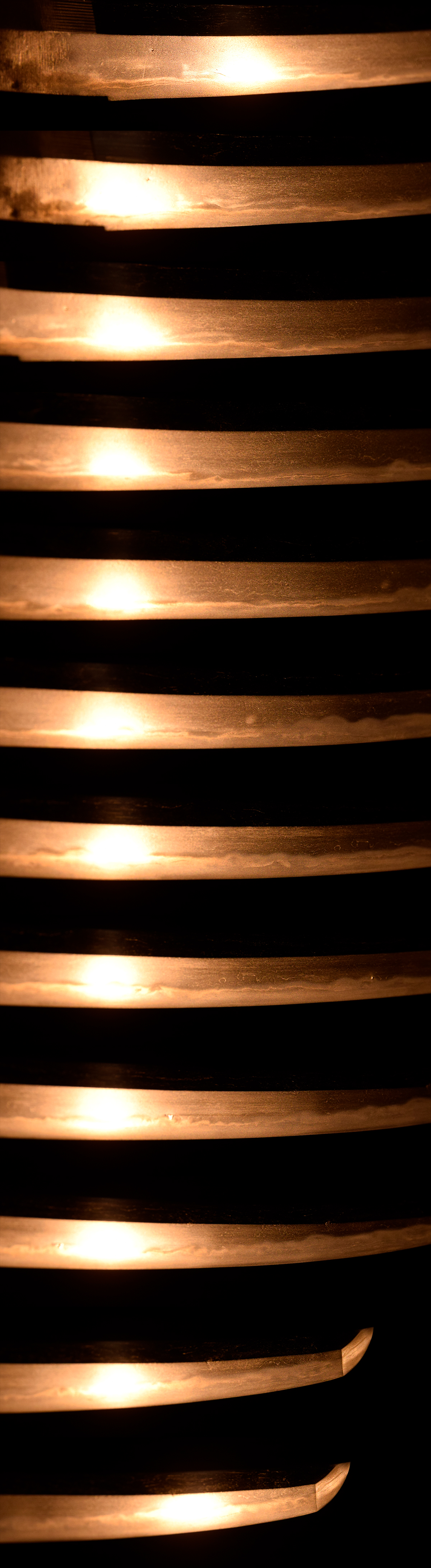
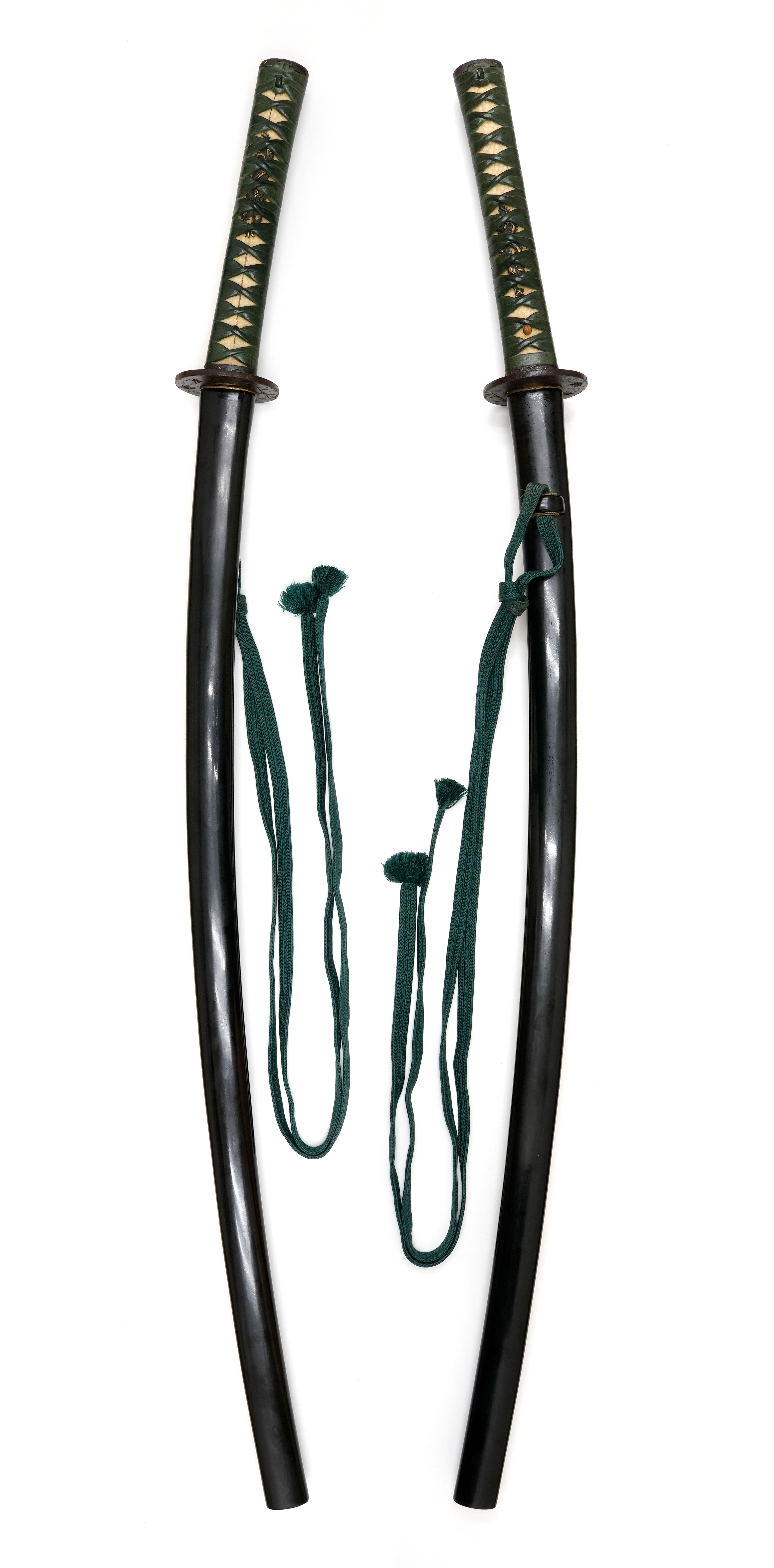
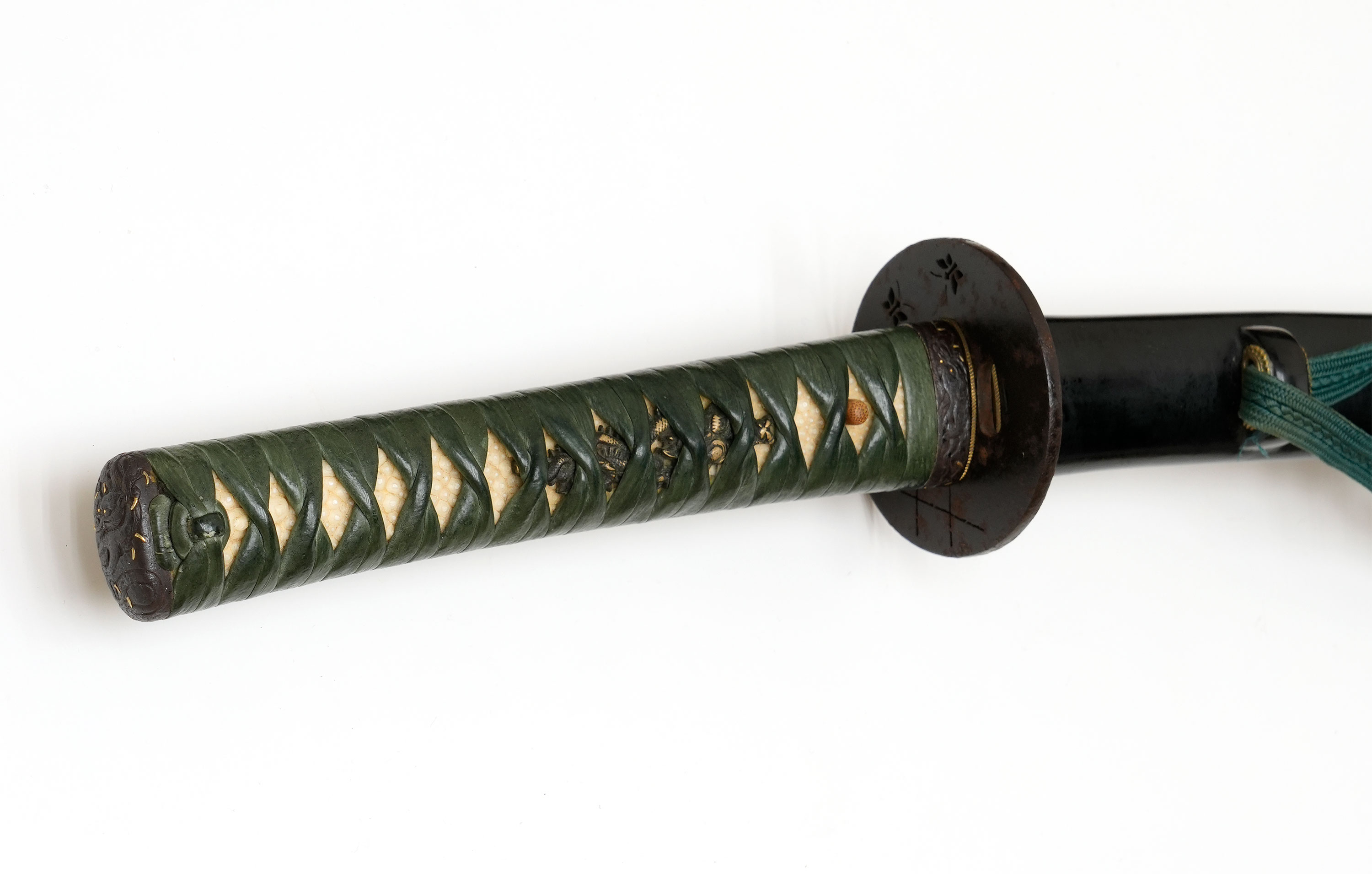
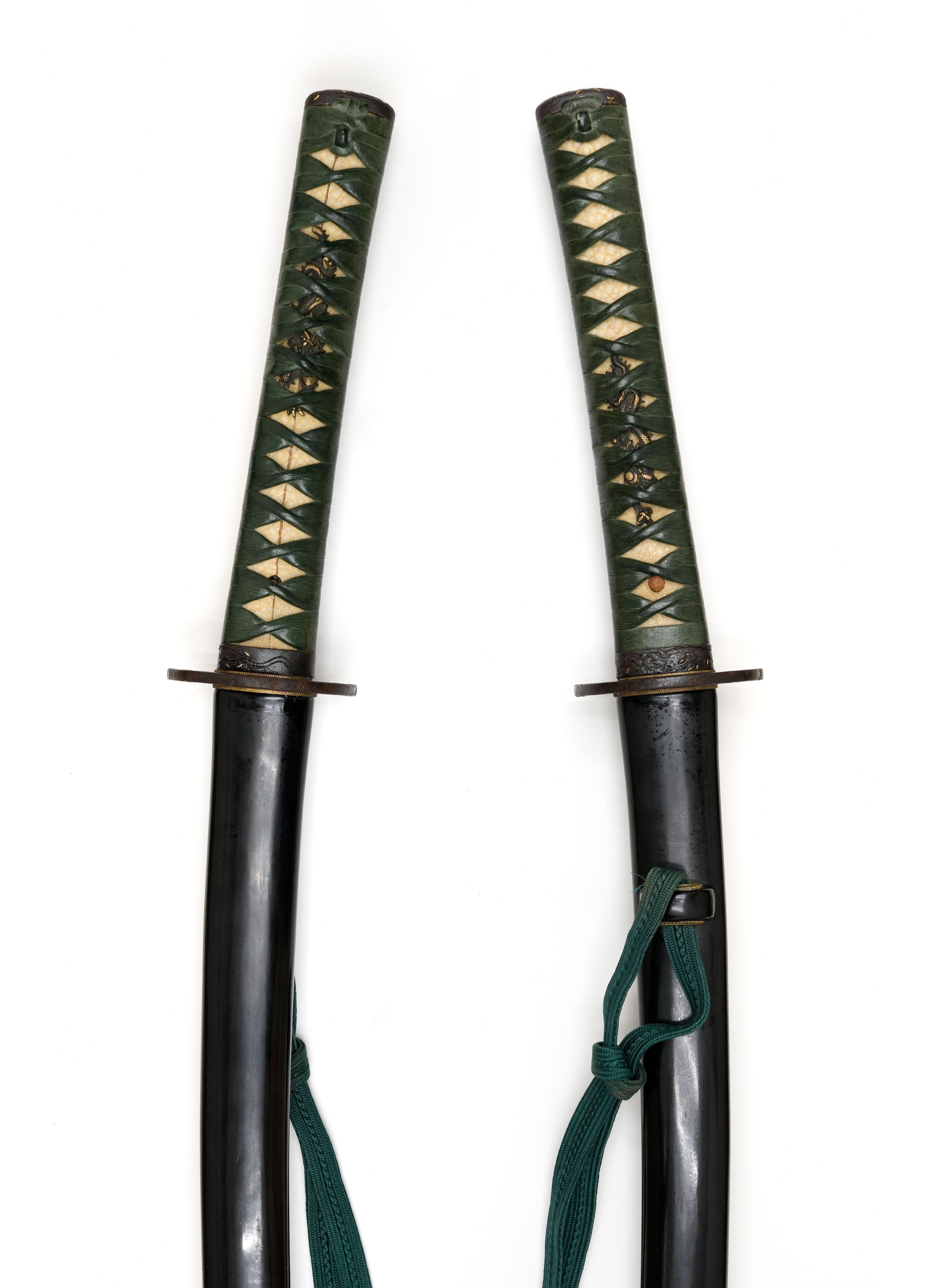
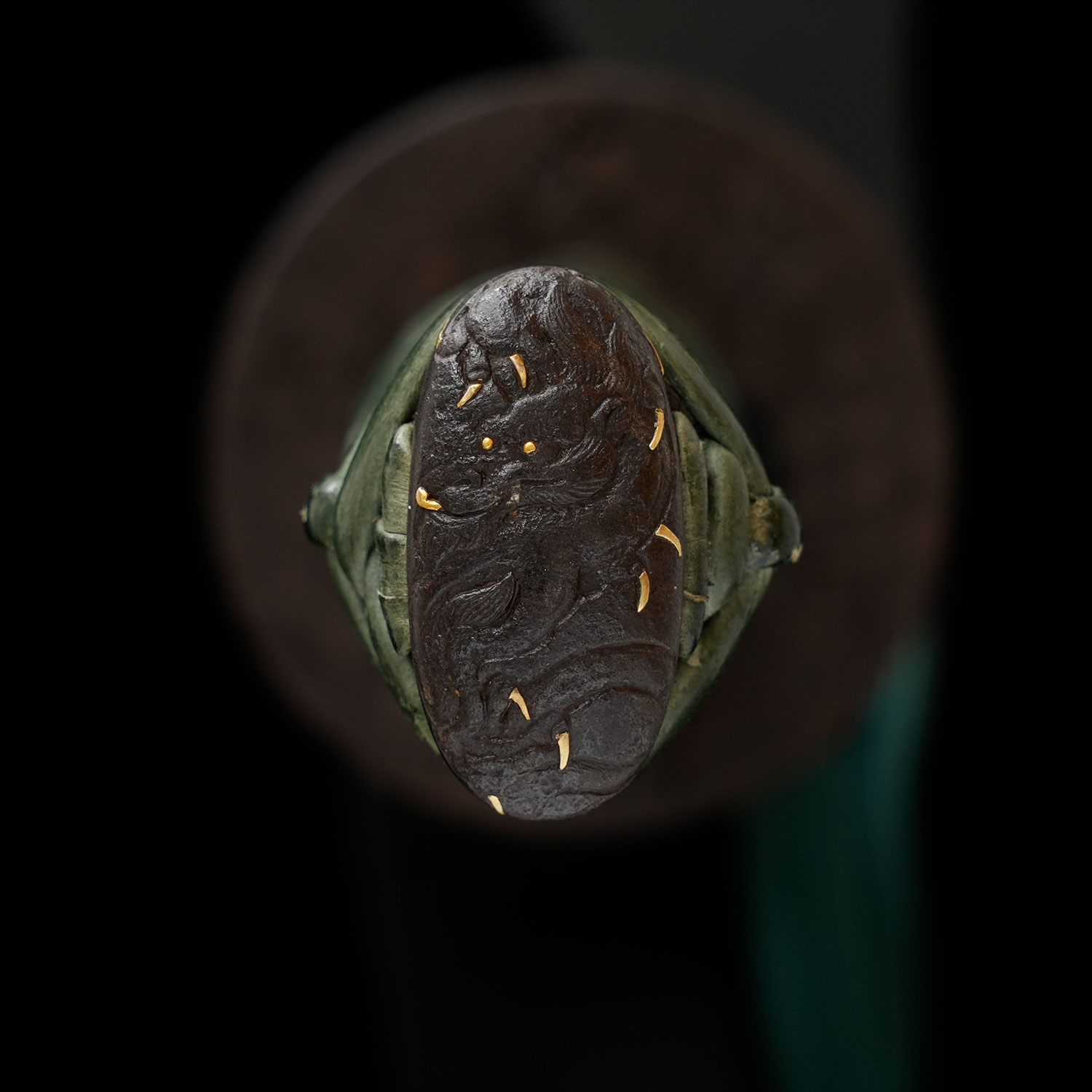
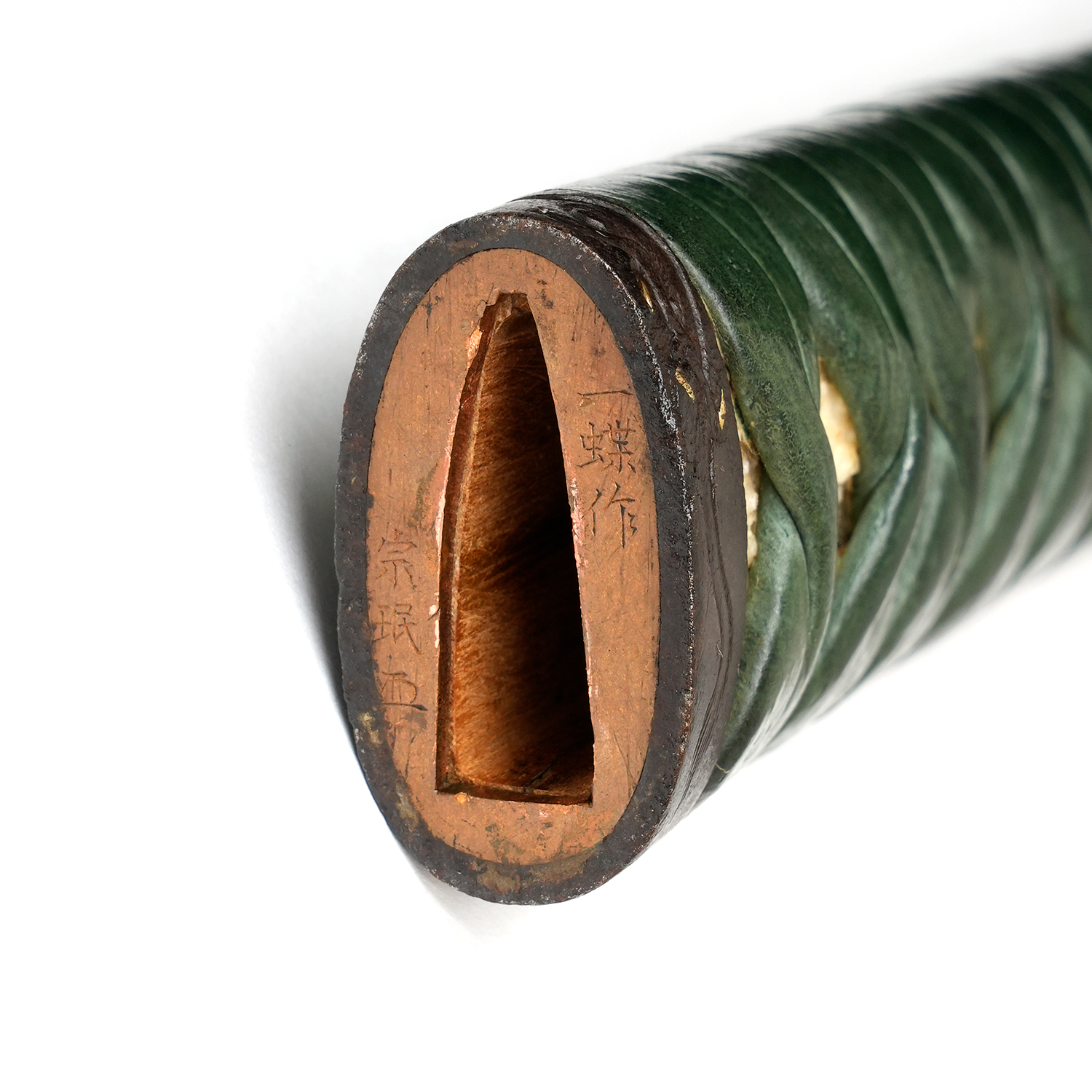
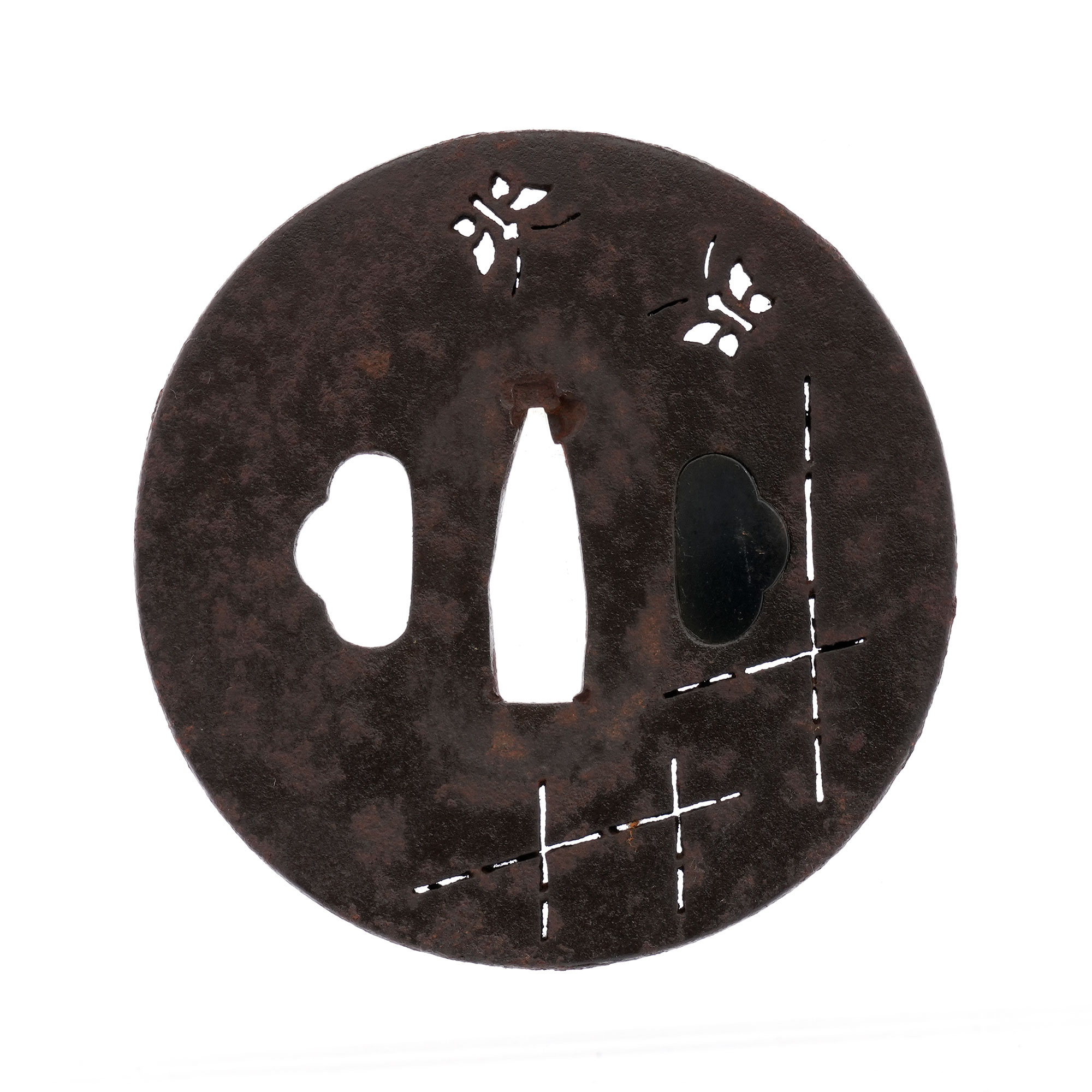
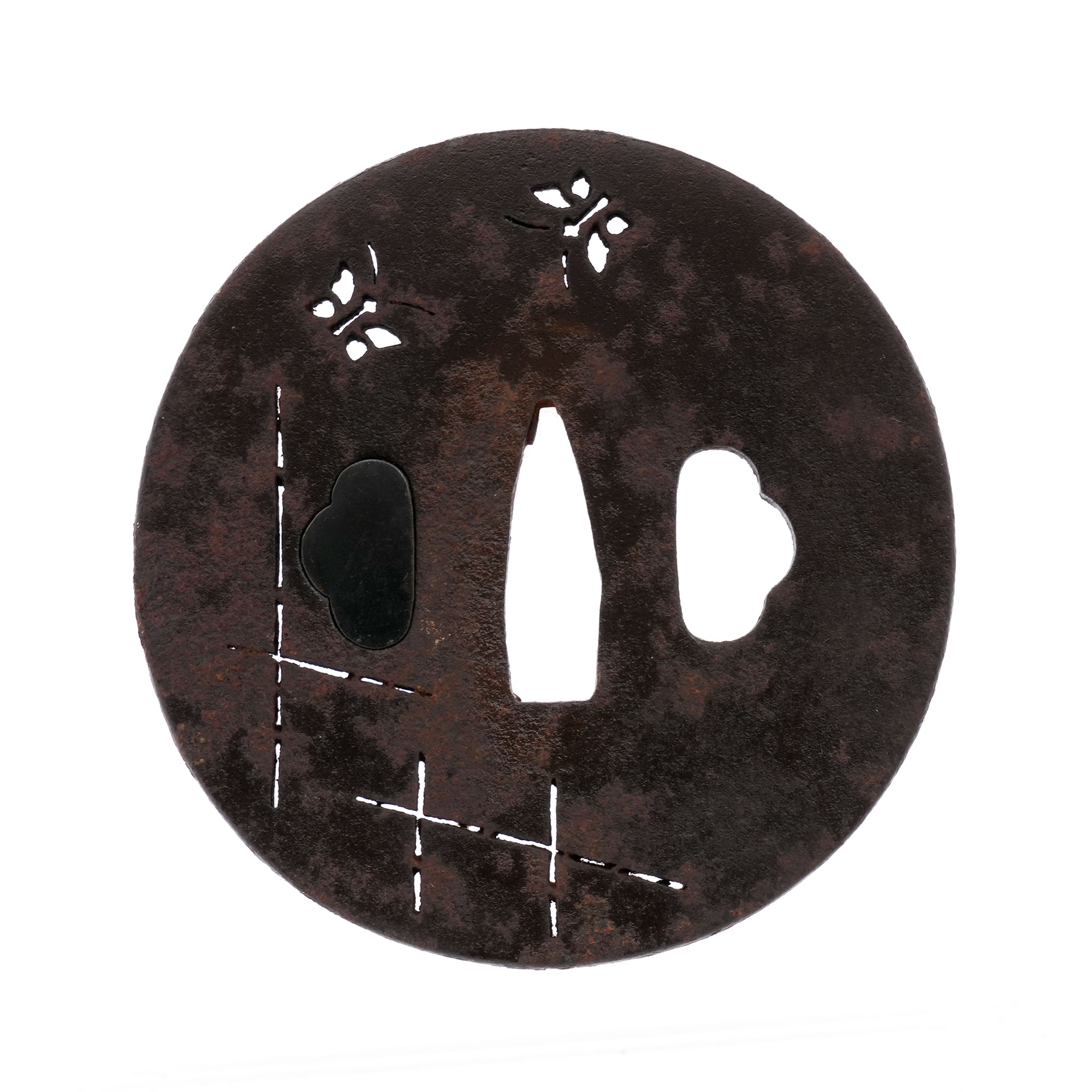
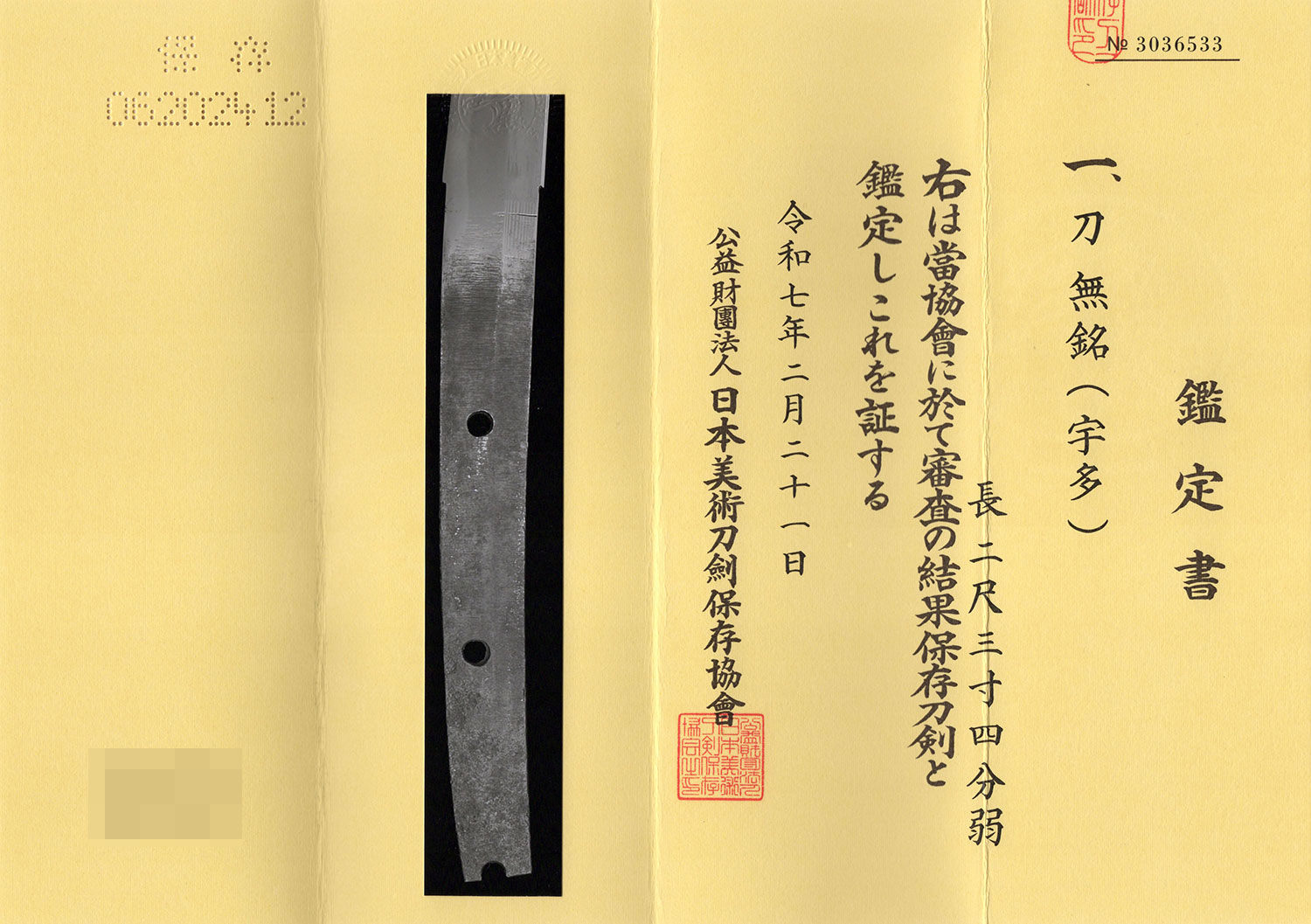
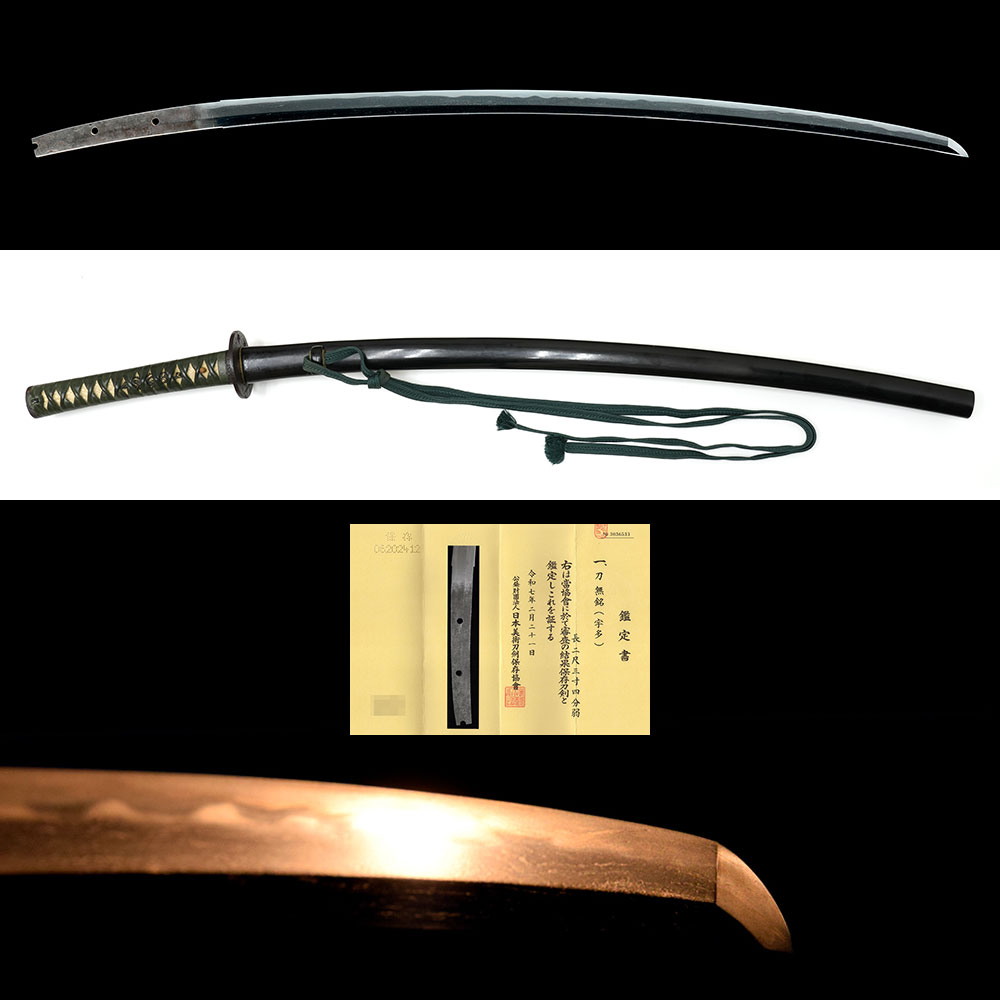
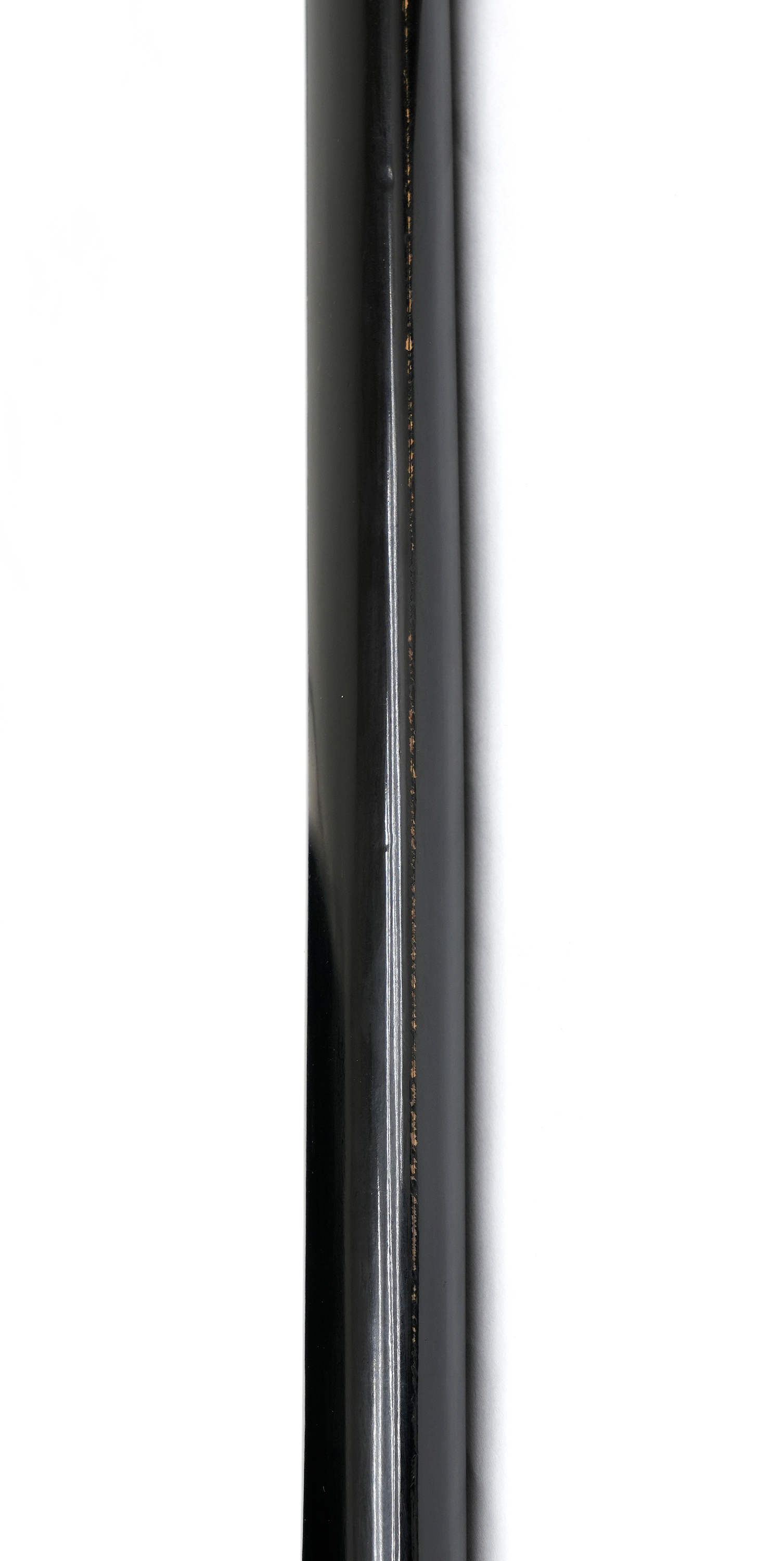
Nagasa 71.0 cm, Sori 2.6 cm Motohaba 26.75 mm, Motokasane 6.4 mm Monouchi-haba 20.3 mm, Monouchi-kasane 4.3 mm Yokote-position haba 15.7 mm, Matsubasaki-kasane 3.0 mm Bare blade weight 561 grams. Weight housed in koshirae without saya 857 grams. Early Muromachi (around Oei) The early years of Muromachi era Showa 61 May 15 Gunma Prefecture Registration Included: Hozon Token Kanteisho, silver and gold-plated tachi habaki, kuro-ro-nuri saya uchigatana koshirae The Uda school originated in the late Kamakura period with Ko-Nyudo Kunimitsu as the founder, and during the Nanbokucho period, master smiths such as Kunifusa, Kunimune, and Kunitsugu were active. It was a major school that flourished until the end of the Muromachi period with the same names succeeding through generations; among these, high-quality works dating no later than the Nanbokucho period are generally termed "Ko-Uda". As the Uda school originally hailed from Uda District in Yamato Province, many works clearly show the temperament of the Yamato-den, though they also left behind works that occasionally show the influence of the Soshu-den. This katana is an o-suriage blade exuding a grand dignity, and judging from the taihai, it was likely originally forged as a tachi. It conveys an archaic sugata to the present day. It still possesses funbari, the sori is deep, and the elegant form ending in a ko-kissaki allows one to imagine its original state as a tachi with koshi-zori exceeding a length of 2 shaku 5 sun. The jigane is itame-hada flowing in masame, becoming hadatachi with faint utsuri appearing and chikei entering; the hamon is suguha-cho mixed with notare, showing kuichigai-ba, niju-ba, and yubashiri in places, with kinsuji and inazuma shining clearly. Among these, the hataraki on the habuchi near the monouchi, which could be called either uchinoke or yubashiri, is a masterpiece, appearing powerfully and prominently as if gunome were tempered in reverse. The boshi is sugu with frequent hakikake becoming yakizume-fu, and the presence of the Yamato-den characteristic of the Uda school is certainly felt. On the certificate, it is given a kiwame as an Uda work of the Muromachi period, but from its workmanship and dignity, it is a gem with many highlights that I would like to view as a masterpiece of Ko-Uda from the late Nanbokucho period. Power hidden within tranquility, the soul of the craftsman echoing across eras. This single blade reflecting ancient beauty will surely add certain value to your collection. The accompanying koshirae is a magnificent tailoring that combines practicality and beauty. The tsuka is powerfully wrapped in leather with katatsumi-maki, achieving a grip that fits firmly in the hand. While giving a robust and practical impression, it also conveys an elegant composure. The saya is crafted with the area near the koiguchi slightly plump and the other parts finished slenderly, a design choice to reduce the burden on the hip bone. It is a construction where the craftsman's attentiveness shines, combining portability and functional beauty. Furthermore, as the koiguchi is robust and firm, I recommend storing it with the koiguchi slightly open rather than forcing it closed. No looseness or rattling is seen in the tsuka, and the tsuba-nari is slight. It is in good condition, maintaining a generally tightened impression. Martial and beauty, utility and grace. The koshirae, which harmonizes both aspects magnificently, further enhances the presence of the blade. At our shop, we have applied a serious museum-grade commercial togishi polish. Please fully enjoy the crisply standing yokote area and the clarity of the ji and ha that have just been polished.
NihontoWatchOffered by Toushin
This piece has sold
25 on the market
Get an email when new Uda School work hits the market.

Machine translation from the shop's Japanese · may contain errors ·
Wakimono · Etchu
25 pieces on the market now
Among the provincial lineages that carried the Yamato-den northward, the Uda school (宇多) of Etchu province holds a distinct place. Its origin lies in the late Kamakura period, when the monk-smith Kunimitsu, remembered as Ko-Nyudo Kunimitsu, migrated from Uda District in Yamato to Etchu around the close of the era. From this founder descended a long line of Kuni-named smiths; the reference registers carry Kunifusa and Kunimune as sons of the founder, Kunitsugu and Kunihisa among the generations that followed, the studio names recurring through the Oei, Hotoku, Bunmei and Tenbun eras down to the end of Muromachi and on into shinto times. The school worked the tanto (broad for its length, with little curvature) more readily than the tachi or uchigatana, and because its smiths individuate little, a signed Uda blade is read less as one hand than as the manner of its period. The school is identified first off the steel rather than the temper. The shared forging is an itame that runs and tends to stand, flowing toward masame and mixing mokume, with standing o-hada and ji-nie throughout; the steel turns whitish and at times blackish, so that a shirake-utsuri or faint bo-utsuri stands in the ji. Over this northern jigane the temper ranges from a chu-suguha opening shallowly into ko-notare and ko-midare to a vigorous gunome carrying pointed elements, ashi and yo entering, ko-nie well adhered along a tight nioiguchi. The Yamato activity of hotsure and kuichigai-ba names the old province along the habuchi, while kinsuji and sunagashi run through nearly every surviving blade.
From this base the corpus divides: a quieter Yamato-rooted suguha face, seen on the tanto; a Soshu-leaning midare face traced to Kunifusa's study under Etchu Norishige, in which the nie thickens and grows at times coarse with yubashiri and broadened yakihaba; and a refined register in which a compacted ko-itame gathers abundant ji-nie and a round, luminous nie scatters through the yakiba. Ko-Uda, the earlier work of the Nanbokucho and early Muromachi generations, reads cleaner and closer to its Yamato and Soshu models; the later Uda hands run coarser and more provincial in character. To kantei an Uda blade is to find its Yamato roots wearing a coarser northern character. The whitish, standing jigane with its masame tendency and shirake-utsuri returns the blade to the school when the temper alone might recall a Yamashiro or Soshu hand; a nie-laden example reads as Soshu at first glance and is brought home by the dark, standing steel and the nioiguchi that holds rather than glows. The best members close the distance to their models: Kunihisa, the Oei-era hand the published sources read against the founder, forged a ko-itame bright enough that the judges found his finest wakizashi and tanto all but mistakable for Rai Kunimitsu or Kunitsugu, while his standing itame and shirake-utsuri keep him within Uda. Kunimune and Kunitsugu carry the same two faces over the one northern steel, the dated and signed pieces (a Bunmei 11 katana, a Bunmei 17 yari) valued as research material for the school as much as for their make. Signed Uda blades are uncommon, so the school's standing rests heavily on mumei attributions read by jigane and temper. Provenance tends toward long, settled holding, with designated work resting in shrines and museums, and some recorded in Honma's inventory of the Imperial collection, rather than circulating, so that a signed Uda piece comes to a private collector only from time to time and with patience, a clear window onto how the Yamato tradition was carried into the northern provinces. Learn more →
| Smith | Era | Designated |
|---|---|---|
| Kunihisa國久 | 1394-1428 | 10 |
| Kunimune國宗 | 1429-1479 | 5 |
| Tomotsugu友次 | 1381-1384 | 3 |
| Kunitsugu國次 | 1469-1487 | 3 |
| Kunifusa國房 | 1455-1457 | 3 |
The Muromachi period (1392 to 1573)
After the Ōnin War broke the Ashikaga order, a century of Sengoku warfare armed nearly every province in Japan. The era rewards a discriminating eye: routine work exists in quantity, and beside it stand custom blades of the first rank.
Certifies a genuine blade worth preserving: a signature confirmed correct, or, if unsigned, an era, province, and school that the NBTHK can reliably identify.
The NBTHK (Nihon Bijutsu Tōken Hozon Kyōkai, the Society for the Preservation of Japanese Art Swords) is a public-interest incorporated foundation founded in 1948 and supervised by Japan’s Agency for Cultural Affairs (Bunkachō); it is based at the Japanese Sword Museum in Tokyo. Its expert panels physically examine each submitted work (shinsa) and issue a certificate (kanteishō) ranking it by artistic and historical merit. NBTHK papers are the most widely recognized standard of authentication for Japanese swords and fittings.
NBTHK official siteAs a rule we do not accept returns, except when we have sent a different item from the one ordered or when there is a significant discrepancy between the description and the item. If you wish to return an item, please contact us within 3 days of its arrival and then send it back.