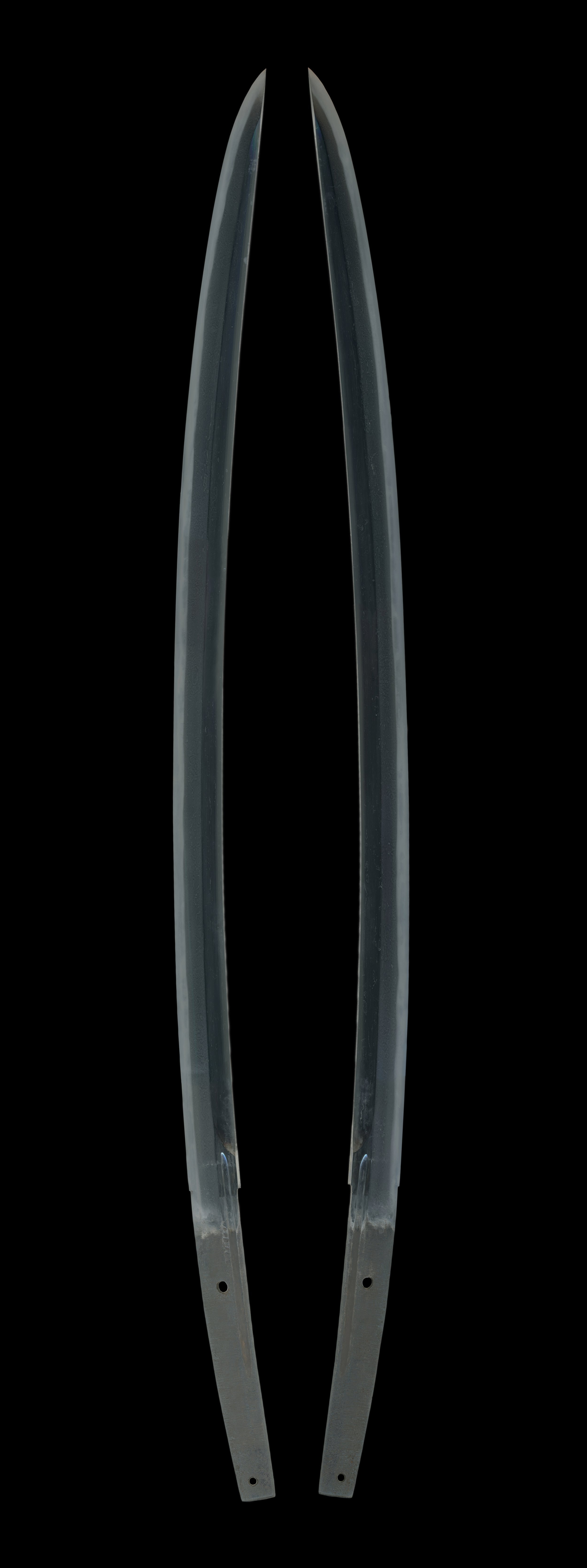
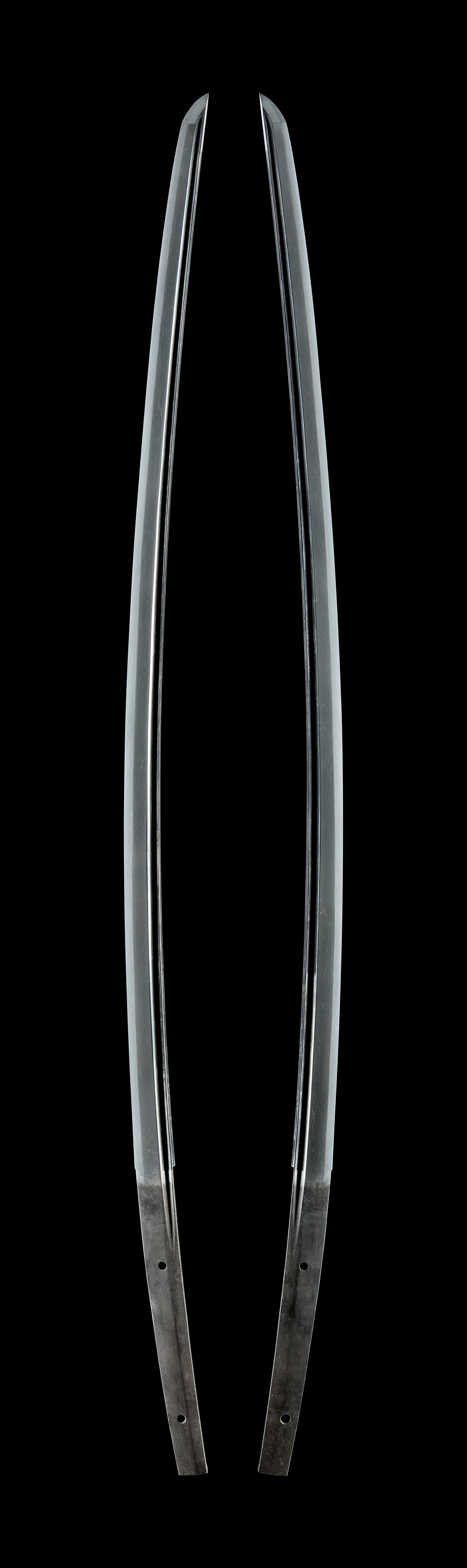
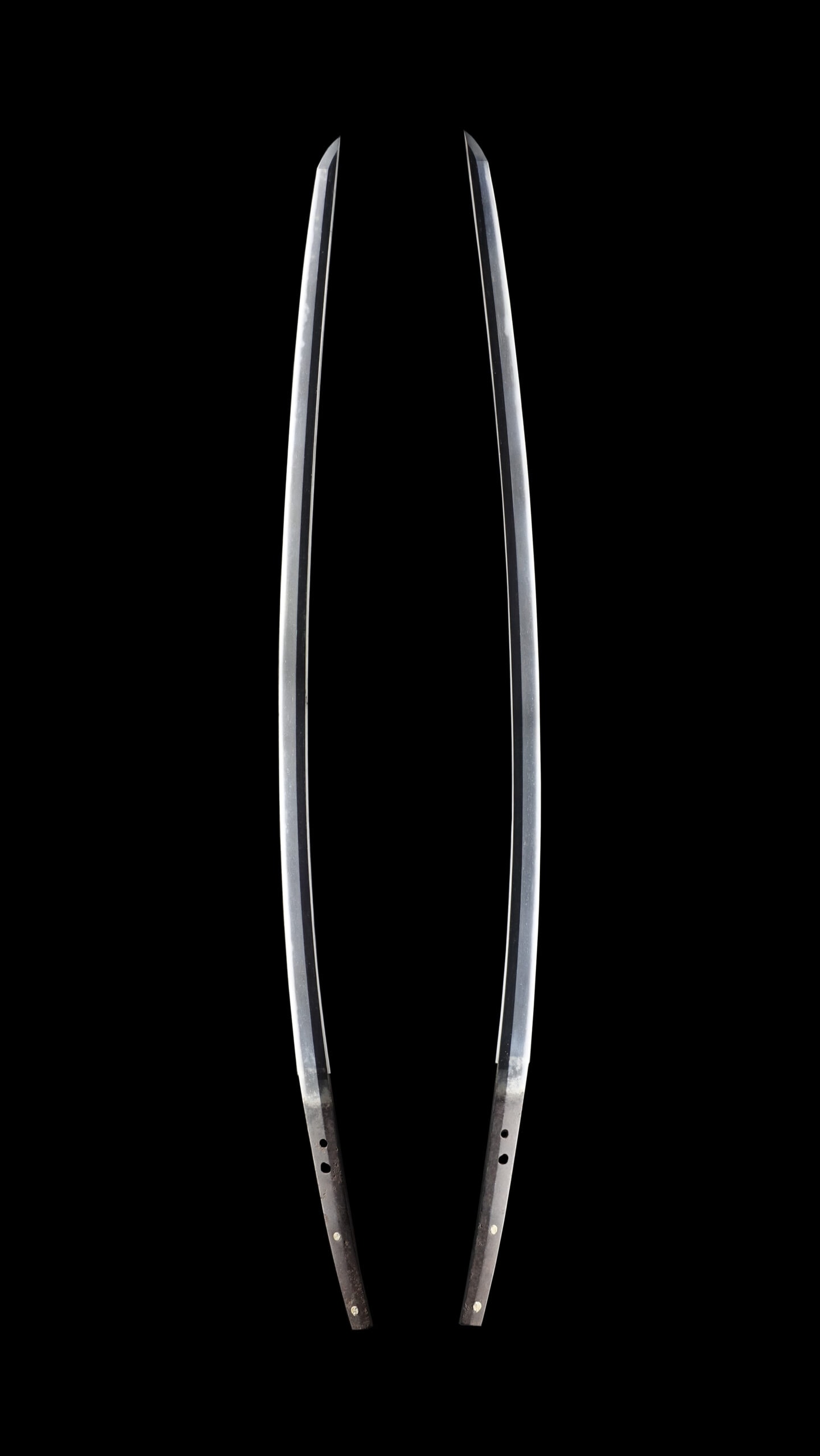
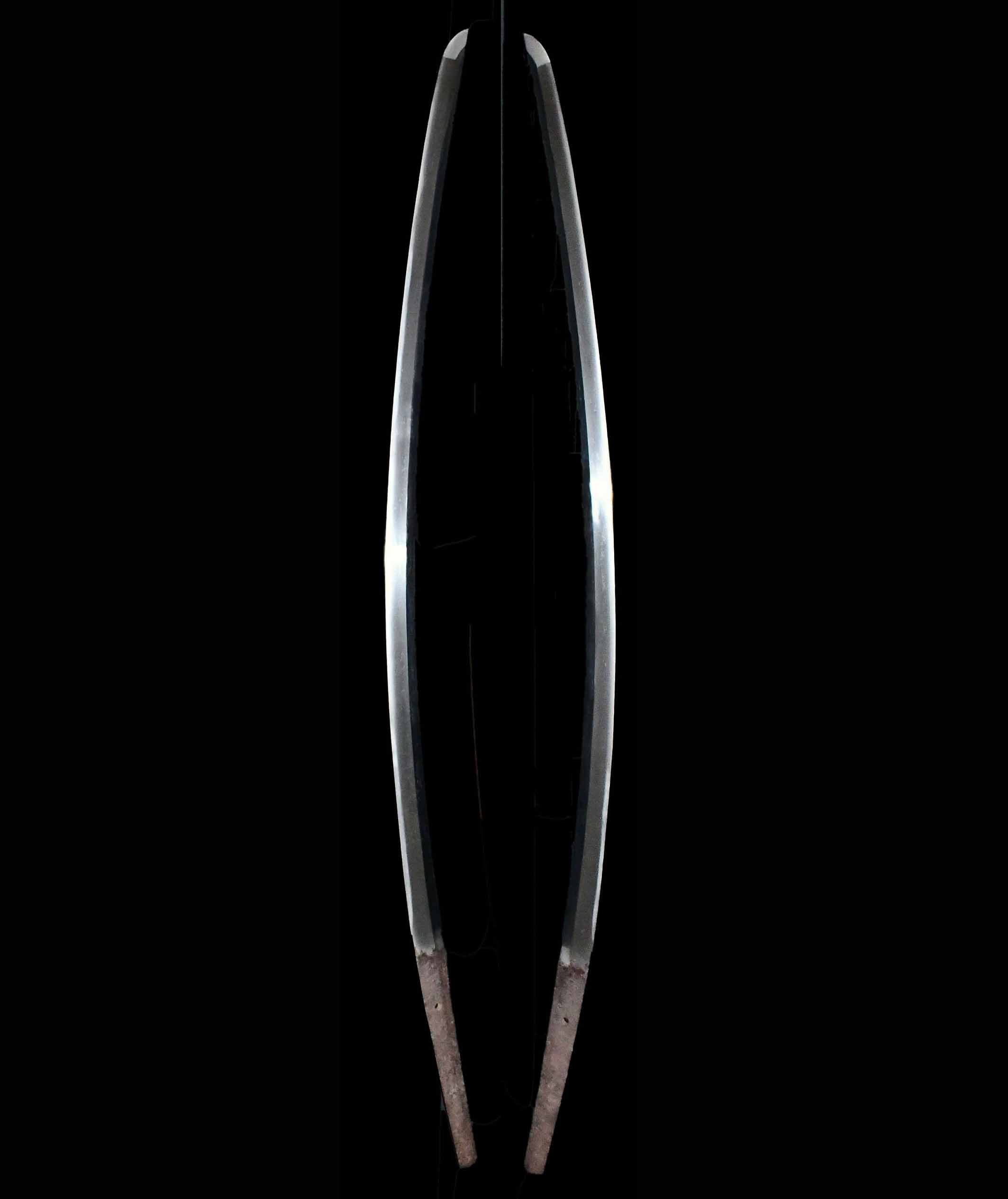
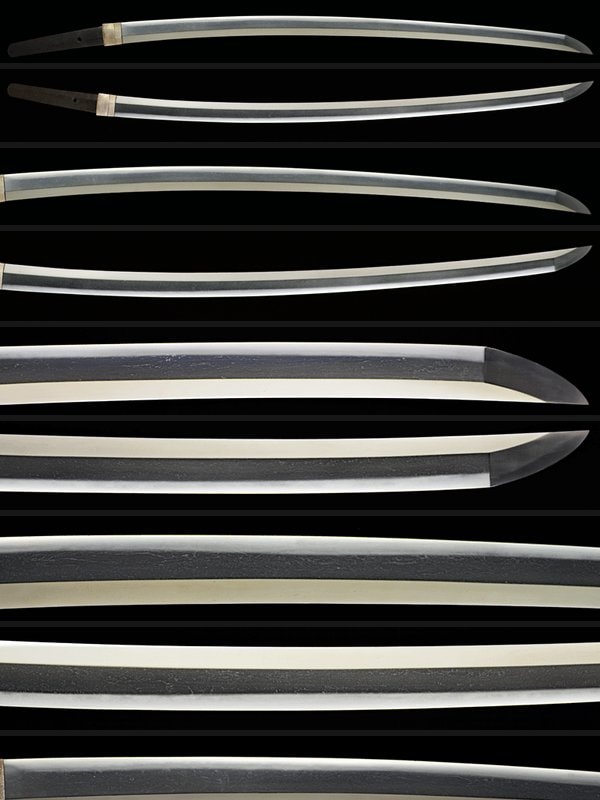
One signed Uda Kunimune carries a Bunmei 11 date of 1479 cut on the reverse of an essentially tang, and that single dated blade fixes the smith his name records best: a maker of the Uda school working in the middle of the period. The published sources hold the first-generation Kunimune to be a son of Ko-Nyūdō Kunimitsu, the founder who carried the line north from Uda District in Yamato to around the Bunpō era at the close of the period, and the younger brother of Kunifusa. The name then continued through several generations from the period down through the late and on into the era, so that a signed Uda Kunimune is read less as one hand than as the school manner of a period. Because the school's smiths individuate little, the published record appraises the surviving signed work by shape and the character of and rather than by an individual signature, placing the dated and dateable pieces around the Bunmei era when the Uda school flourished.
His work is read in two faces over one . The quieter is the Yamato root the school never lost, seen most plainly on a signed in with customary and a carving. There the is a with mixing in toward the edge, adhering and entering, and over it the temper is a with the somewhat tight, adhering, the boundary near the tending toward , the running straight into a . The published sources read this register as a clear statement of origin, observing that the forging in which flowing mingles with the grain vividly expresses the Yamato tradition and that the blade as a whole displays the distinctive character of Uda work.
The more active face is the school's , the manner the published sources date to around the Bunmei era from the shape and the character of and . Over an mixed at times with , flowing and standing rather than lying flat, the temper is a broken by , , -like elements and a pointed tendency, with and entering well, adhering and running frequently. Here and there slight and appear, and on the widest blade the broadens until from the middle upward it reaches the and around the shows an overall -like temper, the a vigorous in and carrying , tempered down long into the tang. On the calmer pieces that turnback becomes -like and shows . The published sources call one such a fine example in which the is bright and adheres well, demonstrating not only the maker's style but the distinctive character of the whole Uda school.
Under both faces lies the one the appraisal turns on. His is an that flows and tends to stand, mixing in toward the edge, adhering and intermingling, and it is this northern, Yamato-derived steel that returns an Uda blade to its school when the temper alone might recall a Yamashiro or hand. The carving on his blades extends the Yamato temperament: the dated bears long set one above another with a below on the , and three with a in kaki-nagashi on the , work the published sources judge splendid. The signatures are a four-character cut with a fine or somewhat thick chisel below the , and the tangs are or only very slightly , the feature that makes these blades documents as much as swords.
What sets his work apart is read through his own grounded traits rather than through any borrowed comparison. The flowing, standing with its mixed , the frequent , and the carrying pointed elements and are the marks the published record names as the Uda character, against which his single stands as the quiet Yamato counterpart. The published sources are explicit that this is a school appraisal: they record the founder's migration from Yamato to , the descent of Kunimune from Kunimitsu and his place beside Kunifusa, and the continuation of the name through several generations, and they assign the dated and dateable signed pieces to the Bunmei era on the evidence of shape and workmanship. Across the corpus the resemblance to the -leaning Uda manner of the generations is present in the activity, while the brightness of the and the standing northern keep the verdict with the Uda school.
The whole of Kunimune's official record is held in the tier, where four signed blades survive across , , and , with Fujishiro rating him Jō- and the Tōkō Taikan placing him at 300. He has no National Treasures and no Important Cultural Properties, so the honest account is of a school name carried by -ranked work and by its value as research material rather than of a roll-call of famous swords. The published sources single out the dated for exactly this, noting that signed of this period are few and that the blade is therefore valuable source material, and they read the dated as an important document for research into the smith and the school, sound in both and . Two of his blades are recorded in the Imperial Collection, the most distinguished provenance his work carries. For a private collector the signed Uda Kunimune pieces in the tier come to market only from time to time and with patience, a maker whose blades reward the student of how the Yamato tradition was carried into the northern provinces more than the chaser of a celebrated name.