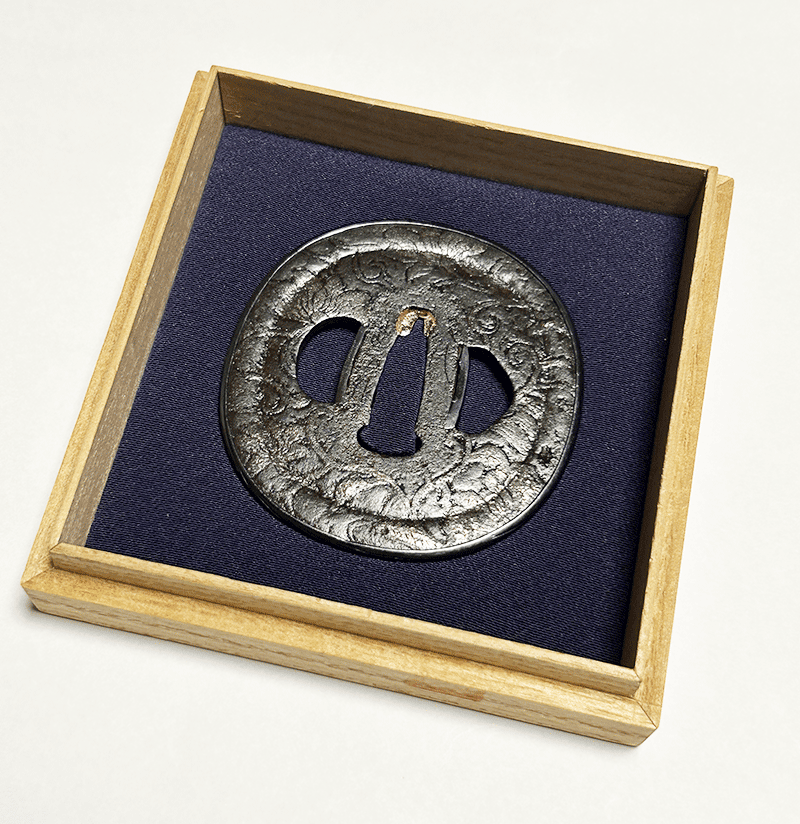
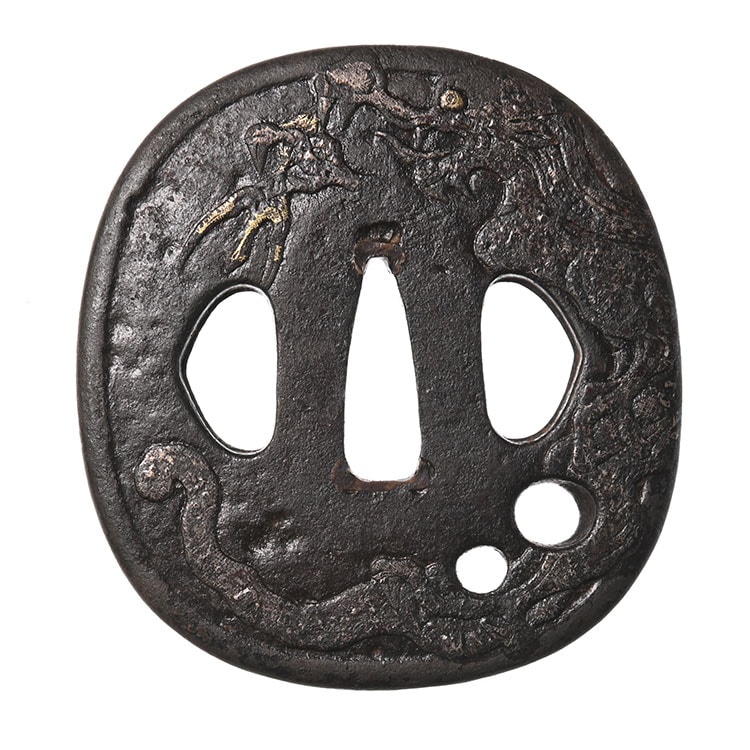
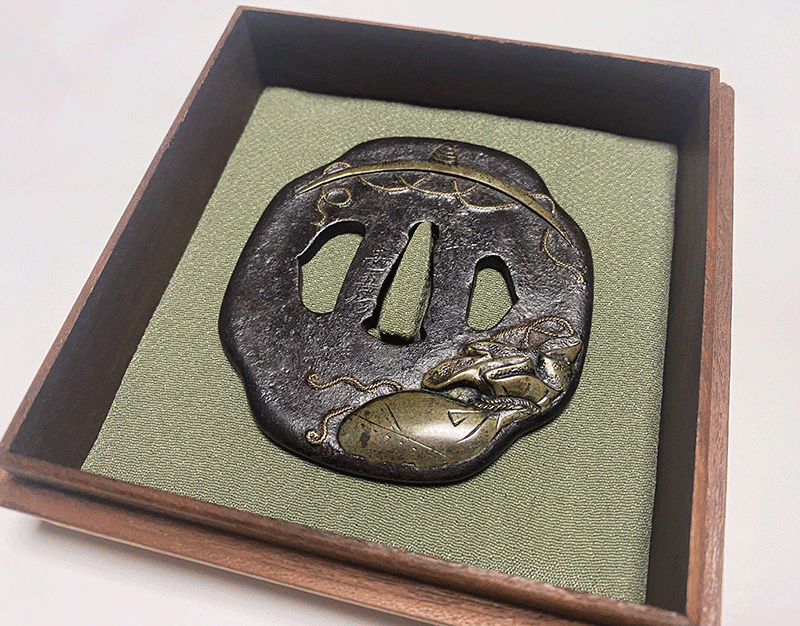
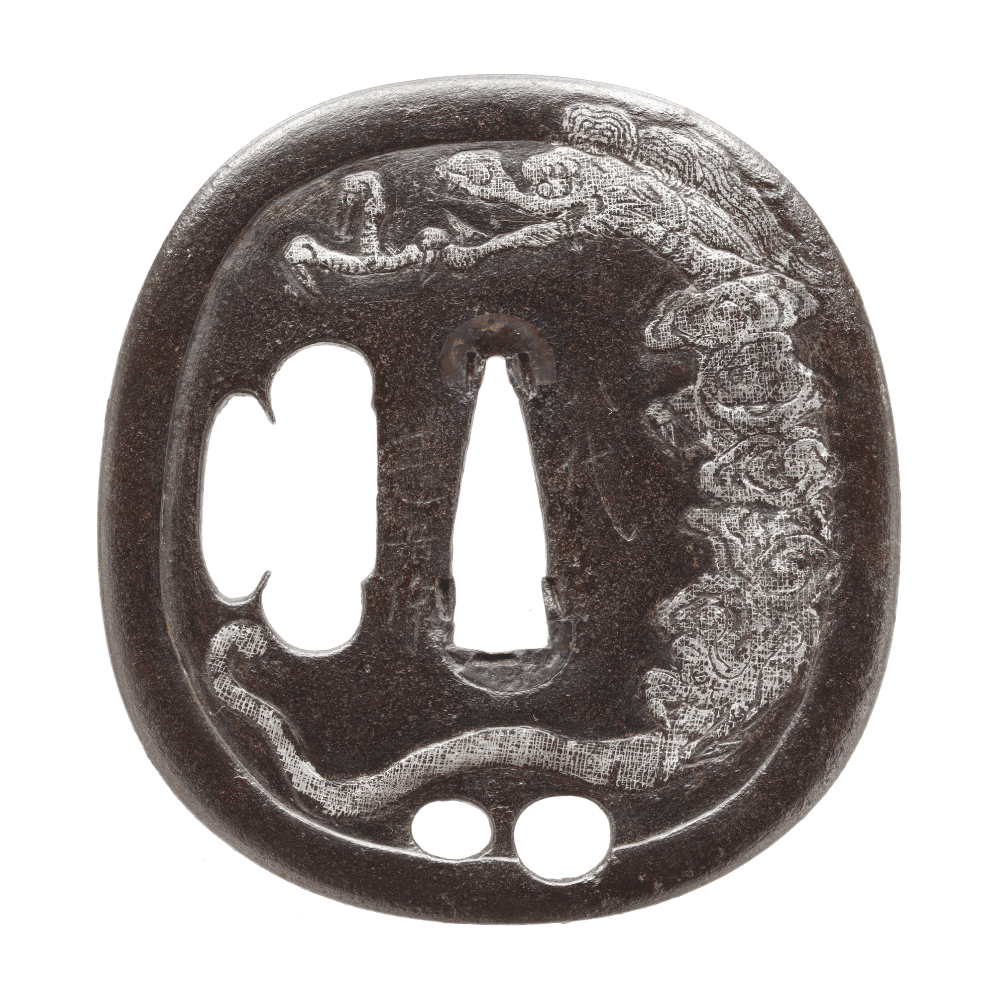
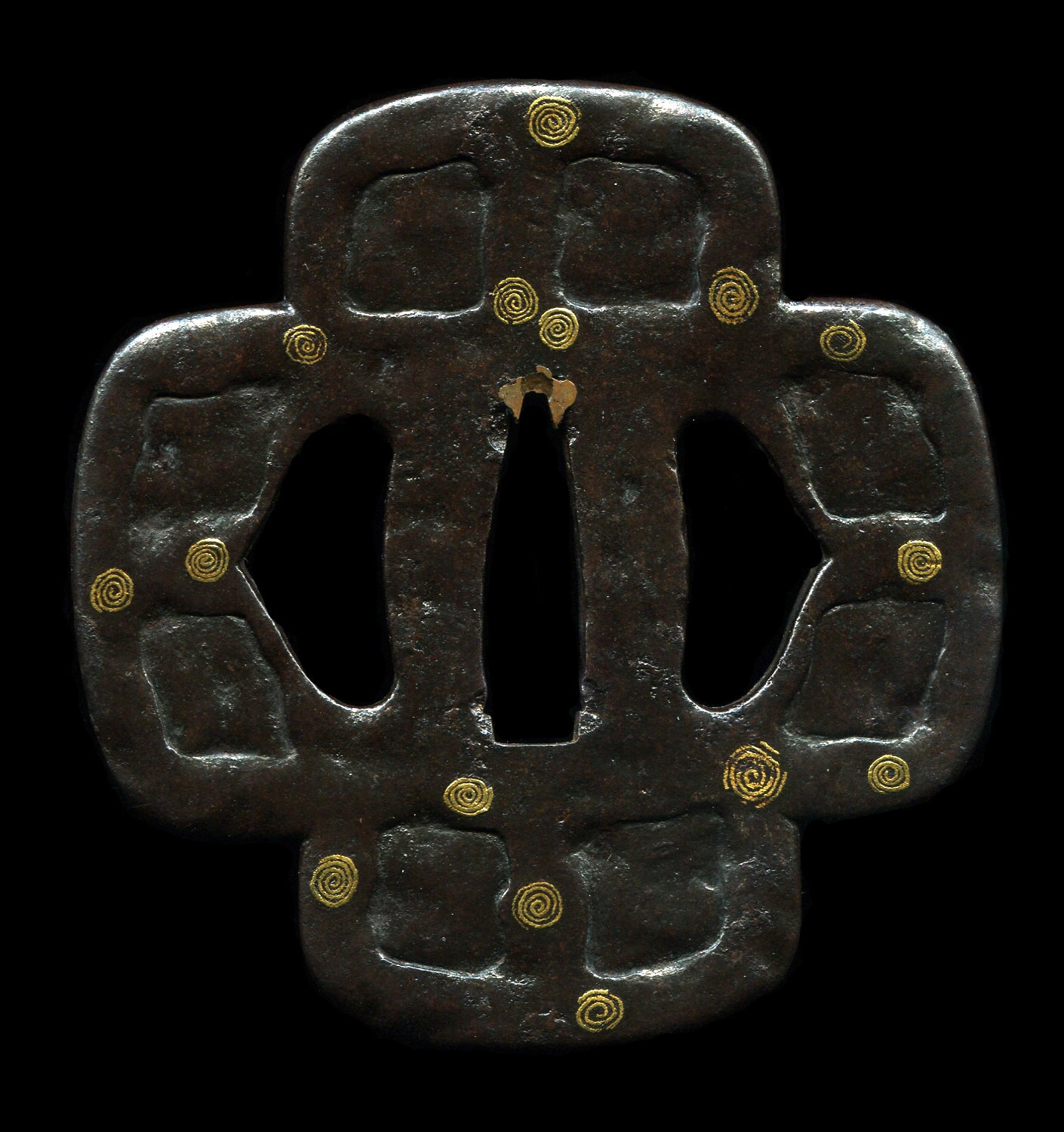
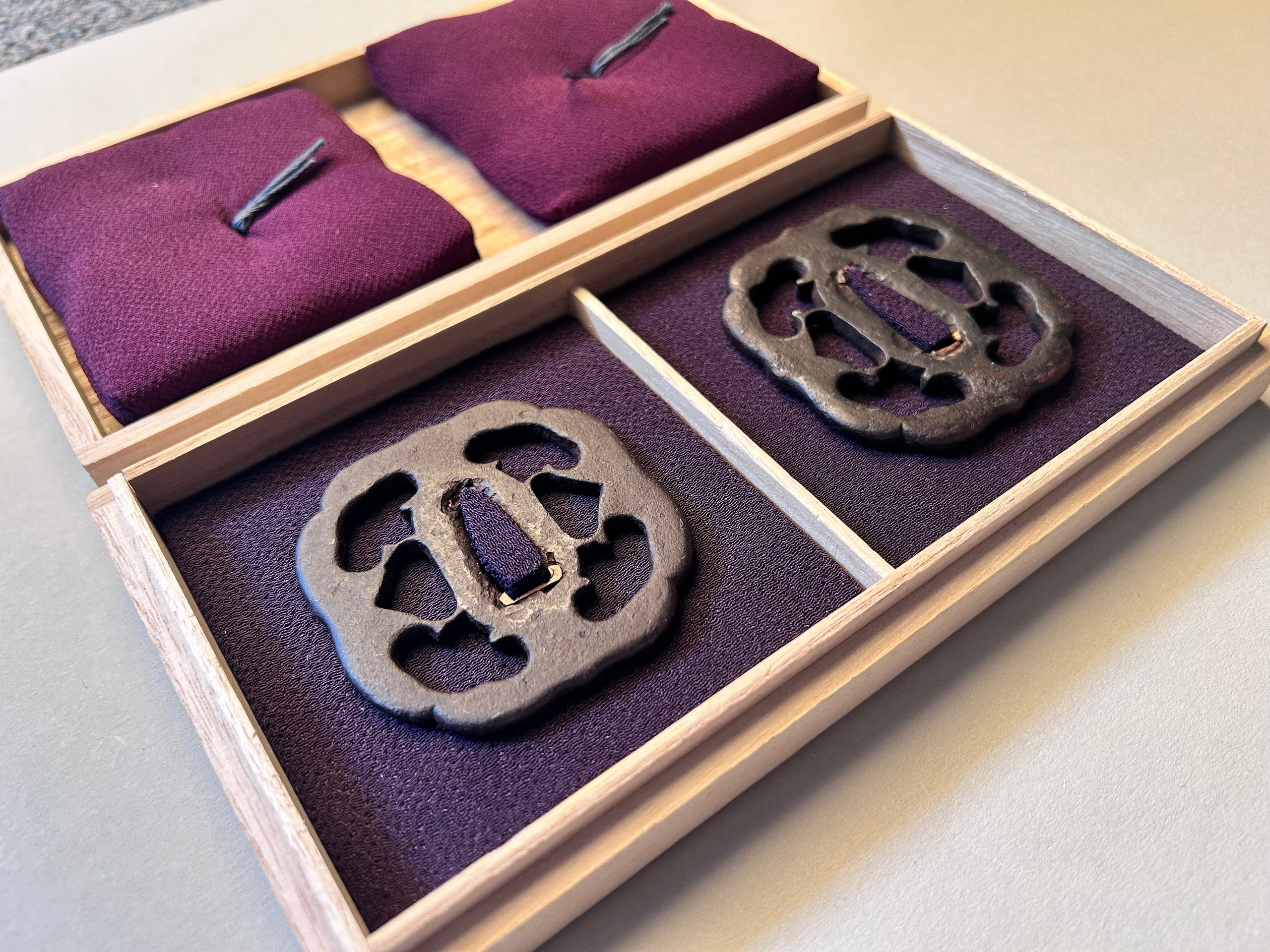
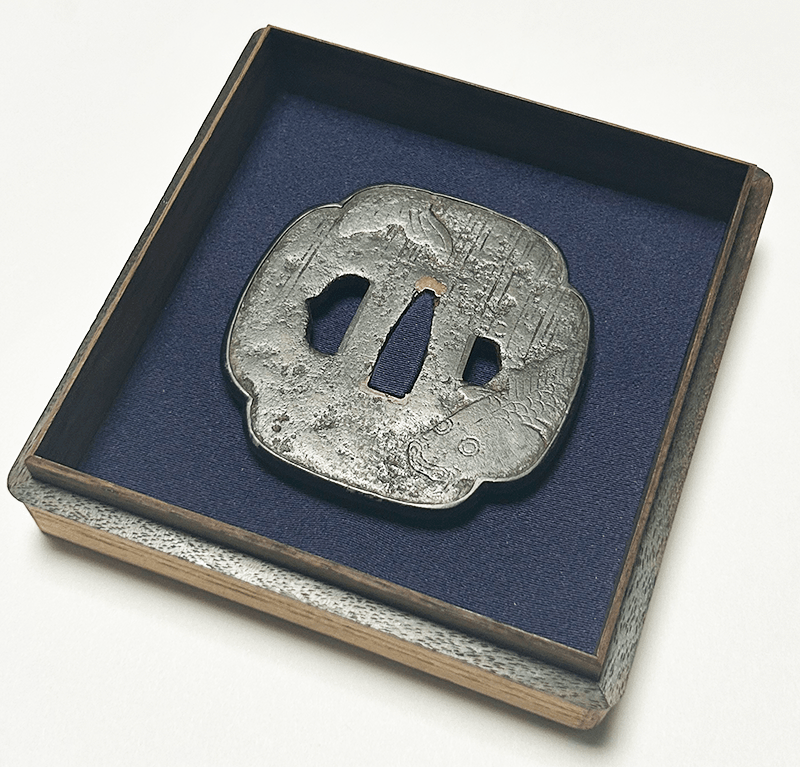
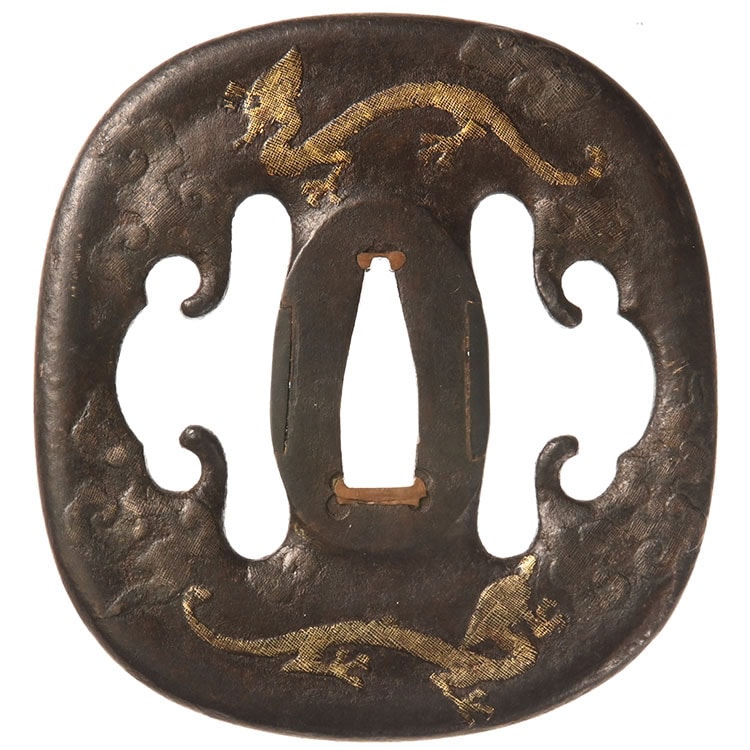
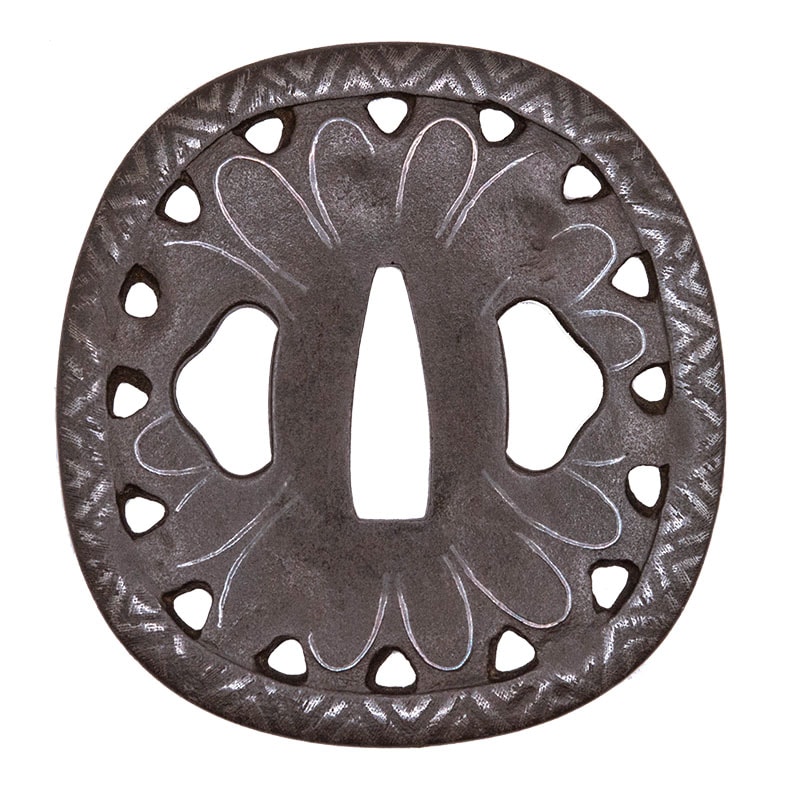
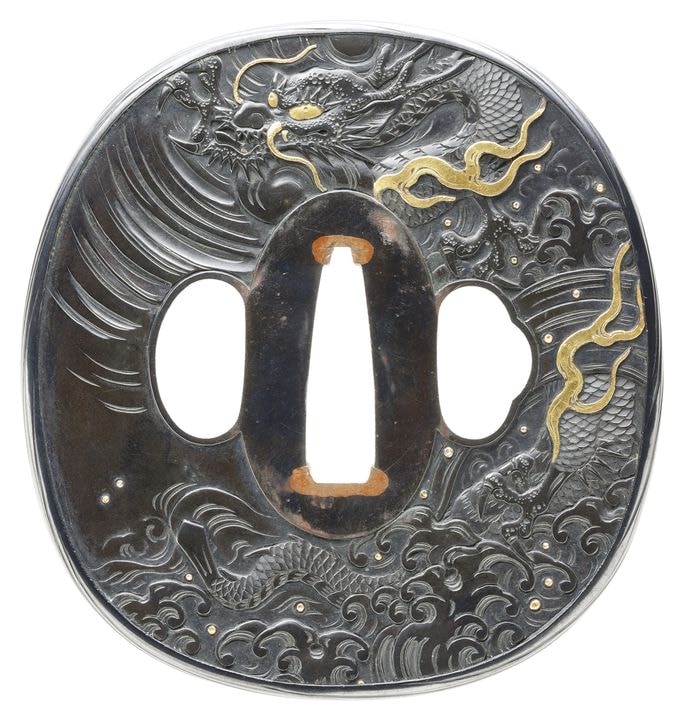
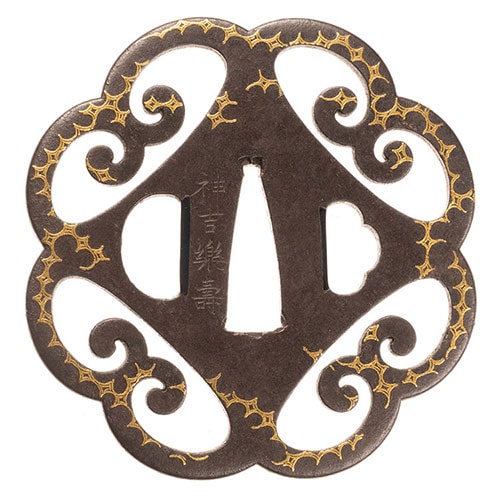
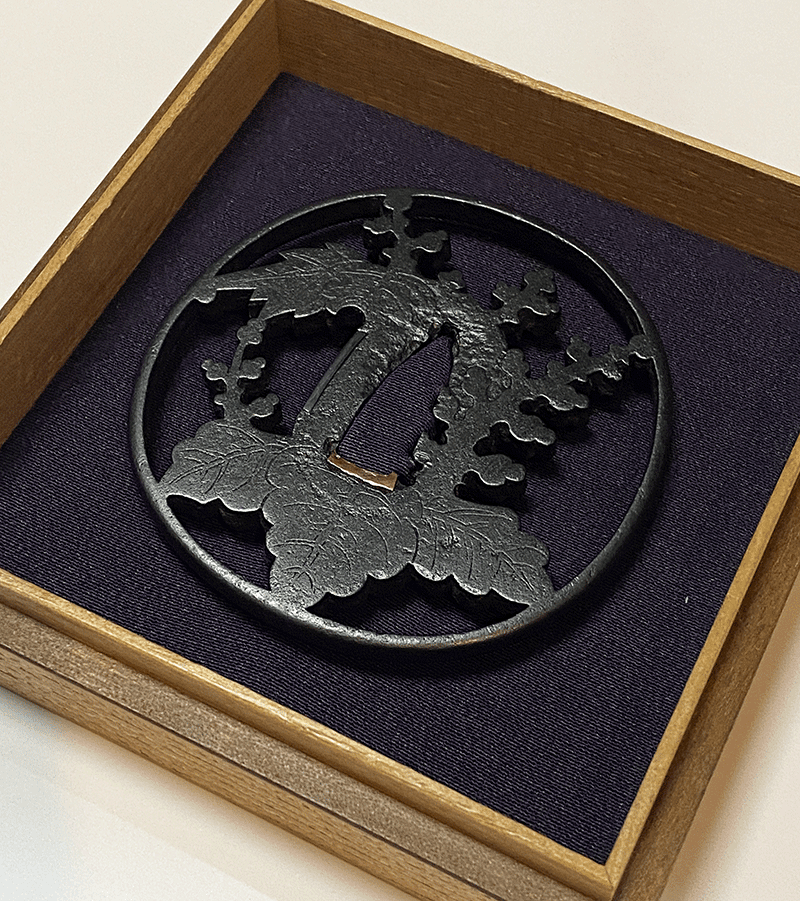
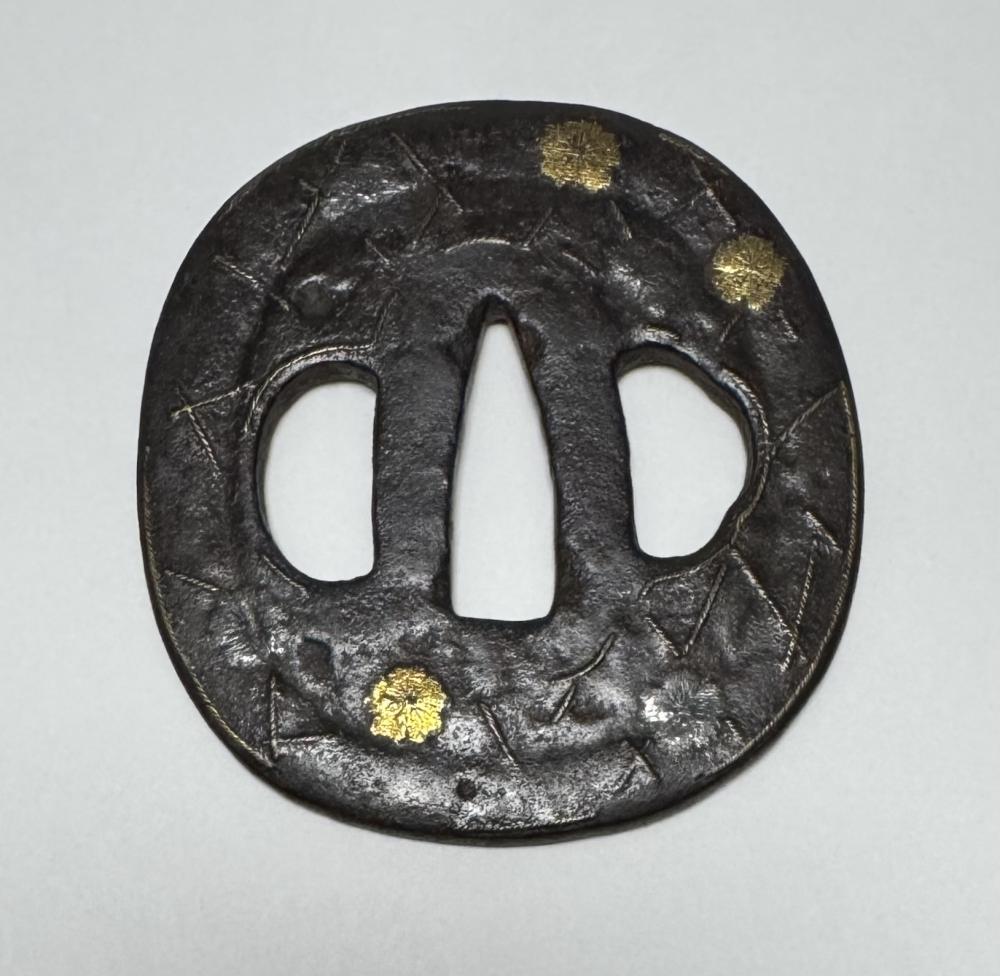
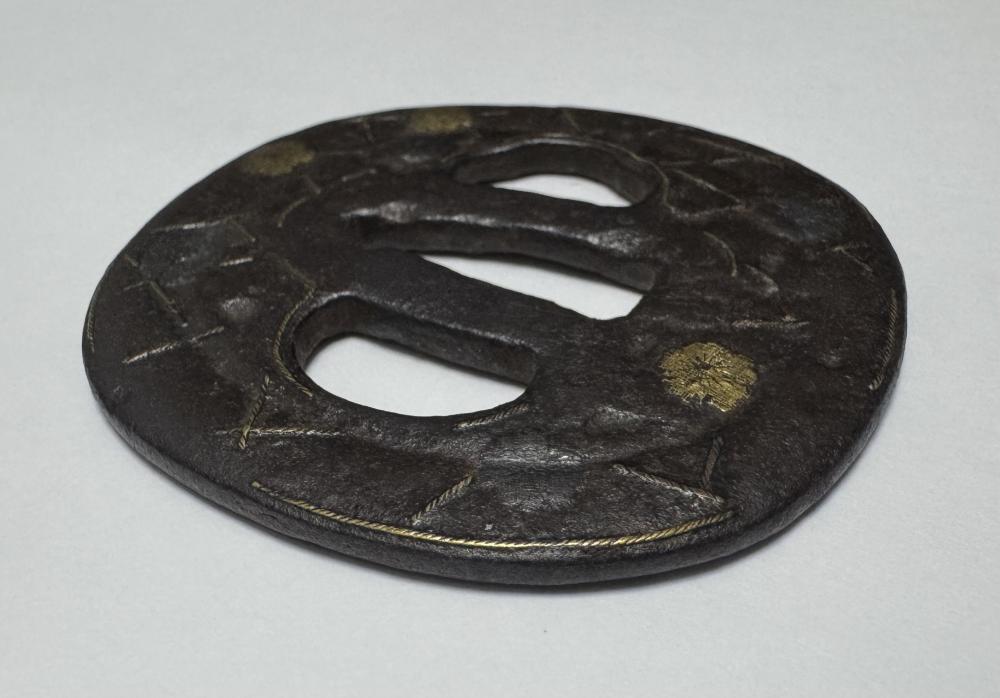
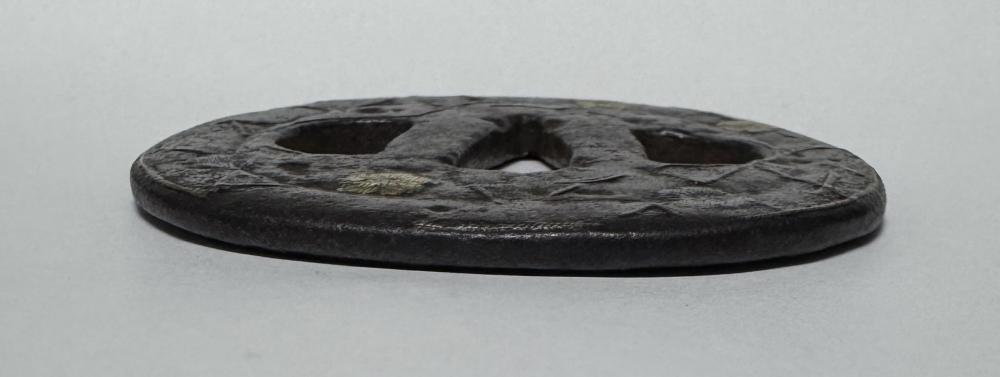
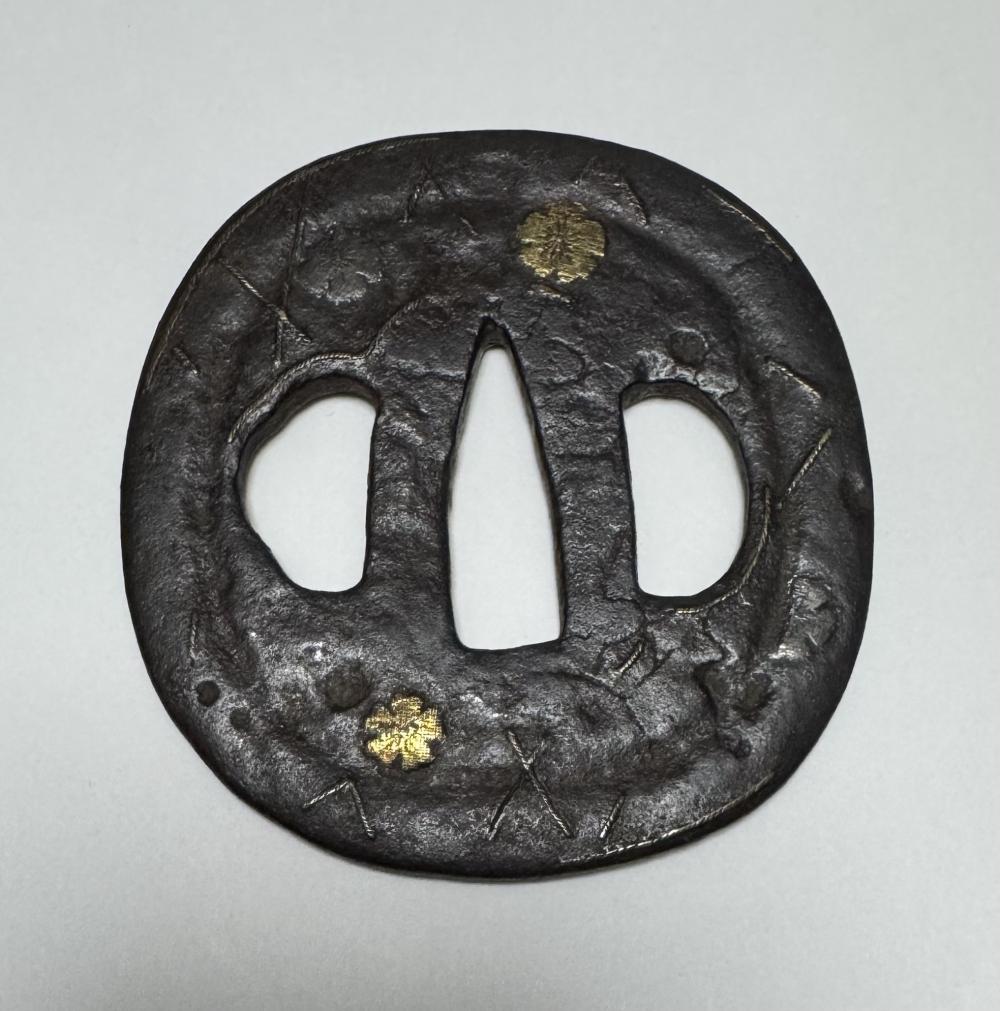
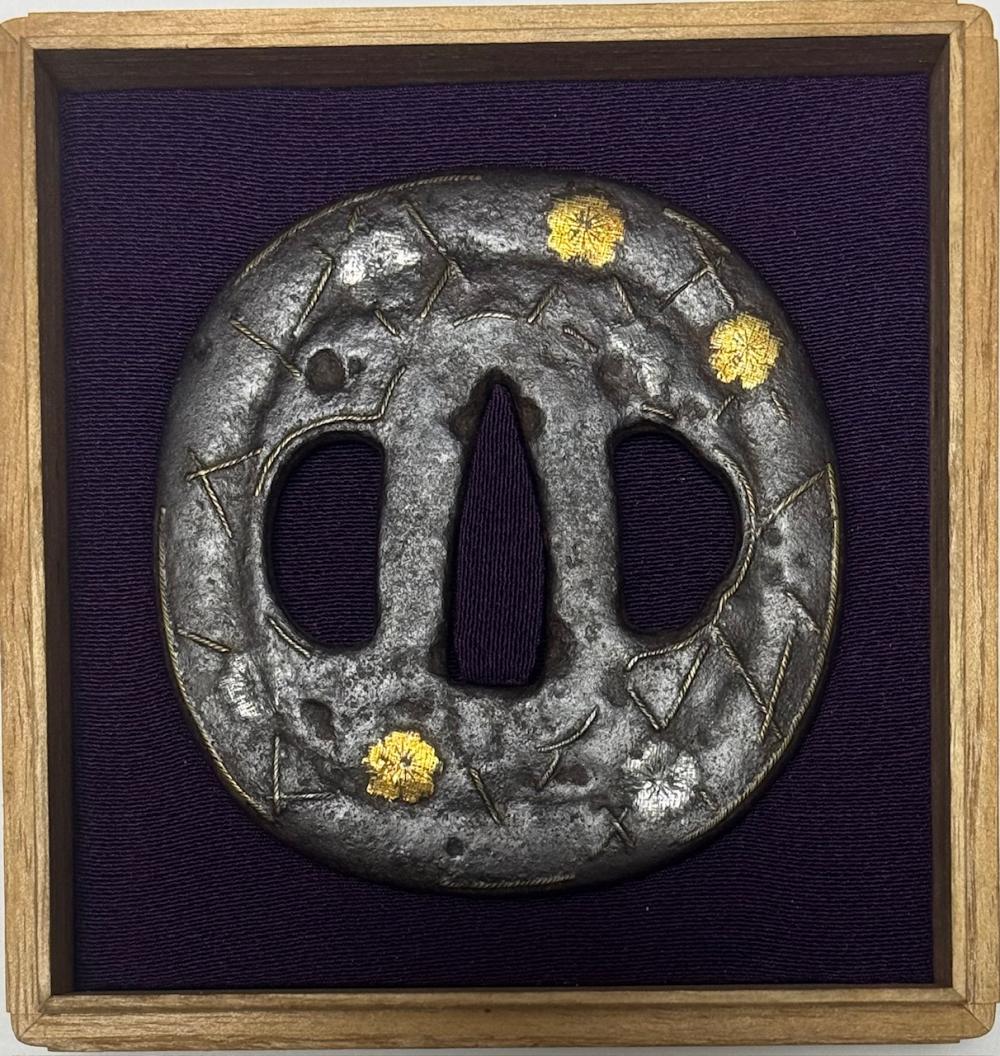
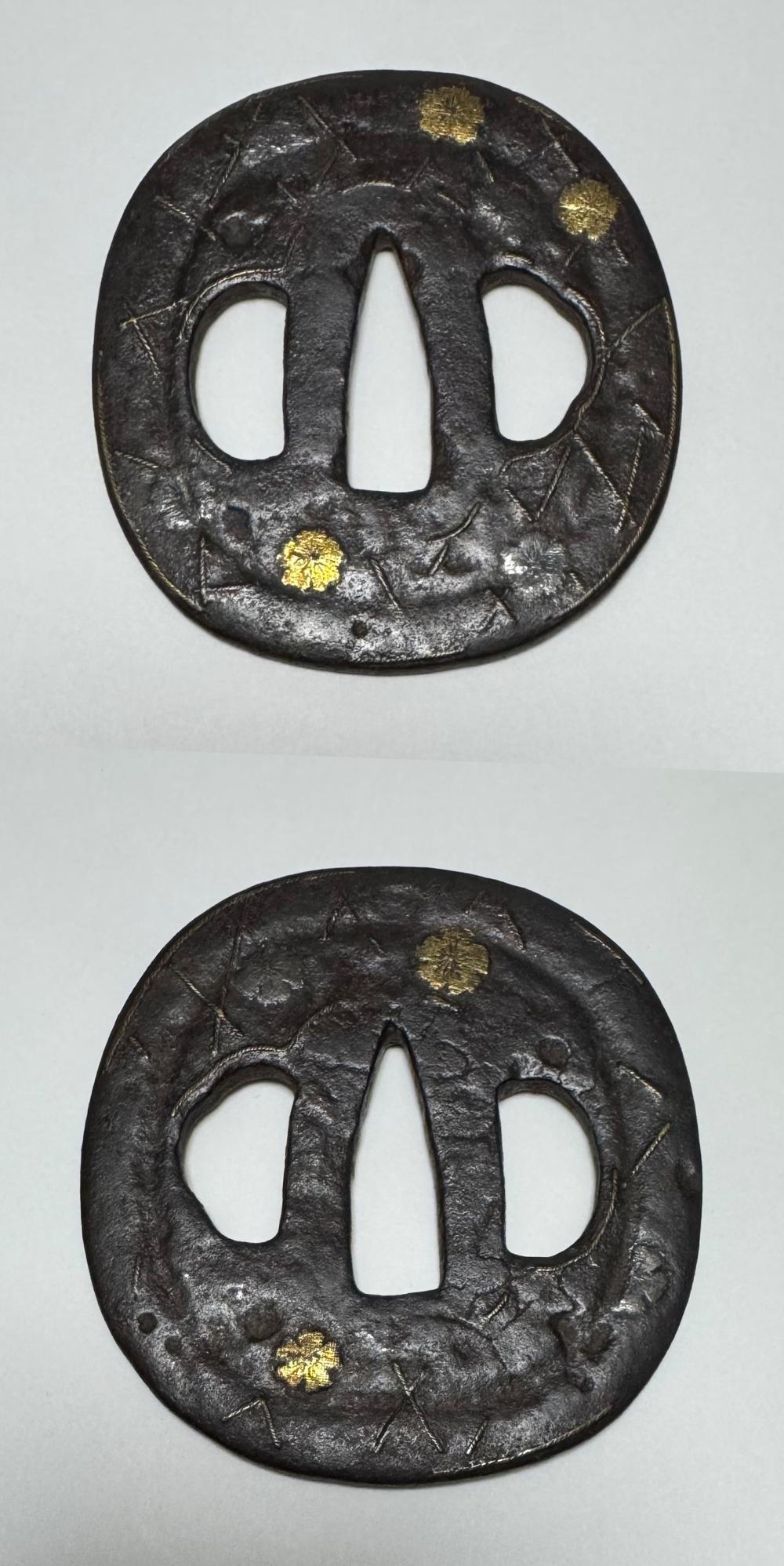
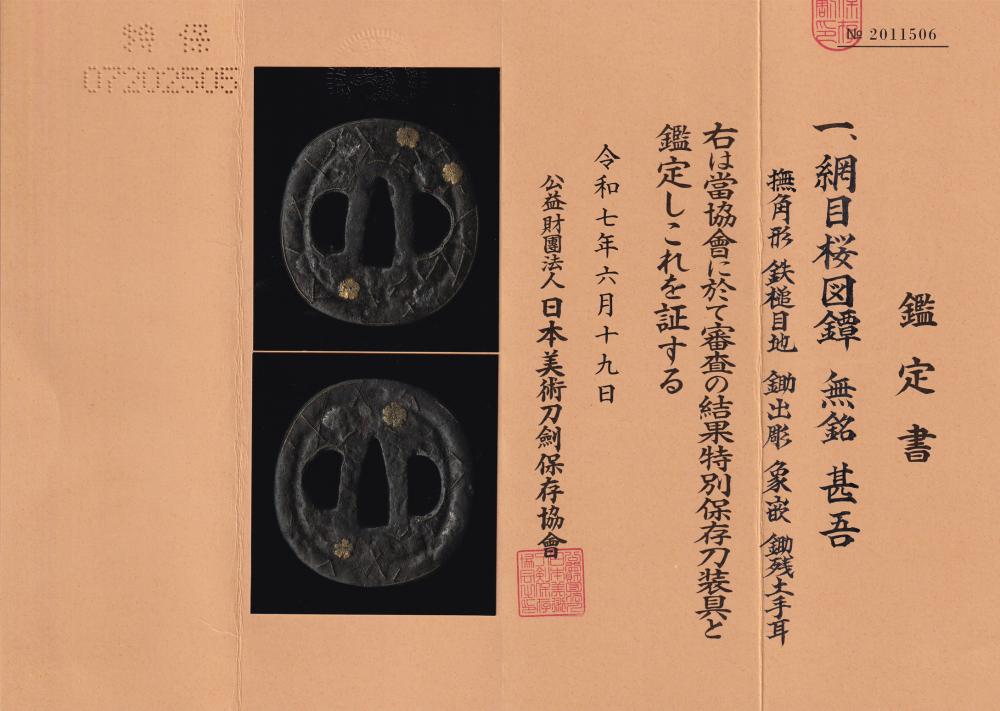
This is an unsigned tsuba attributed to Jingo, a prominent maker of the Shimizu school within the Higo kinko tradition. It features a distinctive ami-me (net pattern) design with cherry blossoms inlaid in gold and silver nunome-zogan. The tsuba is certified as Tokubetsu Hozon Tosogu by the NBTHK.
Certificate reading — 無銘(甚吾)
 NihontoWatch
mumei · 志水 · Edo
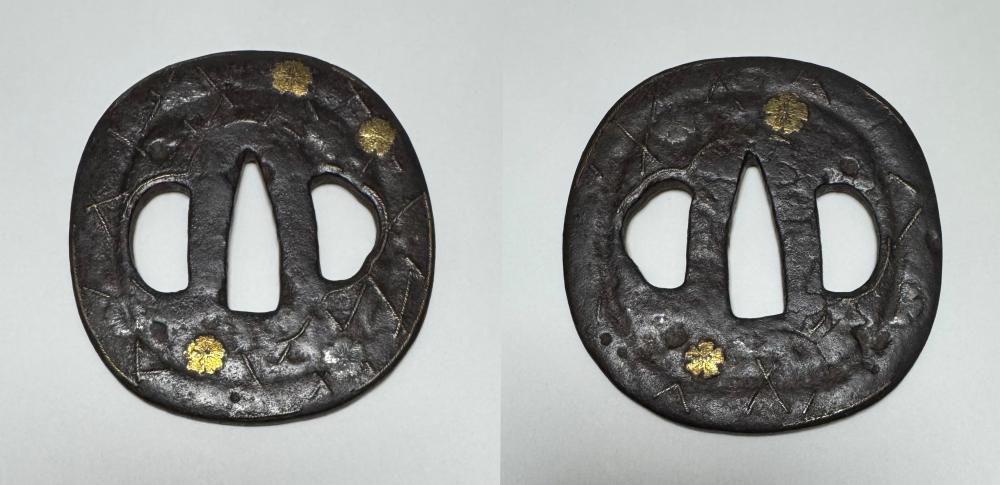
Higo · Higo · around 1746-1823
2 pieces on the market now
Higo · Higo
26 pieces on the market now
The Shimizu school is one of the four mainline houses -- together with Hayashi, Hirata, and Nishigaki -- that represent the orthodox tradition of Higo kinko (肥後金工). Its founder, the first-generation Shimizu Jinbei, is traditionally said to have been a nephew of Hirata Hikozo, and to have studied under him. All four founding masters were retained by the great tea-master and warrior Hosokawa Sansai (Tadaoki) and received his direct guidance. In Kan'ei 9 (1632), following the dispossession of the Kato family, Sansai's son Tadatoshi was enfeoffed with 540,000 koku at Kumamoto; Sansai then withdrew to Yatsushiro Castle in the same province as his place of retirement. The first-generation Jingo accompanied Hikozo in following Sansai to Yatsushiro, where the Shimizu line would flourish through successive generations as retained metalworkers under Hosokawa patronage. From the second generation onward, the heads of the house took the professional name Jingo (甚五), which was "succeeded by multiple generations," though no signed works by the first or second generation are known. Among the Higo metalworkers, the Shimizu school stands out for what the NBTHK setsumei consistently describe as "the most intense individuality" (hitokirwa kyoretsu na kosei). The technical hallmark of the school is bold brass suemon-zogan (据紋象嵌, raised inlay) executed on iron plates finished in a hammered ground with a yakite (burnt-hammer) surface treatment.
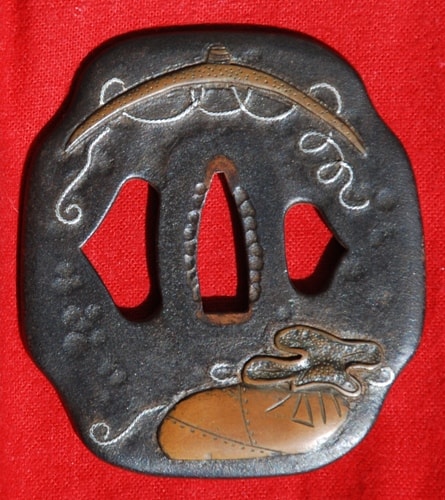
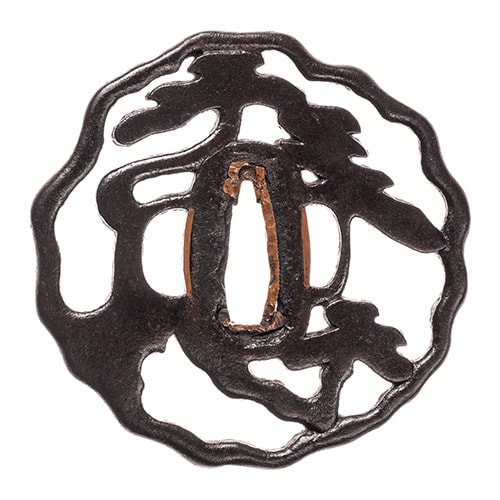
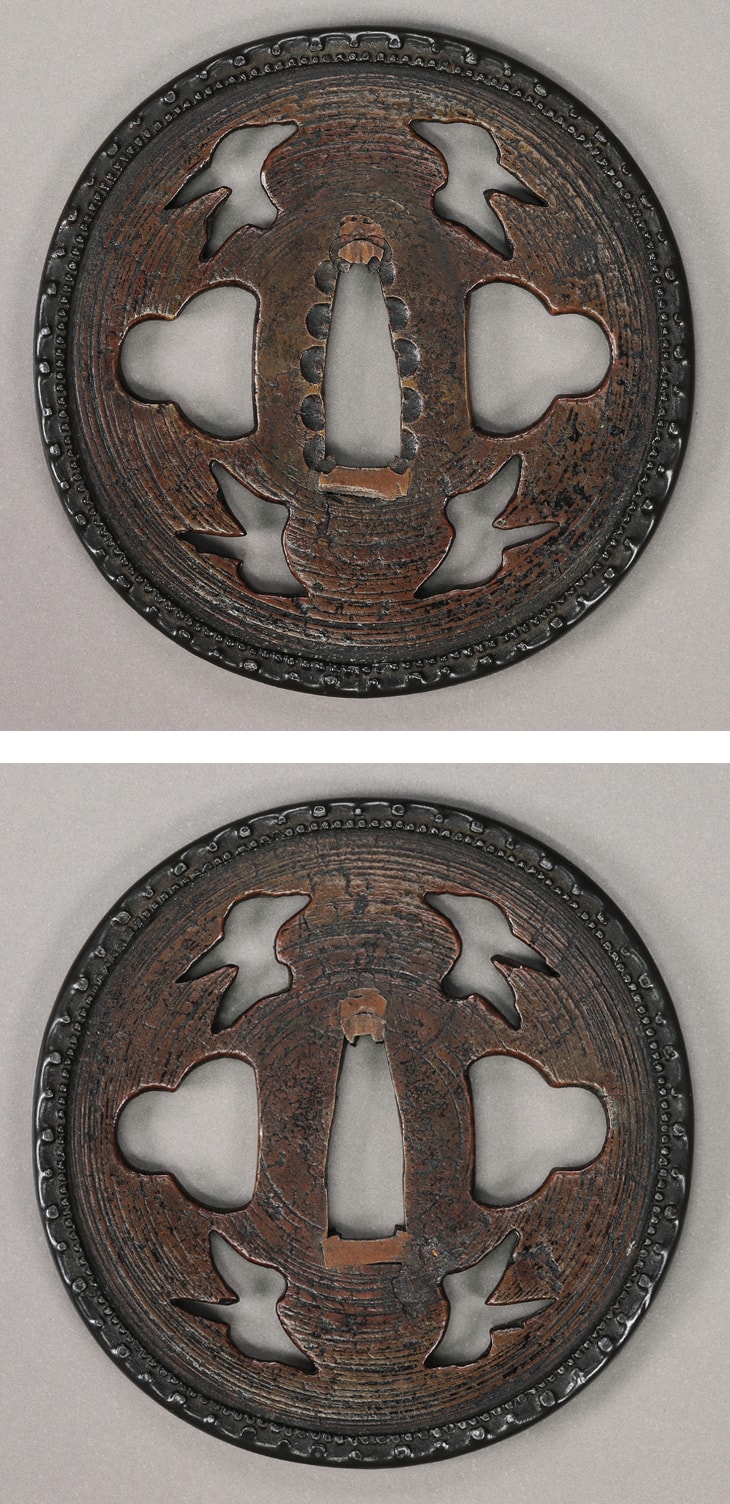
On the obverse, subjects such as fierce birds of prey, roosters, owls (mimizuku), ameryu (rain dragons), octopi, and crabs are rendered on a large scale with powerful relief. In deliberate contrast, the reverse is composed with broad expanses of open space, the motifs placed in smaller scale with gentler coloration and more restrained modeling, thereby balancing the two sides and deepening a quiet, austere atmosphere of sabi (寂). This asymmetrical yet harmonious interplay of obverse animation and reverse stillness is the school's most recognizable compositional device, described in setsumei after setsumei as producing works that are "overall remarkably well-balanced" despite their apparent asymmetry. While brass suemon-zogan on iron constitutes the dominant mode -- an approach "probably modeled on Heianjō-style inlay, yet what distinguishes it from Heianjō work is the boldness of the designs" -- the school's repertoire also encompassed sukidashi-takabori (raised carving) enriched with gold and silver nunome-zogan, as well as works on suaka (plain copper) ground, proving that its masters could convey the same weighty profundity regardless of the base metal. The Shimizu school occupies a singular position within the Higo kinko tradition as its most unconventional and artistically forceful lineage. " His owl-on-pine and hawk-on-pine compositions are so closely identified with his name as to be "virtually synonymous" with it, and the NBTHK has described his finest works as possessing a quality whereby "great skill appears clumsy" (taiko wa setsu naru ga gotoshi): what looks artless is not artless, but rather the expression of a technique so consummate that it surpasses conventional craft. Among his signed works, the rare mei "Uokin Jingo"[[c:1]] attests to his artistic identity, while the school's later use of diverse materials -- silver nunome-zogan, kebori (hairline engraving), and colored metals -- demonstrates the lineage's evolving technical range. The distinctive pictorial quality of the Shimizu manner, with its daring compositions, striking contrast between dark iron and bright brass, and an "open, generous atmosphere not encountered in the work of other metalworkers," answers to a sensibility that the setsumei note "also appeals to a modern sensibility" -- a testament to the enduring vitality of this Higo school's artistic vision. Learn more →
| Smith | Era | Designated |
|---|---|---|
| Jingo甚五 | — | 14 |
| Nagatsugu永次 | 1691-1777 | 0 |
| Shigenaga茂永 | 1795-1854 | 0 |
| Jingo甚吾 | 1746-1823 | 0 |
| Jingo甚吾 | — | 0 |
A Hozon-certified fitting of notably superior craftsmanship and condition, often with signature or workmanship of high reference value.
The NBTHK (Nihon Bijutsu Tōken Hozon Kyōkai, the Society for the Preservation of Japanese Art Swords) is a public-interest incorporated foundation founded in 1948 and supervised by Japan’s Agency for Cultural Affairs (Bunkachō); it is based at the Japanese Sword Museum in Tokyo. Its expert panels physically examine each submitted work (shinsa) and issue a certificate (kanteishō) ranking it by artistic and historical merit. NBTHK papers are the most widely recognized standard of authentication for Japanese swords and fittings.
NBTHK official sitePlease contact us by phone within 3 days of the item's arrival and ship it back the next day. The postage and security service fees are the customer's responsibility.
This is an unsigned tsuba attributed to Jingo, a prominent maker of the Shimizu school within the Higo kinko tradition. It features a distinctive ami-me (net pattern) design with cherry blossoms inlaid in gold and silver nunome-zogan. The tsuba is certified as Tokubetsu Hozon Tosogu by the NBTHK.
Certificate reading — 無銘(甚吾)
NihontoWatchmumei · 志水 · Edo
Higo · Higo · around 1746-1823
2 pieces on the market now
Higo · Higo
26 pieces on the market now
The Shimizu school is one of the four mainline houses -- together with Hayashi, Hirata, and Nishigaki -- that represent the orthodox tradition of Higo kinko (肥後金工). Its founder, the first-generation Shimizu Jinbei, is traditionally said to have been a nephew of Hirata Hikozo, and to have studied under him. All four founding masters were retained by the great tea-master and warrior Hosokawa Sansai (Tadaoki) and received his direct guidance. In Kan'ei 9 (1632), following the dispossession of the Kato family, Sansai's son Tadatoshi was enfeoffed with 540,000 koku at Kumamoto; Sansai then withdrew to Yatsushiro Castle in the same province as his place of retirement. The first-generation Jingo accompanied Hikozo in following Sansai to Yatsushiro, where the Shimizu line would flourish through successive generations as retained metalworkers under Hosokawa patronage. From the second generation onward, the heads of the house took the professional name Jingo (甚五), which was "succeeded by multiple generations," though no signed works by the first or second generation are known. Among the Higo metalworkers, the Shimizu school stands out for what the NBTHK setsumei consistently describe as "the most intense individuality" (hitokirwa kyoretsu na kosei). The technical hallmark of the school is bold brass suemon-zogan (据紋象嵌, raised inlay) executed on iron plates finished in a hammered ground with a yakite (burnt-hammer) surface treatment.
On the obverse, subjects such as fierce birds of prey, roosters, owls (mimizuku), ameryu (rain dragons), octopi, and crabs are rendered on a large scale with powerful relief. In deliberate contrast, the reverse is composed with broad expanses of open space, the motifs placed in smaller scale with gentler coloration and more restrained modeling, thereby balancing the two sides and deepening a quiet, austere atmosphere of sabi (寂). This asymmetrical yet harmonious interplay of obverse animation and reverse stillness is the school's most recognizable compositional device, described in setsumei after setsumei as producing works that are "overall remarkably well-balanced" despite their apparent asymmetry. While brass suemon-zogan on iron constitutes the dominant mode -- an approach "probably modeled on Heianjō-style inlay, yet what distinguishes it from Heianjō work is the boldness of the designs" -- the school's repertoire also encompassed sukidashi-takabori (raised carving) enriched with gold and silver nunome-zogan, as well as works on suaka (plain copper) ground, proving that its masters could convey the same weighty profundity regardless of the base metal. The Shimizu school occupies a singular position within the Higo kinko tradition as its most unconventional and artistically forceful lineage. " His owl-on-pine and hawk-on-pine compositions are so closely identified with his name as to be "virtually synonymous" with it, and the NBTHK has described his finest works as possessing a quality whereby "great skill appears clumsy" (taiko wa setsu naru ga gotoshi): what looks artless is not artless, but rather the expression of a technique so consummate that it surpasses conventional craft. Among his signed works, the rare mei "Uokin Jingo"[[c:1]] attests to his artistic identity, while the school's later use of diverse materials -- silver nunome-zogan, kebori (hairline engraving), and colored metals -- demonstrates the lineage's evolving technical range. The distinctive pictorial quality of the Shimizu manner, with its daring compositions, striking contrast between dark iron and bright brass, and an "open, generous atmosphere not encountered in the work of other metalworkers," answers to a sensibility that the setsumei note "also appeals to a modern sensibility" -- a testament to the enduring vitality of this Higo school's artistic vision. Learn more →
| Smith | Era | Designated |
|---|---|---|
| Jingo甚五 | — | 14 |
| Nagatsugu永次 | 1691-1777 | 0 |
| Shigenaga茂永 | 1795-1854 | 0 |
| Jingo甚吾 | 1746-1823 | 0 |
| Jingo甚吾 | — | 0 |
A Hozon-certified fitting of notably superior craftsmanship and condition, often with signature or workmanship of high reference value.
The NBTHK (Nihon Bijutsu Tōken Hozon Kyōkai, the Society for the Preservation of Japanese Art Swords) is a public-interest incorporated foundation founded in 1948 and supervised by Japan’s Agency for Cultural Affairs (Bunkachō); it is based at the Japanese Sword Museum in Tokyo. Its expert panels physically examine each submitted work (shinsa) and issue a certificate (kanteishō) ranking it by artistic and historical merit. NBTHK papers are the most widely recognized standard of authentication for Japanese swords and fittings.
NBTHK official sitePlease contact us by phone within 3 days of the item's arrival and ship it back the next day. The postage and security service fees are the customer's responsibility.