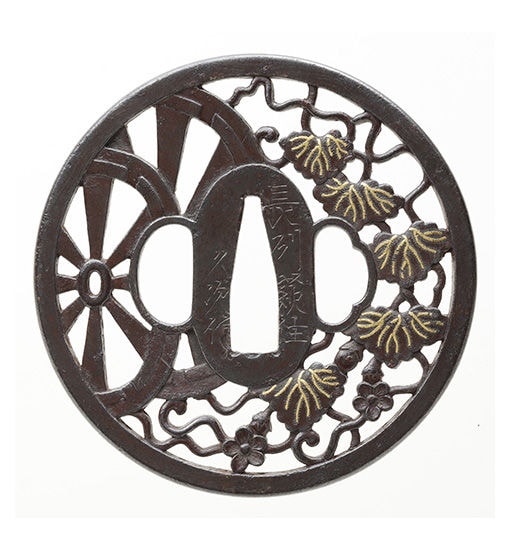
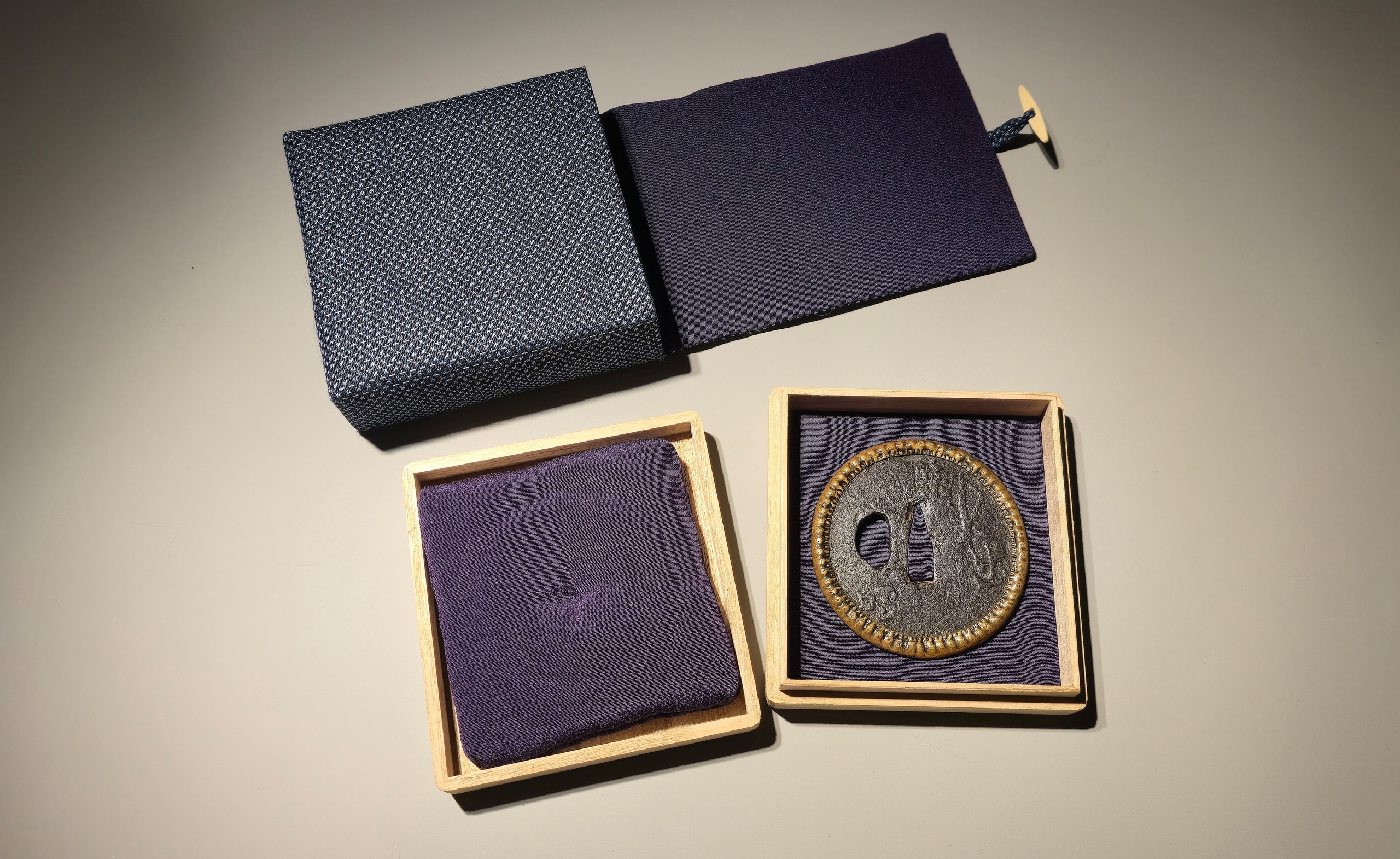
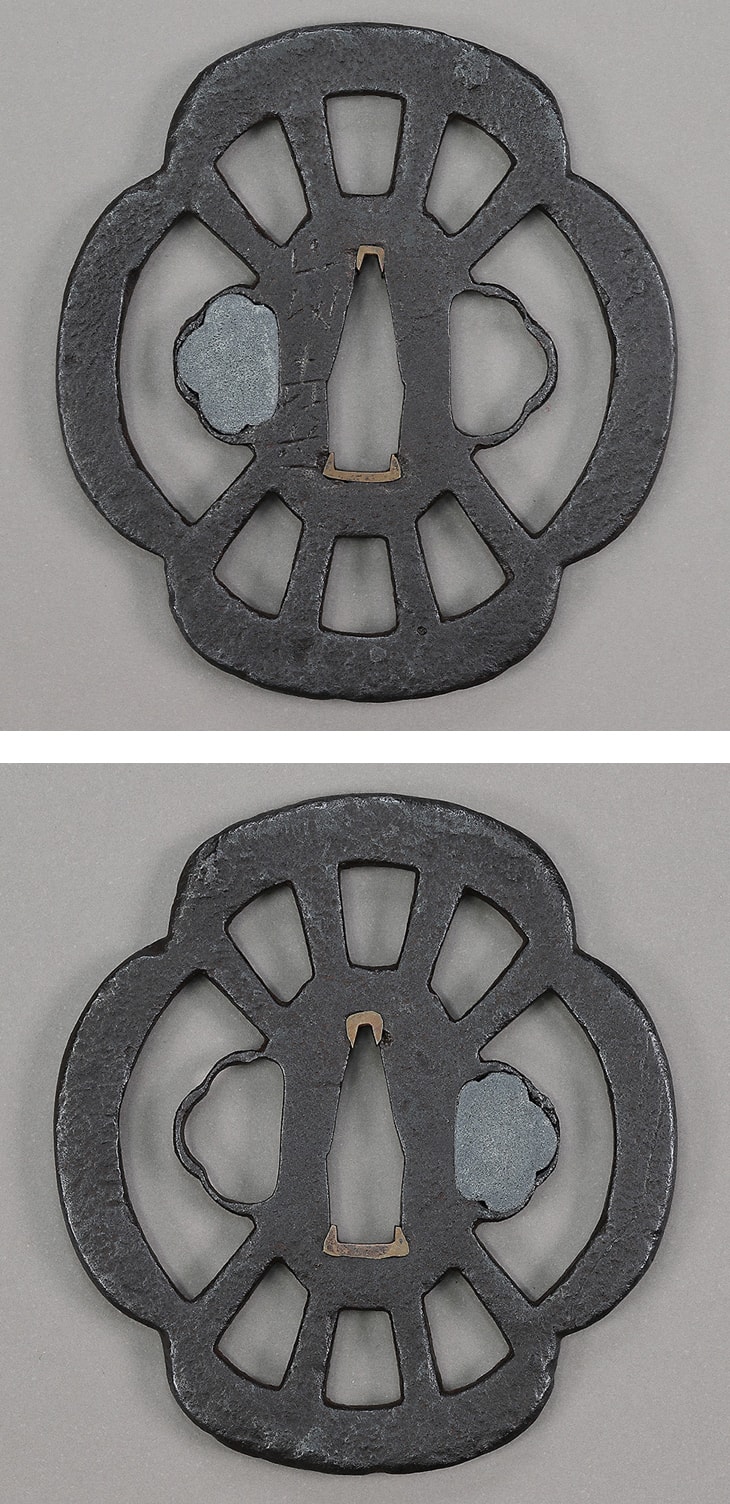
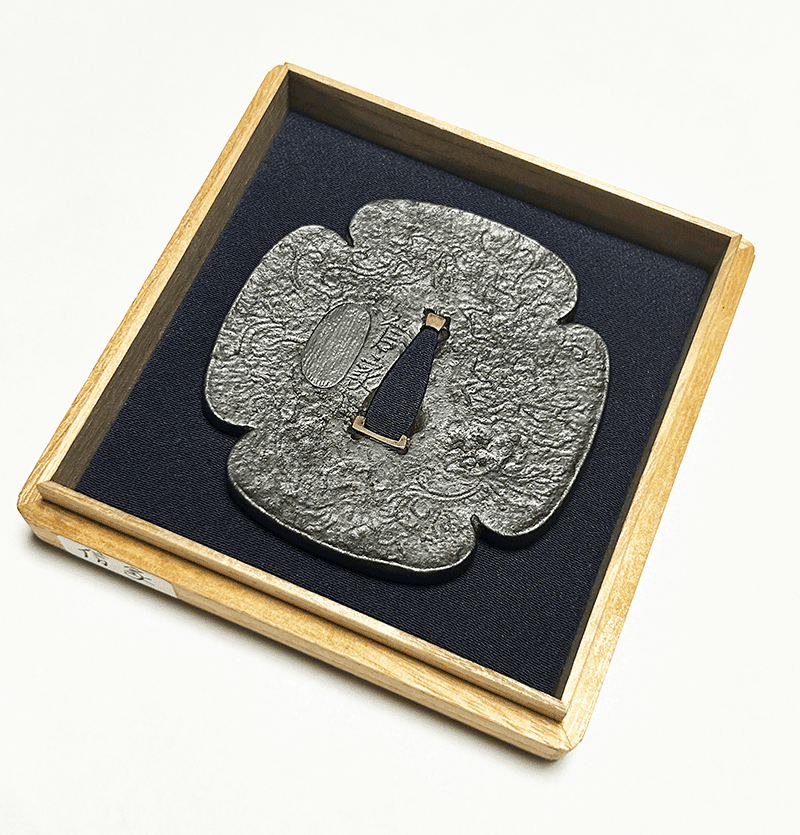
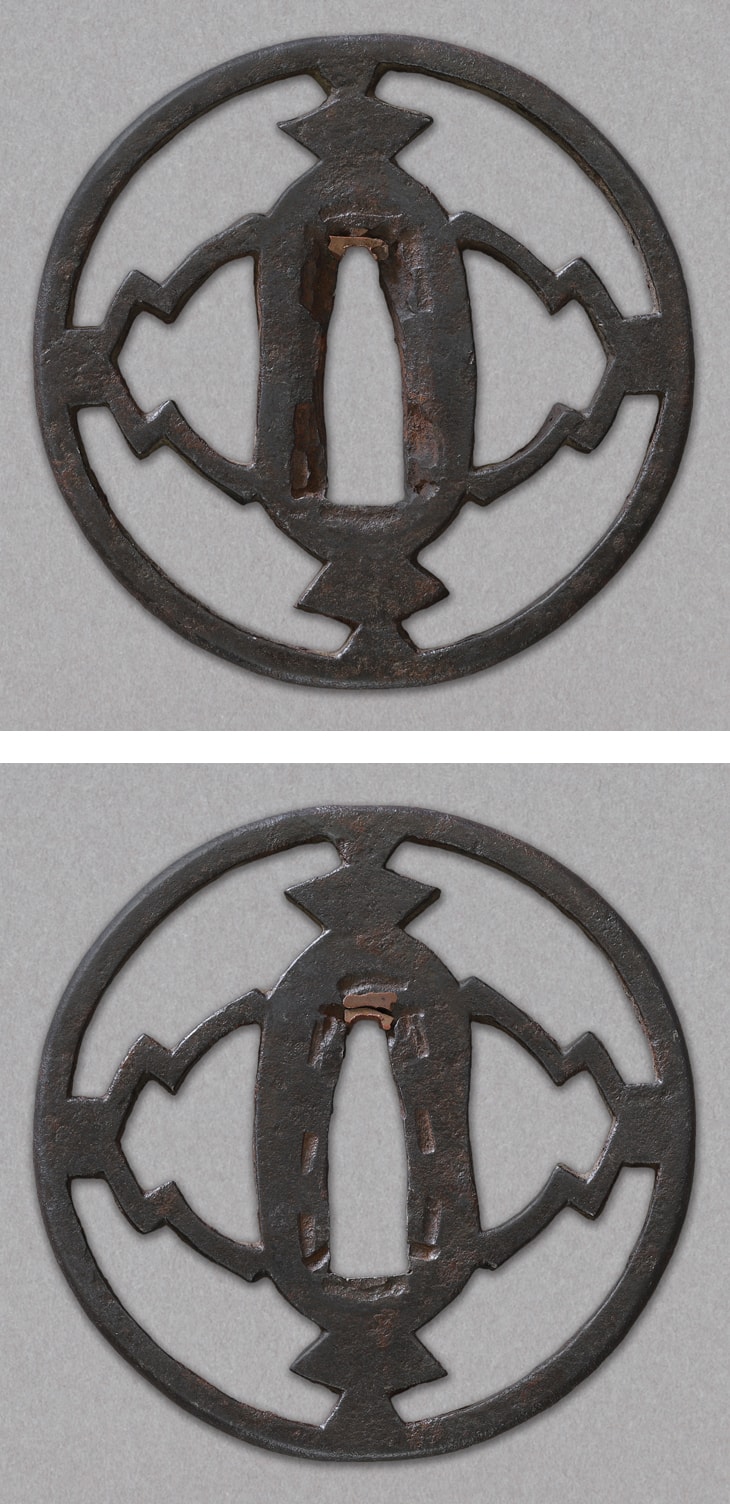
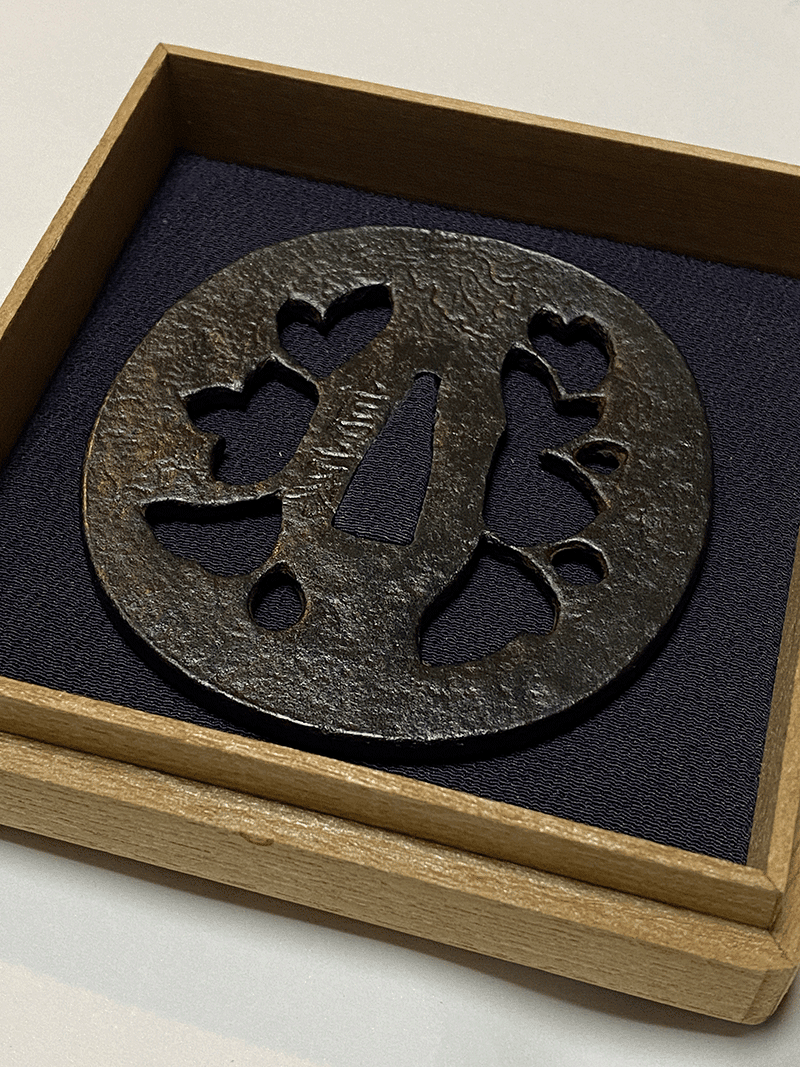
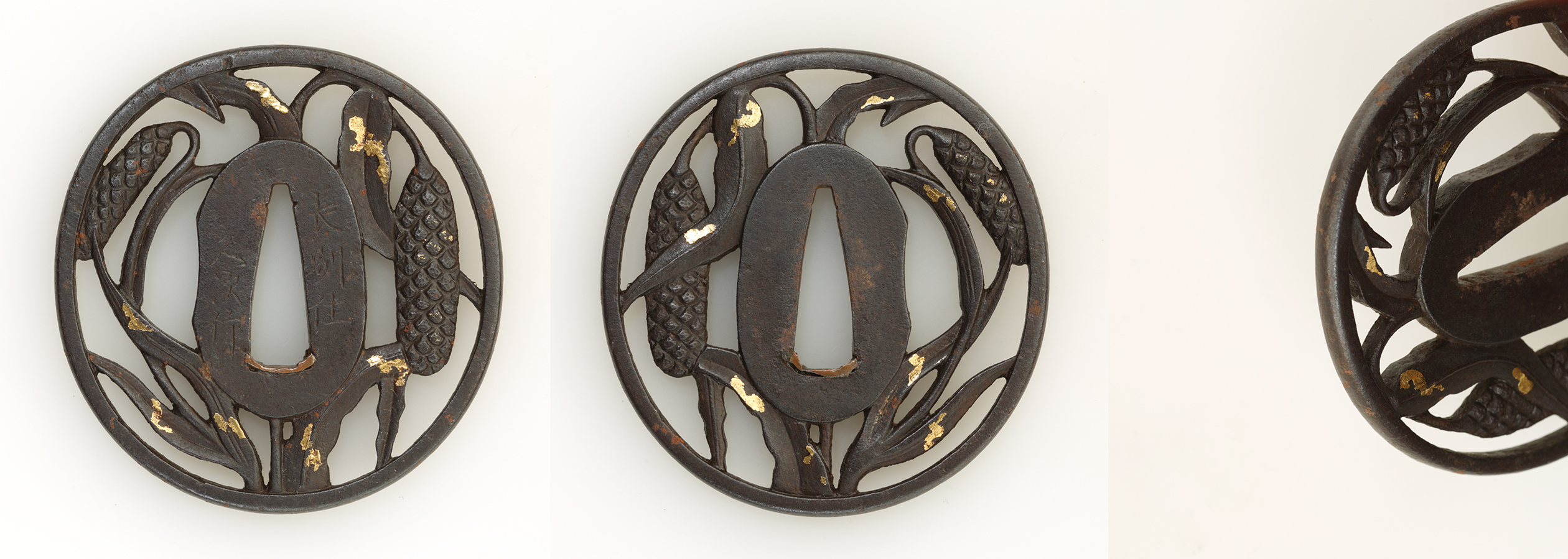
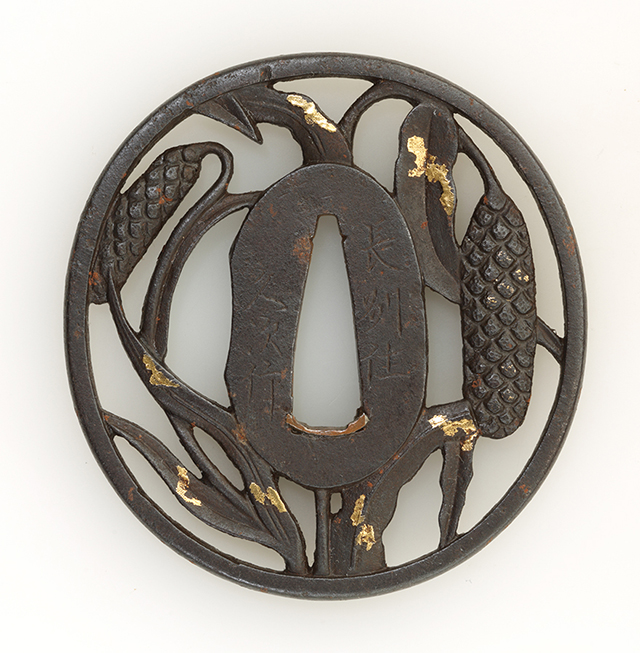
This is an Edo period tsuba made of iron, featuring millet ear openwork and thick gold nunome-zogan. It is signed by Hisatsugu from Nagato province. The tsuba has a round shape with a single hitsu-ana and shows minor rust that can be improved with care.
 NihontoWatch
mei · Edo
Iron-tsuba · Owari
3 pieces on the market now
Iron-tsuba · Owari
5 pieces on the market now
The Hoan school takes its name from its founder Hoan (法安), whose personal name was Kawaguchi Saburuemon, an arms-smith (bugu-kaji) active in Kiyosu, Owari Province, from the late Muromachi into the Momoyama period. Originally an armorer by trade, Hoan entered the service of the Asano family as a retained craftsman, residing successively at Kofu in Kai Province and at Wakayama in Kii Province before his death on the twentieth day of the fifth month of Keicho 18 (1613). His posthumous Buddhist name was Honpoin Soan Nisshin Koji. " Within this triad, Hoan is distinguished as "somewhat more technical in execution" than Nobuie and "a step more polished and sophisticated" than Yamakichi[[c:2]]. Following Hoan's death, his son-in-law Hisatsugu relocated to Hiroshima in Aki Province during the Genna era in connection with the Asano family's transfer of fief, establishing the Hiroshima branch of the lineage; the family cemetery remains at Kokuzen-ji Temple in that city. Hoan's plate iron was celebrated for its extraordinary toughness, "to the extent that it was also known by the epithet uwabami-tetsu" ("great-serpent iron").
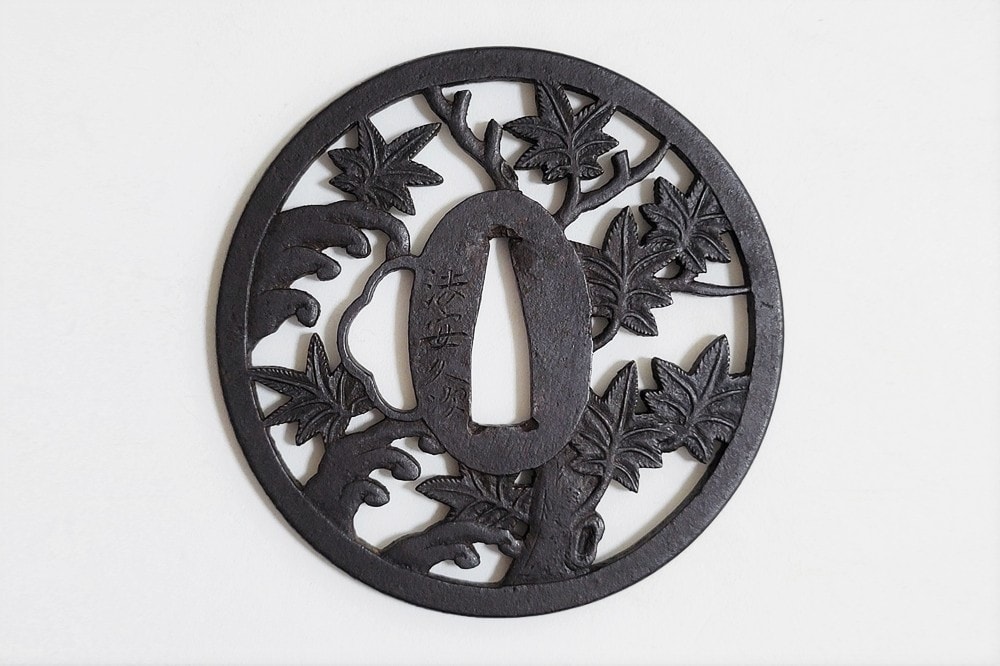
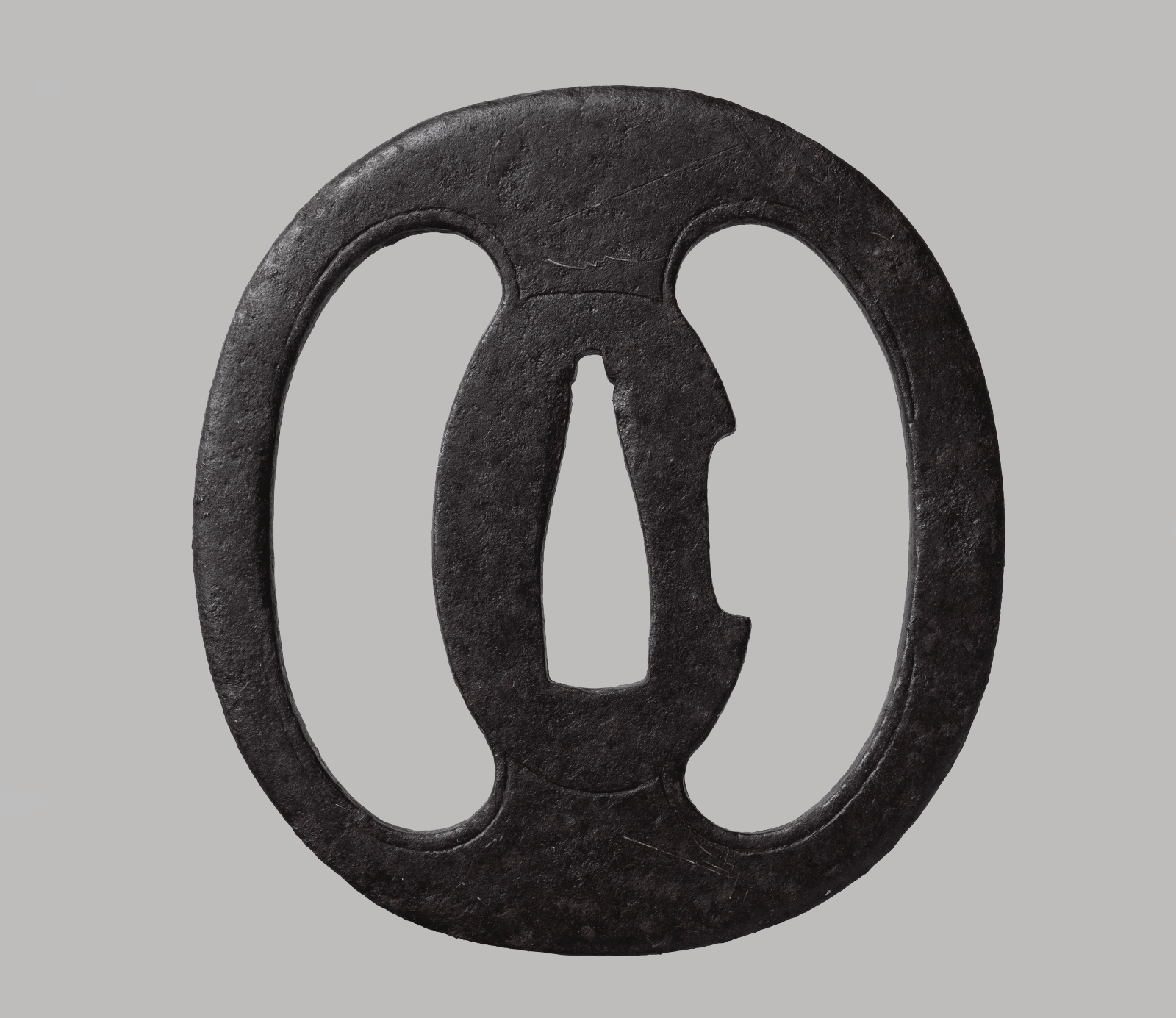
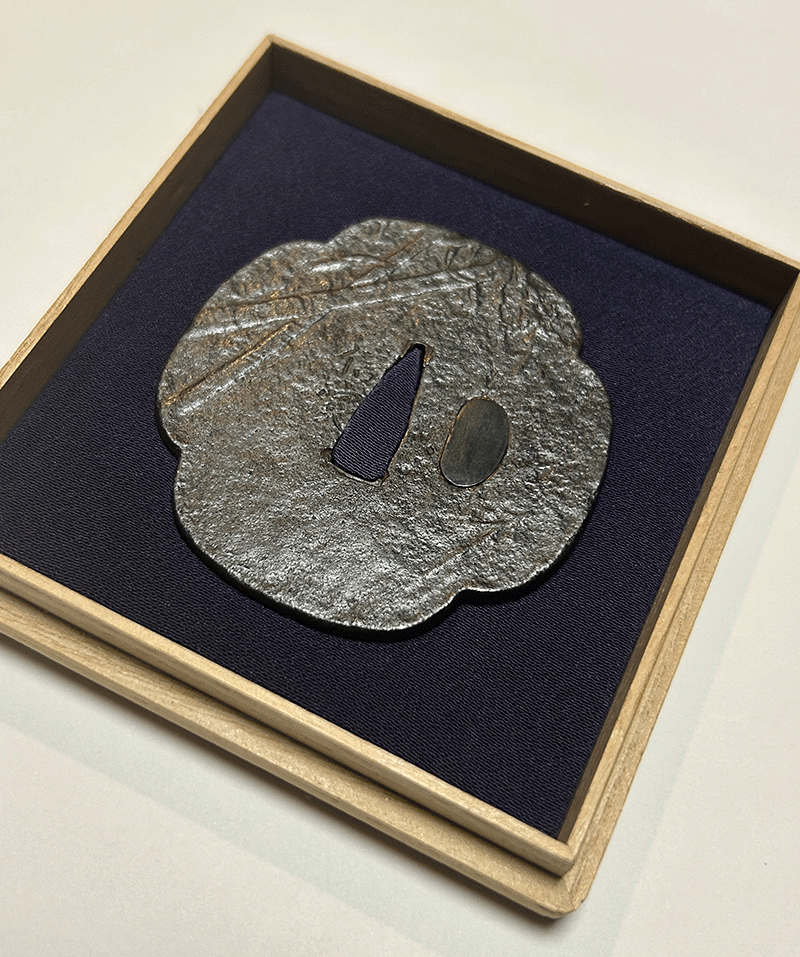
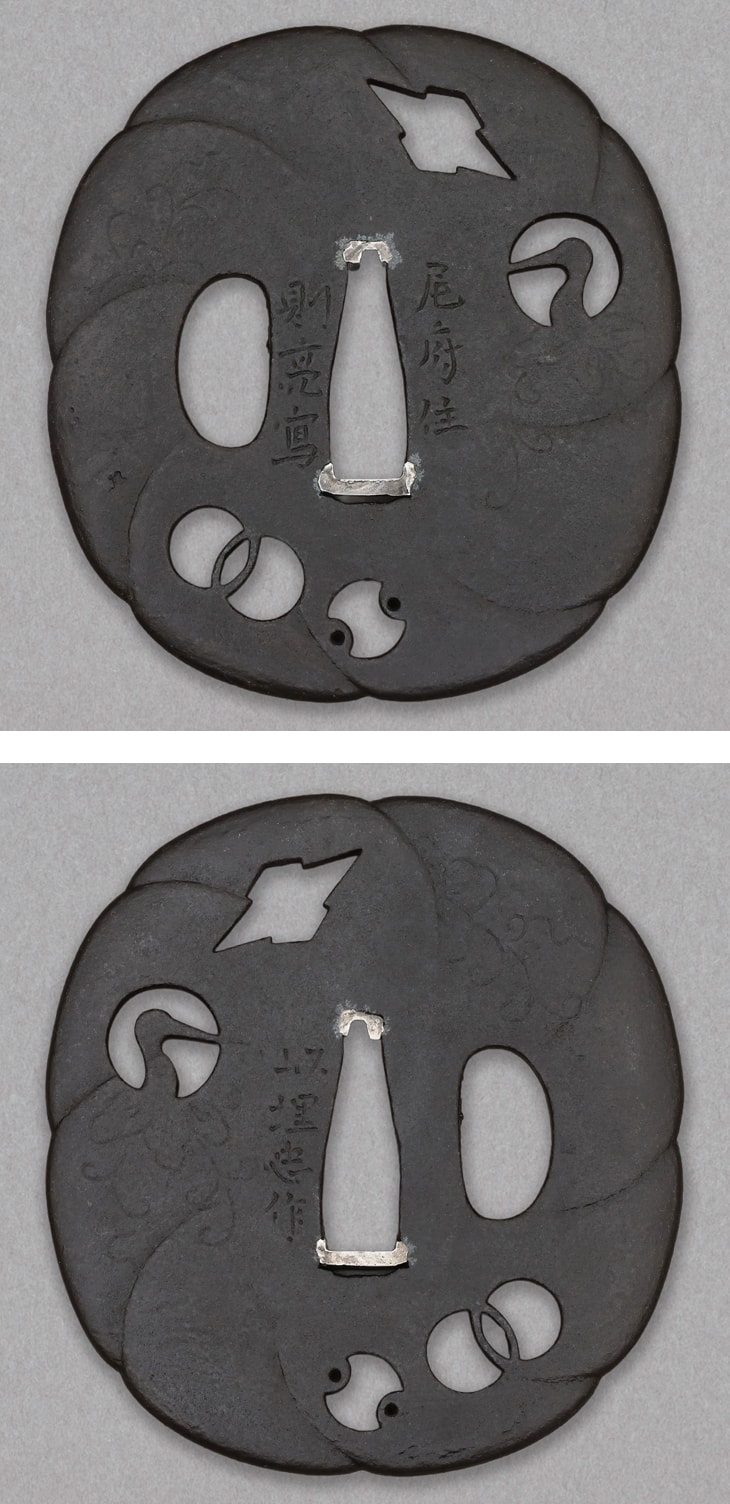
Across the designated corpus, this iron is described as possessing a distinctive "viscous" (nettori) and tenacious character, with the forged texture (kitae-hada) emerging "here and there with lively animation" and tekkotsu (iron bones) appearing prominently at the surface. " This technique was deployed both for surface treatment across the ji and for the depiction of figural subjects, as in the long-eared rabbit rendered at the rim of one designated tsuba. Hoan's repertoire further embraced kuruma-sukashi (wheel openwork), amida-yasuri file-mark patterning employed as a deliberate design element, tsuchime-ji (hammered ground), and sukidashi-bori (raised carving). " The Hoan school occupies a position of high regard within the Owari iron-tsuba tradition. The NBTHK observes that "because there exist fine examples of kuruma-sukashi, the name Hoan is held in high regard[[c:4]]," and the designated works consistently display what the examiners characterize as a unique artistic world realized within a single tsuba. Learn more →
| Smith | Era | Designated |
|---|---|---|
| Hoan法安 | — | 5 |
| Hoan法安 | — | 0 |
| Kanenobu兼信 | — | 0 |
| Hisatsugu久次 | — | 0 |
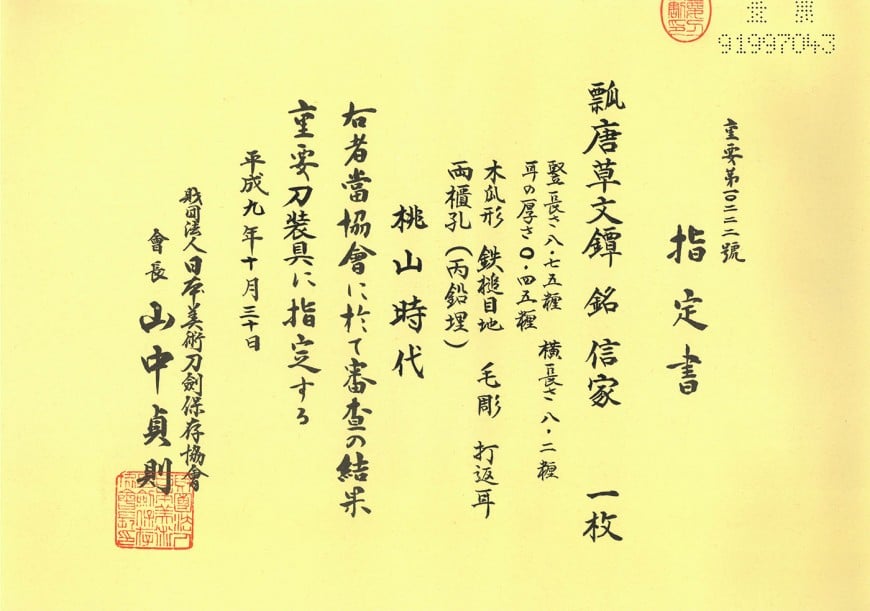
We could not find an authenticity certificate on the seller’s listing. Japanese swords and fittings are normally papered by the NBTHK (or the NTHK). Without one, the attribution is the seller’s own assessment and has not been independently verified — treat it with caution and ask the dealer about certification before buying.
If you judge that the condition of the delivered item differs significantly from the photos or description on our site, a return is possible. However, the return shipping cost is the customer's responsibility. To use cooling-off, please apply in writing by postal mail within one week of the item's arrival. The return shipping cost is the customer's responsibility.
¥48,000
This is an Edo period tsuba made of iron, featuring millet ear openwork and thick gold nunome-zogan. It is signed by Hisatsugu from Nagato province. The tsuba has a round shape with a single hitsu-ana and shows minor rust that can be improved with care.
NihontoWatchmei · Edo
Iron-tsuba · Owari
3 pieces on the market now
Iron-tsuba · Owari
5 pieces on the market now
The Hoan school takes its name from its founder Hoan (法安), whose personal name was Kawaguchi Saburuemon, an arms-smith (bugu-kaji) active in Kiyosu, Owari Province, from the late Muromachi into the Momoyama period. Originally an armorer by trade, Hoan entered the service of the Asano family as a retained craftsman, residing successively at Kofu in Kai Province and at Wakayama in Kii Province before his death on the twentieth day of the fifth month of Keicho 18 (1613). His posthumous Buddhist name was Honpoin Soan Nisshin Koji. " Within this triad, Hoan is distinguished as "somewhat more technical in execution" than Nobuie and "a step more polished and sophisticated" than Yamakichi[[c:2]]. Following Hoan's death, his son-in-law Hisatsugu relocated to Hiroshima in Aki Province during the Genna era in connection with the Asano family's transfer of fief, establishing the Hiroshima branch of the lineage; the family cemetery remains at Kokuzen-ji Temple in that city. Hoan's plate iron was celebrated for its extraordinary toughness, "to the extent that it was also known by the epithet uwabami-tetsu" ("great-serpent iron").
Across the designated corpus, this iron is described as possessing a distinctive "viscous" (nettori) and tenacious character, with the forged texture (kitae-hada) emerging "here and there with lively animation" and tekkotsu (iron bones) appearing prominently at the surface. " This technique was deployed both for surface treatment across the ji and for the depiction of figural subjects, as in the long-eared rabbit rendered at the rim of one designated tsuba. Hoan's repertoire further embraced kuruma-sukashi (wheel openwork), amida-yasuri file-mark patterning employed as a deliberate design element, tsuchime-ji (hammered ground), and sukidashi-bori (raised carving). " The Hoan school occupies a position of high regard within the Owari iron-tsuba tradition. The NBTHK observes that "because there exist fine examples of kuruma-sukashi, the name Hoan is held in high regard[[c:4]]," and the designated works consistently display what the examiners characterize as a unique artistic world realized within a single tsuba. Learn more →
| Smith | Era | Designated |
|---|---|---|
| Hoan法安 | — | 5 |
| Hoan法安 | — | 0 |
| Kanenobu兼信 | — | 0 |
| Hisatsugu久次 | — | 0 |
We could not find an authenticity certificate on the seller’s listing. Japanese swords and fittings are normally papered by the NBTHK (or the NTHK). Without one, the attribution is the seller’s own assessment and has not been independently verified — treat it with caution and ask the dealer about certification before buying.
If you judge that the condition of the delivered item differs significantly from the photos or description on our site, a return is possible. However, the return shipping cost is the customer's responsibility. To use cooling-off, please apply in writing by postal mail within one week of the item's arrival. The return shipping cost is the customer's responsibility.
¥48,000