The twentieth century nearly killed the craft twice: wartime distortion, then the occupation ban. The NBTHK’s founding in 1948 and licensed forging from 1953 rebuilt the sword as an art, crowned by Living National Treasures and the mukansa rank.
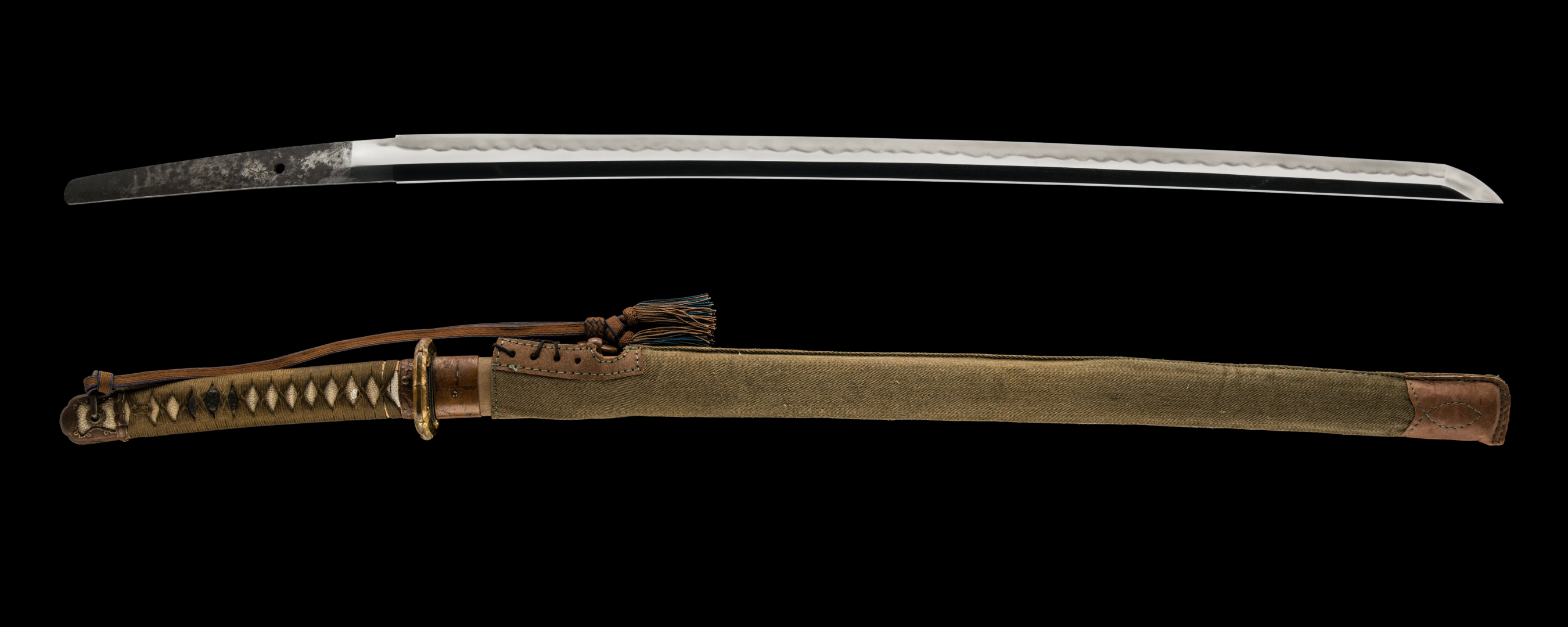
Ishido Teruhide (1900-1982) was the 10th and last generation of the prestigious Ishido Korekazu line of Edo/Musashi province swordsmiths – direct descendants of the highly ranked Musashi Daijō Fujiwara Korekazu. During the Second World War he produced quality blades for high-ranking military officers, and was specially ranked Betsuki in the 1943 list of top Gendai swordsmiths by both the Nihon Token Tanrenjo and the Nihon Token Shinbunshi – a distinction reserved for the finest active smiths of the era. On this sword Teruhide chiselled his name with the classic two-character signature he favoured early in his career. The construction is everything you would expect from the Ishido tradition: a fine ko-itame jihada blended with muji-hada, and a prominent gunome midare hamon that moves with real energy along the blade. The blade is housed in its original WWII Japanese Army Officer Shin-Gunto koshirae, complete with a protective cover for its unusual lightweight wooden scabbard – signed by the craftsman, a happy discovery when the cover was first peeled back. All fittings carry matching serial number 3, and the hilt proudly retains the blue and brown Company Officer tassel. Two NTHK-NPO Kanteishō certificates accompany the sword, one validating the blade as a quality gendaitō made by traditional folding methods, the other certifying the koshirae.
Offered by Unique Japan
This piece has sold
Get an email when a new Teruhide piece hits the market.


Tokyo · around 1926-1989
Shōwa to the present: destruction and revival
The twentieth century nearly killed the craft twice: wartime distortion, then the occupation ban. The NBTHK’s founding in 1948 and licensed forging from 1953 rebuilt the sword as an art, crowned by Living National Treasures and the mukansa rank.
The NTHK’s principal certificate, issued for a blade of considerable quality. It confirms a genuine signature, or, for an unsigned (mumei) work, records the judges’ attribution to a smith or school. The paper carries a detailed worksheet with a numerical point score.
The NTHK (Nihon Tōken Hozon Kai, the Society for the Preservation of the Japanese Sword) is the oldest of Japan’s sword-appraisal bodies, founded in 1910, decades before the NBTHK. After the death of its long-serving head it divided into two successor societies, the NTHK and the NTHK-NPO, both of which continue to hold shinsa. NTHK blade certificates are known for a detailed worksheet that records a numerical point score alongside the judges’ written opinion (fitting papers carry the judges’ opinion without a point score), and the society is especially respected for its attribution of unsigned (mumei) work.
All swords come with a three-day inspection period beginning from the date of delivery. If not satisfied, the sword may be returned within this period for a full refund of the purchase price. Outside of this period, all sales are final. Swords purchased on a layaway payment plan are not eligible for the three-day inspection period.