 NihontoWatchNihontoWatch
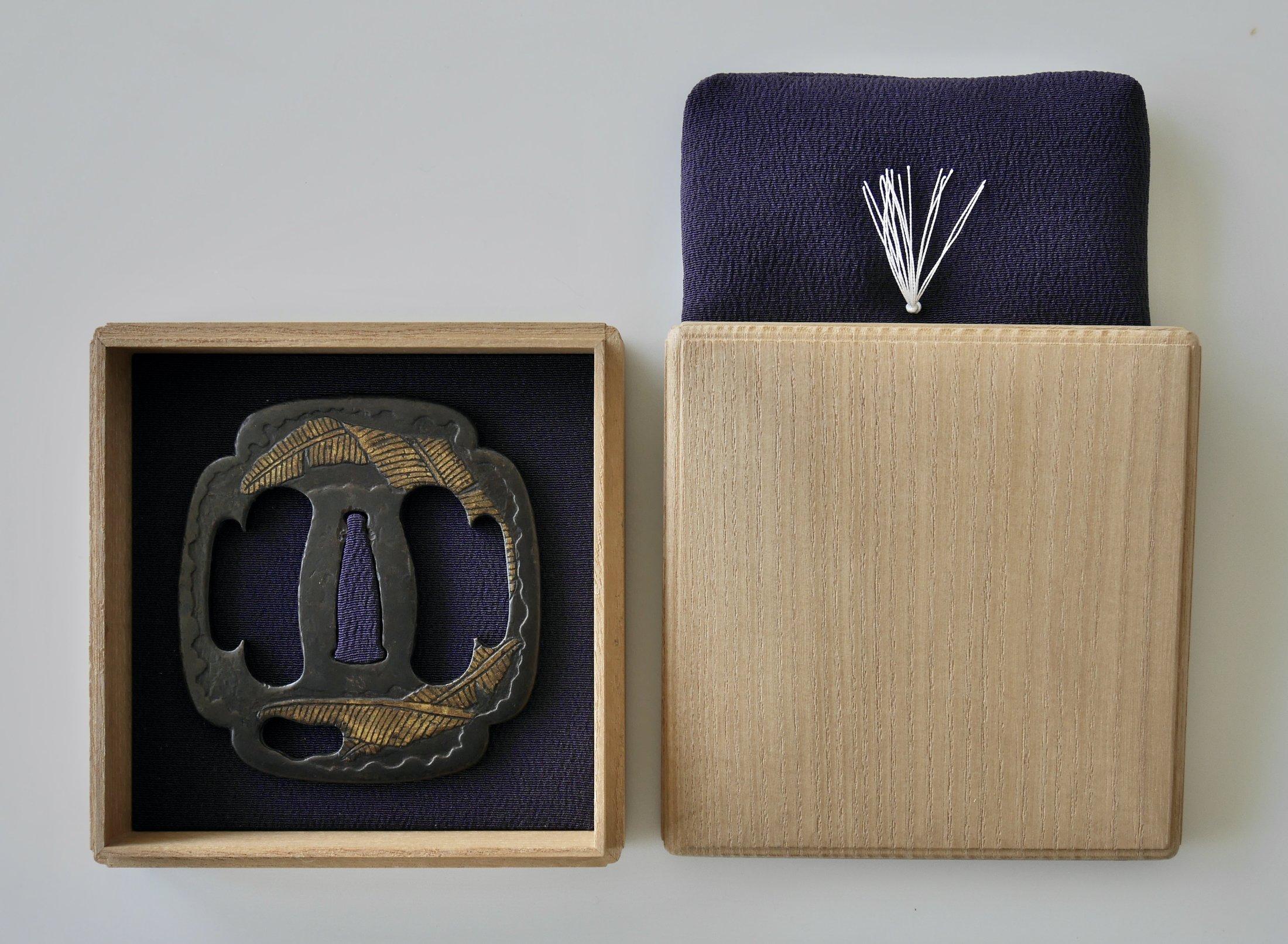
The Shimizu family began with the first generation Jinbei, who was the nephew of Hirata Hikozo, and met its end as metalworkers with the fifth generation Shigenaga. Although the birth year of the fifth generation Shigenaga is unknown, since his year of death was Kaei 7 (1854), he is thought to have been a metalworker of the same generation as Kamiyoshi Fukanobu. At that time, Jingo-style items were popular not only in Kumamoto but also in Edo, suggesting that they took the world by storm. This was Shigenaga's achievement, and it is clear that he was highly evaluated at the time. This tsuba is in a well-formed mokko shape, with the left and right hitsu-ana pierced in kasane-mochi style, and windows created on the hirachi through kura-shi, inside of which basho leaves are vividly depicted. The iron has a radiant luster, and the mimi shows linear kitae-me, giving it a grand atmosphere. The holes opened above and below the nakago-ana also prove that it is a work by Shigenaga despite being mumei. The basho leaves, expressed with low sukisage, are decorated with rubbed-away gold nunome-zogan, serving as an accent. It is a tsuba overflowing with Shigenaga's individuality and is a masterpiece worthy of cherished possession.
NihontoWatchOffered by Gallery Youyou

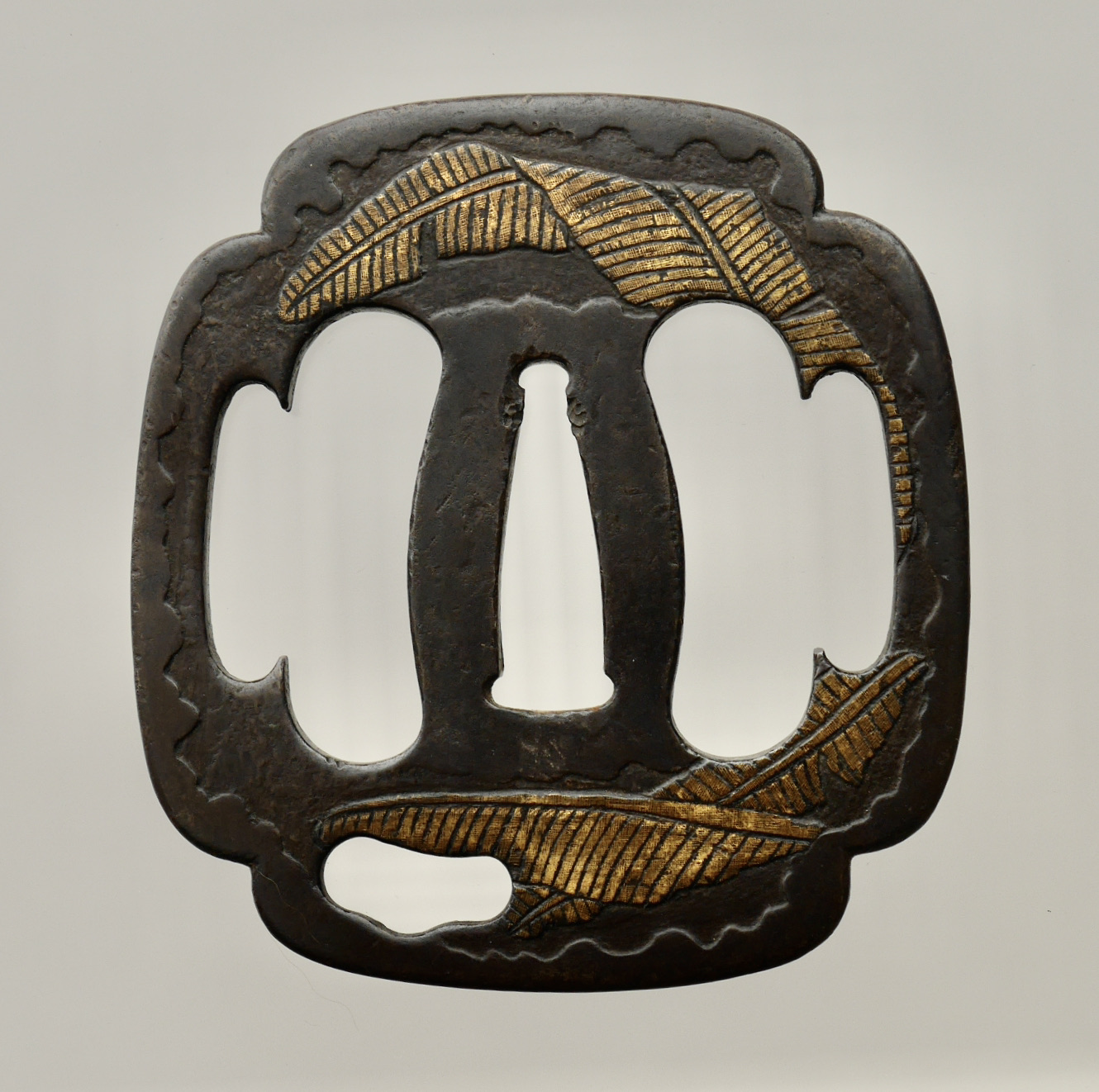
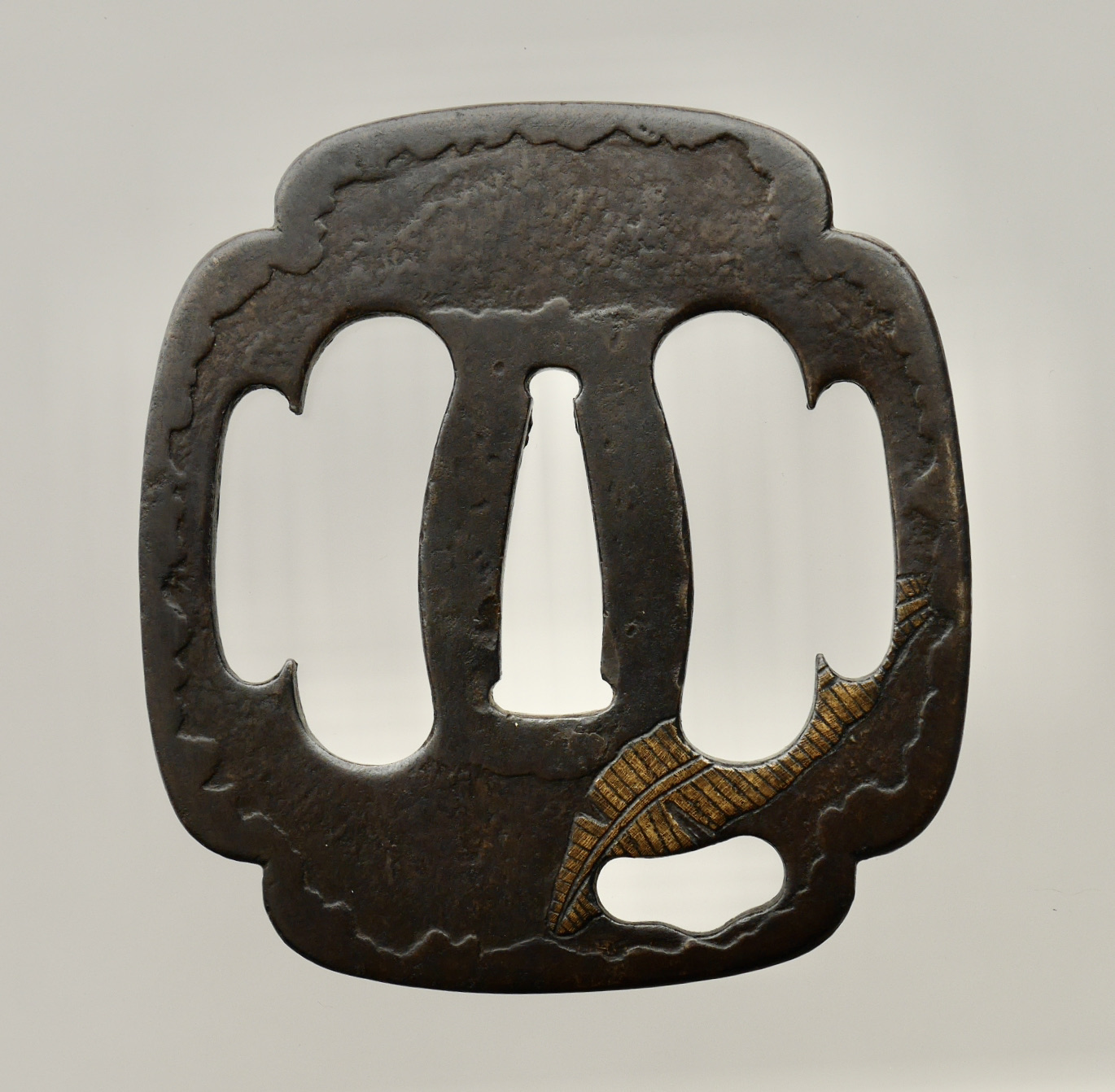
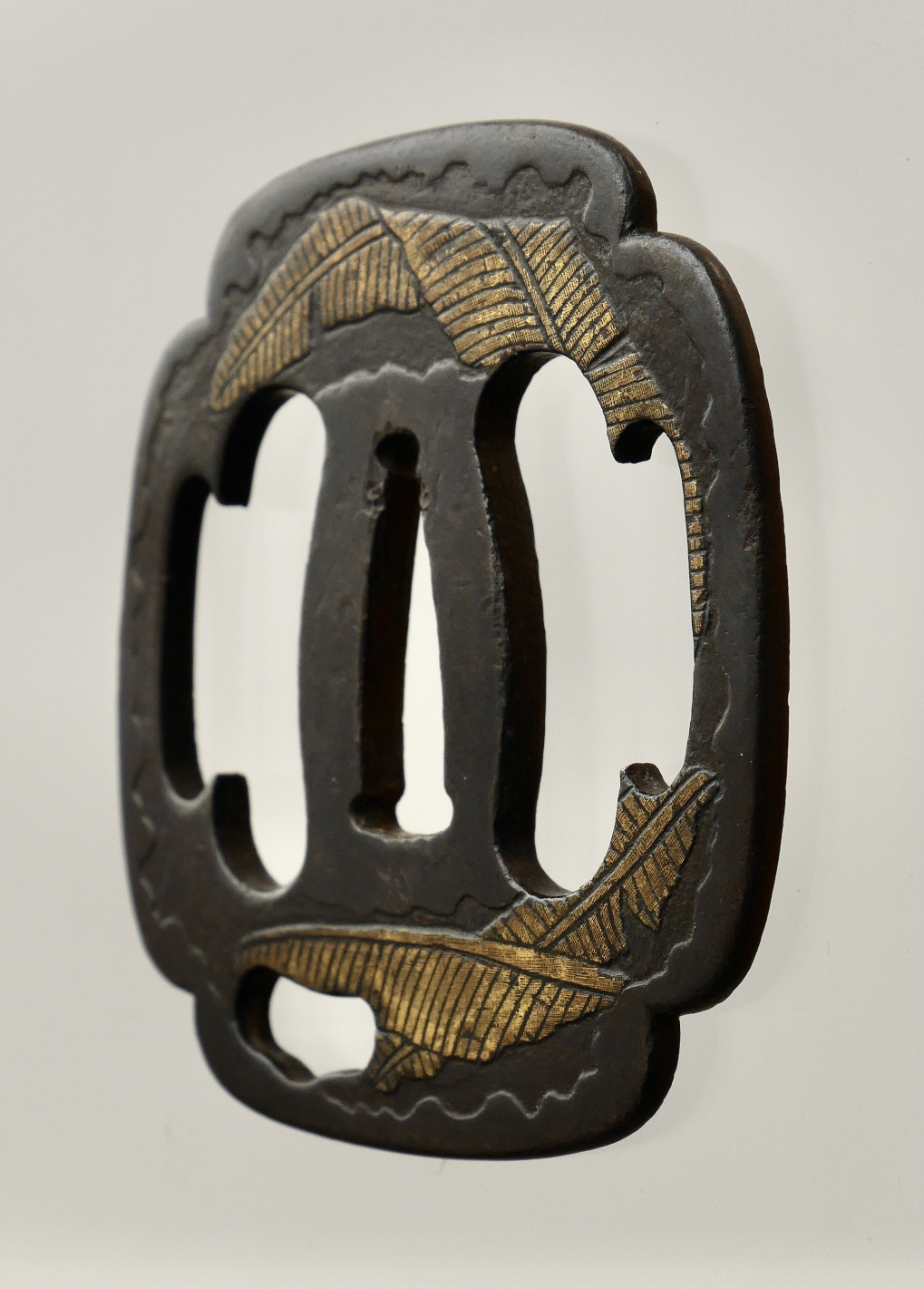
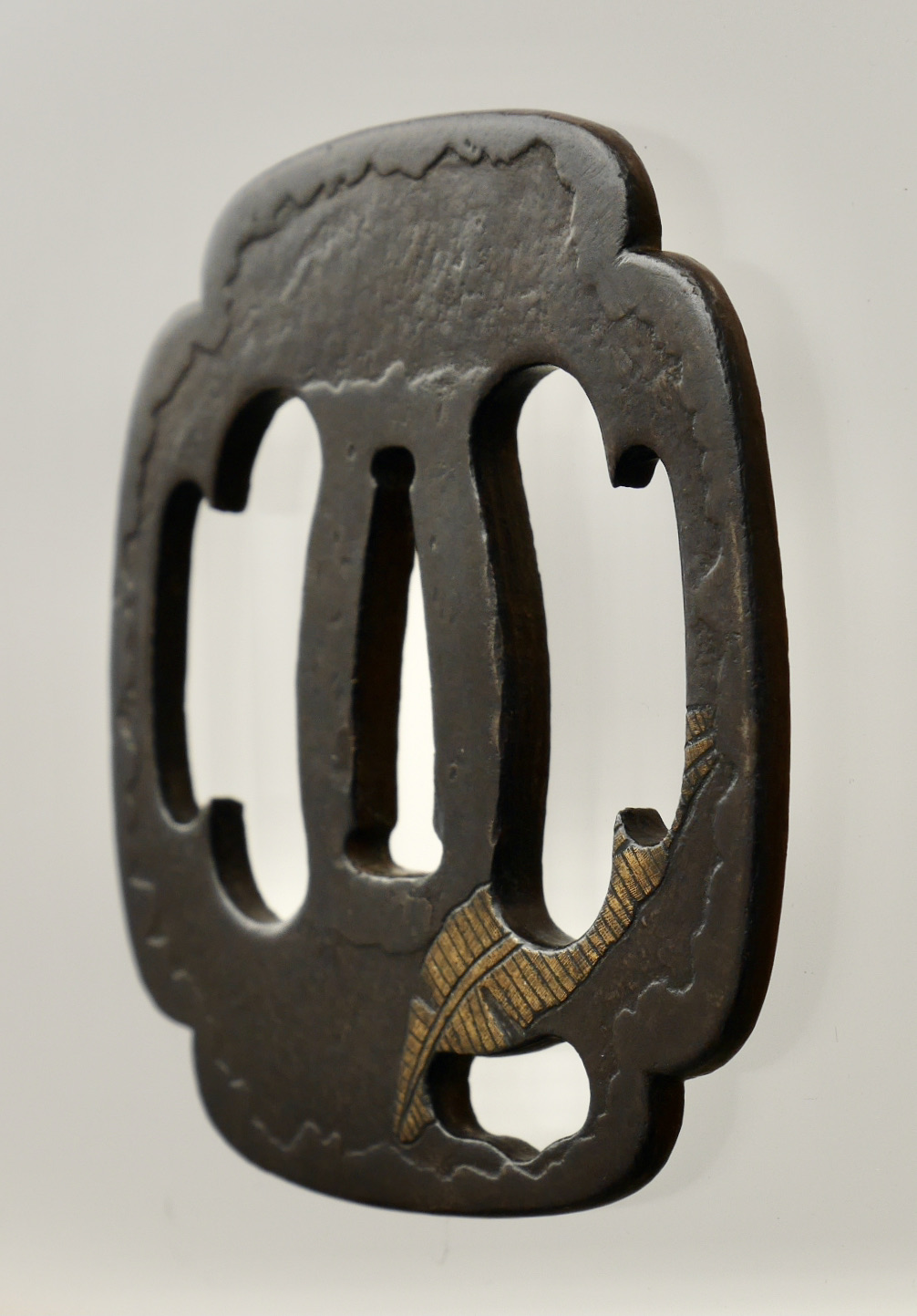
Machine translation of the shop's Japanese ·
Machine translation from the shop's Japanese · may contain errors ·
Higo · Higo
23 pieces on the market now
The Shimizu school is one of the four mainline houses -- together with Hayashi, Hirata, and Nishigaki -- that represent the orthodox tradition of Higo kinko (肥後金工). Its founder, the first-generation Shimizu Jinbei, is traditionally said to have been a nephew of Hirata Hikozo, and to have studied under him. All four founding masters were retained by the great tea-master and warrior Hosokawa Sansai (Tadaoki) and received his direct guidance. In Kan'ei 9 (1632), following the dispossession of the Kato family, Sansai's son Tadatoshi was enfeoffed with 540,000 koku at Kumamoto; Sansai then withdrew to Yatsushiro Castle in the same province as his place of retirement. The first-generation Jingo accompanied Hikozo in following Sansai to Yatsushiro, where the Shimizu line would flourish through successive generations as retained metalworkers under Hosokawa patronage. From the second generation onward, the heads of the house took the professional name Jingo (甚五), which was "succeeded by multiple generations," though no signed works by the first or second generation are known. Among the Higo metalworkers, the Shimizu school stands out for what the NBTHK setsumei consistently describe as "the most intense individuality" (hitokirwa kyoretsu na kosei). The technical hallmark of the school is bold brass suemon-zogan (据紋象嵌, raised inlay) executed on iron plates finished in a hammered ground with a yakite (burnt-hammer) surface treatment.
On the obverse, subjects such as fierce birds of prey, roosters, owls (mimizuku), ameryu (rain dragons), octopi, and crabs are rendered on a large scale with powerful relief. In deliberate contrast, the reverse is composed with broad expanses of open space, the motifs placed in smaller scale with gentler coloration and more restrained modeling, thereby balancing the two sides and deepening a quiet, austere atmosphere of sabi (寂). This asymmetrical yet harmonious interplay of obverse animation and reverse stillness is the school's most recognizable compositional device, described in setsumei after setsumei as producing works that are "overall remarkably well-balanced" despite their apparent asymmetry. While brass suemon-zogan on iron constitutes the dominant mode -- an approach "probably modeled on Heianjō-style inlay, yet what distinguishes it from Heianjō work is the boldness of the designs" -- the school's repertoire also encompassed sukidashi-takabori (raised carving) enriched with gold and silver nunome-zogan, as well as works on suaka (plain copper) ground, proving that its masters could convey the same weighty profundity regardless of the base metal. The Shimizu school occupies a singular position within the Higo kinko tradition as its most unconventional and artistically forceful lineage. " His owl-on-pine and hawk-on-pine compositions are so closely identified with his name as to be "virtually synonymous" with it, and the NBTHK has described his finest works as possessing a quality whereby "great skill appears clumsy" (taiko wa setsu naru ga gotoshi): what looks artless is not artless, but rather the expression of a technique so consummate that it surpasses conventional craft. Among his signed works, the rare mei "Uokin Jingo"[[c:1]] attests to his artistic identity, while the school's later use of diverse materials -- silver nunome-zogan, kebori (hairline engraving), and colored metals -- demonstrates the lineage's evolving technical range. The distinctive pictorial quality of the Shimizu manner, with its daring compositions, striking contrast between dark iron and bright brass, and an "open, generous atmosphere not encountered in the work of other metalworkers," answers to a sensibility that the setsumei note "also appeals to a modern sensibility" -- a testament to the enduring vitality of this Higo school's artistic vision. Learn more →
| Smith | Era | Designated |
|---|---|---|
| Jingo甚五 | — | 14 |
| Nagatsugu永次 | 1691-1777 | 0 |
| Jingoro甚五郎 | 1620-1710 | 0 |
| Shigenaga茂永 | 1795-1854 | 0 |
| Jingo甚吾 | — | 0 |
Certifies a genuine fitting worth preserving: a correct signature, or, if unsigned, an identifiable era and school, with recognized artistic and craft value.
The NBTHK (Nihon Bijutsu Tōken Hozon Kyōkai, the Society for the Preservation of Japanese Art Swords) is a public-interest incorporated foundation founded in 1948 and supervised by Japan’s Agency for Cultural Affairs (Bunkachō); it is based at the Japanese Sword Museum in Tokyo. Its expert panels physically examine each submitted work (shinsa) and issue a certificate (kanteishō) ranking it by artistic and historical merit. NBTHK papers are the most widely recognized standard of authentication for Japanese swords and fittings.
NBTHK official siteIf the item is not to your liking, we accept returns. As each item is one of a kind, please contact us within 7 days, counting the day of arrival, and send it back securely packed within a day or two of contacting us. Return shipping is at the customer's expense. Items delivered overseas cannot be returned.
¥380,000