 NihontoWatchNihontoWatch
The urayuki is strongly hammered out, as if to proclaim that these are old menuki. The thickness of the jihada is thin, and one can almost see the back of the metalsmith as he strikes the plate. As expected, the era reveals itself in the urayuki. No less than the face on the front, the urayuki is packed with the interest of exploring the true essence. However, the ne might be work from a later generation. I feel the color tone differs from the main body. Looking at the front, the iroe is gold uttori. A groove-like line can be confirmed at the bottom where the gold plate was applied. It is likely uttori zogan rather than fukuro-gise. Regarding that uttori, it seems it was originally applied to the peach fruits of both the omote and ura menuki, but currently it has peeled off cleanly. This in itself is to the extent that one might think it was in this state from the beginning, and it does not bother me. (This is just what this shop thinks, and I will not interfere with how everyone else perceives it.) Furthermore, gold tsuyu-zogan is adorned, and for its time, it must have been a considerably high-quality work. The kanteisho simply says kin-iroe, but I wish they would at least judge the difference between kin-iroe and kin-fukuro-gise (currently it seems fukuro-gise and uttori are treated the same)... (No, certainly both are types of kin-iroe without a doubt, and I am not complaining by wondering if they understand.) For that reason, this work is a reasonably old production. I believe it is from the Momoyama period, no, the late Muromachi period. From the deep and powerful horikuchi, could it be Joshin? Just kidding. Since it is designated as Ko-Goto, I was merely imagining a metalsmith that fits that era on my own. Please forgive me. Speaking of the peach motif, did you know it is surprisingly rare? In this work, the peach fruit is clearly placed in the center, with peach blossoms adding color, and as a form, it is something I am seeing for the first time. In that sense, it might be rare. (...This is also the opinion of this shop, and in truth, it might be a common design...)
NihontoWatchOffered by Asahi Token

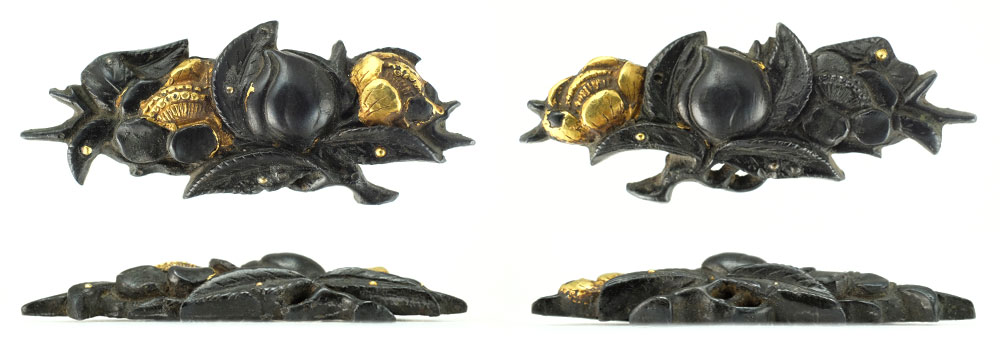
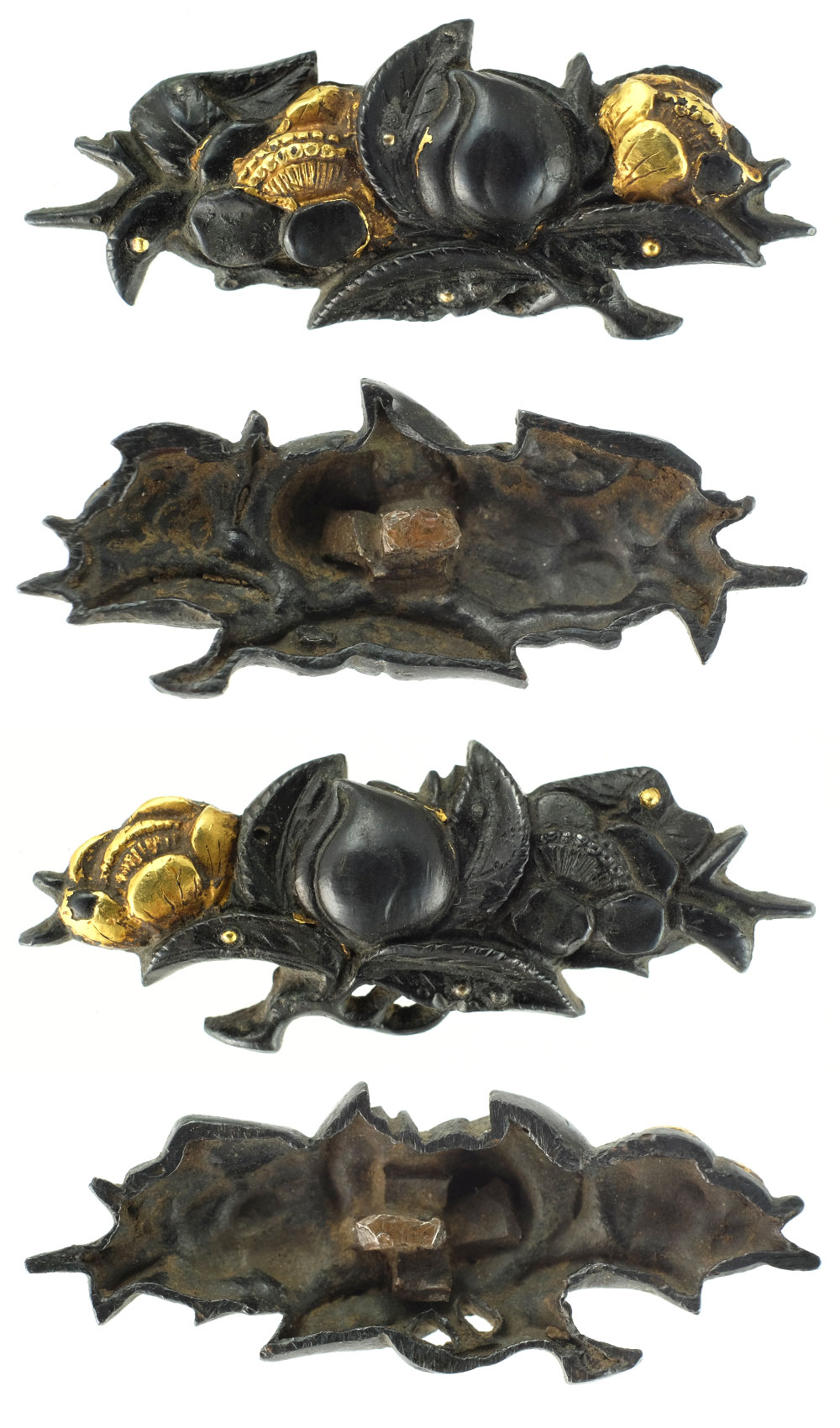
Goto School
Muromachi
Unsigned
Hozon (NBTHK)
Machine translation of the shop's Japanese ·
Machine translation from the shop's Japanese · may contain errors ·
Iebori · Yamashiro
315 pieces on the market now
The Goto house stands as the preeminent dynasty of sword-fitting makers in the history of Japanese metalwork, an unbroken lineage of seventeen generations spanning from the founding master Yujo (1440--1512), who served Ashikaga Yoshimasa amid the refined culture of Higashiyama, through the final head Hojo (1816--1856) in the closing years of the Tokugawa shogunate. From its inception the house served successive rulers -- Ashikaga shoguns, Oda Nobunaga, Toyotomi Hideyoshi, and the Tokugawa -- and its productions became known as iebori, the "house carving" distinguished from machibori made for ordinary public demand. The fourth master Kojo first introduced warrior subjects and employed preparatory drawings by Kano Motonobu and Eitoku; the fifth master Tokujo struck the celebrated "Tokujo kiri" hallmark upon oban gold coinage for Hideyoshi; the third master Joshin -- "not only a metalworker but also a warrior" -- was killed in battle against the Azai clan in 1562. The seventh master Kenjo, praised since ancient times as a restorer of the house's fortunes (the finest exponents being termed Yuko-ken), traveled to Kaga and laid the foundations for the later flourishing of the Kaga-Goto tradition, while the tenth master Renjo carried the mainline from Kyoto to Edo, where it would remain through the seventeenth generation. The eleventh master Tsujo bridged the formal tradition with the expressive spirit of the Genroku era, and the thirteenth master Enjo served as an authoritative appraiser, authenticating works by earlier masters across the entire succession. The collective technical vocabulary of the Goto house is built upon shakudo nanako-ji grounds of extraordinarily minute and dense stippling, upon which motifs are rendered in takabori with kin-iroe and gin-iroe, frequently supplemented by solid gold (kinmuku) construction and kin'ura gilt backing. The sculptural manner is characterized by what the NBTHK repeatedly describes as "high mountains and deep valleys" -- a modulation of volume in which modeling rises emphatically while recesses are cut deep and clean, producing forceful and crisply articulated relief.
" Sojo inherited and tightened these forms with controlled elegance; Joshin amplified them to conspicuously larger scale with claws that are "characteristically large and long, with the tips splayed open"; Eijo brought a finer, more delicate precision to compositions of equally grand ambition; and Kenjo introduced a distinctive shosha quality -- austere and urbane -- that distinguished his work from the first six generations. The later masters sustained this discipline: Teijo's calm restraint and distinctive coloristic effects, Renjo's forty-five years of deeply worked takabori capturing instantaneous warrior movements, Tsujo's innovative left-right spreading compositions, and Hojo's reintroduction of machibori aesthetics into the official house style all demonstrate the lineage's capacity for renewal within tradition. The Goto house's enduring significance resides not merely in the technical excellence of individual masters but in the institutional continuity of a critical tradition sustained across four centuries. Works from the "upper six generations" (kami roku-dai) through Eijo established the canonical repertoire of prescribed okitemono motifs -- dragons, lions, paulownia crests, Kurikara, and auspicious figures -- while successive heads served simultaneously as makers and authenticators, issuing origami certificates and kiwame-mei inscriptions that themselves constitute important documents of connoisseurship. Valuations reaching one thousand kan and transmission through such distinguished collections as the Konoike, Shimazu, Tokugawa, and Maeda houses attest to the unrivaled esteem in which Goto metalwork has been held. Even Sokujo, whose tenure lasted barely four years before his death at thirty-two, left a small but distinguished body of work authenticated across eight subsequent generations of headmasters. From Yujo's founding vision through Hojo's final flowering -- whose technical command the NBTHK judges the finest from the twelfth master onward, betraying "not the slightest hint of the approaching conclusion" of the unbroken line -- the Goto house represents the defining standard against which all Japanese metalwork is measured, the wellspring from which the entire sokeN kinkO tradition flows. Learn more →
| Smith | Era | Designated |
|---|---|---|
| Goto Joshin後藤乗真 | 1512-1562 | 68 |
| Goto Yujo後藤祐乗 | 1440-1512 | 41 |
| Goto Kenjo後藤顕乗 | 1586-1663 | 46 |
| Goto Sojo後藤宗乗 | 1461-1538 | 56 |
| Goto Teijo後藤程乗 | 1603-1673 | 42 |
Certifies a genuine fitting worth preserving: a correct signature, or, if unsigned, an identifiable era and school, with recognized artistic and craft value.
The NBTHK (Nihon Bijutsu Tōken Hozon Kyōkai, the Society for the Preservation of Japanese Art Swords) is a public-interest incorporated foundation founded in 1948 and supervised by Japan’s Agency for Cultural Affairs (Bunkachō); it is based at the Japanese Sword Museum in Tokyo. Its expert panels physically examine each submitted work (shinsa) and issue a certificate (kanteishō) ranking it by artistic and historical merit. NBTHK papers are the most widely recognized standard of authentication for Japanese swords and fittings.
NBTHK official siteReturns are accepted within 7 days of the item's arrival, provided its condition has not changed since the time of sale. Once the return is confirmed, the payment is promptly refunded to your designated account.
¥180,000