 NihontoWatchNihontoWatch
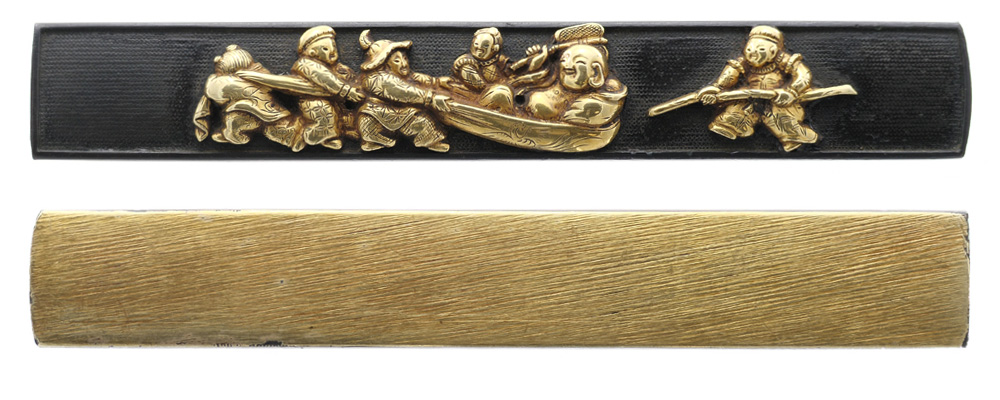
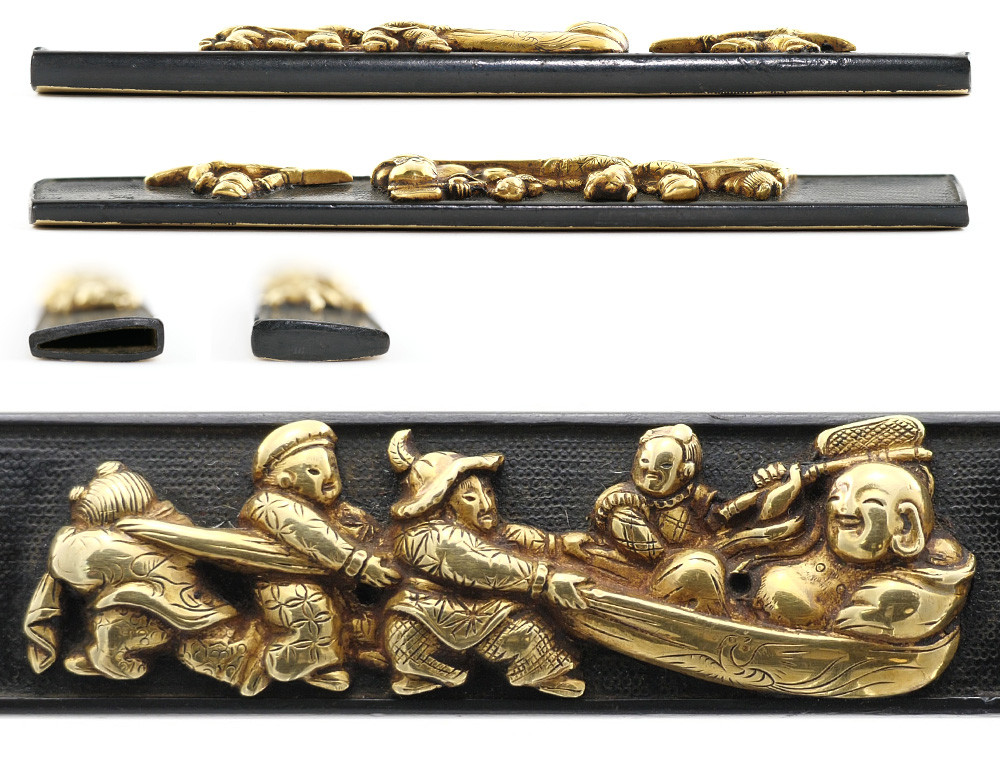
地板(額)の面積に対して不釣り合いなほど大きな金紋が、どっかりと据えられています。左右の幅はさほどでもありませんが、天地は小縁にかかるほどの大きさ。これだけだったらまだしも、その立体感が半端なく、これでもかと迫り来る迫力です。もう高彫という域ではなく立体彫と言える代物で、なおかつ金紋ですから重量感もさることながら贅沢な一品。ただ、大柄な金紋に対してキャンパスとなる地板が貧相に見えることが少し残念かと・・・と、ここまでは良いのですが、ちょっとデザイン的に無理をしたかの如きこの小柄が悦乗に極められていることには、かなり抵抗を覚えます。 金紋自体の彫は確かに細かく丁寧で顔の表情もしっかり彫られています。正直上手いです。問題はやはりこの大きさで、後藤家九代・程乗の次男である悦乗がここまでアンバランスな作を作るのか?という点。仮にも前田家のお抱え工であり、加賀後藤の立役者、そして実質的な創始者と言われている悦乗がです。ん〜腑に落ちません。贅沢な金紋で画題と作風が似ているからでしょうか。確かに親である程乗極めの作に本小柄と瓜二つの作があるようです。様々な点で類似し、違っているのは服装の模様、帽子の形状、右端の唐子が持っている棒の形状ぐらい。他の部分はほぼ同じ図柄・形状をしています。しかし、程乗の布袋唐子の紋は本作のようにアンバランスではなく地板に見合うサイズで、品格も感じられます。それに比して・・・(まあ、どちらも後藤家の作ではない可能性もありますが)・・・逃道の仮説として、こういう見方はどうでしょうか。この本体は後補の作で、後世の金工が紋だけ移植した・・・本体の裏面に施された金の焼付が小縁まで回り込まず中途半端な気がするのです。悦乗の手になる作であれば、金紋とのバランスそして風合いを考慮し、小縁まで回り込ませても不思議ではありません。さらにこの金紋は上部からのリベット留め。留めるために空けられた穴が3カ所あり、どうみても後補の所作にしか思えません。悦乗なら新規製作時にこんな造込をしない、そう考えるのが自然な気がします。であれば元来の作は一回り大きい小柄だったことになりますが、ギリギリ許容範囲としたいところです。 ともあれ本作の鑑定書の極は悦乗。無理にそれを受け入れるとすれば、このアンバランスなレイアウトは布袋唐子の由来を皮肉って悦乗があえてこのレイアウトにしたとも考えられますね。気ままで怠慢でいい加減な布袋様を真似て、その風刺をこの大きすぎる金紋で表現したのかもしれません。
NihontoWatchOffered by Asahi Token
This piece has sold
74 on the market
Get an email when new Waki-Goto School work hits the market.

Waki-Goto School
Edo
Unsigned
Hozon (NBTHK)
As written by the shop
Iebori · Kyoto
74 pieces on the market now
The Waki-Goto tradition designates the branch and collateral lines of the Goto mainline (soke) that sustained the family's metalworking legacy across generations while extending its reach beyond the central house in Kyoto and later Edo. The Goto family itself constituted the preeminent dynasty of sword-fitting craftsmen in Japanese history, serving successive shogunal families from the Muromachi period through the Edo era. Their work, designated iebori ("house carving"), was distinguished from the machibori ("town carving") produced for general market demand. Among the most important Waki-Goto lines were the Rihei house, established by Teijo (the ninth mainline master) and continued through Etsujo, who anchored the tradition in Kaga Province under Maeda patronage; the various mainline heads themselves -- Kojo (fourth generation), Renjo (tenth generation), and Teijo -- who shaped the canonical vocabulary; and the later Shichiroemon branch, which produced Ichijo and Koran, the terminal masters who brought the Goto heritage to its culminating expression in the Bakumatsu period. The technical vocabulary of the Waki-Goto lineages adheres with remarkable fidelity to the orthodox manner established by the founding patriarch Yujo. The characteristic ground is shakudo finished with impeccably regular nanako-ji, praised across generations for its orderly precision and deep, limpid quality. Upon this lustrous black surface, motifs are rendered through takabori and sukidashi takabori (raised high-relief carving) enriched by gold and silver iroe, with solid gold nikubori and sculptural yobori employed for menuki. The canonical Goto subjects -- dragons, lions (shishi), kirin, and clouds -- recur throughout the lineage, transmitted according to established conventions and executed with meticulous niku-dori (modulation of sculpted flesh). Kojo, identified as second in ability only to the founder, introduced preparatory drawings (shita-e) by Kano masters and is credited with originating warrior-figure and dragon-and-tiger motifs within the house.
His works display the Momoyama spirit -- heroic, dynamic, and brimming with vitality. Teijo's carving is characterized as restrained and meticulous, achieving a crisp, controlled effect, while Renjo inherited his father's methods and introduced fresh elements: robust and magnificent carving that "raises the peaks high and drives the valleys deep," recalling the grand manner of the early generations. Etsujo, transmitting the mainline aesthetic into Kaga, maintained a standard "in no way inferior to that of Teijo," and his contributions are credited with fostering the flourishing of Kaga metalwork. The later Shichiroemon branch, under Ichijo and Koran, shifted toward compositions grounded in close observation from life -- birds, flowers, and landscapes -- while sustaining the ancestral foundation of nanako-ji grounds, polychrome iroe, and chuya shitate (day-and-night construction). Across all branches, signed works are characterized as exceedingly rare and of high documentary value. The Waki-Goto tradition represents the mechanism by which the Goto house's artistic achievement was preserved, transmitted, and adapted across nearly five centuries. " The Rihei branch's transplantation to Kaga ensured that the tradition flourished beyond its Kyoto and Edo centers, while the Shichiroemon branch's culmination in Ichijo produced an artist whose command of the full kinko repertoire "adorned the shaft-end" of the entire Goto lineage. Works from across the Waki-Goto branches have been transmitted through distinguished collections -- the Konoike merchant house, the Hachisuka and Maeda daimyo families -- and carry origami appraisals from successive Goto masters assigning valuations of exceptional magnitude. In its collective continuity and its capacity to adapt the iebori heritage to changing tastes while preserving its essential dignity, the Waki-Goto tradition stands as one of the most remarkable dynasties in the decorative arts of Japan. Learn more →
| Smith | Era | Designated |
|---|---|---|
| Korejo是乗 | 1818-1830 | 3 |
| Munetomo/Sochi宗知 | — | 0 |
| Morimura Atsutaka守邨厚隆 | — | 0 |
| Taijo泰乗 | — | 0 |
| Mitsuharu光治 | — | 0 |
Certifies a genuine fitting worth preserving: a correct signature, or, if unsigned, an identifiable era and school, with recognized artistic and craft value.
The NBTHK (Nihon Bijutsu Tōken Hozon Kyōkai, the Society for the Preservation of Japanese Art Swords) is a public-interest incorporated foundation founded in 1948 and supervised by Japan’s Agency for Cultural Affairs (Bunkachō); it is based at the Japanese Sword Museum in Tokyo. Its expert panels physically examine each submitted work (shinsa) and issue a certificate (kanteishō) ranking it by artistic and historical merit. NBTHK papers are the most widely recognized standard of authentication for Japanese swords and fittings.
NBTHK official siteReturns are accepted within 7 days of the item's arrival, provided its condition has not changed since the time of sale. Once the return is confirmed, the payment is promptly refunded to your designated account.