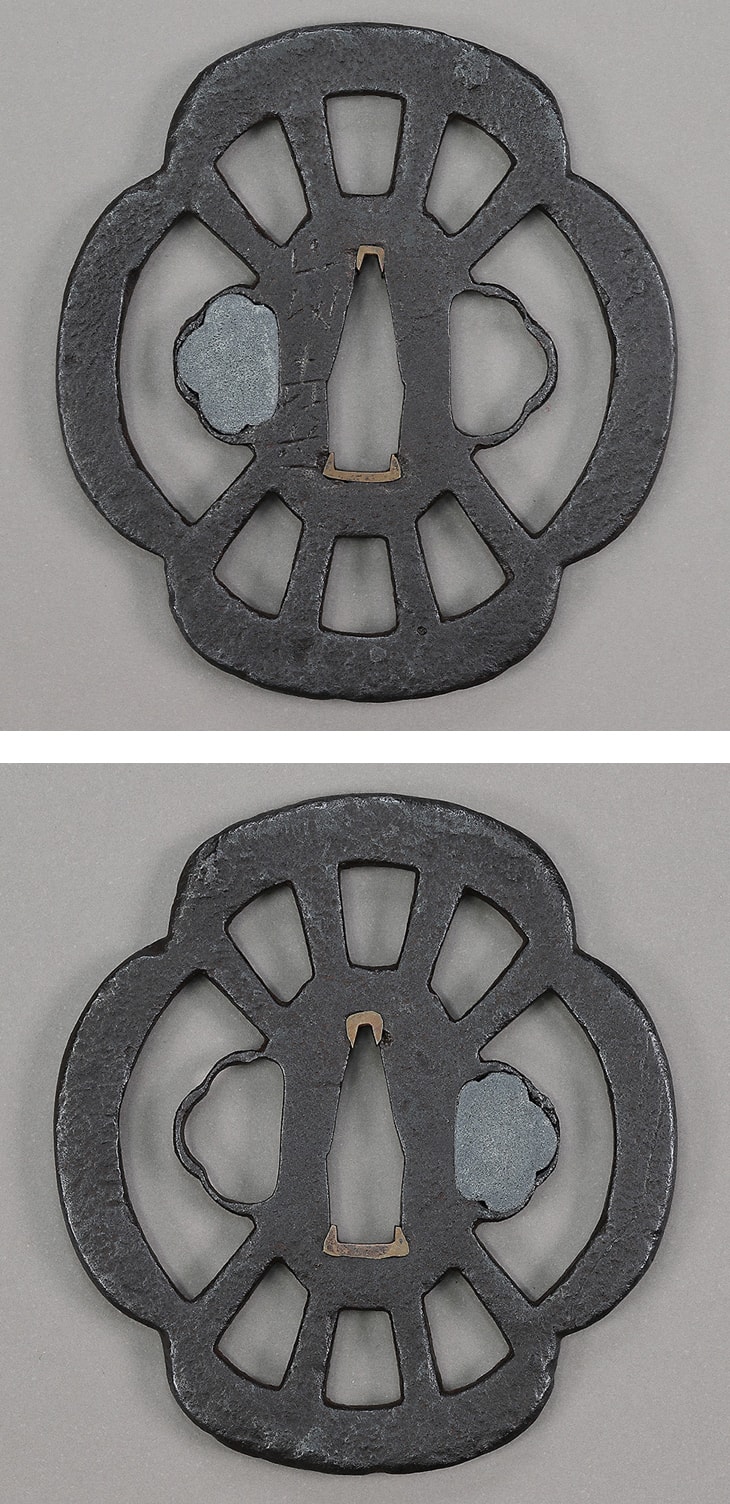
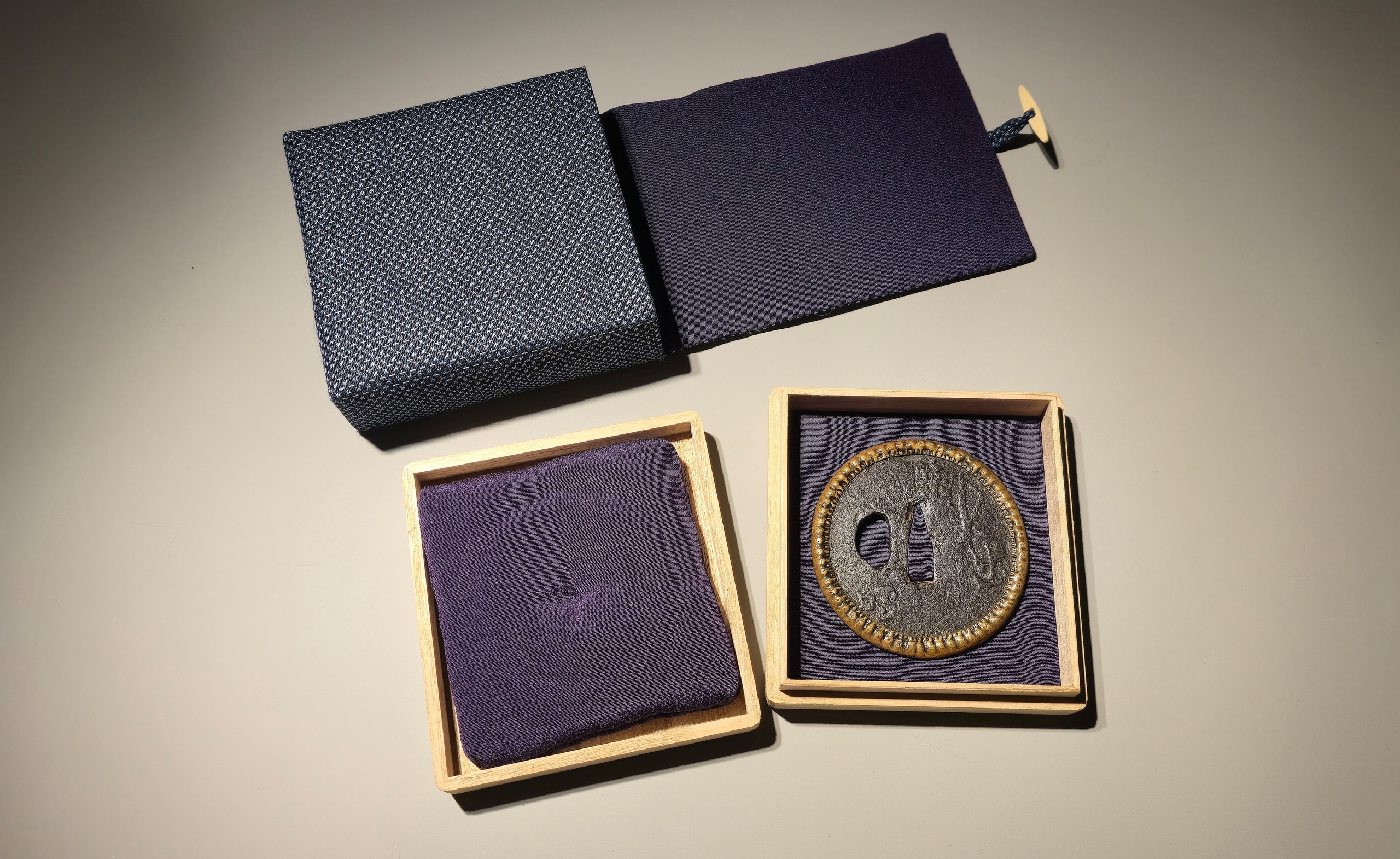
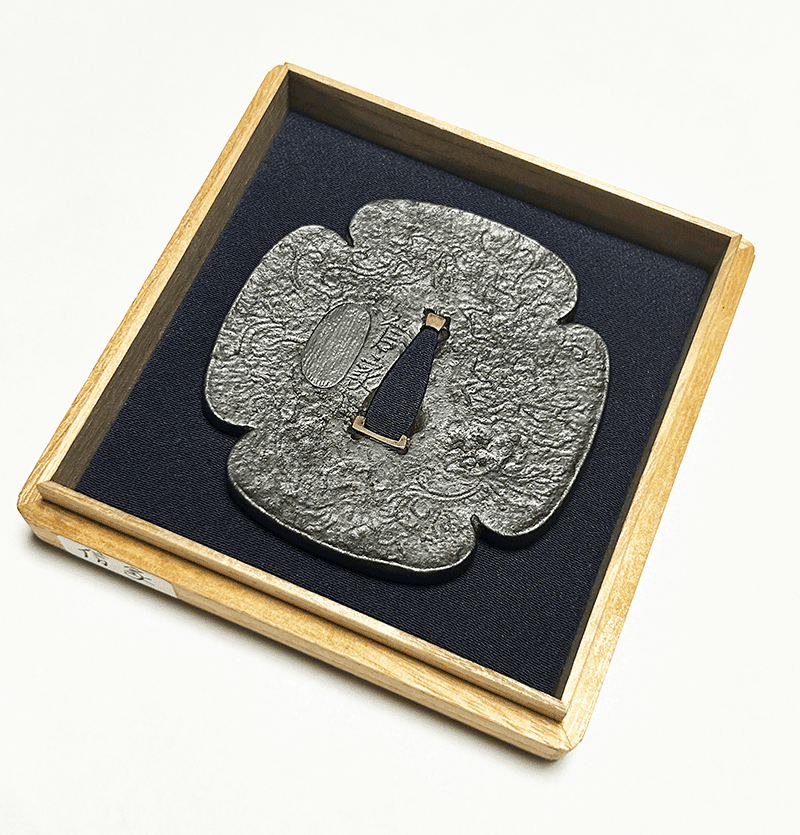
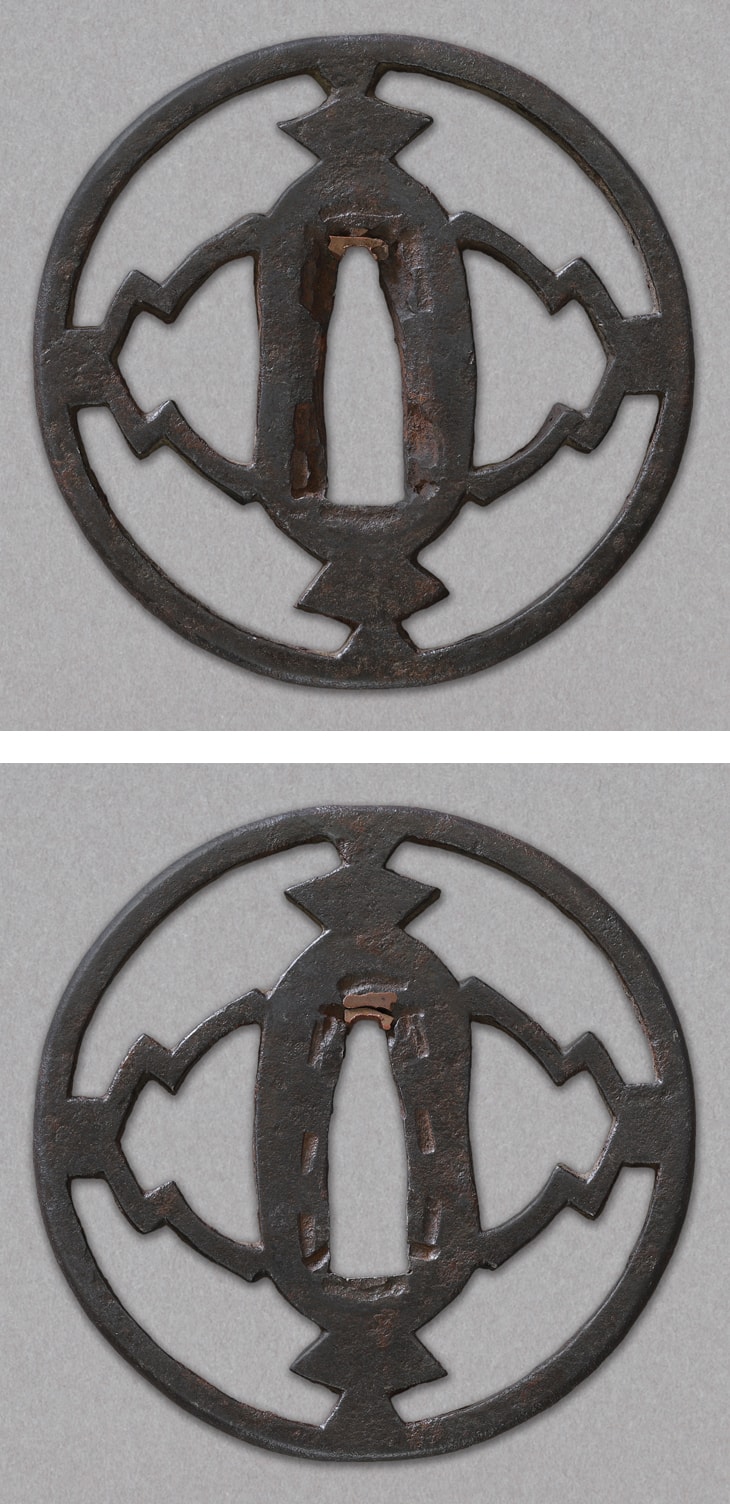
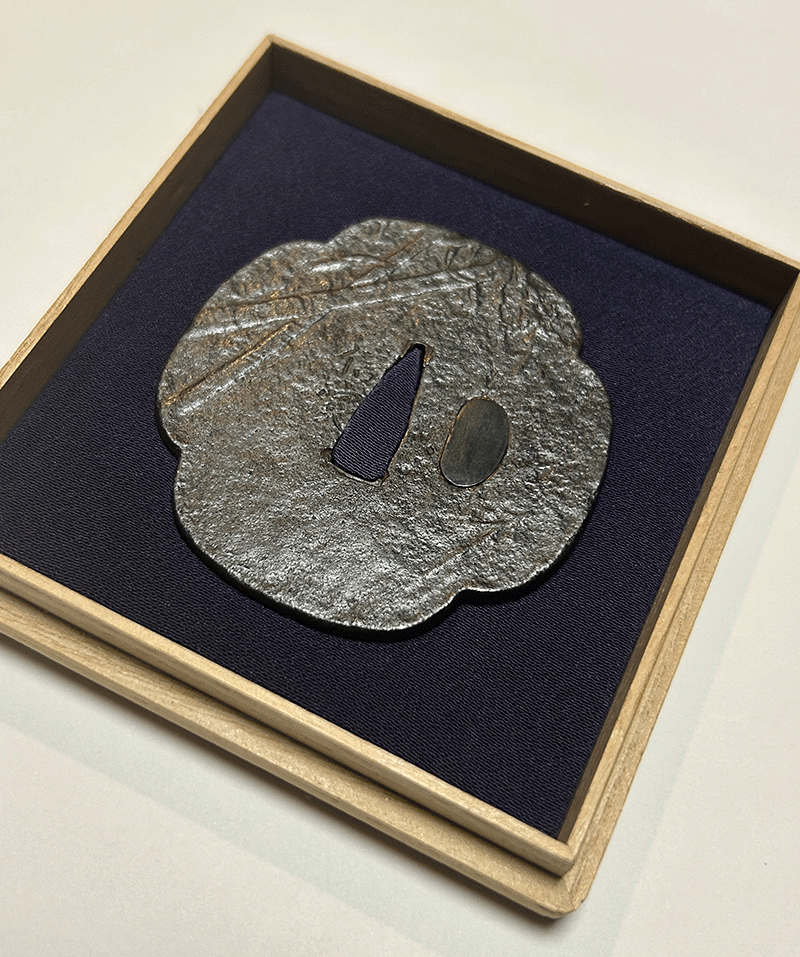
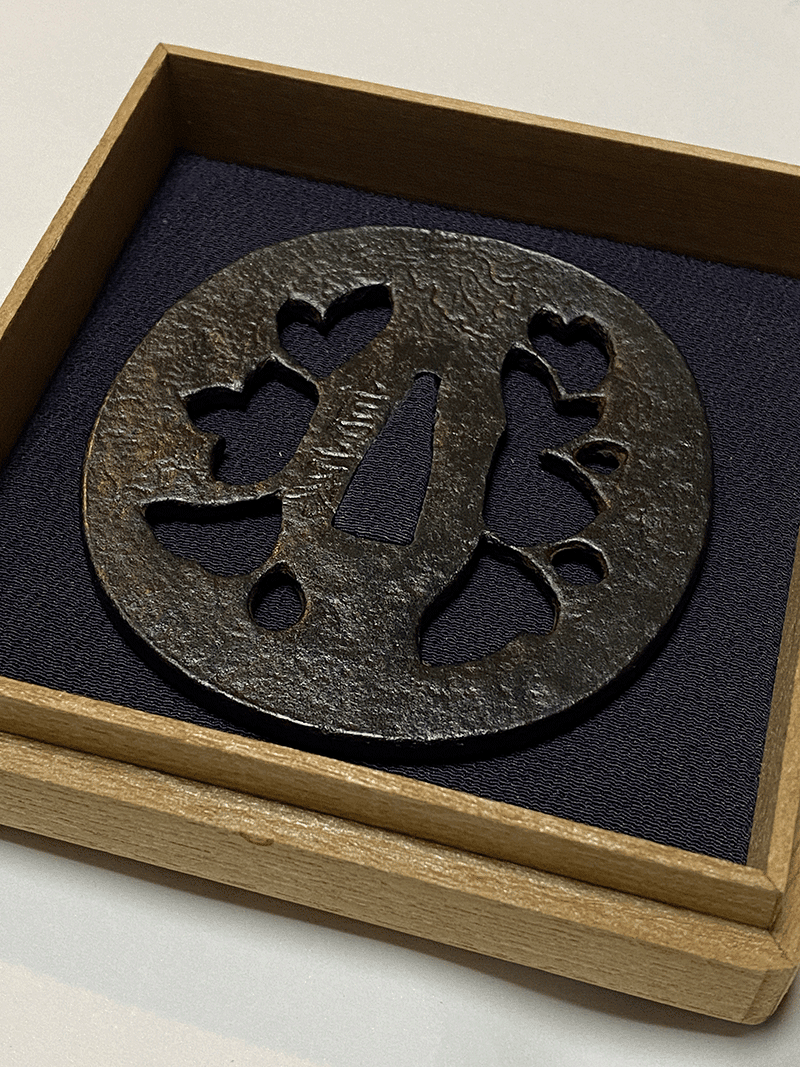
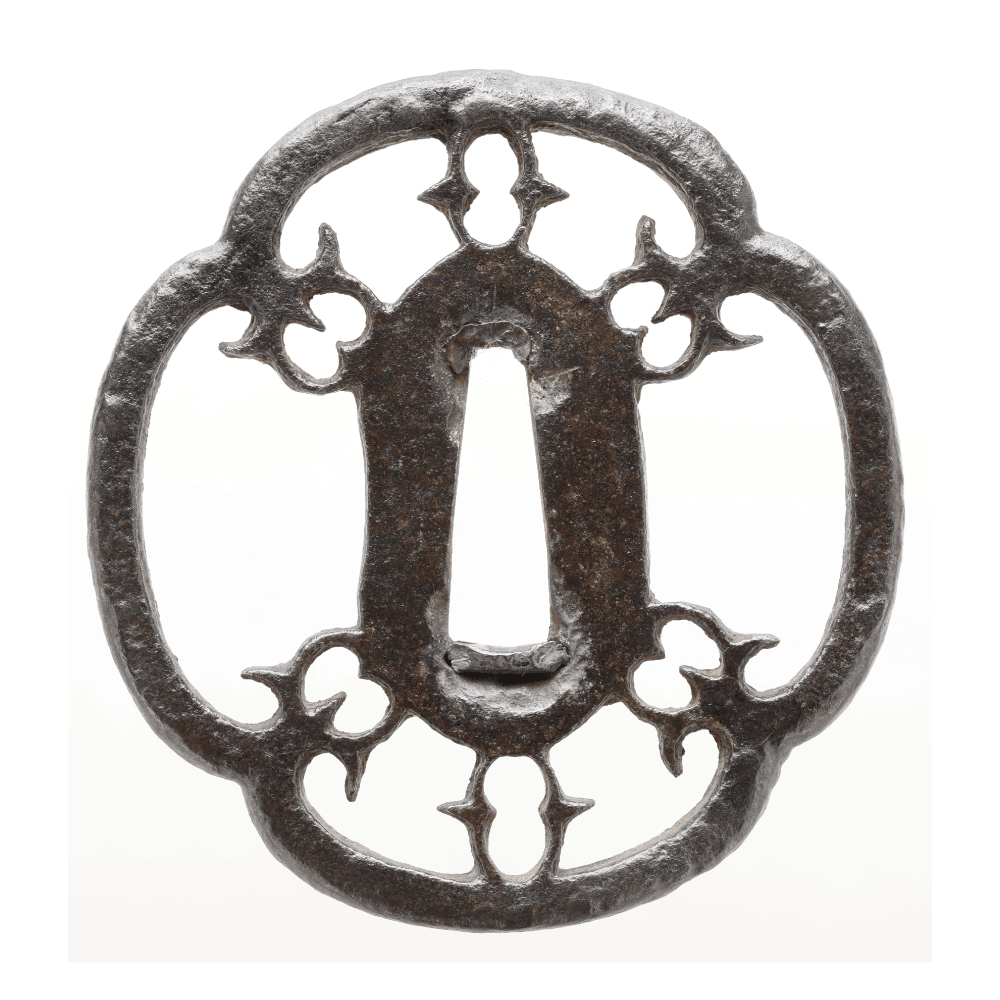
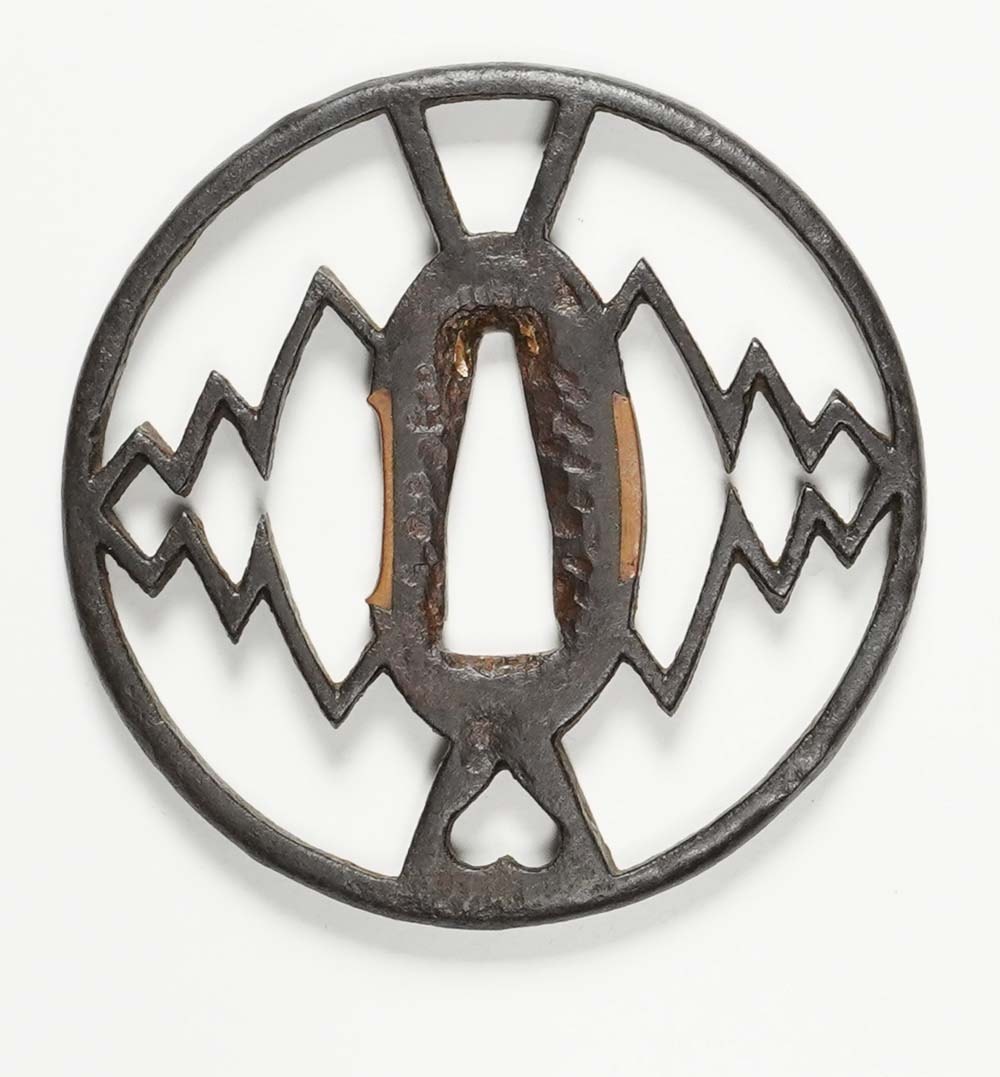
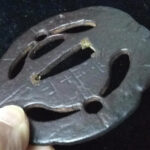
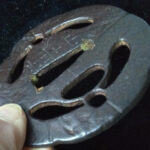
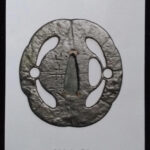
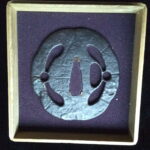
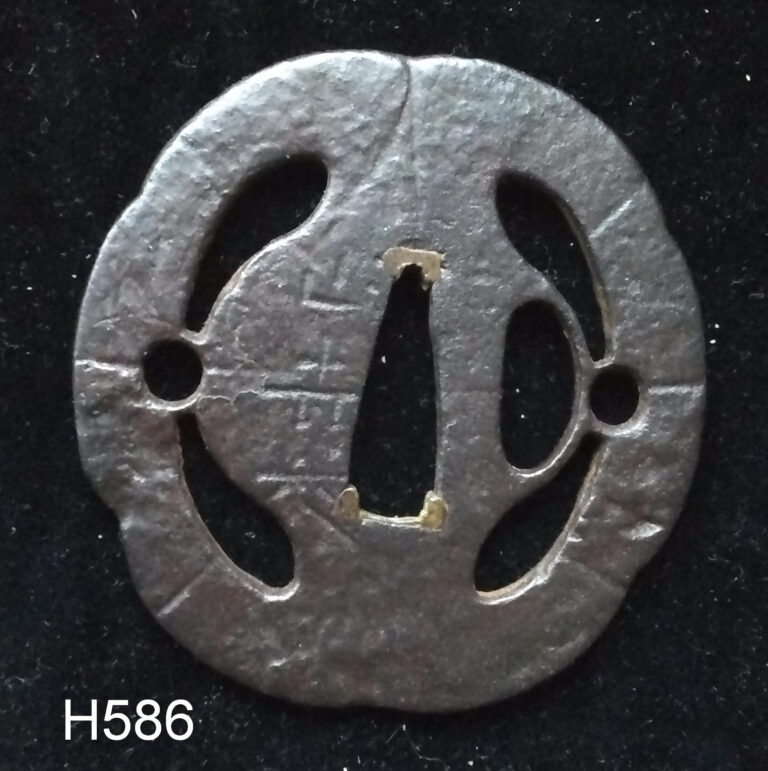
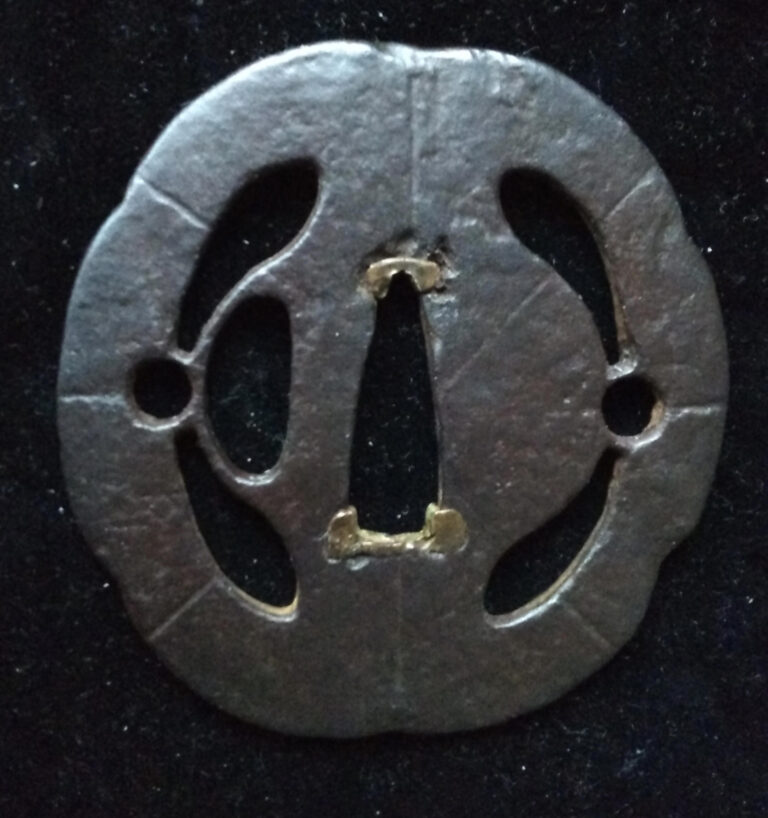
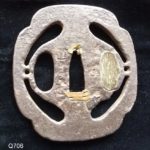
This is an iron sukashi tsuba signed by Yamakichibei, measuring 7 x 7.4 x 0.35 cm. It features a classic design, possibly rabbits or dragonflies, with prominent tekkotsu on the rim and plate, and a partially melted (yakite) surface. The tsuba is in excellent condition and comes with a fitted box and pillow.
 NihontoWatch
signed
Yamakichi Yamakichibei
Sagami
Signed
Iron-tsuba · Owari
4 pieces on the market now
Yamakichibei — also recorded as Yamasaka Kichibee — is regarded, together with Hōan, as one of the representative tsubakō of Owari. He worked in the Momoyama period, and while it has long been circulated that the first generation was a disciple of Nobuie, the NBTHK notes that "there are no documents or firsthand examined works that substantiate a master–pupil relationship." Points held in common with Nobuie are in fact scarce; rather, there are many similarities with Hōan, giving a stronger sense of connection to that line. The name was inherited over several generations, distinguished by the calligraphic style of the chisel-cut signature: those signed in full as "Yamasaka Kichibee" are considered stylistically the earliest, while the third generation further adds a cherry-blossom seal alongside the provincial designation Bishū.
Yamakichibei's iron guards are characterized by commanding presence, excellent forging, and the prominent emergence of tekkotsu (iron bones) through yaki-namashi (annealing), which imparts what the NBTHK describes as an elegant taste while also evoking a sense of strength. The Amida-yasuri (radiating file marks) for which the school is celebrated represent "the very essence" of the second generation's art; it is said that "whether among earlier or later works, no one equals Yamakichibei in Amida-yasuri." The file marks appear as though cut in double lines, integrating with tsuchime-ji (hammered ground) and fire-finished surfaces to produce grounds whose appearance "changes with remarkable freedom and variety." Representative openwork designs include geese-and-sickle (gankama sukashi), wheels, chrysanthemums, and fence motifs — all rendered with an unpretentious, rustic sukidashi treatment. The robust uchikaeshi-mimi (turned-back rim) further tightens the silhouette, and the tekkotsu densely set within it proclaim the beauty of iron tsuba.
The NBTHK repeatedly identifies Yamakichibei's works as guards that "appear all the more striking when mounted on the uchigatana-koshirae that were in vogue at the time," affirming their essential unity with Momoyama-period martial culture. Across designated examples, evaluative language converges on a distinctive rustic charm and deep, subdued elegance — a beauty described as "solitary and aloof," residing within formidable workmanship, that "resonates with the spirit of bushidō." The interplay of powerful tekkotsu, richly nuanced hammering, and restrained openwork constitutes an aesthetic inherited from the earliest armorer's and swordsmith's guards, elevated to a level "fully worthy of demonstrating Yamakichibei's true value" within the Owari iron-plate tradition.
Where Yamakichibei stands among comparable artisans: across all of nihontō, and within tradition, era, and period. The tiers (Foremost · Leading · Major · Notable) weigh official designations from the NBTHK and Japan's Agency for Cultural Affairs, together with historical honors of lasting repute such as the Sansaku and Meibutsu-chō.
Select a lens to see how it's measured.
Iron-tsuba · Owari
4 pieces on the market now
The Yamakichibei lineage, originally known by the full surname Yamasaka Kichibei[[c:1]], constitutes one of the two pillars of the Owari tsuba tradition, standing alongside Hoan as a representative tsubako of the province. The school is said to have originated as armorers in the service of the Oda family, and the earliest works -- those signed in full as "Yamasaka Kichibee"[[c:2]] without abbreviating the surname -- are associated with a maker active around the Genki era (c. 1570) in the closing years of the Muromachi period. These display the most archaic stylistic character within the school's oeuvre. The name was thereafter inherited across several generations: works signed "Yamakichibei"[[c:3]] in abbreviated form are attributed to the second generation, active in the Momoyama period, while makers who styled themselves "Sakura Yamakichi"[[c:4]] with a cherry-blossom seal and the Bishu province name are placed in the Kanbun to Genroku eras (1661--1704). It has long been circulated that the first-generation Yamakichibei was a disciple of Nobuie; however, as the NBTHK setsumei observe, "there are no documents or firsthand examined works that substantiate a master-pupil relationship," and points held in common with Nobuie are in fact scarce. Rather, there are many similarities with Hoan works, giving a stronger sense of connection to that line. The collective style of the Yamakichibei school is grounded in the forging and finishing of iron plate. " The tsuchime (槌目, hammered ground) and yakite-shiage (焼手仕上げ, fire finishing) produce surfaces of remarkable freedom and variety, with a characteristic reddish-cast rust tone to the iron's patina.
" Openwork designs are rendered in a rustic, unpretentious idiom; the school's representative sukashi motifs include ganigama-sukashi (wild geese and sickle) and kuruma-sukashi (cart-wheel openwork), the latter a specialty shared broadly among Owari makers. Chrysanthemum forms and sukidashi-bori (ground carved away to leave the motif in relief) also appear. The uchikaeshi-mimi (打返耳, turned-back rim) is a recurring structural element, powerfully executed and dense with granular tekkotsu, while the lead-filled hitsu-ana set slightly below the surrounding ground constitute the "Owari plugging" (Owari-ume) prized by connoisseurs. " The Yamakichibei school occupies a central place in the canon of Owari iron tsuba. The first generation -- the so-called "great first generation" (o-shodai) signing "Yamasaka Kichibee" -- produced works of striking formal innovation, adopting the otafuku mokko-gata form and bold, large-scale openwork whose taut, sharply defined lines convey what the NBTHK describes as the severity of the Sengoku period. The second generation refined the school's aesthetic toward a more nuanced interplay of Amida-yasuri and hammered texture, achieving an "aloof beauty" (koko no utsukushisa) that the setsumei characterize as resonant with the spirit of bushido. The school's works inherit "the elegant flavor of early tsuba -- such as armorer's (katchushi) tsuba and swordsmith (tosho) tsuba" -- while investing that legacy with a distinctive rustic vigor and deep, subdued elegance. Across generations, the Yamakichibei tradition embodies the defining virtues of Owari workmanship: powerful forging, expressive tekkotsu, and an unadorned beauty born of iron mastery. Learn more →
| Smith | Era | Designated |
|---|---|---|
| Yamakichibei山吉兵衛 | — | 10 |
| Yamakichibei山吉兵衛 | Momoyama | 3 |
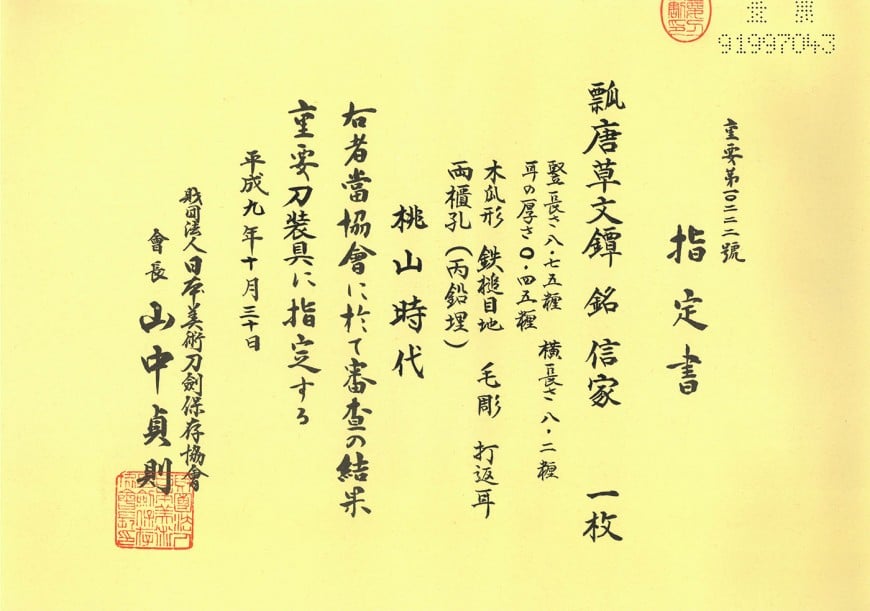
We could not find an authenticity certificate on the seller’s listing. Japanese swords and fittings are normally papered by the NBTHK (or the NTHK). Without one, the attribution is the seller’s own assessment and has not been independently verified — treat it with caution and ask the dealer about certification before buying.
3-day return window from receipt.
This is an iron sukashi tsuba signed by Yamakichibei, measuring 7 x 7.4 x 0.35 cm. It features a classic design, possibly rabbits or dragonflies, with prominent tekkotsu on the rim and plate, and a partially melted (yakite) surface. The tsuba is in excellent condition and comes with a fitted box and pillow.
NihontoWatchsigned
Yamakichi Yamakichibei
Sagami
Signed
Iron-tsuba · Owari
4 pieces on the market now
Yamakichibei — also recorded as Yamasaka Kichibee — is regarded, together with Hōan, as one of the representative tsubakō of Owari. He worked in the Momoyama period, and while it has long been circulated that the first generation was a disciple of Nobuie, the NBTHK notes that "there are no documents or firsthand examined works that substantiate a master–pupil relationship." Points held in common with Nobuie are in fact scarce; rather, there are many similarities with Hōan, giving a stronger sense of connection to that line. The name was inherited over several generations, distinguished by the calligraphic style of the chisel-cut signature: those signed in full as "Yamasaka Kichibee" are considered stylistically the earliest, while the third generation further adds a cherry-blossom seal alongside the provincial designation Bishū.
Yamakichibei's iron guards are characterized by commanding presence, excellent forging, and the prominent emergence of tekkotsu (iron bones) through yaki-namashi (annealing), which imparts what the NBTHK describes as an elegant taste while also evoking a sense of strength. The Amida-yasuri (radiating file marks) for which the school is celebrated represent "the very essence" of the second generation's art; it is said that "whether among earlier or later works, no one equals Yamakichibei in Amida-yasuri." The file marks appear as though cut in double lines, integrating with tsuchime-ji (hammered ground) and fire-finished surfaces to produce grounds whose appearance "changes with remarkable freedom and variety." Representative openwork designs include geese-and-sickle (gankama sukashi), wheels, chrysanthemums, and fence motifs — all rendered with an unpretentious, rustic sukidashi treatment. The robust uchikaeshi-mimi (turned-back rim) further tightens the silhouette, and the tekkotsu densely set within it proclaim the beauty of iron tsuba.
The NBTHK repeatedly identifies Yamakichibei's works as guards that "appear all the more striking when mounted on the uchigatana-koshirae that were in vogue at the time," affirming their essential unity with Momoyama-period martial culture. Across designated examples, evaluative language converges on a distinctive rustic charm and deep, subdued elegance — a beauty described as "solitary and aloof," residing within formidable workmanship, that "resonates with the spirit of bushidō." The interplay of powerful tekkotsu, richly nuanced hammering, and restrained openwork constitutes an aesthetic inherited from the earliest armorer's and swordsmith's guards, elevated to a level "fully worthy of demonstrating Yamakichibei's true value" within the Owari iron-plate tradition.
Where Yamakichibei stands among comparable artisans: across all of nihontō, and within tradition, era, and period. The tiers (Foremost · Leading · Major · Notable) weigh official designations from the NBTHK and Japan's Agency for Cultural Affairs, together with historical honors of lasting repute such as the Sansaku and Meibutsu-chō.
Select a lens to see how it's measured.
Iron-tsuba · Owari
4 pieces on the market now
The Yamakichibei lineage, originally known by the full surname Yamasaka Kichibei[[c:1]], constitutes one of the two pillars of the Owari tsuba tradition, standing alongside Hoan as a representative tsubako of the province. The school is said to have originated as armorers in the service of the Oda family, and the earliest works -- those signed in full as "Yamasaka Kichibee"[[c:2]] without abbreviating the surname -- are associated with a maker active around the Genki era (c. 1570) in the closing years of the Muromachi period. These display the most archaic stylistic character within the school's oeuvre. The name was thereafter inherited across several generations: works signed "Yamakichibei"[[c:3]] in abbreviated form are attributed to the second generation, active in the Momoyama period, while makers who styled themselves "Sakura Yamakichi"[[c:4]] with a cherry-blossom seal and the Bishu province name are placed in the Kanbun to Genroku eras (1661--1704). It has long been circulated that the first-generation Yamakichibei was a disciple of Nobuie; however, as the NBTHK setsumei observe, "there are no documents or firsthand examined works that substantiate a master-pupil relationship," and points held in common with Nobuie are in fact scarce. Rather, there are many similarities with Hoan works, giving a stronger sense of connection to that line. The collective style of the Yamakichibei school is grounded in the forging and finishing of iron plate. " The tsuchime (槌目, hammered ground) and yakite-shiage (焼手仕上げ, fire finishing) produce surfaces of remarkable freedom and variety, with a characteristic reddish-cast rust tone to the iron's patina.
" Openwork designs are rendered in a rustic, unpretentious idiom; the school's representative sukashi motifs include ganigama-sukashi (wild geese and sickle) and kuruma-sukashi (cart-wheel openwork), the latter a specialty shared broadly among Owari makers. Chrysanthemum forms and sukidashi-bori (ground carved away to leave the motif in relief) also appear. The uchikaeshi-mimi (打返耳, turned-back rim) is a recurring structural element, powerfully executed and dense with granular tekkotsu, while the lead-filled hitsu-ana set slightly below the surrounding ground constitute the "Owari plugging" (Owari-ume) prized by connoisseurs. " The Yamakichibei school occupies a central place in the canon of Owari iron tsuba. The first generation -- the so-called "great first generation" (o-shodai) signing "Yamasaka Kichibee" -- produced works of striking formal innovation, adopting the otafuku mokko-gata form and bold, large-scale openwork whose taut, sharply defined lines convey what the NBTHK describes as the severity of the Sengoku period. The second generation refined the school's aesthetic toward a more nuanced interplay of Amida-yasuri and hammered texture, achieving an "aloof beauty" (koko no utsukushisa) that the setsumei characterize as resonant with the spirit of bushido. The school's works inherit "the elegant flavor of early tsuba -- such as armorer's (katchushi) tsuba and swordsmith (tosho) tsuba" -- while investing that legacy with a distinctive rustic vigor and deep, subdued elegance. Across generations, the Yamakichibei tradition embodies the defining virtues of Owari workmanship: powerful forging, expressive tekkotsu, and an unadorned beauty born of iron mastery. Learn more →
| Smith | Era | Designated |
|---|---|---|
| Yamakichibei山吉兵衛 | — | 10 |
| Yamakichibei山吉兵衛 | Momoyama | 3 |
We could not find an authenticity certificate on the seller’s listing. Japanese swords and fittings are normally papered by the NBTHK (or the NTHK). Without one, the attribution is the seller’s own assessment and has not been independently verified — treat it with caution and ask the dealer about certification before buying.
3-day return window from receipt.