

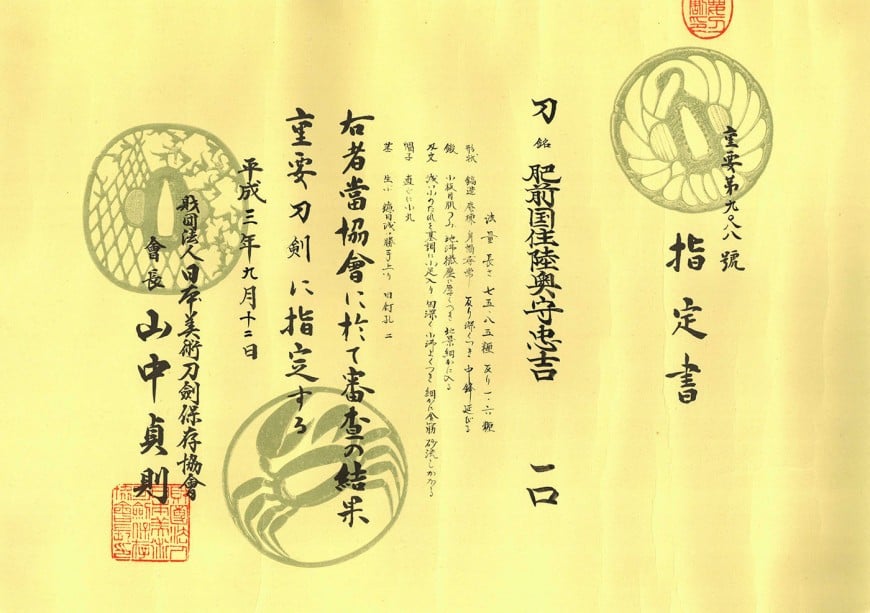



-, 37th Session — Designated September 12, 1991
, : no jū Mutsu no Kami (肥前国住陸奥守忠吉)
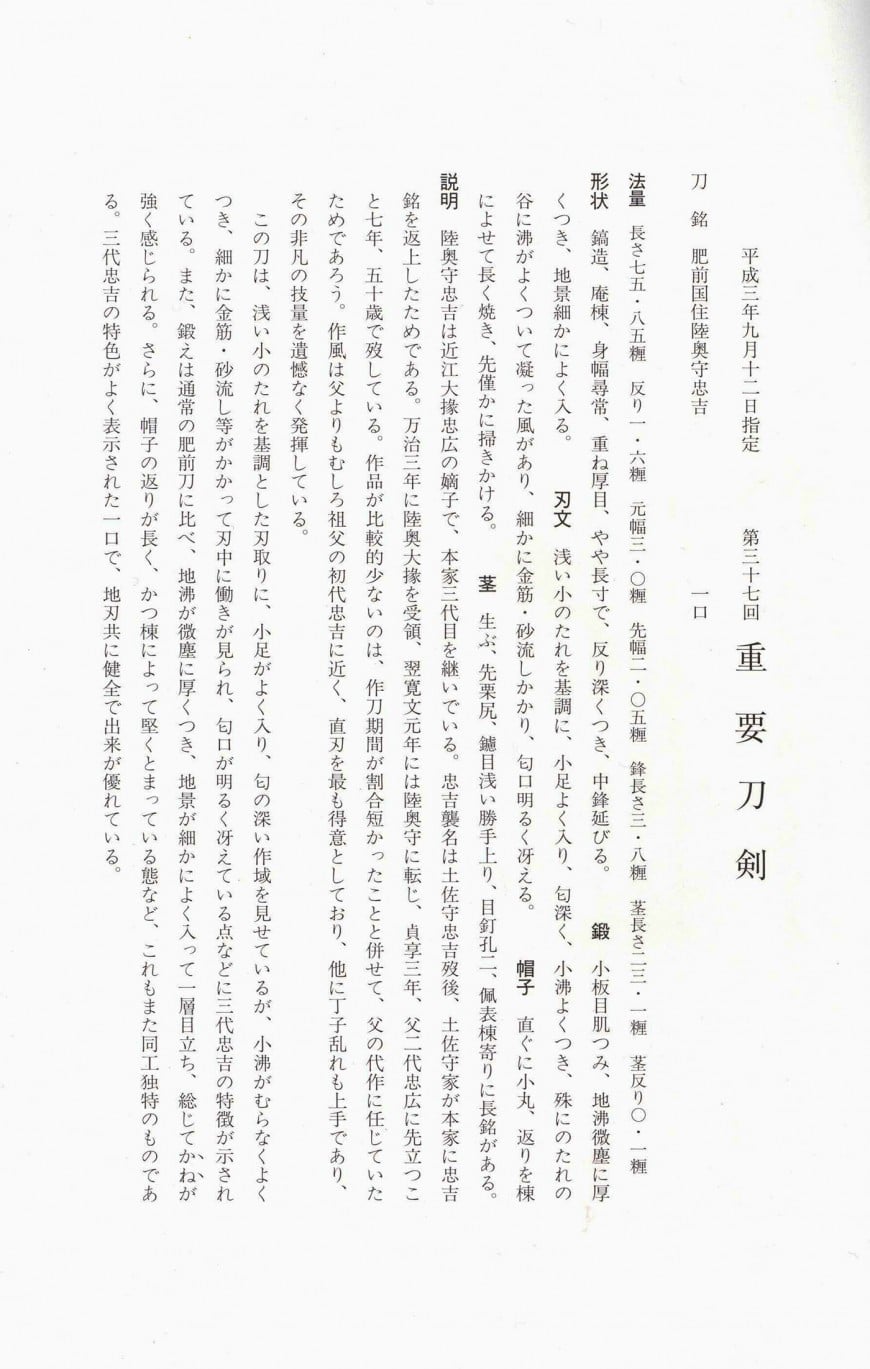
Measurements 75.85 cm, 1.6 cm, 3.0 cm, 2.05 cm, 3.8 cm, 23.1 cm, 0.1 cm
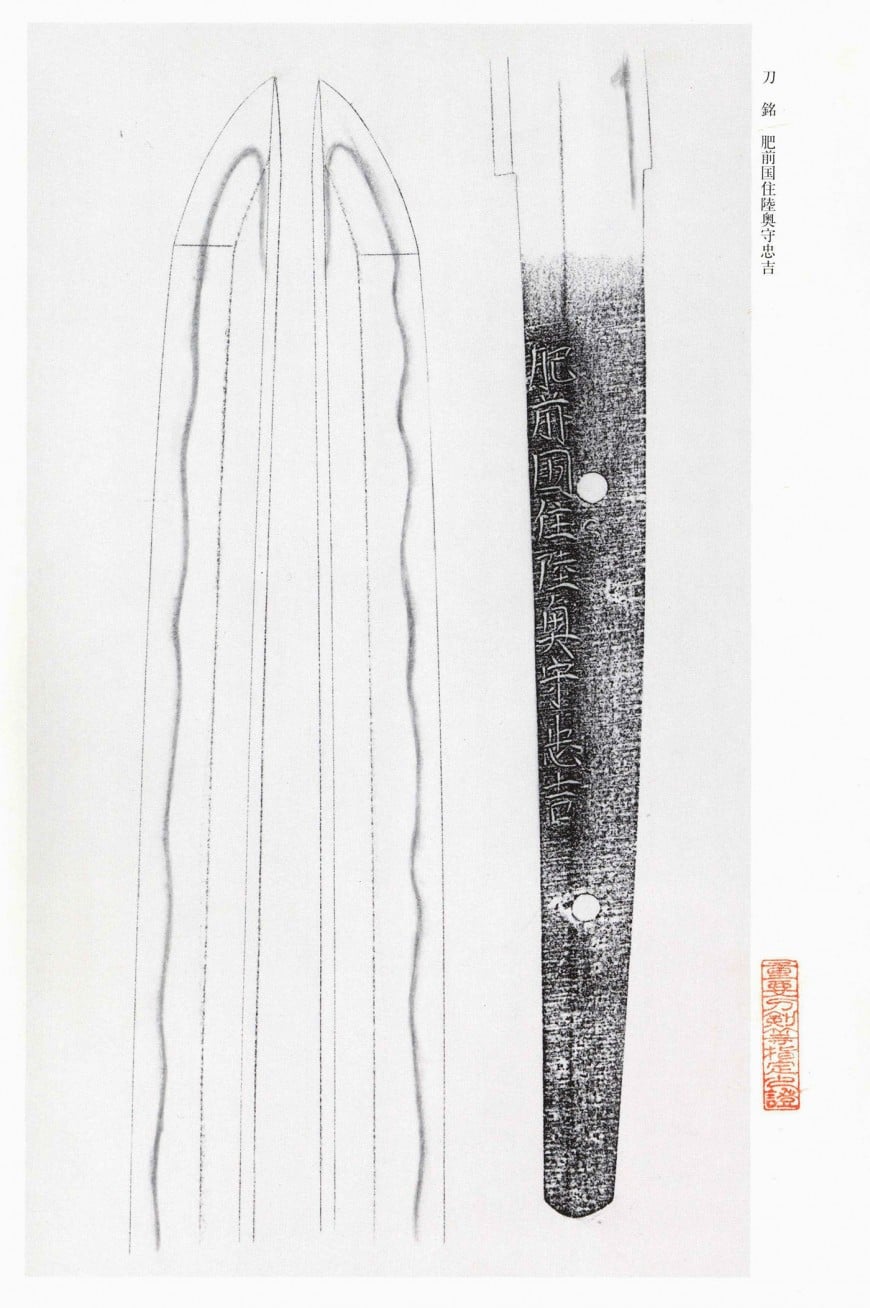
Description : , ; standard ; rather thick ; slightly long in proportion; deep ; somewhat extended. : Dense ; fine adheres thickly in a manner; enters finely and well. : Based on a shallow ; enter well; is deep; adheres well and evenly; in particular, dense gathers in the valleys of the , giving a wrought, elaborate feeling; fine and are seen; the is bright and clear. : Straight, forming ; the is long, brought to a firm stop along the ridge (); the tip shows slight . : None. : ; ; shallow ; two ; a long signature on the side, placed toward the .
Artisan Mutsu no Kami (肥前国住陸奥守忠吉), third generation of the main line
Era Early period (mid-17th century)
Explanation Mutsu no Kami was the legitimate heir of Ōmi no Daijō Tadahiro, and he succeeded as the third generation head of the main line. He assumed the name after Tosa no Kami died and the Tosa no Kami house returned the “” signature to the main family. In Manji 3 (1660) he received the title Mutsu no Daijō, and in the following year, 1 (1661), he advanced to Mutsu no Kami. He died at the age of fifty in Jōkyō 3 (1686), seven years before his father, the second-generation Tadahiro.
The relative scarcity of his works is likely due not only to the comparatively short span of his working life, but also because he was engaged in producing (substitute works) on behalf of his father. In style, he is closer to his grandfather, the first-generation , than to his father. He was especially accomplished in , and was also highly skilled at , fully demonstrating his uncommon ability.
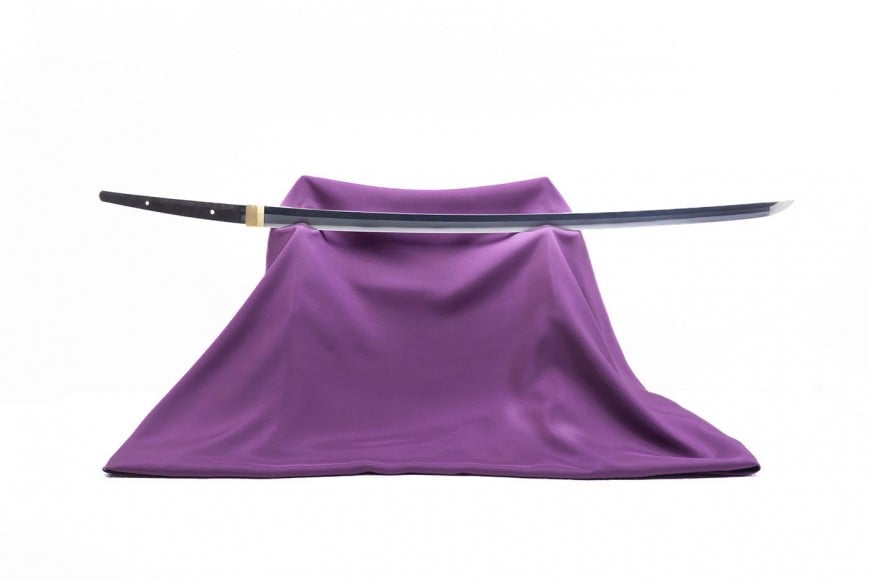
This shows a temper based on shallow , into which enter well, presenting a deep, timely working character. adheres evenly and thoroughly, and fine and , among other activities, appear within the hardened edge; moreover, the is bright and clear—points that display the distinctive traits of the third-generation .
In addition, compared with typical blades, the forging shows that adheres thickly in a fine manner, and enters finely and conspicuously, giving an overall impression of especially strong steel. Furthermore, the has a long and is brought to a firm stop along the ridge (), which is again a hallmark unique to this smith.
This is an example that clearly expresses the characteristic features of the third-generation ; both and are (sound and well-preserved), and the workmanship is excellent.