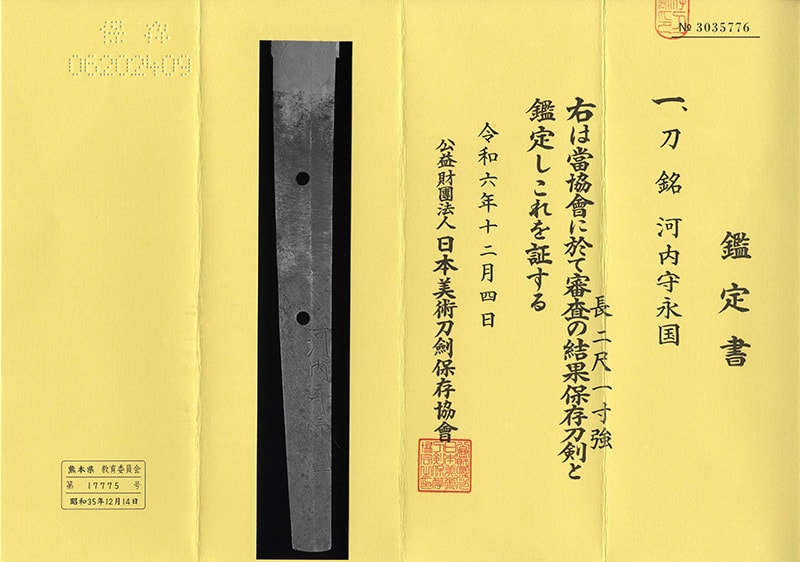
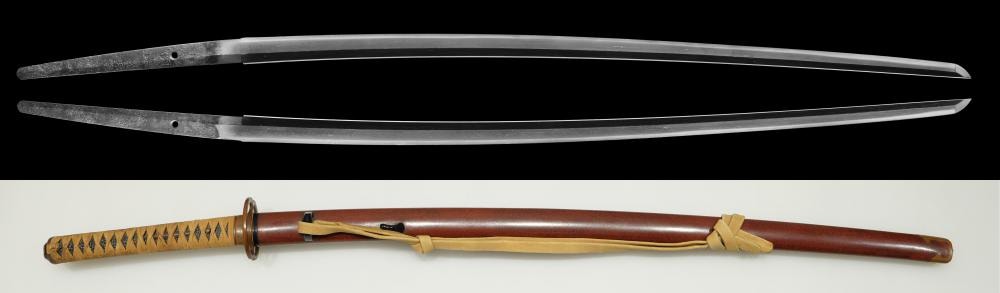
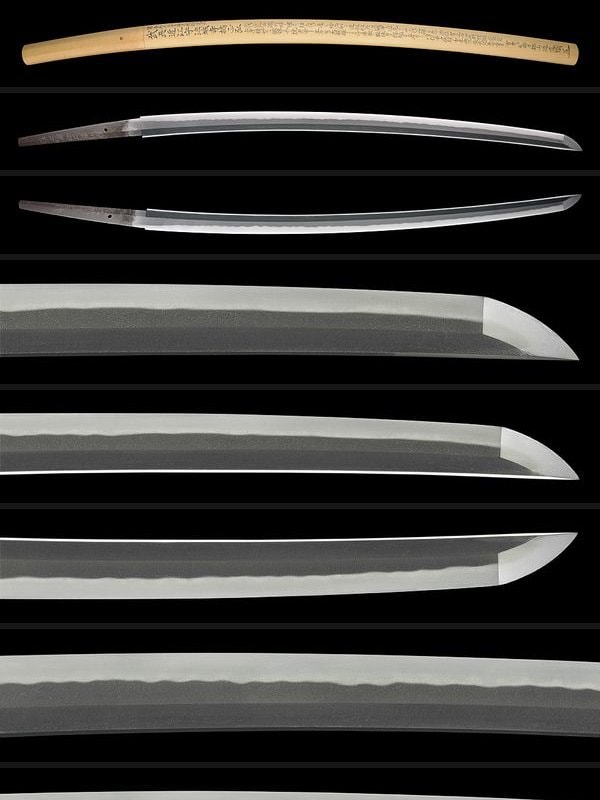
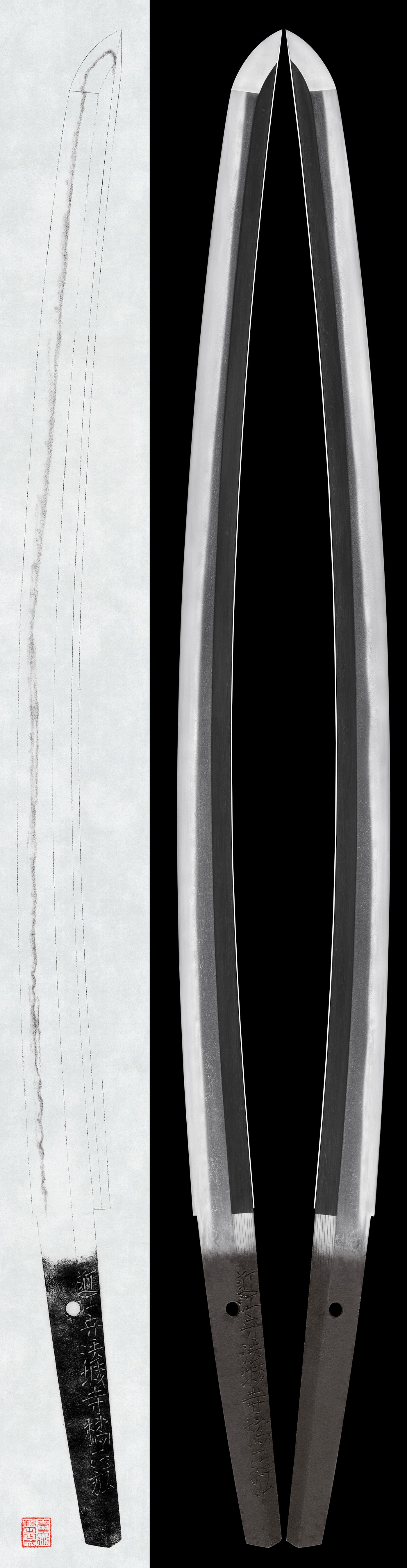
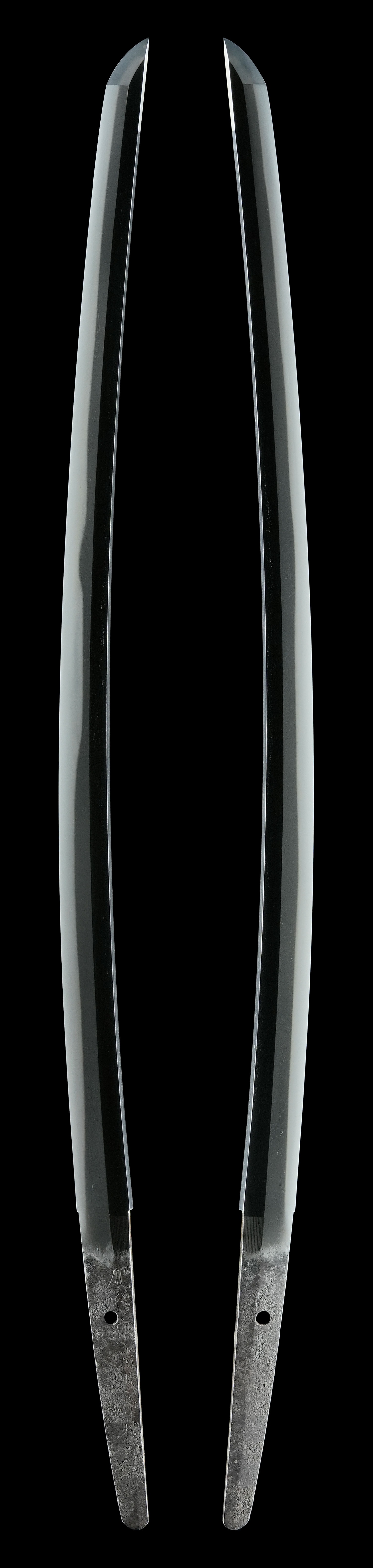
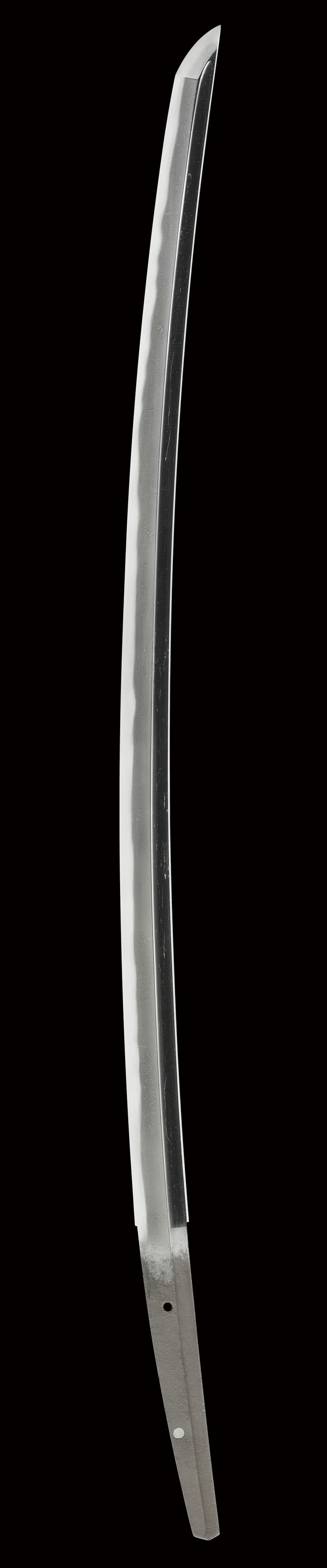
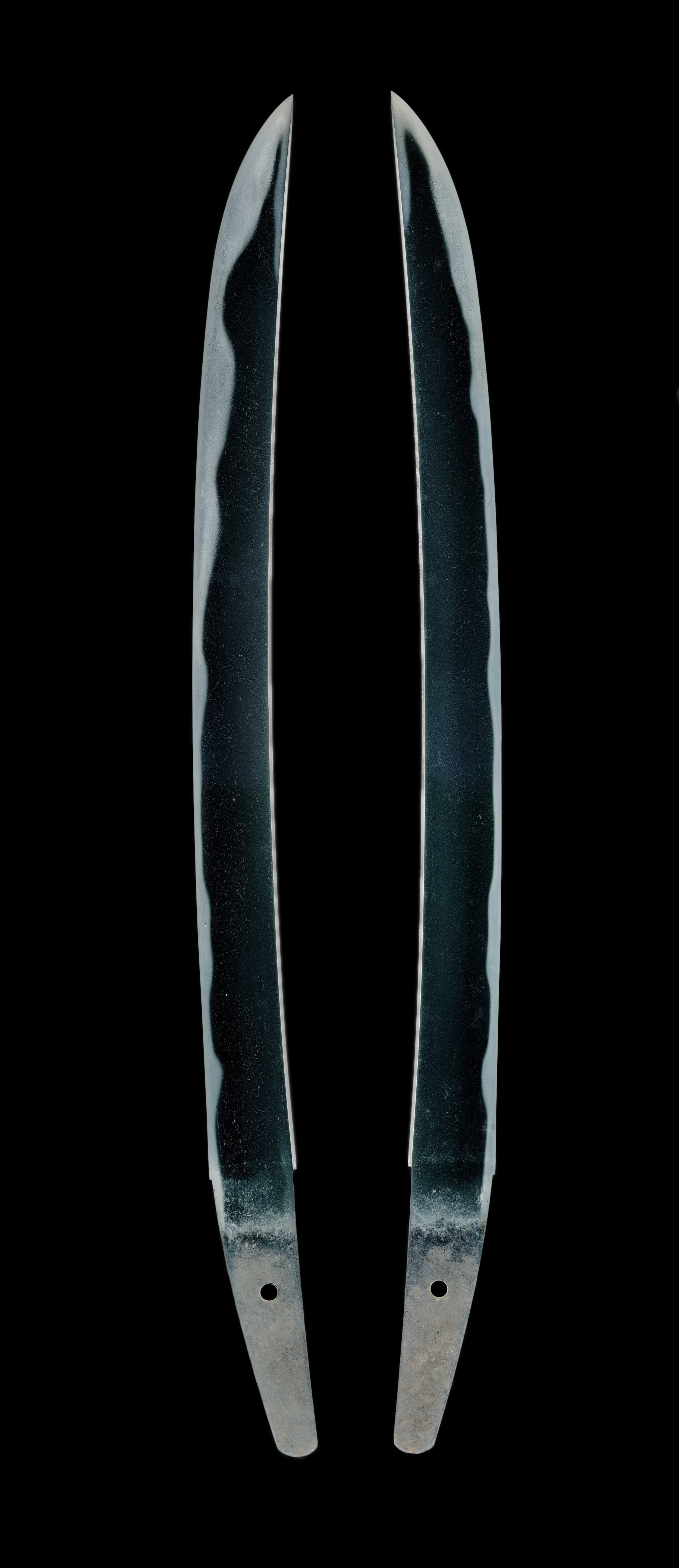
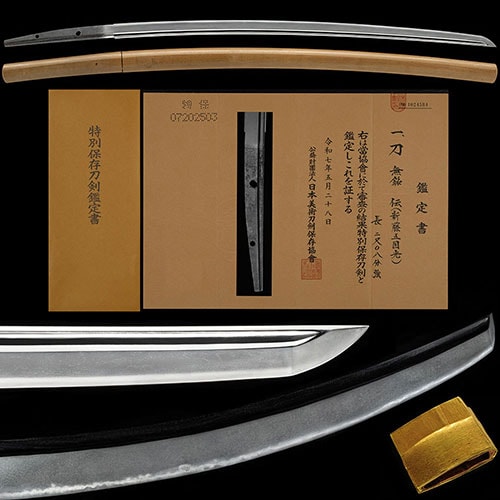
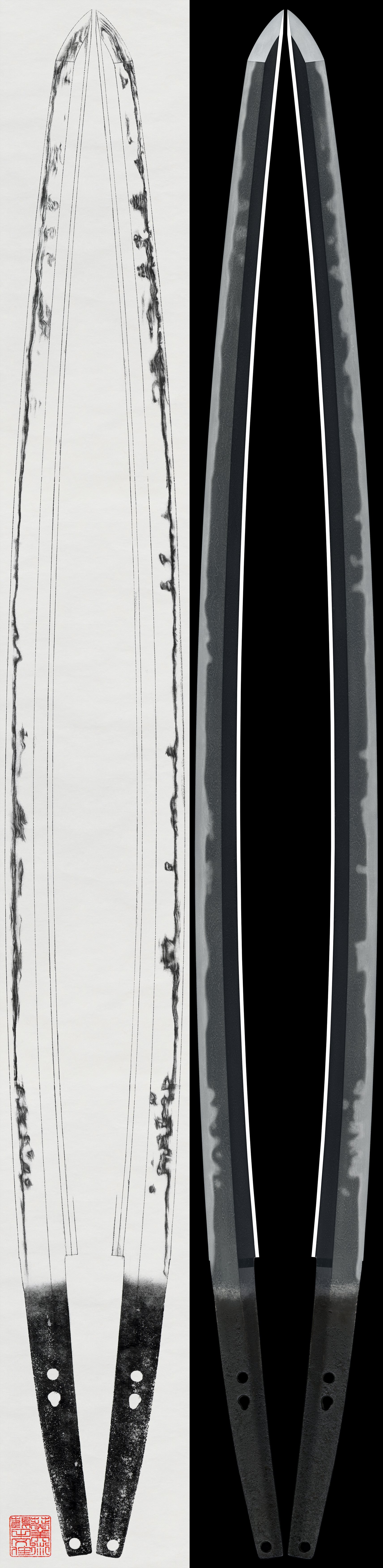
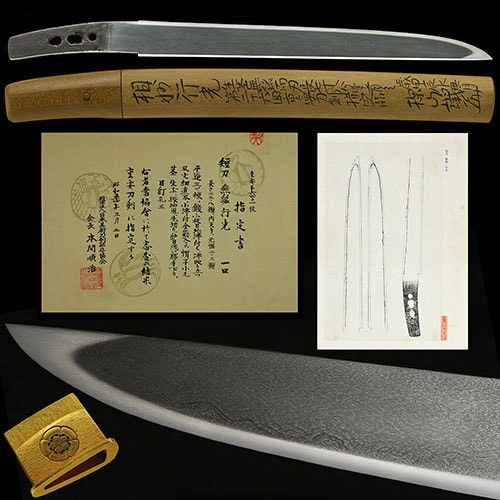
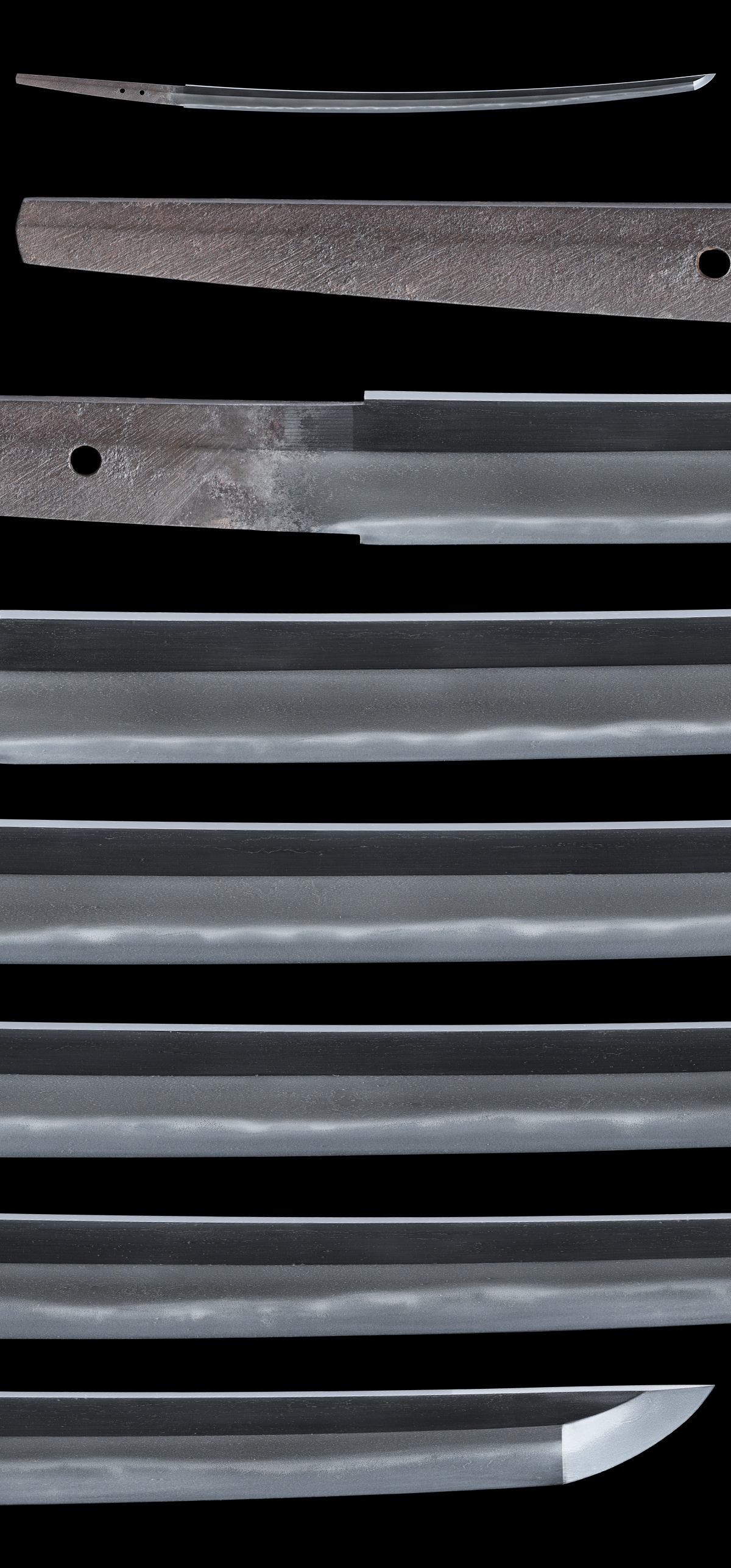
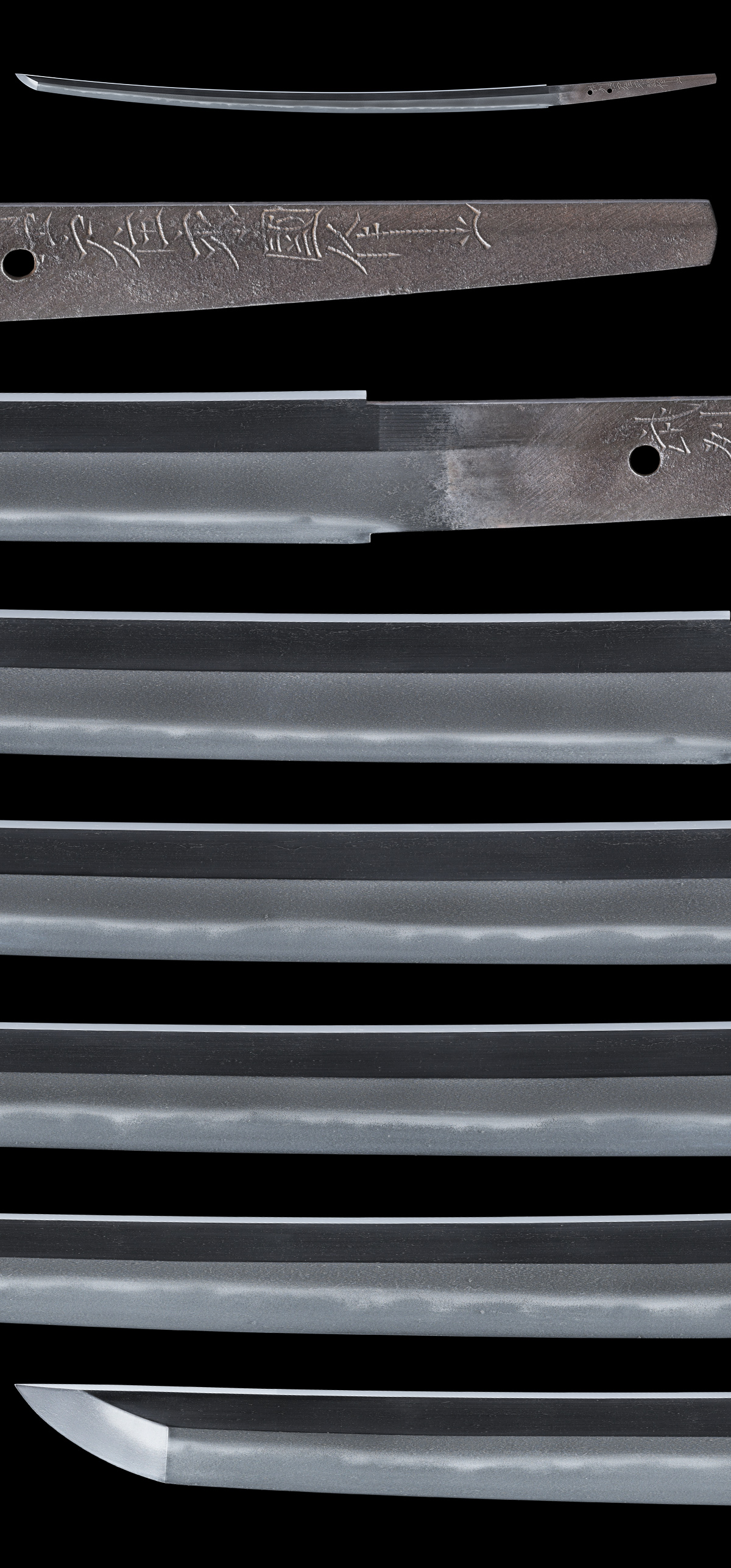
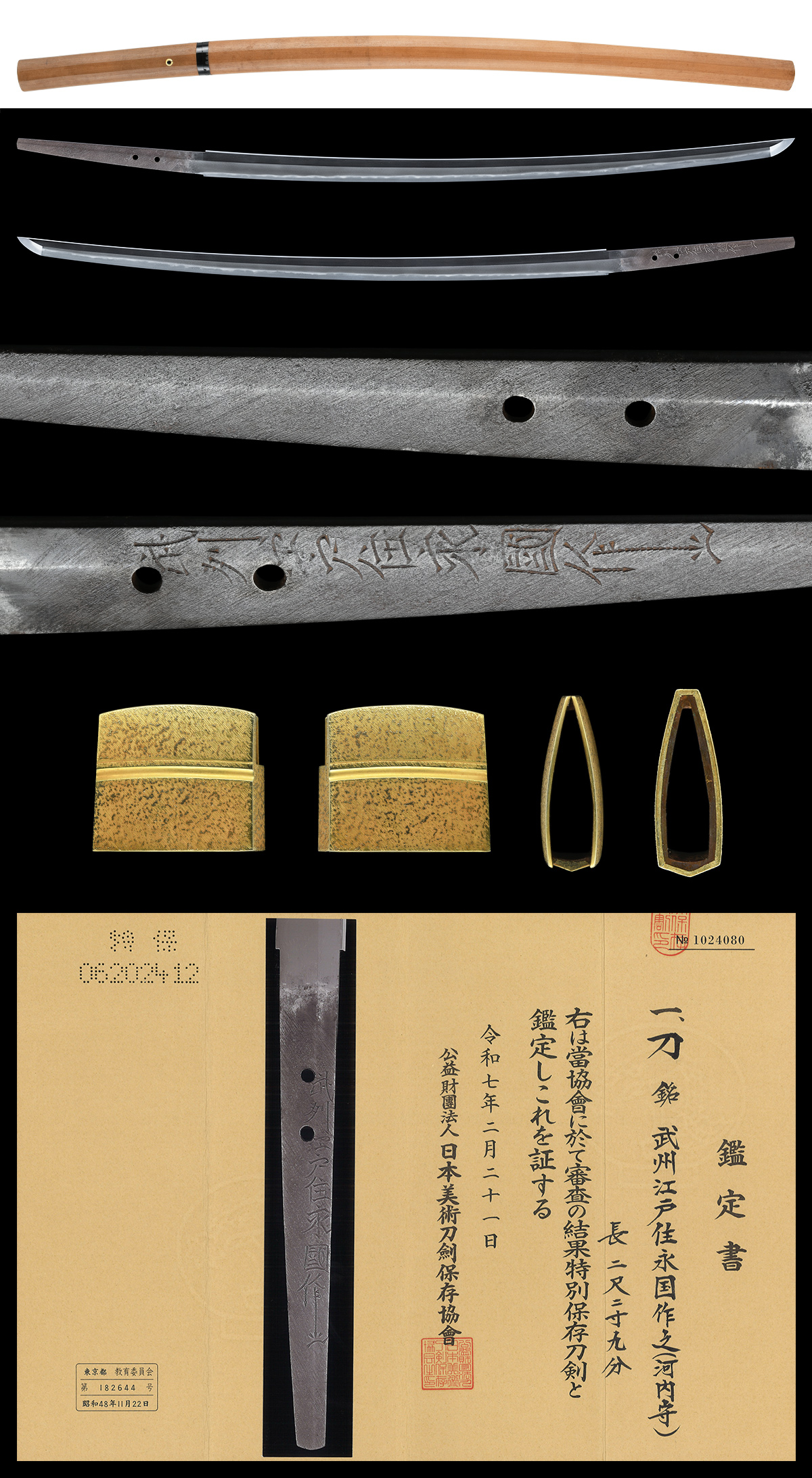
This is a katana made by Nagakuni (Kawachi no Kami) of Bushu-Edo-ju during the middle Edo period (circa 1661~). The blade has a length of 69.3cm and features a notare hamon with gunome and juzuba. It comes with a gold foil habaki and a Tokubetsu Hozon Token certificate.
 NihontoWatch
mei · Kanbun (1661-1673) · nagasa 69.3cm · sori 1.6cm
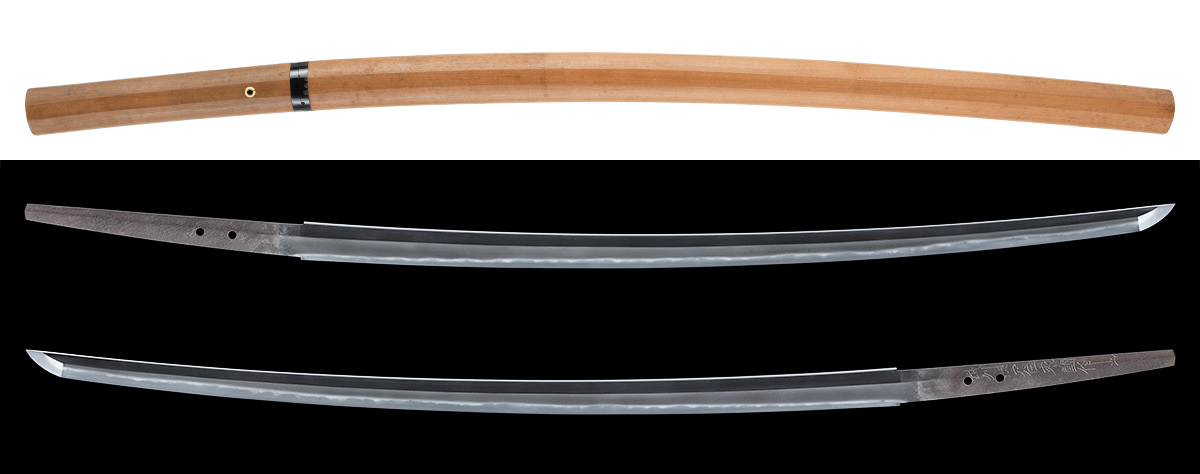

Hojoji (Kawachi no Kami line, Edo and Higo) · Higo · around 1661-1673
Fujishiro Jo saku · Tōken Taikan top 49%
1 piece on the market now
Kawachi no Kami Minamoto Nagakuni signed a katana in Kanbun 8 (1668) and had it test-cut on the reverse for a two-body cut by Koga Jizaemon Hisatomo, a blade the published sources call a representative work whose workmanship in both ji and ha is exceedingly fine. He was a Kanbun-era shinto smith, said to have been born in Echizen about Kan'ei 10 (1633), a date the commentary fixes by reckoning backward from a surviving blade inscribed as made at age thirty-six in Kanbun 8. He trained in Edo, transmitted variously as a student of Hojoji Kunimasa or of Higo no Kami Yoshitsugu, and later forged at Kumamoto in Higo, where one of his blades carries the residence inscription recording the place of work. Fujishiro rates him Jo-saku. Common opinion files him within the Hojoji lineage, the school name under which he is held, though the published record itself stops short of certainty on his teacher.
His characteristic hand is the temper the published sources call "the typical appearance of Kanbun-era shinto"[[c:1]]. Over a tightly packed ko-itame he begins in a suguha yakidashi and then carries a suguha-toned pattern into which gunome link and mingle, the connected gunome the constant axis of his ha. Thick ashi enter well, the nioi is deep, nie adheres, sunagashi and kinsuji run through the temper, and the nioiguchi is bright; the boshi turns back in an o-maru manner with hakikake at the point. The commentary reads this configuration, with its deep nioi and bright nioiguchi, as recalling at first glance Kazusa no Suke Kaneshige and Hojoji Yoshitsugu, the Edo masters among whom he stands, while one of his katana is judged so fine in ji and ha as to approach the Nagasone Kotetsu lineage.
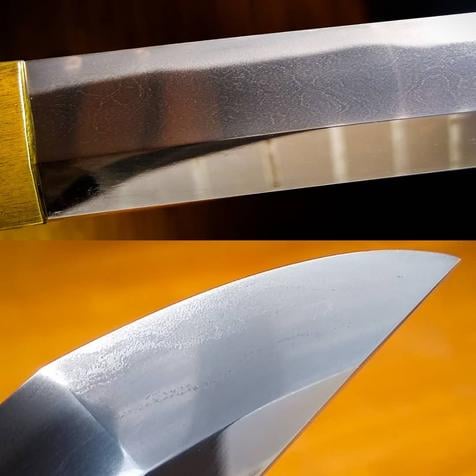
The jigane is the refined half of the picture. His forging is a ko-itame tightly packed, on the best blades mixed with mokume, with ji-nie adhering thickly in fine particles and fine chikei entering well, the jigane the published sources judge especially refined and the basis on which his best work earns its comparison to Kotetsu. Over it the suguha base supports more than a quiet temper: in his fullest survivor the lower half links the gunome into midare with abundant ko-ashi, while the upper half mixes gunome with ko-notare, ko-gunome and pointed elements, with yo entering, patches of yubashiri and tobiyaki appearing, and kinsuji and nie-suji running well, the whole closing in an o-maru boshi with a long kaeri. It is the sunagashi and the deep nioi above all, present across his small body of work, that keep the suguha and its gunome from reading flat.
His work resolves into two registers of one manner. The first is the typical Kanbun hand described above, the suguha yakidashi rising into connected gunome with deep nioi and a bright nioiguchi, the manner the commentary names typical Kanbun shinto and reads as akin to Kaneshige and Yoshitsugu. The second is an elaborated late hand, seen in his finest survivor, where the temper grows richer in its midare and gains yubashiri and tobiyaki; of this blade the published sources note that "compared with this smith's usual work, the particularly deep nioi, the thickly adhering ko-nie, the activity within the temper and the brightness of the nioiguchi deserve special note"[[c:2]]. His blades are made in shinogi-zukuri with iori-mune, in the typical Kanbun bearing of shallow sori, a marked taper from base to tip and a compact chu-kissaki, though one distinctive wakizashi is built in kiriba-zukuri on the omote and shinogi-zukuri on the ura, with a wide body and an o-kissaki, a construction the sources liken to contemporaneous Edo work. All four of his designated blades are signed on an ubu nakago, the file marks beginning shallow and deepening into o-sujikai, and bearing a six- or seven-character signature, with the long signature and gold-inlaid cutting-test inscription appearing on one of them.
What sets him apart is argued within the Edo milieu rather than against a distant school. Although common opinion places him in the Hojoji lineage, the published sources read the linked gunome of his ha, the ko-notare mixed into the gunome, the thickly adhering ko-nie and the deepening o-sujikai file marks of his nakago as recalling Yamato no Kami Yasusada, and go so far as to suggest that "Nagakuni may instead be a smith of the Yasusada group"[[c:3]], a question they expressly leave to further research. His own affirmative marks are the suguha base under the connected gunome, the deep nioi carried in sunagashi, the fine chikei of his late ji and the bright nioiguchi the commentary returns to. His move to Higo is documented in his own steel: he forged at Kumamoto using nanban-tetsu, probably, the sources reason, at the invitation of the Hosokawa house, lords of Kumamoto Domain, and his exchanges are traced not to Miyamoto Musashi, who died when he was a child, but to Musashi's disciples Murakami Masao and Terao Nobuyuki, whose names appear on blades dated Tenna 2 (1682).
Nagakuni is rated Jo-saku by Fujishiro, with a Toko Taikan valuation of 3,500,000 yen. His designated record is four blades, all at the Juyo Token level and none above it, a record that places him as a capable and individual Kanbun hand rather than a celebrated master. The published sources repeatedly call surviving examples by him "comparatively few"[[c:4]], and within that small body the designated pieces are the outstanding survivors, every one signed and several dated or tested, their cutting-test and residence inscriptions singled out as material valuable for understanding the scope and movements of a thinly documented smith. No provenance to a daimyo house or museum is recorded among them; they have passed through private hands, the test-cuts and the Kumamoto residence inscription standing in for the named pedigrees that sparsely documented shinto blades usually lack. For a collector this means a Nagakuni is not unobtainable in the way a National Treasure is, but it is uncommon: with only four designated blades on record, all of them signed and most carrying a date or a test-cut, an example comes to market rarely, and a well-made one, bright in the nioiguchi and forged in the tightly knit ji the sources praise, is the kind of early-Edo signed work that rewards patience.
Where Nagakuni stands among comparable artisans: across all of nihontō, and within tradition, era, and period. The tiers (Foremost · Leading · Major · Notable) weigh official designations from the NBTHK and Japan's Agency for Cultural Affairs, together with historical honors of lasting repute such as the Sansaku and Meibutsu-chō.
Select a lens to see how it's measured.
Soshu-den · Tajima
20 pieces on the market now
The Hojoji name (法城寺) begins as a place in Tajima province, where, the published sources relate, the Nanbokucho naginata master Kunimitsu lived at that spot and so took the place for his name, the man and the locality becoming one. The Meikan records a first generation of this Kunimitsu working in the Joji era (1362-68) and a second at Oei, the koto root from which the line descends. Learn more →
| Smith | Era | Designated |
|---|---|---|
| Kunimitsu國光 | 1345-1350 | 22 |
| Masahiro正弘 | 1658-1671 | 26 |
| Sadakuni貞國 | 1658-1673 | 8 |
| Yoshitsugu吉次 | 1661-1673 | 6 |
| Masateru正照 | 1684-1688 | 5 |
A Hozon-certified blade judged to show notably superior workmanship and a better state of preservation. The bar is higher: re-tempered blades and most unsigned Muromachi/Edo works are excluded.
The NBTHK (Nihon Bijutsu Tōken Hozon Kyōkai, the Society for the Preservation of Japanese Art Swords) is a public-interest incorporated foundation founded in 1948 and supervised by Japan’s Agency for Cultural Affairs (Bunkachō); it is based at the Japanese Sword Museum in Tokyo. Its expert panels physically examine each submitted work (shinsa) and issue a certificate (kanteishō) ranking it by artistic and historical merit. NBTHK papers are the most widely recognized standard of authentication for Japanese swords and fittings.
NBTHK official siteNo cooling-off period or returns; refund only if the purchased sword is proven fake, capped at purchase price (excludes commission sales, accessories, auction items).
This is a katana made by Nagakuni (Kawachi no Kami) of Bushu-Edo-ju during the middle Edo period (circa 1661~). The blade has a length of 69.3cm and features a notare hamon with gunome and juzuba. It comes with a gold foil habaki and a Tokubetsu Hozon Token certificate.
NihontoWatchmei · Kanbun (1661-1673) · nagasa 69.3cm · sori 1.6cm
Hojoji (Kawachi no Kami line, Edo and Higo) · Higo · around 1661-1673
Fujishiro Jo saku · Tōken Taikan top 49%
1 piece on the market now
Kawachi no Kami Minamoto Nagakuni signed a katana in Kanbun 8 (1668) and had it test-cut on the reverse for a two-body cut by Koga Jizaemon Hisatomo, a blade the published sources call a representative work whose workmanship in both ji and ha is exceedingly fine. He was a Kanbun-era shinto smith, said to have been born in Echizen about Kan'ei 10 (1633), a date the commentary fixes by reckoning backward from a surviving blade inscribed as made at age thirty-six in Kanbun 8. He trained in Edo, transmitted variously as a student of Hojoji Kunimasa or of Higo no Kami Yoshitsugu, and later forged at Kumamoto in Higo, where one of his blades carries the residence inscription recording the place of work. Fujishiro rates him Jo-saku. Common opinion files him within the Hojoji lineage, the school name under which he is held, though the published record itself stops short of certainty on his teacher.
His characteristic hand is the temper the published sources call "the typical appearance of Kanbun-era shinto"[[c:1]]. Over a tightly packed ko-itame he begins in a suguha yakidashi and then carries a suguha-toned pattern into which gunome link and mingle, the connected gunome the constant axis of his ha. Thick ashi enter well, the nioi is deep, nie adheres, sunagashi and kinsuji run through the temper, and the nioiguchi is bright; the boshi turns back in an o-maru manner with hakikake at the point. The commentary reads this configuration, with its deep nioi and bright nioiguchi, as recalling at first glance Kazusa no Suke Kaneshige and Hojoji Yoshitsugu, the Edo masters among whom he stands, while one of his katana is judged so fine in ji and ha as to approach the Nagasone Kotetsu lineage.
The jigane is the refined half of the picture. His forging is a ko-itame tightly packed, on the best blades mixed with mokume, with ji-nie adhering thickly in fine particles and fine chikei entering well, the jigane the published sources judge especially refined and the basis on which his best work earns its comparison to Kotetsu. Over it the suguha base supports more than a quiet temper: in his fullest survivor the lower half links the gunome into midare with abundant ko-ashi, while the upper half mixes gunome with ko-notare, ko-gunome and pointed elements, with yo entering, patches of yubashiri and tobiyaki appearing, and kinsuji and nie-suji running well, the whole closing in an o-maru boshi with a long kaeri. It is the sunagashi and the deep nioi above all, present across his small body of work, that keep the suguha and its gunome from reading flat.
His work resolves into two registers of one manner. The first is the typical Kanbun hand described above, the suguha yakidashi rising into connected gunome with deep nioi and a bright nioiguchi, the manner the commentary names typical Kanbun shinto and reads as akin to Kaneshige and Yoshitsugu. The second is an elaborated late hand, seen in his finest survivor, where the temper grows richer in its midare and gains yubashiri and tobiyaki; of this blade the published sources note that "compared with this smith's usual work, the particularly deep nioi, the thickly adhering ko-nie, the activity within the temper and the brightness of the nioiguchi deserve special note"[[c:2]]. His blades are made in shinogi-zukuri with iori-mune, in the typical Kanbun bearing of shallow sori, a marked taper from base to tip and a compact chu-kissaki, though one distinctive wakizashi is built in kiriba-zukuri on the omote and shinogi-zukuri on the ura, with a wide body and an o-kissaki, a construction the sources liken to contemporaneous Edo work. All four of his designated blades are signed on an ubu nakago, the file marks beginning shallow and deepening into o-sujikai, and bearing a six- or seven-character signature, with the long signature and gold-inlaid cutting-test inscription appearing on one of them.
What sets him apart is argued within the Edo milieu rather than against a distant school. Although common opinion places him in the Hojoji lineage, the published sources read the linked gunome of his ha, the ko-notare mixed into the gunome, the thickly adhering ko-nie and the deepening o-sujikai file marks of his nakago as recalling Yamato no Kami Yasusada, and go so far as to suggest that "Nagakuni may instead be a smith of the Yasusada group"[[c:3]], a question they expressly leave to further research. His own affirmative marks are the suguha base under the connected gunome, the deep nioi carried in sunagashi, the fine chikei of his late ji and the bright nioiguchi the commentary returns to. His move to Higo is documented in his own steel: he forged at Kumamoto using nanban-tetsu, probably, the sources reason, at the invitation of the Hosokawa house, lords of Kumamoto Domain, and his exchanges are traced not to Miyamoto Musashi, who died when he was a child, but to Musashi's disciples Murakami Masao and Terao Nobuyuki, whose names appear on blades dated Tenna 2 (1682).
Nagakuni is rated Jo-saku by Fujishiro, with a Toko Taikan valuation of 3,500,000 yen. His designated record is four blades, all at the Juyo Token level and none above it, a record that places him as a capable and individual Kanbun hand rather than a celebrated master. The published sources repeatedly call surviving examples by him "comparatively few"[[c:4]], and within that small body the designated pieces are the outstanding survivors, every one signed and several dated or tested, their cutting-test and residence inscriptions singled out as material valuable for understanding the scope and movements of a thinly documented smith. No provenance to a daimyo house or museum is recorded among them; they have passed through private hands, the test-cuts and the Kumamoto residence inscription standing in for the named pedigrees that sparsely documented shinto blades usually lack. For a collector this means a Nagakuni is not unobtainable in the way a National Treasure is, but it is uncommon: with only four designated blades on record, all of them signed and most carrying a date or a test-cut, an example comes to market rarely, and a well-made one, bright in the nioiguchi and forged in the tightly knit ji the sources praise, is the kind of early-Edo signed work that rewards patience.
Where Nagakuni stands among comparable artisans: across all of nihontō, and within tradition, era, and period. The tiers (Foremost · Leading · Major · Notable) weigh official designations from the NBTHK and Japan's Agency for Cultural Affairs, together with historical honors of lasting repute such as the Sansaku and Meibutsu-chō.
Select a lens to see how it's measured.
Soshu-den · Tajima
20 pieces on the market now
The Hojoji name (法城寺) begins as a place in Tajima province, where, the published sources relate, the Nanbokucho naginata master Kunimitsu lived at that spot and so took the place for his name, the man and the locality becoming one. The Meikan records a first generation of this Kunimitsu working in the Joji era (1362-68) and a second at Oei, the koto root from which the line descends. Learn more →
| Smith | Era | Designated |
|---|---|---|
| Kunimitsu國光 | 1345-1350 | 22 |
| Masahiro正弘 | 1658-1671 | 26 |
| Sadakuni貞國 | 1658-1673 | 8 |
| Yoshitsugu吉次 | 1661-1673 | 6 |
| Masateru正照 | 1684-1688 | 5 |
A Hozon-certified blade judged to show notably superior workmanship and a better state of preservation. The bar is higher: re-tempered blades and most unsigned Muromachi/Edo works are excluded.
The NBTHK (Nihon Bijutsu Tōken Hozon Kyōkai, the Society for the Preservation of Japanese Art Swords) is a public-interest incorporated foundation founded in 1948 and supervised by Japan’s Agency for Cultural Affairs (Bunkachō); it is based at the Japanese Sword Museum in Tokyo. Its expert panels physically examine each submitted work (shinsa) and issue a certificate (kanteishō) ranking it by artistic and historical merit. NBTHK papers are the most widely recognized standard of authentication for Japanese swords and fittings.
NBTHK official siteNo cooling-off period or returns; refund only if the purchased sword is proven fake, capped at purchase price (excludes commission sales, accessories, auction items).