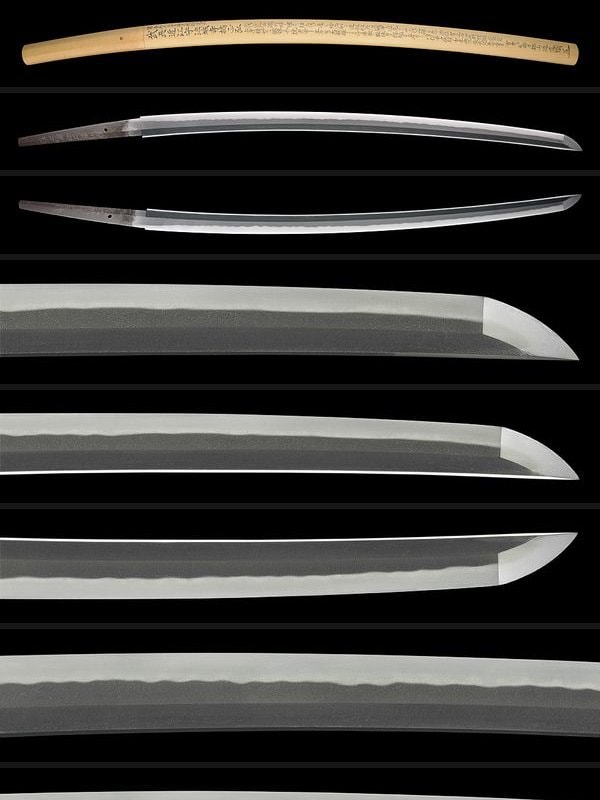
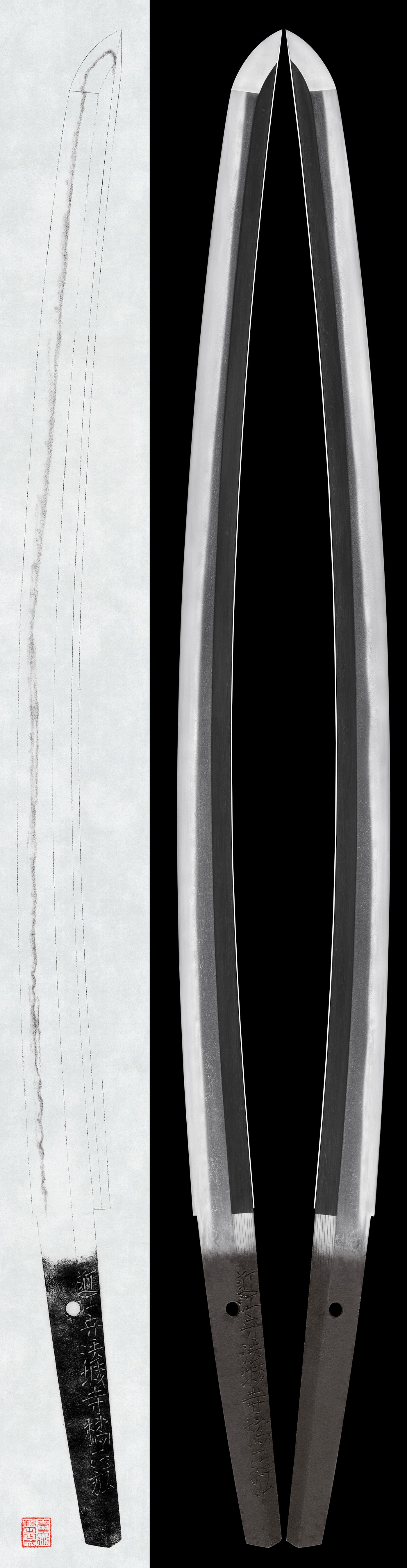
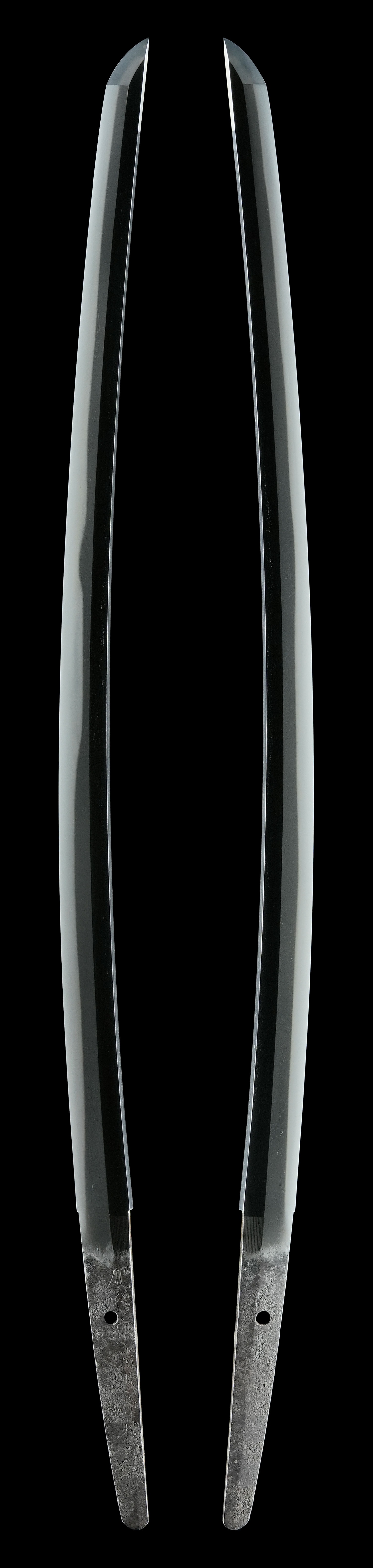
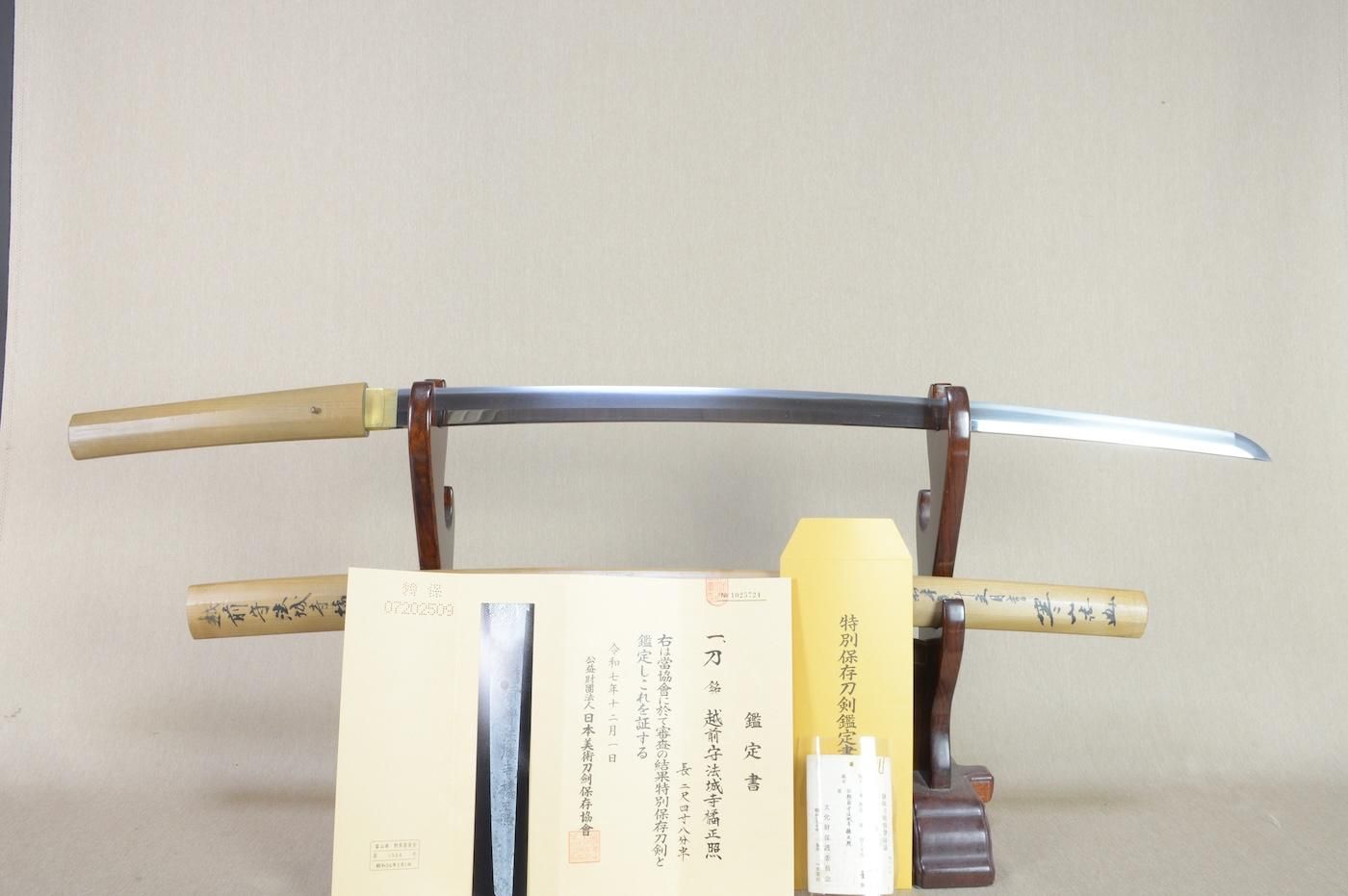
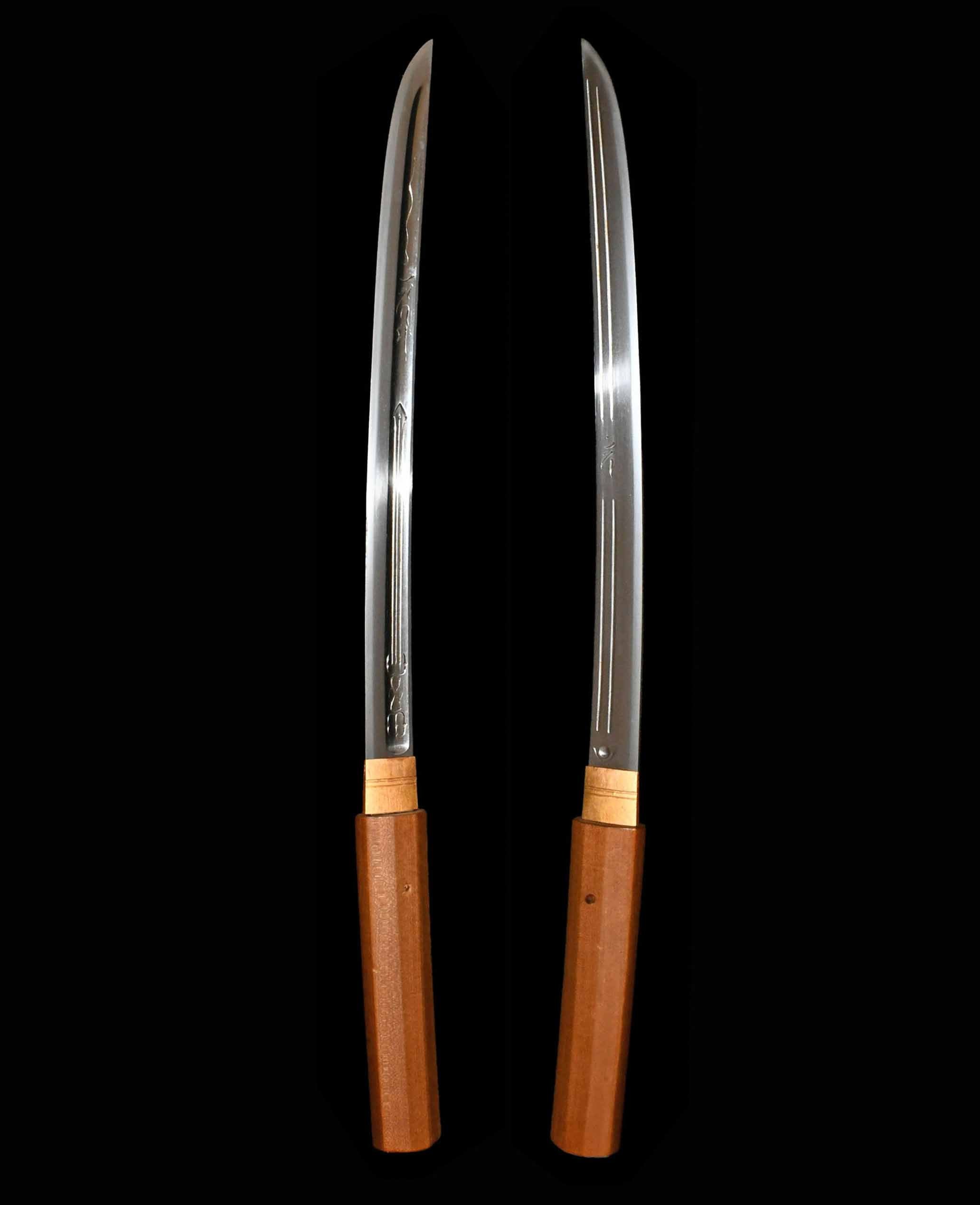
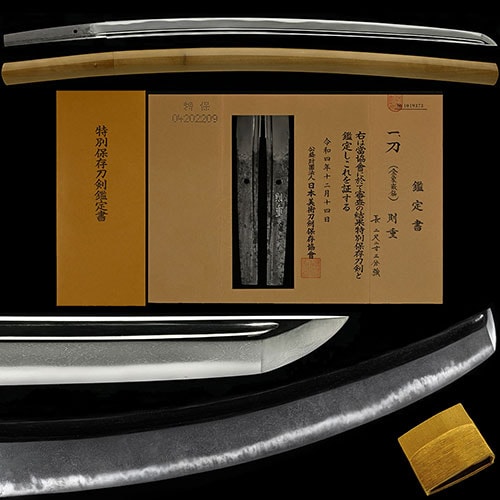
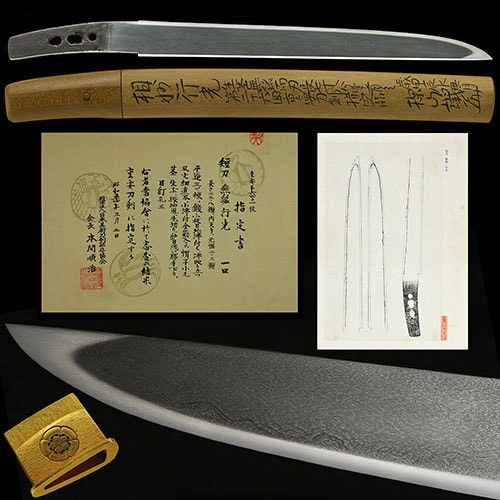
Kawachi no Kami Minamoto Nagakuni signed a in 8 (1668) and had it test-cut on the reverse for a two-body cut by Jizaemon Hisatomo, a blade the published sources call a representative work whose workmanship in both and is exceedingly fine. He was a -era smith, said to have been born in about 'ei 10 (1633), a date the commentary fixes by reckoning backward from a surviving blade inscribed as made at age thirty-six in 8. He trained in , transmitted variously as a student of Hojoji Kunimasa or of no Kami Yoshitsugu, and later forged at Kumamoto in , where one of his blades carries the residence inscription recording the place of work. Fujishiro rates him Jo-. Common opinion files him within the Hojoji lineage, the school name under which he is held, though the published record itself stops short of certainty on his teacher.
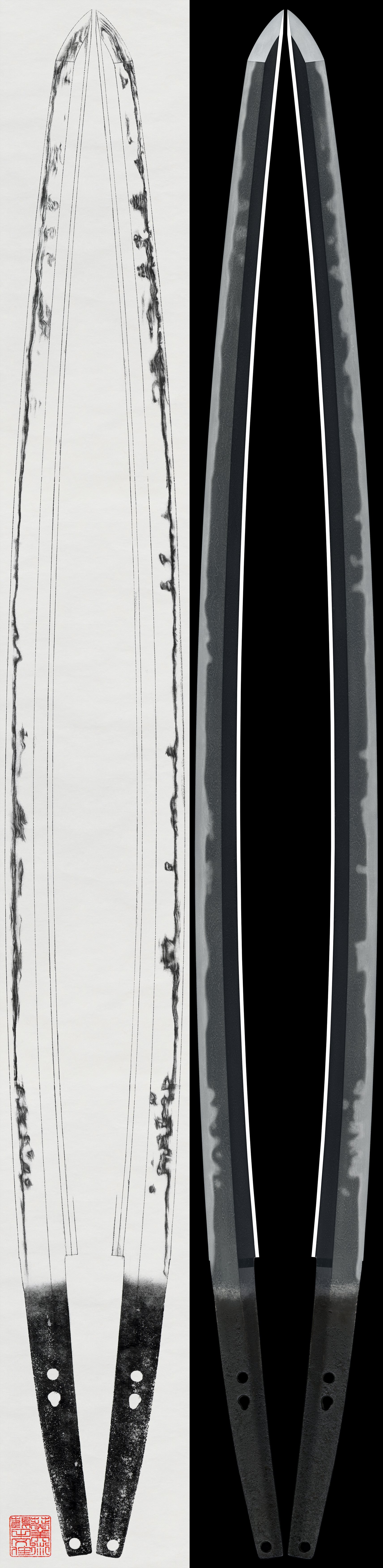
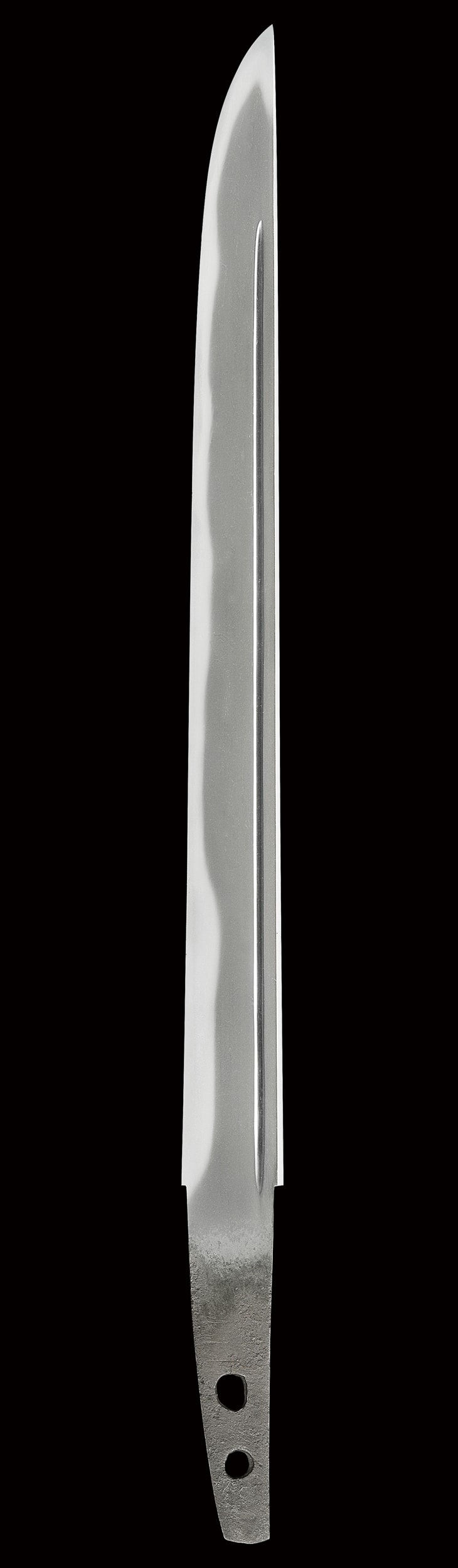
His characteristic hand is the temper the published sources call "the typical appearance of -era ". Over a tightly packed he begins in a and then carries a -toned pattern into which link and mingle, the connected the constant axis of his . Thick enter well, the is deep, adheres, and run through the temper, and the is bright; the turns back in an manner with at the point. The commentary reads this configuration, with its deep and bright , as recalling at first glance Kazusa no Kaneshige and Hojoji Yoshitsugu, the masters among whom he stands, while one of his is judged so fine in and as to approach the Nagasone Kotetsu lineage.
The is the refined half of the picture. His forging is a tightly packed, on the best blades mixed with , with adhering thickly in fine particles and fine entering well, the the published sources judge especially refined and the basis on which his best work earns its comparison to Kotetsu. Over it the base supports more than a quiet temper: in his fullest survivor the lower half links the into midare with abundant , while the upper half mixes with , and pointed elements, with entering, patches of and appearing, and and running well, the whole closing in an with a long . It is the and the deep above all, present across his small body of work, that keep the and its from reading flat.
His work resolves into two registers of one manner. The first is the typical hand described above, the rising into connected with deep and a bright , the manner the commentary names typical and reads as akin to Kaneshige and Yoshitsugu. The second is an elaborated late hand, seen in his finest survivor, where the temper grows richer in its and gains and ; of this blade the published sources note that "compared with this smith's usual work, the particularly deep , the thickly adhering , the activity within the temper and the brightness of the deserve special note". His blades are made in with , in the typical bearing of shallow , a marked taper from base to tip and a compact , though one distinctive is built in on the and on the , with a wide body and an , a construction the sources liken to contemporaneous work. All four of his designated blades are signed on an , the file marks beginning shallow and deepening into , and bearing a six- or seven-character signature, with the long signature and gold-inlaid cutting-test inscription appearing on one of them.
What sets him apart is argued within the milieu rather than against a distant school. Although common opinion places him in the Hojoji lineage, the published sources read the linked of his , the mixed into the , the thickly adhering and the deepening file marks of his as recalling Yamato no Kami Yasusada, and go so far as to suggest that "Nagakuni may instead be a smith of the Yasusada group", a question they expressly leave to further research. His own affirmative marks are the base under the connected , the deep carried in , the fine of his late and the bright the commentary returns to. His move to is documented in his own steel: he forged at Kumamoto using nanban-tetsu, probably, the sources reason, at the invitation of the Hosokawa house, lords of Kumamoto Domain, and his exchanges are traced not to Miyamoto , who died when he was a child, but to 's disciples Murakami Masao and Terao Nobuyuki, whose names appear on blades dated Tenna 2 (1682).
Nagakuni is rated Jo- by Fujishiro, with a Toko Taikan valuation of 3,500,000 yen. His designated record is four blades, all at the level and none above it, a record that places him as a capable and individual hand rather than a celebrated master. The published sources repeatedly call surviving examples by him "comparatively few", and within that small body the designated pieces are the outstanding survivors, every one signed and several dated or tested, their cutting-test and residence inscriptions singled out as material valuable for understanding the scope and movements of a thinly documented smith. No provenance to a house or museum is recorded among them; they have passed through private hands, the test-cuts and the Kumamoto residence inscription standing in for the named pedigrees that sparsely documented blades usually lack. For a collector this means a Nagakuni is not unobtainable in the way a National Treasure is, but it is uncommon: with only four designated blades on record, all of them signed and most carrying a date or a test-cut, an example comes to market rarely, and a well-made one, bright in the and forged in the tightly knit the sources praise, is the kind of early- signed work that rewards patience.