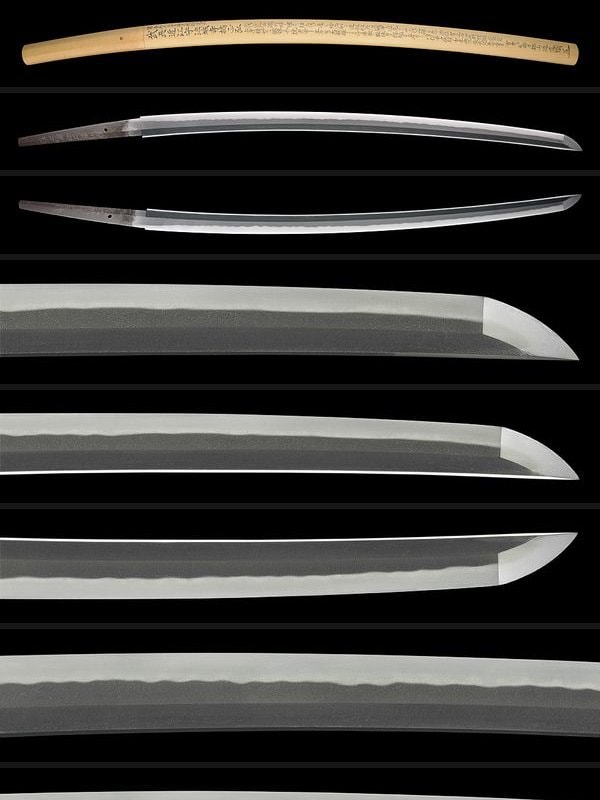
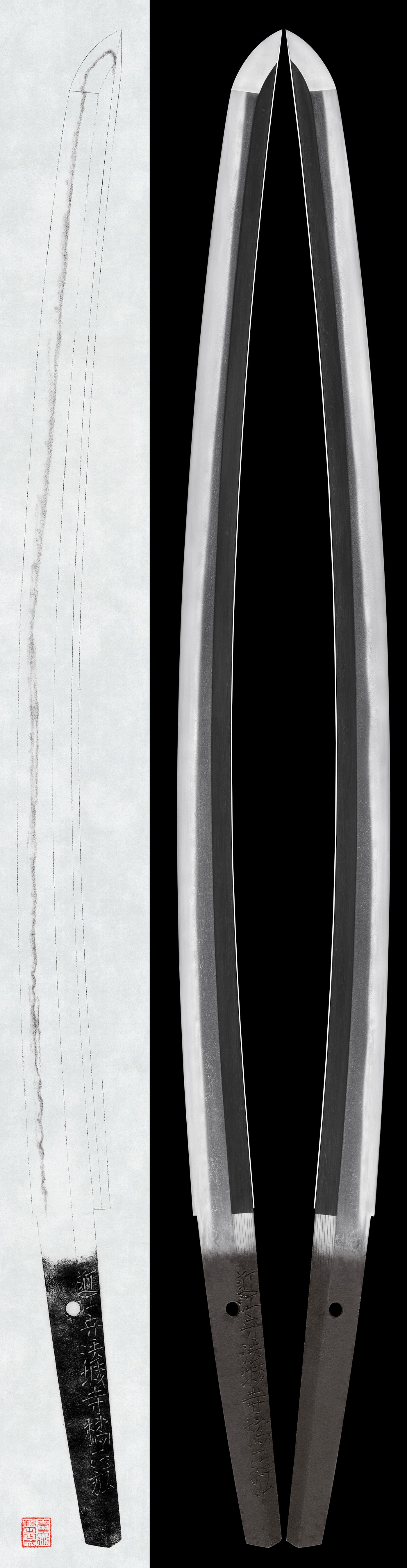
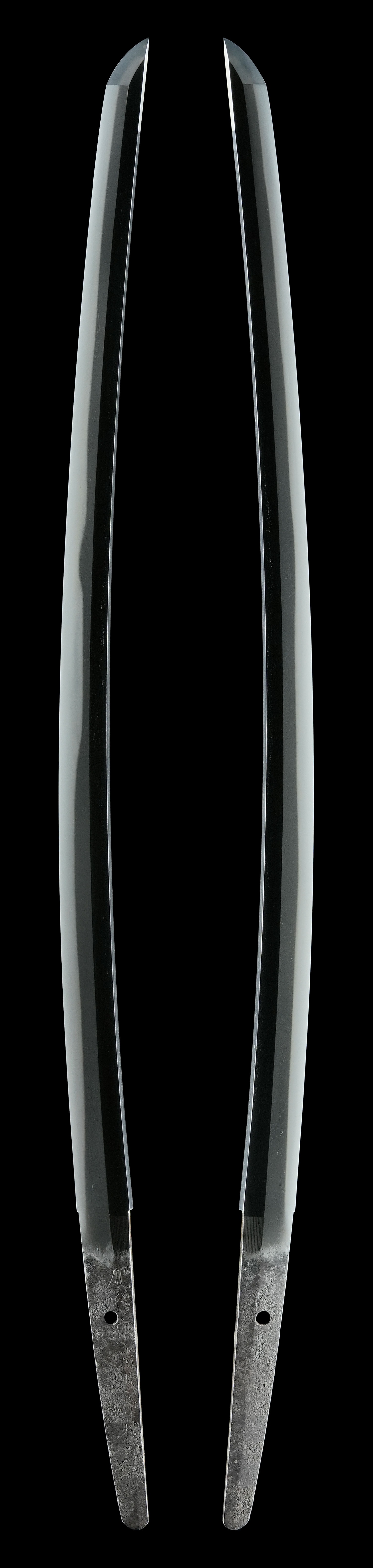
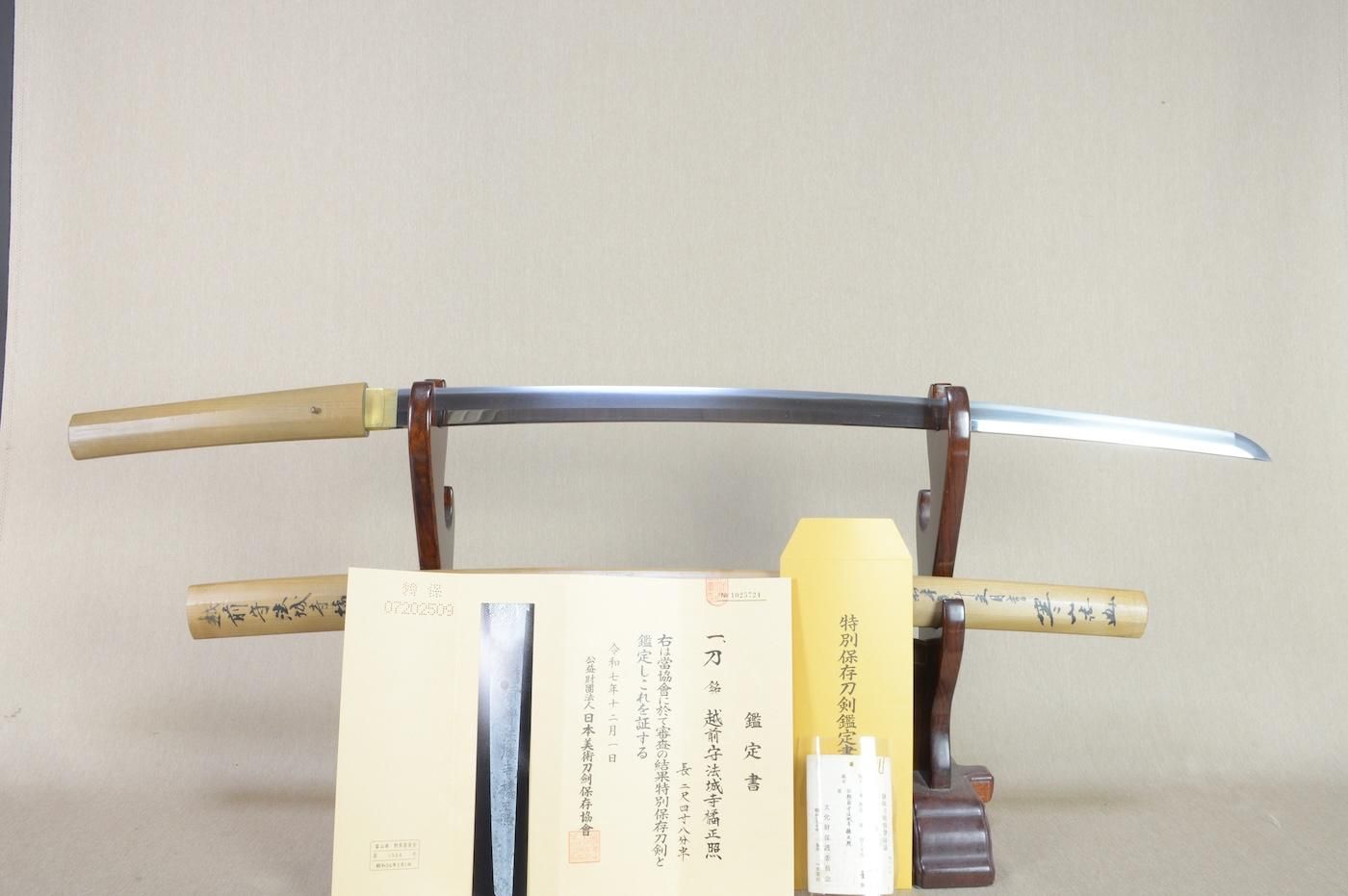
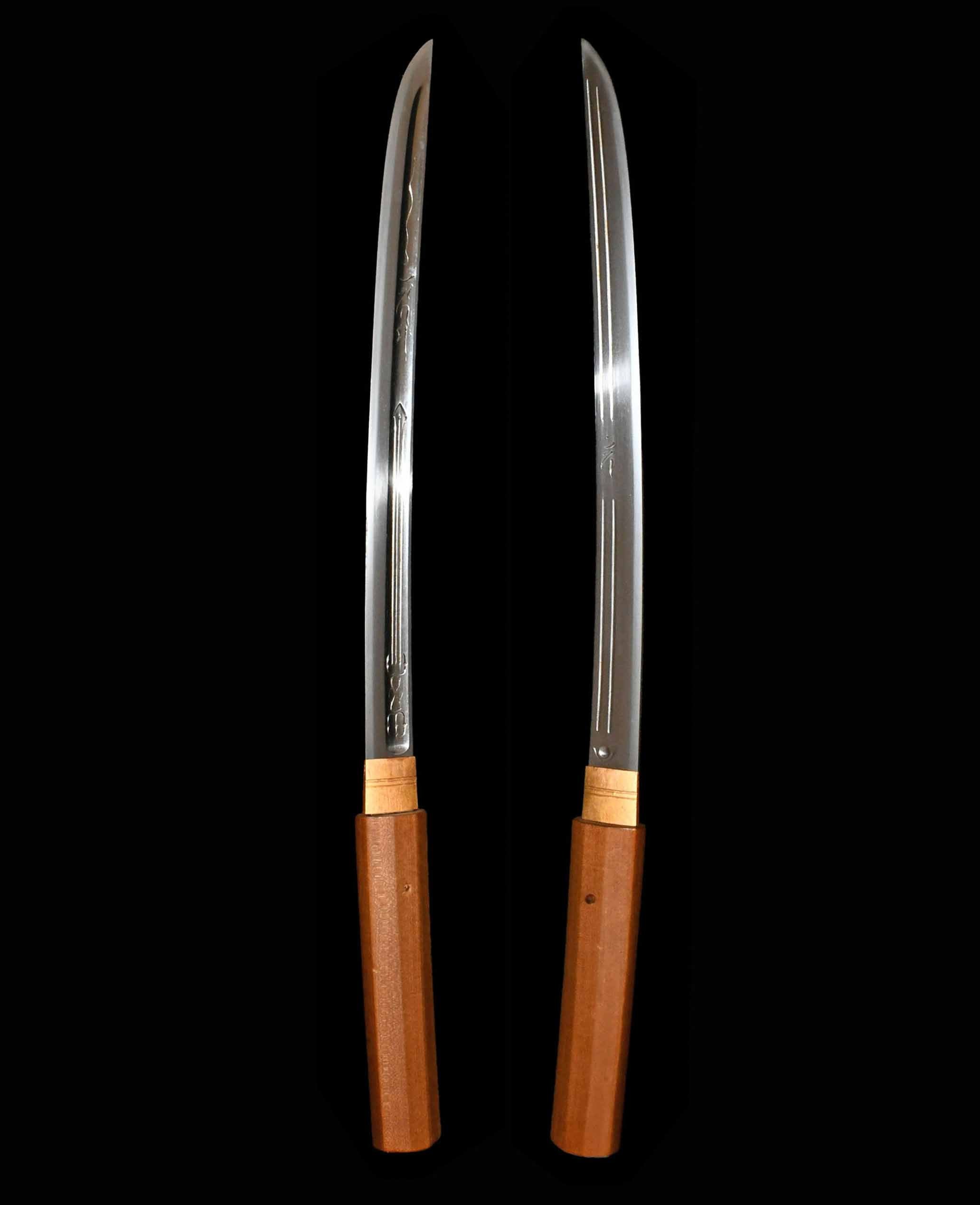
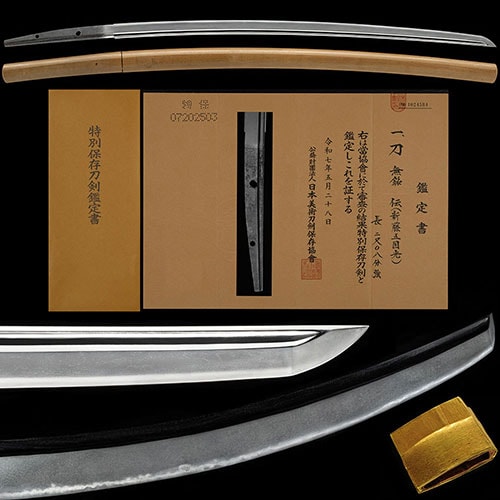
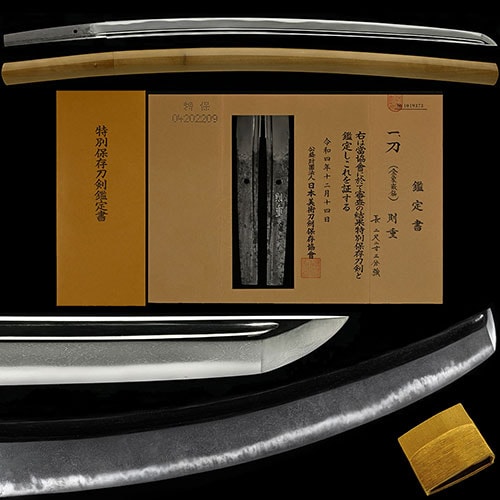
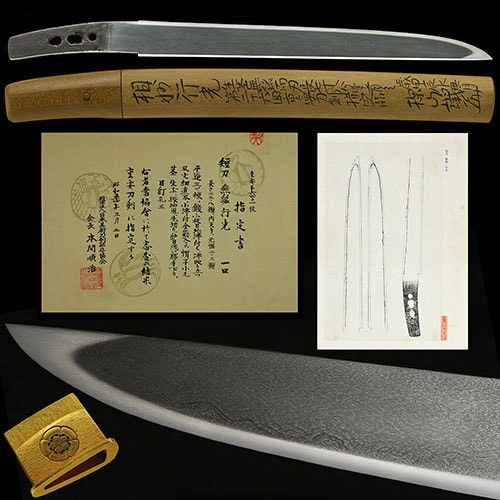
Tajima no Kami Hojoji Tachibana Sadakuni made swords in from the Manji years into the and Enpo eras, and one of his carries a gold-inlaid cutting-test inscription dated the seventh day of the tenth month of 5, recording a three-body cut by the tester Yamano Ka'emon Nagahisa. He belonged to the Hojoji group, a community of smiths that the published sources describe as "the largest body of swordsmiths active in " in the and Enpo years, producing many capable hands. Its first generation was Omi no Kami Hojoji Masahiro, and Sadakuni stands directly after him in time. A surviving blade signed in full and dated Manji 3 on the reverse fixes his activity before the era, so the published commentary places him as the smith who follows the founder, one whose "swordmaking is already seen by Manji 3". Fujishiro rates him Jo-. The school descends from the Tajima Hojoji tradition, of which the line was an offshoot, and the name Sadakuni it inherited belongs here to the Hojoji hand and not to the Shimosaka smith of the characters.
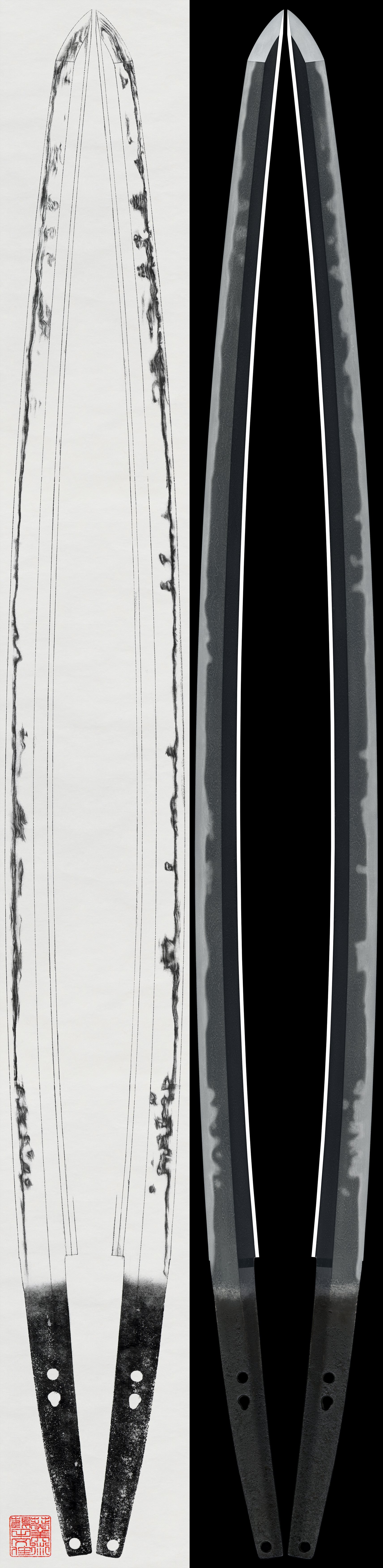
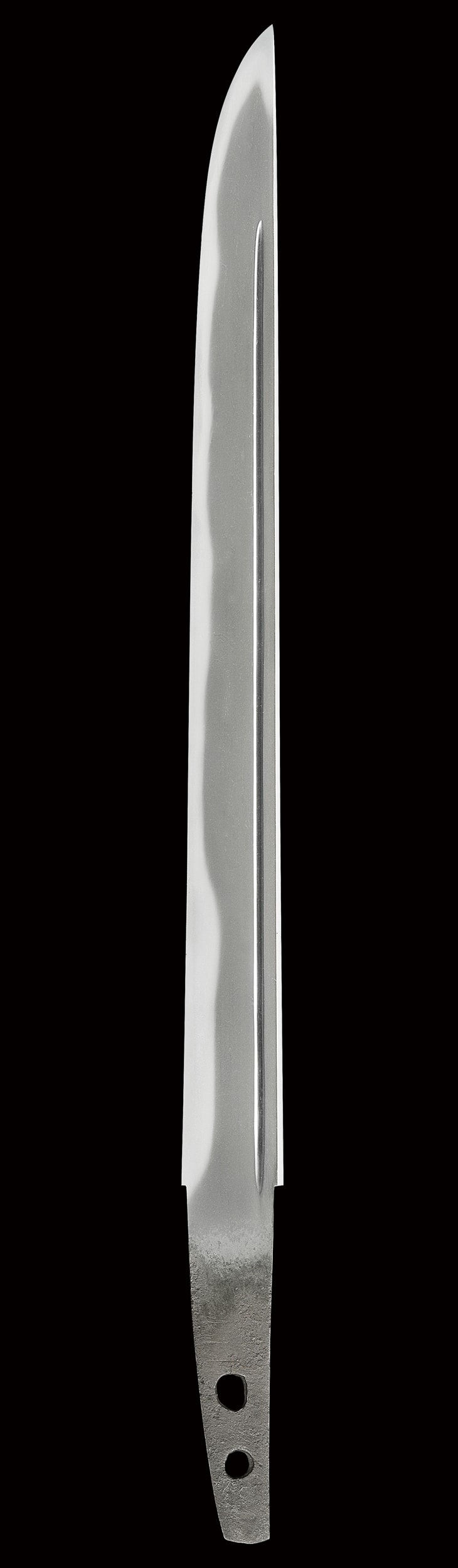
His characteristic hand is the manner the published sources name again and again as resembling the founder. Over a tight , in places drawing toward a slightly standing , with well-adhering, he tempers a base into which are mixed. The enter thickly, the is deep, gathers, runs through the , and the is bright; the goes straight and turns back in . The commentary treats this configuration as the typical work of the school as a whole, and one is judged to show the representative style so fully that its workmanship "approaches the Nagasone lineage, and is the finest among his works", measuring him for a moment against Kotetsu and his pupils. Of the - the published record observes that the commonly resolves the way, "the being one that turns back straight into as a rule", so that the temper and its turnback read together as a single, settled formula.
The is the steadier half of the picture. The forging is a , well knit and tightly packed, at times mixed with and on one blade carrying a -like passage toward the edge, with lying over it. In his later and most refined the is at its clearest: the published sources describe a dense with very fine adhering thickly and fine entering well, the point on which his best work earns the comparison to Kotetsu's line. The over it is a -based temper with a shallow tendency, paired and continuous crossing it, abundant entering, deep and thick , fine and , and in the upper half a small admixture of and , the bright and the showing a touch of at the point. The activity is consistent across the surviving body of work, and it is the above all, running through nearly every blade, that keeps the quiet and its from reading flat.
His work resolves into two registers of one manner. The first is the typical Hojoji hand described above, the - with deep and a straight that the commentary calls a quintessential, "typical example clearly displaying the characteristics of the school and smith". The second is the refined later hand seen in his Heisei-designated , where the tightens into a fine, -laden and the edge gains and . The published sources read this second register pointedly: of the in the upper half they note that " is also frequently seen in Hojoji Masahiro", and they take it as evidence of the close relation between the two men. Almost all of his designated blades are signed, and the signature is a long one, cut on an , often with a thick chisel in large characters, reading Tajima no Kami Hojoji Tachibana Sadakuni; half of them carry a gold-inlaid cutting-test inscription on the reverse, by Yamano Ka'emon Nagahisa, Yamano Kanjuro Hisahide, or Shibasaki Denzaemon Masatsugu, recording the three-body cuts of the test-cutters and adding to each blade a documentary value the commentary singles out.
What distinguishes him is set against the founder rather than against a rival school. The published sources hold his hand to be extremely close to Masahiro's and then mark the difference precisely: in the clarity of the and the strength of the , they write, he "falls a small margin short". That single, measured shortfall is the explicit basis on which the two are told apart, and it is the more telling for being small. His own marks are the affirmative ones the commentary returns to: the base under the , the deep carried in , the bright of his refined pieces, and the fine of his late . Within the Hojoji school he is the earliest-dated hand after the founder, the maker through whom Masahiro's manner passed into a productive workshop of many capable smiths, and his blades are the yardstick against which the group's representative work is measured.
Sadakuni is rated Jo- by Fujishiro, with a Toko Taikan valuation of 4,500,000 yen. His designated record is eight blades, every one of them at the level and none designated above it, a record that places him as a fine school hand rather than a celebrated master. The published sources call surviving examples by him comparatively few, and within that small body the designated pieces are nearly all signed and many are tested, several bearing the gold-inlaid of the Yamano house that lend them additional reference value. No provenance to a house or museum is recorded among them; they have passed through private hands, the cutting-test inscriptions standing in for the named pedigrees that thinner-documented blades usually lack. For a collector this means a Hojoji Sadakuni is not beyond reach in the way a National Treasure is, but it is uncommon: his , signed and frequently dated by their test-cuts, come to market only from time to time, and a well-made example, bright in the and tested by a known hand, is the kind of early- signed work that rewards patience rather than search.