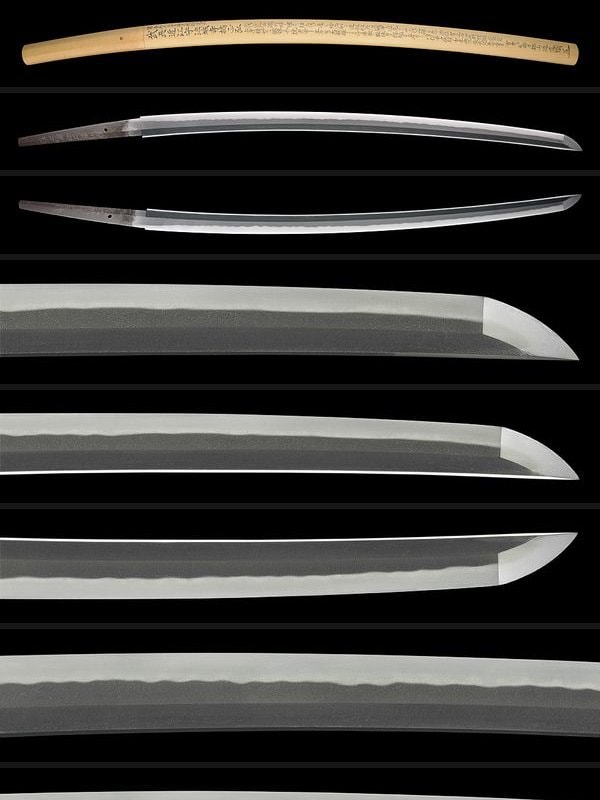
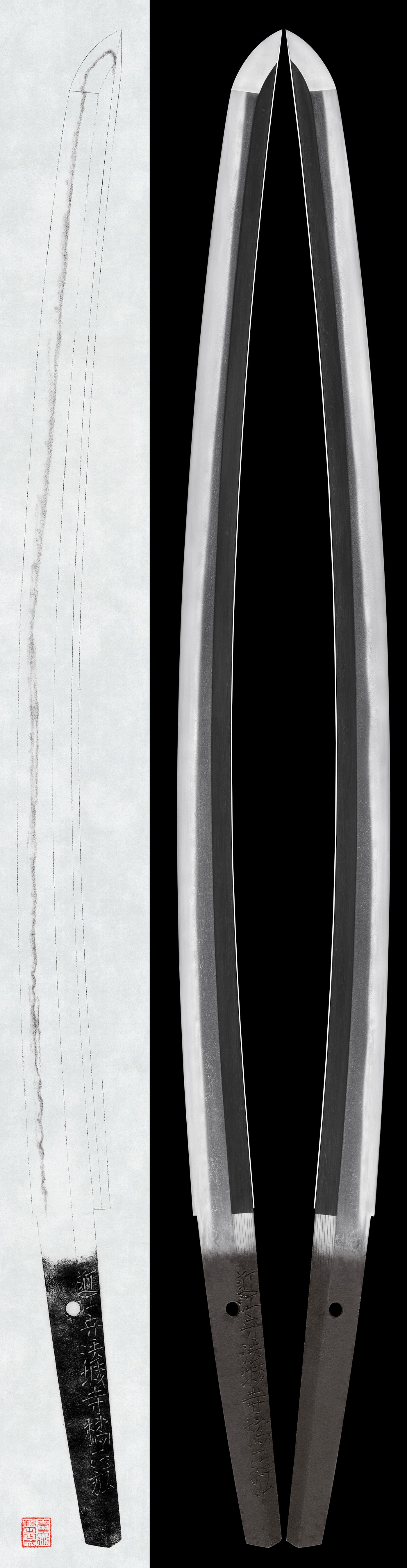
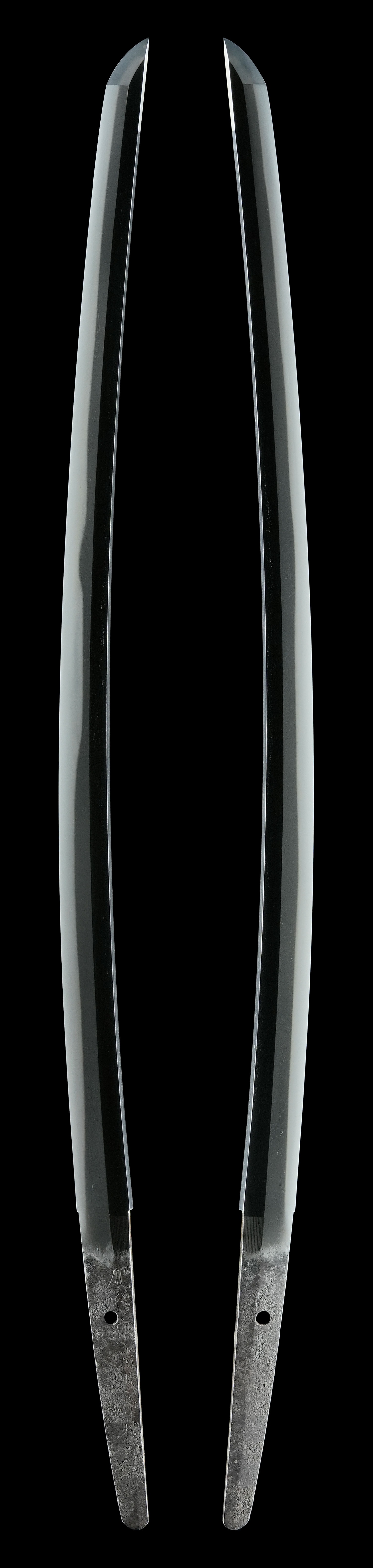
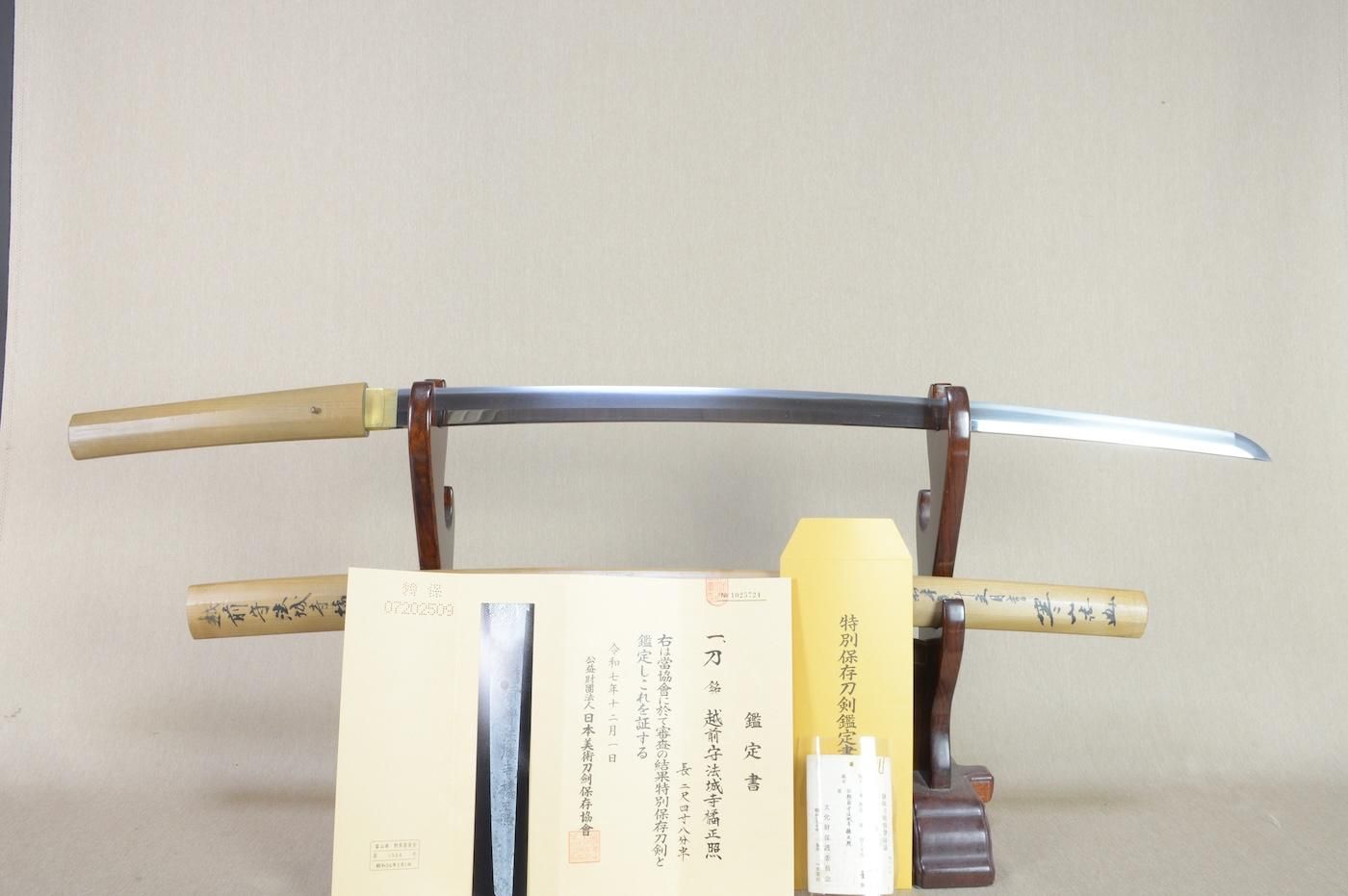
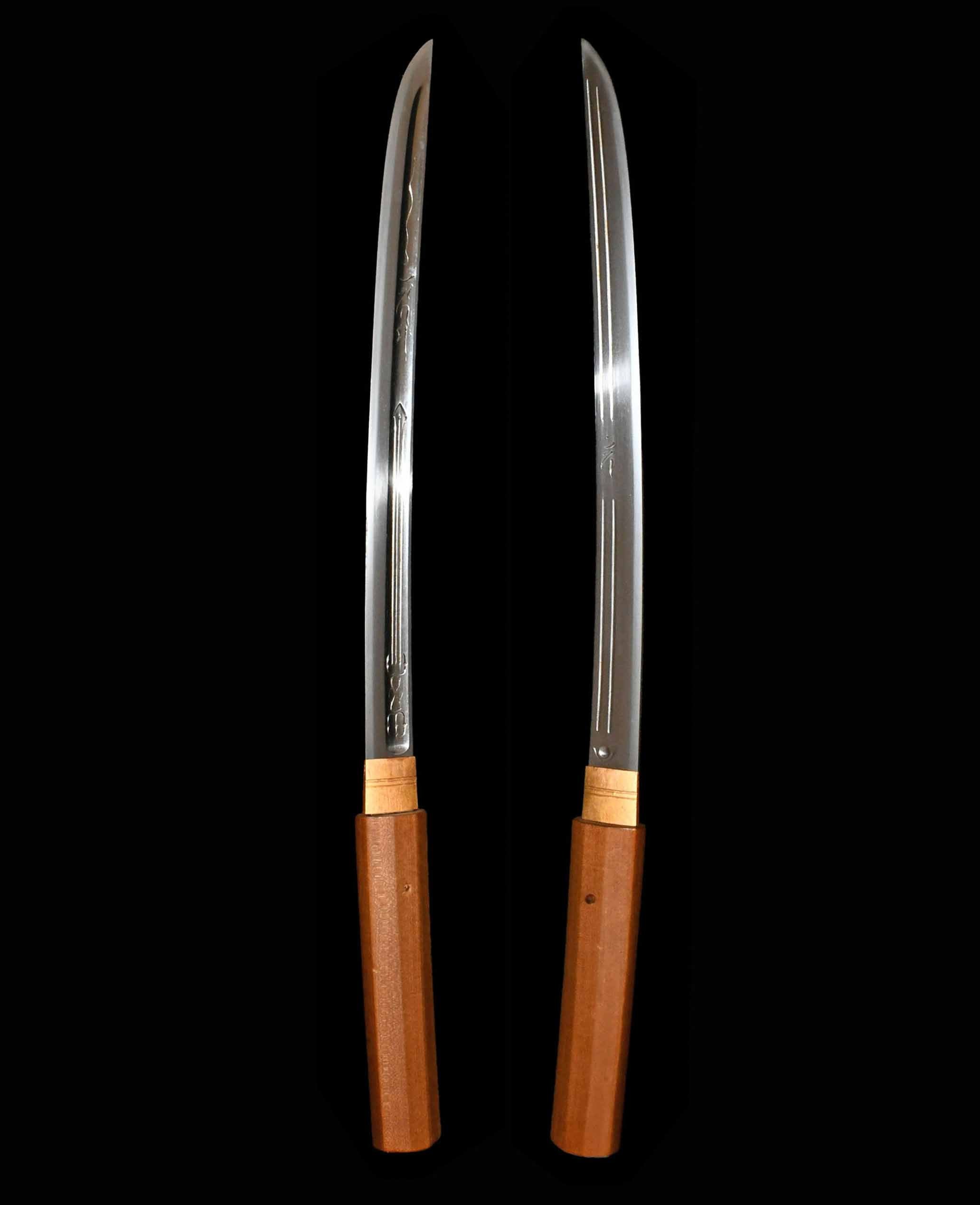
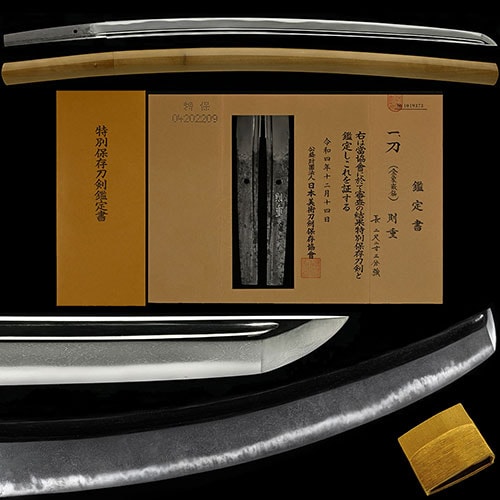
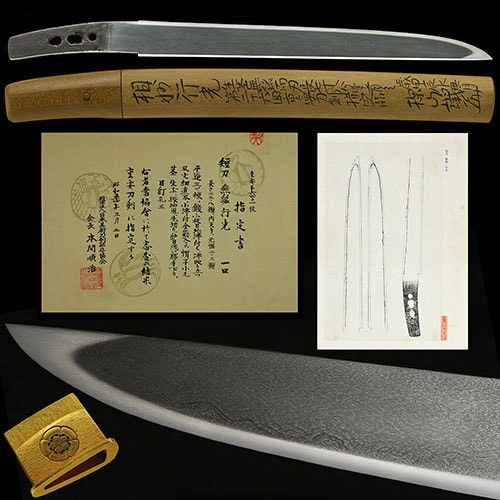
Hojoji is a place name in Tajima province, and the published sources open the record with that fact: because "the master of the , Kunimitsu" lived at that spot in the period, the smith himself came to be called Hojoji, the man and the place one name. The lists a first generation working in the Joji era (1362-68) and a second at Oei, and records work dated Joji. Yet his fame rests on a paradox the published sources state outright: not one signed or survives. The signed work is exceedingly scarce, confined to and , and the and the conversions from that carry his name are without exception attributions, so that his celebrated manner exists almost entirely as a headed by his name.
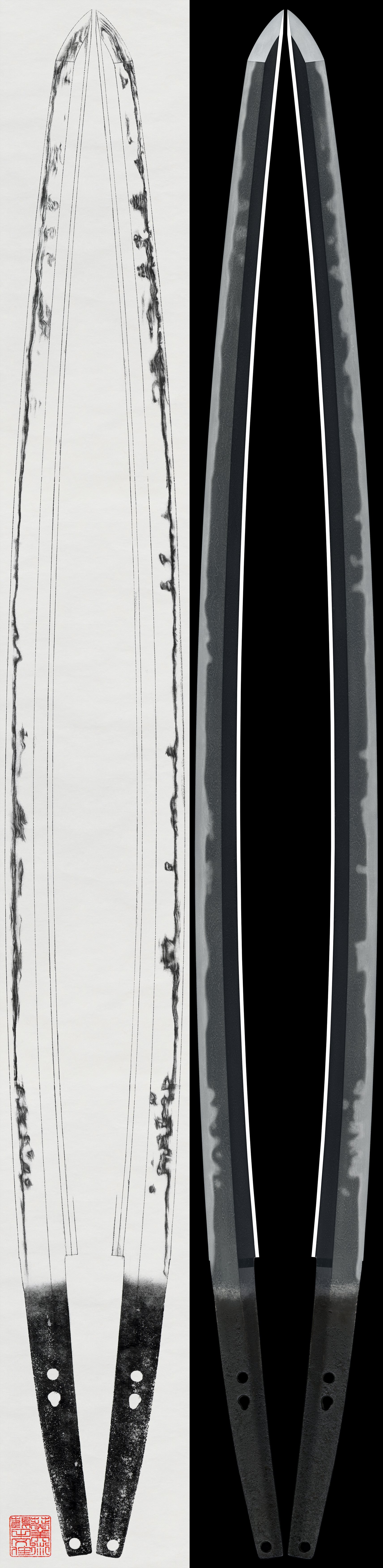
For the works the states its formula in text after text, in two steps. The blades temper a flamboyant "mistakable at first sight for "; the name is then settled against by "a workmanship in which the of and is markedly stronger, enters the large-patterned forging, which stands out vigorously, and and are worked incessantly through the ". The blades keep the build of the long , wide and with little difference between and , the pared away in conversion so the runs thin, with a large . The mixes in , and enter richly, the is deep and the thick, and on the boldest pieces and join in. The runs with strong and ends , which the published sources explain as a trace of the remaking, "because the was filed down in later times".
The beneath that temper carries the rest of the appraisal. It is mixed with and flowing , standing out in a large pattern, with thick and woven in, and a rises, vivid on some blades and faint on more. The faintness is itself a tell: of a that at first sight could pass among work, one text writes that "the points to look for in Tanshu Hojoji lie in the with its well-covered and the weakness of the , and in the with its well-applied ". Another locates the division from in the -based of mixed with , and "further in the violence of the ". A quieter strand of the works a shallow notare base with and mixed in, and the published record admits a -based hand as well, its tight and its unobtrusive.
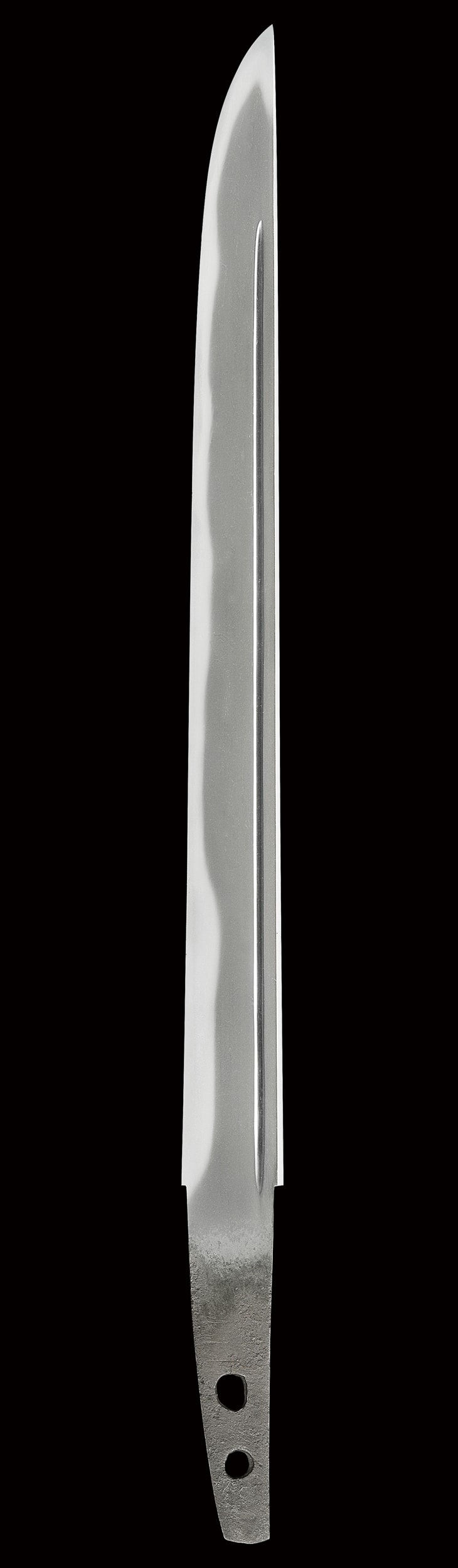
The signed work stands apart, and the published sources restate the distance with every signed blade: the quiet show "a gap in manner from the attributions". These are with , on with a shallow , normally bearing the five-character Tanshu-ju Kunimitsu cut large with a thick chisel below the ; one instead bears a two-character Kunimitsu on the , perhaps for wear as a mete-zashi, a placement the text calls "exceedingly unusual". None of the extant signed blades tempers the flamboyant . They divide instead between a quiet hand, with slight , niju-ba and sanju-ba above the and a rising over steel of darkish color, and a hand with , the strong and coarse, sweeping through, the sinking. and appear on several. Yet the two bodies of work are sewn together from inside: reading the Akimoto closely, the finds in the rough, large-patterned standing forging, the conspicuous activity of and , and the sinking something "running in one vein into the manner of the attributions".
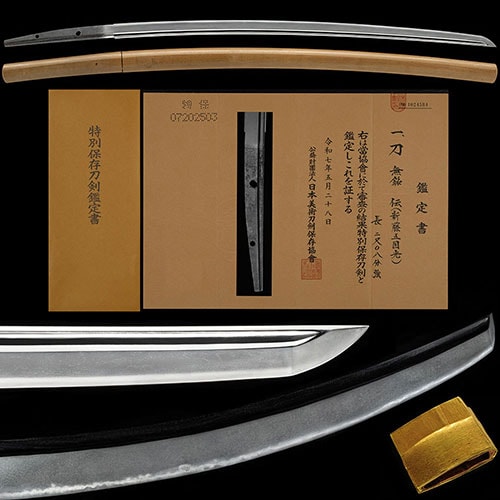
His place in the genealogies is a legend the reports only to reject. The old books count Tanshu Kunimitsu among the three great pupils of Sadamune, and the texts answer in turn that "there are many doubts about this, and it cannot readily be assented to", that the claim "wants plausibility", that it is "unwarranted to begin with"; one of them concludes that "the influence of work is rather the stronger". The generations are left as the record gives them: "the lists a first and a second generation for Kunimitsu, placing the first at Joji and the second at Oei". Of four judged at one sitting, Honma Junji writes in the Bijutsuhin record that they read "at a glance as wholly the hand, the first-generation Tanshu Kunimitsu", adding that he had seen a mere two blades of this temper he would give to the second generation. The Honami line vouched for the blades across centuries, with attribution inscriptions, never signatures: a Bijutsuhin carries a gold-inlay attribution by Honami Koon, a a four-character gold-inlay judged the hand of Honami Mitsutada, and another keeps a red-lacquer Tanshu Kunimitsu attribution on the of its .
He is Jo-jo in Fujishiro's grading, and twenty-three designated works stand on record: two Important Cultural Properties, five , thirteen and three Bijutsuhin, eighteen blades in the and tiers together, and five signed pieces in all. Six blades carry recorded provenance, and it runs high. The Akimoto appears in the Kozan annotated for Lord Tokumatsu, the infant heir of the fifth shogun Tokugawa Tsunayoshi, and after the boy's early death was granted by Tsunayoshi in 1698 to Akimoto Takatomo, descending in the Akimoto house of Tatebayashi. The of session 25 was owned by the tea master Kobori Enshu before passing to the Maeda house of , its old scabbard recording a polish by Honami Mitsusa in Bunkyu 2, and another Maeda keeps a scabbard inscribed Hojoji by Honami Shosaburo. Of recorded whereabouts today, blades are held at Izushi Jinja in Tajima, the Otaki Castle Museum and the Kurokawa Research Institute. The two Important Cultural Properties are patrimony, preserved outside the market; what a collector may realistically encounter is the and tier, conversions above all, and even these appear only from time to time, while a signed is among the rarest encounters the school affords.