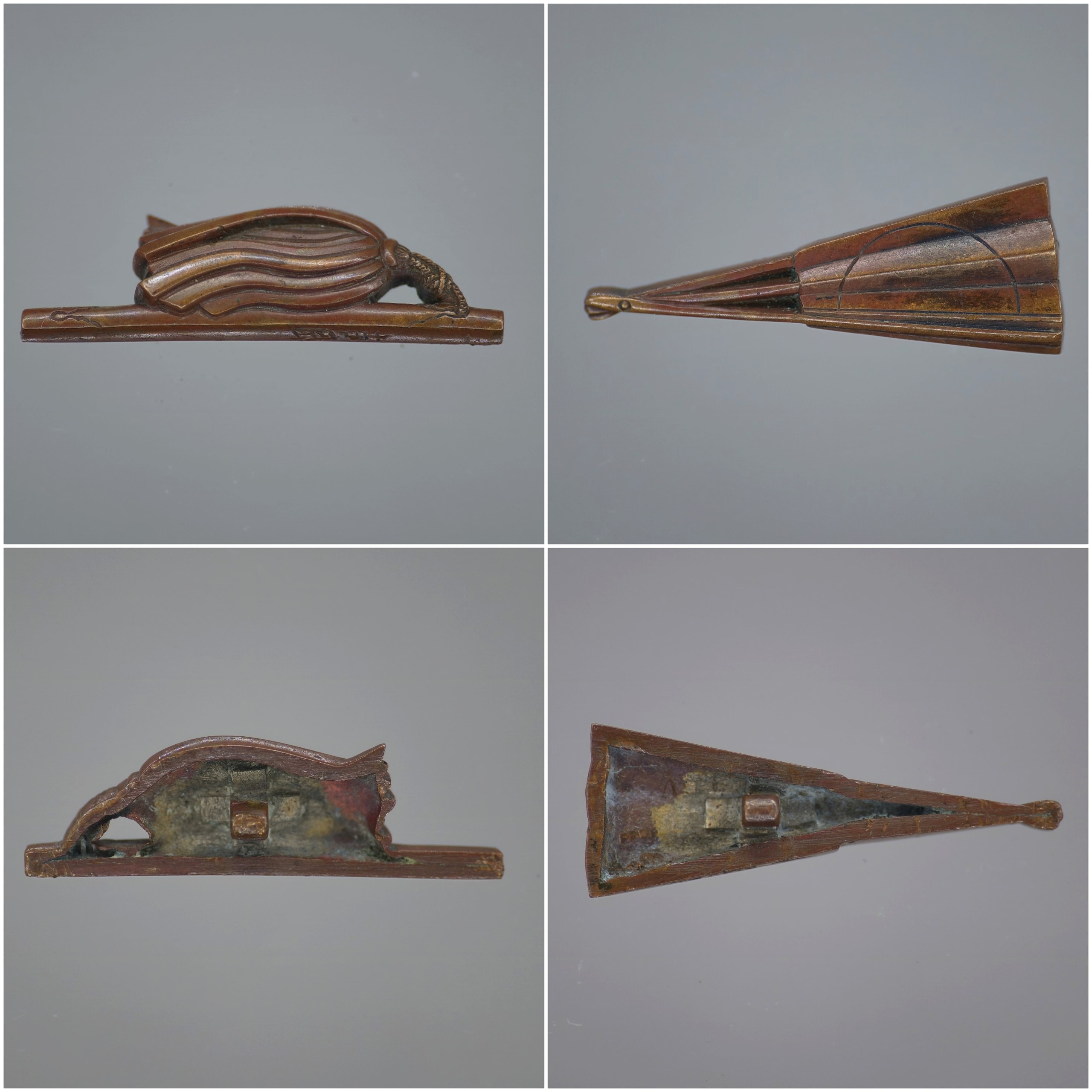
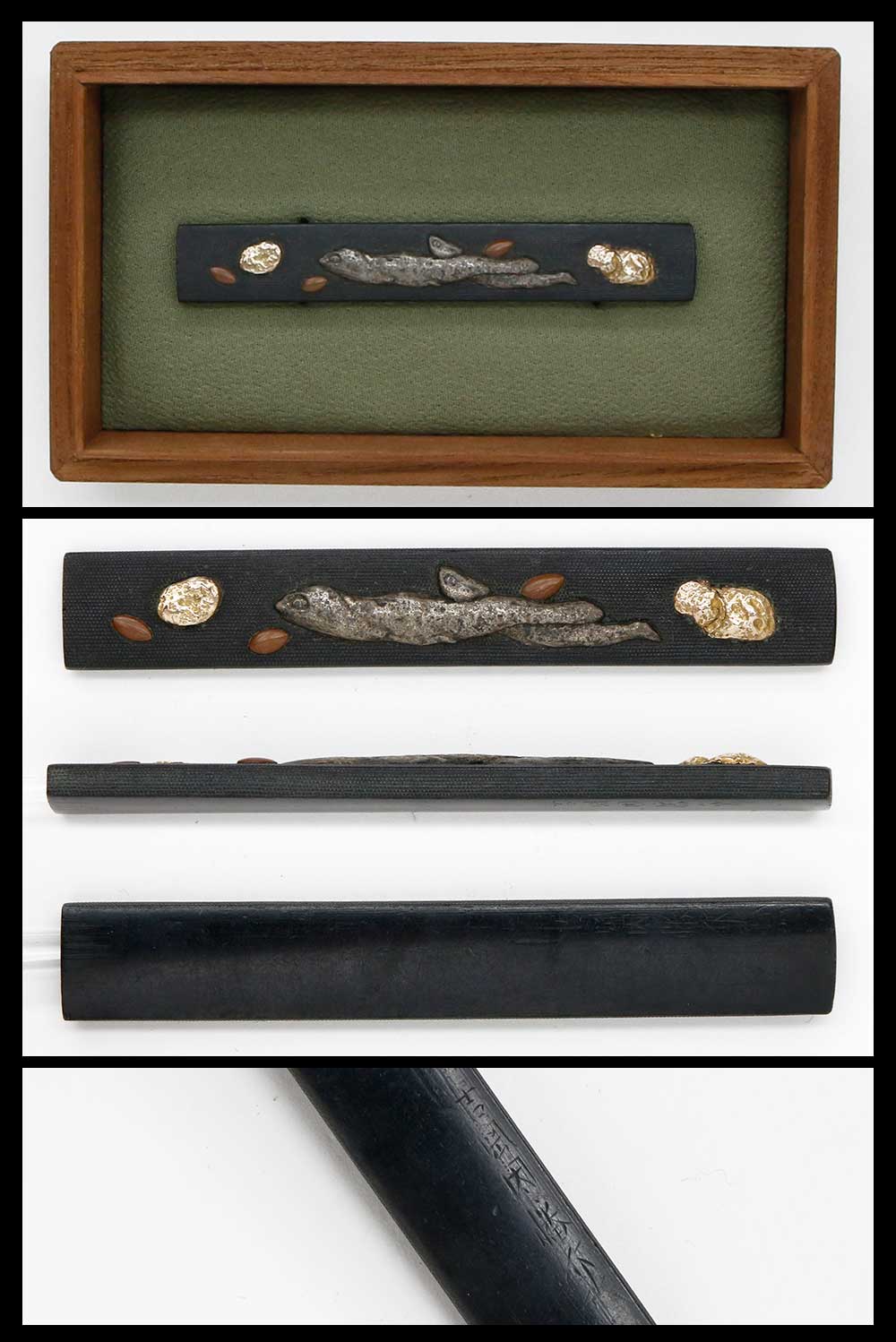
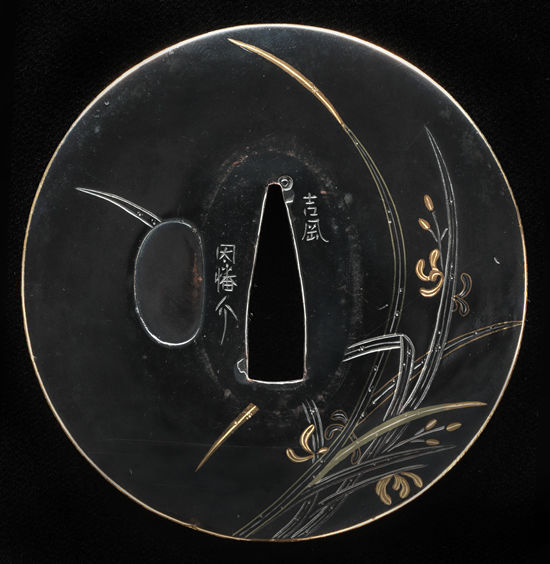
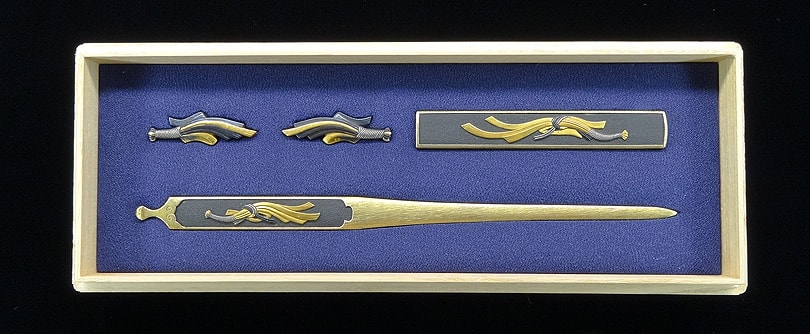
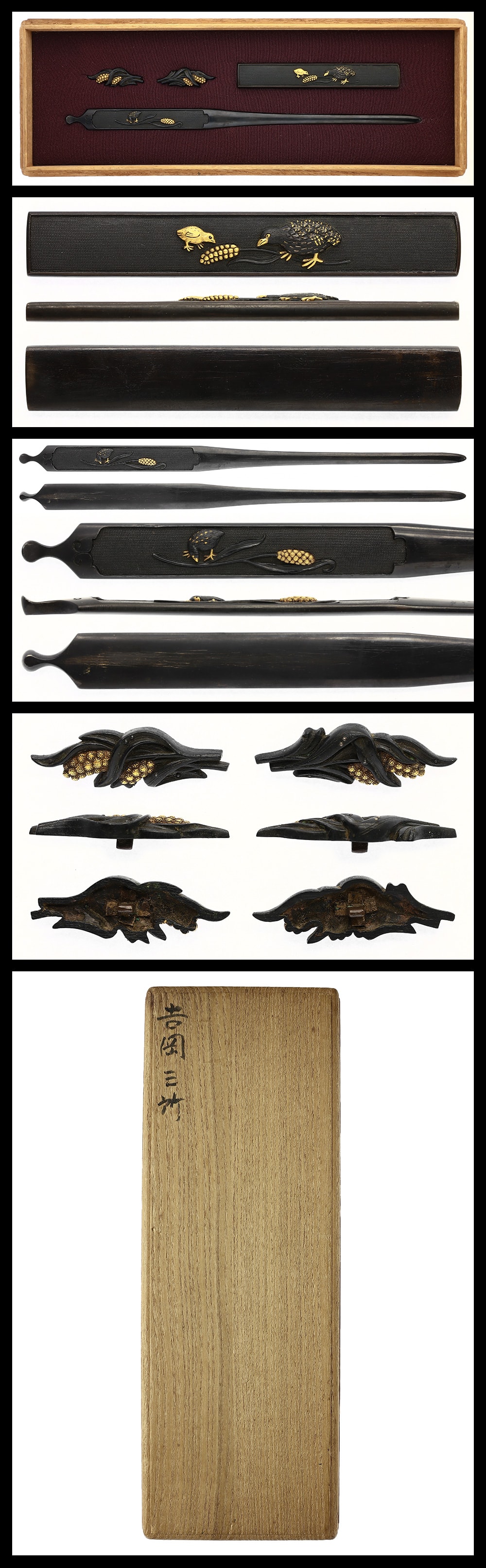
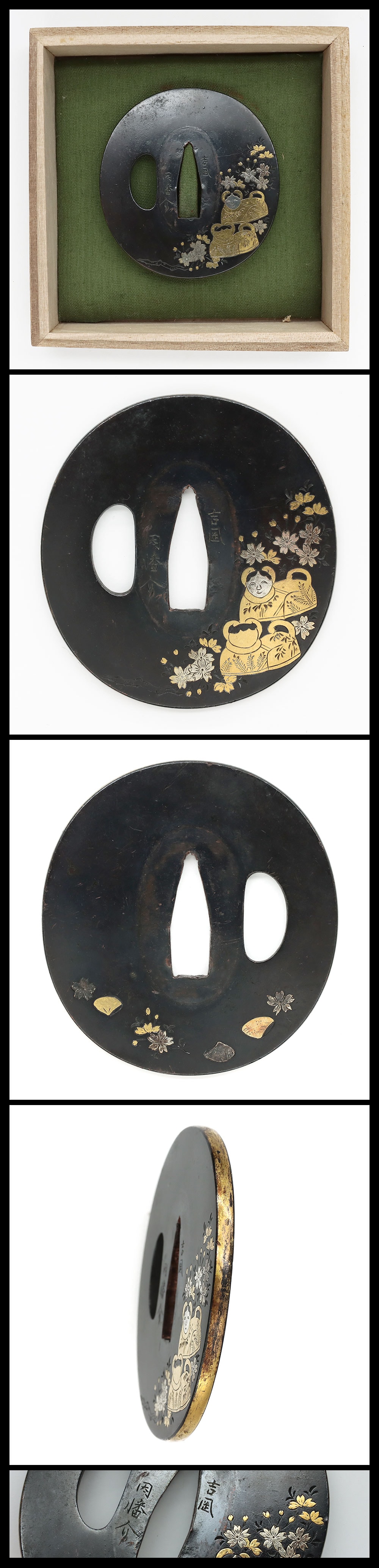
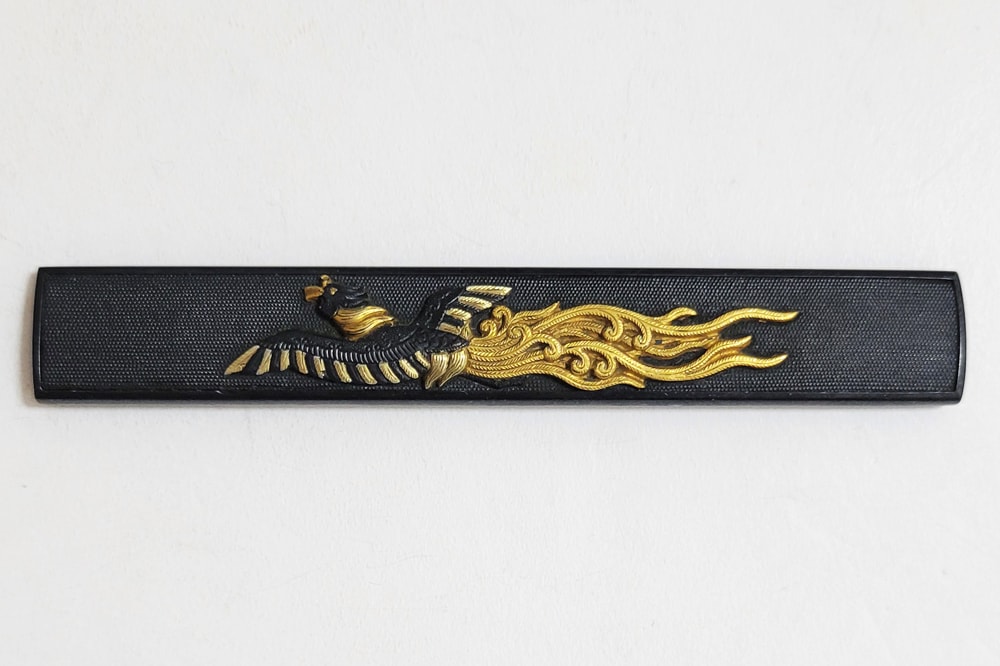
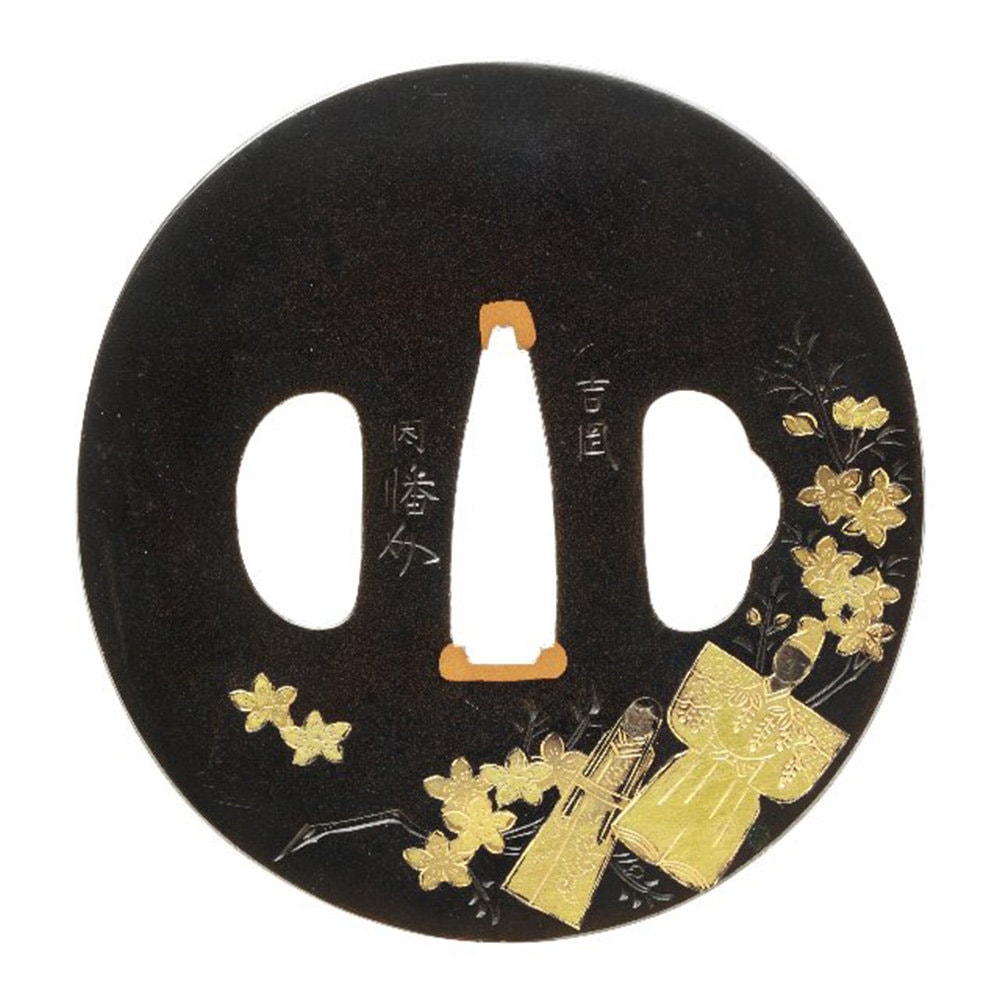
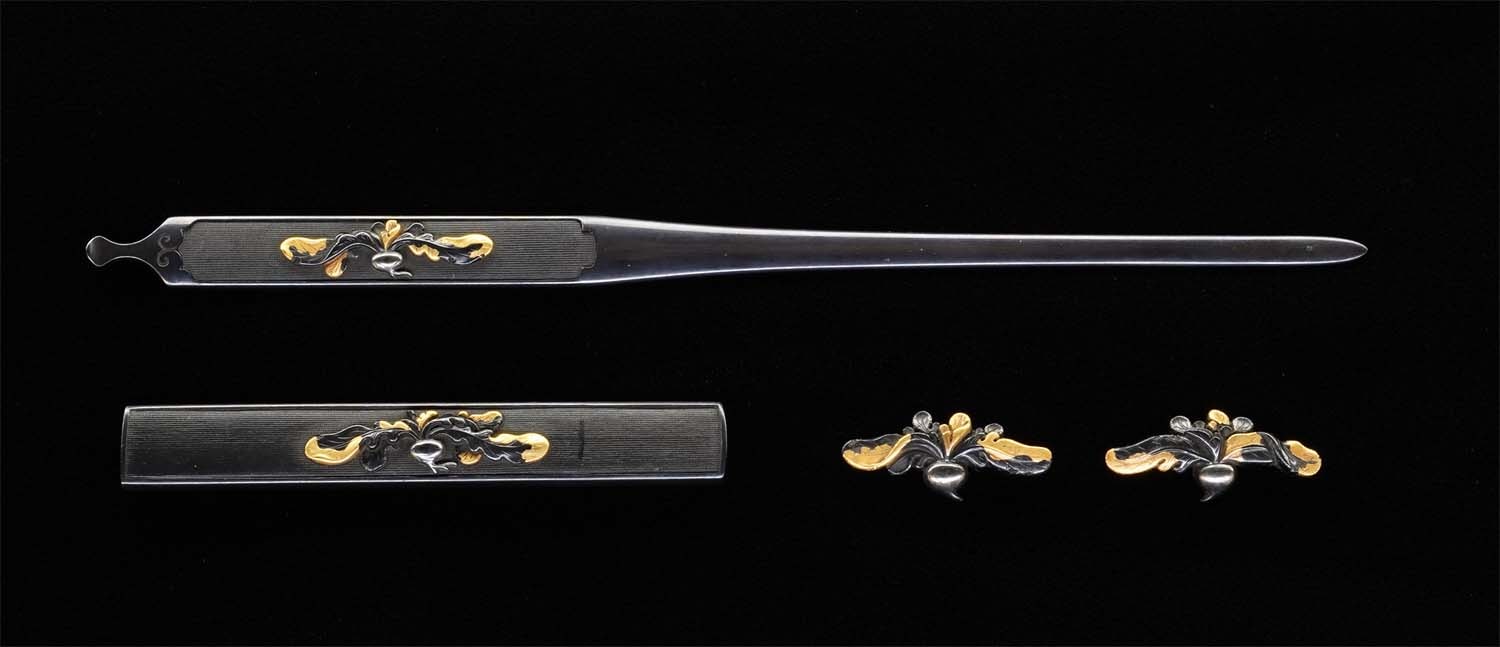
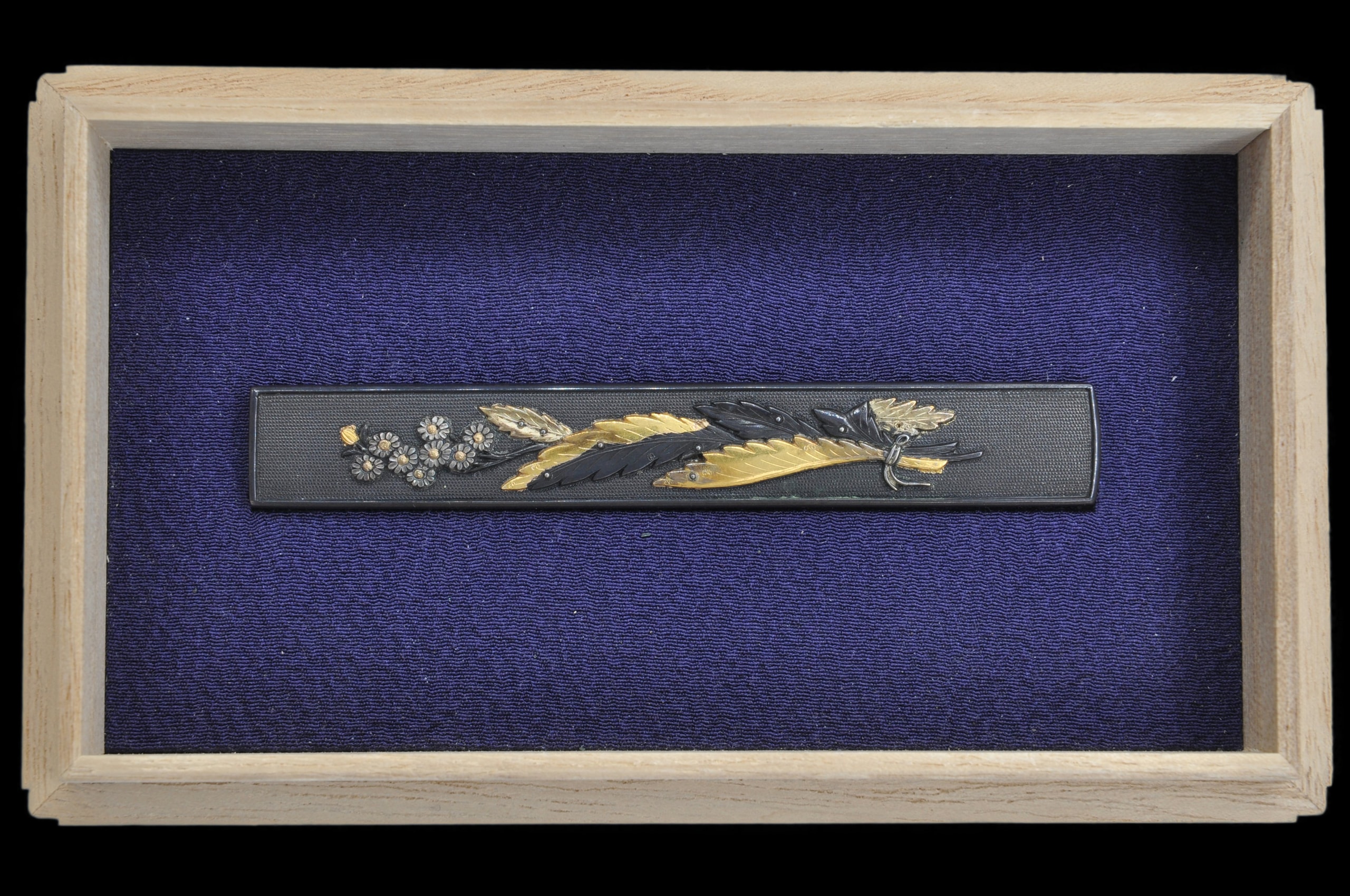
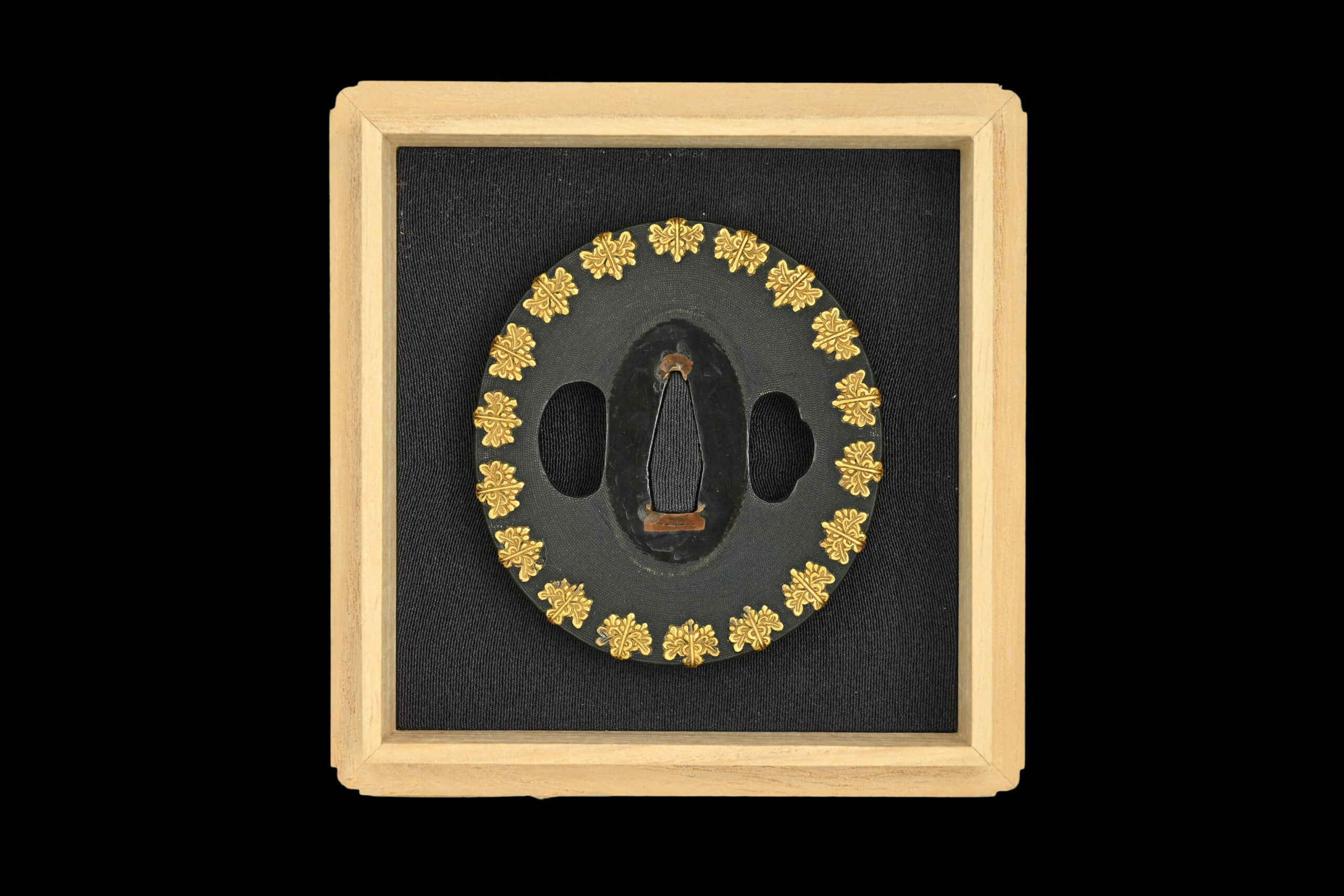
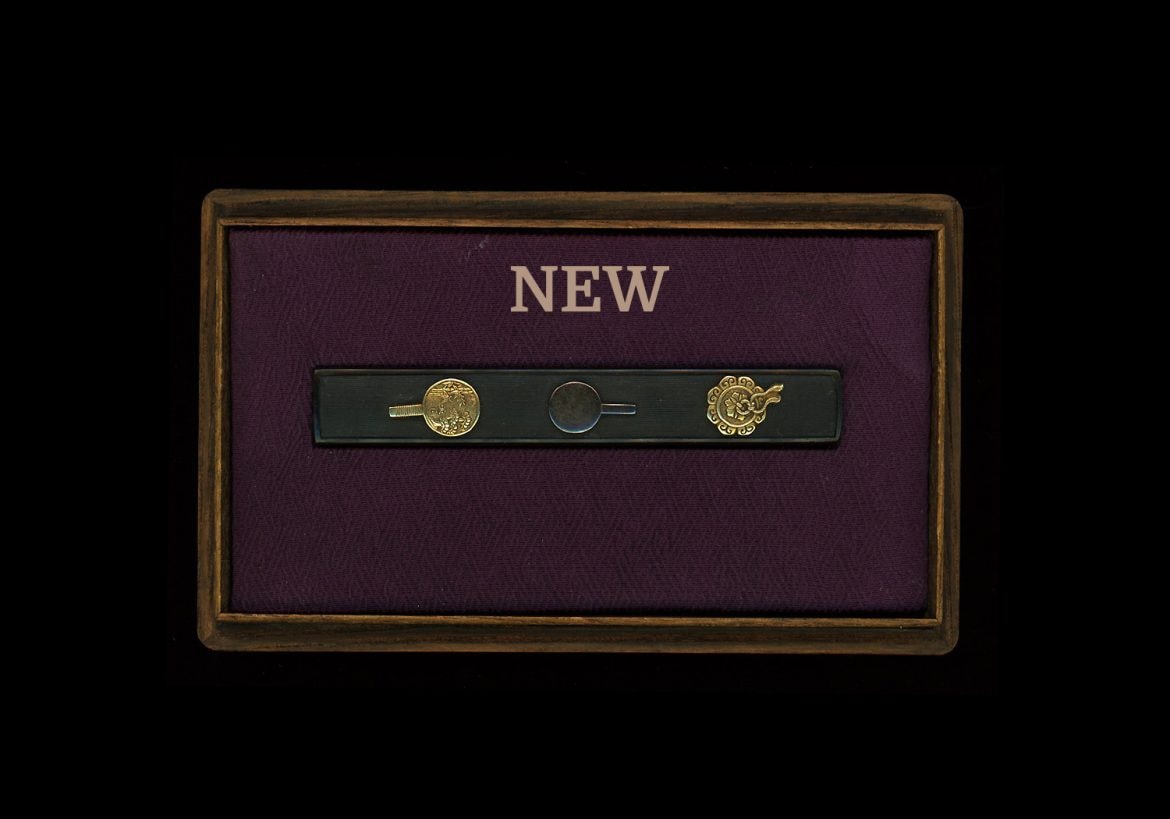
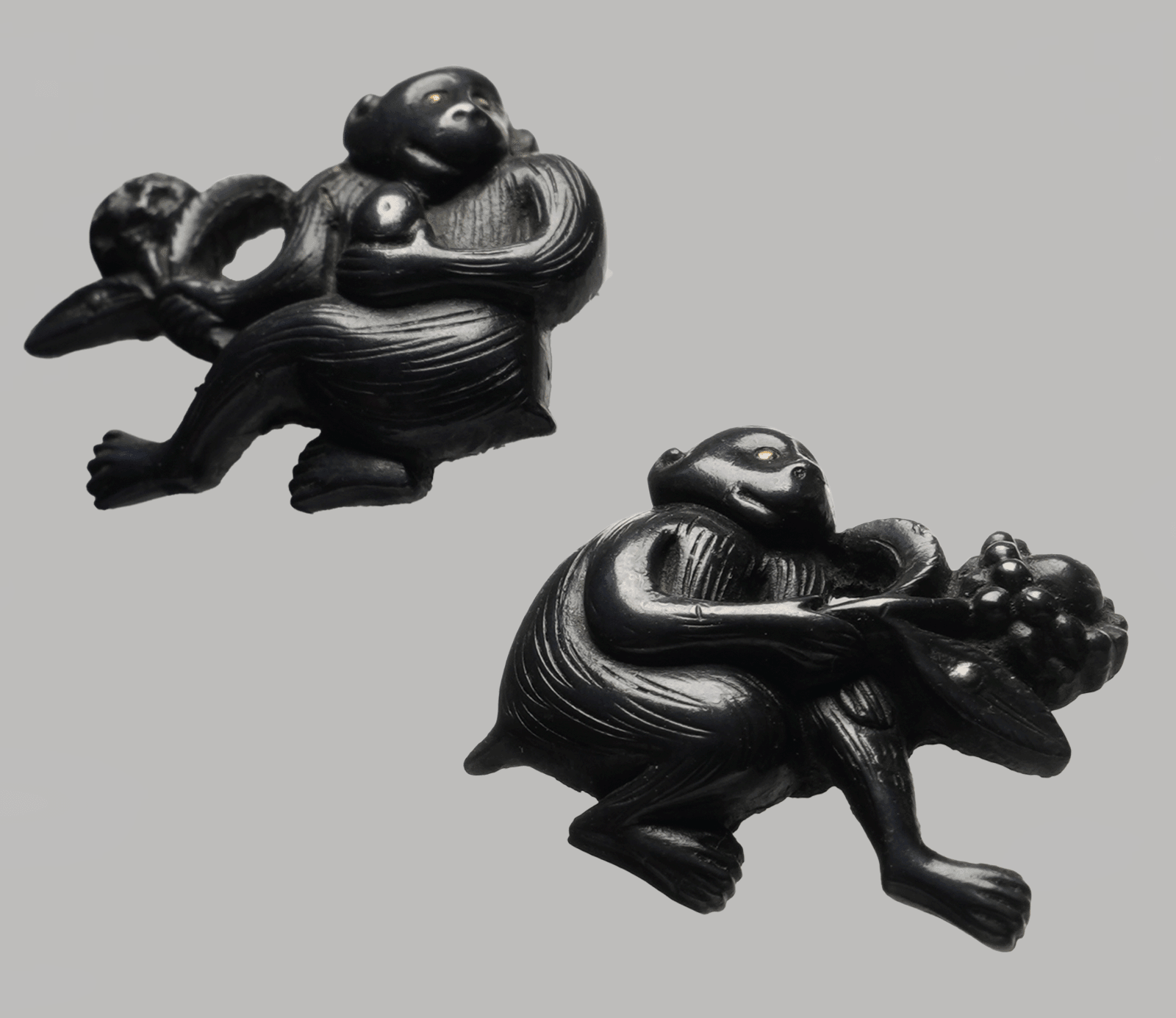
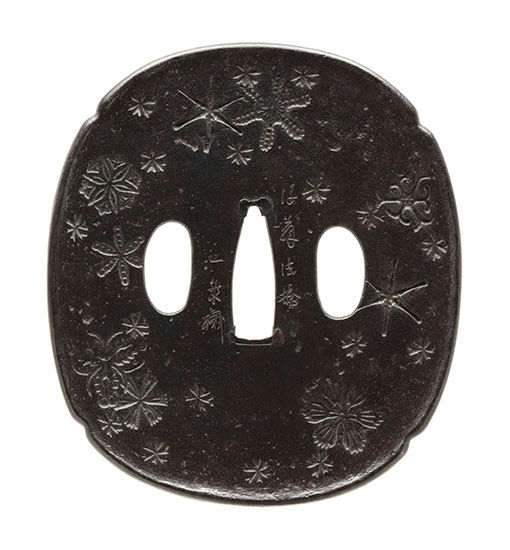
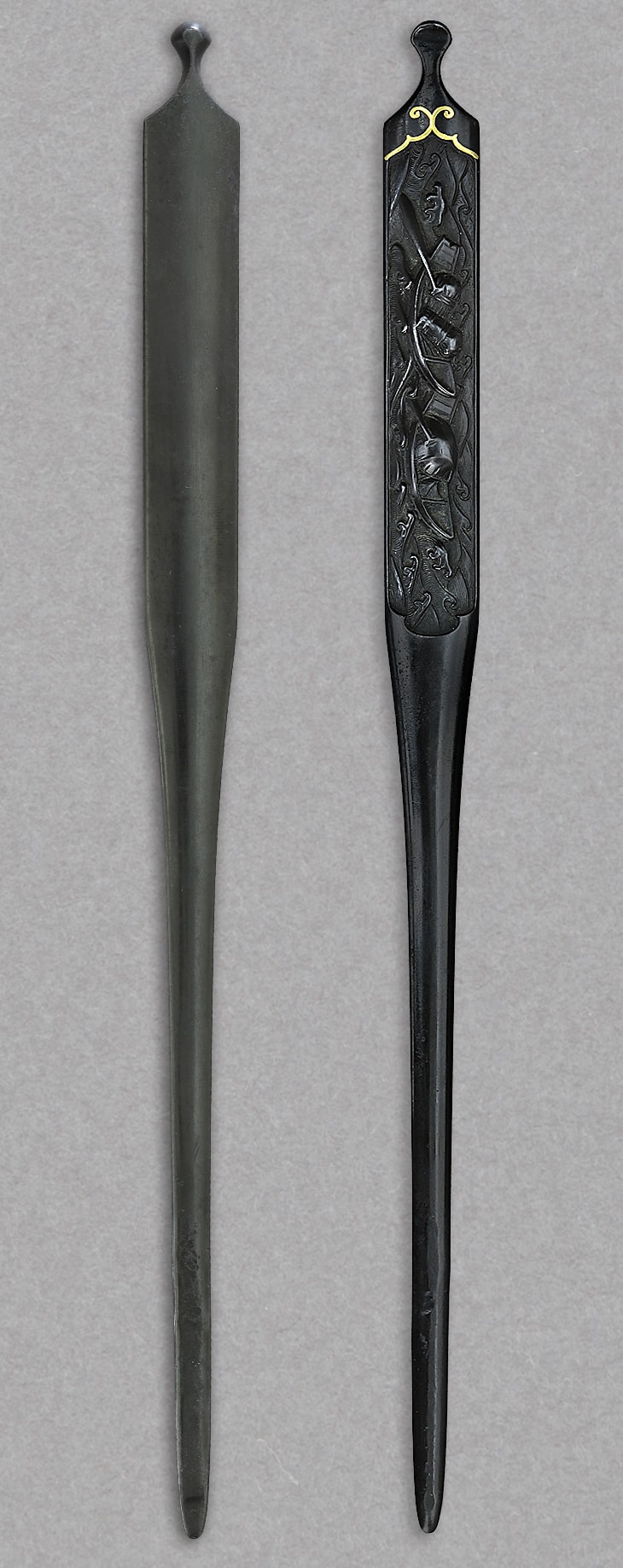
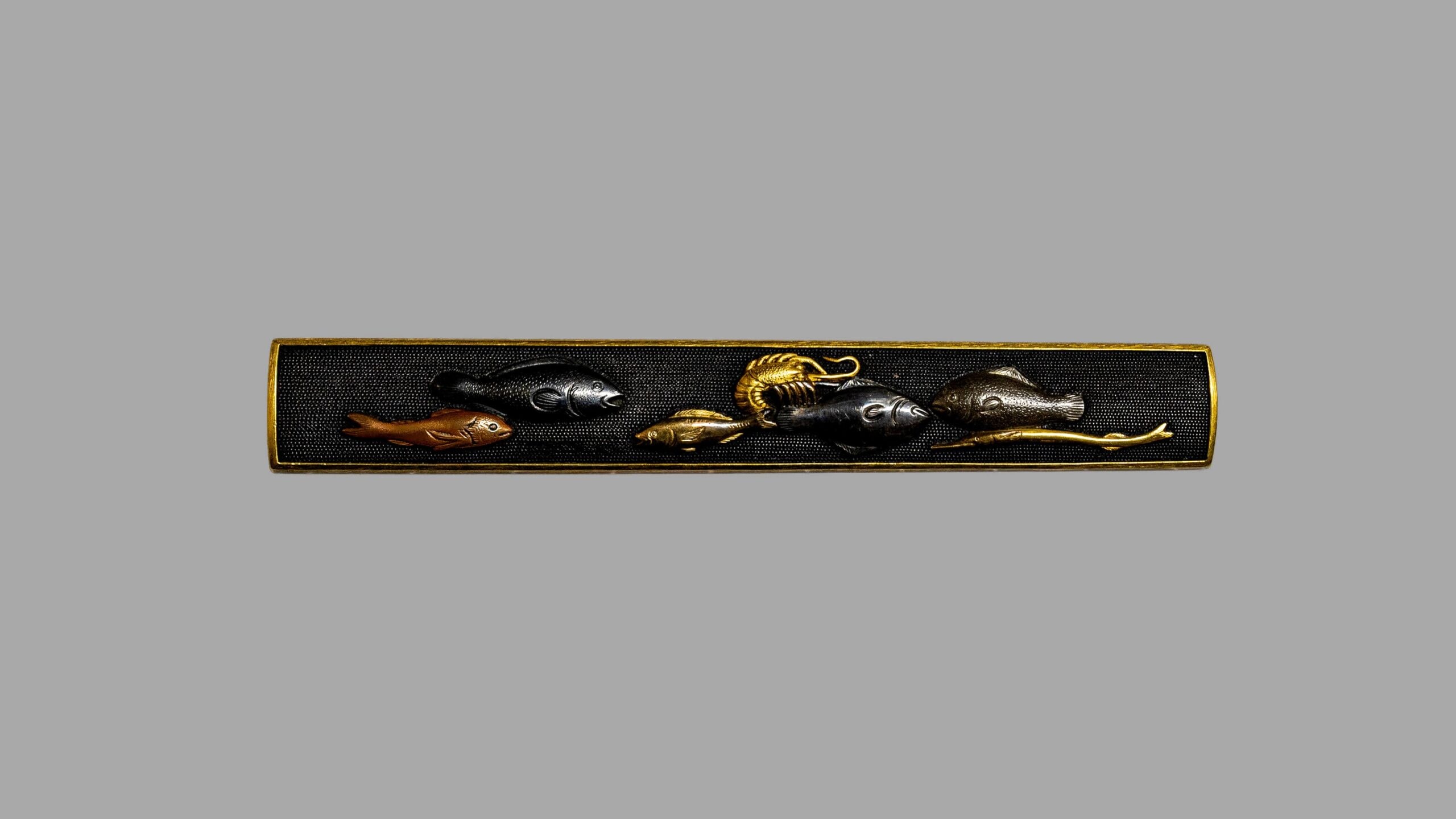
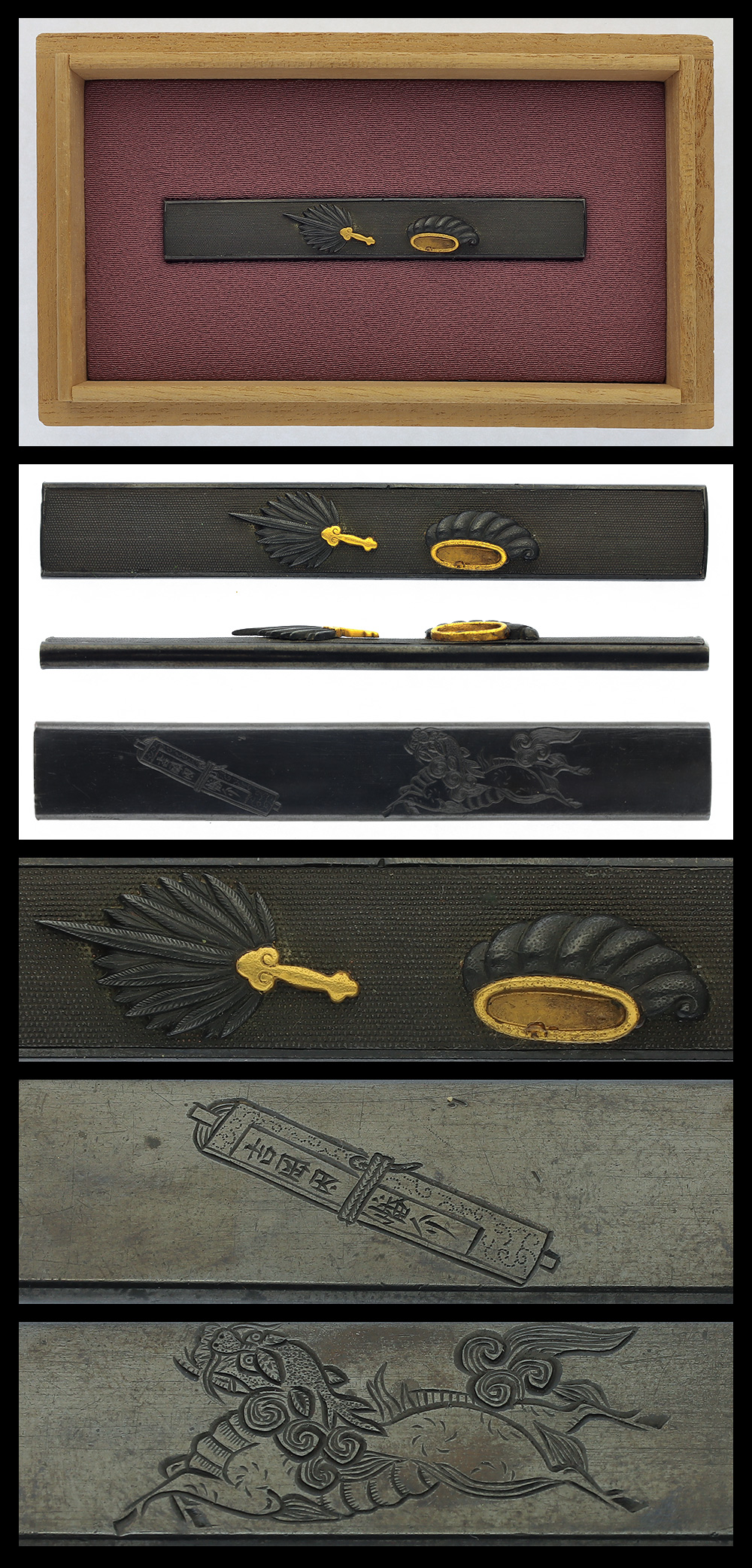
This is a kozuka by Yoshioka Inaba Suke, a metal smith family that served the Edo shogunate. It features a shakudo nanako plate with carvings of a hand fan and a Chinese hat, symbols of Zhuge Liang. The reverse side has engravings of a qilin and a scroll with the smith's name. It comes with an NBTHK Tokubetsu Hozon paper.
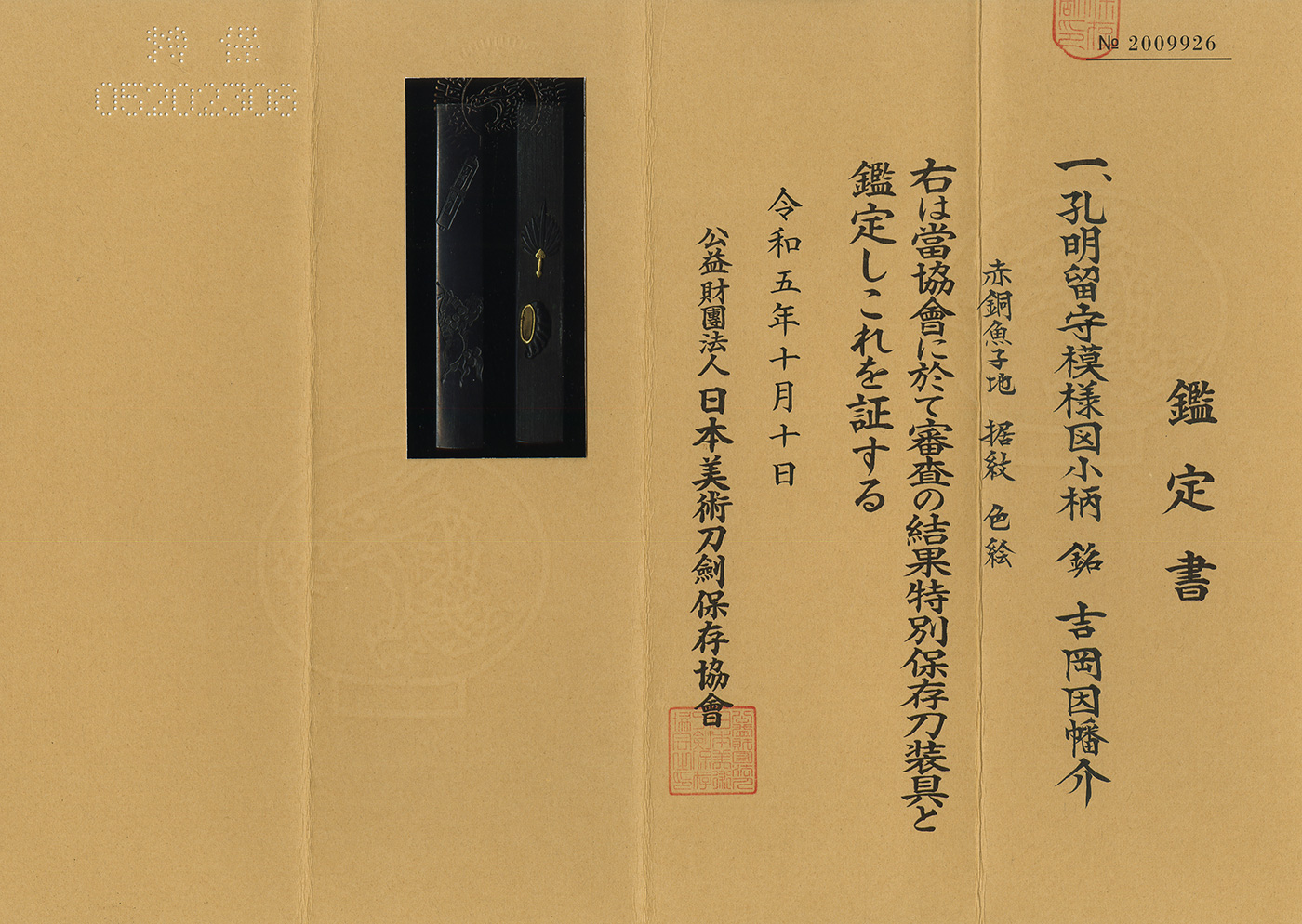
Certificate reading — 銘 吉岡因幡介
 NihontoWatch
mei · Edo (1670)
Yoshioka Inaba no Suke
Edo
Signed
Tokuho (NBTHK)
Iebori · around 1670
8 pieces on the market now
The Yoshioka family (Yoshioka-ryu) was a prestigious lineage of metalworkers retained by the Tokugawa shogunate, receiving a stipend of one hundred hyo (bales of rice) and rations for ten persons. The house flourished from the first-generation master Shigetsugu, who was summoned into service by Tokugawa Ieyasu during the Keicho era, through to the ninth-generation Shigesada at the close of the shogunate. Over successive generations they adopted the Fujiwara surname, and from the second generation onward they held the court title Inaba no Suke. Because works produced in the earlier period were all delivered to the bakufu, they are entirely unsigned; the practice of cutting the five-character signature "Yoshioka Inaba no Suke" is thought to have begun around the fifth generation, Yasutsugu, yet since personal names were not inscribed, distinguishing individual generations remains difficult.
The Yoshioka school's characteristic manner centres on shakudo nanako-ji enhanced with takabori (high-relief carving) and kin-iroe (gold colour inlay), producing workmanship that is solid and precise. Their steady, reliable carving is paired with meticulously applied iroe using many kinds of coloured metals, yielding surfaces that, while sumptuous, remain filled with dignity and refinement. Compositions range from the Eight Views of Omi rendered in polychrome sukidashi-bori, to dragon-and-tiger programmes deployed across complete daisho-soroi suites, to the restrained formality of ripened rice ears (inaho) unified across matched mountings. Techniques of kin-sue-mon (gold applied motifs) and kin-zogan (gold inlay) are employed to achieve striking contrasts between flat inlay that conveys the momentum of a brushstroke and higher-relief applied decoration.
The NBTHK evaluations consistently characterise the Yoshioka house as producing work of elevated and formal tone, marked by a serious, straightforward manner. As official kakae-ko (shogunate-employed artisans), their output embodies the requirements of shogunal ceremonial culture, from ito-maki tachi koshirae made for the Kii Tokugawa house to issaku (unified-suite) mountings whose coherent thematic organisation demonstrates the true worth of a shogunate-employed master metalworker[[c:1]]. Like the Goto family, to whom the NBTHK draws direct comparison, the Yoshioka line occupies a central position within the institutional tradition of Edo-period kinko metalwork.
Where Inaba no Suke stands among comparable artisans: across all of nihontō, and within tradition, era, and period. The tiers (Foremost · Leading · Major · Notable) weigh official designations from the NBTHK and Japan's Agency for Cultural Affairs, together with historical honors of lasting repute such as the Sansaku and Meibutsu-chō.
Select a lens to see how it's measured.
Iebori
14 pieces on the market now
The Yoshioka family (Yoshioka-ke) was an authoritative lineage of metalworkers retained by the Tokugawa shogunate, granted a stipend of one hundred hyo (bales of rice) and rations for ten persons. The house was founded by the first-generation master Shigetsugu, who was summoned into service by Tokugawa Ieyasu during the Keicho era (1596--1615), and it flourished continuously through nine generations down to Shigesada at the close of the shogunate. Over successive generations the family adopted the Fujiwara surname, and from the second generation onward each head received the court title Inaba no Suke. Because the works of the earlier generations were all produced as official deliveries to the bakufu, they are entirely unsigned. It is thought that the five-character signature "Yoshioka Inaba no Suke" began to be used from around the fifth generation, Yasutsugu; yet because individual personal names were not inscribed, distinguishing the generations by signature alone remains difficult. Among the named masters whose signed works survive, the fourth-generation Shigehiro--who succeeded to the name Rizaemon in Hoei 3 (1706) and was appointed Inaba no Suke in Hoei 7--and the seventh-generation Terutsugu are the most prominently documented in the designated corpus. The Yoshioka school's collective style is characterized by a steady, reliable carving manner (kenzen na horikuchi) executed principally upon shakudo nanako-ji grounds, enriched with takabori (high-relief carving), kin-iroe (gold color inlay), and kin-suemon (gold applied motifs). Like the Goto family, to which the NBTHK explicitly compares them, the Yoshioka masters worked predominantly in shakudo enhanced with gold, producing fittings of elevated formal tone (kakucho). Their technical repertoire extended to kin-hira-zogan (gold flat inlay), kin-zogan rendered in an ink-painting manner (sumi-e-fu) to capture the momentum of a brushstroke, and polychrome iroe employing diverse colored metals including silver, shibuichi, and suaka.
The school excelled in producing complete unified suites (issaku or so-kanagu) in which tsuba, fuchi-kashira, kozuka, kogai, and menuki share a single design theme--whether the Tokugawa maru-ni-mitsuba-aoi crest, scattered omodaka (water-plantain) crests, ripened rice ears (inaho), or dragon-and-tiger compositions--and are executed with the same materials and techniques throughout. A hallmark of their production is the deployment of family crests in gold upon shakudo nanako-ji, frequently for formal Tokugawa and daimyo commissions: ito-maki tachi koshirae for the Kii Tokugawa house, daishо koshirae conforming to castle-attendance regulations, and ceremonial aikuchi mountings bearing the hollyhock crest. The effect, as the setsumei repeatedly attest, is workmanship that--while sumptuous--remains filled with dignity and refinement. The Yoshioka school occupies a distinguished position in the tosogu canon as the foremost iebori (house-carving) lineage in direct service to the Tokugawa shogunate. The NBTHK assessment that their work is "in no way inferior in tone and authority to the main Goto line"[[c:1]] (Goto honke ni mo otoranu kakucho) places the school at the summit of Edo-period official metalwork. Their production served the highest echelons of the warrior establishment: mountings transmitted from the Kishu Tokugawa family--including one traditionally dated to Jokyo 3 (1686), made to the taste of Tokugawa Mitsusada--and fittings for a sword that was a personal possession (sashiryo) of the fifth shogun Tsunayoshi, later used by the fourteenth shogun Iemochi. Works by the fourth-generation Shigehiro, whose signed tsuba on a Kaga Maeda family ito-maki tachi constitutes valuable documentary material for establishing mid-Edo production chronology, and by the seventh-generation Terutsugu, whose rare personal-name-and-age inscription is deemed indispensable for research into distinguishing the Yoshioka generations, together demonstrate the true worth (shinka) of artisans who served the shogunal house. Across the designated corpus, the school's fittings consistently embody what the setsumei term the full demonstration of the merit of a shogunate-employed master metalworker. Learn more →
| Smith | Era | Designated |
|---|---|---|
| Inaba no Suke因幡介 | 1670 | 6 |
| Shigehiro重広 | 1670 | 1 |
| Terutsugu照次 | 1670 | 2 |
| Mitsuhiro光広 | — | 0 |
| Shigesada重貞 | — | 0 |
A Hozon-certified fitting of notably superior craftsmanship and condition, often with signature or workmanship of high reference value.
The NBTHK (Nihon Bijutsu Tōken Hozon Kyōkai, the Society for the Preservation of Japanese Art Swords) is a public-interest incorporated foundation founded in 1948 and supervised by Japan’s Agency for Cultural Affairs (Bunkachō); it is based at the Japanese Sword Museum in Tokyo. Its expert panels physically examine each submitted work (shinsa) and issue a certificate (kanteishō) ranking it by artistic and historical merit. NBTHK papers are the most widely recognized standard of authentication for Japanese swords and fittings.
NBTHK official siteIf you wish to return an item, please notify us within 3 days of receipt. After this period we cannot accept cancellations. Please ship the return to us within 5 business days. Cancellation is conditional on the item being kept in the same condition as at the time of sale, so please handle it with care.
¥250,000
This is a kozuka by Yoshioka Inaba Suke, a metal smith family that served the Edo shogunate. It features a shakudo nanako plate with carvings of a hand fan and a Chinese hat, symbols of Zhuge Liang. The reverse side has engravings of a qilin and a scroll with the smith's name. It comes with an NBTHK Tokubetsu Hozon paper.
Certificate reading — 銘 吉岡因幡介
NihontoWatchmei · Edo (1670)
Yoshioka Inaba no Suke
Edo
Signed
Tokuho (NBTHK)
Iebori · around 1670
8 pieces on the market now
The Yoshioka family (Yoshioka-ryu) was a prestigious lineage of metalworkers retained by the Tokugawa shogunate, receiving a stipend of one hundred hyo (bales of rice) and rations for ten persons. The house flourished from the first-generation master Shigetsugu, who was summoned into service by Tokugawa Ieyasu during the Keicho era, through to the ninth-generation Shigesada at the close of the shogunate. Over successive generations they adopted the Fujiwara surname, and from the second generation onward they held the court title Inaba no Suke. Because works produced in the earlier period were all delivered to the bakufu, they are entirely unsigned; the practice of cutting the five-character signature "Yoshioka Inaba no Suke" is thought to have begun around the fifth generation, Yasutsugu, yet since personal names were not inscribed, distinguishing individual generations remains difficult.
The Yoshioka school's characteristic manner centres on shakudo nanako-ji enhanced with takabori (high-relief carving) and kin-iroe (gold colour inlay), producing workmanship that is solid and precise. Their steady, reliable carving is paired with meticulously applied iroe using many kinds of coloured metals, yielding surfaces that, while sumptuous, remain filled with dignity and refinement. Compositions range from the Eight Views of Omi rendered in polychrome sukidashi-bori, to dragon-and-tiger programmes deployed across complete daisho-soroi suites, to the restrained formality of ripened rice ears (inaho) unified across matched mountings. Techniques of kin-sue-mon (gold applied motifs) and kin-zogan (gold inlay) are employed to achieve striking contrasts between flat inlay that conveys the momentum of a brushstroke and higher-relief applied decoration.
The NBTHK evaluations consistently characterise the Yoshioka house as producing work of elevated and formal tone, marked by a serious, straightforward manner. As official kakae-ko (shogunate-employed artisans), their output embodies the requirements of shogunal ceremonial culture, from ito-maki tachi koshirae made for the Kii Tokugawa house to issaku (unified-suite) mountings whose coherent thematic organisation demonstrates the true worth of a shogunate-employed master metalworker[[c:1]]. Like the Goto family, to whom the NBTHK draws direct comparison, the Yoshioka line occupies a central position within the institutional tradition of Edo-period kinko metalwork.
Where Inaba no Suke stands among comparable artisans: across all of nihontō, and within tradition, era, and period. The tiers (Foremost · Leading · Major · Notable) weigh official designations from the NBTHK and Japan's Agency for Cultural Affairs, together with historical honors of lasting repute such as the Sansaku and Meibutsu-chō.
Select a lens to see how it's measured.
Iebori
14 pieces on the market now
The Yoshioka family (Yoshioka-ke) was an authoritative lineage of metalworkers retained by the Tokugawa shogunate, granted a stipend of one hundred hyo (bales of rice) and rations for ten persons. The house was founded by the first-generation master Shigetsugu, who was summoned into service by Tokugawa Ieyasu during the Keicho era (1596--1615), and it flourished continuously through nine generations down to Shigesada at the close of the shogunate. Over successive generations the family adopted the Fujiwara surname, and from the second generation onward each head received the court title Inaba no Suke. Because the works of the earlier generations were all produced as official deliveries to the bakufu, they are entirely unsigned. It is thought that the five-character signature "Yoshioka Inaba no Suke" began to be used from around the fifth generation, Yasutsugu; yet because individual personal names were not inscribed, distinguishing the generations by signature alone remains difficult. Among the named masters whose signed works survive, the fourth-generation Shigehiro--who succeeded to the name Rizaemon in Hoei 3 (1706) and was appointed Inaba no Suke in Hoei 7--and the seventh-generation Terutsugu are the most prominently documented in the designated corpus. The Yoshioka school's collective style is characterized by a steady, reliable carving manner (kenzen na horikuchi) executed principally upon shakudo nanako-ji grounds, enriched with takabori (high-relief carving), kin-iroe (gold color inlay), and kin-suemon (gold applied motifs). Like the Goto family, to which the NBTHK explicitly compares them, the Yoshioka masters worked predominantly in shakudo enhanced with gold, producing fittings of elevated formal tone (kakucho). Their technical repertoire extended to kin-hira-zogan (gold flat inlay), kin-zogan rendered in an ink-painting manner (sumi-e-fu) to capture the momentum of a brushstroke, and polychrome iroe employing diverse colored metals including silver, shibuichi, and suaka.
The school excelled in producing complete unified suites (issaku or so-kanagu) in which tsuba, fuchi-kashira, kozuka, kogai, and menuki share a single design theme--whether the Tokugawa maru-ni-mitsuba-aoi crest, scattered omodaka (water-plantain) crests, ripened rice ears (inaho), or dragon-and-tiger compositions--and are executed with the same materials and techniques throughout. A hallmark of their production is the deployment of family crests in gold upon shakudo nanako-ji, frequently for formal Tokugawa and daimyo commissions: ito-maki tachi koshirae for the Kii Tokugawa house, daishо koshirae conforming to castle-attendance regulations, and ceremonial aikuchi mountings bearing the hollyhock crest. The effect, as the setsumei repeatedly attest, is workmanship that--while sumptuous--remains filled with dignity and refinement. The Yoshioka school occupies a distinguished position in the tosogu canon as the foremost iebori (house-carving) lineage in direct service to the Tokugawa shogunate. The NBTHK assessment that their work is "in no way inferior in tone and authority to the main Goto line"[[c:1]] (Goto honke ni mo otoranu kakucho) places the school at the summit of Edo-period official metalwork. Their production served the highest echelons of the warrior establishment: mountings transmitted from the Kishu Tokugawa family--including one traditionally dated to Jokyo 3 (1686), made to the taste of Tokugawa Mitsusada--and fittings for a sword that was a personal possession (sashiryo) of the fifth shogun Tsunayoshi, later used by the fourteenth shogun Iemochi. Works by the fourth-generation Shigehiro, whose signed tsuba on a Kaga Maeda family ito-maki tachi constitutes valuable documentary material for establishing mid-Edo production chronology, and by the seventh-generation Terutsugu, whose rare personal-name-and-age inscription is deemed indispensable for research into distinguishing the Yoshioka generations, together demonstrate the true worth (shinka) of artisans who served the shogunal house. Across the designated corpus, the school's fittings consistently embody what the setsumei term the full demonstration of the merit of a shogunate-employed master metalworker. Learn more →
| Smith | Era | Designated |
|---|---|---|
| Inaba no Suke因幡介 | 1670 | 6 |
| Shigehiro重広 | 1670 | 1 |
| Terutsugu照次 | 1670 | 2 |
| Mitsuhiro光広 | — | 0 |
| Shigesada重貞 | — | 0 |
A Hozon-certified fitting of notably superior craftsmanship and condition, often with signature or workmanship of high reference value.
The NBTHK (Nihon Bijutsu Tōken Hozon Kyōkai, the Society for the Preservation of Japanese Art Swords) is a public-interest incorporated foundation founded in 1948 and supervised by Japan’s Agency for Cultural Affairs (Bunkachō); it is based at the Japanese Sword Museum in Tokyo. Its expert panels physically examine each submitted work (shinsa) and issue a certificate (kanteishō) ranking it by artistic and historical merit. NBTHK papers are the most widely recognized standard of authentication for Japanese swords and fittings.
NBTHK official siteIf you wish to return an item, please notify us within 3 days of receipt. After this period we cannot accept cancellations. Please ship the return to us within 5 business days. Cancellation is conditional on the item being kept in the same condition as at the time of sale, so please handle it with care.
¥250,000