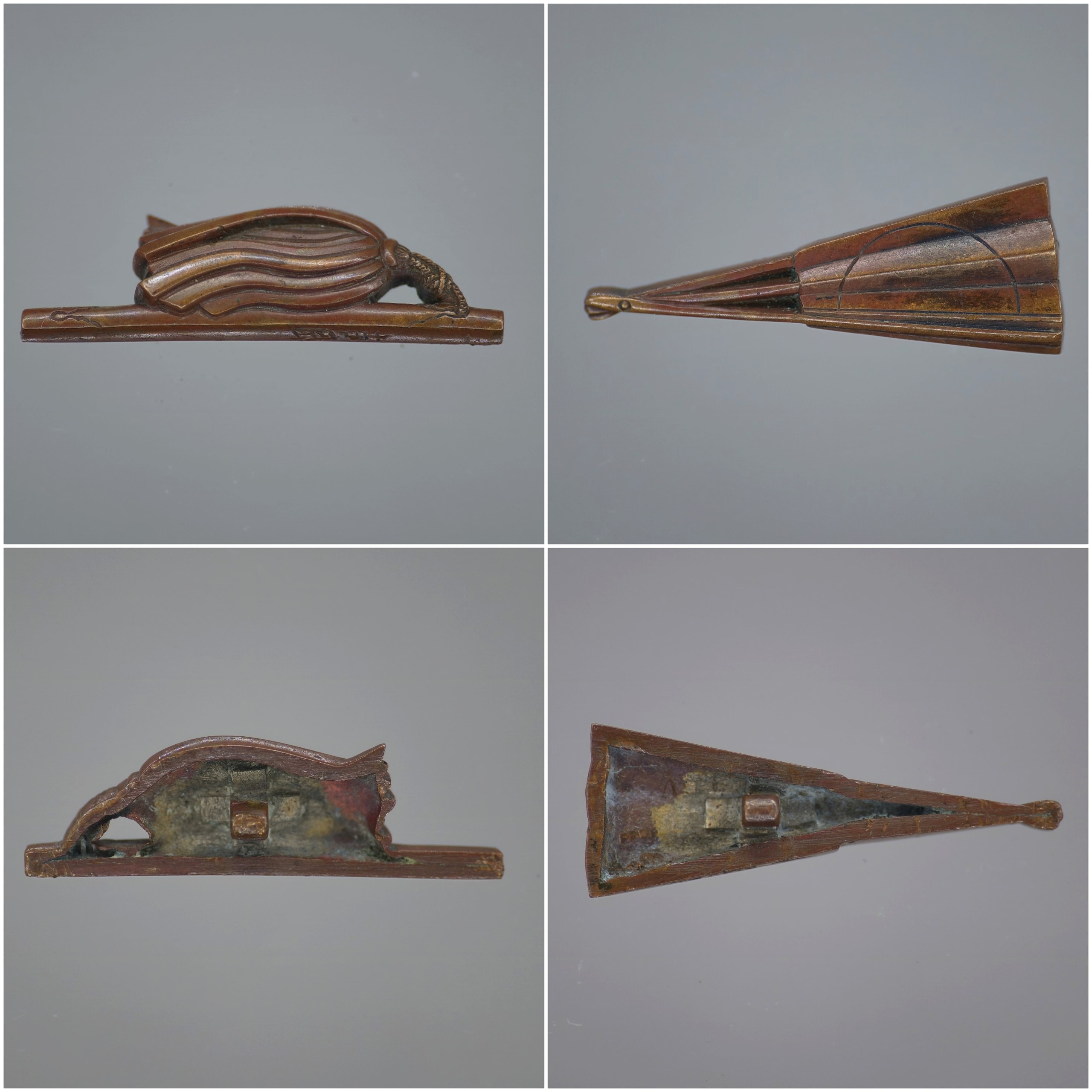
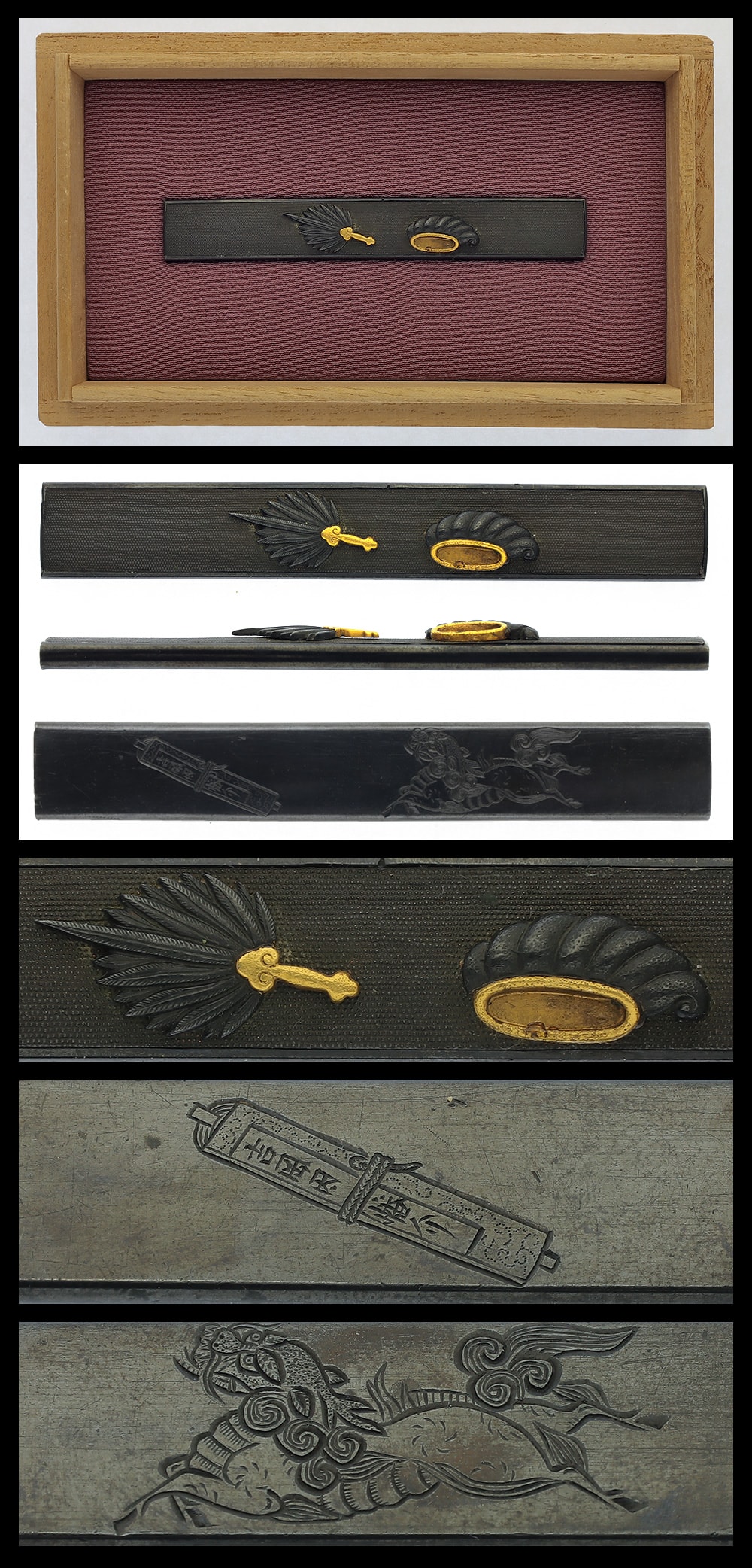
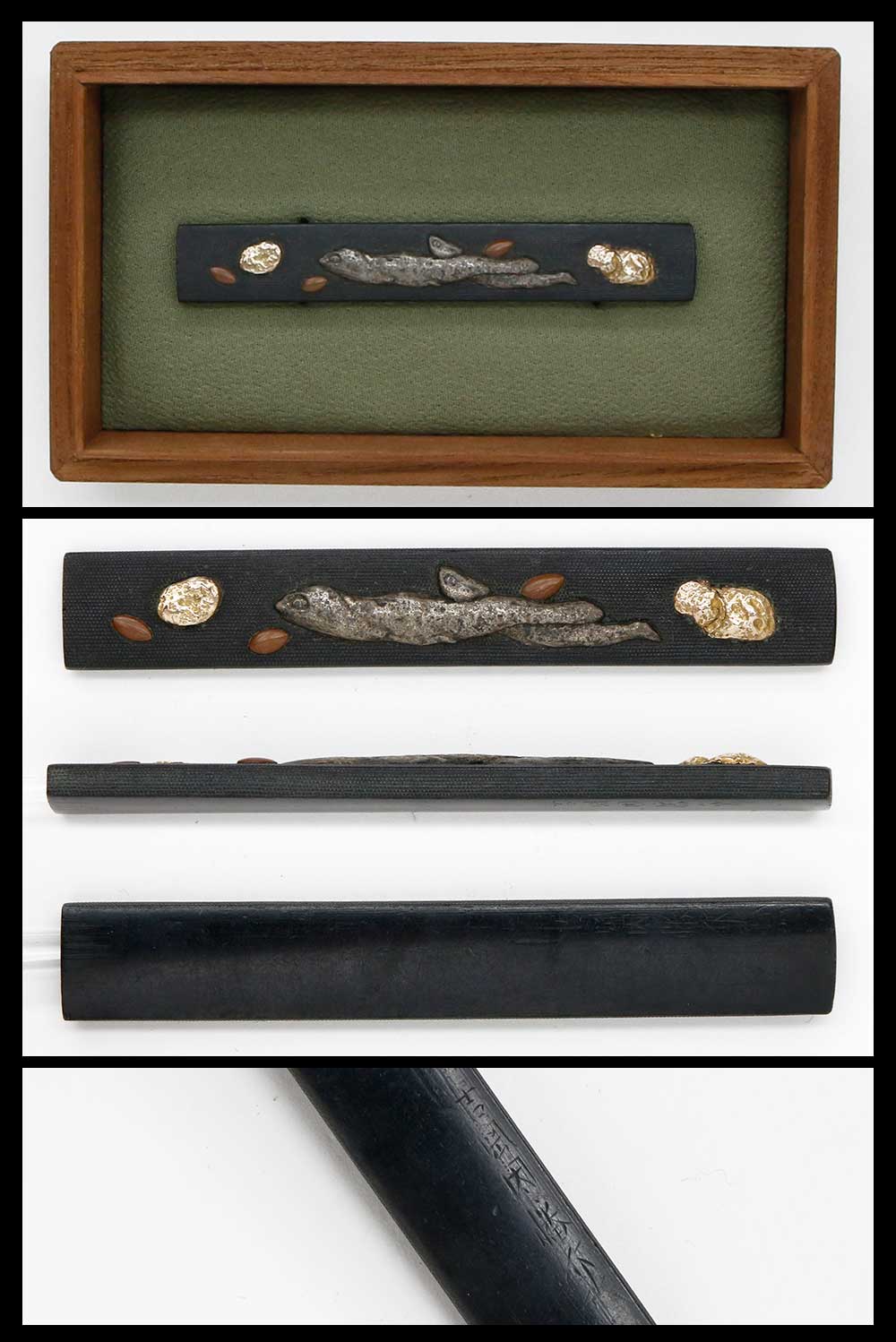
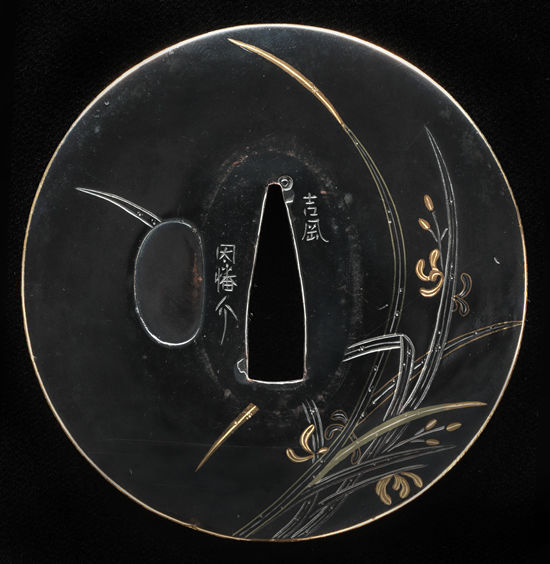
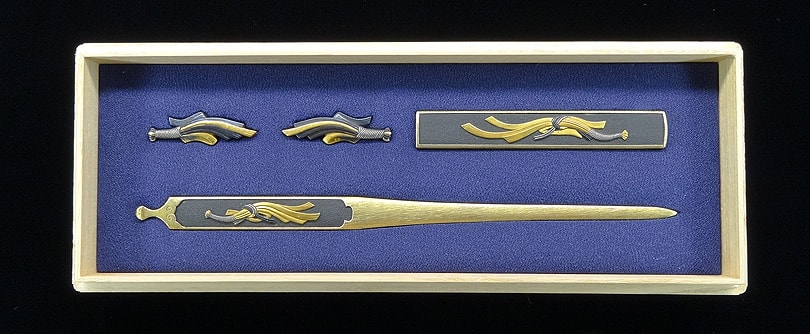
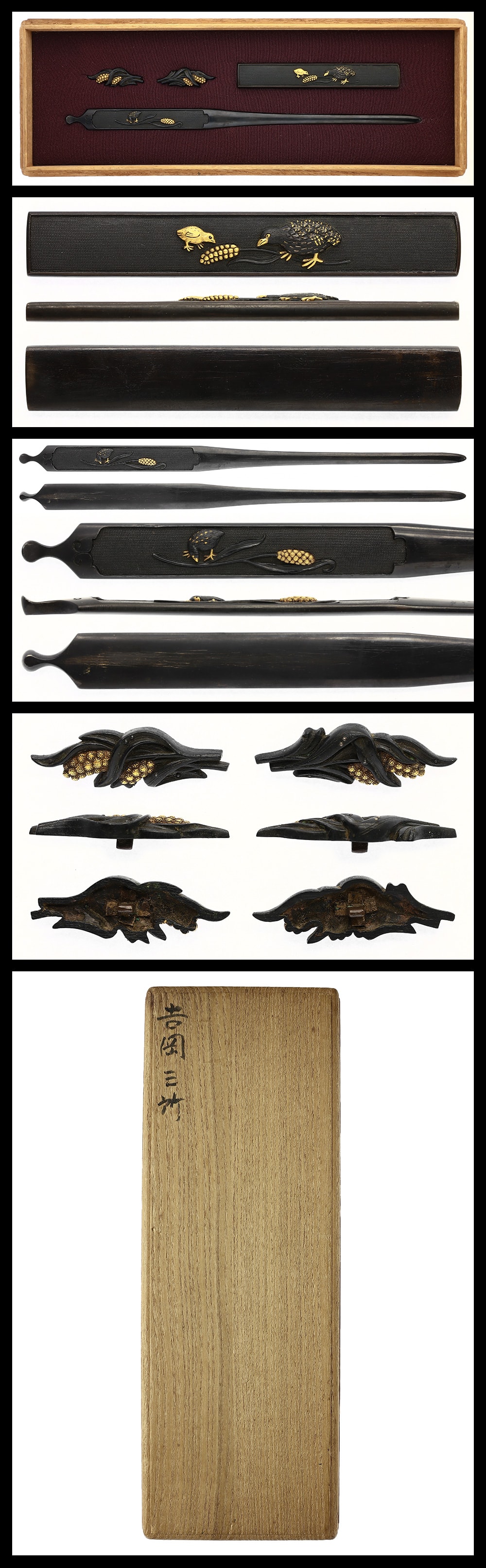
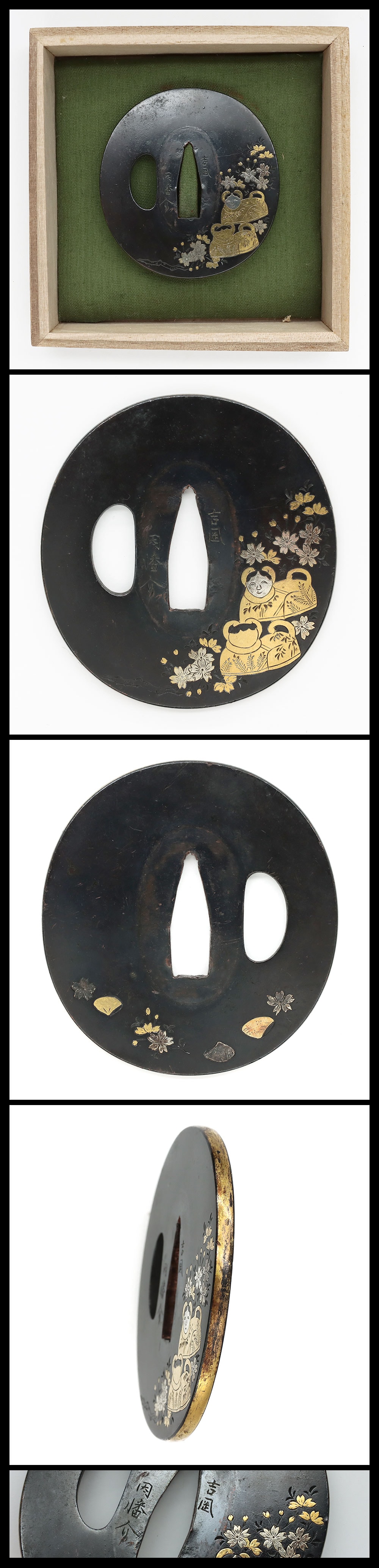
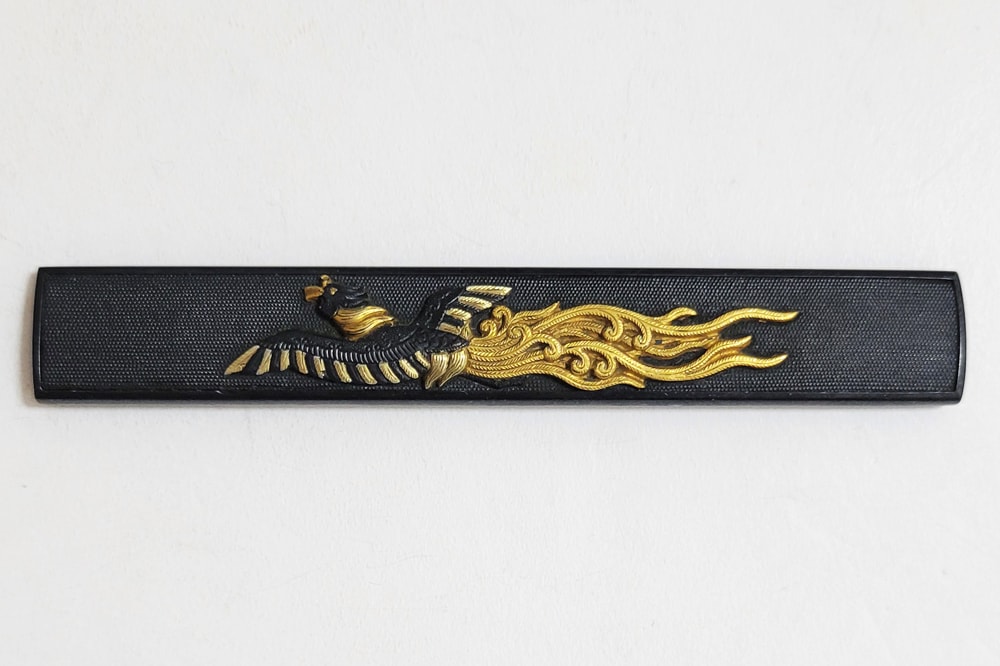
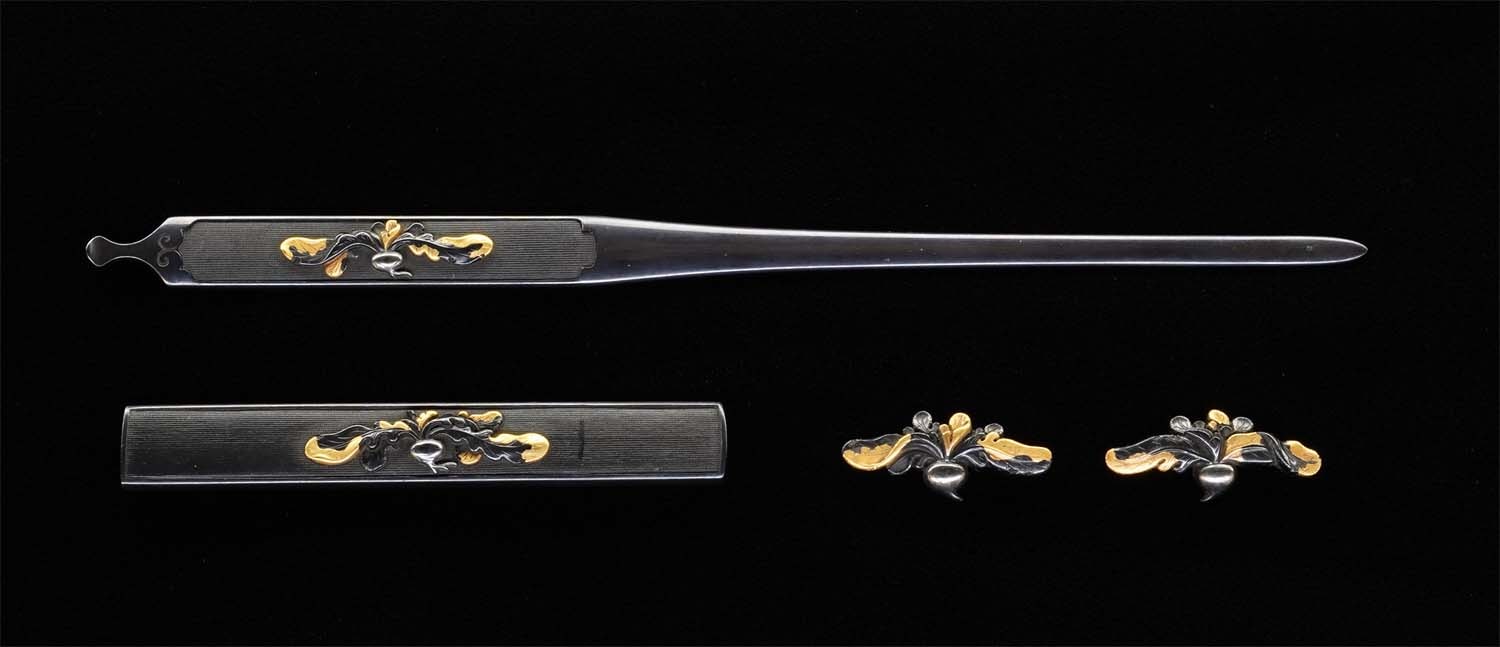
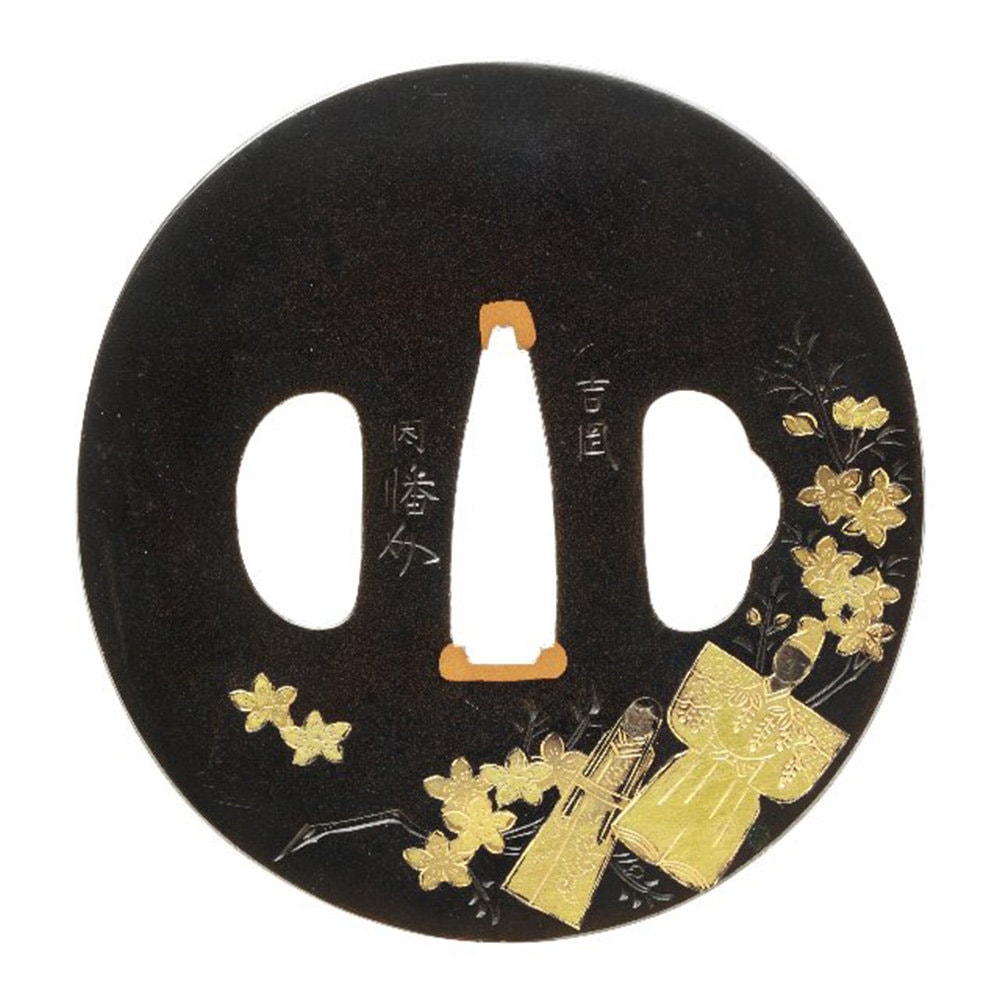
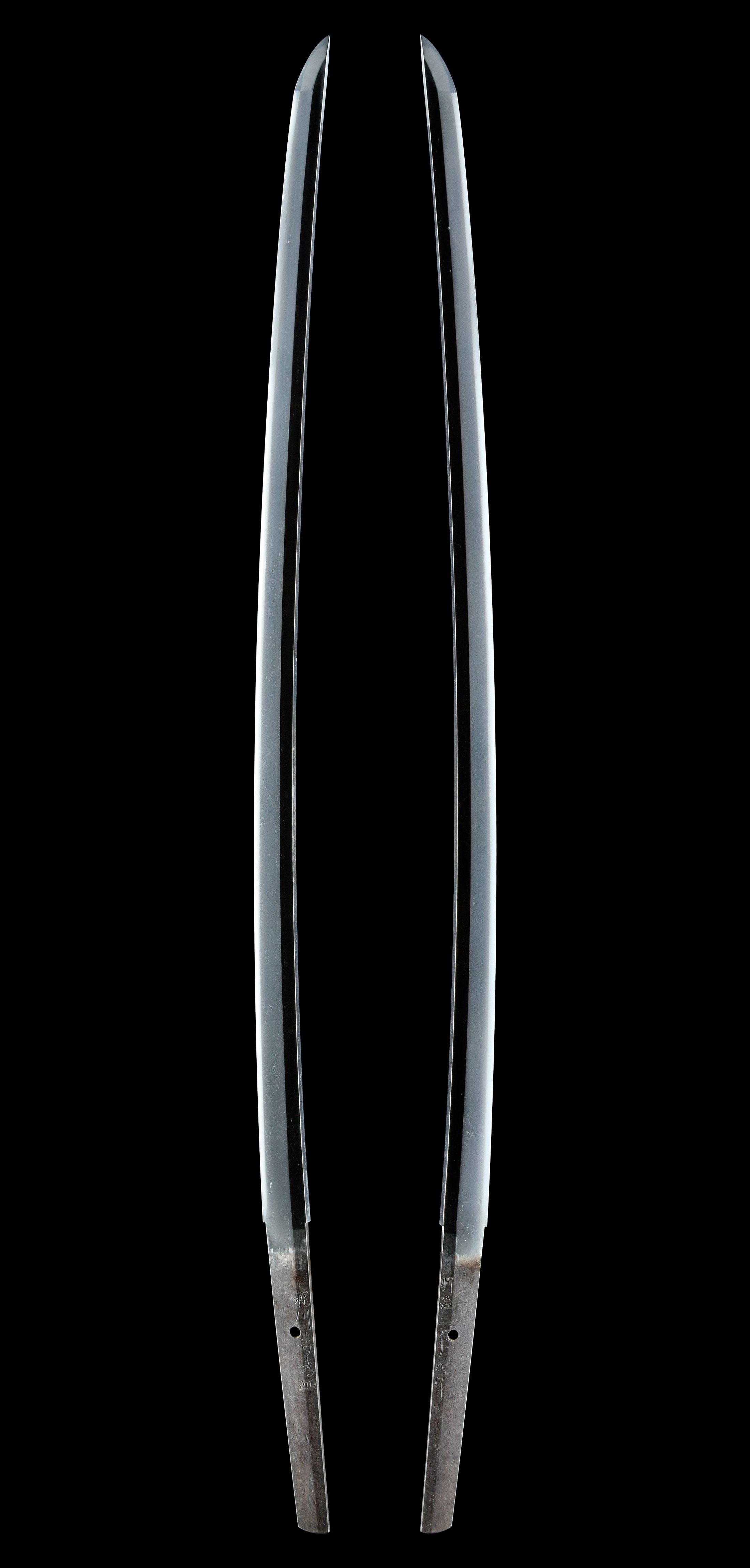
This is an uchigatana koshirae (sword mounting) featuring a black lacquer saya with ichibun-kizami (fine carved lines). The tsuba, attributed to Yoshioka Inaba nosuke, depicts peonies and kachimushi (dragonflies) in gold on a shakudo nanako ground. The koshirae is designed for ease of handling while maintaining an elegant appearance.
mumei · Edo


Iebori · around 1670
7 pieces on the market now
The Yoshioka family (Yoshioka-ryu) was a prestigious lineage of metalworkers retained by the Tokugawa shogunate, receiving a stipend of one hundred hyo (bales of rice) and rations for ten persons. The house flourished from the first-generation master Shigetsugu, who was summoned into service by Tokugawa Ieyasu during the Keicho era, through to the ninth-generation Shigesada at the close of the shogunate. Over successive generations they adopted the Fujiwara surname, and from the second generation onward they held the court title Inaba no Suke. Because works produced in the earlier period were all delivered to the bakufu, they are entirely unsigned; the practice of cutting the five-character signature "Yoshioka Inaba no Suke" is thought to have begun around the fifth generation, Yasutsugu, yet since personal names were not inscribed, distinguishing individual generations remains difficult.
The Yoshioka school's characteristic manner centres on shakudo nanako-ji enhanced with takabori (high-relief carving) and kin-iroe (gold colour inlay), producing workmanship that is solid and precise. Their steady, reliable carving is paired with meticulously applied iroe using many kinds of coloured metals, yielding surfaces that, while sumptuous, remain filled with dignity and refinement. Compositions range from the Eight Views of Omi rendered in polychrome sukidashi-bori, to dragon-and-tiger programmes deployed across complete daisho-soroi suites, to the restrained formality of ripened rice ears (inaho) unified across matched mountings. Techniques of kin-sue-mon (gold applied motifs) and kin-zogan (gold inlay) are employed to achieve striking contrasts between flat inlay that conveys the momentum of a brushstroke and higher-relief applied decoration.
The NBTHK evaluations consistently characterise the Yoshioka house as producing work of elevated and formal tone, marked by a serious, straightforward manner. As official kakae-ko (shogunate-employed artisans), their output embodies the requirements of shogunal ceremonial culture, from ito-maki tachi koshirae made for the Kii Tokugawa house to issaku (unified-suite) mountings whose coherent thematic organisation demonstrates the true worth of a shogunate-employed master metalworker[[c:1]]. Like the Goto family, to whom the NBTHK draws direct comparison, the Yoshioka line occupies a central position within the institutional tradition of Edo-period kinko metalwork.
Where Inaba no Suke stands among comparable artisans: across all of nihontō, and within tradition, era, and period. The tiers (Foremost · Leading · Major · Notable) weigh official designations from the NBTHK and Japan's Agency for Cultural Affairs, together with historical honors of lasting repute such as the Sansaku and Meibutsu-chō.
Select a lens to see how it's measured.
Iebori
15 pieces on the market now
The Yoshioka family (Yoshioka-ke) was an authoritative lineage of metalworkers retained by the Tokugawa shogunate, granted a stipend of one hundred hyo (bales of rice) and rations for ten persons. The house was founded by the first-generation master Shigetsugu, who was summoned into service by Tokugawa Ieyasu during the Keicho era (1596--1615), and it flourished continuously through nine generations down to Shigesada at the close of the shogunate. Learn more →
| Smith | Era | Designated |
|---|---|---|
| Inaba no Suke因幡介 | 1670 | 6 |
| Terutsugu照次 | 1670 | 2 |
| Shigesada重貞 | — | 0 |
| Kiyotsugu清次 | — | 0 |
| Morotsugu師次 | — | 0 |
We could not find an authenticity certificate on the seller’s listing. Japanese swords and fittings are normally papered by the NBTHK (or the NTHK). Without one, the attribution is the seller’s own assessment and has not been independently verified — treat it with caution and ask the dealer about certification before buying.
If, due to our fault, the item differs significantly from its proper condition, the item may be returned. Cooling-off is within one week of the item's arrival.
This is an uchigatana koshirae (sword mounting) featuring a black lacquer saya with ichibun-kizami (fine carved lines). The tsuba, attributed to Yoshioka Inaba nosuke, depicts peonies and kachimushi (dragonflies) in gold on a shakudo nanako ground. The koshirae is designed for ease of handling while maintaining an elegant appearance.
mumei · Edo


Iebori · around 1670
7 pieces on the market now
The Yoshioka family (Yoshioka-ryu) was a prestigious lineage of metalworkers retained by the Tokugawa shogunate, receiving a stipend of one hundred hyo (bales of rice) and rations for ten persons. The house flourished from the first-generation master Shigetsugu, who was summoned into service by Tokugawa Ieyasu during the Keicho era, through to the ninth-generation Shigesada at the close of the shogunate. Over successive generations they adopted the Fujiwara surname, and from the second generation onward they held the court title Inaba no Suke. Because works produced in the earlier period were all delivered to the bakufu, they are entirely unsigned; the practice of cutting the five-character signature "Yoshioka Inaba no Suke" is thought to have begun around the fifth generation, Yasutsugu, yet since personal names were not inscribed, distinguishing individual generations remains difficult.
The Yoshioka school's characteristic manner centres on shakudo nanako-ji enhanced with takabori (high-relief carving) and kin-iroe (gold colour inlay), producing workmanship that is solid and precise. Their steady, reliable carving is paired with meticulously applied iroe using many kinds of coloured metals, yielding surfaces that, while sumptuous, remain filled with dignity and refinement. Compositions range from the Eight Views of Omi rendered in polychrome sukidashi-bori, to dragon-and-tiger programmes deployed across complete daisho-soroi suites, to the restrained formality of ripened rice ears (inaho) unified across matched mountings. Techniques of kin-sue-mon (gold applied motifs) and kin-zogan (gold inlay) are employed to achieve striking contrasts between flat inlay that conveys the momentum of a brushstroke and higher-relief applied decoration.
The NBTHK evaluations consistently characterise the Yoshioka house as producing work of elevated and formal tone, marked by a serious, straightforward manner. As official kakae-ko (shogunate-employed artisans), their output embodies the requirements of shogunal ceremonial culture, from ito-maki tachi koshirae made for the Kii Tokugawa house to issaku (unified-suite) mountings whose coherent thematic organisation demonstrates the true worth of a shogunate-employed master metalworker[[c:1]]. Like the Goto family, to whom the NBTHK draws direct comparison, the Yoshioka line occupies a central position within the institutional tradition of Edo-period kinko metalwork.
Where Inaba no Suke stands among comparable artisans: across all of nihontō, and within tradition, era, and period. The tiers (Foremost · Leading · Major · Notable) weigh official designations from the NBTHK and Japan's Agency for Cultural Affairs, together with historical honors of lasting repute such as the Sansaku and Meibutsu-chō.
Select a lens to see how it's measured.
Iebori
15 pieces on the market now
The Yoshioka family (Yoshioka-ke) was an authoritative lineage of metalworkers retained by the Tokugawa shogunate, granted a stipend of one hundred hyo (bales of rice) and rations for ten persons. The house was founded by the first-generation master Shigetsugu, who was summoned into service by Tokugawa Ieyasu during the Keicho era (1596--1615), and it flourished continuously through nine generations down to Shigesada at the close of the shogunate. Learn more →
| Smith | Era | Designated |
|---|---|---|
| Inaba no Suke因幡介 | 1670 | 6 |
| Terutsugu照次 | 1670 | 2 |
| Shigesada重貞 | — | 0 |
| Kiyotsugu清次 | — | 0 |
| Morotsugu師次 | — | 0 |
We could not find an authenticity certificate on the seller’s listing. Japanese swords and fittings are normally papered by the NBTHK (or the NTHK). Without one, the attribution is the seller’s own assessment and has not been independently verified — treat it with caution and ask the dealer about certification before buying.
If, due to our fault, the item differs significantly from its proper condition, the item may be returned. Cooling-off is within one week of the item's arrival.