

The twentieth century nearly killed the craft twice: wartime distortion, then the occupation ban. The NBTHK’s founding in 1948 and licensed forging from 1953 rebuilt the sword as an art, crowned by Living National Treasures and the mukansa rank.
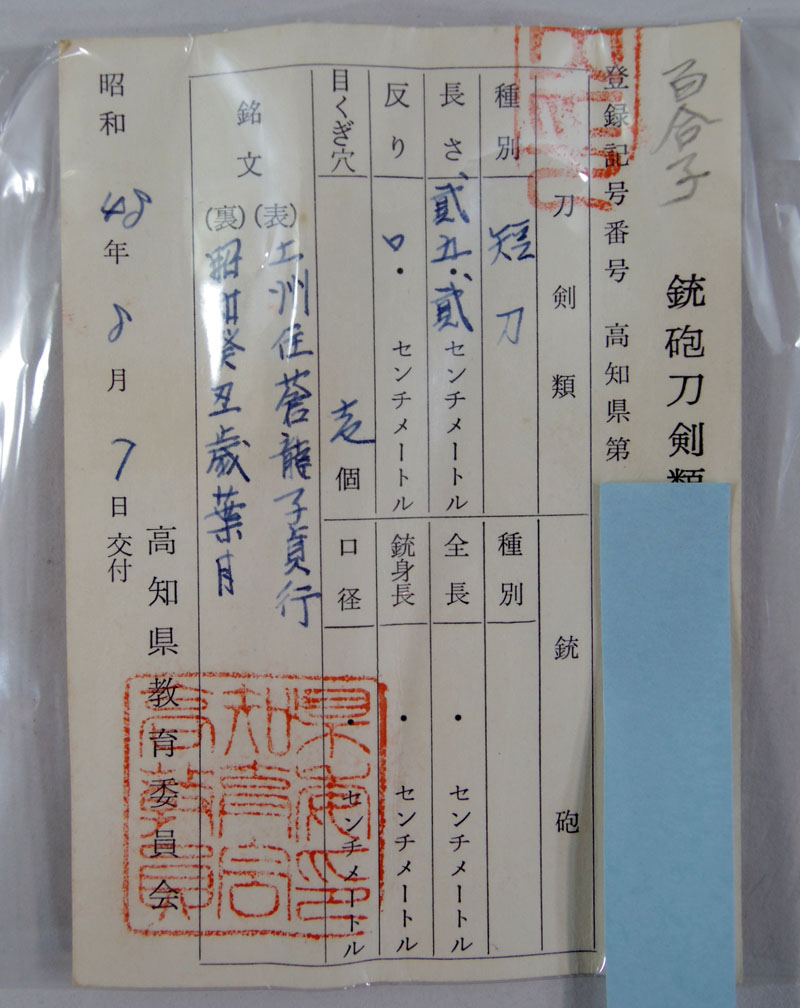
Sadayuki's real name was Yamamura Toru, born in Meiji 42, lived in Kokubu, Nankoku City, Kochi Prefecture, and his teacher was Yamamura Yoshisada, a student of the first generation Kawashima Tadayoshi; he was selected many times for the Shinsakuto Exhibition. Perhaps because he held his local predecessor "Sa Yukihide" as his ideal, there are many works where he aimed for the style of "Sa Yukihide." This tanto is also thought to be a work that copied Sa Yukihide. *This koshirae is not the work of a professional.
Soryushi Sadayuki (Yamamura Yuu)
Offered by E-sword


As written by the shop
Machine translation from the shop's Japanese · may contain errors ·
Shōwa to the present: destruction and revival
The twentieth century nearly killed the craft twice: wartime distortion, then the occupation ban. The NBTHK’s founding in 1948 and licensed forging from 1953 rebuilt the sword as an art, crowned by Living National Treasures and the mukansa rank.
We could not find an authenticity certificate on the seller’s listing. Japanese swords and fittings are normally papered by the NBTHK (or the NTHK). Without one, the attribution is the seller’s own assessment and has not been independently verified — treat it with caution and ask the dealer about certification before buying.
Cooling-off (returns or exchanges) is accepted within 3 days of the item's arrival. Return shipping and refund transfer fees are the customer's responsibility. Fees other than the item price (transfer fees, credit card fees, etc.) cannot be refunded. Returns and refunds are not available for overseas destinations.
¥180,000