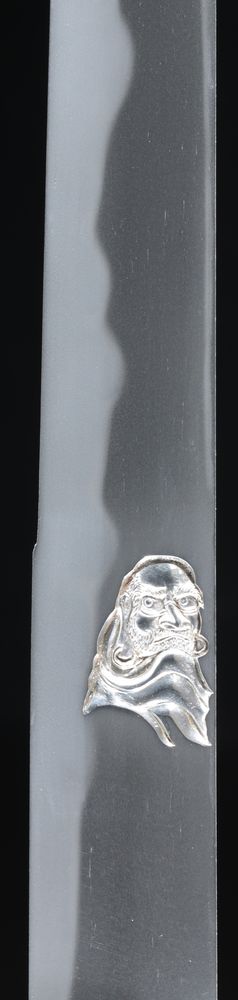
A work where the master of toshin chokoku Yanagimura Senju carved an image of Daruma Daishi on a pair of swords (okogatana) by Kanbayashi Tsunehira, one of the representative tosho of the modern sword world. The mei includes "Gagyusan-shita," bearing the name of Bitchu Matsuyama Castle, and it is a work from Okayama. The sugata is sharp with deep ryomachi, no sori, and a withered fukura. The jitetsu is a tight ko-itame hada, with fine chikei moving dynamically in the depths of the ji, and the hada is moistened with small grains of jinie. The gunome choji midareba has a bright habuchi with pure white konie, ashi enter, and the ha-chu is clear. The boshi is deeply tempered and has a long yaki-sage along the mune.
The characters Kanbayashi Tsunehira carved on the sashi-ura of the toshin are "Ko-Fujin (plowing without end)." The meaning is "If you plow the fields, crops will be harvested well. However, there is no end to that work. In the same way, all things must be continued diligently." Senju, who took this meaning to heart, carved the image of Daruma Daishi on the toshin. The ground is scooped out, and the stern expression of one who will not compromise until attaining liberation is carved with rich texture, looking as if to say one must surely practice. In Showa 58, just before becoming Mukansa in Showa 60, Tsunehira was winning special prizes such as the Takamatsunomiya Sho consecutively, and the previous year, Senju held his first solo exhibition in Okayama, a period when he was solidifying his foundation as an artist. The two in their 30s, full of ambition and physical strength, must have been prepared to continue walking their respective endless paths of sakuto and toshin chokoku. And they surely also put in the thought that the person who holds this work should be healthy forever.
Machine translation from the shop's Japanese · may contain errors ·
A work where the master of toshin chokoku Yanagimura Senju carved an image of Daruma Daishi on a pair of swords (okogatana) by Kanbayashi Tsunehira, one of the representative tosho of the modern sword world. The mei includes "Gagyusan-shita," bearing the name of Bitchu Matsuyama Castle, and it is a work from Okayama. The sugata is sharp with deep ryomachi, no sori, and a withered fukura. The jitetsu is a tight ko-itame hada, with fine chikei moving dynamically in the depths of the ji, and the hada is moistened with small grains of jinie. The gunome choji midareba has a bright habuchi with pure white konie, ashi enter, and the ha-chu is clear. The boshi is deeply tempered and has a long yaki-sage along the mune.
The characters Kanbayashi Tsunehira carved on the sashi-ura of the toshin are "Ko-Fujin (plowing without end)." The meaning is "If you plow the fields, crops will be harvested well. However, there is no end to that work. In the same way, all things must be continued diligently." Senju, who took this meaning to heart, carved the image of Daruma Daishi on the toshin. The ground is scooped out, and the stern expression of one who will not compromise until attaining liberation is carved with rich texture, looking as if to say one must surely practice. In Showa 58, just before becoming Mukansa in Showa 60, Tsunehira was winning special prizes such as the Takamatsunomiya Sho consecutively, and the previous year, Senju held his first solo exhibition in Okayama, a period when he was solidifying his foundation as an artist. The two in their 30s, full of ambition and physical strength, must have been prepared to continue walking their respective endless paths of sakuto and toshin chokoku. And they surely also put in the thought that the person who holds this work should be healthy forever.
Historical context
Shōwa to the present: destruction and revival
›
The twentieth century nearly killed the craft twice: wartime distortion, then the occupation ban. The NBTHK’s founding in 1948 and licensed forging from 1953 rebuilt the sword as an art, crowned by Living National Treasures and the mukansa rank.
We could not find an authenticity certificate on the seller’s listing. Japanese swords and fittings are normally papered by the NBTHK (or the NTHK). Without one, the attribution is the seller’s own assessment and has not been independently verified — treat it with caution and ask the dealer about certification before buying.
If, due to our fault, the item differs significantly from its proper condition, the item may be returned. Cooling-off is within one week of the item's arrival.




 NihontoWatch