




The twentieth century nearly killed the craft twice: wartime distortion, then the occupation ban. The NBTHK’s founding in 1948 and licensed forging from 1953 rebuilt the sword as an art, crowned by Living National Treasures and the mukansa rank.
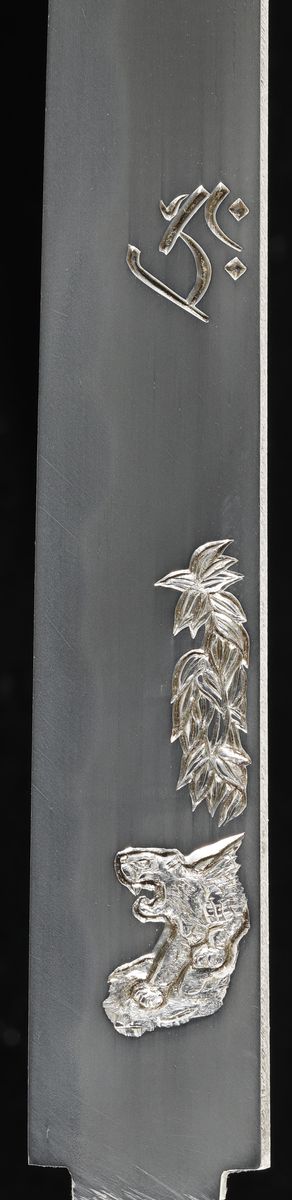
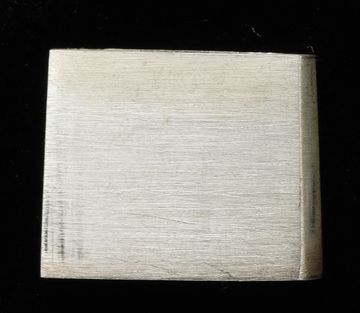
Swordsmith Yoshihara Kuniie was born in Showa 20. Along with his older brother Yoshindo, he assisted the first generation Kuniie (his grandfather) from the time he was a middle school student to master the craft of smithing, received numerous special prizes at the Shinsaku Meito Ten exhibitions, was certified as a Mukansa swordsmith, and also bore the heavy responsibility of forging the Goshinpo Tachi for the Ise Jingu Shikinen Sengu. Having produced many clear and refined masterpieces featuring Bizen-den choji midareba and Bitchu Aoe style sakasa choji midareba on tightly forged jigane, Kuniie shi was one of the master smiths representing the modern era (Note 1). This kozuka ho has a wide mihaba and a robust tsukurikomi. The jigane is a tightly forged ko-itame hada, with fine ji-nie appearing over the entire surface and the steel color refined in blue, and the gunome midare hamon has small nie falling like white snow with a soft, bright nioiguchi, while the boshi thrusts up and returns in ko-maru. Upon this, the carvings of a roaring fierce tiger and the bonji for Senju Kannon by the master of toshin chokoku, Hashimoto Shuha shi (Note 2), shine magnificently. The nakago remains white and shining just as it was at the time of production, with sujikai yasuri carefully applied. The mei characters "Musashi Ju Kuniie Saku" strongly chiseled on the sashi-ura of the toshin exude the confidence of a leading figure. It is accompanied by a shu-ishimeji nuri koshirae with a shiro-dashi samegawa tsuka and go-san no kiri mon menuki. (Item Number 1714) Note 1... Finding time in between his busy sword-making life, he also appeared in the role of a swordsmith in the movie "The Last Samurai" starring Tom Cruise in Heisei 15. Note 2... A student of Kokeguchi Senshu shi. He was in charge of the carvings for the restoration of the Honebami Toshiro owned by Toyokuni Jinja, and also devoted himself to the restoration of the iron sword excavated from the Inariyama Kofun.
Offered by Choshuya


Machine translation from the shop's Japanese · may contain errors ·
Shōwa to the present: destruction and revival
The twentieth century nearly killed the craft twice: wartime distortion, then the occupation ban. The NBTHK’s founding in 1948 and licensed forging from 1953 rebuilt the sword as an art, crowned by Living National Treasures and the mukansa rank.
We could not find an authenticity certificate on the seller’s listing. Japanese swords and fittings are normally papered by the NBTHK (or the NTHK). Without one, the attribution is the seller’s own assessment and has not been independently verified — treat it with caution and ask the dealer about certification before buying.
If, due to our fault, the item differs significantly from its proper condition, the item may be returned. Cooling-off is within one week of the item's arrival.
¥300,000