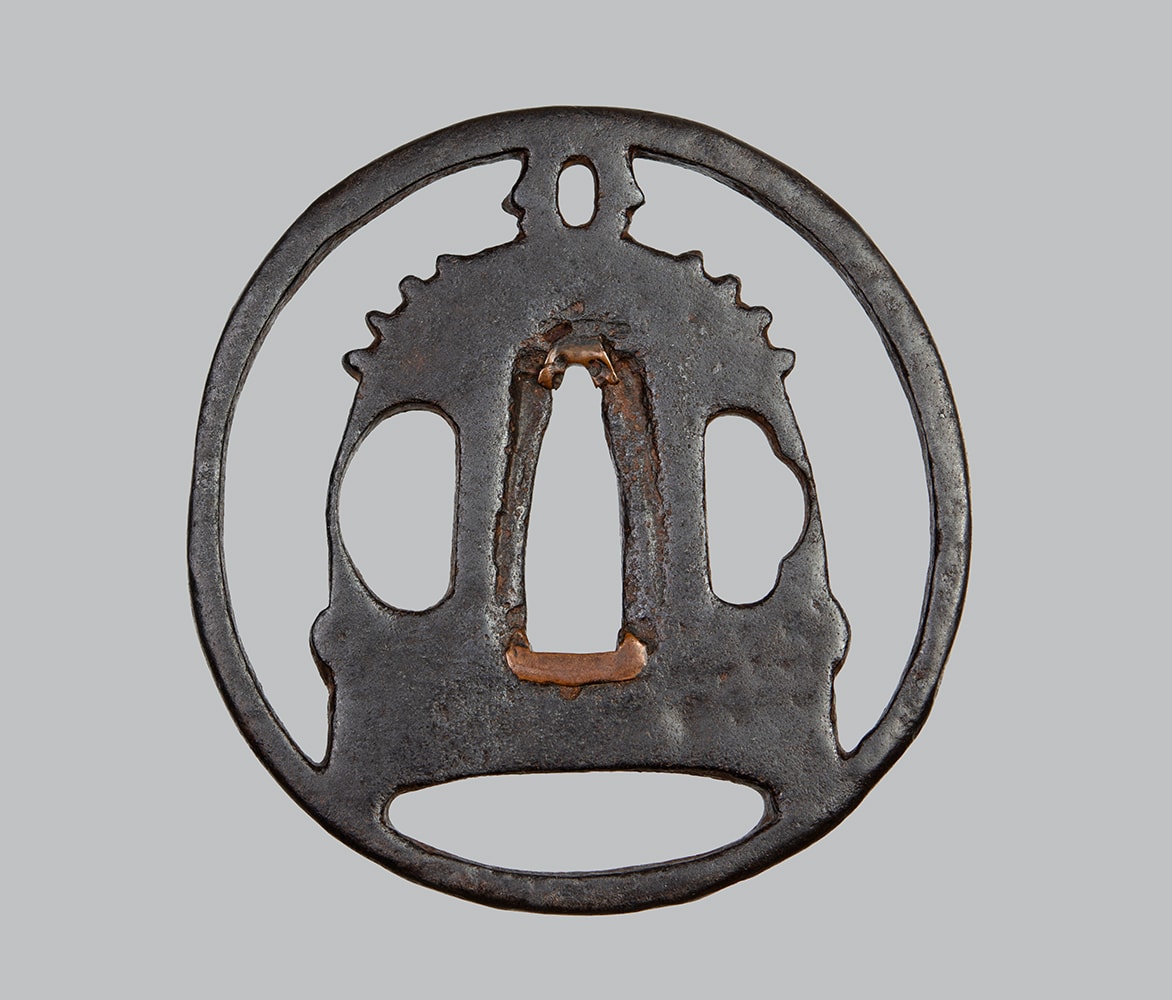
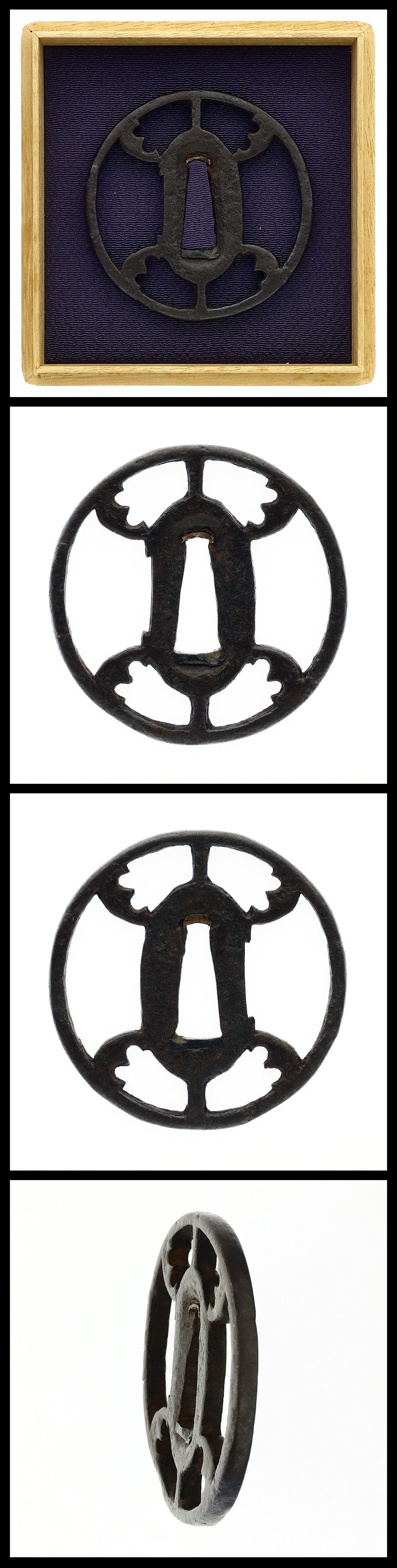
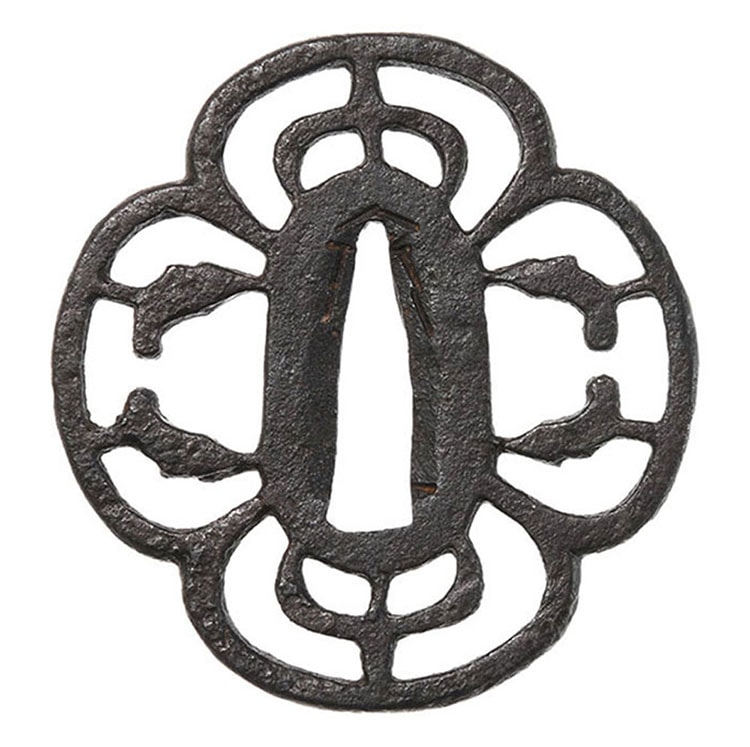
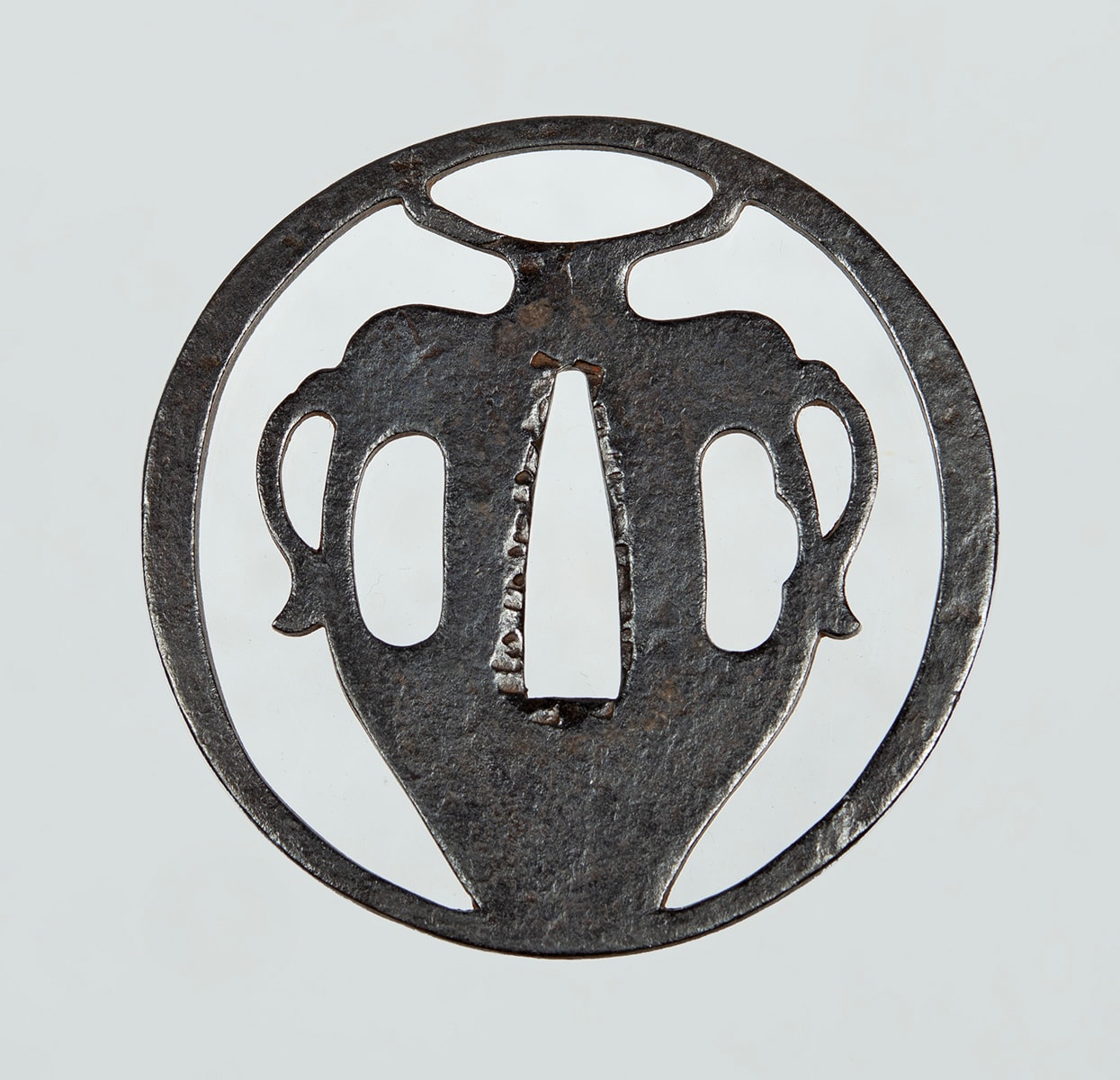
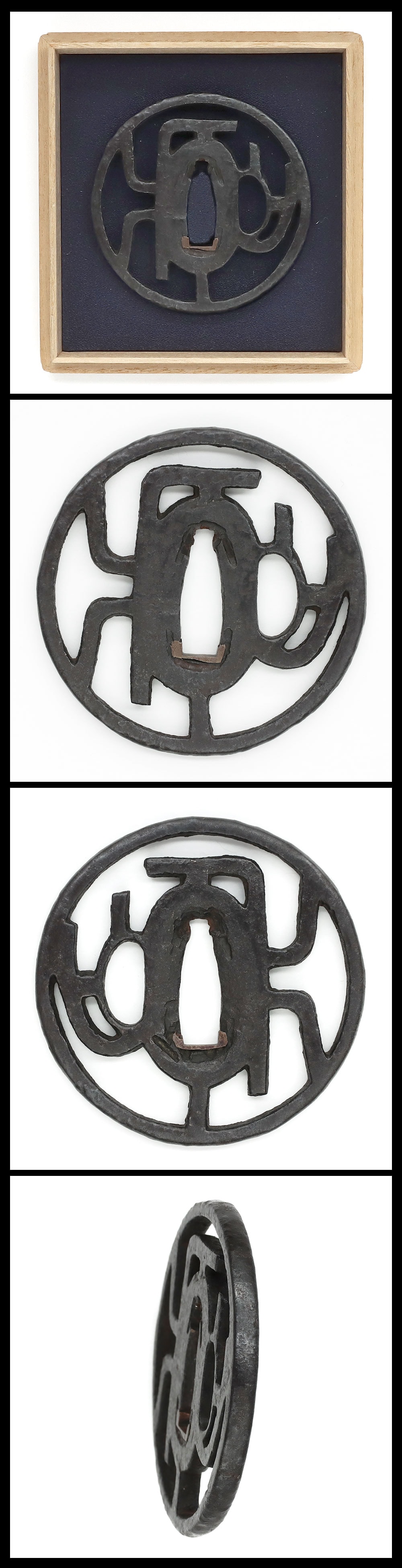
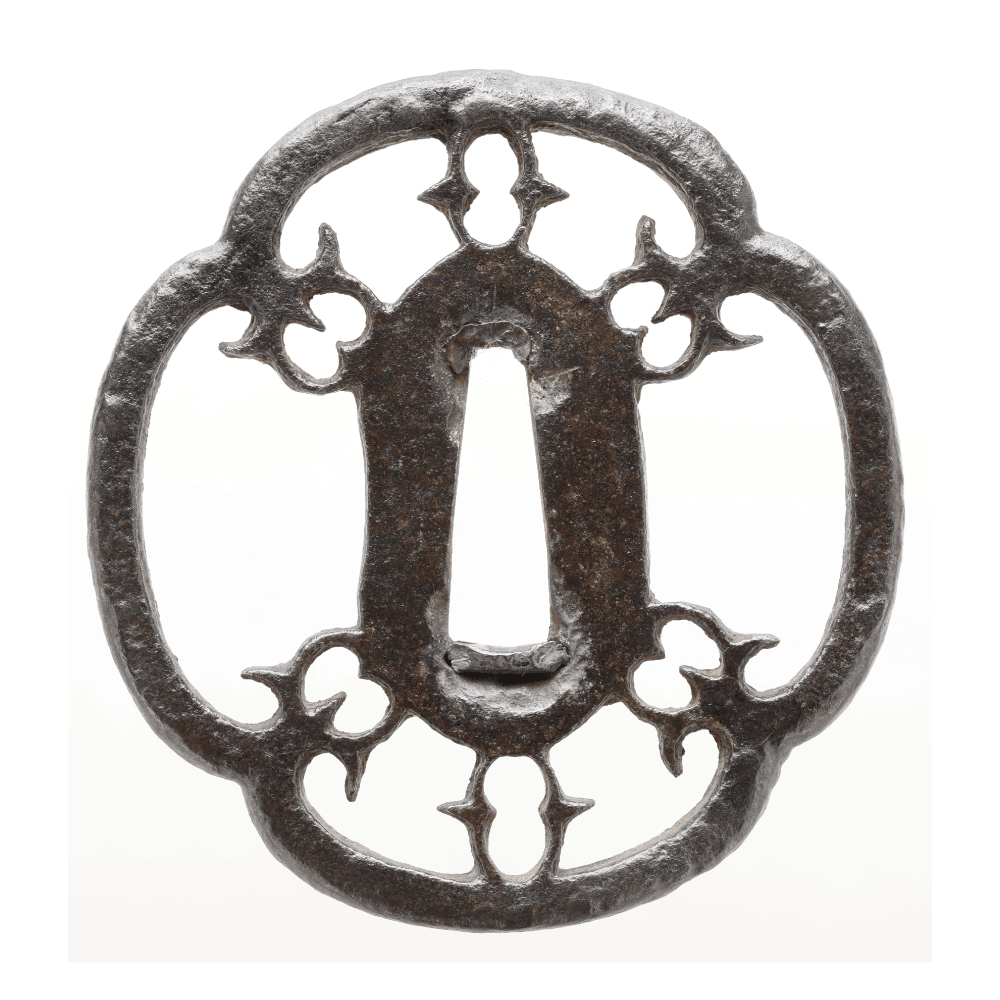
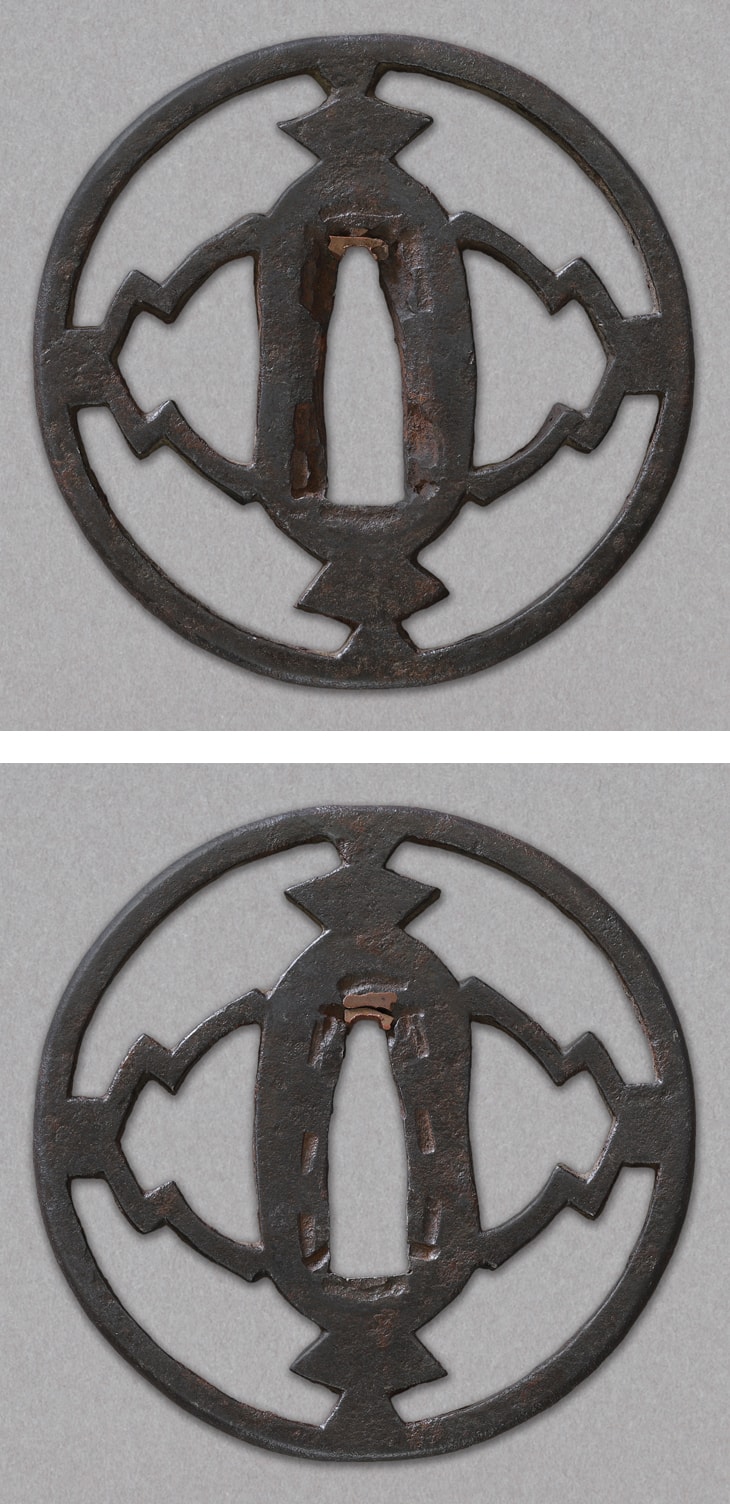
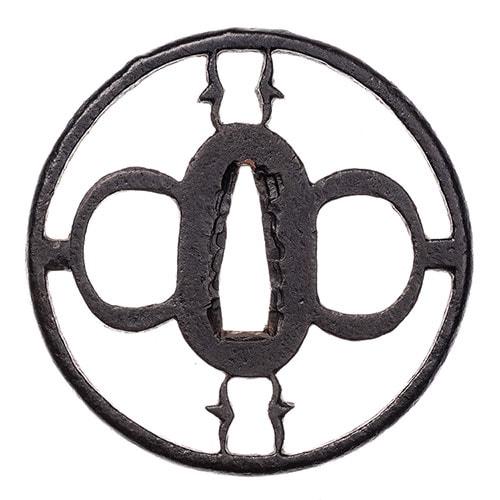
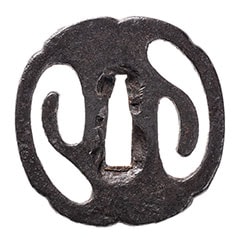
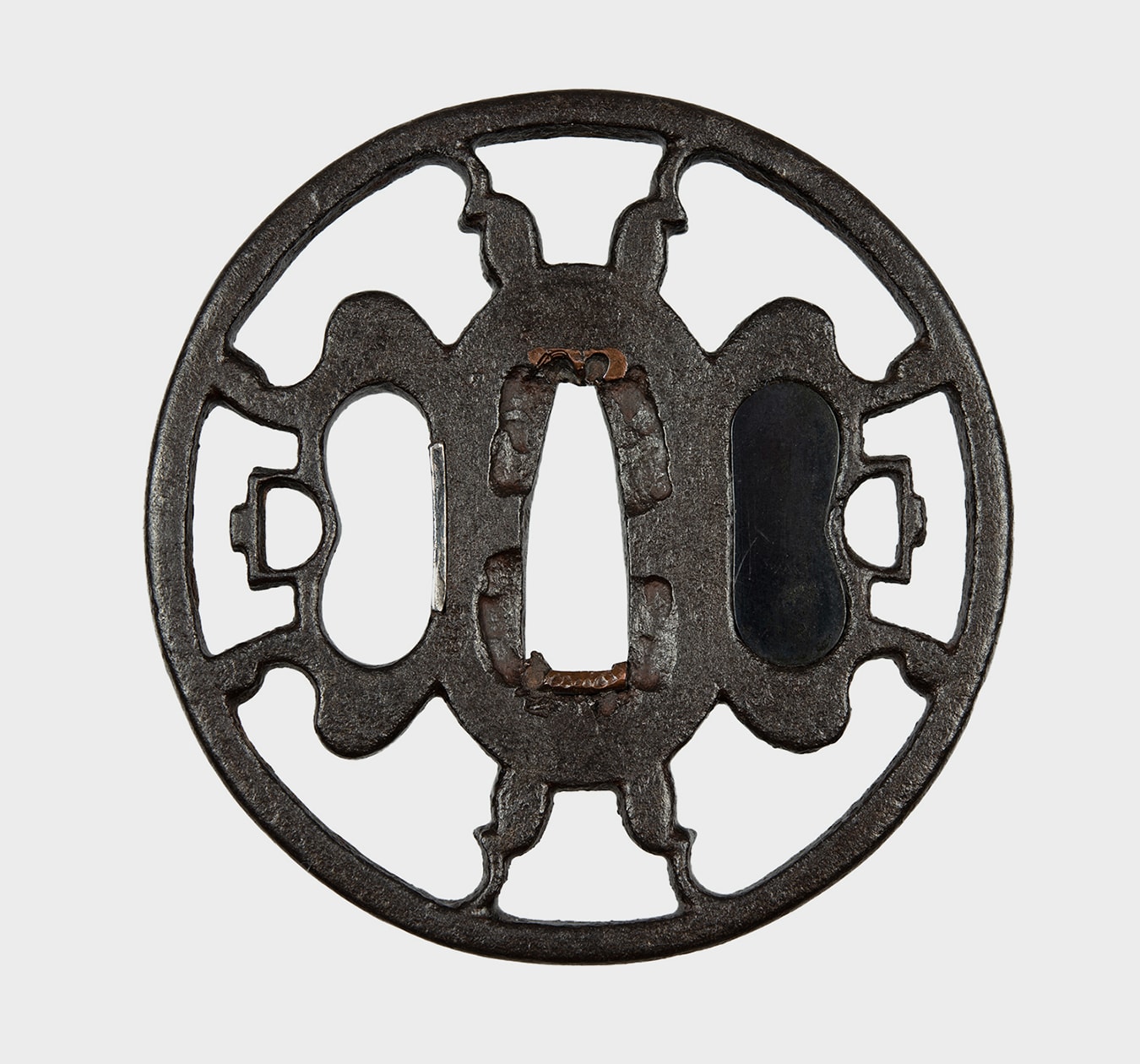
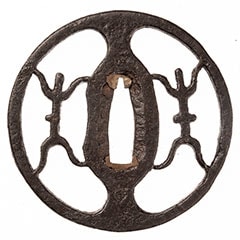
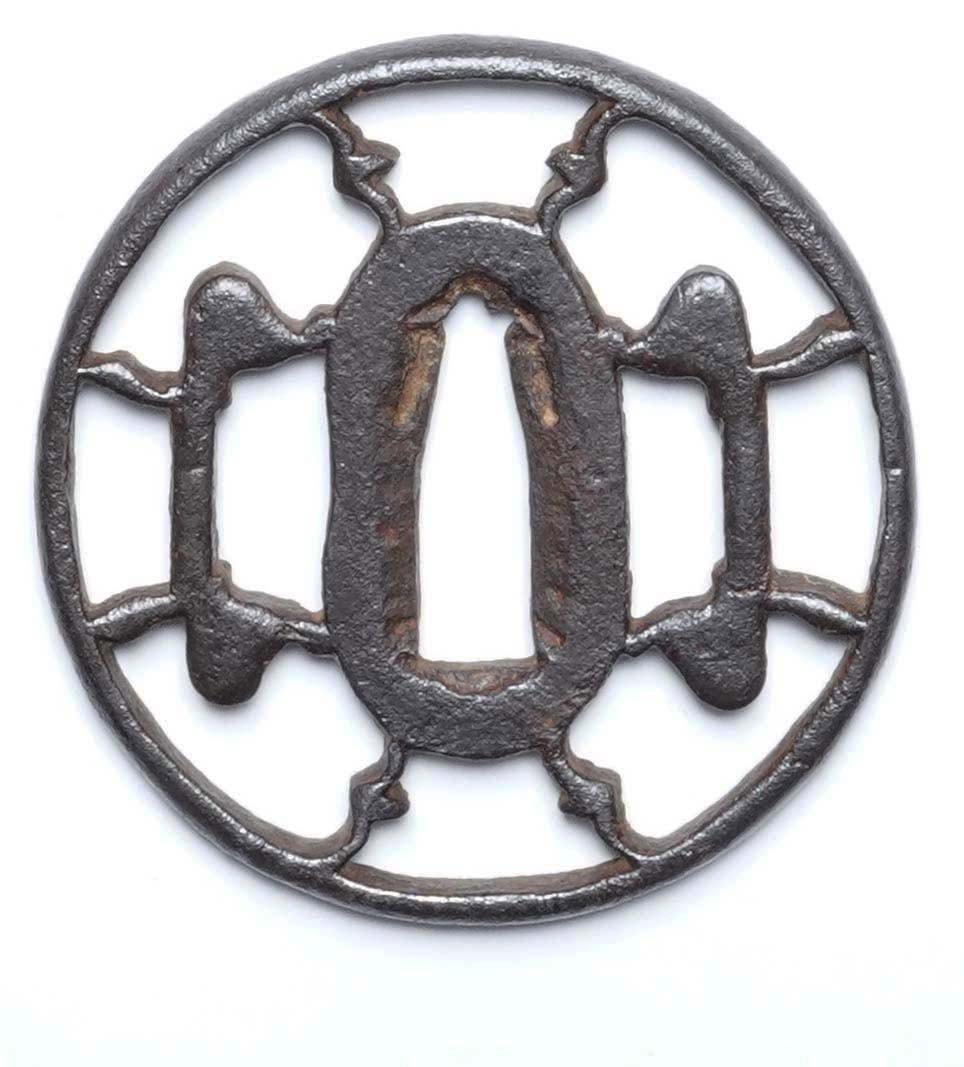
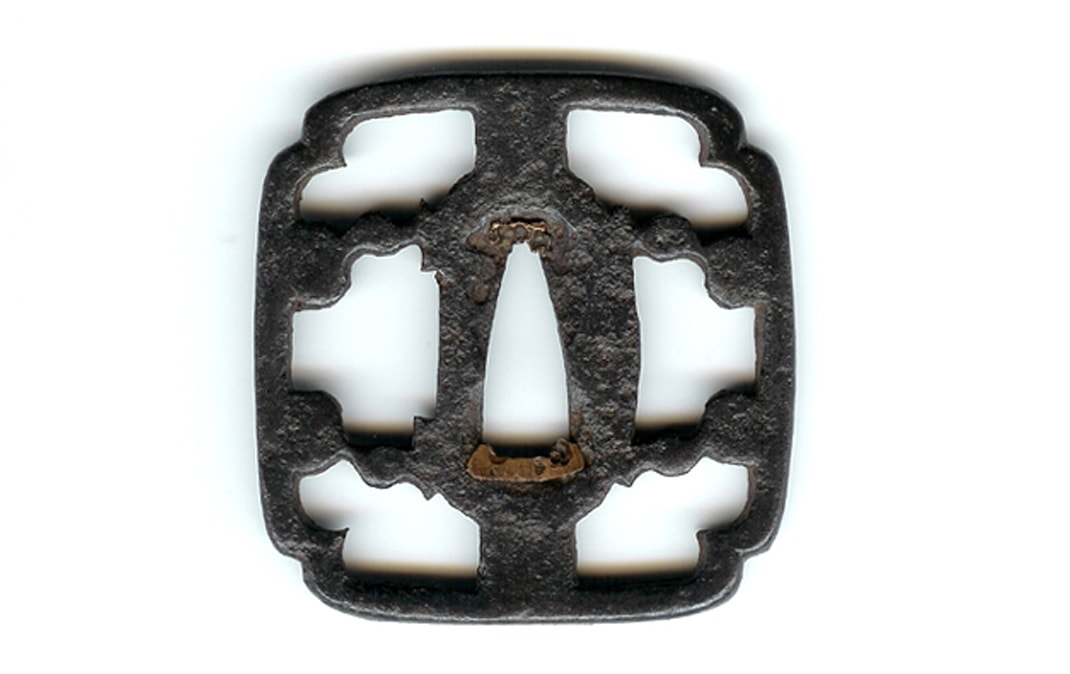
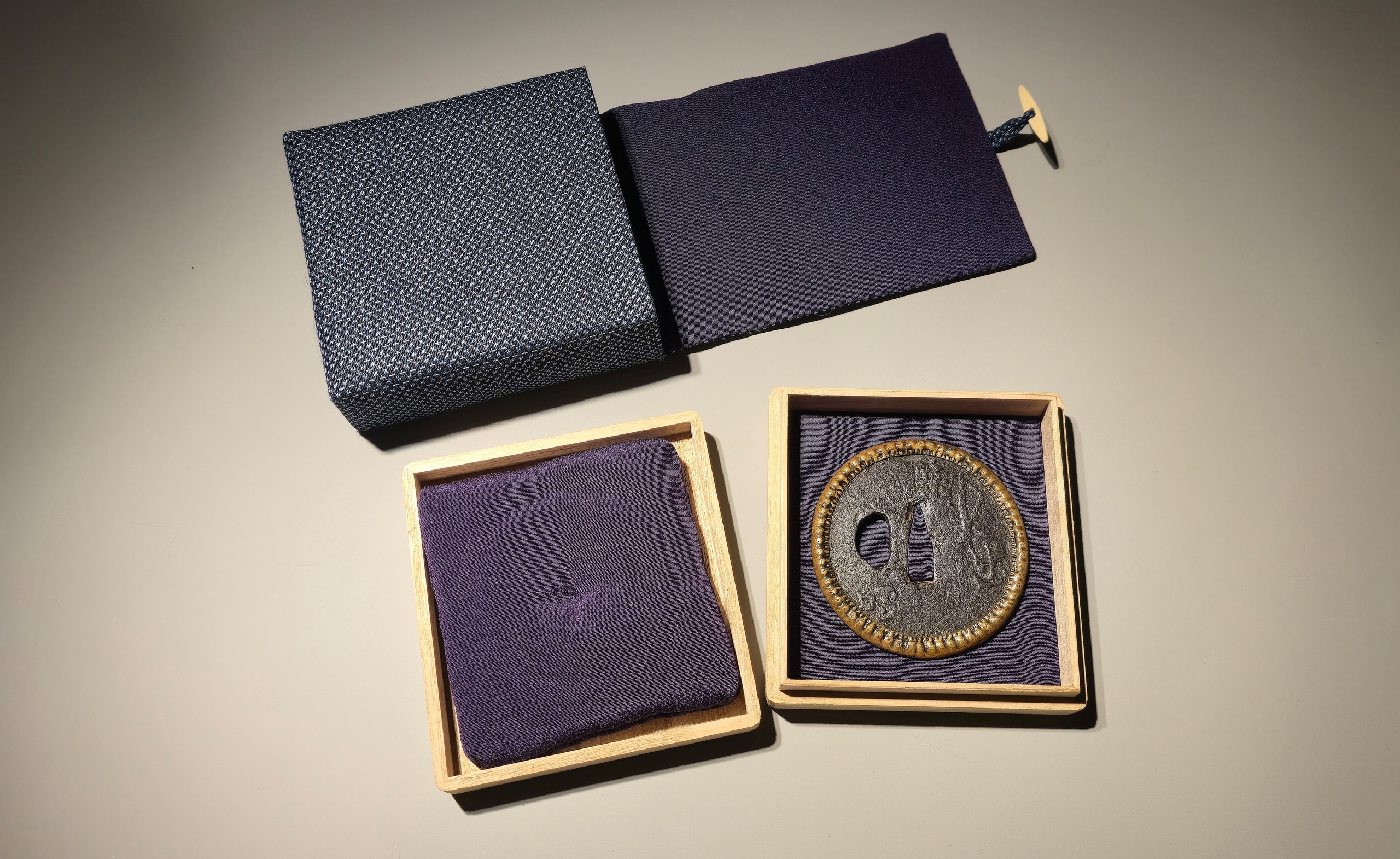
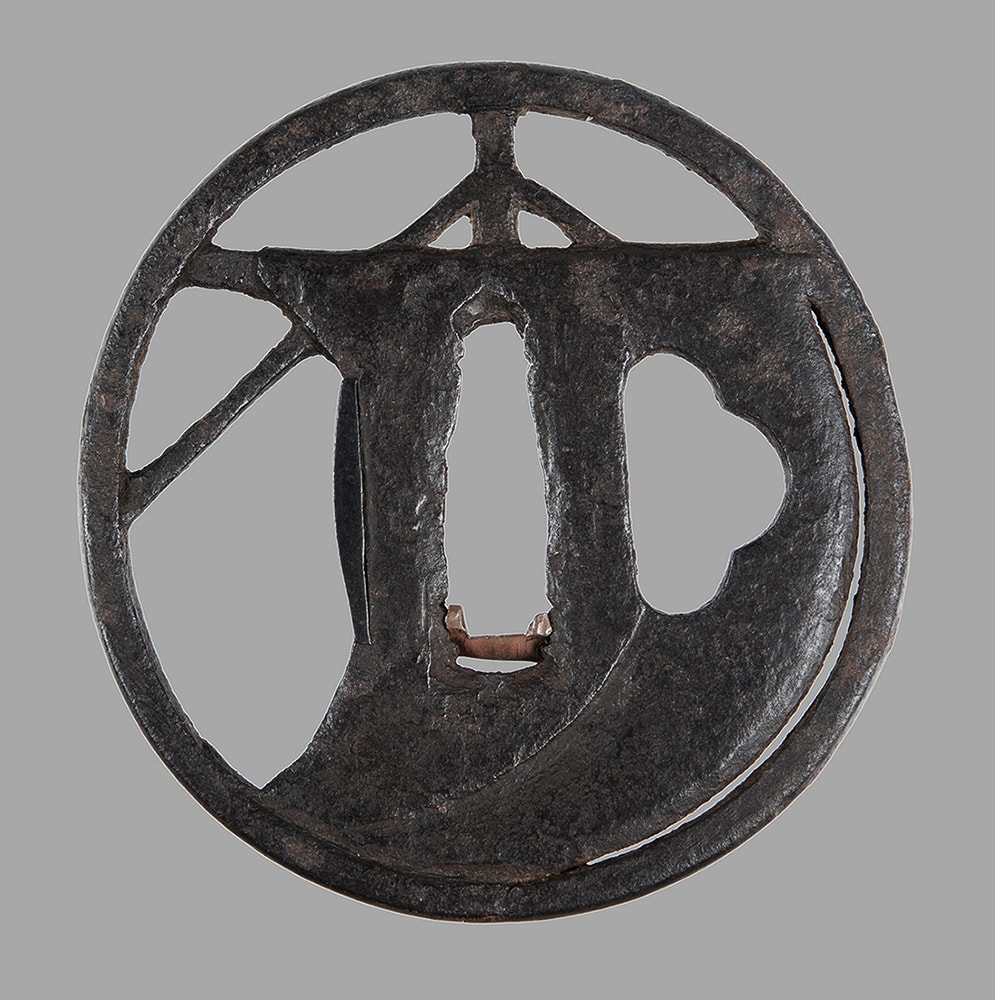
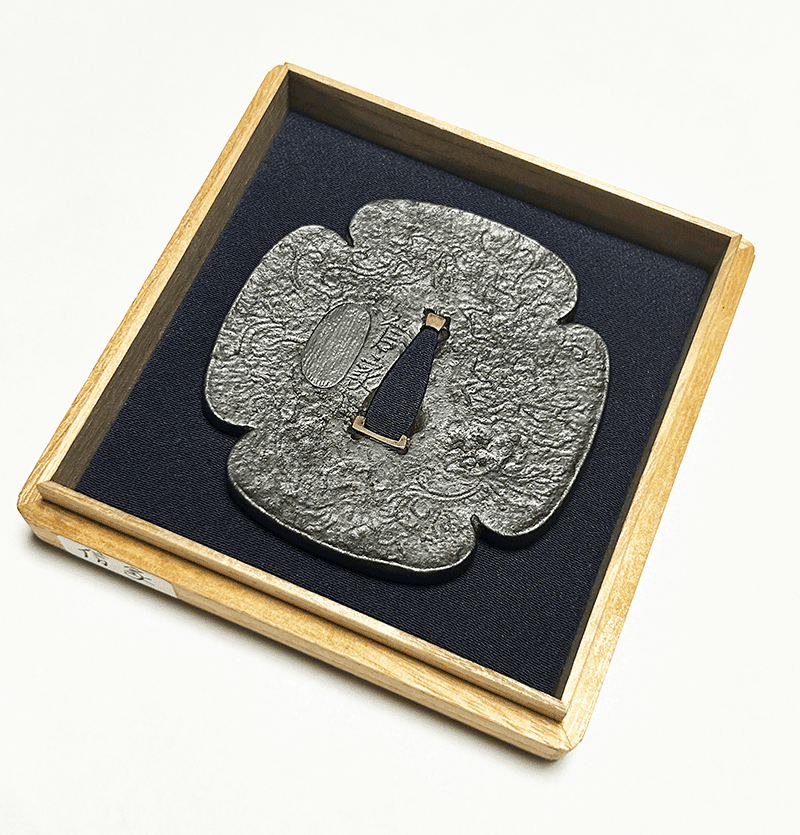
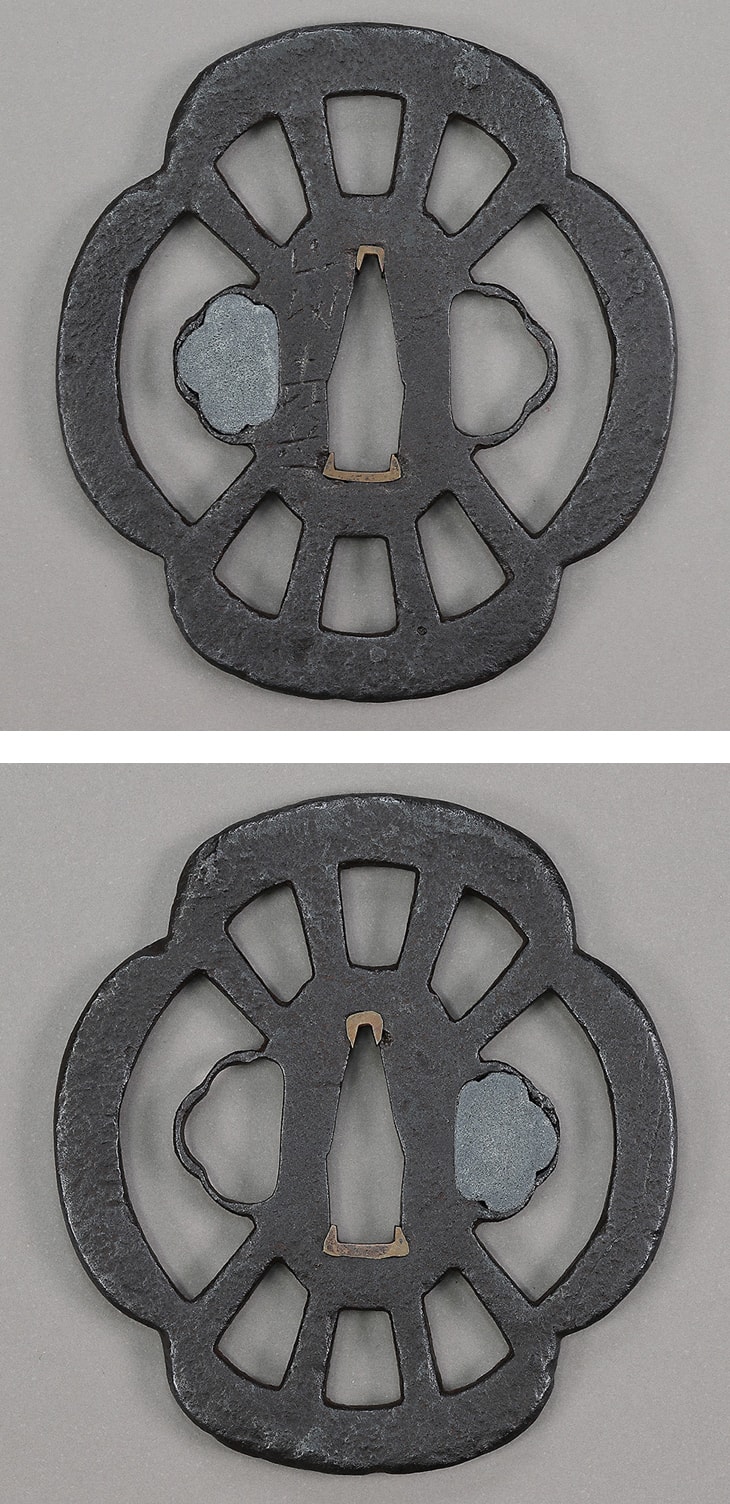
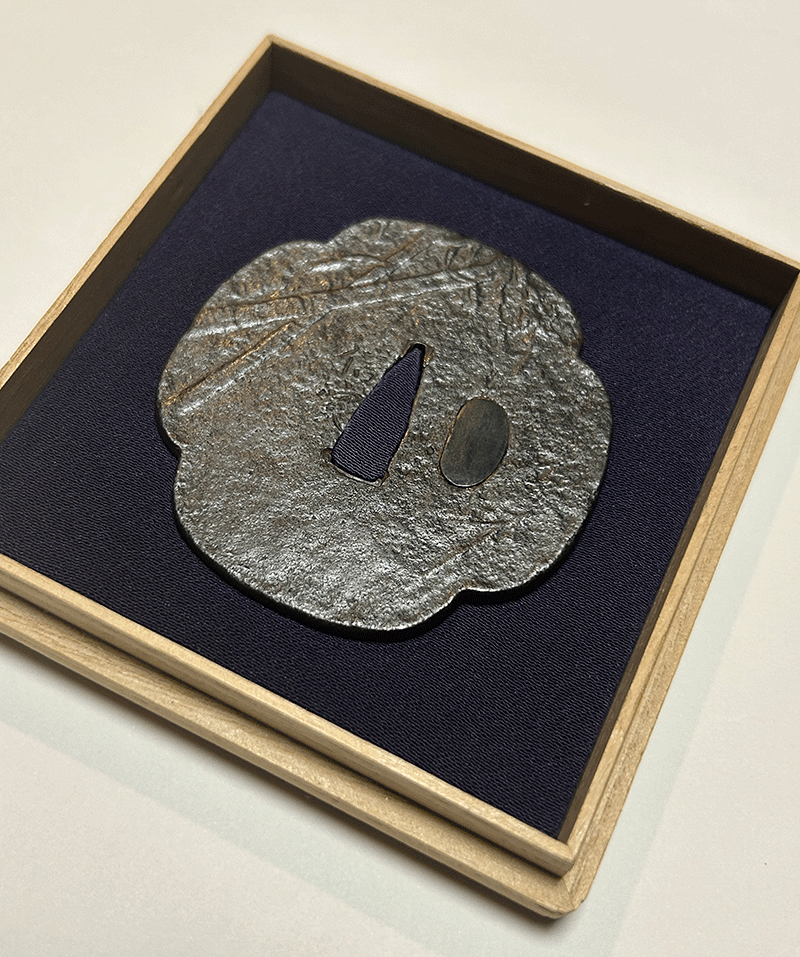
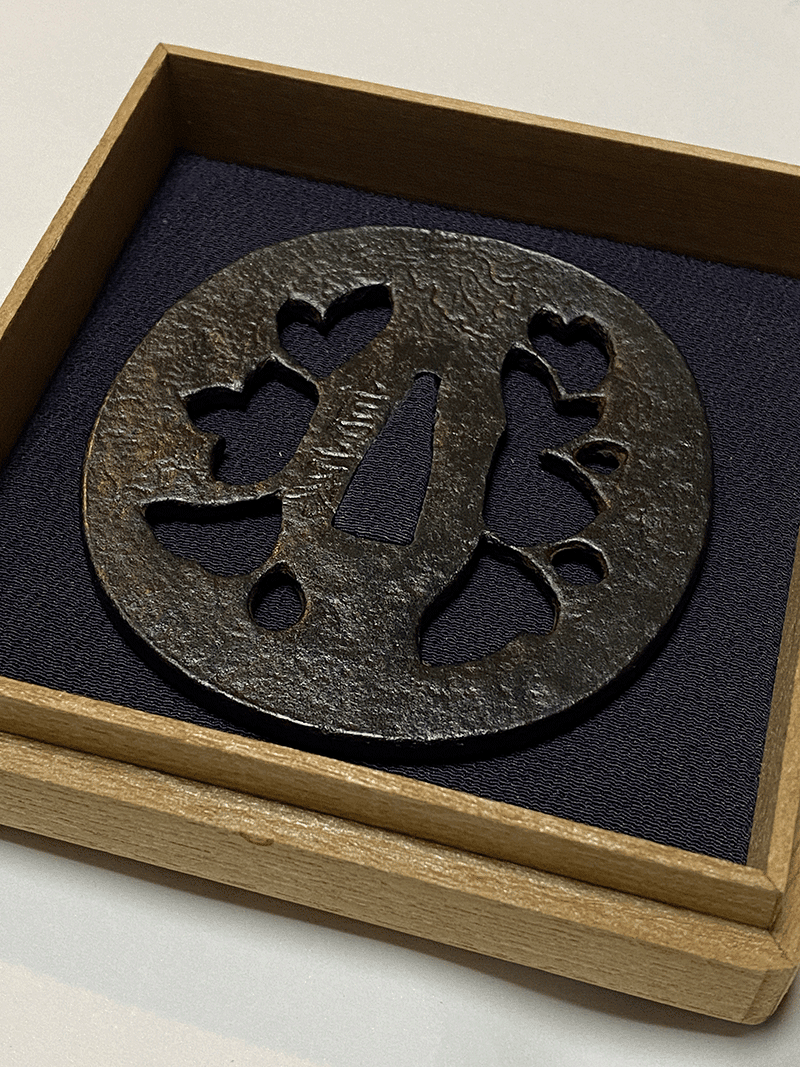
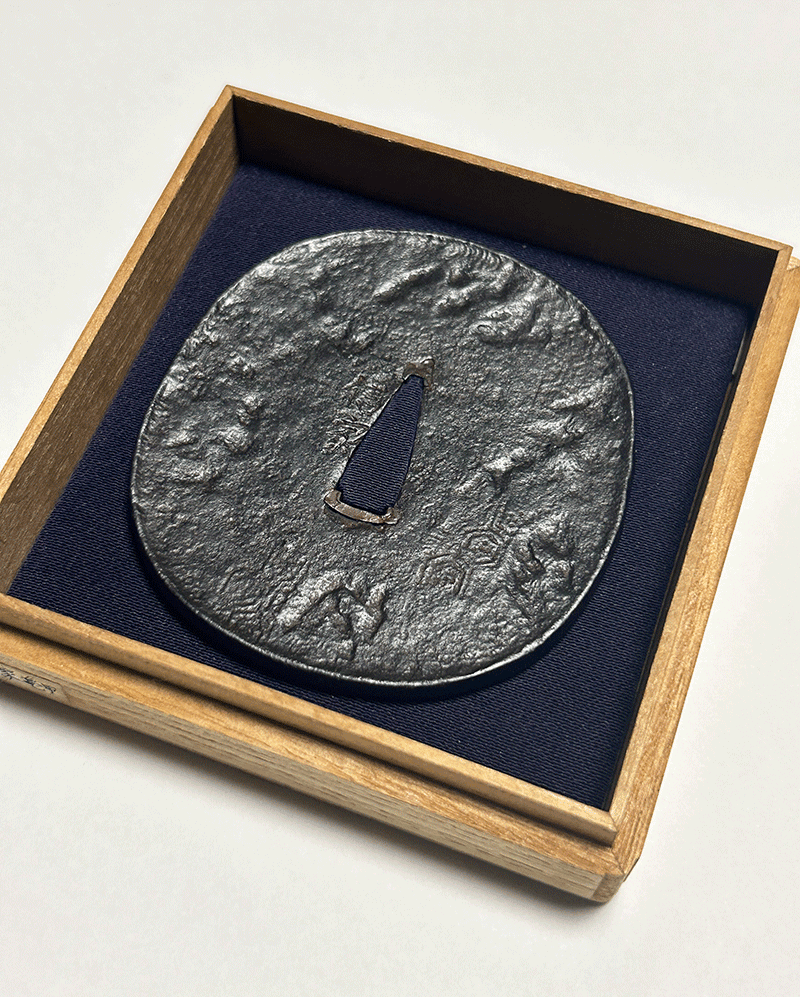
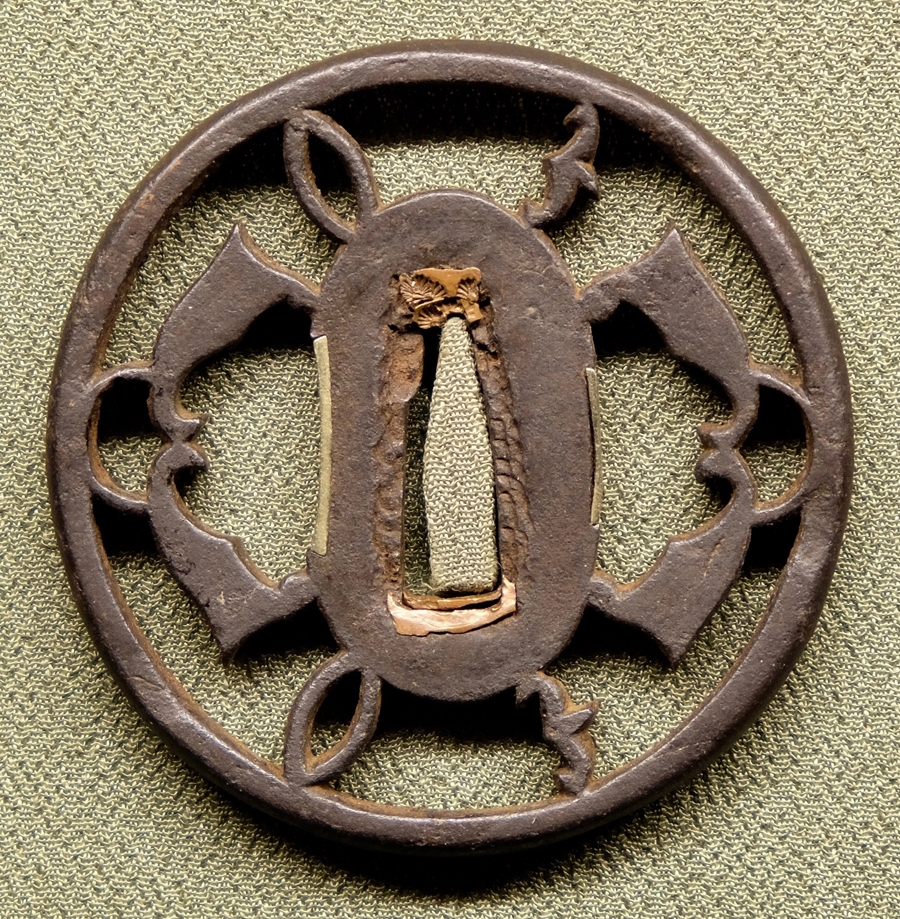
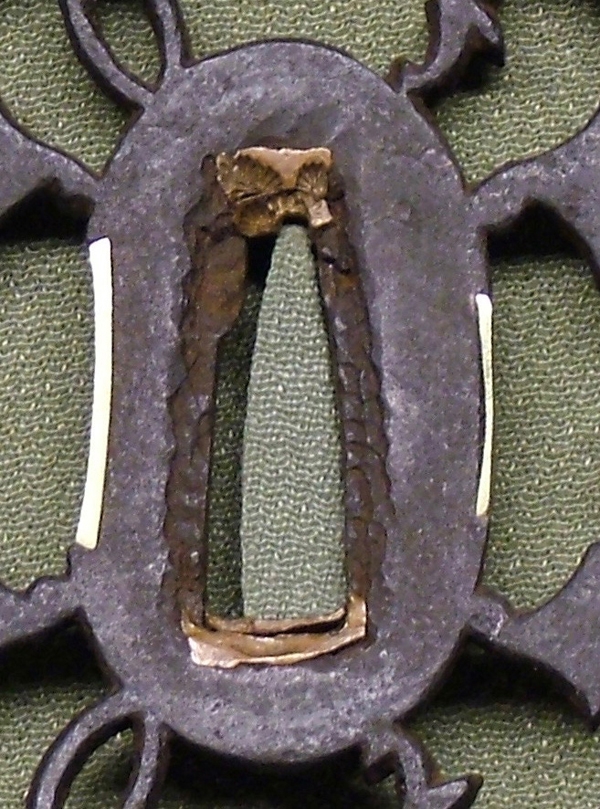
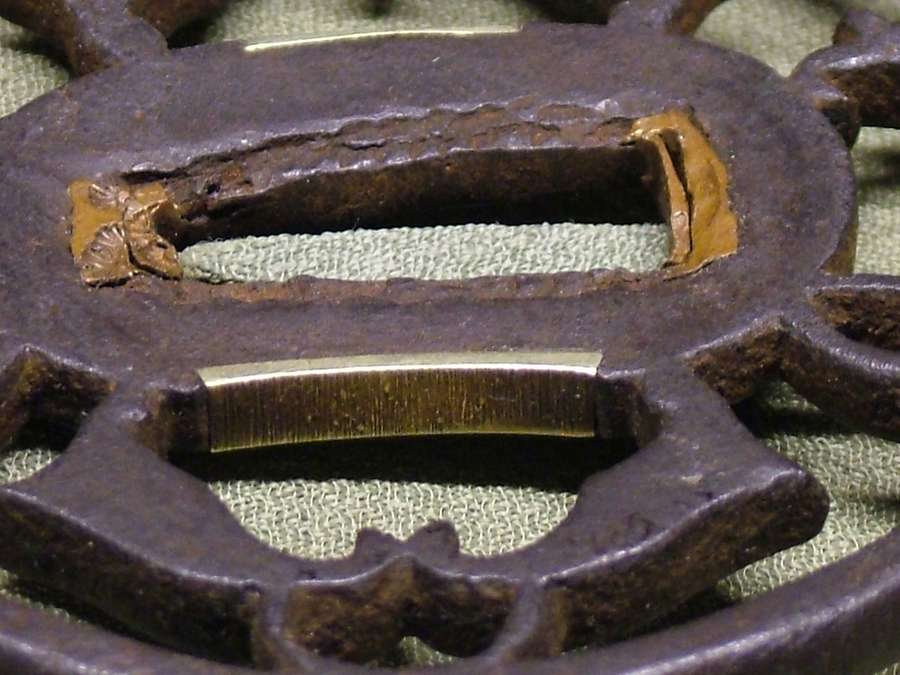
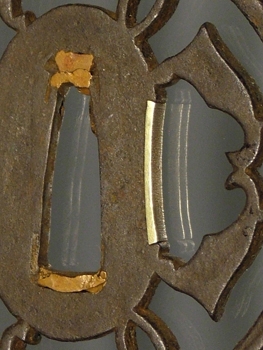
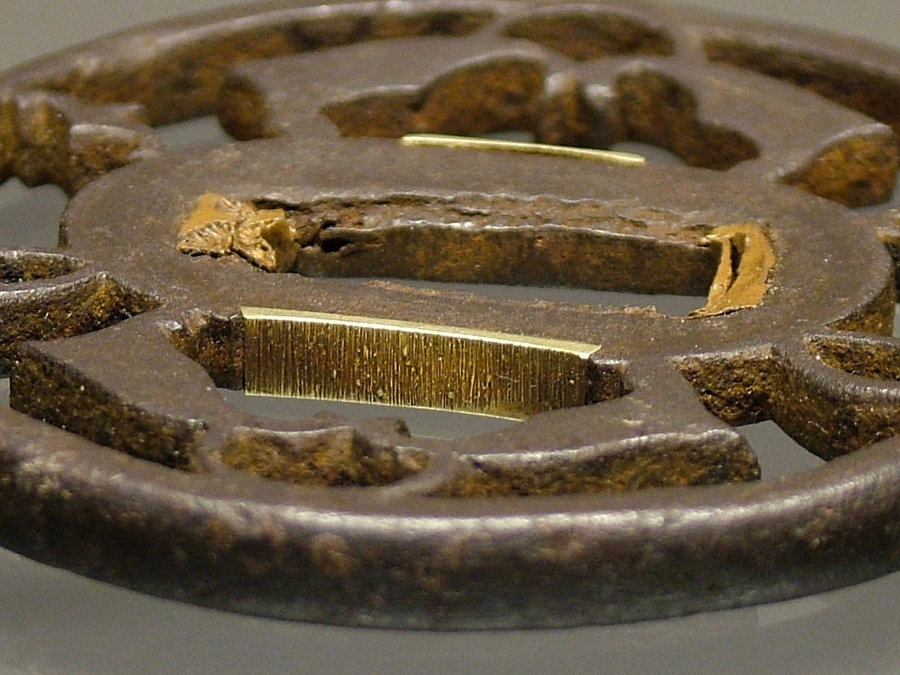
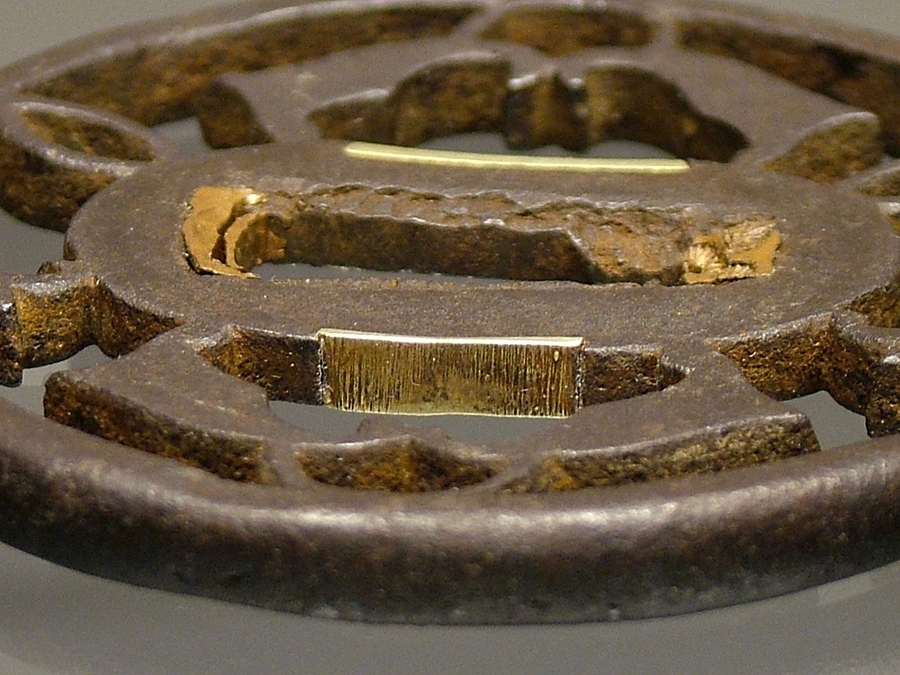
This is a Kanayama tsuba featuring a design of ginger (myoga) and wild geese (chidori). While attribution to Kanayama or Owari schools can be challenging, the dealer believes this to be an Edo period Kanayama work. The tsuba is visually appealing and includes gold hitsu-ana inserts, indicating it was highly valued by a previous owner.
 NihontoWatch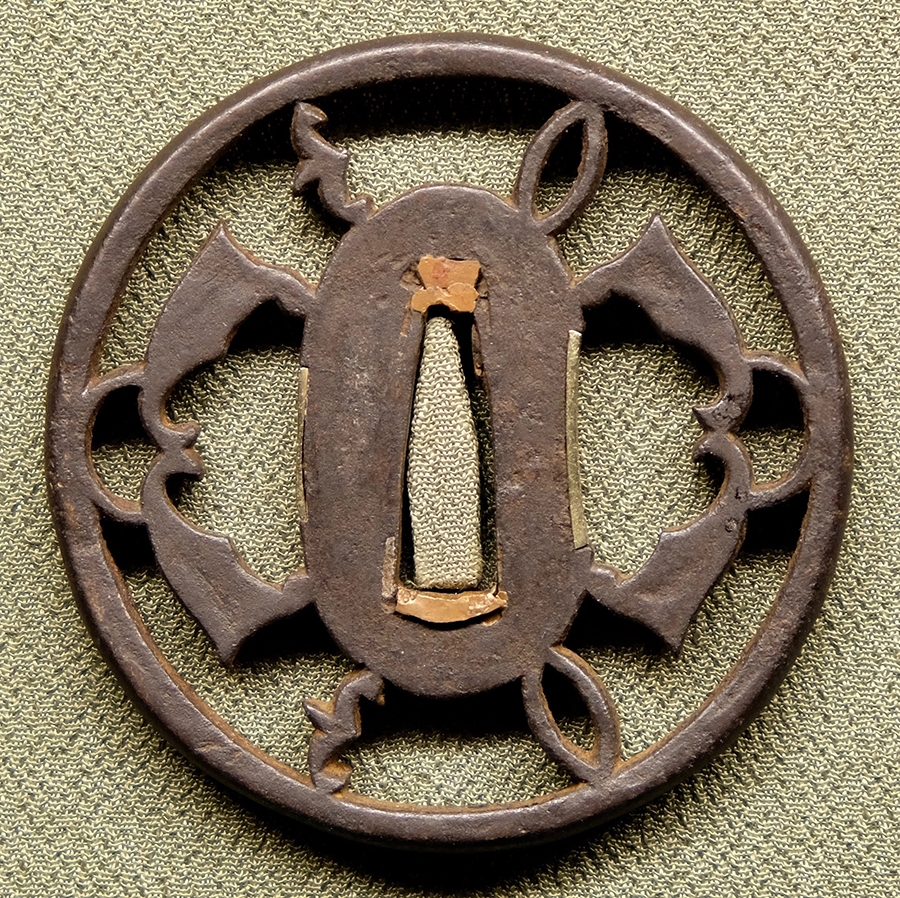
Iron-tsuba · Owari
The Kanayama school of iron tsuba emerged in the vicinity of Kanayama, a district near Atsuta Shrine in Owari Province, flourishing from the late Muromachi through the Momoyama period. The locality took its name from the enshrinement of the deity Kanayama-hiko, and local metalworkers developed a distinctive tradition of sword guards characterized by exceptional plate iron and an unadorned aesthetic sensibility. Working primarily for the warrior class during a turbulent age, Kanayama artisans produced guards that reflected the martial spirit and ascetic values of their time, favoring directness of expression over decorative elaboration. The collective style of Kanayama work exhibits marked coherence in materials, construction, and design philosophy. Kanayama tsuba are executed as ichimai (single-plate) iron guards, typically round in form, with surfaces finished in tsuchime-ji (hammer texture) and designs rendered through ji-sukashi (ground openwork). The iron itself displays a distinctive character, showing darker tones within its coloration and often developing purplish patinations; most notably, the plate reveals prominent tekkotsu (iron "bones")—granular or mass-like crystalline structures that appear within the rim and on the surface, conveying rustic vigor.
Kanayama designs favor geometric simplicity, employing circles, squares, straight lines, and curves in bold compositions: bells (suzu, tsurigane), rings (wa), measuring boxes (masu), tea caddies (chatsubo), court-lady hats (ichimegasa), and abstract motifs such as clouds and moon (ungetsu). Rather than pursuing ornamental refinement, these patterns are conceived with directness and clarity, evoking what appraisers consistently describe as a "Zen-like flavor"—an aesthetic that suggests inner resilience, spiritual strength, and the austere dignity befitting mature practitioners of the warrior path. Kanayama tsuba occupy a significant position within the broader history of Muromachi-period iron openwork guards, standing alongside Owari work as representative expressions of the age. While the two traditions share certain technical affinities, Kanayama is distinguished by its characteristically blackish iron tone and its vigorous tekkotsu, which together impart an archaic, untamed quality. The school's appeal lies in the fusion of material excellence—thick, well-prepared plate iron with deep patinas—and conceptual restraint, yielding guards that, though unpretentious, possess formidable presence and enduring spiritual resonance. The tradition represents an artistic philosophy in which simplicity becomes a vehicle for profound expression, and in which the essence of martial values is communicated not through ornament, but through clarity of form and strength of material. Learn more →
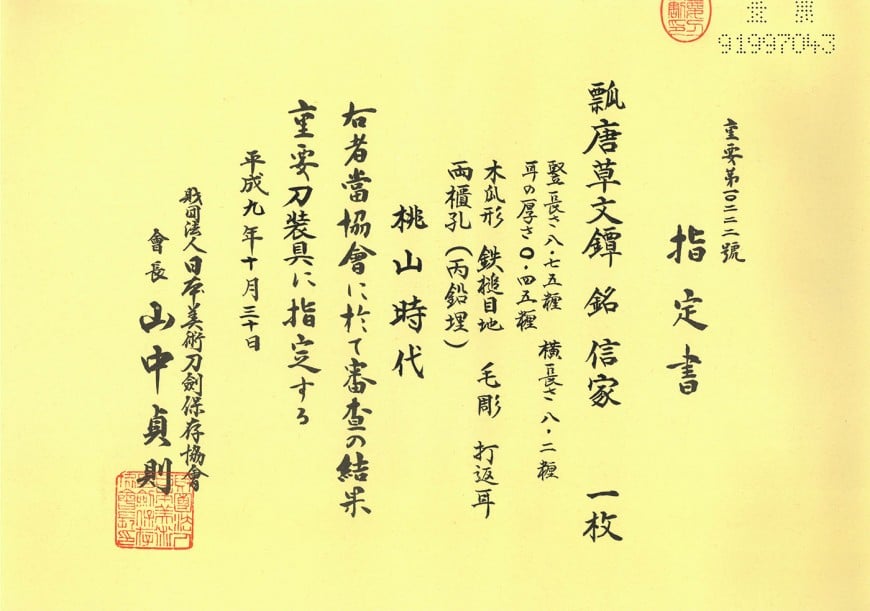
We could not find an authenticity certificate on the seller’s listing. Japanese swords and fittings are normally papered by the NBTHK (or the NTHK). Without one, the attribution is the seller’s own assessment and has not been independently verified — treat it with caution and ask the dealer about certification before buying.
All swords sold for $5000 USD or less are considered final! Swords above the $5000 range may be returned for any reason within 48 hrs. Buyer will receive a full refund minus shipping/handling, insurance and or any fees incurred in shipping or sale.
$1,200
This is a Kanayama tsuba featuring a design of ginger (myoga) and wild geese (chidori). While attribution to Kanayama or Owari schools can be challenging, the dealer believes this to be an Edo period Kanayama work. The tsuba is visually appealing and includes gold hitsu-ana inserts, indicating it was highly valued by a previous owner.
NihontoWatchIron-tsuba · Owari
The Kanayama school of iron tsuba emerged in the vicinity of Kanayama, a district near Atsuta Shrine in Owari Province, flourishing from the late Muromachi through the Momoyama period. The locality took its name from the enshrinement of the deity Kanayama-hiko, and local metalworkers developed a distinctive tradition of sword guards characterized by exceptional plate iron and an unadorned aesthetic sensibility. Working primarily for the warrior class during a turbulent age, Kanayama artisans produced guards that reflected the martial spirit and ascetic values of their time, favoring directness of expression over decorative elaboration. The collective style of Kanayama work exhibits marked coherence in materials, construction, and design philosophy. Kanayama tsuba are executed as ichimai (single-plate) iron guards, typically round in form, with surfaces finished in tsuchime-ji (hammer texture) and designs rendered through ji-sukashi (ground openwork). The iron itself displays a distinctive character, showing darker tones within its coloration and often developing purplish patinations; most notably, the plate reveals prominent tekkotsu (iron "bones")—granular or mass-like crystalline structures that appear within the rim and on the surface, conveying rustic vigor.
Kanayama designs favor geometric simplicity, employing circles, squares, straight lines, and curves in bold compositions: bells (suzu, tsurigane), rings (wa), measuring boxes (masu), tea caddies (chatsubo), court-lady hats (ichimegasa), and abstract motifs such as clouds and moon (ungetsu). Rather than pursuing ornamental refinement, these patterns are conceived with directness and clarity, evoking what appraisers consistently describe as a "Zen-like flavor"—an aesthetic that suggests inner resilience, spiritual strength, and the austere dignity befitting mature practitioners of the warrior path. Kanayama tsuba occupy a significant position within the broader history of Muromachi-period iron openwork guards, standing alongside Owari work as representative expressions of the age. While the two traditions share certain technical affinities, Kanayama is distinguished by its characteristically blackish iron tone and its vigorous tekkotsu, which together impart an archaic, untamed quality. The school's appeal lies in the fusion of material excellence—thick, well-prepared plate iron with deep patinas—and conceptual restraint, yielding guards that, though unpretentious, possess formidable presence and enduring spiritual resonance. The tradition represents an artistic philosophy in which simplicity becomes a vehicle for profound expression, and in which the essence of martial values is communicated not through ornament, but through clarity of form and strength of material. Learn more →
We could not find an authenticity certificate on the seller’s listing. Japanese swords and fittings are normally papered by the NBTHK (or the NTHK). Without one, the attribution is the seller’s own assessment and has not been independently verified — treat it with caution and ask the dealer about certification before buying.
All swords sold for $5000 USD or less are considered final! Swords above the $5000 range may be returned for any reason within 48 hrs. Buyer will receive a full refund minus shipping/handling, insurance and or any fees incurred in shipping or sale.
$1,200