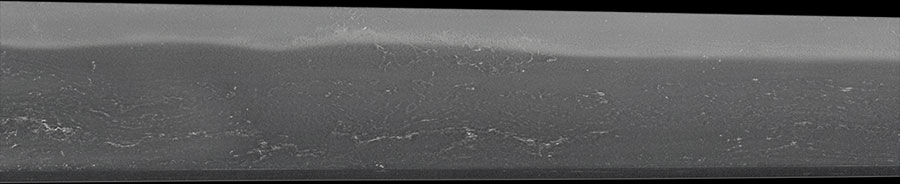
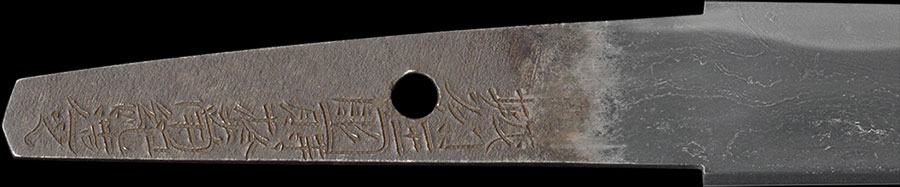
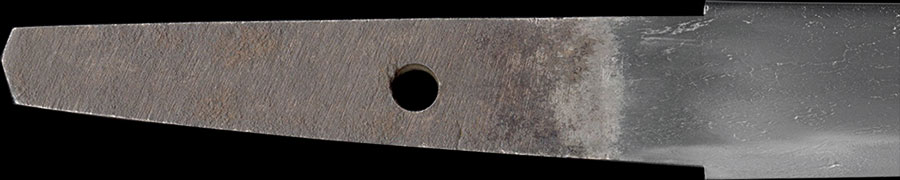
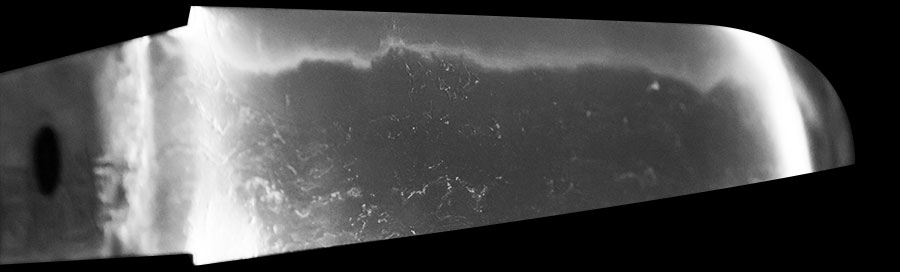
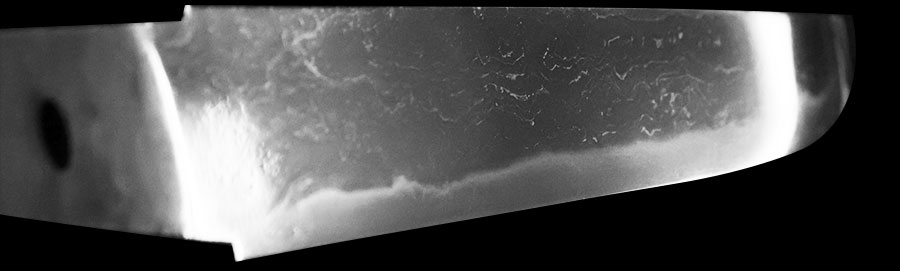
It has appeared, it has appeared. According to the Nihonto Meikan edited by Honma Kunzan sensei, Nisshu ju Kunitoki, Joshu ju Kunitoki o Nanki kore o tsukuru, a student of Horikawa Kunihiro who later moved to Kishu around the Kanei era, works are rare, and he is a relative of Sanemasa, who is said to be the grandfather or father of Kunihiro. A tanto exactly as described in the Meikan has appeared. This is a wonderful new discovery. While the works of Horikawa Kunihiro, who is spoken of with respect as the founder of Shinto, are famous, they can only be seen in places like the National Museum, and he is the highest-ranking master of the Shinto period, with 11 blades designated as Important Cultural Property and 12 blades as Important Art Object. In his shadow existed a group of swordsmiths of the school centered on Kunihiro, and this Kunitoki is thought to be a cousin of Horikawa Kunihiro, and because he mainly served as a proxy maker for Kunihiro due to being a particularly close blood relative, his own signed works are not wonderful, making them the object of desire for collectors of the Kunihiro school. This tanto copies the famous master of Chikushu, Sa, the mune is a shin no mune of the Soshu den, it exhibits a tanto sugata with no sori that has a difference between the moto-mihaba and saki-mihaba, the jigane exhibits a wild and powerful jigane in the Kunihiro style with itame-hada forged and mixed with masame-hada, the hamon is a nioi-deki notare-midare-ba mixed with gunome, and the boshi is sharp and kaeru, which is the greatest characteristic of Sa, and is magnificent. The nakago sugata also exhibits a shape that slightly refines the tanto shape of Horikawa Kunihiro, and it is well understood that the swordsmith Kunitoki was a proxy maker for Kunihiro. After the death of Horikawa Kunihiro, the swordsmith Kunitoki, just as Izumi no Kami Kunisada and Kawachi no Kami Kunisuke moved to Osaka, moved to Kishu, which was a major city of the Kishu Tokugawa family at the time. There are not even 3 existing works by the swordsmith Kunitoki, and this tanto is a wonderfully precious tanto. Unfortunately, even in the collection of Ise Torahiko, the greatest collector of Kunihiro and the Kunihiro school, it was not possible to collect works by this swordsmith Kunitoki. It is a famous tanto that is indispensable for collectors of the Kunihiro school. Please enjoy this rare famous tanto that copies Sa, by the historically precious master and blood relative of Horikawa Kunihiro, Joshu ju Kunitoki o Nanki kore o tsukuru.
Machine translation from the shop's Japanese · may contain errors ·
It has appeared, it has appeared. According to the Nihonto Meikan edited by Honma Kunzan sensei, Nisshu ju Kunitoki, Joshu ju Kunitoki o Nanki kore o tsukuru, a student of Horikawa Kunihiro who later moved to Kishu around the Kanei era, works are rare, and he is a relative of Sanemasa, who is said to be the grandfather or father of Kunihiro. A tanto exactly as described in the Meikan has appeared. This is a wonderful new discovery. While the works of Horikawa Kunihiro, who is spoken of with respect as the founder of Shinto, are famous, they can only be seen in places like the National Museum, and he is the highest-ranking master of the Shinto period, with 11 blades designated as Important Cultural Property and 12 blades as Important Art Object. In his shadow existed a group of swordsmiths of the school centered on Kunihiro, and this Kunitoki is thought to be a cousin of Horikawa Kunihiro, and because he mainly served as a proxy maker for Kunihiro due to being a particularly close blood relative, his own signed works are not wonderful, making them the object of desire for collectors of the Kunihiro school. This tanto copies the famous master of Chikushu, Sa, the mune is a shin no mune of the Soshu den, it exhibits a tanto sugata with no sori that has a difference between the moto-mihaba and saki-mihaba, the jigane exhibits a wild and powerful jigane in the Kunihiro style with itame-hada forged and mixed with masame-hada, the hamon is a nioi-deki notare-midare-ba mixed with gunome, and the boshi is sharp and kaeru, which is the greatest characteristic of Sa, and is magnificent. The nakago sugata also exhibits a shape that slightly refines the tanto shape of Horikawa Kunihiro, and it is well understood that the swordsmith Kunitoki was a proxy maker for Kunihiro. After the death of Horikawa Kunihiro, the swordsmith Kunitoki, just as Izumi no Kami Kunisada and Kawachi no Kami Kunisuke moved to Osaka, moved to Kishu, which was a major city of the Kishu Tokugawa family at the time. There are not even 3 existing works by the swordsmith Kunitoki, and this tanto is a wonderfully precious tanto. Unfortunately, even in the collection of Ise Torahiko, the greatest collector of Kunihiro and the Kunihiro school, it was not possible to collect works by this swordsmith Kunitoki. It is a famous tanto that is indispensable for collectors of the Kunihiro school. Please enjoy this rare famous tanto that copies Sa, by the historically precious master and blood relative of Horikawa Kunihiro, Joshu ju Kunitoki o Nanki kore o tsukuru.
Historical context
The Edo period (1615 to 1868)
›
For two and a half centuries of peace the sword was the warrior’s legal badge rather than his weapon. Each great city developed its own manner, Edo’s tested strength against Ōsaka’s polished brilliance, until demand thinned in the era’s last decades.
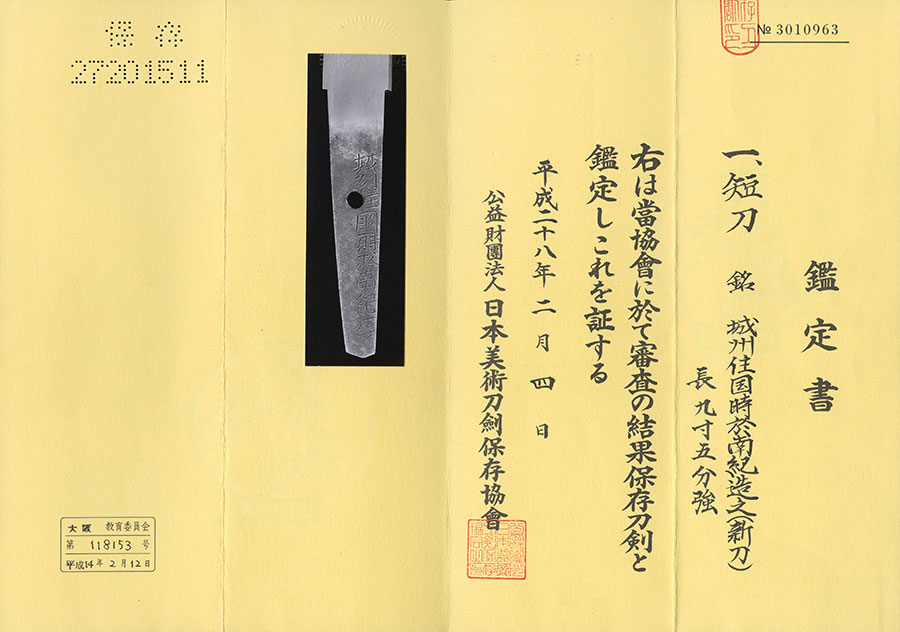
Certifies a genuine blade worth preserving: a signature confirmed correct, or, if unsigned, an era, province, and school that the NBTHK can reliably identify.
About the NBTHK›
The NBTHK (Nihon Bijutsu Tōken Hozon Kyōkai, the Society for the Preservation of Japanese Art Swords) is a public-interest incorporated foundation founded in 1948 and supervised by Japan’s Agency for Cultural Affairs (Bunkachō); it is based at the Japanese Sword Museum in Tokyo. Its expert panels physically examine each submitted work (shinsa) and issue a certificate (kanteishō) ranking it by artistic and historical merit. NBTHK papers are the most widely recognized standard of authentication for Japanese swords and fittings.
For returns due to customer circumstances, the cost is the customer's responsibility. For returns due to our mis-shipment or a defective item, we bear the cost.






 NihontoWatch