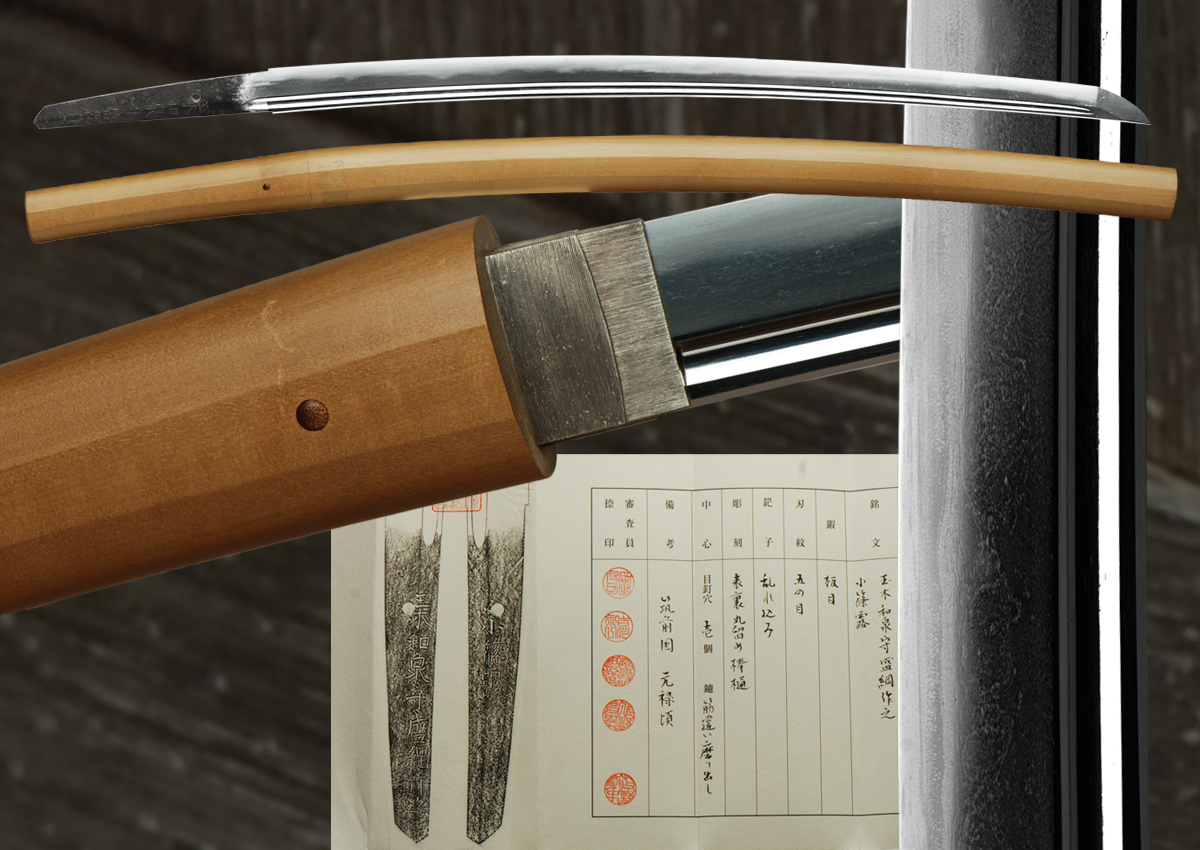
During the Nanbokuchō period two groups of smiths worked in Chikuzen Province: the Samonji line and the Kongōbyōe line, named for the temple-associated smiths from whom the lineage descends. The setsumei trace the line to the shodai Kongōbyōe Moritaka (初代金剛兵衛盛高) and frame this early chapter, Ko-Kongōbyōe, as the Nanbokuchō founding generations rather than the Muromachi continuation. The smiths who anchor this phase in surviving work are Moritaka himself, present in a mumei katana attributed to Kongō Hyōe Moritaka, and Reizei Sadamori (冷泉貞盛), called a smith of the Kongōbyōe line and traditionally traced back to Moritaka. The repeated documentary touchstone is Sadamori's signed tantō inscribed "Chikushū Reizei Sadamori, Shōhei 25, first month, day," dated 1370, which fixes the active period of the early line and serves as the reference against which other works are appraised. One Moritaka attribution notes an example dated Shōhei 4 (1349), while the bulk of work bearing his name belongs to the Muromachi period and later, which separates the early Nanbokuchō chapter described here from what follows. What the setsumei describe again and again is a Yamato temperament read in both ji and ha. The forging is itame mixed with mokume, often flowing toward masame near the edge, with the grain standing out (hada-dachi); ji-nie adheres and chikei enter as a relied-upon feature. The steel takes a somewhat dark, blackish kanairo with slight cloudiness, and a whitish utsuri or shirake-utsuri appears, conspicuously so in several of the wider katana.
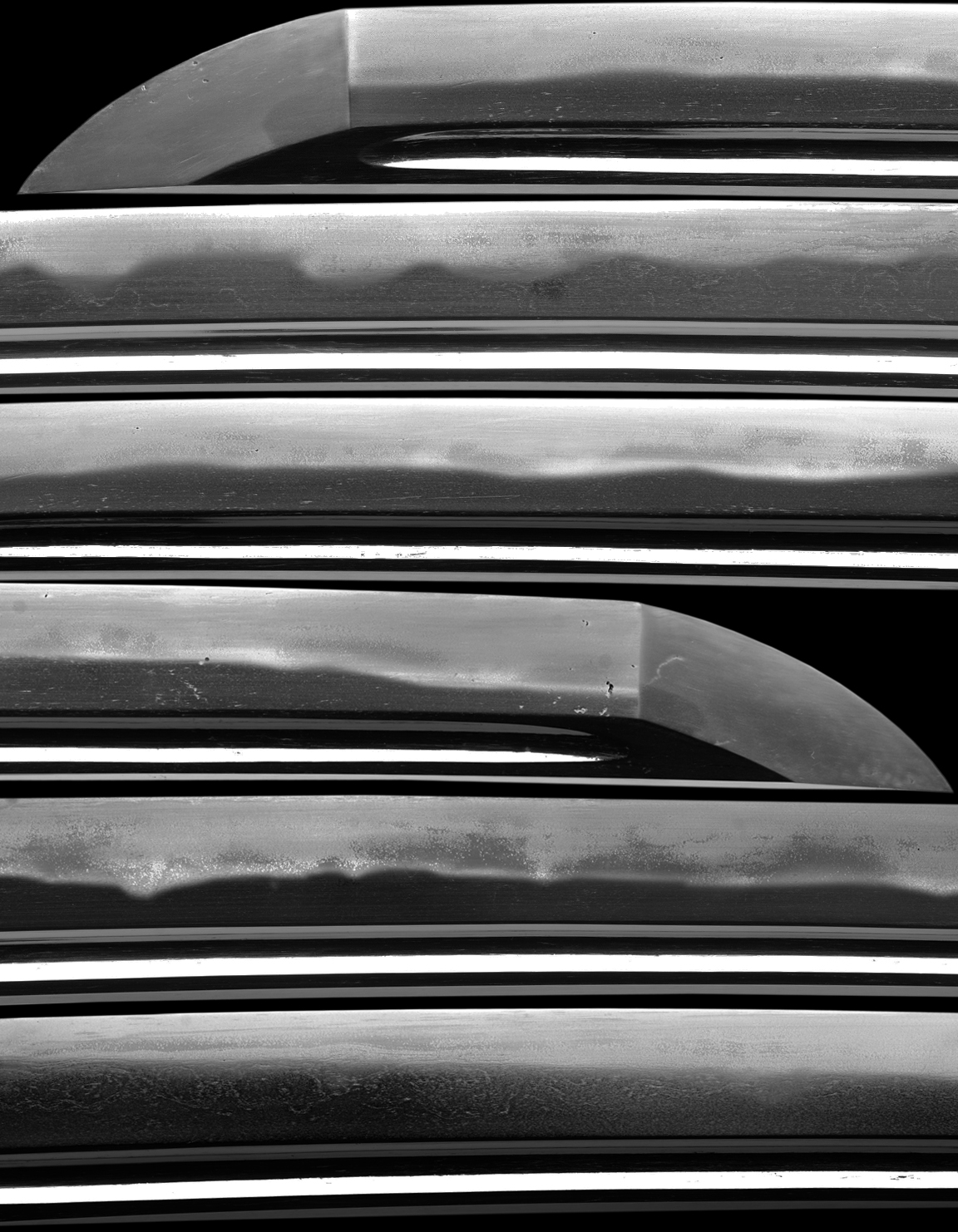
The temper is characteristically a narrow suguha or hoso-suguha, low in height, with a nioiguchi that tends toward tightness and ko-nie; along the habuchi come hotsure, uchi-noke, and a nijūba-like aspect, while kinsuji and sunagashi run modestly through ji and ha. The bōshi runs sugu to ko-maru with hakikake at the point, and grooves such as bō-hi or futasuji-hi are carved kaki-nagashi. A distinct sub-current within Sadamori's own work widens this manner: certain signed hira-zukuri pieces show notare mixed with gunome, abundant ashi, and kuichigai-hi in a naginata-hi arrangement, contrasted explicitly in one setsumei against the narrow-suguha dated standard. This early restraint, dark steel, shirake ground, and tight low suguha is what the records use to set Ko-Kongōbyōe apart from the later Sue-Kongōbyōe production carried into the Muromachi period. For kantei, the setsumei converge on a recognizable cluster: flowing itame leaning to masame, well-entered chikei, blackish and whitish-cast steel showing the coloration the records tie to Kyūshū work, and a narrow suguha whose nioiguchi tends to shizumi with hotsure and uchi-noke along the edge. Many surviving blades are ō-suriage mumei katana in Nanbokuchō taihai, broad with shallow sori and extended chū- to ō-kissaki, while the signed evidence sits in tantō and hira-zukuri wakizashi. Named smiths attached to this phase are Moritaka and Reizei Sadamori, the latter also written Reizen Sadamori in earlier records. On provenance, the tantō certified Jūyō Bijutsuhin in 1939 was held by Koizumi Shinji of Kanagawa, and the line is documented in references including Imamura Oshigata and Nihontō Taikan, with later attributions to Sadamori grounded on the Shōhei 25 standard. Learn more →


 NihontoWatch