In the Sengoku era the school served a second warrior court: the Later Hōjō at Odawara, whose patronage kept the Tsunahiro line forging hitatsura for the uchigatana age until the castle fell to Hideyoshi in 1590.
 NihontoWatchNihontoWatch
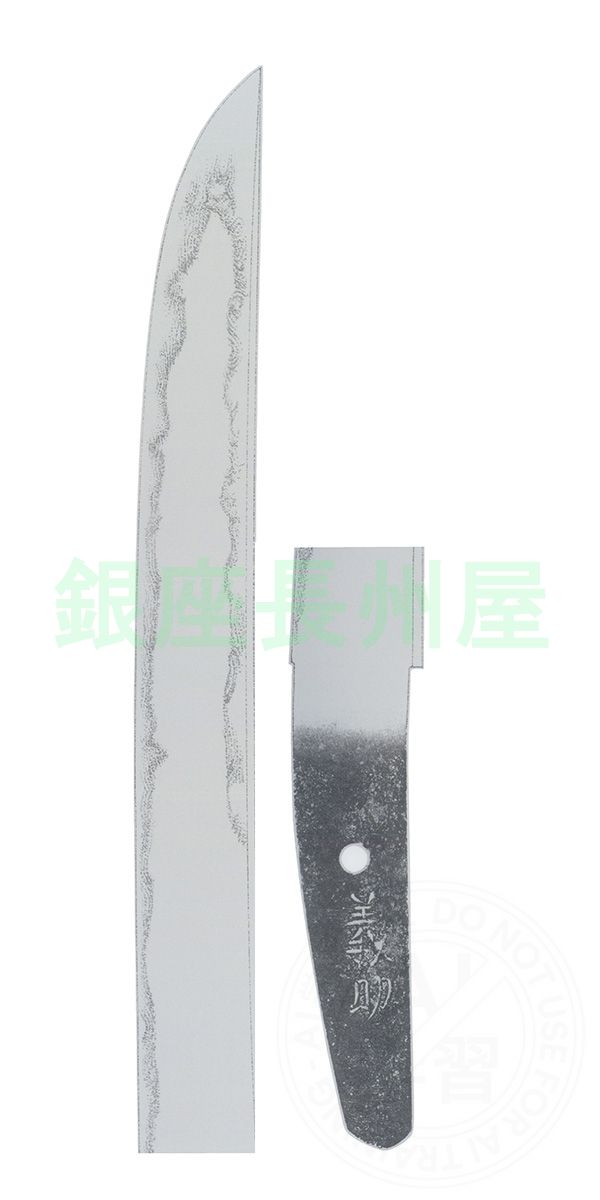
義助は駿河国島田(注)の刀鍛冶で、三河、駿河、遠江の戦国大名今川氏に仕えた島田三名工の筆頭に挙げられる優工。義助には片切刃造に梵字を刻した貞宗写しの脇差や、茎尻が極端に細く長谷部國重や國信の舟形茎を想わせる短刀の傑作がある。相州上工の鍛法を充分に咀嚼したうえで打ち出された義助の作は真に迫り、前線に立つ武将を大いに奮い立たせたことであろう。 この短刀は、棟を真に仕立て、身幅広く重ねを控えめに刃先を鋭くし、わずかに反りの付いた、相州行光を想わせる上品な造り込み。杢を交えた板目鍛えの地鉄は地景によって肌目が鮮明に立つも、鍛着部は密に詰み、地沸が厚く付いて正宗と同門の則重の如き肌合いとなり、加えて淡い飛焼と沸映りが平地を彩る。浅い湾れに互の目の刃文は、尖りごころの刃、雁又風の刃、箱がかった刃を交えて表裏揃いごころとなり、先へ行って焼きが高く、沸深く付き、鍛えに感応して太い金線が躍り、砂流しが盛んに掛かる。帽子は激しく掃き掛け、棟を長く焼き下げ、ここにも金線と砂流しを激しく配しており、覇気に溢れた作となっている。特別の需に応え、行光や則重を念頭に置いての意欲作とみられ、本間薫山博士の「相州伝」と記された鞘書も意味深く貴重である。 注...静岡県島田市元島田。
NihontoWatchOffered by Choshuya
This piece has sold
9 on the market
Get an email when new Shimada School work hits the market.







Soshu-den · Suruga
9 pieces on the market now
The Shimada school (島田) took its name from its base in Suruga Province, where it worked from the mid-Muromachi period along the Tōkaidō between the Mino hearths and the late Sōshū smiths of neighboring Sagami. The published sources place its founding generation in the Kōshō (or Kyōshō) era and trace its principal names without interruption down into the shintō period, with the same names continuing as late as the shinshintō era. Three smiths stand as the school's central hands: Yoshisuke (義助), held to be the principal mainstream name at the head of all Shimada work; Sukemune (助宗), recorded as the younger brother of the founder; and Hirosuke (廣助), placed as the son of the second-generation Yoshisuke. The oldest extant dated example, an Eishō 2 (1505) tantō by Yoshisuke, fixes the early corpus, and because the signature style does not separate the hands, a signed Shimada blade is read for its workmanship rather than assigned a generation. The Shimada smiths produced the working blades of the Muromachi century; one Hirosuke katana, a Kōshū-uchi work dated Eiroku 2 (1559), was held by Hara Mino Nyūdō Toratane of the Twenty-Four Generals of the Takeda, and the cut struck into the mune at the monouchi of a Yoshisuke katana drew a NBTHK remark that it speaks to martial use. Across the members the school reads in a single Soshu-den idiom inflected by Mino and Ise. The jigane the smiths describe is an itame, well knit and at times dense, that flows and leans toward masame, standing somewhat open in hada-dachi, with fine ji-nie lying through it, chikei entering, and a tonality the commentaries repeatedly call whitish; this flowing, slightly standing steel, rather than a tight Bizen surface, is what marks the Shimada hand for the eye. Upon it the smiths set a notare crossed with gunome, with ko-chōji and pointed togariba entering, ko-ashi, abundant nie, and sunagashi and kinsuji running through, the bōshi commonly midare-komi turning back rounded, at times with hakikake; tobiyaki and slight muneyaki appear, and on the larger blades the activity rises toward hitatsura in nie.
Sukemune's particular register is the connected gunome the NBTHK names the school's hallmark, while Hirosuke shows the most robust make, favoring a wide mihaba with sakizori and an extended kissaki. Against this typical midare every hand keeps a quieter exception: a hoso-suguha the commentary calls comparatively uncommon for Yoshisuke, and a suguha mixed with small gunome on a Sukemune tantō read as made with an eye toward the manner of Shizu. The carving tradition is shared throughout, bonji, suken, gomabashi, relief kurikara, and the figures of Marishiten and Fudō Myōō, with openwork sukashi-bori noted by examiners as an uncommon thing to find; the school also produced comparatively many yari, Yoshisuke's ōmi-yari among them. To kantei a Shimada blade is to read the late Sōshū idiom in a provincial Suruga register: the whitish, standing itame beneath a nie-laden notare-gunome with sunagashi, kinsuji, and frequent tobiyaki, set apart from a tight Bizen jigane and tied by the published sources to Sue-Sōshū, late Seki, the Senju group, and the work of Mino and Ise. Form sorts the manner: the broad Sōshū-leaning katana on one side, the school's tantō and wakizashi (often hira-zukuri with mitsu-mune, thick kasane, and a withered fukura kare) on the other. Among the members Yoshisuke is the name the sources reach for in describing the group, his finest katana and tantō praised for a jihada and hamon of clear, bright result; Sukemune's Osaka katana is judged his finest work; and Hirosuke's best pieces, one called hakubi, the best among its kind, with a suggestion he privately emulated Bizen Chōgi, number among the finest of the whole lineage. Dated and fully signed works such as those inscribed Shimada Hirosuke are particularly valued, the tangs anchoring the chronology of the later generations, and a rare collaborative blade between Hirosuke and Gensuke attests to the collegial working of the shop. Provenance reaches to the Imperial collection, Honma's inventory of which records works by Yoshisuke, Sukemune, and Hirosuke; with the Takeda general's blade and the documentary dated pieces, these holdings mark the standing of a respected one-province school whose hand sits close to the late Sōshū tradition. Learn more →
| Smith | Era | Designated |
|---|---|---|
| Yoshisuke義助 | 1492-1504 | 6 |
| Yoshisuke義助 | 1455-1526 | 5 |
| Sukemune助宗 | 1444-1449 | 4 |
| Yoshisuke義助 | 1573-1592 | 3 |
| Sukemune助宗 | 1661-1673 | 1 |
Sōshū in the Muromachi period
In the Sengoku era the school served a second warrior court: the Later Hōjō at Odawara, whose patronage kept the Tsunahiro line forging hitatsura for the uchigatana age until the castle fell to Hideyoshi in 1590.
A Hozon-certified blade judged to show notably superior workmanship and a better state of preservation. The bar is higher: re-tempered blades and most unsigned Muromachi/Edo works are excluded.
The NBTHK (Nihon Bijutsu Tōken Hozon Kyōkai, the Society for the Preservation of Japanese Art Swords) is a public-interest incorporated foundation founded in 1948 and supervised by Japan’s Agency for Cultural Affairs (Bunkachō); it is based at the Japanese Sword Museum in Tokyo. Its expert panels physically examine each submitted work (shinsa) and issue a certificate (kanteishō) ranking it by artistic and historical merit. NBTHK papers are the most widely recognized standard of authentication for Japanese swords and fittings.
NBTHK official siteIf, due to our fault, the item differs significantly from its proper condition, the item may be returned. Cooling-off is within one week of the item's arrival.