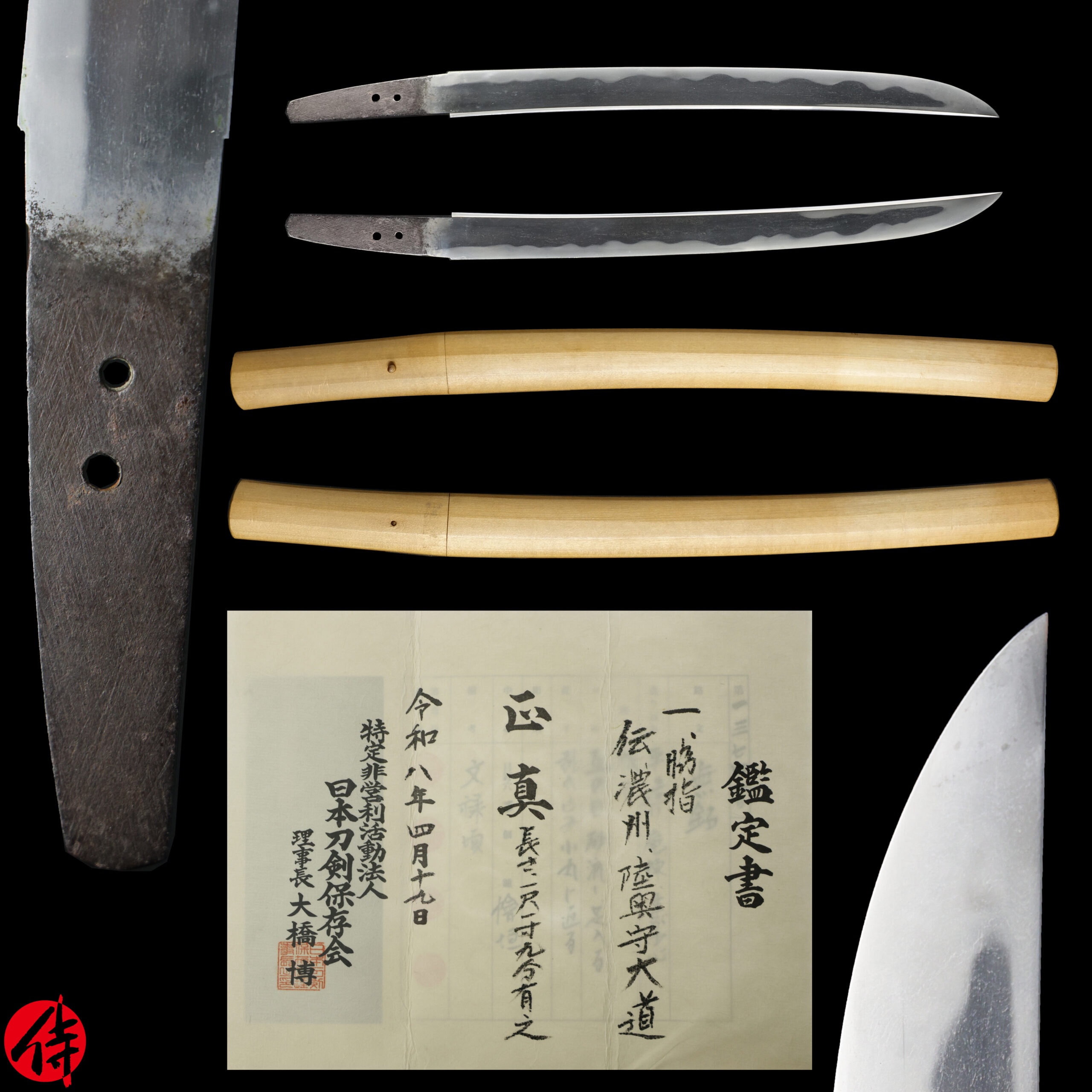
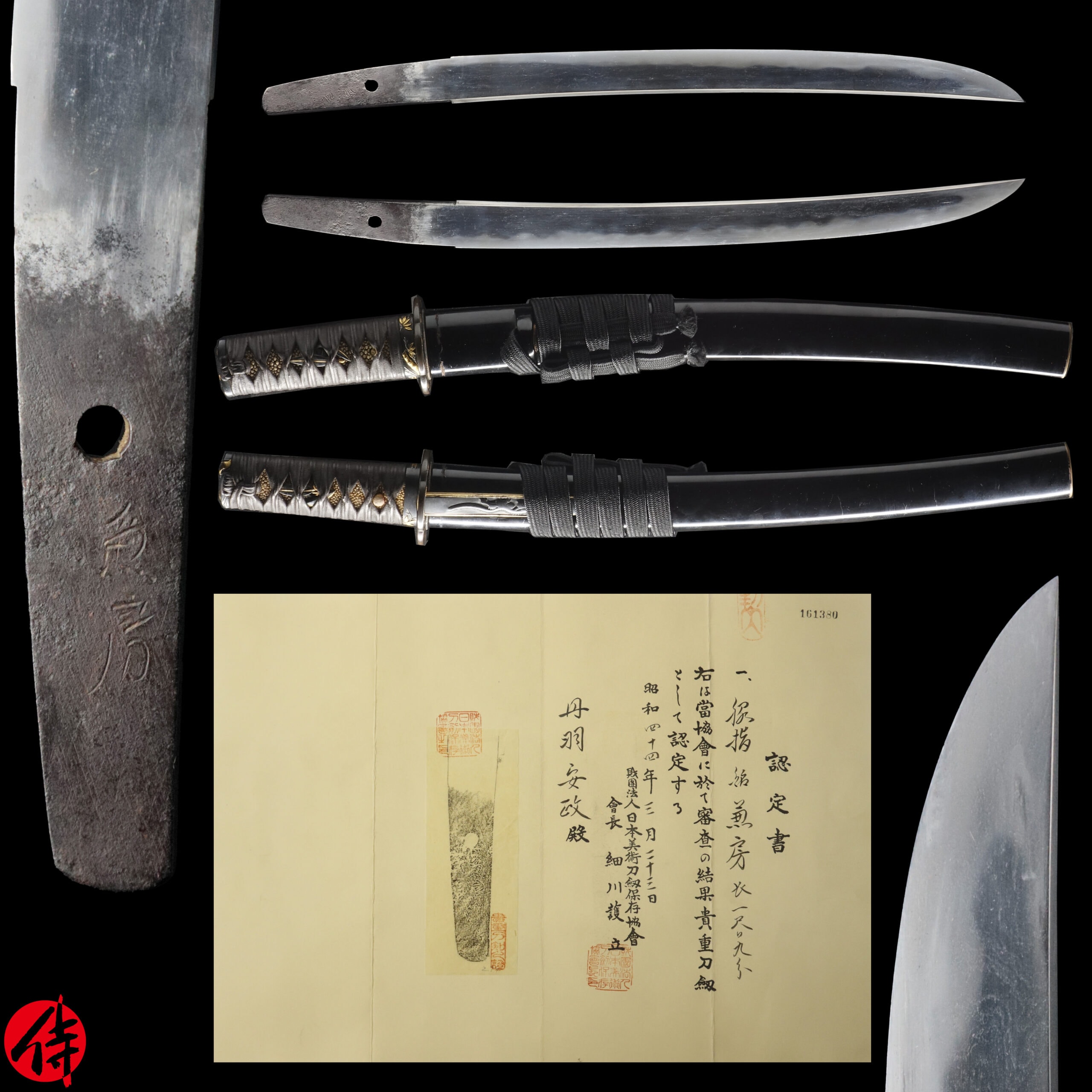
説明
Antique Japanese Sword Wakizashi Attributed to Shimada with NBTHK
Hozon
Certificate
【Description】
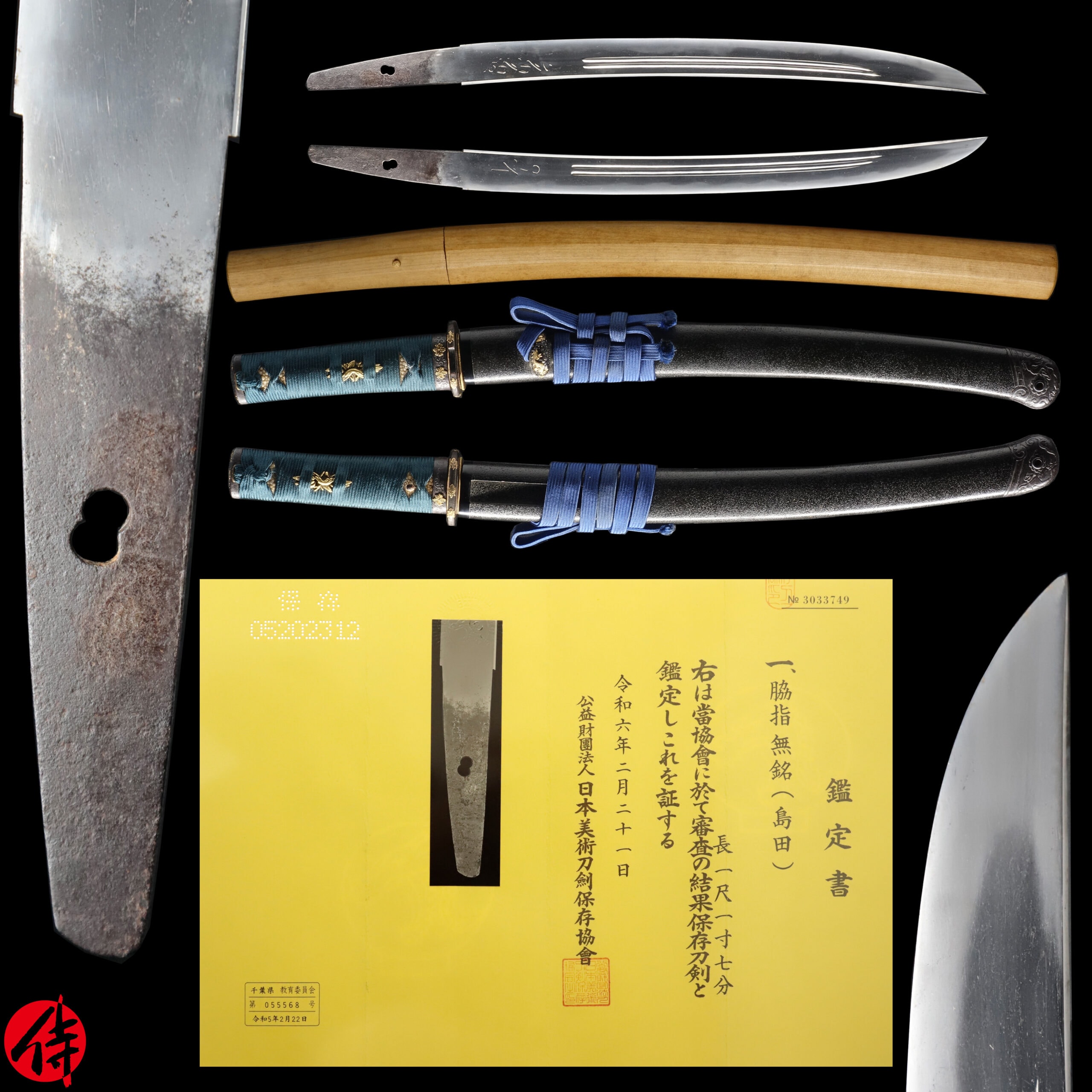
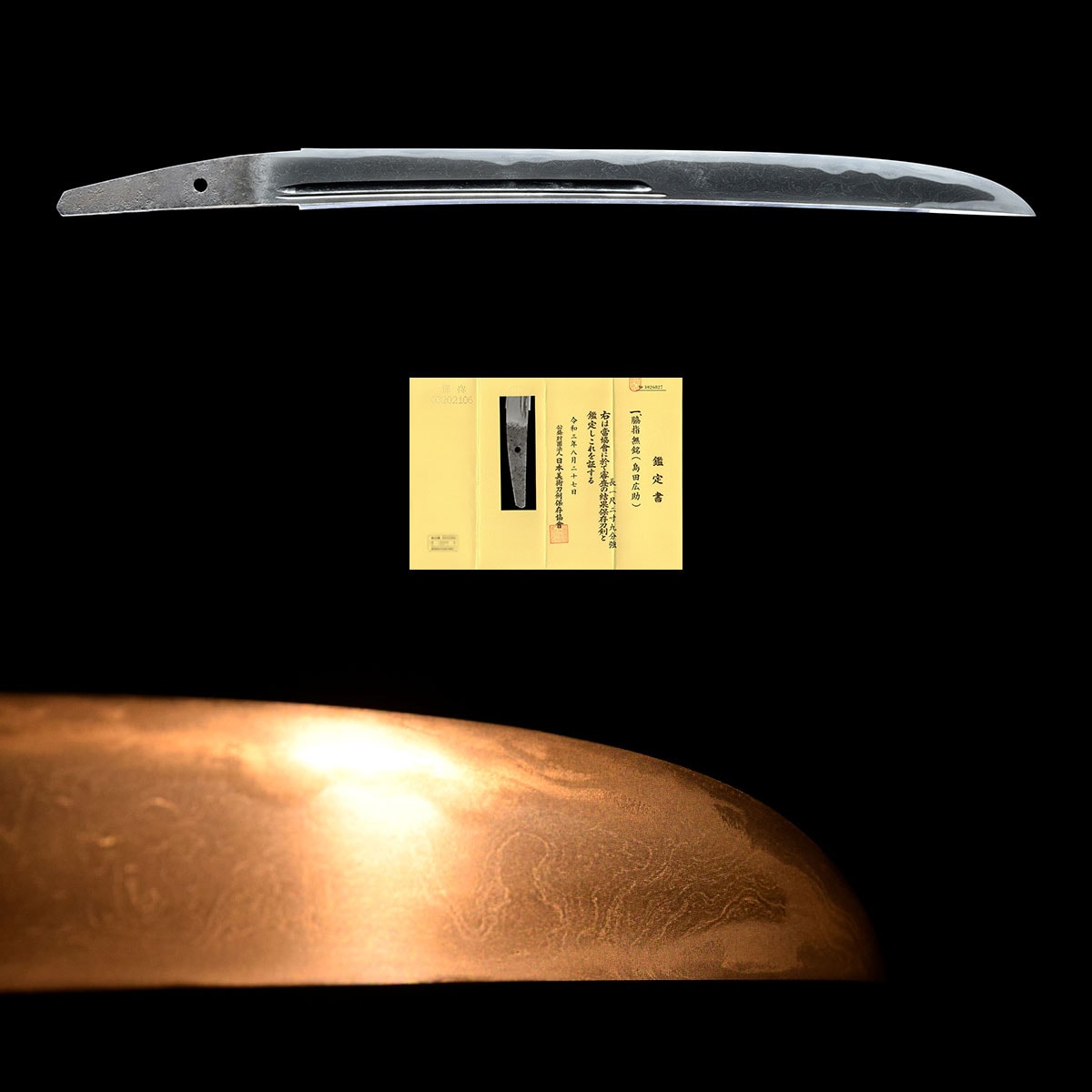
This blade is attributed to a work of Shimada school, according to NBTHK’s appraisal. Shimada school was founded by Yoshisuke (義助) during the mid-Muromachi period and lasted by the late Edo period. The group of Shimada swordsmiths resided in Shimada city, Suruga province (today’s Shizuoka prefecture). Other famous swordsmiths from this school are Sukemune, Hirotsugu, and Sadahiro.
The first-gen Yoshisuke was active during the Kosho era (1455-57). It is said that the first-gen Yoshisuke was a descendant of Bizen Ichimonji Sukemune, one of the most famous swordsmiths in Japanese history. The first-gen Yoshisuke served a powerful feudal family named Imagawa. It is said that he received his maker’s name 義 from Imagawa Yoshitada.
Shimada school interacted with other schools in Soshu swordsmiths living near Odawara castle in Kanagawa prefecture. The Suruga domain was vital for strong feudal lords such as Takeda, Tokugawa, and Hojo clan during the Sengoku Jidai (Warring state period: Late Muromachi period). The swordsmiths in Shimada school received many orders from these powerful feudal families. The first-gen Yoshisuke had mastered excellent craftsmanship, and it was passed down to swordsmiths in Shimada school.
Horimono (Engraving)
This blade has beautiful engravings on both sides. You would find the Horimono of Bonjis (梵字) and Gomahashi (護摩箸) on this blade.
Bonji (梵字) is Sanscrit characters carved into the blade invoking Buddhist deities. Sword carvings often depict Fudo Myo-O (不動明王, acalanātha) or his incarnations, and there are also Sanskrit characters that represent this god. Among the various Buddhist Buddhas, Fudo Myo-O was deeply worshiped by Samurai warriors. According to a theory, this god is the incarnation of Dainichi Nyorai (大日如来, Mahāvairocana, the principal image of esoteric Buddhism). Perhaps the most common type of Sanskrit character carved on the blades is the character “Kahn (カーン)”, which means Fudo Myo-O. There is also a Sanskrit character called “Kanmarn (カンマーン),” which is combined with the word “Man.” There was once a trend that Samurai warriors incorporated motifs with religious meaning into their battle costumes, such as armor and helmets, and this sword carving was also a way to express their religious beliefs. We hope you enjoy this carving as well as the beauty of the blade itself.
Gomahashi (護摩箸) is a horimono in the form of the ritual chopsticks used in both Shinto and Buddhist rites.
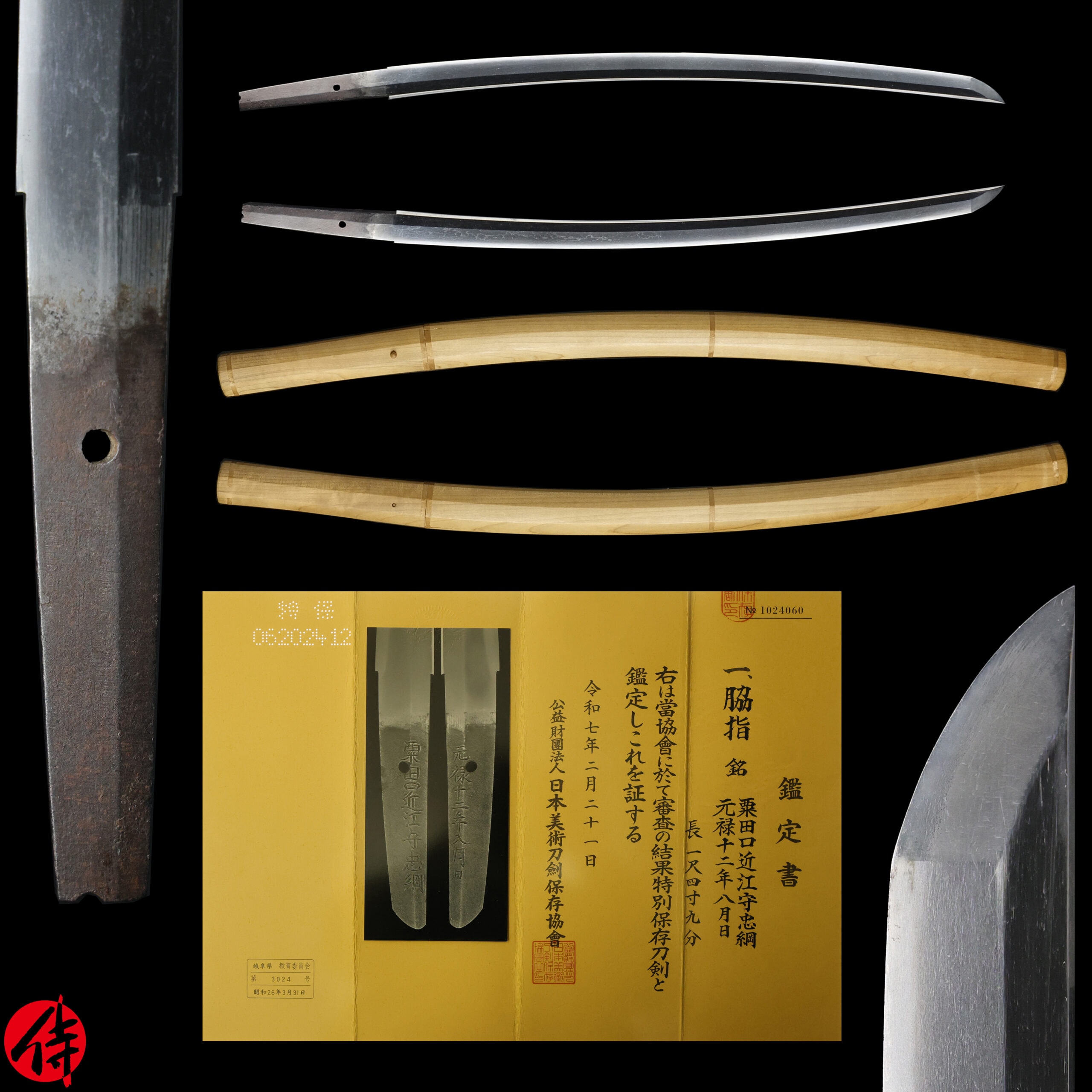
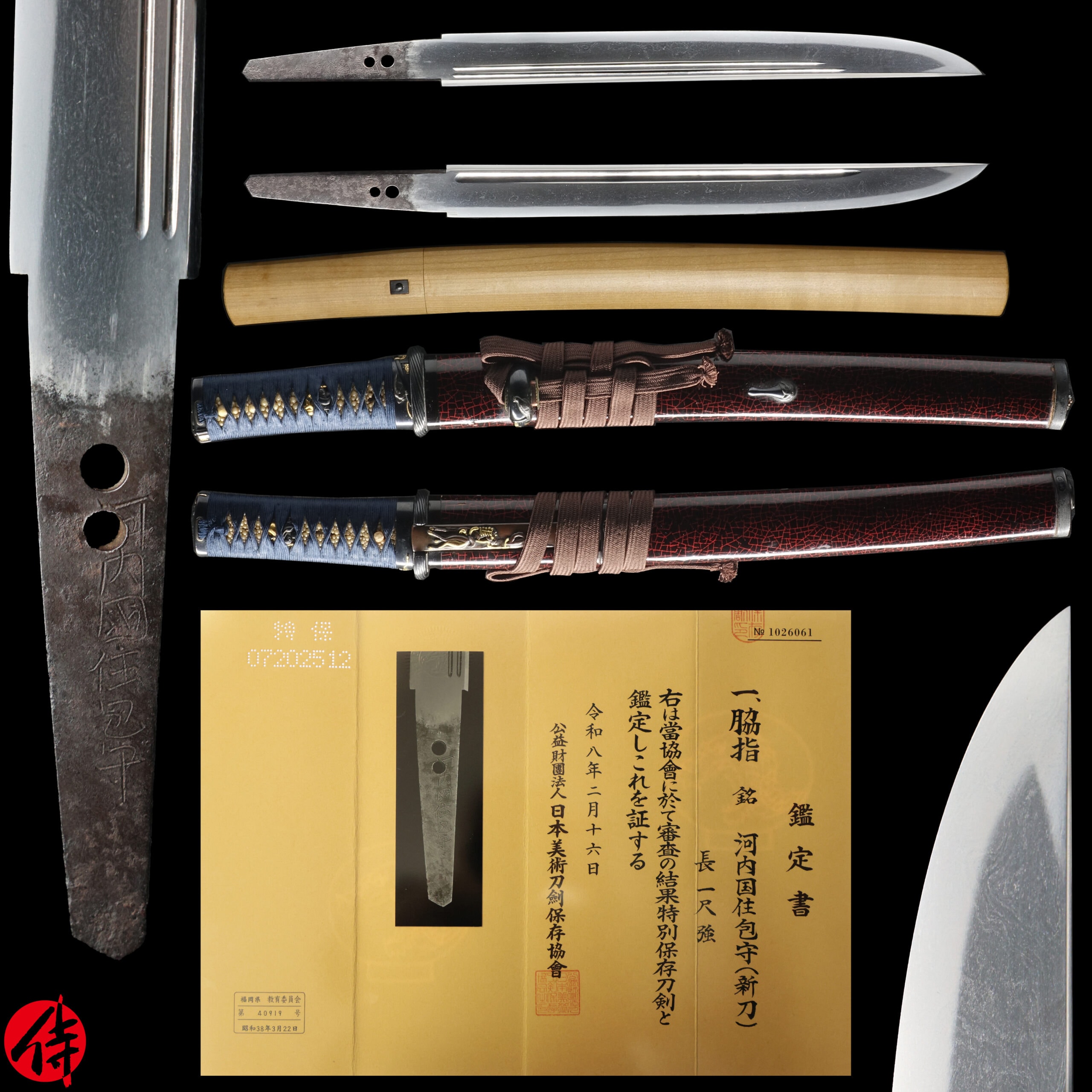
This blade is appraised as a Hozon Token (保存刀剣) issued by NBTHK (Nihon Bijutsu Touken Hozon Kyokai:日本美術刀剣保存協会). This authentication paper was only given to authentic Japanese swords, well preserved with artistic value.
【Blade】
Cutting Edge Length(Nagasa)
:
35.4 cm (13.9
inches)
Curvature(Sori)
:
0.8
cm (0.31 inches)
Hamon
:
The crystalline structure which forms along the cutting edge of a blade as a result of the hardening process
Jimon(Jihada)
:
visible steel surface pattern created by folding and hammering during forging process
Kissaki
:
Kissaki is the tip of the Japanese sword.
Nakago
:
Nakago is the tang of the Japanese sword.
Japanese swordsmiths left the black rust on the tang because it prevents red rust while the tang is in its handle. And the discoloration of the tang was created over time, and it is a great indicator for a Japanese sword specialist to estimate when the sword was forged.
Koshirae
:Koshirae is the mounting of the Japanese sword. There are several parts that consist of Koshirae such as Saya(Scabbard), Tsuka( Handle), Tsuba(Handguard).
Fuchi-Kashira
:
A pair of matching sword fittings that cover the upper and bottom parts of its sword hilt.
The theme of this Fuchi Kashira is Gosan-no-Kiri (五三の桐). Also, the arabesque (唐草:Karakusa) pattern is carved into the surface.
Gosan-no-Kiri (五三の桐) comes from the Kiri (桐, paulownia) pattern. The Kiri (桐) pattern is generally composed of three standing straight inflo