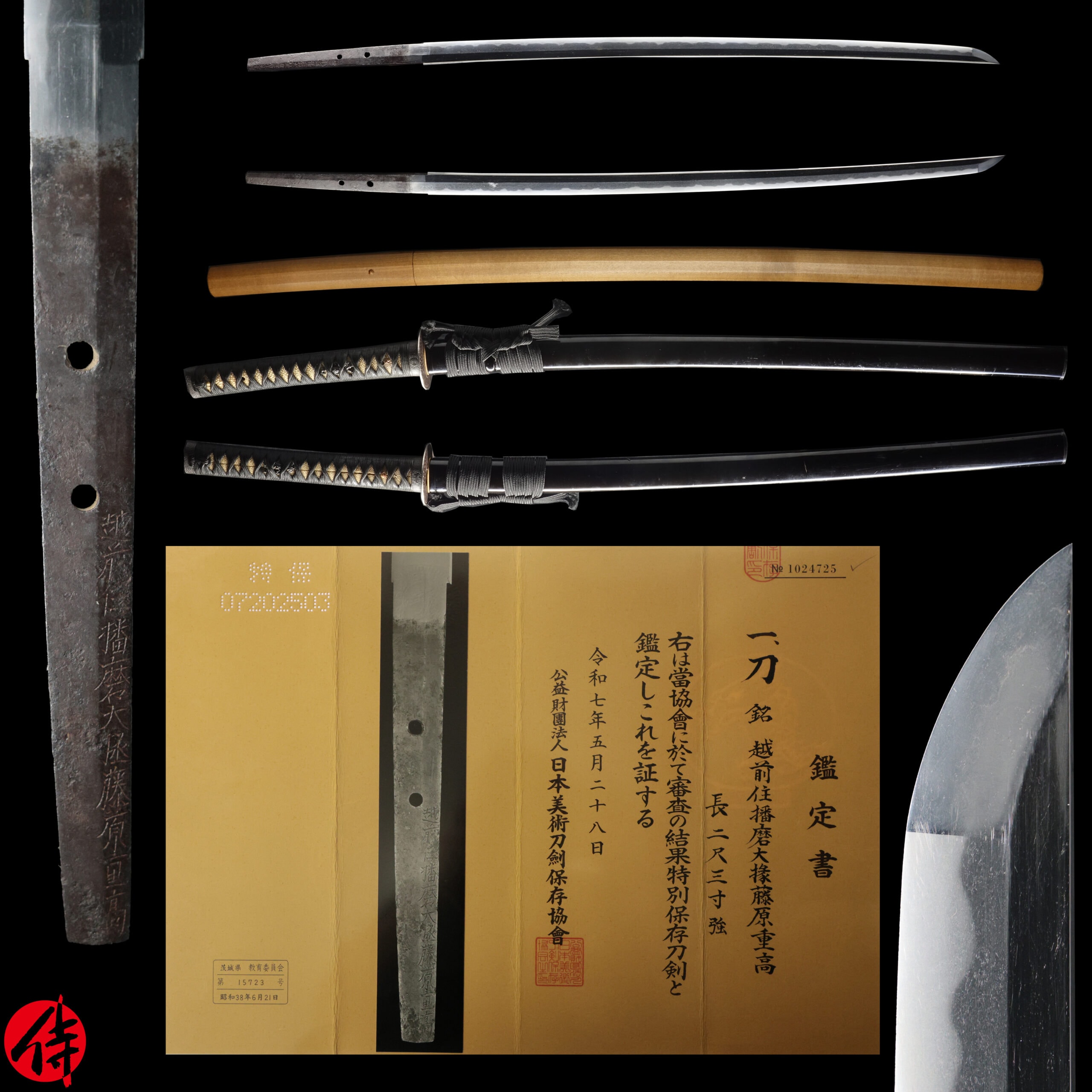
説明
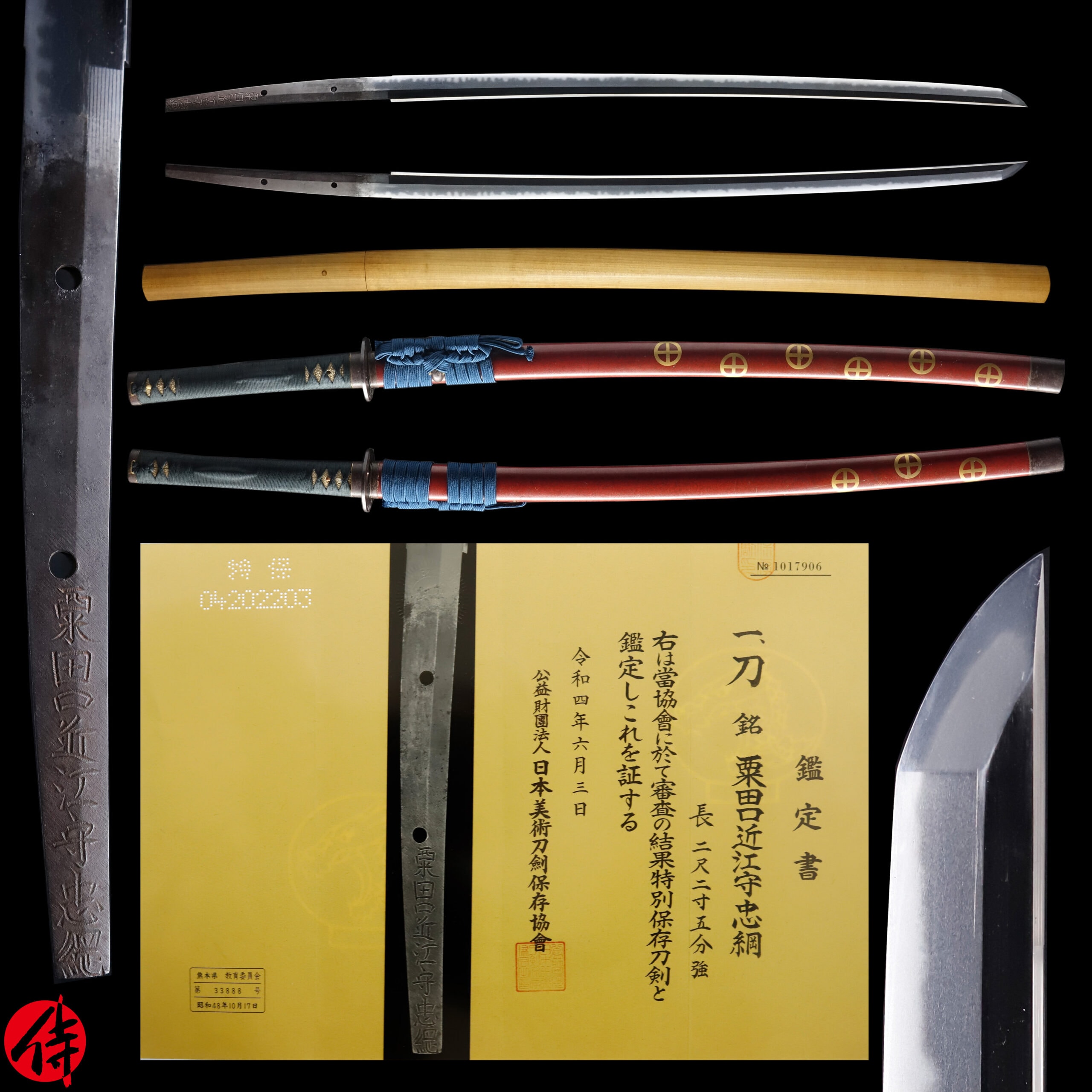
Antique Japanese Sword Katana Signed by Awataguchi Tadatsuna with
Tokubetsu Hozon
Certificate
【Description】
Summary
This blade was forged by the second-gen Awataguchi Omi no kami Tadatsuna(粟田口近江守忠綱) in the early Edo period (
Late 17th century
), based on the characteristic of the signature on the tang. The second-gen Tadatsuna is one of Osaka’s most skilled and popular swordsmiths in the early Edo period, following Tsuda Sukehiro and Inoue Shinkai. These three sword makers are called Sanketsu of *Osaka Shinto.
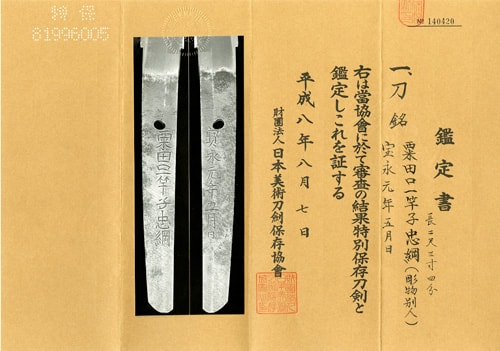
The second-gen Tadatsuna was born in 1644 as the first son of the first-gen Tadatsuna, who called himself the descendant of Awataguchi Kunitsuna, a famous swordsmith in the early Kamakura period.Father was born in Hyogo prefecture and forged swords in Ushiroyama castle in Mie prefecture. Eventually, the first-gen Tadatsuna moved to Osaka.The second-gen Tadatsuna’s real name is Asai Mandayu. The swordsmith’s name Tadatsuna lasted three generations, and the second-gen is said to have been the most famous and skilled one. And he was not only excellent at forging swords with different kinds of tempering lines (Hamon) but also excellent at inscribing sculptures on his work.
The second-gen Tadatsuna first signed as Tadakuni(忠国). According to his remaining work, he started to forge swords in 1672 and kept creating his blades until he was about 80 years old(1716). He received the honorable title of Omi no Kami during Enpo era(1673-1680). He started to sign Ikkanshi Tadatsuna after the second year of Genroku era(1689).
During the early Genroku era, he used 縄 letter instead of 綱 when signing his creation, but after the mid-Genroku era, he used 綱 to sign his blades. Since this blade was signed as 忠縄, we can assume it was forged around the late 17th century. Genraoku period lasted 1688-1704.He kept forging swords for about 50 years in his career.
One of Tadatsuna’s works is designated as Important Cultural Property of Japan. His swords are Ryuwazamono and Shinto Jyojyo Saku(Highly ranked swords among Japanese sword experts).
There is one interesting historical incident related to the work of the second-gen Tadatsuna.
It was March 24th in the 4th year of Tenmei(1784). Sano Zenzaemon, A direct retainer of Shogun, attacked a son of Tanuma Okitsugu, who was the chief minister of the Edo government. Sano used a wakizashi signed by the second-gen Tadatsuna. The son was eventually died, and Sano was ordered to do Seppuku for his misconduct. Interestingly, since this incident happened, the price of rice decreased dramatically after the sharp rise, which suffered many people. And, people started to worship Tadatsuna’s swords as Yonaoshi Daimyojin, a Great God that makes the world a better place. The Tadatsuna’s popularity skyrocketed, and this incident is much talked about when you learn about the work of Tadatsuna. It is said that only noble high-class Samurai could afford to buy a sword forged by the Tadatsuna during the Edo period.
*What is Osaka Shinto?
Shinto is Japanese Sword terminology that refers to the swords forged during 1596-1781. The blades made in Osaka area during this period are called Osaka Shinto. There are many famous swordsmiths in this Osaka Shinto era. After Hideyoshi Toyotomi built Osaka castle, Osaka city flourished as a castle town and became the business center. Many swordsmiths moved to Osaka to look for better opportunities. They not only forged swords for those Samurai who lived in Osaka but also for feudal lords nationwide. Ikanshi Tadatsuna(Awataguchi Omi no Kami Tadatsuna), Inoue Shinkai, and Tsuda Sukehiro are the most famous ones among those many swordsmiths.
It is appraised as a
Tokubetsu Hozon Token
(特別保存刀剣) issued by NBTHK(Nihon Bijutsu Touken Hozon Kyokai:日本美術刀剣保存協会). This authentication paper was only given to authentic Japanese swords, especially well preserved and high quality with artistic value.
【 Blade】
Cutting Edge Length(Nagasa)
:
68.2 cm ( 26.8 inches)
Curvature(Sori)
:
0.8 cm ( 0.31 inches)
Ha