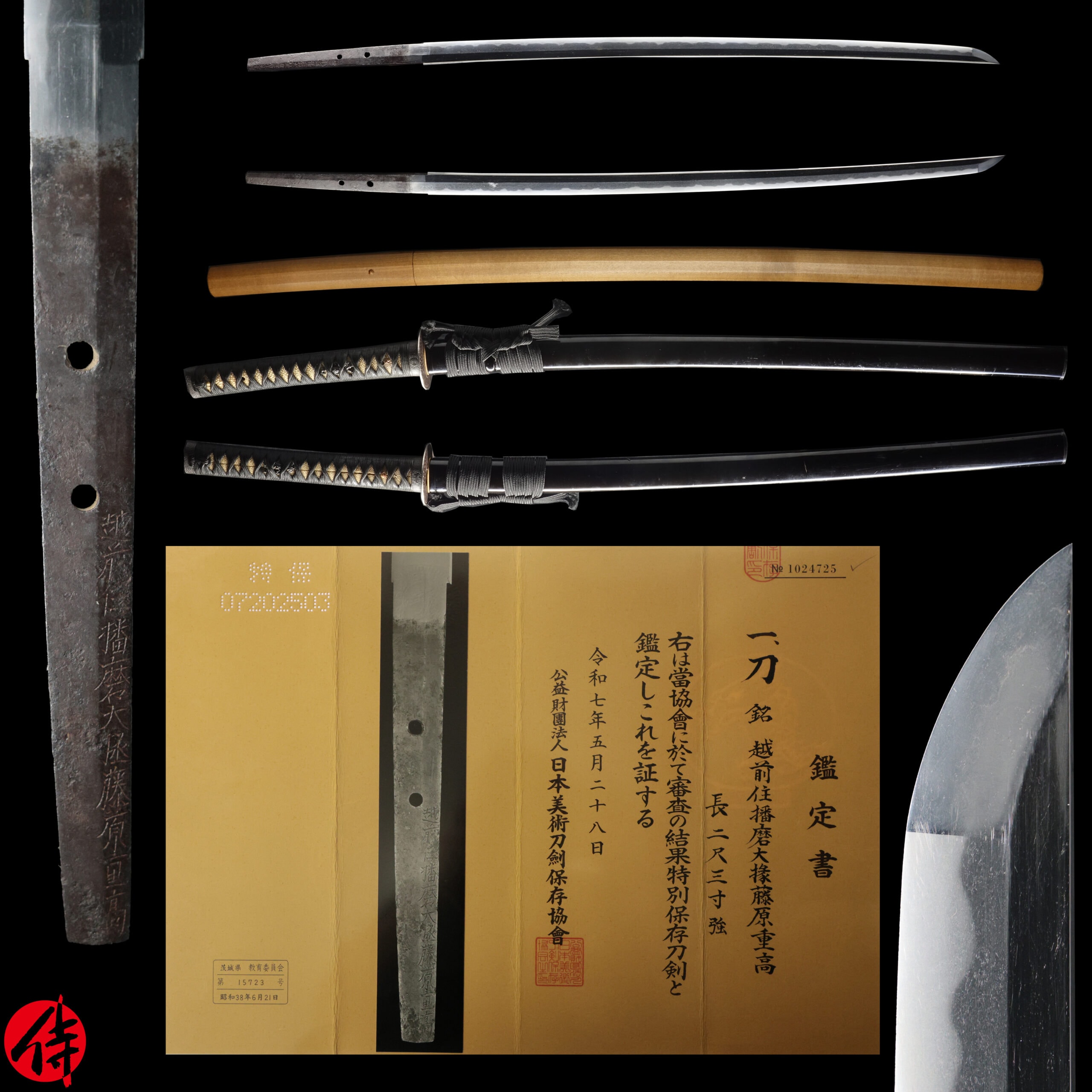
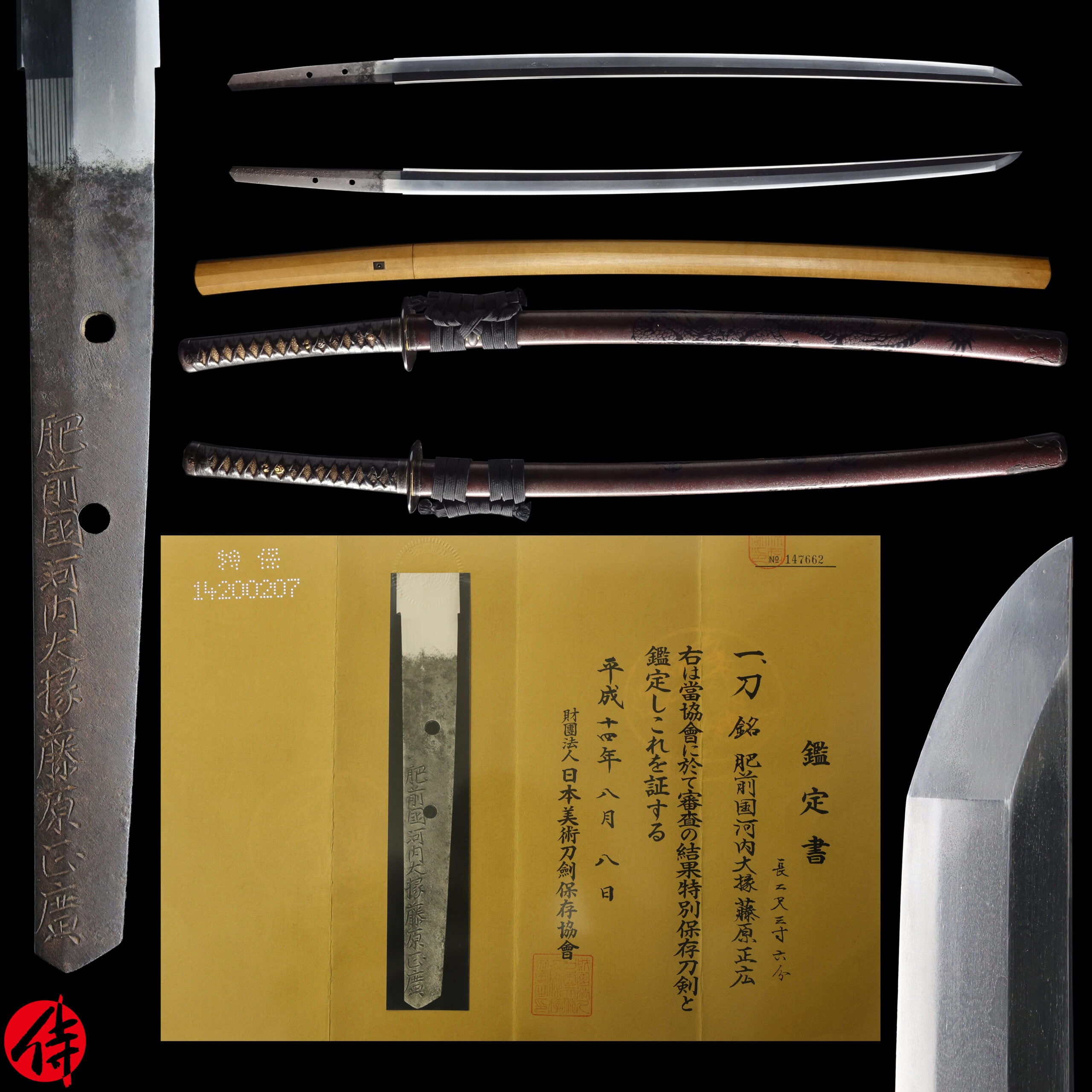
説明
Antique Japanese Sword Katana Signed by Yoshiyuki with
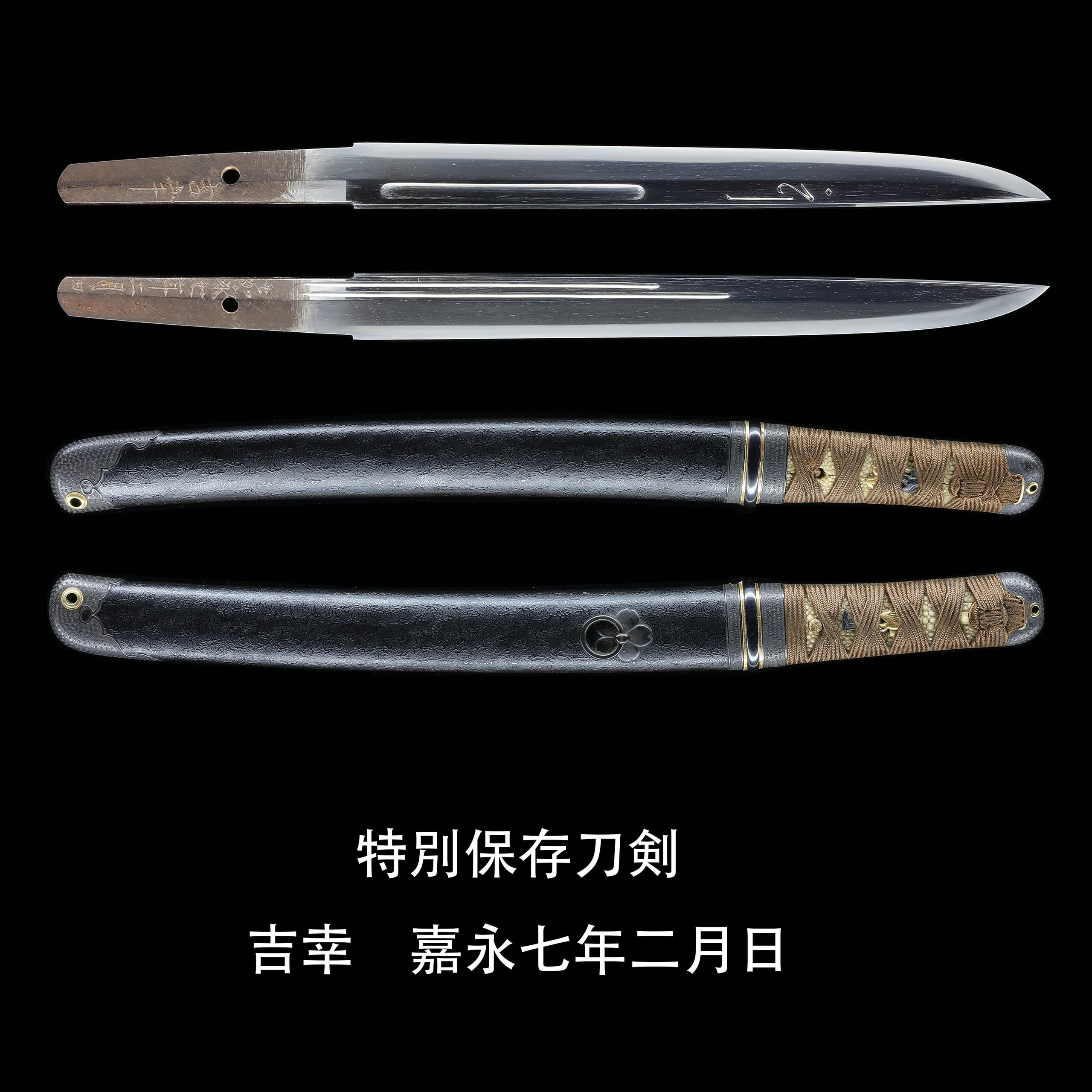
Tokubetsu Hozon
Certificate
& Hozon Tosogu
【Description】
Summary
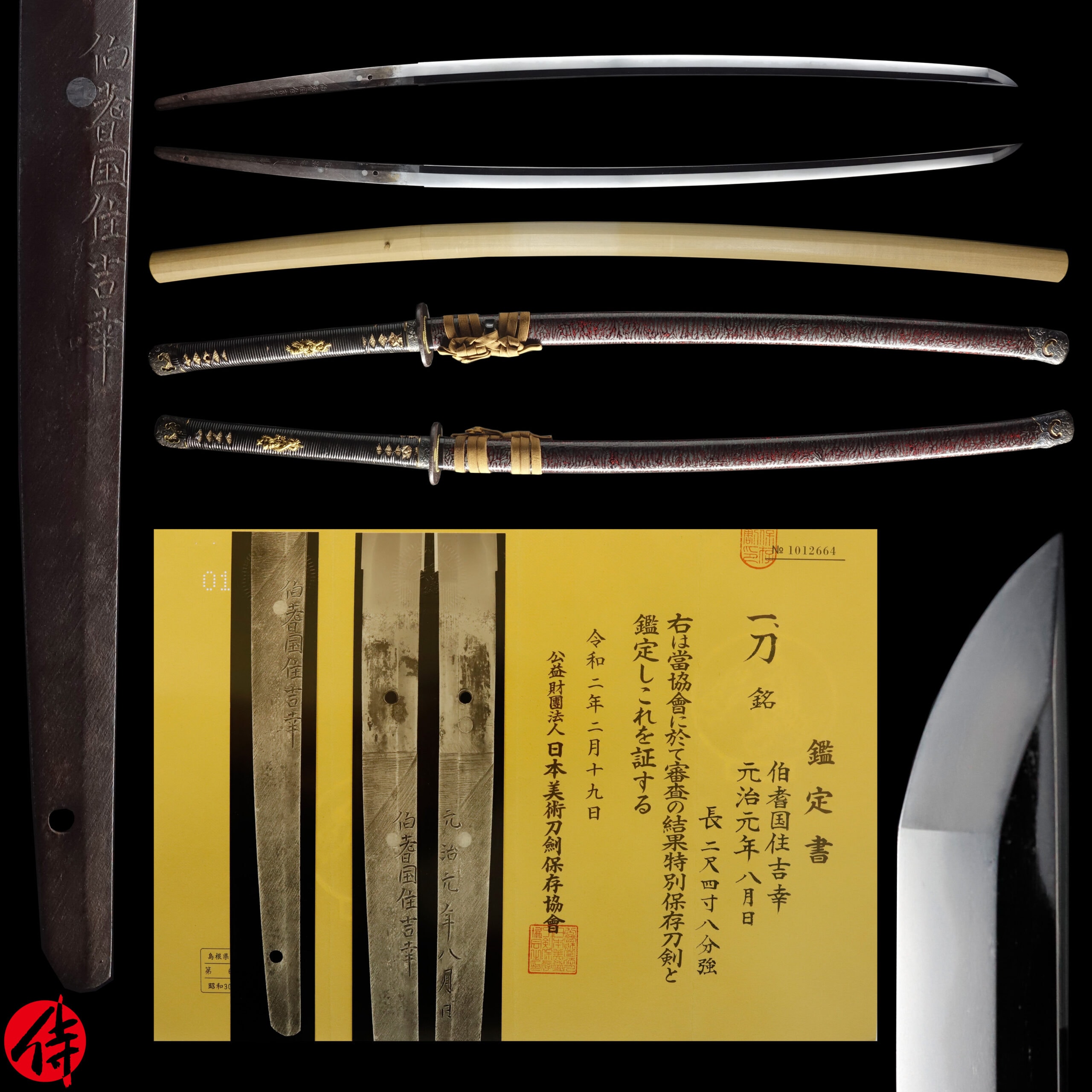
This blade was forged by Hoki Koku Jyu Yoshiyuki(伯耆国住吉幸) in August, the seventh year of Bunkyu era(
1863
: late Edo period), judging from the signature and NBTHK authentication paper. He lived in Hokikoku(Today’s Tottori prefecture) when he created this blade.
Yoshiyuki(吉幸) was born as the son of Yamazaki Heiemon Yoshihiro(山崎平右衛門吉広) in Izumo Koku(Today’s Shimane prefecture). Later on, he moved to Yonago city in Hokikoku to serve a swordsmith named Shimizu Masayoshi(清水正吉). His master eventually adopted Yoshiyuki. In his career, he mainly forged swords in Yonago city, but there are also records where he made blades in Izumo koku(his birthplace). Izumo Koku and Hokikoku were neighboring provinces.
He first signed as Yoshiyuki(吉行) but changed it to Yoshiyuki(吉幸) while its pronunciation was the same.
In his career, he served the Izumo domain as both Samurai and swordsmith. Izumo is the most famous place for producing Tamahagane, special carbon steel used to make Japanese swords. We assume Yoshiyuki had easy access to refined, high-quality steel because of where he lived. We are confident you can appreciate Yoshiyuki’s superb craftsmanship in this blade. Based on his remaining work, he was active at sword-forging from the Ansei era to the early Meiji period (1855-1876). He died at the age of 75 in the 19th year of the Meiji period(1886).
The Background History
Japan enjoyed a relatively peaceful time from the early Edo period to the mid-Edo period(the 1600s-1760s) because of the stable economy and the powerful government run by Tokugawa Shogun. Samurai didn’t have many opportunities to utilize his Katana sword in public or on battlefields during this time. Thus, they carried their swords more as a symbol of their social status. The demand for weapons decreased accordingly compared to the previous Warring state period called Sengoku Jidai. (1467-1600)
However, toward the end of the Edo period(1764-1876), the Japanese sword’s role changed dramatically. With the poverty spreading in Japan, there were so many riots initiated by the civilians. Japanese sword started to play an essential role in maintaining public safety.
Pressure from foreign countries to open Japanese borders also forced Samurai to order strong-looking swords to survive this tumultuous time. We believe many swordsmiths, including Yoshiyuki, made great efforts to forged high-quality, practical blades for their masters to prepare for battles.
There was a civil war between Tokugawa’s military government and the new Meiji government at the end of the Edo period. That means the original owner of this Katana might have seen the moment when Samurai’s life changed forever. This blade has a strong looking and must have been practical to use in that demanding time.
It is appraised as a
Tokubetsu Hozon Token
(特別保存刀剣) issued by NBTHK(Nihon Bijutsu Touken Hozon Kyokai:日本美術刀剣保存協会). This authentication paper was only given to authentic Japanese swords, especially well preserved and high quality with artistic value.
【 Blade】
Cutting Edge Length(Nagasa)
:
75.4 cm ( 29.7 inches)
Curvature(Sori)
:
1.36 cm ( 0.53 inches)
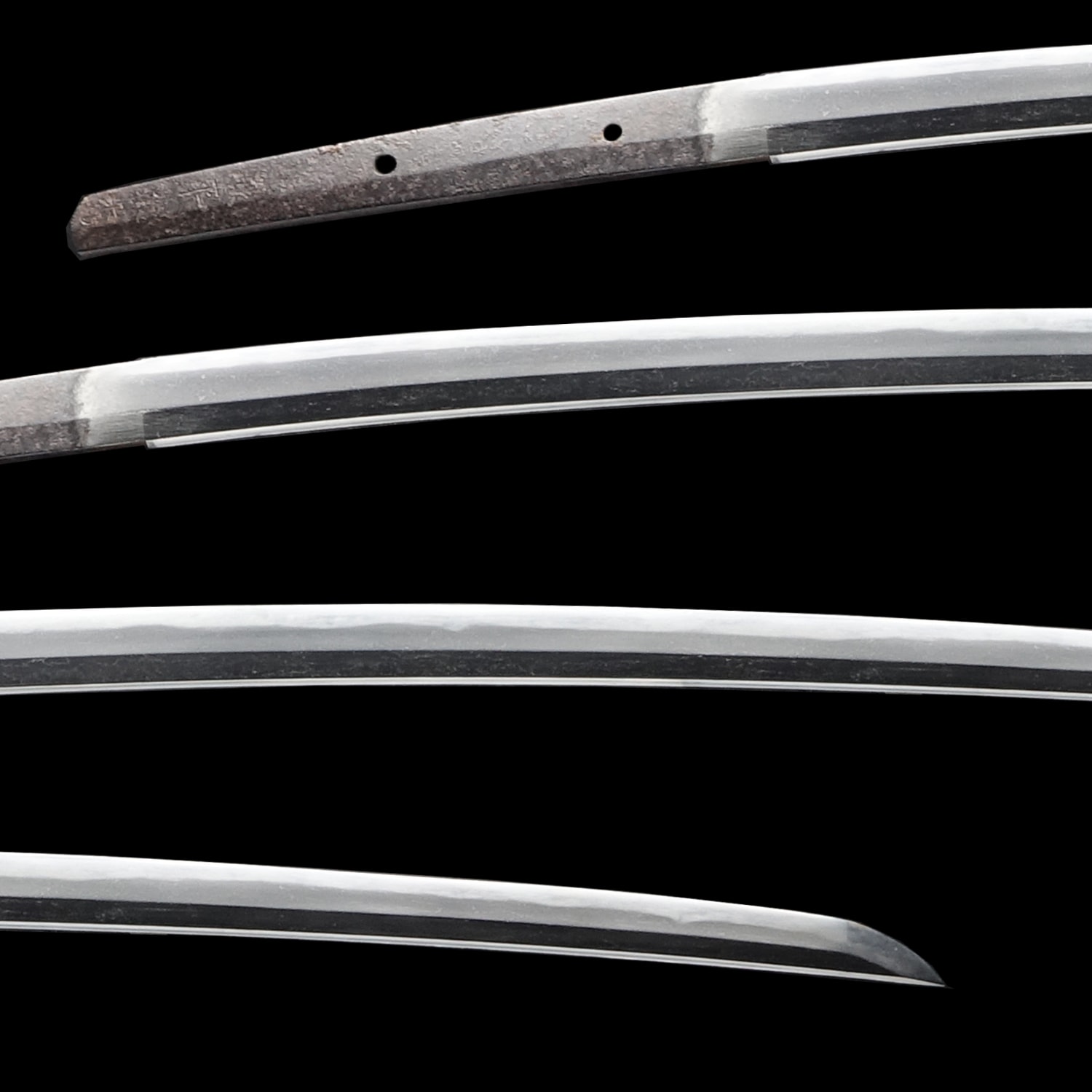
Hamon
:
The crystalline structure which forms along the cutting edge of a blade as a result of the hardening process
Jimon(Jihada)
:
visible steel surface pattern created by folding and hammering during forging process
Nakago
:
Nakago is the tang of the Japanese sword.
Japanese swordsmiths left the black rust on the tang because it prevents red rust while the tang is in its handle. And the discoloration of the tang was created over time, and it is a great indicator for a Japanese sword specialist to estimate when the sword was forged.
Koshirae:
Koshirae is the mounting of the Japanese sword. There are several parts that consist of Koshirae such as Saya(Scabbard), Tsuka(Handle), Tsuba(Handguard).
This Katana’s Koshirae has the certificate of NBTHK. And it