説明
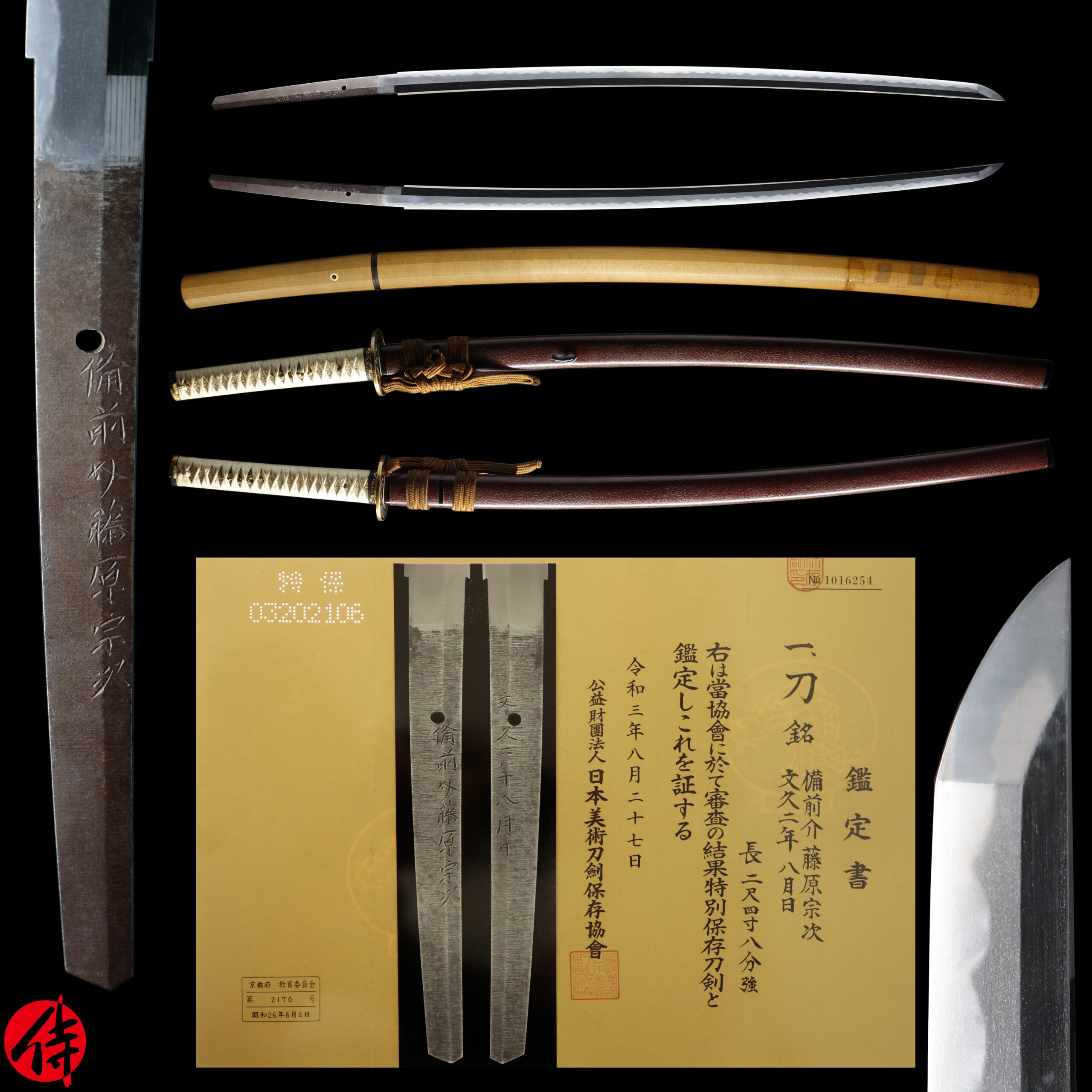
Antique Japanese Sword Katana Signed by Munetsugu with
Tokubetsu Hozon
Certificate
【Description】
This blade was signed by Bizen no Suke Fujiwara Munetsugu (備前介藤原宗次) in the 2nd year of the Bunkyu era (1862: the end of the Edo period). He is also known as Koyama Munetsugu (固山宗次), who was active during the late Edo period (1830-1860). His birth name name Koyama Sobei (固山宗兵衛). He was born as the third son of Koyama Munehira (固山宗平) in Shirakawa domain in Mutsu province (today’s Fukushima prefecture) in 1802. It is said that he learned the sword-forging technique from Kato Tsunahide (加藤綱英) first and was also an apprentice of
Chounsai Tsunatoshi (長運斎綱俊)
, a younger brother of Tsunahide to improve his craftsmanship
.
Munetsugu first served Shirakawa Matsudaira (白河松平家) clan as Hanko (藩工:retained swordsmith). After Matsudaira clan was ordered to relocate to Kuwana domain (today’s Mie prefecture), Munetsugu became a swordsmith for that domain. However, he eventually settled in Edo city from the second year of the Koka era (1845) by working for Matsudaira clan of the Kuwana family. Because of these historical records, we believe this blade was made in Edo city.
Munetsugu received an honorable title of Bizen no Suke (備前助/備前介) in the same year when he moved to Edo city (1845). His work reflects Bizen Den, one of the five most traditional Japanese sword-forging techniques (五箇伝). He was excellent at forging blades with Choji Gunome Midare tempering line, one of the most noticeable characteristics of Bizen Tradition. He was active in sword-forging during 1830-1870. He is arguably the finest smith working in the Bizen tradition at the end of the Edo period.
Munetsugu was one of the most popular and famous swordsmiths in Edo city during the end Edo period. His swords have been known for their sharpness. There are many records of his swords passing the test cutting process (Tameshigiri). In his career, he pursued and researched sword-forging to make extremely sharp blades that were practically effective in battles to meet up the demands of the clan. There was a record of him studying to improve the sharpness of his swords from the seventh-gen Yamada Asaemon, who is a master of Tameshigiri and an author of Owazamono. He often received orders from feudal lords or famous figures during the end of the Edo period. Munetsugu has been highly regarded among Japanese sword collectors and experts. It is said that his level of craftsmanship is close to or at least equivalent to Sushinshi Masahide, Naotane and other very selected swordsmiths from the end of the Edo period.
It is appraised as a
Tokubetsu Hozon Token
(特別保存刀剣) issued by NBTHK (Nihon Bijutsu Touken Hozon Kyokai:日本美術刀剣保存協会). This authentication paper was only given to authentic Japanese swords, especially well preserved and high quality with artistic value.
【Blade】
Cutting Edge Length(Nagasa)
:
75.4 cm (29.6 inches)
Curvature(Sori)
:
1.66 cm (0.65 inches)
Hamon
:
The crystalline structure which forms along the cutting edge of a blade as a result of the hardening process
Jimon(Jihada)
:
visible steel surface pattern created by folding and hammering during forging process
Kissaki
:
Kissaki is the tip of the Japanese sword.
Nakago
:
Nakago is the tang of the Japanese sword.
Japanese swordsmiths left the black rust on the tang because it prevents red rust while the tang is in its handle. And the discoloration of the tang was created over time, and it is a great indicator for a Japanese sword specialist to estimate when the sword was forged.
Koshirae
:
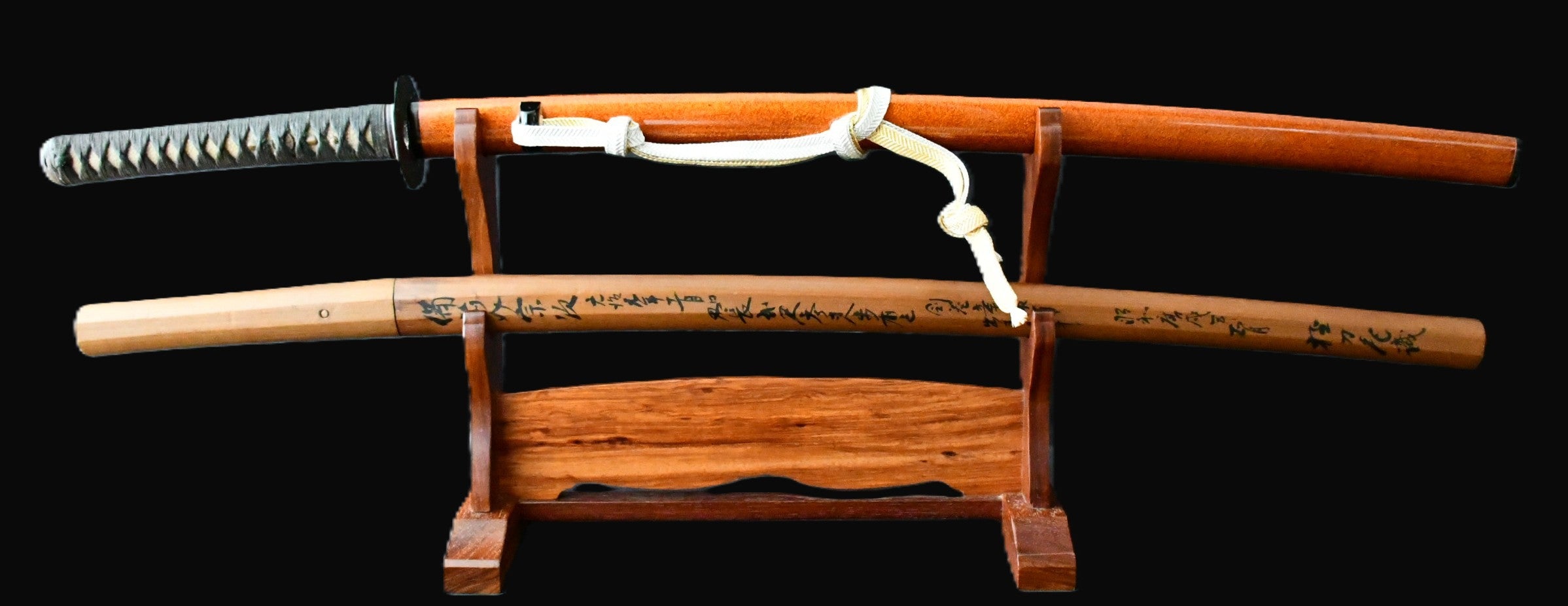
Koshirae is the mounting of the Japanese sword. There are several parts that consist of Koshirae such as Saya (Scabbard), Tsuka (Handle), Tsuba (Handguard).
Fuchi-Kashira
:
A pair of matching sword fittings that cover the upper and bottom parts of its sword hilt.
The theme of this Fuchi Kashira is the Hatou Zu (波涛図), which depicts large undulating and splashing waves.
A
s waves’ movements continue endlessly, the wave pattern represents eternity, immorta



![Sunnobi Tanto [Bizen-no-suke Munetsugu (Koyama Munetsugu)] [N.B.T.H.K] Tokubetsu Hozon Token](/_next/image?url=https%3A%2F%2Fitbhfhyptogxcjbjfzwx.supabase.co%2Fstorage%2Fv1%2Fobject%2Fpublic%2Flisting-images%2Fworld-seiyudo%2FL73468%2F00.jpg&w=2560&q=90)