説明

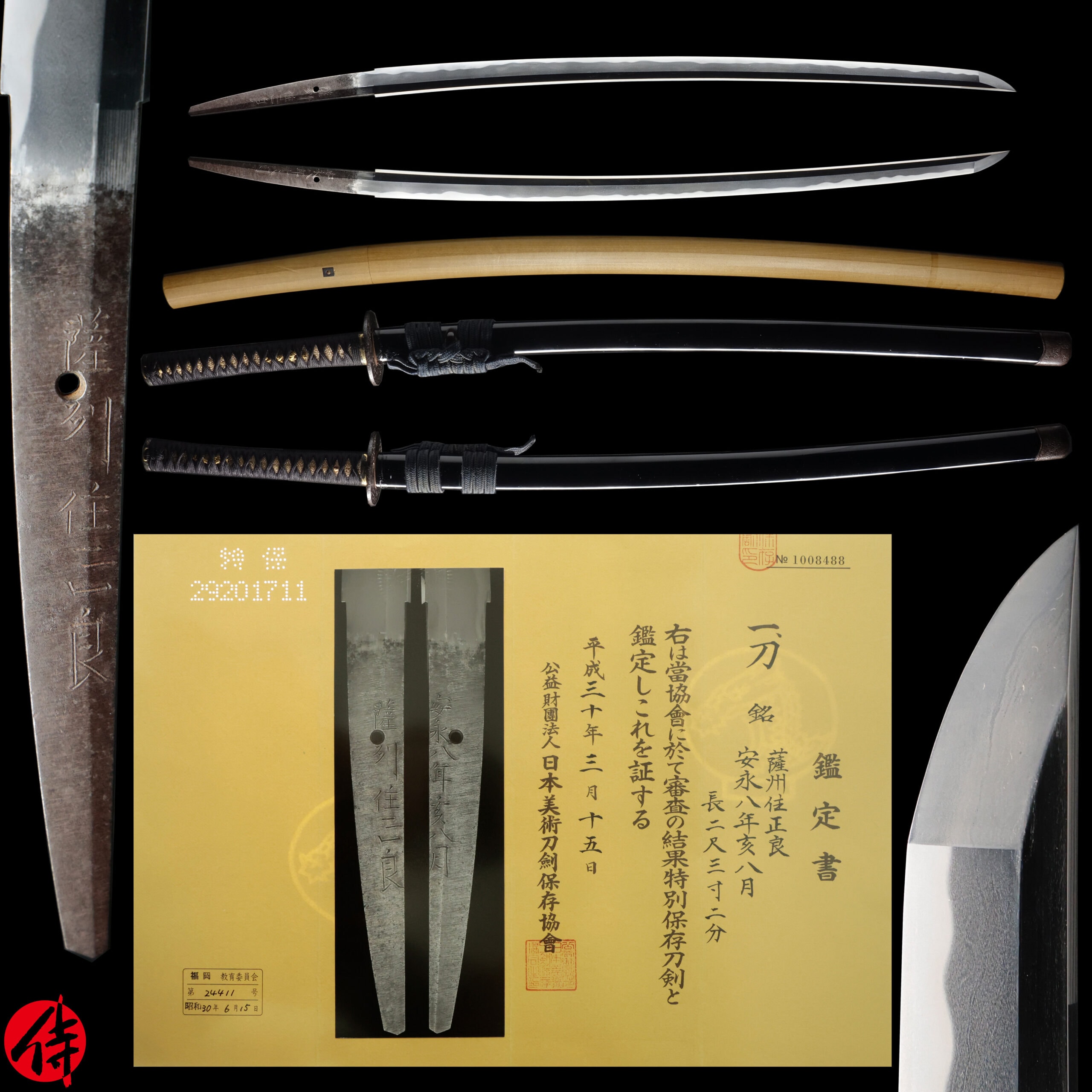
Antique Japanese Sword Katana Signed by Masayoshi with Tokubetsu Hozon Certificate 【Description】 This blade was signed by Sasshu Ju Masayoshi (薩州住正良), also known as Hoki no Kami Taira Ason Masayuki (伯耆守平朝臣正幸), in the 8th year of the Anei era (1779: the mid Edo period). Sasshu is another name of Satsuma province (today’s Kagoshima prefecture), and Sasshu Ju means he resided in this area when he forged this blade. According to available records, Masayuki was active during 1772-1817 (the end of the Edo period). Masayuki was born in the 18th year of the Kyoho era (1733) as the first son of the second-gen Ijichi Masayoshi (伊地知正良). Masayuki first called himself Masayoshi (third-generation Masayoshi) after taking over his father’s school. And in the first year of Kanei (1769), he received Hoki no Kami (伯耆守) as an official title and changed his maker’s name to Masayuki. He passed down the maker’s name, “Masayoshi” name to his first son. Masayuki died at the age of 86 in the first year of 1818. Masayuki was one of the most famous swordsmiths in the Satsuma domain (today’s Kagoshima prefecture) in the late Edo period, apart from Okuyamato no Kami Motohira. It is said that Masayuki was passionate about training his students. There were 60 swordsmiths who learned the sword-forging technique under Masayuki. Satsuma province had a high ratio of Samurai population compared to other parts of Japan. And they are famous for their military power ruled by Shimazu clan. We assume a swordsmith needed to be very skilled to stay active and popular in this demanding place. Masayuki was one of them. Masayuki’s father served the Satsuma domain. It was highly likely that Msayuki also forged swords for this domain, considering his prestigious position. It is appraised as a Tokubetsu Hozon Token (特別保存刀剣) issued by NBTHK (Nihon Bijutsu Touken Hozon Kyokai:日本美術刀剣保存協会). This authentication paper was only given to authentic Japanese swords, especially well preserved and high quality with artistic value. *Please keep in mind that there are a couple of Kitae Kizu on this blade. If you like to know the detailed condition, please feel free to contact us. 【Blade】 Cutting Edge Length(Nagasa) : 70.2 cm (27.6 inches) Curvature(Sori) : 1.51 cm (0.59 inches) Hamon : The crystalline structure which forms along the cutting edge of a blade as a result of the hardening process Jimon(Jihada) : visible steel surface pattern created by folding and hammering during forging process Kissaki : Kissaki is the tip of the Japanese sword. Nakago : Nakago is the tang of the Japanese sword. Japanese swordsmiths left the black rust on the tang because it prevents red rust while the tang is in its handle. And the discoloration of the tang was created over time, and it is a great indicator for a Japanese sword specialist to estimate when the sword was forged. Koshirae : Koshirae is the mounting of the Japanese sword. There are several parts that consist of Koshirae such as Saya (Scabbard), Tsuka (Handle), Tsuba (Handguard). Fuchi-Kashira : A pair of matching sword fittings that cover the upper and bottom parts of its sword hilt. The theme of this Fuchi Kashira is the Unryu Zu (雲龍図). It is a combination of dragons (龍) and clouds (雲). Initially, dragons were imaginary creatures found in ancient foreign traditions or myths. Furthermore, it is regarded as a symbolic beast of auspicious signs. Its body is likened to nine animals: antlers are deer, the head is a camel, eyes are demons, the neck is a snake, the belly is the Mizuchi (蛟, a mythical animal in Japan that looks like a snake and has a horn and four legs), scales are fish, claws are falcons, palms are tigers and ears are cows. It was thought that the dragon would reign at the top of all animals because of its odd-looking appearance. Regarding the cloud pattern, clouds bring blessed rain and snow, and their movements significantly affect the day’s weather. Due to its supernatural power, a theory says that gods, spirits, and dragons dwell

Antique Japanese Sword Katana Signed by Masayoshi NBTHK Tokubetsu Hozon Certificate
売切れ
Tokuho売切れ

Antique Japanese Sword Katana Signed by Masayoshi NBTHK Tokubetsu Hozon Certificate

売却済

世界81社の刀剣商を横断追跡 · 価格履歴 · 売却アーカイブ

仕様

長さ

70.2 cm

反り

1.51 cm

作者について

Satsuma Masayoshi正良

10 重要刀剣

薩摩の正良の名で指定を受けた数口は、一人の工ではなく一家の襲名を負う。説明はこの名を薩摩藩工伊地知家と読み、記録は三代を主とする。三代は享保十八年に生まれて正良の名を継ぎ、寛政元年、奥元平と時を同じくして伯耆守を受領、同時に正良の名を嫡男に譲って以後は正幸と銘し、文政元年八十六歳で歿した。記録が及ぶ最も古い手は初代で、説明はこれを上原十左衛門と呼び、肥後に接する薩摩北端の出水郷の士とし、後の伯耆守の祖にあたると記す。代を超えて説明は一つの評を保つ。「薩摩新々刀鍛冶の中では奥大和守元平と共に双璧である」とし、師正近にも父祖にも優ったとして、この工を端的に「師に優る上手」と呼ぶ。 その作は頑健な相州伝の手であり、最も恒常的な見どころは地刃の働きにある。記録の全ての刃文に砂流しがかかり、大半に金筋と短い沸筋が加わって、深い匂と豊かな厚い沸の中をこれらの長い線が相絡んで走る。沸そのものが第二の標識である。沸は厚くつき、大半の作で荒沸を顕著に交える。明るく激しいこの鉄が、当代の備前復古や大坂物の締まった沸と薩摩の手を分かつ。働きが乗る刃文はのたれを基調とし、互の目・小互の目に尖りごころを交え、足よく入る。説明はこののたれに互の目・尖りごころの刃を交える作を彼の常々の手とする。整った互の目でも備前の丁子でもなく、のたれに乗る尖りごころが、説明が繰り返しこの工の典型とするところである。 地鉄は第三の見分けで、これは学派の定型ではなくこの工自身の作から読まねばならない。彼の地は肌立って開いた板目で、杢・流れ肌を交え、しばしば肌立ちごころをおび、その上に地沸が厚くつき地景が頻りに入る。優品では説明が「地景風の変り金」を指摘し、鉄中の異色の文様が独特の地合をなす。これは山城や大坂の締まった清い小板目ではなく、頑健で働きのある地で、説明が薩摩の地鉄として述べるものである。帽子は刃に応じる。説明が刻む定型句は「乱れ込み、先尖りごころに掃きかける」であり、乱れ込んで先は尖りごころとなり掃きかけて結ぶ。最も覇気ある作では強く掃きかけて火焰風となり、ある作は小丸あるいは一枚ごころに静かに返る。その姿は説明が常々の彼の作とする身幅広く重ね厚く長寸で頑健な造込みで、鋒は延びた中鋒、あるいは最大の作では大鋒となる。 この一つの作風の中に、記録は二つの時期と、作を近く位置づける銘の変遷とを描く。初代の唯一よく現存する一口は享和頃の作で、既にこの家の作域を備え、小のたれに互の目・尖りごころの刃を交え、さかんに沸づいて荒沸を交え、砂流し・金筋・沸筋が顕著で、帽子は乱れ込んで先丸く長く掃きかけて返り、作の少ない同作中の代表作とされる。三代の本領が残りの記録を満たし、説明はこれを志津に倣う相州伝と読む。天明五年の一口を「志津風の作域」と明言して成功作とし、別の明和・安永頃の初期作は古作の郷や大坂の井上真改に範をとったかと説く。銘はこの編年を追う。刀銘と太刀銘とがあり、薩州住平正良の「平」姓は天明年間から入るため、平正良の銘はそれ以後に位置づけられる。年紀は通例「日」の字をきり入れず、ある安永六年の刀は年や干支さえ略して年のみをきり、説明は極めて稀な例として注目する。 彼を分かつものは、対比よりも彼自身の確かな見どころから引くのがよい。深く荒い沸、のたれ互の目の中を流れる金筋・砂流し、地景を伴う肌立ちごころの薩摩の地鉄、これらがその手を見分けさせ、乱れ込んで尖り掃きかけ時に火焰風となる帽子が画を結ぶ。説明はこの工を同家最後の充実期の頂に置き、「出藍の誉が高く」、すなわち師にまさる弟子の誉をその名に冠する。彼は正近の門に学び、終に奥大和守元平と並んで立つ。薩摩新々刀の名工を量るとき説明が常に併記する両工である。藩の示現流に発する豪壮な造込みと手取りの重さを、説明は彼が人にまさって備えたとし、その最も覇気ある作は薩摩物中でも別格とする。 藤代はこの工を上作とし、記録の諸口はみな重要刀剣である。中に国宝・重要文化財はなく、説明はこれらに大名の伝来も収蔵機関も残さない。これらは、入手し得ぬというより稀な、藩の名工の堅実な作で、秘蔵の遺産として閉ざされるより私蔵に伝わり時に世に現れる類である。中で最も長く最も力強い天明五年の大鋒の刀は八十六糎を超え、説明はこれを「畢生の大作にして白眉」と呼び、その長寸・覇気・手取りの重さに近い比を見ない一口とし、地景の鍛えは常にも増して強く、荒沸の目立つ刃文の雄大さも別格とする。伯耆守正幸の作が真摯な蒐集家のもとに現れるのは時折、薩摩の上位においてであり、世に出れば末期の伝統の標である。肌立ちごころの薩摩の地鉄に深く沸づいた流れの乱れは、これを鍛えた手を疑わせない。

刀剣商

サムライミュージアム

samuraimuseum.jp

売切れ